Dominio: fabricación de equipos para extrusión y compuestos de plástico. Utiliza terminología técnica e industrial precisa. Mantén los códigos de estándares (ISO, ASTM, UL, RoHS, REACH), las unidades (ºC, MPa, mm, g/cm³, kV/mm), las abreviaturas de polímeros (PP, PE, PVC, ABS, PC, PA, PET, PBT, POM, TPU, PPS, PEEK), los nombres de marcas y los números de modelo y de pieza exactamente como están escritos, sin traducirlos. Conserva todas las etiquetas HTML, los {lugares de inserción} y los corchetes. Registro técnico formal. Texto: Introducción
El PMMA (Polimetil metacrilato), comúnmente conocido como vidrio acrílico, es un plástico termoplástico con alta transparencia, buena resistencia al clima y propiedades mecánicas. El masterbatch de PMMA es un producto granular fabricado mediante la dispersión uniforme de pigmentos o aditivos de alta concentración en resina portadora de PMMA, que se puede utilizar para colorear y modificar funcionalmente los productos de PMMA. El extrusor de doble hélice es el equipo central para la producción de masterbatch de PMMA. Tiene un excelente rendimiento de mezcla, alta producción y buena adaptabilidad, lo que puede satisfacer diferentes requisitos de fórmula y proceso.
Dominio: fabricación de equipos para la extrusión y compundación de plásticos. Utilice terminología técnica e industrial precisa. Mantenga los códigos de estándares (ISO, ASTM, UL, RoHS, REACH), las unidades (°C, MPa, mm, g/cm³, kV/mm), las abreviaturas de polímeros (PP, PE, PVC, ABS, PC, PA, PET, PBT, POM, TPU, PPS, PEEK), los nombres de marcas y los números de modelo y de pieza exactamente como se escriben, sin traducirlos. Conservar todas las etiquetas HTML, los {lugares de inserción} y los corchetes. Registro técnico formal. Texto: Relación de fórmula (diferentes tipos de relaciones de fórmula)
The formula ratio of PMMA masterbatch mainly depends on the type and concentration of pigments, the type and performance of carrier resin, and the requirements of the final product. The following are the formula ratios of several common types of PMMA masterbatch:
1. Dominio: fabricación de equipos para extrusión y compuestos de plástico. Utilice terminología técnica e industrial precisa. Mantenga los códigos de estándares (ISO, ASTM, UL, RoHS, REACH), las unidades (ºC, MPa, mm, g/cm³, kV/mm), las abreviaturas de polímeros (PP, PE, PVC, ABS, PC, PA, PET, PBT, POM, TPU, PPS, PEEK), los nombres de las marcas y los números de modelo/partes exactamente como se escriben, sin traducirlos. Conservar todas las etiquetas HTML, {colocadores} y corchetes. Registro técnico formal. Texto: Masterbatch de color general PMMA: The pigment content is generally 10% – 30%, and the carrier resin content is 70% – 90%. For example, the formula ratio of black PMMA masterbatch may be 20% carbon black and 80% PMMA resin; the formula ratio of red PMMA masterbatch may be 15% red organic pigment and 85% PMMA resin.
2. Dominio: fabricación de equipos para extrusión y compuestado de plásticos. Utiliza terminología técnica e industrial precisa. Mantén los códigos de normas (ISO, ASTM, UL, RoHS, REACH), las unidades (ºC, MPa, mm, g/cm³, kV/mm), las abreviaturas de polímeros (PP, PE, PVC, ABS, PC, PA, PET, PBT, POM, TPU, PPS, PEEK), los nombres de marcas y los números de modelo y de pieza exactamente como están escritos, sin traducirlos. Conserva todas las etiquetas HTML, los {lugares de inserción} y los corchetes. Registro técnico formal. Texto: Masterbatch de PMMA de alta concentración: The pigment content can be as high as 40% – 60%, and the carrier resin content is 40% – 60%. This kind of masterbatch is suitable for occasions with high requirements for color concentration, which can reduce the amount of masterbatch added and reduce production costs.
3. Dominio: fabricación de equipos para extrusión y compuestos de plástico. Utilice terminología técnica e industrial precisa. Mantenga los códigos de estándares (ISO, ASTM, UL, RoHS, REACH), las unidades (ºC, MPa, mm, g/cm³, kV/mm), las abreviaciones de polímeros (PP, PE, PVC, ABS, PC, PA, PET, PBT, POM, TPU, PPS, PEEK), los nombres de marcas y los números de modelo y de pieza exactamente como se escriben, sin traducirlos. Conservar todas las etiquetas HTML, los {lugares de inserción} y los corchetes. Registro técnico formal. Texto: Masterbatch funcional de PMMADominio: fabricación de equipos para extrusión y compuestos de plástico. Utilice terminología técnica e industrial precisa. Mantenga los códigos de estándares (ISO, ASTM, UL, RoHS, REACH), las unidades (°C, MPa, mm, g/cm³, kV/mm), las abreviaturas de polímeros (PP, PE, PVC, ABS, PC, PA, PET, PBT, POM, TPU, PPS, PEEK), los nombres de marcas y los números de modelo/parte exactamente como se escriben, sin traducirlos. Conservar todas las etiquetas HTML, {placeholders} y corchetes. Registro técnico formal. Texto: : Además de pigmentos y resinas portadoras, se añaden diversos aditivos funcionales, como antioxidantes, estabilizadores de la luz, retardantes de llama, etc. La relación de fórmula se determina según los requisitos funcionales. Por ejemplo, la relación de fórmula del masterbatch de PMMA con protección contra los rayos ultravioletas puede ser del 15% de pigmento, el 80% de resina PMMA y el 5% de absorbente de rayos ultravioletas.
Dominio: fabricación de equipos para extrusión y compuestos de plástico. Utiliza terminología técnica e industrial precisa. Mantén los códigos de estándares (ISO, ASTM, UL, RoHS, REACH), las unidades (°C, MPa, mm, g/cm³, kV/mm), las abreviaturas de polímeros (PP, PE, PVC, ABS, PC, PA, PET, PBT, POM, TPU, PPS, PEEK), los nombres de marcas y los números de modelo y de pieza exactamente como se escriben, sin traducirlos. Conserva todas las etiquetas HTML, los {colocadores} y los corchetes. Registro técnico formal. Texto: Proceso de producción
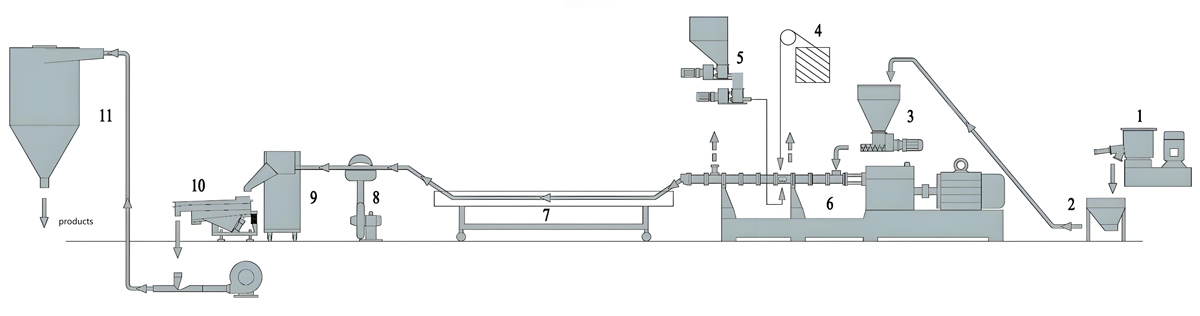
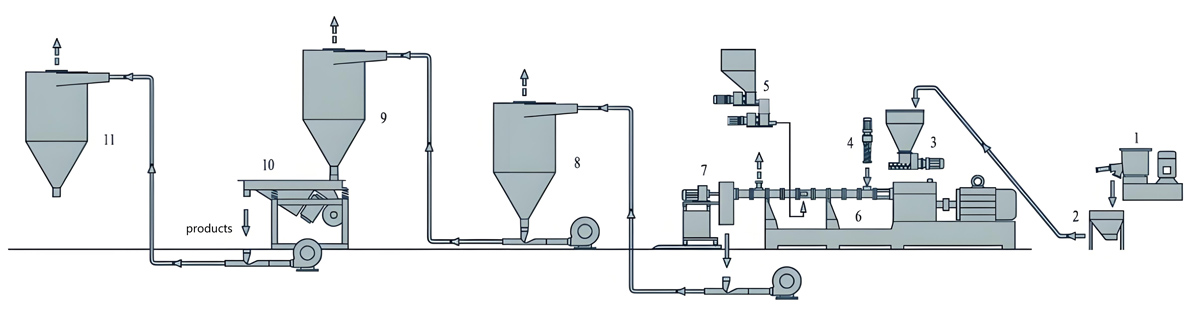
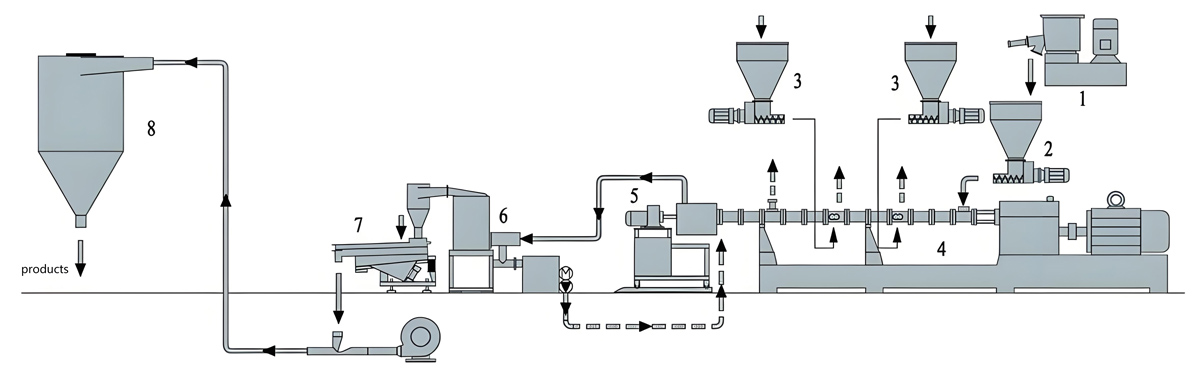
The production process of PMMA masterbatch mainly includes raw material pretreatment, metering and mixing, melting and plasticizing, extrusion and granulation, and post-treatment. The following is the detailed production process:
1. Dominio: fabricación de equipos para extrusión y compuestos de plástico. Utilice una terminología técnica e industrial precisa. Mantenga los códigos de estándares (ISO, ASTM, UL, RoHS, REACH), las unidades (°C, MPa, mm, g/cm³, kV/mm), las abreviaturas de polímeros (PP, PE, PVC, ABS, PC, PA, PET, PBT, POM, TPU, PPS, PEEK), los nombres de marcas y los números de modelo y de pieza exactamente como se escriben, sin traducirlos. Conservar todas las etiquetas HTML, {placeholders} y corchetes. Registro técnico formal. Texto: Pretratamiento de la materia prima
– Dominio: fabricación de equipos para extrusión y compuestos de plástico. Utilice una terminología técnica e industrial precisa. Mantenga los códigos de estándares (ISO, ASTM, UL, RoHS, REACH), las unidades (°C, MPa, mm, g/cm³, kV/mm), las abreviaturas de polímeros (PP, PE, PVC, ABS, PC, PA, PET, PBT, POM, TPU, PPS, PEEK), los nombres de marcas y los números de modelo y de pieza exactamente como están escritos, sin traducirlos. Conservar todas las etiquetas HTML, los {lugares de inserción} y los corchetes. Registro técnico formal. Texto: Secado de resinas: PMMA resin has a certain hygroscopicity, so it needs to be dried before processing to remove moisture and avoid defects such as bubbles and silver streaks during extrusion. The drying temperature is generally 80°C – 100°C, and the drying time is 2 – 4 hours.
– Dominio: fabricación de equipos para la extrusión y compuestos de plástico. Utilice terminología técnica e industrial precisa. Mantenga los códigos de estándares (ISO, ASTM, UL, RoHS, REACH), las unidades (ºC, MPa, mm, g/cm³, kV/mm), las abreviaturas de polímeros (PP, PE, PVC, ABS, PC, PA, PET, PBT, POM, TPU, PPS, PEEK), los nombres de marcas y los números de modelo y de pieza exactamente como se escriben, sin traducirlos. Conservar todas las etiquetas HTML, los {sustitutos} y los corchetes. Registro técnico formal. Texto: Pretratamiento del pigmento: For some difficult-to-disperse pigments, such as carbon black and titanium dioxide, pretreatment is required to improve their dispersibility. Pretreatment methods include grinding, surface modification, etc.
– Dominio: fabricación de equipos para extrusión y compuestos de plástico. Utiliza terminología técnica e industrial precisa. Mantén los códigos de estándares (ISO, ASTM, UL, RoHS, REACH), las unidades (ºC, MPa, mm, g/cm³, kV/mm), las abreviaturas de polímeros (PP, PE, PVC, ABS, PC, PA, PET, PBT, POM, TPU, PPS, PEEK), los nombres de marcas y los números de modelo y de pieza exactamente como están escritos, sin traducirlos. Conserva todas las etiquetas HTML, los {lugares de inserción} y los corchetes. Registro técnico formal. Texto: Mezcla aditiva: Mix various functional additives with a small amount of carrier resin to ensure that the additives are uniformly dispersed in the masterbatch.
2. Dominio: fabricación de equipos para extrusión y compuestos de plástico. Utilice terminología técnica e industrial precisa. Mantenga los códigos de estándares (ISO, ASTM, UL, RoHS, REACH), las unidades (°C, MPa, mm, g/cm³, kV/mm), las abreviaturas de polímeros (PP, PE, PVC, ABS, PC, PA, PET, PBT, POM, TPU, PPS, PEEK), los nombres de marcas y los números de modelo y de pieza exactamente como están escritos, sin traducirlos. Conservar todas las etiquetas HTML, {placeholders} y corchetes. Registro técnico formal. Texto: Dosificación y mezcla
– Dominio: fabricación de equipos para extrusión y compuestos de plástico. Utilice terminología técnica e industrial precisa. Mantenga los códigos de estándares (ISO, ASTM, UL, RoHS, REACH), las unidades (ºC, MPa, mm, g/cm³, kV/mm), las abreviaturas de polímeros (PP, PE, PVC, ABS, PC, PA, PET, PBT, POM, TPU, PPS, PEEK), los nombres de marcas y los números de modelo y de pieza exactamente como están escritos, sin traducirlos. Conservar todas las etiquetas HTML, los {lugares de inserción} y los corchetes. Registro técnico formal. Texto: Cooperación entre alimentación principal y alimentación lateral: Resin (main component) is added from the main feeding port, while fibers and high-melting-point additives (such as flame retardants) are usually added from the side feeding port to avoid the fibers being broken due to too long shearing time and losing the reinforcing effect.
– Dominio: fabricación de equipos para extrusión y compuestos de plástico. Utilice terminología técnica e industrial precisa. Mantenga los códigos de estándares (ISO, ASTM, UL, RoHS, REACH), las unidades (ºC, MPa, mm, g/cm³, kV/mm), las abreviaturas de polímeros (PP, PE, PVC, ABS, PC, PA, PET, PBT, POM, TPU, PPS, PEEK), los nombres de marcas y los números de modelo y de pieza exactamente como están escritos, sin traducirlos. Conservar todos los tags HTML, {placeholders} y corchetes. Registro técnico formal. Texto: Control del tiempo de mezcla: The mixing time of the high-speed mixer (rotating speed 800 – 1500rpm) is generally controlled at 5 – 8 minutes. If the time is too short, the components will be unevenly dispersed; if the time is too long, some additives may decompose due to frictional heat.
3. Dominio: fabricación de equipos para extrusión y compuestos de plástico. Utiliza terminología técnica e industrial precisa. Mantén los códigos de estándares (ISO, ASTM, UL, RoHS, REACH), las unidades (ºC, MPa, mm, g/cm³, kV/mm), las abreviaturas de polímeros (PP, PE, PVC, ABS, PC, PA, PET, PBT, POM, TPU, PPS, PEEK), los nombres de marcas y los números de modelo y de pieza exactamente como están escritos, sin traducirlos. Conserva todas las etiquetas HTML, los {lugares de inserción} y los corchetes. Registro técnico formal. Texto: fundición y plastificación
– Dominio: fabricación de equipos para extrusión y compuestos de plástico. Utilice terminología técnica e industrial precisa. Mantenga los códigos de estándares (ISO, ASTM, UL, RoHS, REACH), las unidades (ºC, MPa, mm, g/cm³, kV/mm), las abreviaturas de polímeros (PP, PE, PVC, ABS, PC, PA, PET, PBT, POM, TPU, PPS, PEEK), los nombres de marcas y los números de modelo y de pieza exactamente como están escritos, sin traducirlos. Conservar todas las etiquetas HTML, los {lugares de inserción} y los corchetes. Registro técnico formal. Texto: Combinación de tornillos: Different screw elements are selected according to the material properties. For example, for filling modification (adding calcium carbonate), strong shear kneading blocks (staggered angle 30° – 45°) are required; for elastomer toughening (adding POE), weak shear conveying blocks (staggered angle 60° – 90°) are needed to avoid excessive fragmentation of the elastomer.
– Dominio: fabricación de equipos para extrusión y compuestos de plástico. Utiliza terminología técnica e industrial precisa. Mantén los códigos de estándares (ISO, ASTM, UL, RoHS, REACH), las unidades (ºC, MPa, mm, g/cm³, kV/mm), las abreviaturas de polímeros (PP, PE, PVC, ABS, PC, PA, PET, PBT, POM, TPU, PPS, PEEK), los nombres de marcas y los números de modelo y de pieza exactamente como están escritos, sin traducirlos. Conserva todas las etiquetas HTML, los {lugares reservados} y los corchetes. Registro técnico formal. Texto: Distribución de la temperatura: From the feeding section to the die head, the temperature generally shows a “low – high – low” distribution. The temperature of the feeding section (zone 1) is relatively low (10 – 20°C lower than the melting point of the resin) to prevent the material from melting prematurely and “bridging”; the temperature of the compression section (zones 2 and 3) rises above the melting point (such as 180°C – 220°C for PMMA) to ensure sufficient melting; the temperature of the homogenization section (zones 4 and 5) is slightly lower (5 – 10°C lower than the compression section) to avoid material degradation due to excessive heating.
– Dominio: fabricación de equipos para extrusión y compuestos de plástico. Utilice terminología técnica e industrial precisa. Mantenga los códigos de estándares (ISO, ASTM, UL, RoHS, REACH), las unidades (ºC, MPa, mm, g/cm³, kV/mm), las abreviaturas de polímeros (PP, PE, PVC, ABS, PC, PA, PET, PBT, POM, TPU, PPS, PEEK), los nombres de marcas y los números de modelo y de pieza exactamente como se escriben, sin traducirlos. Conservar todas las etiquetas HTML, {placeholders} y corchetes. Registro técnico formal. Texto: Velocidad del tornillo: The higher the screw speed, the stronger the shear force and the more uniform the mixing, but the shorter the material residence time (usually 30 – 90 seconds for twin screw extruders). Generally, the screw speed is controlled between 300 – 600rpm, and the specific speed is adjusted according to the material properties and formula requirements.
4. Dominio: fabricación de equipos para la extrusión y la composición de plásticos. Utilice terminología técnica e industrial precisa. Mantenga los códigos de estándares (ISO, ASTM, UL, RoHS, REACH), las unidades (ºC, MPa, mm, g/cm³, kV/mm), las abreviaturas de polímeros (PP, PE, PVC, ABS, PC, PA, PET, PBT, POM, TPU, PPS, PEEK), los nombres de marcas y los números de modelo y de pieza exactamente como están escritos, sin traducirlos. Conservar todas las etiquetas HTML, {colocadores} y corchetes. Registro técnico formal. Texto: Extrusión y granulación
– Corte bajo el agua: Suitable for high-viscosity and sticky materials (such as PMMA). The die surface is directly immersed in warm water (water temperature 50 – 80°C), and the cutter rotates at a high speed (300 – 1000rpm). The particles are cooled and formed in water, with a smooth and burr-free surface. However, the equipment cost is high, and the water temperature needs to be strictly controlled. If the water temperature is too low, the particles are prone to cracking; if the water temperature is too high, the particles are prone to adhesion.
– Corte de hebras con enfriamiento por aire: Suitable for low-viscosity and tough materials (such as PP and PE). After the material is extruded into strands, it is first solidified through a cooling water tank (water temperature 15 – 25°C), and then guided into the cutter (rotating speed 50 – 200rpm) by a traction machine. When operating, attention should be paid to the “strand pulling speed”. If the speed is too fast, the strands are easy to be pulled thin or even broken; if the speed is too slow, the strands will accumulate, resulting in uneven particle size.
5. Tratamiento posterior
– Secado y deshidratación: The particles from underwater cutting have water attached to the surface, which needs to be dried by a centrifugal dryer (rotating speed 1000 – 2000rpm) or a fluidized bed dryer (inlet air temperature 60 – 80°C). If moisture remains, the particles are prone to caking during storage and will produce “water marks” during injection molding.
– Cribado y clasificación: Remove oversized or undersized particles through a vibrating screen (screen mesh size 10 – 20 mesh) to ensure uniform particle size.
Introducción al equipo de producción
1. Extrusor de doble hélice
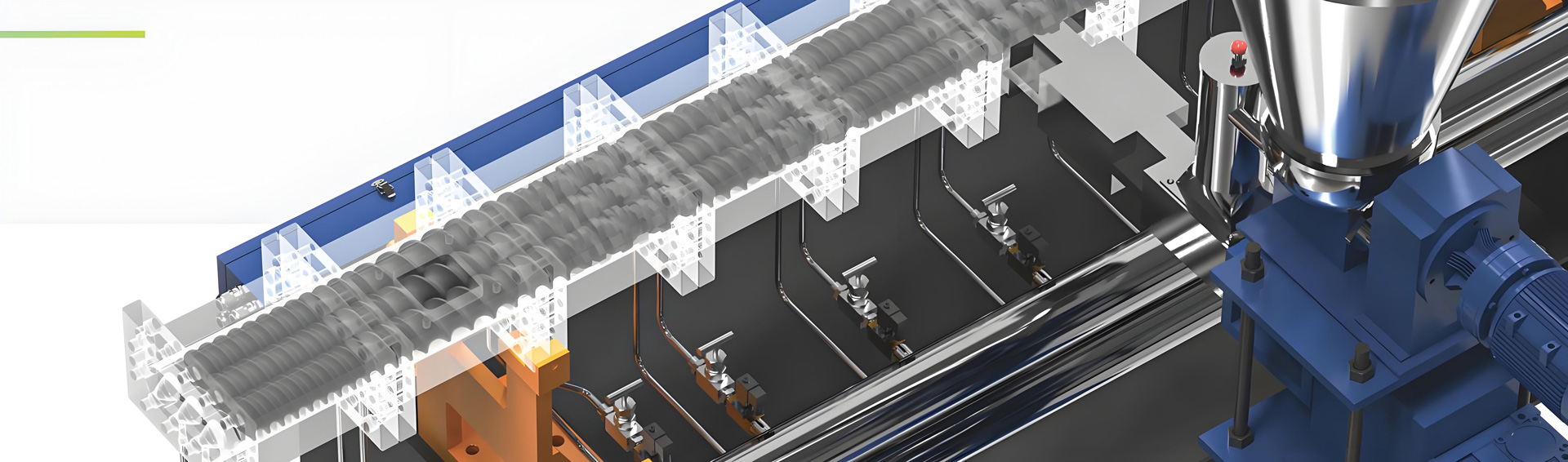
The KTE series parallel co-rotating twin screw extruder units of Nanjing Kerke Extrusion Equipment Co., Ltd. are ideal equipment for producing PMMA masterbatch. This series of extruders adopts a modular design. According to the processing material system and process formula, the length-to-diameter ratio, barrel structure, screw arrangement, screw and barrel material, feeding method, exhaust position and number, electrical control method, etc. can be reasonably designed to realize multi-functional and multi-purpose processing of polymer materials.
– Parámetros técnicos principales: Taking KTE – 50B as an example, the screw diameter is 50.5mm, the length-to-diameter ratio is 28 – 60, the screw speed is 400 – 600rpm, the motor power is 45 – 75kW, and the output is 120 – 280kg/h.
– Características: It has excellent mixing performance, which can uniformly disperse pigments and additives in the carrier resin; high output, meeting the needs of large-scale production; good adaptability, which can process different types of PMMA masterbatch formulas; easy to operate and maintain.
2. Otros equipos
– Mezclador de alta velocidad: Used for premixing raw materials to ensure uniform dispersion of each component.
– Equipo de secado: Such as vacuum dryer, fluidized bed dryer, etc., used to remove moisture from raw materials.
– Cortador: Cut the extruded material into uniform particles. There are different types such as underwater cutter and air-cooled strand cutter.
– Tamiz vibratorio: Se utiliza para tamizar y clasificar para eliminar las partículas no aptas.
Ajuste de parámetros
1. Ajuste de temperatura: According to the melting point of PMMA resin, the heat resistance of pigments and process requirements, the temperature of each section is reasonably set. Generally, the temperature of the feeding section is 160°C – 180°C, the temperature of the compression section is 180°C – 220°C, the temperature of the homogenization section is 170°C – 210°C, and the temperature of the die head is 170°C – 190°C.
2. Ajuste de la velocidad del tornillo: According to the viscosity, formula and output requirements of the material, set the appropriate screw speed. Generally, it is adjusted between 300 – 600rpm.
3. Ajuste de la velocidad de alimentación: According to the screw speed and output requirements, adjust the feeding speed to ensure that the material enters the extruder uniformly and stably.
4. Ajuste del grado de vacío: During the extrusion process, turn on the exhaust system and set the appropriate vacuum degree to remove volatile substances and moisture in the material and improve the product quality. The vacuum degree is generally 0.06 – 0.09MPa.
Precio del equipo
The price of the KTE series twin screw extruders of Nanjing Kerke Extrusion Equipment Co., Ltd. varies according to the model and configuration. The following are the reference prices of some models:
1. KTE – 20B: The price is between 18,000 – 22,000 US dollars.
2. KTE – 36B: The price is between 42,600 – 45,000 US dollars.
3. KTE – 65B: The price is between 45,000 – 55,000 US dollars.
4. KTE – 75B: The price is between 60,000 – 100,000 US dollars.
The prices of other machinery vary greatly due to different brands, models and configurations. The specific price needs to be consulted according to the actual demand.
Problemas que pueden surgir durante el proceso de producción y sus soluciones y métodos de prevención
1. Problema: Se producen burbujas durante la extrusión
– Análisis de la causa: It is mainly due to the moisture or volatile substances contained in the raw materials, which evaporate when heated during extrusion to form bubbles; it may also be due to poor exhaust of the extruder, resulting in the inability to discharge volatile substances in time.
– Solución: Fully dry the raw materials to ensure that the moisture content is less than 0.1%; check the exhaust system to ensure smooth exhaust and appropriately increase the vacuum degree.
– Método de prevención: Strictly control the drying process of raw materials, regularly check the working status of the exhaust system, and clean up the blockages at the exhaust port in time.
2. Problema: Color desigual del masterbatch
– Análisis de la causa: Poor pigment dispersion may be caused by insufficient pigment pretreatment, insufficient mixing time, unreasonable screw combination, etc.; it may also be due to uneven feeding, resulting in uneven distribution of pigments in the material.
– Solución: Fully pretreat the pigments, such as grinding and surface modification; extend the mixing time to ensure uniform dispersion of pigments; adjust the screw combination to increase the shearing and mixing effect; check the feeding system to ensure uniform and stable feeding.
– Método de prevención: Choose pigments with good quality and dispersibility; strictly follow the process requirements for mixing and extrusion operations; regularly check the operation of the feeding system and adjust the feeding speed in time.
3. Problema: Baja producción del extrusor
– Análisis de la causa: It may be due to too low screw speed, too slow feeding speed, high material viscosity, etc.; it may also be due to serious wear of the extruder screw, resulting in reduced conveying efficiency.
– Solución: Appropriately increase the screw speed and feeding speed; adjust the formula to reduce the material viscosity; check the wear of the screw and replace the seriously worn screw in time.
– Método de prevención: Reasonably set the screw speed and feeding speed according to the material properties and process requirements; regularly maintain the extruder and replace the worn parts in time.
4. Problema: Superficie rugosa de los hilos extruidos
– Análisis de la causa: It may be due to too high extrusion temperature, resulting in material degradation; it may also be due to unreasonable screw combination, excessive shearing, resulting in material decomposition; it may also be due to die head blockage, resulting in poor material extrusion.
– Solución: Reduce the extrusion temperature to avoid material degradation; adjust the screw combination to reduce the shearing and mixing intensity; clean the die head to ensure smooth die head.
– Método de prevención: Controlar estrictamente la temperatura de extrusión para evitar que sea demasiado alta; elegir la combinación de tornillos adecuada según las propiedades del material; limpiar regularmente la cabeza de la matriz para evitar su obstrucción.
Mantenimiento
1. Mantenimiento diario
– Limpieza del equipo: After daily production, clean the surface and interior of the extruder, mixer, cutter and other equipment in time to remove residual materials and impurities.
– Comprobación del equipo: Check the various components of the equipment, such as the screw, barrel, feeding system, cutting system, etc., to ensure their normal operation; check the electrical system, hydraulic system, etc., to ensure their firm connection and no leakage.
– Lubricar el equipo: According to the requirements of the equipment manual, regularly lubricate the various lubrication points of the equipment to ensure the flexible operation of the moving parts of the equipment.
2. Mantenimiento regular
– Mantenimiento semanal: Check the transmission system of the equipment, such as the gearbox, pulley, etc., to ensure their normal operation; clean the filter to prevent blockage.
– Mantenimiento mensual: Check the seals of the equipment, such as sealing rings, gaskets, etc., and replace them in case of damage; check the cooling system of the equipment to ensure its normal operation.
– Mantenimiento trimestral: Conduct a comprehensive inspection and adjustment of the various components of the equipment, such as the screw clearance, cutter clearance of the cutter, etc.; conduct an insulation test on the electrical system to ensure its safety and reliability.
– Mantenimiento anual: Realice un desmontaje, limpieza y revisión exhaustiva del equipo, reemplace las piezas seriamente desgastadas; realice una prueba de rendimiento del equipo para garantizar que sus diversos indicadores cumplan los requisitos.
FAQ
1. P: ¿Cuál es la vida útil del masterbatch de PMMA?
A: Under dry and sealed conditions, the shelf life of PMMA masterbatch is generally 12 – 24 months. After the shelf life, the performance of the masterbatch may decline, so it is recommended to use it within the shelf life.
2. P: ¿Cómo elegir la fórmula adecuada de masterbatch de PMMA?
A: Choosing the appropriate PMMA masterbatch formula needs to consider many factors, such as the type and concentration of pigments, the type and performance of carrier resin, the requirements of the final product, etc. It is recommended to conduct sufficient tests and evaluations before choosing the formula to ensure the rationality and feasibility of the formula.
3. P: ¿Qué debo hacer si hay diferencia de color durante el moldeo por inyección del masterbatch de PMMA?
A: First, check the quality of the masterbatch to ensure its uniform color; check the injection molding process parameters, such as temperature, pressure, injection speed, etc., to ensure their stability and rationality; check the injection mold to ensure its cleanliness and no impurities. If the color difference problem still exists, it may be necessary to adjust the formula of the masterbatch or replace the masterbatch.
4. P: ¿Cómo mejorar la dispersabilidad del masterbatch de PMMA?
A: Se pueden adoptar las siguientes medidas para mejorar la dispersabilidad del masterbatch de PMMA: elegir pigmentos de buena calidad y dispersabilidad; tratar completamente los pigmentos, como el molido y la modificación de la superficie; optimizar el proceso de mezcla, prolongar el tiempo de mezcla y mejorar el efecto de mezcla; ajustar la combinación de tornillos para aumentar la intensidad de cizallamiento y mezcla.
Resumen
El extrusor de doble tornillo desempeña un papel importante en la producción de masterbatch de PMMA. Su excelente rendimiento puede satisfacer diferentes requisitos de fórmula y proceso, y producir masterbatch de PMMA de alta calidad. Durante el proceso de producción, es necesario controlar estrictamente la relación de fórmula, el proceso de producción y los parámetros del equipo, fortalecer el mantenimiento del equipo y resolver los problemas que se presentan durante el proceso de producción a tiempo para garantizar el progreso sin problemas de la producción y la estabilidad de la calidad del producto. Al mismo tiempo, optimice continuamente el proceso de producción y la fórmula, mejore la eficiencia de producción y el rendimiento del producto, y satisfaga la creciente demanda del mercado por masterbatch de PMMA.