導入
PMMA(ポリメチルメタクリレート)は、一般にアクリルガラスとして知られ、高い透明性、優れた耐候性、および機械的特性を備えた熱可塑性プラスチックです。PMMAマスターバッチは、高濃度の顔料や添加剤をPMMAキャリア樹脂に均一に分散させることにより製造される粒状製品で、PMMA製品の着色や機能改変に使用できます。ツインスクリュー押出機は、PMMAマスターバッチを生産するためのコア装置です。優れた混合性能、高出力、そして適応性が高く、さまざまな配合物と工程の要件を満たすことができます。
フォーミュラ比率(さまざまな種類のフォーミュラ比率)
The formula ratio of PMMA masterbatch mainly depends on the type and concentration of pigments, the type and performance of carrier resin, and the requirements of the final product. The following are the formula ratios of several common types of PMMA masterbatch:
1. 一般色のPMMAマスターバッチ: The pigment content is generally 10% – 30%, and the carrier resin content is 70% – 90%. For example, the formula ratio of black PMMA masterbatch may be 20% carbon black and 80% PMMA resin; the formula ratio of red PMMA masterbatch may be 15% red organic pigment and 85% PMMA resin.
2. 高濃度PMMAマスターバッチ: The pigment content can be as high as 40% – 60%, and the carrier resin content is 40% – 60%. This kind of masterbatch is suitable for occasions with high requirements for color concentration, which can reduce the amount of masterbatch added and reduce production costs.
3. 機能性PMMAマスターバッチ: 顔料と基材樹脂に加えて、酸化防止剤、光安定剤、難燃剤などのさまざまな機能性添加剤が添加されます。配合比は機能要件に応じて決定されます。例えば、紫外線防止用PMMAマスターバッチの配合比は、15%の顔料、80%のPMMA樹脂、5%の紫外線吸収剤です。
生産プロセス
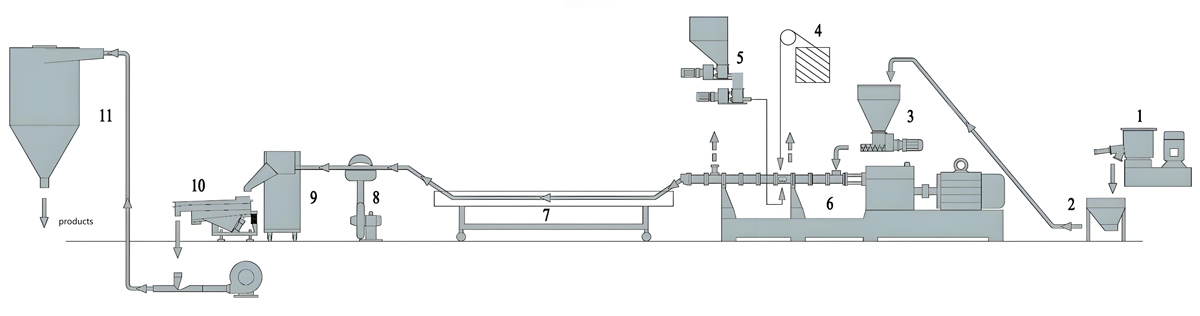
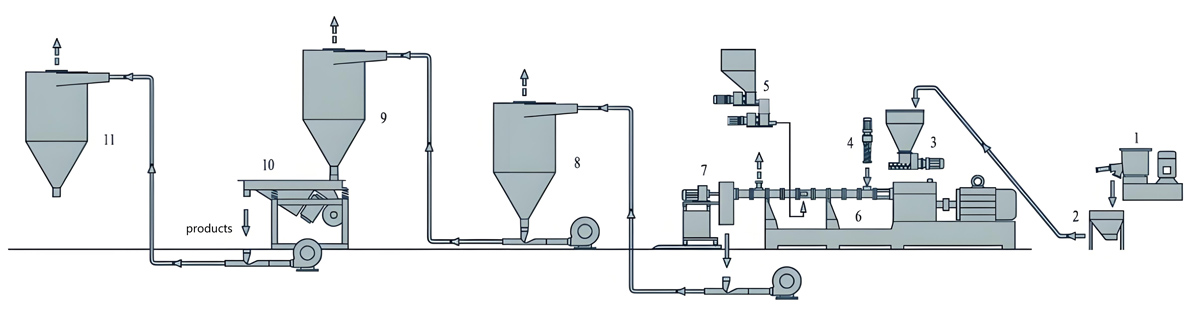
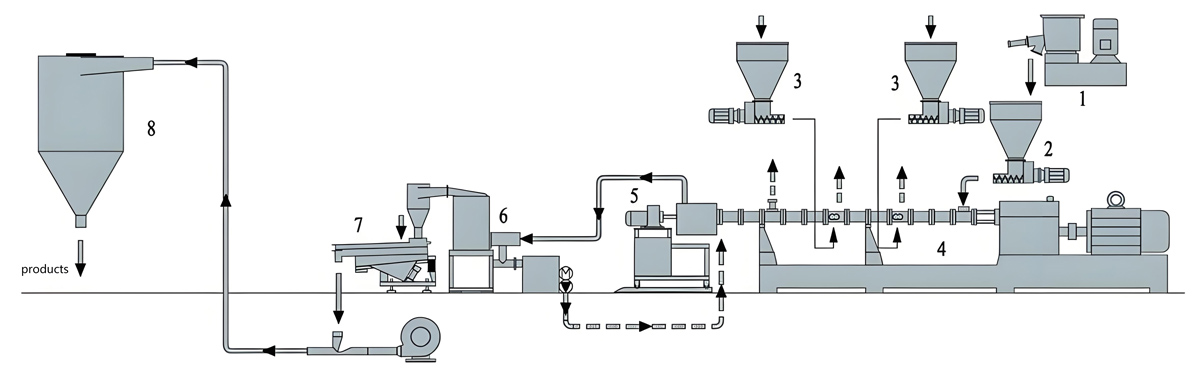
The production process of PMMA masterbatch mainly includes raw material pretreatment, metering and mixing, melting and plasticizing, extrusion and granulation, and post-treatment. The following is the detailed production process:
1. 原料の前処理
– 樹脂の乾燥: PMMA resin has a certain hygroscopicity, so it needs to be dried before processing to remove moisture and avoid defects such as bubbles and silver streaks during extrusion. The drying temperature is generally 80°C – 100°C, and the drying time is 2 – 4 hours.
– 顔料の前処理: For some difficult-to-disperse pigments, such as carbon black and titanium dioxide, pretreatment is required to improve their dispersibility. Pretreatment methods include grinding, surface modification, etc.
– 添加物の混合: Mix various functional additives with a small amount of carrier resin to ensure that the additives are uniformly dispersed in the masterbatch.
2. 計測と混合
– 主供給と側供給間の協調: Resin (main component) is added from the main feeding port, while fibers and high-melting-point additives (such as flame retardants) are usually added from the side feeding port to avoid the fibers being broken due to too long shearing time and losing the reinforcing effect.
– 混合時間の制御: The mixing time of the high-speed mixer (rotating speed 800 – 1500rpm) is generally controlled at 5 – 8 minutes. If the time is too short, the components will be unevenly dispersed; if the time is too long, some additives may decompose due to frictional heat.
3. 溶融とプラスチケ化
– ねじの組み合わせ: Different screw elements are selected according to the material properties. For example, for filling modification (adding calcium carbonate), strong shear kneading blocks (staggered angle 30° – 45°) are required; for elastomer toughening (adding POE), weak shear conveying blocks (staggered angle 60° – 90°) are needed to avoid excessive fragmentation of the elastomer.
– 温度分布: From the feeding section to the die head, the temperature generally shows a “low – high – low” distribution. The temperature of the feeding section (zone 1) is relatively low (10 – 20°C lower than the melting point of the resin) to prevent the material from melting prematurely and “bridging”; the temperature of the compression section (zones 2 and 3) rises above the melting point (such as 180°C – 220°C for PMMA) to ensure sufficient melting; the temperature of the homogenization section (zones 4 and 5) is slightly lower (5 – 10°C lower than the compression section) to avoid material degradation due to excessive heating.
– ねじ回転速度: The higher the screw speed, the stronger the shear force and the more uniform the mixing, but the shorter the material residence time (usually 30 – 90 seconds for twin screw extruders). Generally, the screw speed is controlled between 300 – 600rpm, and the specific speed is adjusted according to the material properties and formula requirements.
4. 押出と顆粒化
– 水中切断: Suitable for high-viscosity and sticky materials (such as PMMA). The die surface is directly immersed in warm water (water temperature 50 – 80°C), and the cutter rotates at a high speed (300 – 1000rpm). The particles are cooled and formed in water, with a smooth and burr-free surface. However, the equipment cost is high, and the water temperature needs to be strictly controlled. If the water temperature is too low, the particles are prone to cracking; if the water temperature is too high, the particles are prone to adhesion.
– 空気冷却式ストランドカット: Suitable for low-viscosity and tough materials (such as PP and PE). After the material is extruded into strands, it is first solidified through a cooling water tank (water temperature 15 – 25°C), and then guided into the cutter (rotating speed 50 – 200rpm) by a traction machine. When operating, attention should be paid to the “strand pulling speed”. If the speed is too fast, the strands are easy to be pulled thin or even broken; if the speed is too slow, the strands will accumulate, resulting in uneven particle size.
5. 処理後
– 乾燥と脱水: The particles from underwater cutting have water attached to the surface, which needs to be dried by a centrifugal dryer (rotating speed 1000 – 2000rpm) or a fluidized bed dryer (inlet air temperature 60 – 80°C). If moisture remains, the particles are prone to caking during storage and will produce “water marks” during injection molding.
– スクリーニングと分類: Remove oversized or undersized particles through a vibrating screen (screen mesh size 10 – 20 mesh) to ensure uniform particle size.
生産設備の紹介
1. ツインスクリューエクストラーダ
The KTE series parallel co-rotating twin screw extruder units of Nanjing Kerke Extrusion Equipment Co., Ltd. are ideal equipment for producing PMMA masterbatch. This series of extruders adopts a modular design. According to the processing material system and process formula, the length-to-diameter ratio, barrel structure, screw arrangement, screw and barrel material, feeding method, exhaust position and number, electrical control method, etc. can be reasonably designed to realize multi-functional and multi-purpose processing of polymer materials.
– 主な技術的パラメータ: Taking KTE – 50B as an example, the screw diameter is 50.5mm, the length-to-diameter ratio is 28 – 60, the screw speed is 400 – 600rpm, the motor power is 45 – 75kW, and the output is 120 – 280kg/h.
– 特徴: It has excellent mixing performance, which can uniformly disperse pigments and additives in the carrier resin; high output, meeting the needs of large-scale production; good adaptability, which can process different types of PMMA masterbatch formulas; easy to operate and maintain.
2. その他の機械
– 高速ミキサ: Used for premixing raw materials to ensure uniform dispersion of each component.
– 乾燥装置: Such as vacuum dryer, fluidized bed dryer, etc., used to remove moisture from raw materials.
– カッター: Cut the extruded material into uniform particles. There are different types such as underwater cutter and air-cooled strand cutter.
– 振動スクリーン: 不合格の粒子を除去するためのスクリーニングと分類に使用されます。
パラメータ設定
1. 温度設定: According to the melting point of PMMA resin, the heat resistance of pigments and process requirements, the temperature of each section is reasonably set. Generally, the temperature of the feeding section is 160°C – 180°C, the temperature of the compression section is 180°C – 220°C, the temperature of the homogenization section is 170°C – 210°C, and the temperature of the die head is 170°C – 190°C.
2. ねじ速度設定: According to the viscosity, formula and output requirements of the material, set the appropriate screw speed. Generally, it is adjusted between 300 – 600rpm.
3. 給餌速度の設定: According to the screw speed and output requirements, adjust the feeding speed to ensure that the material enters the extruder uniformly and stably.
4. 真空度設定: During the extrusion process, turn on the exhaust system and set the appropriate vacuum degree to remove volatile substances and moisture in the material and improve the product quality. The vacuum degree is generally 0.06 – 0.09MPa.
機器価格
The price of the KTE series twin screw extruders of Nanjing Kerke Extrusion Equipment Co., Ltd. varies according to the model and configuration. The following are the reference prices of some models:
1. KTE – 20B: The price is between 18,000 – 22,000 US dollars.
2. KTE – 36B: The price is between 42,600 – 45,000 US dollars.
3. KTE – 65B: The price is between 45,000 – 55,000 US dollars.
4. KTE – 75B: The price is between 60,000 – 100,000 US dollars.
The prices of other machinery vary greatly due to different brands, models and configurations. The specific price needs to be consulted according to the actual demand.
生産プロセス中に発生する可能性のある問題とその解決方法および予防方法
1. 問題:押出中に気泡が生じる
– 原因分析: It is mainly due to the moisture or volatile substances contained in the raw materials, which evaporate when heated during extrusion to form bubbles; it may also be due to poor exhaust of the extruder, resulting in the inability to discharge volatile substances in time.
– ソリューション: Fully dry the raw materials to ensure that the moisture content is less than 0.1%; check the exhaust system to ensure smooth exhaust and appropriately increase the vacuum degree.
– 予防方法: Strictly control the drying process of raw materials, regularly check the working status of the exhaust system, and clean up the blockages at the exhaust port in time.
2. 問題:マスターバッチの色が均一でない
– 原因分析: Poor pigment dispersion may be caused by insufficient pigment pretreatment, insufficient mixing time, unreasonable screw combination, etc.; it may also be due to uneven feeding, resulting in uneven distribution of pigments in the material.
– ソリューション: Fully pretreat the pigments, such as grinding and surface modification; extend the mixing time to ensure uniform dispersion of pigments; adjust the screw combination to increase the shearing and mixing effect; check the feeding system to ensure uniform and stable feeding.
– 予防方法: Choose pigments with good quality and dispersibility; strictly follow the process requirements for mixing and extrusion operations; regularly check the operation of the feeding system and adjust the feeding speed in time.
3. 問題:エクストラーダの出力が低い
– 原因分析: It may be due to too low screw speed, too slow feeding speed, high material viscosity, etc.; it may also be due to serious wear of the extruder screw, resulting in reduced conveying efficiency.
– ソリューション: Appropriately increase the screw speed and feeding speed; adjust the formula to reduce the material viscosity; check the wear of the screw and replace the seriously worn screw in time.
– 予防方法: Reasonably set the screw speed and feeding speed according to the material properties and process requirements; regularly maintain the extruder and replace the worn parts in time.
4. 問題:押出されたストランドの粗い表面
– 原因分析: It may be due to too high extrusion temperature, resulting in material degradation; it may also be due to unreasonable screw combination, excessive shearing, resulting in material decomposition; it may also be due to die head blockage, resulting in poor material extrusion.
– ソリューション: Reduce the extrusion temperature to avoid material degradation; adjust the screw combination to reduce the shearing and mixing intensity; clean the die head to ensure smooth die head.
– 予防方法:押出温度を厳密に制御し、過高の温度を回避します。材料の特性に応じて適切なねじ組み合わせを選択します。ダイヘッドを定期的に清掃し、ダイヘッドの詰まりを防ぎます。
メンテナンス
1. 日常メンテナンス
– 機器を清掃する: After daily production, clean the surface and interior of the extruder, mixer, cutter and other equipment in time to remove residual materials and impurities.
– 機器を確認してください: Check the various components of the equipment, such as the screw, barrel, feeding system, cutting system, etc., to ensure their normal operation; check the electrical system, hydraulic system, etc., to ensure their firm connection and no leakage.
– 機器を潤滑する: According to the requirements of the equipment manual, regularly lubricate the various lubrication points of the equipment to ensure the flexible operation of the moving parts of the equipment.
2. 定期メンテナンス
– 毎週メンテナンス: Check the transmission system of the equipment, such as the gearbox, pulley, etc., to ensure their normal operation; clean the filter to prevent blockage.
– 毎月の保守: Check the seals of the equipment, such as sealing rings, gaskets, etc., and replace them in case of damage; check the cooling system of the equipment to ensure its normal operation.
– 四半期メンテナンス: Conduct a comprehensive inspection and adjustment of the various components of the equipment, such as the screw clearance, cutter clearance of the cutter, etc.; conduct an insulation test on the electrical system to ensure its safety and reliability.
– 年間保守: 設備の包括的な分解、清掃、オーバーホールを行い、重度に劣化した部品を交換します。また、設備の性能試験を実施し、各指標が要件を満たしていることを確認します。
FAQ
1. Q: PMMAマスターバッチの保存期間はどのくらいですか?
A: Under dry and sealed conditions, the shelf life of PMMA masterbatch is generally 12 – 24 months. After the shelf life, the performance of the masterbatch may decline, so it is recommended to use it within the shelf life.
2. Q:適切なPMMAマスターバッチの配合方法はどのように選択すればよいですか?
A: Choosing the appropriate PMMA masterbatch formula needs to consider many factors, such as the type and concentration of pigments, the type and performance of carrier resin, the requirements of the final product, etc. It is recommended to conduct sufficient tests and evaluations before choosing the formula to ensure the rationality and feasibility of the formula.
3. Q: PMMAマスターバッチの射出成形中に色の違いが生じた場合、どうすればよいですか?
A: First, check the quality of the masterbatch to ensure its uniform color; check the injection molding process parameters, such as temperature, pressure, injection speed, etc., to ensure their stability and rationality; check the injection mold to ensure its cleanliness and no impurities. If the color difference problem still exists, it may be necessary to adjust the formula of the masterbatch or replace the masterbatch.
4. Q: PMMAマスターバッチの分散性を向上させるにはどうすればよいですか?
A: PMMAマスターバッチの分散性を向上させるためには、次の対策がとれます。品質と分散性に優れた顔料を選択し、粉砕や表面改質などの完全な前処理を行います。混合プロセスを最適化し、混合時間を延長して混合効果を向上させます。スクリュの組み合わせを調整して、せん断と混合の強度を高めます。
要約
PMMAマスターバッチの生産において、ツインスクリュー押出機は重要な役割を果たします。その優れた性能により、さまざまな配合比率と製造プロセスの要件を満たし、高品質のPMMAマスターバッチを生産することができます。生産プロセス中、配合比率、製造プロセス、設備パラメーターを厳密に管理し、設備の保守を強化するとともに、生産プロセス中に発生する問題をタイムリーに解決することで、生産の円滑な進め方と製品品質の安定性を確保する必要があります。同時に、生産プロセスと配合比率を継続的に最適化し、生産効率と製品性能を向上させ、PMMAマスターバッチに対する成長する市場需要に応えることが重要です。