プラスチックにおける熱感受性の課題
PVC(塩化ビニル)、TPU(熱可塑性ポリウレタン)、EVA(エチレン酢酸ビニル)、および特定の生分解性ポリマー(PLA等)のような熱感受性プラスチックの加工には、独特かつ重大な課題が伴う。これらの材料は加工ウィンドウが極めて狭く、温度が特定のしきい値をわずか10°C超えるだけで劣化、変色(黄変または褐変)、腐食性ガス(PVCからのHCl等)の放出、または物理的特性(TPUの弾性)の喪失を引き起こす。摩擦と外部加熱に大きく依存する標準押出機は、これらの材料を数秒で破壊し、数トンのスクラップを生じる可能性がある。熱感受性用途向けに設計された専用マスターバッチ押出機は、温度管理、効率的な冷却、および穏やかなせん断を最優先しなければならない。本記事は、これらの困難な材料を成功裏かつ利益を上げて加工するためのKerke双螺杆押出機に用いられるエンジニアリングソリューションを探る。
PVCと腐食性ガス管理の具体的課題
PVC is arguably the most difficult material to process due to its thermal instability. It begins to degrade at temperatures only slightly above its melting point (around 180-200 degrees Celsius). Degradation releases hydrogen chloride (HCl) gas, which is highly corrosive to standard steel extruder components and dangerous to operators. Furthermore, degraded PVC forms “fish eyes” (unmelted gels) and turns yellow, ruining the aesthetic quality of the final product. To handle this, the extruder must have excellent corrosion resistance. Kerke Extruder uses specialized barrel coatings, such as chrome plating or bimetallic liners (like 38CrMoAlA nitrided steel), that resist acid corrosion from HCl.
これらの特殊材料のコストは、標準炭素鋼機械と比較して機械価格に約10〜15%上乗せされるが、長寿命には不可欠である。これがなければ、標準鋼バレルは数週間でピット(孔食)を生じ破損する可能性がある。さらに、ガス発生に対処するため脱揮システムは堅牢でなければならない。空気を吸い込ませずにガスを排出するため、高容量の真空ポンプ(例:ルーツブロワ)が必要であり、空気の吸込みはPVCを酸化させ黄変を引き起こす。耐食性押出機のコストは高いが、その代替——頻繁なバレル交換と莫大なスクラップ率——ははるかに高価である。PVCを加工する工場は腐食コストをROIに組み込まなければならず、Kerkeの機械は材料選定と表面処理技術によりこのリスクを最小限に抑える。
Advanced Barrel Cooling Systems and “Cold Wall” Technology
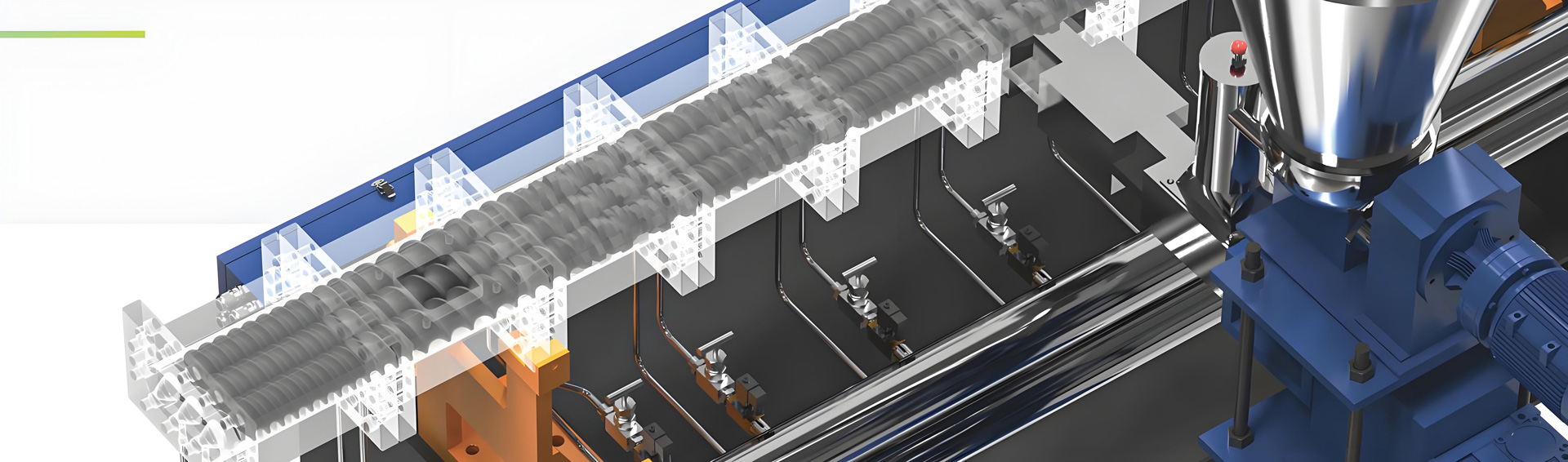
The most critical feature for heat-sensitive materials is the cooling capacity. Standard extruders often use simple cooling fans or single-pass water jackets. However, for PVC or TPU, this is insufficient. High-performance masterbatch extruders use “high-efficiency” cooling systems with spiral cooling channels machined directly into the barrel, close to the inner bore. This allows for rapid heat extraction. The water flow is controlled by proportional valves linked to the melt temperature sensors in real-time.
Some advanced systems use chilled water (5-10 degrees Celsius) even when processing materials that melt at 150 degrees. The goal is to create a “cold wall” effect where the barrel surface is kept cool, and the heat is generated primarily by the controlled shear of the screws, not by the heaters. This prevents the material from sticking to the barrel and degrading (a phenomenon called “scorching” or plate-out). The cost of installing a high-capacity industrial chiller and cooling tower is significant (approx. $8,000 to $15,000 for a dedicated system), but it is mandatory for PVC compounding to ensure product quality and operator safety. Without precise cooling, the process is uncontrollable, and the scrap rate can exceed 20%.
低せん断・穏やかな混合のためのスクリュー設計
For heat-sensitive materials, high shear is the enemy because shear generates heat. The screw configuration must be designed for “distributive mixing” rather than “dispersive mixing.” This means using fewer kneading blocks and more conveying elements. The kneading blocks that are used should have a shallow angle (30 degrees or 45 degrees) to minimize pressure build-up and heat generation. The screw root diameter is often larger (i.e., shallower flights) to reduce the volume of material being sheared at any moment, lowering the torque and temperature rise.
Kerke engineers design specific “PVC screw” or “TPU screw” profiles. These screws have a lower compression ratio to avoid adiabatic compression heating. The mixing sections are placed further downstream, after the material has fully melted, to minimize the residence time at high temperature. For very sensitive materials like TPU, which can degrade in seconds at high shear, the screws might be designed with larger clearances (within safety limits) to reduce shear stress. The trade-off is that mixing efficiency might be slightly lower, requiring perhaps a longer L/D (length to diameter) ratio (e.48:1 or 52:1 instead of 40:1) to compensate for the gentler mixing. A longer machine costs more (approx.10% more per unit length), but it is necessary to achieve dispersion without degradation. The cost of this custom engineering is justified by the ability to process high-value engineering thermoplastic urethanes without burning them.
感受性ポリマーの脱揮とベント
多くの熱感受性ポリマーはまた吸湿性(水分吸収)であり、または揮発性可塑剤(PVCやTPU等)を含む。水分は加工温度下で蒸気となり、押出物に気泡(ボイド)を生じる。蒸気はPETやPC等のポリマーで加水分解を引き起こし、分子鎖を切断して強度を低下させる。双螺杆押出機は、粘性溶融物を搬送しながら高真空(絶対圧50mbarまで)を処理できるため、ここで優れている。ベントポートはしばしば高容量の真空ポンプを備えている。
For PVC, removing moisture and residual monomers (like Vinyl Chloride) is critical for health and safety regulations. The vent design is crucial. Upstream of the vent, the screw elements build pressure to “seal” the vent and prevent air from being sucked in. Downstream, the screws are open to allow the volatiles to escape easily. If the vent is not designed correctly, the material can “foam” or surge out of the vent. Kerke uses simulation software and decades of experience to ensure the vent is located at a point where the melt has sufficient surface renewal but is not so fluid that it flows out. Proper venting allows the processor to run at lower temperatures because the volatiles (which act as plasticizers) are removed, stabilizing the melt viscosity. This directly improves product consistency and reduces the risk of thermal degradation.
滞留時間分布(RTD)制御とサイドスタッフィング
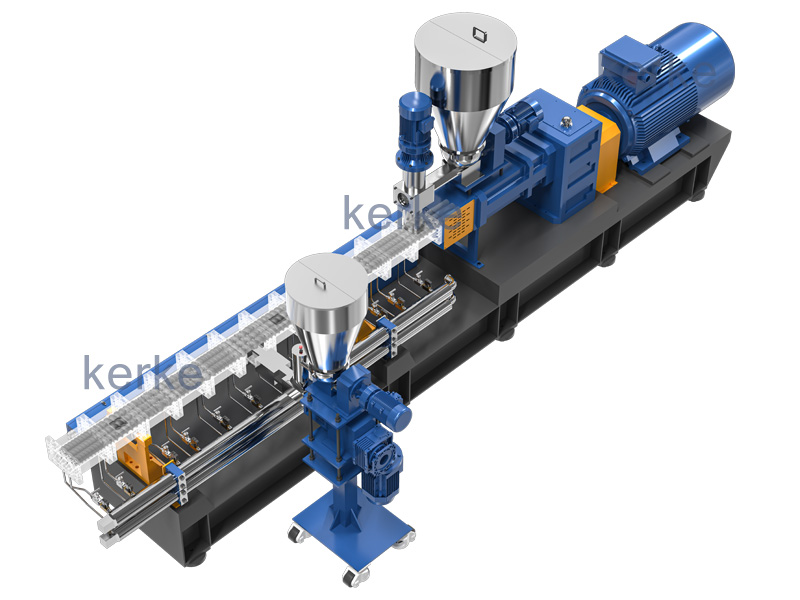
Residence time is the duration a particle of plastic spends inside the extruder. For heat-sensitive materials, the RTD must be narrow and short. A wide RTD means some material stays too long (degrades) while some leaves too early (unmixed). Twin screw extruders have a narrower RTD than single-screw extruders because the positive displacement pushes material through in a “plug flow” manner. However, for ultra-sensitive materials, even this might not be enough. Kerke offers side-stuffing ports that allow liquid additives (like heat-sensitive stabilizers or liquid colorants) to be injected directly into the melt at the very end of the process, minimizing their exposure to heat and shear.
これにより、高価な熱感受性添加剤が最終製品中で活性を維持することが確保される。例えばPVCでは液状安定剤がしばしば添加されるが、早く添加しすぎると蒸発または劣化する。サイド注入はこれを解決する。サイドフィーダの追加コストは約2,000〜4,000米ドルであるが、機能性マスターバッチ(例:感受性フィルム向け酸化防止剤またはUV安定剤マスターバッチ)には不可欠である。この機能は、より単純な装置を持つ競合他社には製造できないハイテクコンパウンドの生産を可能にすることで、機械に価値を付加する。
温度制御精度とセンサ冗長性
標準温度制御のヒステリシスは±5°Cである可能性がある。PVCの場合、205°Cへのスパイクは壊滅的となり得る。ハイエンドのマスターバッチ押出機は、ゾーンごとに冗長センサを備えた二重または三重の熱電対を使用する。制御システムはPID自動チューニングアルゴリズムを使用して温度変化を予測する。例えば、スクリュー速度が上昇すると、コントローラは温度が実際に上昇する前に予防的に冷却弁を開く。この予測制御により、溶融温度を±1°C以内に安定させる。
The cost of high-precision sensors and advanced controllers is a small fraction of the machine price (approx 2-3%) but prevents entire batches of scrap. A single batch of degraded PVC compound can cost $2,000 to $5,000 in raw materials alone, plus disposal fees and lost production time. This precision pays for itself instantly. Furthermore, data logging of temperature profiles is essential for quality certification (like ISO 9001 or medical device standards), providing traceability that justifies the higher cost of the control system. Kerke’s SCADA systems record every degree of temperature fluctuation, ensuring accountability and process repeatability.
感受性ポリマーの材料取扱いと供給システム
発熱はホッパで始まる。材料が架橋(ブリッジ)またはラットホール(鼠穴)を生じると流れが止まり、スクリューが空回りする。新しい材料が最終的に落下すると、高温のバレルに当たり瞬時にフラッシュ劣化する可能性がある。これを防ぐため、サイドマウントホッパまたは撹拌機付きロスインウェイトフィーダを使用して一貫した供給を確保する。流動性が悪いPVC粉末には、強制フィーダ(スクリューフィーダ)が必須である。これは粉末を圧縮して押出機に押し込み、空気の巻き込みを防ぐ。空気溜まりは断熱圧縮されて加熱し、局所的な劣化を引き起こす。
適切な供給システム(ホッパローダ、振動フィーダ、ロスインウェイトシステム)のコストは約5,000〜10,000米ドルであるが、プロセスを安定させ、熱感受性材料が機械に入る瞬間から保護するために不可欠である。一貫した供給がなければ、温度制御は不可能である。供給技術への投資は、困難な材料を利益を上げて加工するための前提条件である。これはバッチプロセスを連続的で安定した運転に変換し、コンパウンディングにおける収益性の基盤となる。
熱感受性材料を加工するコストへの影響
Processing heat-sensitive materials requires a premium machine. A standard masterbatch extruder might cost $50,000, but a PVC-specialized line with corrosion-resistant barrels, high-capacity cooling, and specialized screws might cost $75,000 to $90,000. The additional $25,000 to $40,000 is an investment in capability. If a factory tries to process PVC on a standard machine, the costs include: frequent screw and barrel replacement (due to corrosion), high scrap rates (10-20% due to yellowing/gels), potential safety hazards from gas leaks, and lost production time. The “cost of non-compliance” is much higher than the price of a proper machine.
さらに、特殊機械はより高い加工料金を要求できる。KerkeのPVC押出機を有する工場は、色安定性、ゲルなし、および規制準拠(FDAやREACH等)を保証するため、コンパウンディングサービスにプレミアムを課すことができる。これはトン当たりの収益を増加させる。耐熱性押出機のROIは、効率だけでなく、劣悪な装置を持つ競合他社には閉ざされた市場に参入する能力に基づいて計算される。例えば、医療用PVC市場やハイエンドTPUフィルム市場には、ゼロ劣化を保証できる装置が必要である。機械のプレミアム価格は、これら高利益率市場への入場券である。
結論
熱感受性プラスチック材料の取扱いは、ポリマー押出において最も要求の厳しい作業の一つである。それは単なる加熱器ではなく、精密な熱管理者として機能する機械を必要とする。特殊なスクリュー形状、積極的な冷却システム、耐食性材料、および精密なプロセス制御の使用により、Kerke Extrusionのマスターバッチ押出機は、PVC、TPU、PLA、およびその他の繊細なポリマーを劣化させずに成功裏に加工できる。このような装置の資本コストは標準機よりも高いが、高品質で劣化のないコンパウンドを生産する能力は、収益性の高い市場セグメントを開拓し、スクラップ、装置損傷、安全違反という高コストの落とし穴を回避する。感受性ポリマーコンパウンディングへ参入しようとする製造業者にとって、Kerkeのような専門家による専用の耐熱性押出システムへの投資は、長期的収益性と品質保証への唯一の実行可能な道である。この機械は、安価な装置では製造できないコンパウンドの生産を可能にすることで、元を取る。