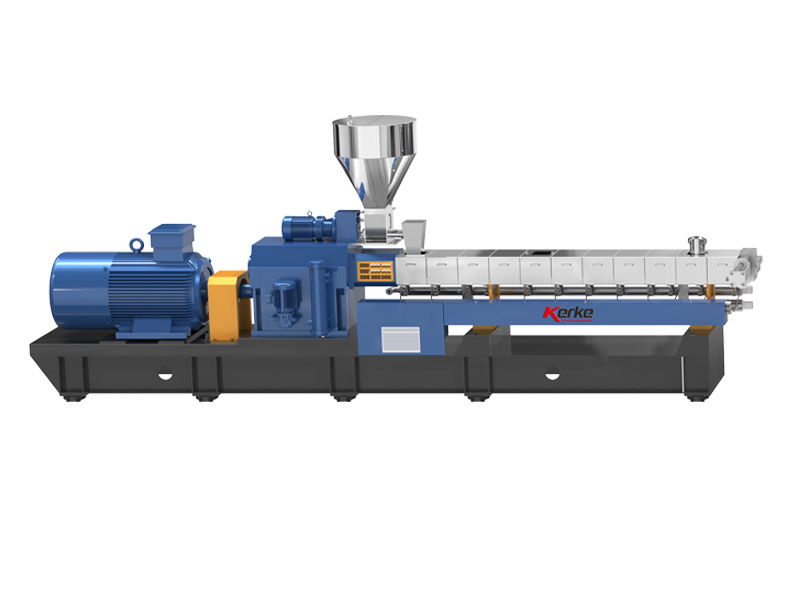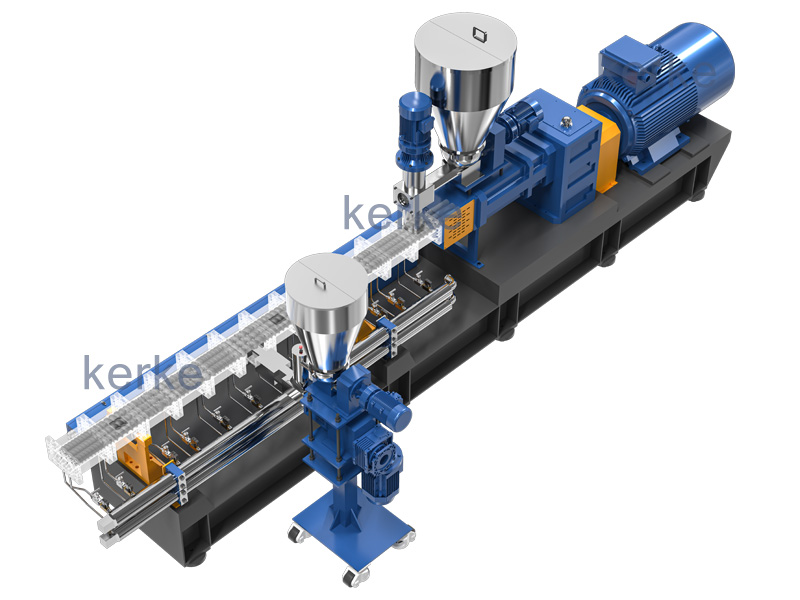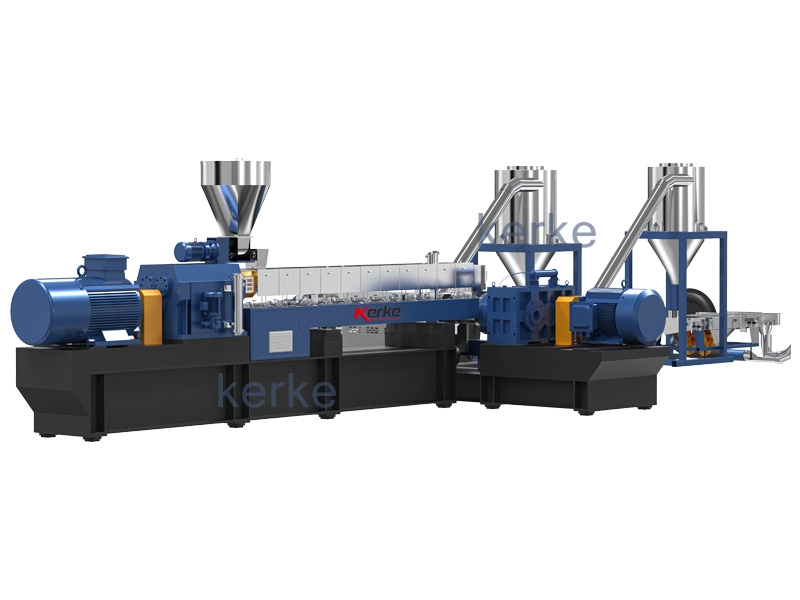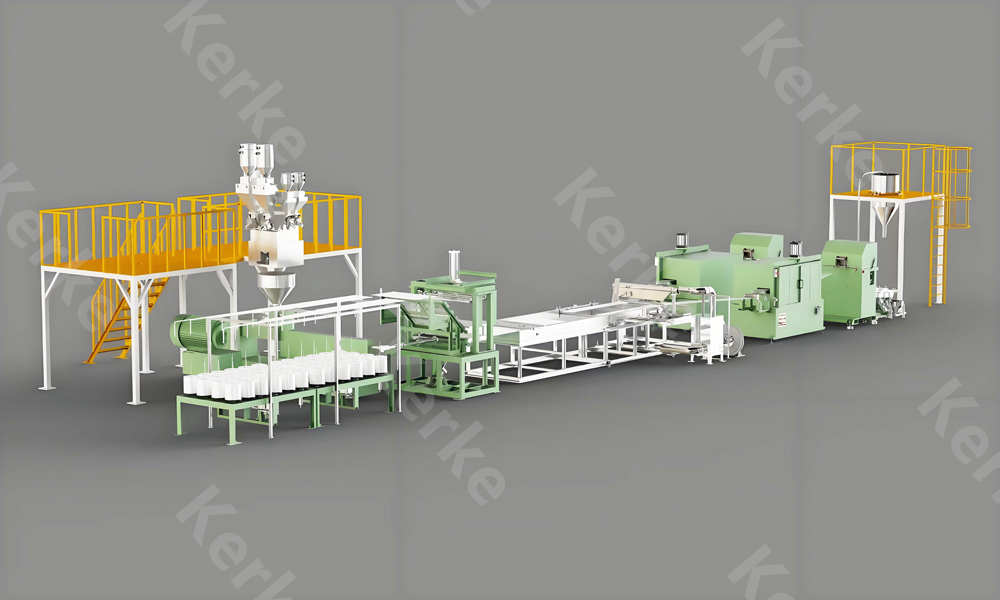
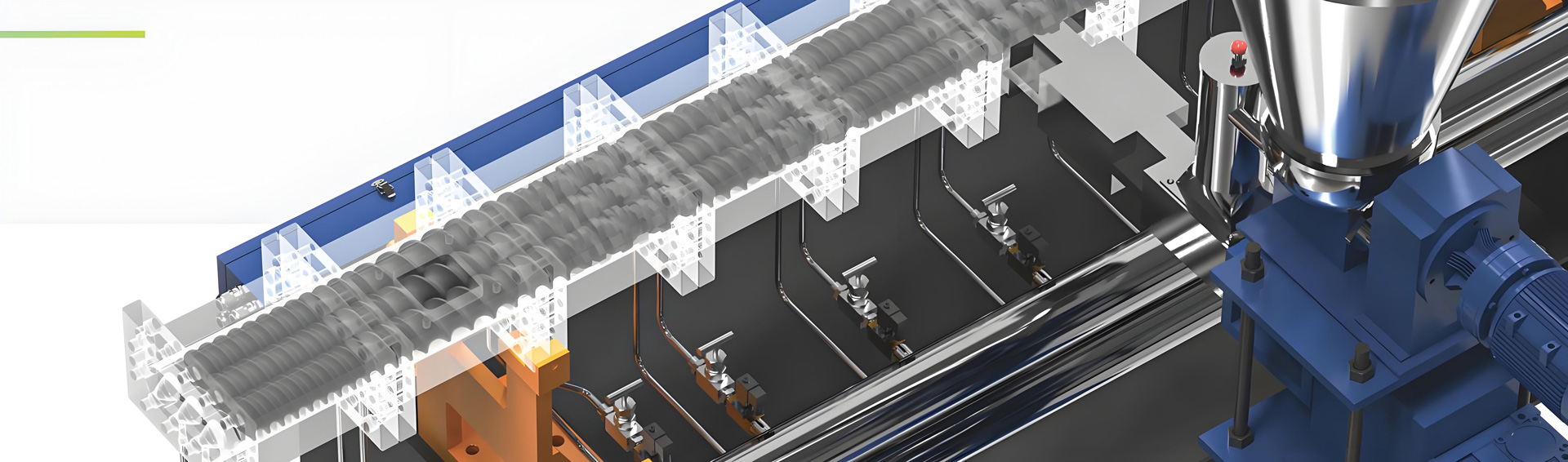
ダイヘッドは押出システムにおける最終ゲートウェイであり、溶融樹脂を目的の形状や形に成形する役割を果たします。特にコンパウンディングやマスターバッチ用途の双螺杆押出機セットアップにおいて、ダイヘッドの選択は極めて重要です。それは製品品質、生産量、ひいてはライン全体のエネルギー消費量を決定します。誤ったダイを選ぶと、メルトフラクチャー(溶融破壊)、流れの不均一、過剰な背圧、頻繁なメンテナンスなどの問題を引き起こす可能性があります。本記事では、双螺杆押出機に最適なダイヘッドを選定するための詳細な技術ガイドを提供し、Kerke Extruder(カーケ押出機)が提供する専門知識と製品ラインアップについても紹介します。ストランドダイ、水中ダイ、プロファイルダイの違い、および詳細なコストとメンテナンスの分析について検討します。
ダイヘッドの機能を理解する
ダイヘッドの主な機能は、ポリマーメルトを均一に分配し、連続したプロファイルに成形することです。コンパウンディング押出機では、ダイは最も一般的にストランドペレット化や水中ペレット化に使用されます。ただし、プロファイル押出(窓枠、パイプ)やシート成形にも使用できます。ダイは高圧(しばしば200〜300 bar)と高温(最大350°C)に耐えながら、寸法精度を維持する必要があります。ダイランド(出口前の直線部)の設計は、流れを安定させ、シャークスキンやメルトフラクチャー現象を排除するために重要です。ダイは単なる成形工具ではなく、製品の最終寸法と表面仕上げを制御する精密な計量器です。マスターバッチ用途では、ダイフェースの孔パターンがカット効率とペレット形状に直接影響します。
双螺杆押出機用ダイヘッドの種類
ダイヘッドを選定する際は、まず用途を特定する必要があります。以下は双螺杆コンパウンディングで最も一般的に使用されるタイプと、その技術仕様および使用例です:
ストランドペレット化ダイヘッド
This is the most common type for compounding and masterbatch production. The molten plastic is extruded through multiple holes in the die face, forming strands. These strands are then cooled in a water bath and cut by a pelletizer. The key consideration here is hole density and land length. For glass-filled materials, the land length must be sufficient to prevent “drool” (material leaking out of the die face due to pressure) but not so long as to cause excessive pressure build-up or material degradation. Typical land lengths range from 2mm to 10mm depending on the viscosity. Kerke offers strand dies with interchangeable insert plates, allowing flexibility in pellet size (e.g., cylindrical, flat, or tri-lobal) and hole count (from 4 to 100+ holes). This modularity allows processors to adapt to different production rates without changing the entire die body. The material of the die plate is critical; for abrasive compounds, hardened tool steel or tungsten carbide is recommended to prevent hole enlargement over time.
水中ペレット化ダイヘッド
Underwater pelletizing is preferred for heat-sensitive materials (like PVC or TPU) or for producing perfectly spherical pellets with no water bath. The die face is submerged in a cutting chamber filled with process water, and a rotating cutter slices the strands immediately upon exit. This requires a very precise die design to ensure the cutter blades do not damage the die face. The tolerance for the die holes is extremely tight (often within 0.01mm) to ensure clean cuts. These dies are more expensive due to the complex water channels, high-precision machining, and the need for corrosion-resistant materials (often stainless steel 316L or duplex steel). The cost of an underwater die head can be 30-50% higher than a strand die, but it eliminates the need for a large water bath and dryer, saving significant floor space and labor. Kerke underwater dies feature a “self-cleaning” design where water flow scours the die face, reducing maintenance frequency.
フィルム・シート用ダイ(Tダイおよびブローダイ)
If the twin screw extruder is used for reactive extrusion or specialized film compounding (e.g., barrier films), a T-die (for cast film) or a Spider die (for blown film) is used. These require sophisticated internal manifolds to ensure uniform flow across the entire width of the die (which can be several meters). The challenge here is “die lip flexibility”—the ability to adjust the gap across the width to correct for thickness variations. Modern T-dies use automatic lip adjustment systems (thermal or mechanical bolts) controlled by the extruder’s PLC. The cost analysis here focuses on width uniformity; a cheaper die might produce “thick edges” and “thin center” film, leading to high scrap rates. For a 2-meter T-die, the cost can range from $40,000 to $80,000 depending on the automation level.
ダイヘッド選定の重要因子
材料適合性と耐摩耗性
ダイヘッドは、高圧、摩擦、および(難燃剤や酸からの)腐食性環境に晒されます。ガラス繊維、シリカ、カーボンブラックを含む研磨性コンパウンドの場合、ダイ材質は極めて硬くなければなりません。標準工具鋼(D2やH13)は汎用ポリオレフィンに一般的ですが、高度な研磨性用途(40%ガラス充填ナイロンなど)には、粉末冶金(PM)鋼や超硬合金インサートが推奨されます。PM鋼ダイは標準鋼の2〜3倍のコストがかかりますが、寿命は5〜10倍長くなる可能性があり、長期的には費用対効果が高くなります。Kerke Extruderは、お客様のコンパウンドの具体的な研磨性に合わせて調整された高品位材料製のダイヘッドを供給しています。また、ダイ材質と均一な摩耗特性をライン全体で一致させるためのバイメタルバレルやスクリューも提供しています。
圧力定格と流動分配
The die must be rated for the maximum pressure of your extruder. A twin screw extruder can generate pressures up to 200-300 bar (3000-4500 psi), and some high-torque lines can exceed 400 bar. If the die is not rated for this, it may deform (bulge), causing dimensional inaccuracies. Computational Fluid Dynamics (CFD) is often used in modern die design to simulate flow and eliminate “dead spots” where material can degrade (causing black specks). Kerke utilizes advanced simulation software to design dies that ensure laminar flow and self-cleaning capabilities, reducing the frequency of die cleaning. The manifold design should be streamlined to minimize residence time, which is critical for heat-sensitive materials.
加熱および冷却ゾーン
Precise temperature control is vital. The die usually has multiple heating zones (top, bottom, body, and lip) to control the temperature profile across the face. Some dies also require internal cooling channels (using chilled water or oil) to prevent the “freeze-off” of material in underwater systems or to control the melt temperature for heat-sensitive polymers to prevent degradation. The complexity of the temperature control system adds to the price. A basic die might have 2 zones, while a high-precision film die might have 10+ zones with independent PID control. Improper heating can cause “die drool” (leakage) or surface defects like “sharkskin.” Kerke dies are equipped with high-wattage cartridge heaters and thermocouples placed directly in the melt channel for accurate feedback.
ダイヘッドのコストと価格分析
ダイヘッドの価格は非常に変動が大きく、多くの場合押出ライン全体コストの10〜15%を占めます。マスターバッチ用の標準150mmストランドダイの場合、価格は5,000ドルから15,000ドルの範囲です。自動スクリーンチェンジャー付きの複雑な300mm水中ペレット化ダイの場合、価格は50,000ドルを超える可能性があります。特殊プロファイル用のカスタム設計ダイ(例:木質プラスチック複合デッキ材プロファイル)は80,000ドル以上になることもあります。
コストの内訳は通常以下を含みます:
1. 原材料:高品位鋼塊(H13、D2、PM鋼)は高価です。大型ダイブロックは500〜1000 kgの重さになることがあります。
2. 機械加工:CNC加工、孔あけ用放電加工(EDM)、およびワイヤーカットは労働集約的なプロセスです。深い孔を持つ複雑なダイの製造には4〜8週間を要する場合があります。
3. 組立と試験:静水圧試験(常用圧力の1.5倍まで)および研磨(PVC用の鏡面仕上げ)がコストを押し上げます。
4. 予備部品:ダイ総コストの約20〜30%の費用がかかる予備ダイプレート(フェースプレート)を購入することをお勧めします。これにより、ダイ本体全体を交換することなく異なる孔構成間で迅速に切り替えられます。20孔ダイの場合、予備プレートは2,000ドル程度になる可能性があります。
5. 設計費:カスタムCFD解析と設計の場合、設計費として5,000〜10,000ドルが加算されることがあります。
When budgeting, consider the “Cost of Ownership.” A cheaper die might save $5,000 upfront but could cause $20,000 in losses due to downtime for cleaning or poor pellet quality (fines). Investing in a high-quality Kerke die head with optimized flow channels ensures higher throughput and longer intervals between maintenance. The ROI on a premium die is often realized within 6 months through reduced scrap and higher line speeds.
メンテナンスとトラブルシューティング
Proper maintenance extends die life significantly. Common issues include “die drool” (leakage), which can be mitigated by using anti-stick coatings (like PTFE or chrome plating) or high-land-length designs. Carbon buildup is another issue, often solved by periodic cleaning with copper wire brushes or chemical cleaners (but care must be taken not to scratch the surface). Kerke die heads are designed with easy-disassembly features, allowing operators to clean the internals without heavy machinery. Regular inspection of the die land for scratches is crucial; even a minor scratch can ruin the surface finish of the extrudate, leading to product rejection.
トラブルシューティングガイド:
1. 流れの不均一:ヒーターバンドの焼損を確認してください。マニホールドが劣化した材料で詰まっていないか確認してください。
2. 表面粗さ:これはダイランドの傷や汚染を示します。ダイを研磨するか、化学洗浄を実施してください。
3. 過剰な圧力:これはスクリーンパックが詰まっているか、ダイ孔が部分的に閉塞していることを意味する可能性があります。バックフラッシュ頻度を増やしてください。
結論
Selecting the right die head for a twin screw extruder is a balance between initial cost, application requirements, and long-term durability. Whether you need a simple strand die for masterbatch or a sophisticated underwater die for engineering plastics, the choice impacts your bottom line. By considering factors like material abrasiveness, pressure rating, and flow distribution, and by choosing a reputable supplier like Kerke Extruder, you can ensure a smooth, efficient, and high-quality extrusion process. Remember, the die is the final touchpoint; getting it right ensures your product meets the market’s highest standards. A well-chosen die head is not an expense; it is an investment in quality and consistency that pays dividends in reduced waste and higher customer satisfaction.