Transparency is a deceptively demanding performance requirement in plastic films. Unlike opacity — which can be achieved by simply adding enough TiO₂ — transparency requires the masterbatch formulator to work with the polymer’s natural optical physics rather than against it. A transparent masterbatch must either leave the polymer’s inherent clarity undisturbed or actively enhance it, all while delivering the functional additives that the film needs for processing and end-use performance. As of 2026, the global transparent packaging film market exceeds $45 billion, driven by consumer preference for product visibility in food packaging and the growing premiumization of retail display. This guide provides a comprehensive technical reference for the formulation, twin-screw compounding, quality testing, and application of transparent masterbatches for both polypropylene (PP) and polyethylene (PE) film systems.
透明マスターバッチとは何ですか?色マスターバッチとの違いは何ですか?
透明マスターバッチとは、通常、キャリア樹脂中に10〜30%の有効添加剤を配合した濃縮化合物です。このマスターバッチは、光学的透明性を低下させることなく、PPまたはPEフィルムに添加するように設計されています。色マスターバッチとは異なり、特定の波長の光を吸収または散乱させることで可視色を生成するものですが、透明マスターバッチは可視スペクトル全体(380〜780nm)の光散乱を最小限に抑える必要があります。この根本的な違いは、添加剤の選択や粒子サイズ制御から、加工条件や品質指標に至るまで、製造設計のあらゆる側面を決定します。
透明なマスターバッチは、フィルム製造において三つの主要な機能を果たします。光学強化 — through clarifying agents and nucleators that refine the polymer’s crystalline structure to sub-wavelength dimensions — is the most technically sophisticated function, particularly in semi-crystalline PP. 加工助剤ブロック防止剤(合成シリカ、サブミクロン粒子サイズのタルク)や滑り加工剤(エルカミド、オレアミド)などは、フィルムの取り扱いと変換において不可欠ですが、ハゼを発生させないように慎重に選定する必要があります。機能性添加物UV安定剤、帯電防止剤、および酸素除去剤なども、厳しい光学相容性要件を満たす場合には、透明なマスターバッチ製剤に組み込むことができます。
For masterbatch producers, the challenge is that every additive particle in the formulation becomes a potential light-scattering center. The formulator’s task is to ensure that each additive component has a refractive index (RI) within approximately ±0.02 of the carrier polymer, and that its particle size is either well below the wavelength of visible light (< 100 nm for レイリー散乱 regime) or well above it so that the particle-matrix interface area is minimized. This dual constraint of RI matching and particle size control defines the technical boundaries within which transparent masterbatch formulation operates.
透明性の科学:屈折率、結晶性、および光散乱
効果的な透明マスターバッチを作り出すためには、ポリマー膜を通過する光の透過を制御する物理的メカニズムを理解することが重要です。全体的な透明度を決定する三つの独立した要因は、ポリマーと添加剤の固有吸収、屈折率不連続性による散乱、および表面の粗さによる散乱です。
屈折率のマッチング
光が、二つの異なる屈折率を持つ材料の間の界面に当たると、一部が反射され、散乱します。充填されたポリマーシステム(まさにマスターバッチ添加物を使用したフィルムがその例です)では、各添加物粒子は、平方ミリメートルあたり数千ものこのような界面を作り出します。各界面での散乱光の強さはフレネル方程式に従い、n₁−n₂² / (n₁ + n₂)²に比例します。PEの屈折率が約1.51である場合、RIが1.53の添加物は、粒子とマトリクスの屈折率であるn₁とn₂の差がわずか0.02となり、その結果の散乱光の強さは、入射光の0.004%以下です。このレベルでは、よくマッチした添加物粒子の高い添加量でも、視覚的に透明です。しかし、不一致が0.2に達すると(PE内のTiO₂(RI ~2.7)の場合)、各界面での散乱光の強さは200倍以上に増加し、TiO₂を効果的な白色顔料にする不透明性を生み出します。
PPの結晶性と球状粒子サイズ
ポリプロピレンは、ポリエチレンとは異なる独特の透明性の問題を抱えています。PEは、固有の小さな層状構造に結晶化し、比較的低いハゼを生成します。一方、PPは大きな球状結晶(スフェリュライト)を形成します。スフェリュライトは、ゆっくり冷却すると直径が10〜100ミクロンに達することがあります。スフェリュライトの大きさが可視光の波長を超える場合、各スフェリュライト内の結晶部と非結晶部の屈折率の差により、大きな光散乱が発生し、不透明な白色の特徴的な外観を呈します。
The solution lies in nucleation technology. By introducing a high density of heterogeneous nucleation sites through clarifying agents, the number of spherulites increases dramatically while their individual size decreases proportionally. When the spherulite diameter falls below approximately 400 nm — the short-wavelength end of the visible spectrum — light passes through with minimal scattering, and the PP becomes transparent. This is the operating principle behind sorbitol-based clarifiers and the newer trisamide-based nucleating agents that have transformed PP’s applicability in transparent packaging since their commercial introduction.
粒子サイズと散乱モード
| 光に対する粒子サイズ | 散乱体制 | 透明度への影響 | マスターバッチでの例 |
|---|---|---|---|
| d << λ (d < 100 nm) | レイリー散乱 | 非常に低い強度 ∝ d⁶; d の場合は無視可能 < 50 nm | ナノシリカによるブロック防止、溶解したクリアライザ分子 |
| 分野: プラスチック押出および混合設備の製造。正確な技術・工業用語を使用します。規格コード(ISO、ASTM、UL、RoHS、REACH)、単位(℃、MPa、mm、g/cm³、kV/mm)、ポリマー略称(PP、PE、PVC、ABS、PC、PA、PET、PBT、POM、TPU、PPS、PEEK)、商標名、モデル・部品番号を正確に記載してください。翻訳しないでください。すべてのHTMLタグ、{プレースホルダー}、および括弧を保持してください。フォーマルな技術用語。テキスト: 分野: プラスチック押出および混合設備の製造。正確な技術・工業用語を使用します。規格コード(ISO、ASTM、UL、RoHS、REACH)、単位(℃、MPa、mm、g/cm³、kV/mm)、ポリマー略称(PP、PE、PVC、ABS、PC、PA、PET、PBT、POM、TPU、PPS、PEEK)、商標名、モデル・部品番号を正確に記載してください。翻訳しないでください。すべてのHTMLタグ、{プレースホルダー}、および括弧を保持してください。フォーマルな技術用語。テキスト: d ≈ λ (100 nm–1 μm) | 三重散乱 | 最大散乱量 — 回避するために重要 | 分散不良の色素凝集体 |
| d >> λ (d > 5 μm) | ジオメトリック散乱 | 適度 - 単位体積あたりの粒子数が少ない | 大型の抗ブロック粒子(透明フィルムでは避ける) |
| d < 40 nm + RI match | 基本的に透明 | Negligible — 添加物が視覚的に見えなくなる | 最適に分散したナノ添加剤 |
このサイズ依存的な挙動は、ナノスケールの添加剤(例えば、10〜40 nmの主粒子サイズを持つ合成無定形シリカ)が透明性を損なわずにアンチブロック機能を提供できる理由を説明します。一方、2〜10μmの従来のダイアトマイシスアースのアンチブロックは、目立つハゼを生成します。マスターバッチの混合プロセスでは、このナノスケールの分散状態を維持する必要があります。押出中に再凝集すると、粒子サイズ分布がミエ散乱域に移行し、透明性が損なわれます。
PP透明マスターバッチ: クリアライザ、核形成剤、製剤戦略
PP transparent masterbatch represents the most technically sophisticated category because it must actively modify the polymer’s crystallization behavior rather than merely avoiding optical disruption. The core additive technology is the clarifying agent, with three generations of sorbitol-based chemistry defining the evolution of PP transparency since the 1980s.
PPクリアリングエージェントの世代
| 世代 | 化学 | マスターバッチでの典型的な積載 | Haze Performance(1mmのプラーク) | 主な特徴 |
|---|---|---|---|---|
| 第1世代(DBS) | ジベンゼリジデン・ソルビトール | 10–20% | 15–25%のハゼ | 低コスト; 限られた熱安定性; 板状化傾向 |
| 第2世代(MDBS) | メチルジベニジリデンソルビトール | 10–20% | 10–18%のハゼ | 明瞭性が向上し、中程度の嗜好性 |
| 第3世代 (DMDBS) | ジメチル-ジベンゾリジデン・ソルビトール | 8–15% | 6–12% のハゼ | 良好な透明度; 広く使用されている; 高負荷時には一部の板状出現 |
| 第4世代(NX 8000) | ノンスロビトール(トリサミドベース、例えば、Millad NX 8000) | 5–10% | 3–8%のハゼ | 優れた透明度、優れた感覚的特性、高いコスト |
Milliken’s Millad NX 8000, introduced commercially in the 2010s, represents the current state-of-the-art in PP clarification. Unlike sorbitol-based clarifiers that require dissolution and re-crystallization in the PP melt — a process that is sensitive to processing temperature and cooling rate — trisamide-based clarifiers operate through a self-assembly mechanism that produces an extremely fine, three-dimensional nanofibrillar network. This network provides an exceptionally high density of nucleation sites, producing spherulites in the 50–200 nm range that are transparent to visible light. The result is haze values as low as 3–5% in 1 mm injection-molded plaques, approaching the clarity of amorphous polymers like polystyrene and polycarbonate.
製剤例: 10% Clarifier PP透明マスターバッチ
| コンポーネント | ロード率(%) | 関数 |
|---|---|---|
| PPホモポリマー(MFI 25) | 82% | キャリア樹脂 — 分散用の高MFIで、フィルムPPと互換性があります |
| Millad NX 8000 | 10% | 澄明剤 — 第4世代トリサミド核化剤 |
| ステアリン酸カルシウム | 3% | 酸除去剤/処理安定剤 |
| 抗酸化剤(Irganox 1010 / Irgafos 168ブレンド) | 2% | 混合およびフィルム押出中の熱酸化安定化 |
| 合成シリカ(12 nm) | 3% | Anti-block — ナノスケールで透明性を維持 |
PPキャストフィルムの2%のレットダウン比で、このマスターバッチはフィニッシュフィルムに0.2%のクリアランス剤を提供します。これは、急速冷却で処理した50ミクロンのフィルムで10%以下のハゼを達成するのに十分です。高MFIキャリア樹脂(MFI 25と通常のフィルムPPのMFI 4〜12)により、フィルムエクストラーダーでクリアランス剤の迅速な溶融と均一な分散が確保され、目に見えるハゼ帯を生成するような局所的な濃度変化を防止します。
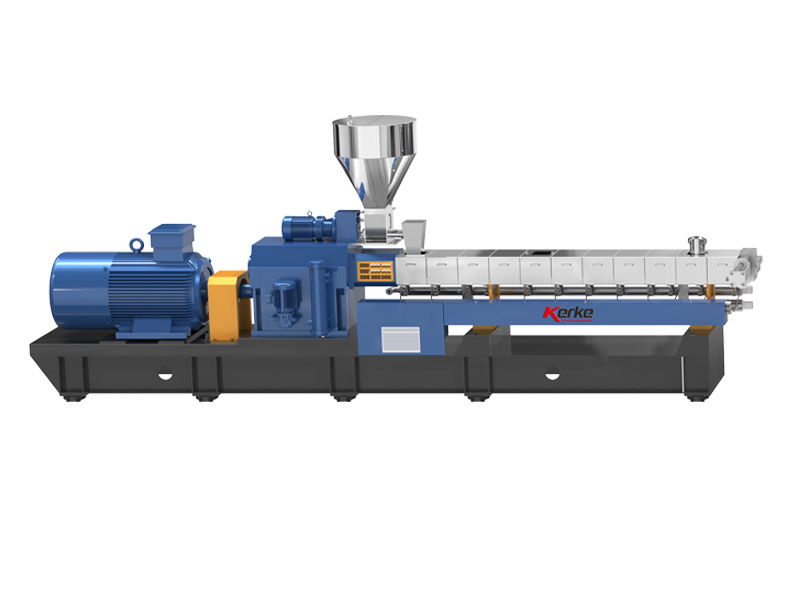
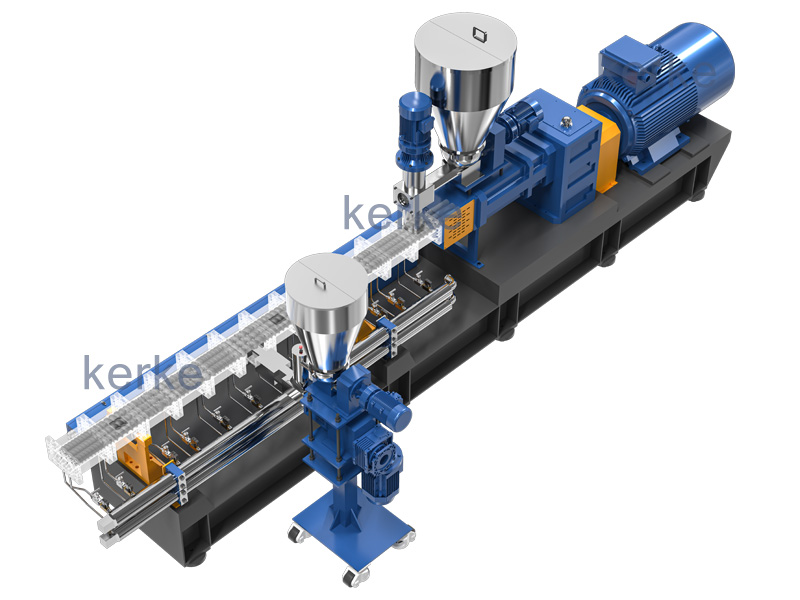
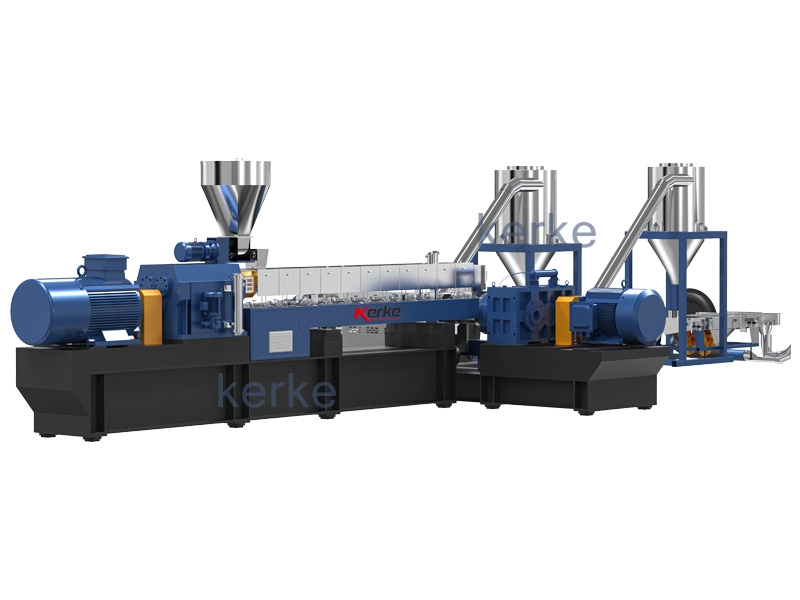
For masterbatch producers running Kerke KTE-series twin-screw extruders, the formulation above requires precise temperature control because NX 8000 must reach its melting point of approximately 245°C to dissolve completely in the PP melt, yet the PP carrier must not exceed 260°C to avoid thermal degradation. The KTE series’ segmented barrel design with independent zone temperature control, combined with computer-optimized screw configurations featuring gentle kneading blocks (30°–45° stagger), enables this narrow processing window to be maintained consistently across production runs.
PE透明マスターバッチ:ブロック防止、滑り防止、および光学強化添加剤
Polyethylene’s transparency challenge differs fundamentally from polypropylene’s. PE does not form large spherulites — its crystalline lamellae are inherently small — so clarifying agents are unnecessary. Instead, PE transparency is primarily limited by surface roughness (which causes haze through diffuse reflection) and by the light-scattering contribution of process-required additives such as anti-block and slip agents. The formulator’s task is therefore to deliver these functional additives in forms that minimize their optical footprint.
透明PEマスターバッチ用のブロック防止剤
Anti-block agents prevent film layers from sticking together on the roll — an essential function for any film that will be unwound for printing, laminating, or bag-making. Conventional anti-blocks such as diatomaceous earth (DE) and natural silica have particle sizes of 2–10 microns and refractive indices of approximately 1.46 — close to PE’s 1.51 but with particle sizes squarely in the 三重散乱 regime. The result is measurable haze, typically 2–5% additional haze per 1,000 ppm of conventional anti-block.
For transparent PE films, synthetic precipitated silica with primary particle sizes of 10–50 nm and specific surface areas of 200–400 m²/g (BET) provides equivalent anti-block performance with dramatically reduced haze. At 500–1,000 ppm in the finished film, nano-silica anti-block typically adds less than 1% to haze values. The trade-off is that nano-scale materials are more difficult to disperse uniformly during masterbatch compounding — they require high shear in the twin-screw extruder’s mixing zones to break up agglomerates, and the dispersion must survive the subsequent let-down step in the film extruder. The Kerke KTE series, with its optimized kneading block configuration and available distributive mixing elements (ZME/TME), is well-suited to this demanding dispersion task. Kerke is a Wanplas factory, and the Wanplas brand’s 12+ years of compounding expertise ensures reliable dispersion of nano-scale additives at production throughputs.
スリップ添加剤
スリップ添加剤(通常は長鎖脂肪酸アミド、例えばエルカミド(C22)やオレアミド(C18))は、PEフィルム表面の摩擦係数(COF)を低減し、包装機械内の金属ガイドや成形機で滑らかな動きを可能にします。完成したフィルムに500〜1,500ppmの添加量を施した場合、これらの添加剤は押出後24〜72時間以内にフィルム表面に浮かび上がり、潤滑効果を発揮する一層を形成します。重要なのは、エルカミドとオレアミドは加工温度でPE溶融体に完全に溶解し、離散粒子を形成しないため、フィルムにゼロの混濁をもたらすことです。これは粒子状添加剤に比べて大きな利点です。
製剤例:PE透明マスターバッチ
| コンポーネント | ロード率(%) | 関数 |
|---|---|---|
| LDPE(MFI 20) | 75% | キャリア樹脂 |
| 合成ナノシリカ(12 nm、300 m²/g BET) | 12% | Anti-block — 最小限のハゼを実現するナノ粒子 |
| エルカミド | 8% | スリップエージェント — 押出後に表面に浮かび上がる |
| 抗酸化パッケージ | 2% | 熱安定化 |
| LDPEワックス | 3% | ナノシリカの分散補助 |
3%のレットダウン比で、このマスターバッチは、製品フィルム中に約3,600 ppmのナノシリカと2,400 ppmのエルキュアミドを提供します。これらのレベルは、効果的なアンチブロック(COF)を実現します。 < 0.3) and slip performance while maintaining haze below 6% in 50-micron LDPE blown film. The LDPEワックス acts as a wetting agent during compounding, coating the nano-silica particles to reduce inter-particle friction and aid dispersion in the twin-screw extruder.
透明マスターバッチ用ツインスクリュー混合プロセス
ツインスクリュー押出機上で透明マスターバッチを混合するには、色のマスターバッチとは根本的に異なるアプローチが必要です。色の混合では、顔料の分散のために最大のせん断力が優先されますが、透明の混合では、添加剤の分散を十分に行いながら、光学処方に固有の二つの危険要因、すなわち添加剤の熱分解(黄変を引き起こす)とナノスケール粒子の再凝集(ハゼを引き起こす)とのバランスを取る必要があります。プロセスの窓は狭くなり、それを超える場合の結果は、完成したフィルムで即座に見えます。
プロセスパラメータ比較:カラー対透明マスターバッチ
| パラメータ | カラーマスターバッチ(50%有機顔料) | 透明マスターバッチ(クリアライザー/アンチブロック) |
|---|---|---|
| ねじ回転速度(RPM) | 400–800 | 250–450 |
| 特定のエネルギー投入量(kWh/kg) | 0.20–0.35 | 0.12–0.20 |
| 溶融温度(℃) | 190–230 | 220–250(PPクリアライザー)、170–200(PEアンチブロック) |
| 揉み合いブロックの段階角 | 45°/90°/45°(高いシェア) | 30°/45°/30°(中程度のせん断) |
| 分散混合に重点を置く | 適度 | High — ナノ添加剤の均一性にとって重要 |
| 脱ガス要件 | オプション(大気放出口) | 必須:真空排気を実行して、黄変を引き起こす揮発性物質を除去します |
透明マスターバッチの低速ネジ回転速度とSEIは、添加物の負荷が低い場合(色の場合の30〜70%に比べて10〜30%)の混合時のエネルギー需要が低下していることを反映しています。さらに重要なのは、熱的劣化を避ける必要があるということです。ソルビトールベースの澄明剤は260℃以上で分解し始め、黄色の変色と食品接触フィルムにおける感官的問題(味や臭い)を生じさせるアルデヒドを放出します。ナノシリカの抗結塊剤は、保護蝋またはシランコーティングが剥がれる過剰なせん断力の下で再凝集し、裸のシリカ表面が結合することがあります。
透明マスターバッチ用ねじ構成
透明マスターバッチ用の理想的なねじ構成では、分散混合よりも分散混合を重視します。色の混合に使用される90°の高シェアのこねブロックの代わりに、30°の前方輸送のこねブロックと歯状混合要素(ZME)を組み合わせることで、ナノ添加剤の十分な分散を実現し、温度上昇とシェア熱を最小限に抑えます。L/D 44:1のKTE-65の典型的な構成には、次のものが含まれます。
- バレル 1–2 (8D):深層運搬 — 固体物の輸送と予熱
- バレル3 (4D):過渡元素 — 中温でポリマーの溶融が始まる
- バレル 4 (4D):KB30/5/36(×2)+KB45/5/36(×1) - ナノ添加剤の凝集破壊のための穏やかな分散混合
- バレル5 (4D):ZMEタービンミキシング(×3) — 統一性を高める高度な分散混合
- バレル 6 (4D):Conveying + 真空排気 — 残留水分と低分子量揮発物の脱離
- バレル 7–8 (8D):伝送 + 圧力の蓄積 — 安定したダイフロー
The Kerke KTE series’ modular screw design, with computer-aided element optimization and excellent interchangeability between screw configurations, allows rapid reconfiguration between color and transparent masterbatch production on the same extruder. This flexibility is particularly valuable for masterbatch producers serving diverse film customers who require both opaque and transparent formulations.
品質テスト:ハゼ、明瞭度、光沢、透過率の測定
Quality testing for transparent masterbatch is more demanding than for opaque formulations because the optical properties are the product’s entire value proposition. The standard test methods defined by ASTM D1003 (haze and luminous transmittance) and ASTM D2457 (gloss) provide the quantitative framework, but practical film evaluation often extends beyond these laboratory measurements to include visual assessment under representative lighting conditions.
キーオプティカルメトリック
| メートル法 | 標準 | 定義 | 典型的なターゲット(50μmフィルム) |
|---|---|---|---|
| Haze | ASTM D1003 | 伝送光の2.5°以上偏れた割合 | PP: 3〜10%; PE: 4〜8% |
| 明確性 | ASTM D1003 | 伝送光の偏差の割合 <2.5° (narrow-angle) | PP: >90%; PE: >85% |
| 総光透過率 | ASTM D1003 | 発光光と入射光の比率(380〜780 nm) | PP: >88%; PE: >89% |
| 光沢度(60°) | ASTM D2457 | 60°の入射角における反射率 | PP: >100 GU; PE: >80 GU |
| 黄色指数(YI) | ASTM E313 | 黄変の程度(数値) | < 2.0 (lower is better) |
マスターバッチ製造業者向け実用的試験プロトコル
透明なマスターバッチの包括的な品質管理プロトコルには、次の手順が含まれる必要があります。これらの手順は、すべての生産バッチで実行されます。
- 標準的なフィルム準備:指定されたレートでマスターバッチを混合し、実験室用カストフィルムラインまたはブローフィルムラインを使用して、制御された厚さ(通常 50 μm)のフィルムを作成します。フィルムの製造条件(温度プロファイル、冷却速度、引き出し比)は、バッチ間の比較可能性を確保するために標準化され、記録されなければなりません。
- ハゼと透過率の測定:校正済みのヘイズ計 (例えば、BYK-Gardner Haze-Gard) を使用して、ウェブ幅全体に均等に配置された五つのフィルムサンプルのヘイズと全透過率を測定します。平均値と標準偏差を報告してください。標準偏差は分散の均一性の指標です。
- 視覚検査:黒い背景の下で、標準化されたD65日光照明下でフィルムサンプルを検査し、目立つシミ、ジェル、または色の変化を確認します。この主観的な評価では、ハゼメーターが見落とす可能性のある欠陥、たとえば個別に存在するジェル粒子などを発見できます。
- 老化試験: Store film samples at 40°C for 7 days and re-measure haze and YI. An increase in YI greater than 1.0 indicates additive degradation or interaction that will manifest as yellowing during the film’s shelf life.
- ブロックおよびスリップテスト:ASTM D1894 に従って、静的および動的 COF を測定し、機能添加物が設計通りに機能していることを確認します。また、光学性能が損なわれることもありません。
用途:食品包装から光学フィルムまで
透明なPPおよびPEマスターバッチは、さまざまなフィルム用途に対応でき、それぞれに特定の光学および機能要件があります。これらの最終用途の要件を理解することは、フィルムコンバーターに一貫した価値を提供するマスターバッチを設計するために不可欠です。
食品包装フィルム
透明な食品包装(ベーカリー製品のオーバーラップ用のPPキャストフィルム、新鮮な生鮮食品用のPEストレッチフィルム、改質大気包装(MAP)用の多層バリアフィルムなど)は、透明なマスターバッチの最大市場を占めています。主要な要件には、8%以下のハゼ(製品の見通しに関する消費者の好み)、2.0以下のYI(新鮮な外観)、EU 10/2011およびFDA 21 CFRを含む食品接触規制への完全な準拠が含まれます。ソルビトールベースのクリアライザーの場合、クリアライザーの移行量は5mg/kgの特定移行限界(SML)以下でなければなりません。PEベースのストレッチフィルムの場合、透明なマスターバッチは、スリップとアンチブロック剤の適切なバランスにより、パレットラッピング性能を実現する付着性をもたらす必要があります。
農業関連映画
温室のカバーとマルチングフィルムでは、最適な植物成長を実現するために高い全光透過率 (>85%) が必要であり、さらに多季節の屋外耐久性を確保するために紫外線安定化も必要です。農業用のPEフィルムの透明なマスターバッチには、完成品フィルム中に0.3〜0.5%のハインデッドアミンサイトライト安定剤(HALS)を提供する必要があり、初期の透明度を犠牲にすることなくこれを達成する必要があります。微小粒子状の粉末よりもナノスケールのHALS分散体が好まれ、ハゼを最小限に抑えることができます。
光学フィルムとディスプレイフィルム
最高レベルのパフォーマンスを求める場合、透明なマスターバッチを使用すると、LCDディスプレイのバックライトユニット向けの光学グレードのフィルムが可能になります。このような用途では、厚さが25〜50ミクロンの場合、ハゼが1%以下で、全透過率が92%以上にする必要があります。これらの用途では、最高レベルの純度の原材料、クリーンルームの混合環境、および超微細な濾過(5〜10μmの溶融濾過)が必要となり、すべての微粒子汚染を排除することができます。このセグメントは、透明なマスターバッチのボリュームの5%未満を占めますが、主流の用途へと降りていく分散技術の革新を促進しています。
Kerke, with its nearly 20,000-square-meter factory and over 2,000 twin-screw extruders operating across more than 70 countries, supports masterbatch producers across all these application tiers. The KTE series’ wide range — from the laboratory-scale KTE-16B for R&D and formulation development to the production-scale KTE-135D for high-volume manufacturing — enables seamless scale-up from pilot trials to full commercial production with consistent dispersion quality. As a Wanplas factory, Kerke benefits from the group’s quality commitments, including the $500 annual free parts program and the Wanplas brand’s “Warm Global Customers With China Plastic Machinery” mission.
よくある質問
マスターバッチを透明にするためには何が必要ですか。
マスターバッチの透明性は、すべての添加剤粒子の屈折率をキャリア樹脂と一致させること(±0.02以内)と、添加剤粒子のサイズが100 nm以下(レイリー領域、最小の散乱)または5 μmを大きく超える(幾何学領域、インターフェイスの数が少ない)ことを確認することで実現します。オパックなマスターバッチ(TiO2白やカーボンブラック)は、屈折率の大きな不一致(TiO2: 2.7 vs. PE: 1.5)を持ち、粒子サイズに関係なく強い光散乱を引き起こします。透明なマスターバッチ添加剤(クリア剤、ナノシリカ、スリップ剤)は、この不一致を避けるために特別に選択されます。
マスターバッチを使用してPPフィルムのハゼを減らすにはどうすればよいですか?
PPフィルムのハゼを減らすためには、1〜3%のレートでソルビトールベースまたはトリサミドベースの澄明剤マスターバッチを使用します。澄明剤はPPスフェリチットのサイズを波長以下の寸法(400 nm 以下)に精密化する高密度の核形成場所を作り出し、半結晶性PPにおけるハゼの主な原因を除去します。230〜250°Cで処理することで、澄明剤が完全に溶解し、フィルム押出後の急速冷却(キャストフィルムのチルロール温度 15〜25°C)により、細かいスフェリチット構造が凍結します。Millad NX 8000 などの第 4 世代の澄明剤を使用すると、50 ミクロンのPPキャストフィルムでハゼ値を 3〜8% にすることができます。
明確化マスターバッチと核化マスターバッチの違いは何ですか?
核化剤は、ポリマー溶融体中の結晶化サイトの数を増やし、より小さな球状結晶を生成し、機械的特性、サイクル時間、および寸法安定性を向上させます。澄明剤は、可視光の波長よりも小さい(400 nm 以下)球状結晶を生成する特殊な核化剤の一種です。すべての澄明剤は核化剤ですが、すべての核化剤が透明性をもたらすわけではありません。一般的な用途の核化剤であるナトリウムベンゾエートは剛性を向上させますが、ハゼを低減しません。この区別は、光学的透明性が主要な性能要件であるフィルムアプリケーションにおいて重要です。
PPとPEの両方に同じ透明マスターバッチを使用できますか?
Generally no, because PP and PE have fundamentally different transparency mechanisms. PP masterbatches use sorbitol or trisamide clarifiers that modify crystal morphology — these are completely ineffective in PE, which does not form large spherulites. PE masterbatches focus on nano-scale anti-block and slip additives to maintain the polymer’s inherent transparency. A universal carrier resin like EVA can serve both polymer families from a compatibility standpoint, but the active additive package must be polymer-specific. Using a PP clarifier masterbatch in PE will provide no clarity benefit and may introduce haze from the incompatible additive particles.
PEフィルムに透明マスターバッチを使用すると、どのようなハゼと明瞭度の値が得られますか?
For LDPE blown film at 50-micron thickness with an optimized transparent masterbatch delivering nano-silica anti-block (500–1,000 ppm) and erucamide slip (800–1,500 ppm), typical haze values of 5–8% and clarity above 85% are achievable. For metallocene-catalyzed LLDPE (mLLDPE) cast film, haze can be reduced to 2–5% due to mLLDPE’s inherently lower crystallinity and more uniform comonomer distribution. The limiting factors are the base resin’s own optical properties and the film cooling rate — faster cooling (chill roll for cast, high BUR for blown) generally produces lower haze by reducing crystalline lamella thickness.
結論
透明なPPおよびPEマスタバッチは、より広いマスタバッチ業界における独自の分野を代表しています。光物理学、添加化学、および混合プロセスエンジニアリングは、非凡な精度で統合する必要があります。PPの場合、決定的な課題は、澄明剤技術を通じた球粒サイズ制御であり、4世代のトリサミド澄明剤は、無定形ポリマーと同等の5%以下のハゼ値を実現しています。PEの場合、課題は、抗ブロック、滑り、紫外線安定剤などの機能性添加剤を、光散乱の影響を最小限に抑える形で提供することです。これは、通常はナノスケールの分散と屈折率の一致を通じて行われます。いずれの場合も、ツインスクリュー押出機が重要な設備プラットフォームであり、プロセスパラメーター(スクリュー速度、温度プロファイル、SEI、スクリュー構成)は、透明な製剤に特化して調整する必要があります。従来の色の混合に比べて、分散混合と熱制御にさらに重点を置きます。
For masterbatch producers seeking to enter or expand in the transparent film segment, the Kerke KTE series of co-rotating parallel twin-screw extruders offers a purpose-built platform with the flexibility to handle both transparent and color formulations through modular screw reconfiguration. With models from the KTE-16B lab extruder to the KTE-135D high-output machine, configurable L/D ratios from 32:1 to 68:1, computer-optimized screw design, and integrated feeding and pelletizing systems — all supported by Kerke’s 12+ years of compounding expertise, a 19,997-square-meter factory, and the Wanplas brand’s commitment to quality with $500 annual free parts — Kerke provides the process capability and reliability that transparent masterbatch production demands.