双螺杆混合の基礎力学
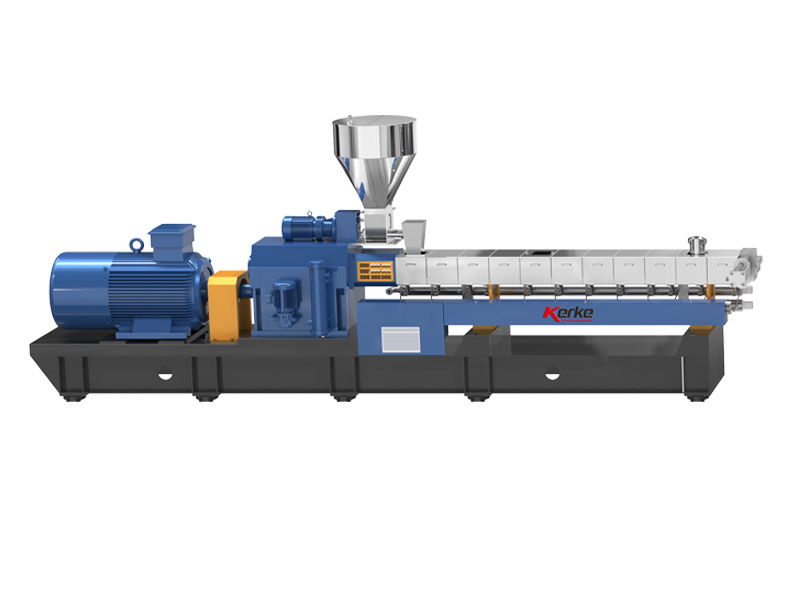
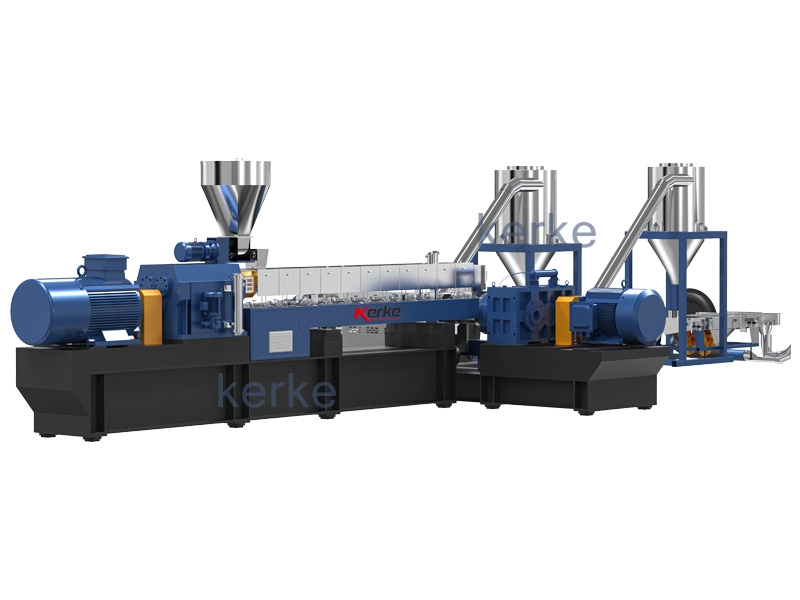
完全に均質なコンパウンドを達成することは、ポリマー加工の究極の目標である。目標がカーボンブラックの凝集体を破砕すること、ナイロンマトリックスにガラス繊維を均一に分布させること、または相溶化剤をポリマーブレンドに溶かし込むことであれ、最終製品の品質は完全に混合効率に依存する。双螺杆押出機は、正の置換と強烈な機械的せん断の原理で動作するため、この課題に独自に適している。単螺杆押出機(混合が主にカオス的で乱流に依存する)と異なり、双螺杆押出機の噛合い同方向回転スクリューは、制御され反復的かつ高強度の混合環境を創出する。本記事は、これらの機械が他の技術では到底及ばない均一性を達成できるようにする複雑なメカニズムを探る。
分散混合:凝集体の破砕
分散混合は、顔料凝集体やフィラー束等の分散相の粒子径を減らすプロセスである。これには凝集力を克服するため高せん断応力が必要である。双螺杆押出機では、分散混合は主にニーディングブロックで発生する。これらは完全には噛み合わないずらした歯を持つスクリュー要素であり、ポリマー溶融物が強制通過させられる狭いギャップを創出する。
材料がこれらのギャップを通過する際、極端なせん断速度を経験する。このせん断の強度はニーディングブロックの設計で精密に制御できる。例えば、90度ずらし角のニーディングブロックは最大せん断を提供し、二酸化チタンやカーボンブラック等の toughな凝集体を破砕するのに理想である。逆に、30度角はより少ないせん断でより多くの搬送を提供し、穏やかな混合に適している。Kerke Extrusionの技術者はCFDを使用してこれらのブロック内の流れパターンをシミュレートし、ポリマーマトリックスを劣化させずに凝集体を破砕するのに十分な応力が加えられることを確保する。優れた分散を達成するコストは性能向上によって正当化される;例えば、良好に分散したカーボンブラックはより低い充填で優れたUV保護と導電性を提供し、添加剤コストを節約する。
分配混合:粒子の均等拡散
While dispersive mixing breaks particles down, distributive mixing ensures they are spread evenly throughout the carrier polymer. This is critical for additives like flame retardants, antistatic agents, or stabilizers, where localized “hot spots” of high concentration can lead to property failures or surface defects. Distributive mixing relies on the repeated reorientation and stretching of fluid layers.
In a twin screw extruder, the intermeshing action of the screws constantly divides and recombines the material stream. Every time a particle of additive crosses the centerline between the two screws, the number of fluid layers containing that additive doubles. This exponential multiplication of layers—often referred to as “layer multiplication”—ensures that even at very low concentrations (e.1% by weight), the additive is uniformly distributed. Specialized mixing elements, such as pineapple mixers or Maddock mixers, are often used in the metering zone to further enhance this effect. The precision of this process means that manufacturers can use less expensive additives more efficiently, as there is no need to “over-dose” to ensure coverage in all areas. This directly impacts the formulation cost-efficiency.
モジュール式スクリュー構成の役割
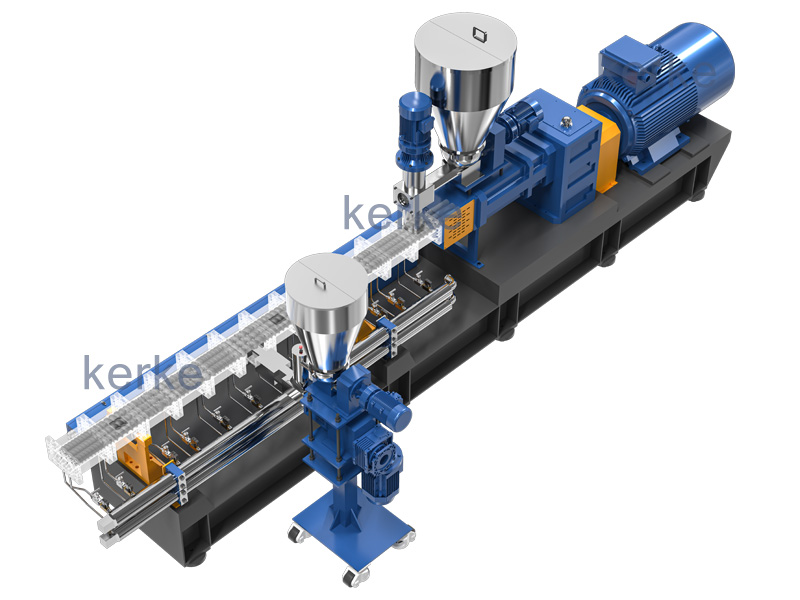
The greatest strength of a co-rotating twin screw extruder is its modularity. The screw is not a monolithic piece of metal but a shaft onto which various functional elements are mounted. This allows for the creation of a “custom recipe” for the screw geometry tailored to a specific compounding task. A typical compounding screw might be divided into several functional zones: a feeding zone, a melting zone, a high-shear mixing zone, a devolatilization zone, and a final metering zone.
Kerke Extruder takes this modularity to the next level by offering a vast library of screw elements. For a glass-fiber reinforced compound, the screw might include gentle conveying elements to prevent fiber breakage, followed by a specialized mixing section that wets out the fibers without chopping them. For a highly viscous masterbatch, the screw might feature high-compression kneading blocks to generate the pressure needed for dispersion. This customization ensures that the energy input is applied exactly where it is needed, avoiding over-processing which can degrade the polymer and waste energy. The cost of designing a custom screw profile is an upfront engineering expense, but it pays dividends in throughput rates and product quality consistency over the machine’s lifespan.
温度制御および熱均質性
Uniform mixing is impossible without precise temperature control. Temperature variations within the melt can cause viscosity differences, leading to flow instabilities and poor mixing. Twin screw extruders excel here because the material is constantly being stirred, which eliminates “stagnant” zones where heat can build up. The barrel is typically divided into multiple independently controlled heating and cooling zones (often 8 to 12 zones on a production line).
Advanced systems use dynamic temperature control, where the cooling channels react instantly to spikes in melt temperature caused by increased shear. This prevents “hot spots” that could cause the polymer to degrade or cross-link, creating gels and specks. Kerke machines often incorporate highly responsive thermocouples placed directly in the melt channel (where possible) or very close to the barrel wall. The cost of this precision is higher than simple band heaters, but the reduction in scrap due to thermal degradation—which can easily run 5-10% on poorly controlled lines—makes it a necessary investment for high-quality compounding.
混合強化としての真空脱ガス
水分および揮発性副産物は混合の障壁として作用する。それらは気泡とボイドを創出し、ポリマーと添加剤の密接な接触を防ぐ。したがって、効率的な脱揮は一種の混合である。双螺杆押出機は、粘性溶融物を搬送しながら高真空(絶対10〜50 mbarまで)を処理する独特の能力を有する。ベントポートは、材料が完全に溶融しているがまだ排出用に加圧されていない場所に戦略的に配置される。
The screw design around the vent is critical. Upstream of the vent, the screw elements build pressure to “seal” the vent and prevent air from being sucked in. Downstream, the screw elements are open to allow the melt to expand and release volatiles. The surface renewal rate of the melt as it passes over the vent determines the efficiency of gas removal. Kerke extruders use specialized vent geometries and high-capacity vacuum pumps (like Roots blowers) to ensure that even highly viscous polymers like PET or PC are effectively degassed. A clean, dry melt mixes significantly better, leading to higher mechanical properties in the final product. The cost of a robust vacuum system adds roughly $5,000 to $10,000 to the line cost, but it is essential for producing engineering-grade compounds.
滞留時間分布(RTD)およびプラグ流れ
The amount of time a particle spends in the extruder—and the consistency of that time—is crucial for uniform mixing. In a single-screw extruder, the residence time distribution is broad; some material exits quickly while some stays for a very long time. This leads to a mix of under-processed and over-processed material. Twin screw extruders, due to their positive displacement nature, approximate “plug flow.” This means the material moves through the barrel like a solid piston, with very little back-mixing.
A narrow RTD ensures that all particles experience the same thermal and shear history. This is vital for reactive compounding, such as grafting maleic anhydride onto polypropylene. If the residence time varies, some chains will be grafted while others remain unmodified, resulting in inconsistent product performance. The cost of achieving a narrow RTD lies in the precision manufacturing of the screws and barrel to minimize clearance gaps, which allows for better control of the flow. Kerke’s tight manufacturing tolerances ensure that the RTD is as narrow as possible, guaranteeing batch-to-batch consistency that is critical for downstream processors like injection molders.
スケールアップの課題および幾何相似性
ラボスケール押出機から生産機への移行時、混合均一性の維持は主要な工学課題である。単に大きなスクリューを作るだけでは同じ結果が保証されない。Kerke Extruderは、異なる機械サイズ間で幾何相似性を維持することでこれに対処する。フライト深さ、スクリュー径、およびチャネル幅の比率は一貫して保持される。これにより、ラボで観察されたせん断速度と流れパターンが生産工場で再現される。
コンパウンディング押出機の価格はサイズとともに非線形に拡大する。35mmラボ押出機は$30,000かもしれないが、120mm生産ラインは$250,000を超える。しかし、生産あたりのコストはスケールとともに大幅に減少する。なぜならスループットは直径の2乗にほぼ比例して増加するが、電力消費はそれほど急激に増加しないからである。適切にスケールされたより大きくよく設計された押出機への投資は、プロセスコストを倍増させる二次的再コンパウンディングステップの必要性をしばしば排除する。適切にスケールされた機械への初期高設備投資は、効率の大幅な向上とやり直しの排除によって相殺される。
結論
双螺杆押出機が均一混合を達成できる能力は、機械設計、熱管理、およびプロセス制御の高度な相互作用の結果である。分散用の高せん断ニーディングブロック、均質化用の分配混合要素、精密な温度制御、および効率的な脱揮を相乗的に組み合わせることで、Kerke Extrusion等の機械は優れた物理的および美的特性を持つコンパウンドを生産する。製造業者にとって、この均一性はより高い製品価値、廃棄の削減、および単純な設備を使用する競合他社が一致できない複雑なレシピの配合能力に変換される。高品質双螺杆押出機への投資は、製品の基本的品質への投資であり、市場における持続可能な競争優位を提供する。