개요
스티렌 아크릴로니트릴(SAN)은 포장재, 용기 및 가정용품에 널리 사용되는 강성 투명 공중합체입니다. SAN 마스터배치는 일반적으로 안료, 난연제 또는 강화 섬유를 높은 비율로 포함해야 합니다. 특히 고충전제 함량과 결합될 때 SAN의 높은 점도는 고토크 트윈스크류 압출기의 사용을 필요로 합니다. 표준 압출기는 정지하거나 점성 용융물을 다이를 통해 밀어낼 충분한 압력을 생성하지 못할 수 있습니다. Nanjing Kerke KTE 시리즈는 고토크 기어박스와 강화된 스크류 요소로 특별히 설계되어 이러한 까다로운 응용 분야에 이상적인 솔루션입니다. 이 기사에서는 SAN 마스터배치 생산의 세부 사항을 다루며, 이 강성 폴리머에 필요한 기계적 요구 사항과 공정 제어에 중점을 둡니다.
배합 비율 (유형별)
투명 컬러 마스터배치
일반 용도의 착색을 위해 배합은 일반적으로 20%에서 40%의 안료(내열성 유기 안료)와 60%에서 80%의 SAN 캐리어로 구성됩니다. SAN이 강성이므로 투명도에 영향을 주지 않도록 안료가 매우 미세해야 합니다. 응집을 방지하기 위해 분산 보조제(0.5-1%)가 중요합니다.
난연 마스터배치
SAN은 가연성이며 종종 변형이 필요합니다. 일반적인 배합에는 50%의 SAN, 30%의 브롬화 난연제(BFR) 또는 인계 난연제, 그리고 20%의 상승제(안티몬 삼산화물 또는 아연 붕산염 등)가 포함됩니다. 고체 첨가제의 높은 충전량은 매우 높은 점도의 용융물을 생성하므로 압출기로부터 최대 토크를 필요로 합니다.
유리섬유 강화 마스터배치
구조용 응용 분야에서는 장섬유(LGF) 또는 단섬유가 사용됩니다. 배합은 30%의 SAN, 60%의 유리섬유(실란 사이징 포함), 그리고 10%의 커플링제일 수 있습니다. 장섬유의 존재는 유동 저항을 크게 증가시키므로, 섬유 파손을 방지하고 좋은 길이 보존을 보장하기 위해 고토크 저속 압출 공정이 필요합니다.
생산 공정
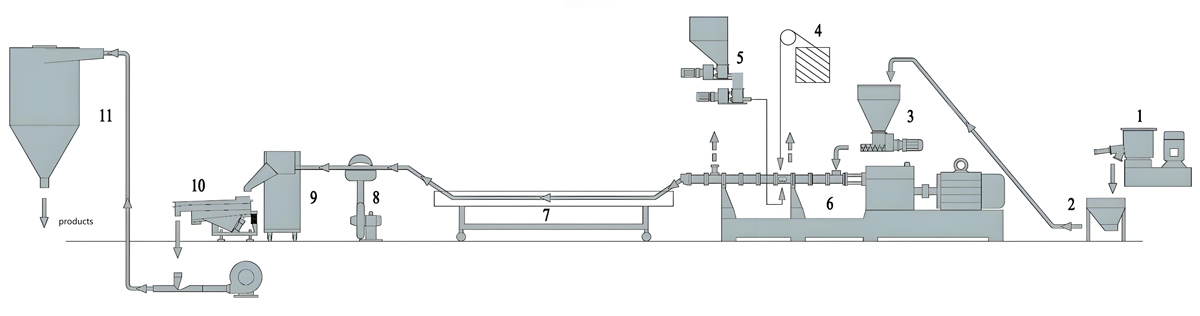
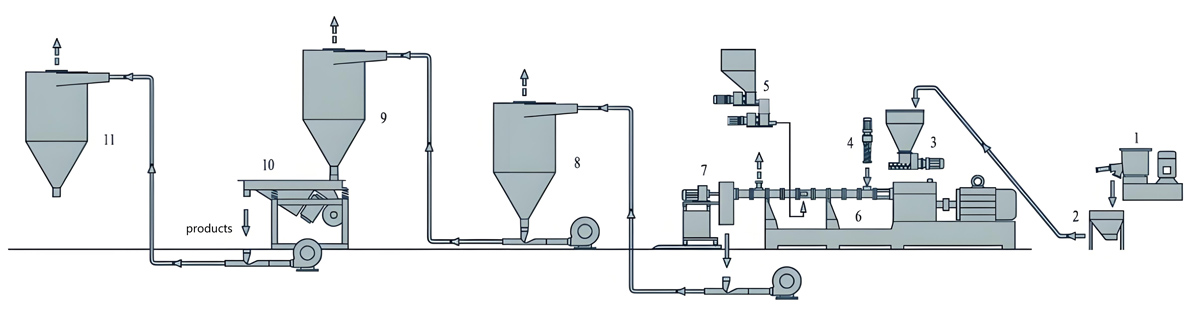
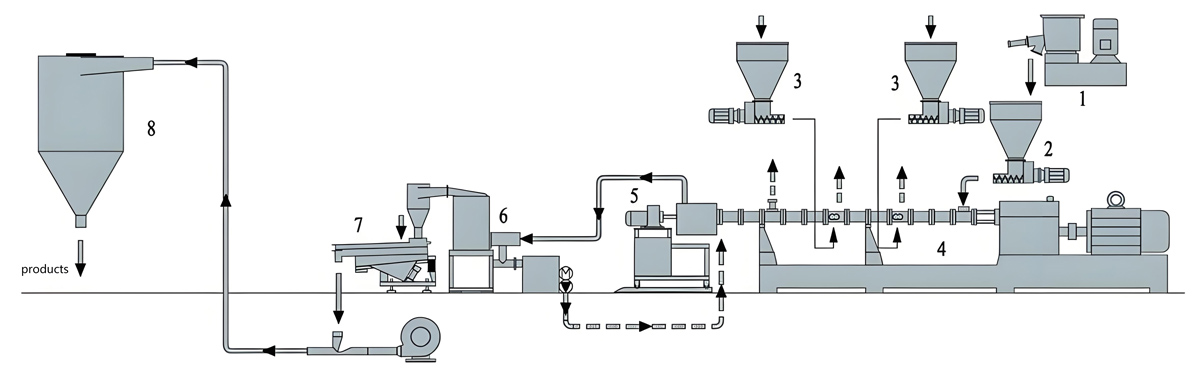
SAN은 비정질이며 상대적으로 높은 용융 점도를 가집니다. 생산 공정은 SAN 펠릿의 사전 건조(수분 < 0.1%)로 시작되며, SAN은 PETG보다 덜 심각하지만 가수분해될 수 있기 때문입니다. 고토크 KTE 압출기는 중량 손실(loss-in-weight) 시스템을 통해 공급됩니다. 스크류 구성이 중요합니다: 높은 점도의 SAN을 용융하고 고충전 첨가제를 포함하는 데 필요한 압력을 생성하기 위해 고압축 니딩 블록을 포함해야 합니다. 혼합 섹션은 강렬하며, 충전재를 효과적으로 분산시키기 위해 종종 90° 교차 니딩 블록을 사용합니다. 용융 온도는 일반적으로 220°C와 260°C 사이로 유지됩니다. 혼합 후, 용융물은 젤이나 혼합되지 않은 섬유 다발을 처리하기 위해 역세척(back-flush) 스크린 체인저를 통과합니다. 스트랜드는 냉각되고 펠릿화됩니다. 황변을 유발할 수 있는 스티렌 성분의 분해를 방지하기 위해 “전단 가열”을 최소화하는 데 특별한 주의가 기울여집니다.
생산 장비 소개
Nanjing Kerke KTE 시리즈 고토크 압출기는 최대 18 Nm/cm³의 비토크 값을 전달할 수 있는 강화된 기어박스로 설계되었습니다. 스크류는 미끄러짐 없이 고점도 용융물을 처리할 수 있도록 깊은 플라이트를 가진 고강도 공구 강철로 만들어집니다. 배럴은 국부적 과열을 방지하기 위해 열 프로파일을 정밀하게 제어하도록 많은 수의 온도 구역(10-12개)을 가지고 있습니다. 구동 모터는 일반적으로 전압 변동 중에도 일정한 토크를 유지하기 위한 벡터 제어가 있는 고출력 AC 모터입니다. 섬유 충전 화합물의 경우, 섬유가 과도하게 절단되지 않고 통과할 수 있도록 넓은 간격을 가진 특수 스크류 요소가 사용됩니다. 공급 시스템은 견고해야 하며, 주 호퍼에서의 브리징을 방지하기 위해 충전재용으로 측면 피더를 사용하는 경우가 많습니다.
파라미터 설정
온도 프로파일
SAN은 강성으로 인해 용융시키기 위해 더 높은 온도가 필요합니다. Zone 1-2: 180°C, Zone 3-5: 220°C – 240°C, Zone 6-8 (혼합): 250°C – 270°C, 다이 헤드: 260°C. 스티렌 분해를 방지하기 위해 280°C를 초과하지 않도록 주의해야 합니다.
토크 및 속도
이것이 결정적인 파라미터입니다. 압출기는 낮은 속도(200-400 rpm)로 작동하되 높은 토크(최대 용량의 70-85%)에서 작동해야 합니다. 높은 토크는 기계적 에너지가 단순히 열이 아니라 혼합 동력으로 변환되도록 보장합니다. 토크가 떨어지면 혼합 품질이 저하됩니다. 스크류 속도는 공급 속도에 기반하여 목표 토크를 유지하도록 조정됩니다.
백압
용융물을 압축하고 좋은 혼합을 보장하기 위해 충분한 백압이 필요합니다. 이는 스크린 체인저 저항과 다이 설계로 제어됩니다. 충전된 SAN 화합물의 일반적인 백압 범위는 50에서 100 bar입니다.
장비 가격
Nanjing Kerke KTE 시리즈(고토크 응용) 참고 가격:
- 모델 KTE-75 (고토크 기어박스): $210,000 – $250,000 USD. 비토크 정격 14-16 Nm/cm³.
- 모델 KTE-95 (중부하): $310,000 – $380,000 USD. 최대 18 Nm/cm³의 비토크 정격. 강화된 스러스트 베어링 포함.
참고: “고토크” 명칭은 기어박스 및 모터 규격을 의미합니다. 가격은 중부하 보조 장치를 포함합니다. FOB Nanjing.
Production Problems, Solutions, and Avoidance
Problem: High Power Consumption / Stalling
Cause Analysis: If the formulation viscosity is too high for the screw design, or if the temperature is too low, the motor will draw excessive current. Another cause is the presence of large agglomerates or foreign contaminants that jam the screw elements. For glass fiber compounds, excessive fiber length or loading can cause plugging.
Solution: Increase the barrel temperature in the feeding zone to pre-melt the polymer. Reduce the feed rate to lower the load. Check the screw configuration; if using fibers, ensure the kneading blocks have wide gaps. Inspect the raw materials for oversized particles or contamination. If stalling occurs, immediately stop, reduce torque, and purge with a lower viscosity polymer.
Avoidance Method: Select an extruder with a specific torque rating at least 20% higher than the calculated requirement for the specific compound. Pre-screen fillers to remove oversized particles. Use a side feeder for fillers to introduce them downstream where the polymer is already molten, reducing the torque required in the feeding zone.
Problem: Surface Roughness of Pellets (Melt Fracture)
Cause Analysis: SAN is prone to melt fracture at high shear rates. If the shear stress at the die wall exceeds a critical value, the melt flow becomes turbulent, resulting in a shark-skin or rough surface on the extrudate. This is common when pushing high-viscosity melts through small die openings at high speeds.
Solution: Increase the die temperature to lower melt viscosity. Reduce the extruder speed. Polish the die land to a mirror finish. Use a processing aid (like a fluoropolymer) in small quantities (0.1%) to reduce friction at the die wall.
Avoidance Method: Design the die with a longer land length to reduce shear rate. Operate at the lowest possible speed that still achieves the required output. Avoid sudden changes in flow channel geometry within the die. For very high viscosity grades, consider a gear pump to stabilize pressure before the die, allowing the extruder to focus on mixing while the pump handles pressure generation.
Problem: Dispersion of Flame Retardants
Cause Analysis: Flame retardants like brominated compounds or phosphates are often high-melting solids. If the mixing energy is insufficient, they remain as undispersed particles, leading to “specks” and inconsistent fire performance. SAN’s high viscosity makes it harder to break down these agglomerates.
Solution: Reconfigure the screw to include more intensive kneading blocks in the melting zone. Increase the screw speed to raise shear rate (within limits of degradation). Ensure the additive feeding point is in a high-shear zone. Pre-compound the flame retardant with a carrier wax or low-viscosity polymer before adding to the main extruder.
Avoidance Method: Use nano-sized or coated flame retardants that are easier to disperse. Optimize the screw profile using simulation software before manufacturing the screws. Ensure the vacuum vent (if used for moisture) is not placed too early, as it might remove volatile components of the additive package.
Maintenance
High torque operation puts significant stress on the drive train. Daily checks of the gearbox oil temperature and pressure are mandatory. Weekly inspection of the screw elements for wear is crucial, especially the kneading blocks which experience high shear forces. For SAN, which can leave carbon deposits if degraded, a regular “acid wash” or chemical cleaning of the barrel and screws might be necessary every 3 months. The thrust bearing needs close monitoring; any abnormal noise indicates potential failure. The heating bands should be checked for uniformity, as “hot spots” can degrade the SAN locally.
FAQ
Q: What is the difference between SAN and ABS masterbatch production?
A: ABS contains rubber particles, making it tougher and less viscous than SAN. SAN is rigid and more heat-sensitive. SAN extrusion requires higher torque and more precise temperature control to avoid degradation compared to ABS.
Q: Can the KTE series handle 60% glass fiber loading?
A: Yes, but it requires a special screw design with wide-pitch elements and a high-torque gearbox (specifically the KTE-95 or larger). The output will be significantly lower than unfilled compounds, and the focus is on maintaining fiber length rather than just melting.
Q: Why is torque more important than speed for SAN?
A: For high-viscosity polymers like SAN, the resistance to flow is immense. Speed alone does not guarantee mixing; the force (torque) applied to the material is what breaks down agglomerates and melts the polymer. High torque at moderate speeds is the most efficient way to process SAN masterbatches.
결론
Producing SAN masterbatches, especially with high loadings of fillers or flame retardants, is a mechanically demanding process. The Nanjing Kerke KTE Series High Torque extruder is specifically engineered to handle the high viscosity and shear requirements of SAN. By utilizing a high-torque gearbox, optimized screw geometry, and precise process control, manufacturers can achieve excellent dispersion and high-quality pellets. The key to success lies in matching the machine’s torque capability to the formulation’s viscosity and maintaining strict temperature control to prevent degradation of the styrene matrix. This investment in high-torque technology ensures consistent product quality and the ability to process challenging formulations that standard extruders cannot handle.