개요
폴리옥시메틸렌 테레프탈레이트 글리콜(PETG)은 투명성, 인성 및 가공 용이성으로 알려진 열가소성 폴리에스터입니다. 그러나 고품질 PETG 마스터배치를 생산하려면 PETG의 열분해 민감성으로 인해 정밀한 온도 제어가 필요합니다. 정온식 트윈 스크류 압출기는 PETG의 좁은 가공 윈도우를 처리하도록 특별히 설계되었습니다. 표준 압출기와 달리, 정온 시스템은 배럴 온도가 ±1°C 범위 내에서 안정적으로 유지되도록 하여 황변을 방지하고 최종 마스터배치의 광학적 특성을 유지합니다. 본 기사에서는 Nanjing Kerke KTE 시리즈 압출기를 사용한 PETG 마스터배치 생산에 대해 다루며, 특히 PETG 소재 특성에 따른 배합, 공정 파라미터 및 문제 해결에 중점을 둡니다.
배합 비율 (유형별)
PETG 마스터배치의 배합은 최종 용도에 따라 달라집니다. 주요 세 가지 유형은 컬러 마스터배치, 첨가제 마스터배치 및 충전재 마스터배치입니다.
컬러 마스터배치
표준 착색의 경우, 일반적인 비율은 40~60%의 PETG 캐리어 수지, 30~50%의 안료(흰색용 이산화티타늄 또는 청록색/녹색용 프탈로시아닌 등) 및 5~10%의 분산제로 구성됩니다. 중요한 첨가제는 열에 의한 PETG의 분해 경향을 상쇄하기 위한 황변 방지제(0.5~1%)이며, 일반적으로 힌더드 페놀 또는 인산염 안정제가 사용됩니다.
첨가제 마스터배치 (UV 안정화 및 난연성)
야외 용도의 경우 UV 흡수제(벤조트리아졸)와 HALS(힌더드 아민 광안정제)가 필수적입니다. 일반적인 배합은 70% PETG 캐리어, 20% 난연제(예: 디에틸포스핀산 알루미늄), 10% UV 안정제 패키지로 구성됩니다. 높은 첨가제 함량은 최종 제품의 블로밍(blooming) 또는 표면 결함을 방지하기 위해 우수한 혼합 효율을 요구합니다.
충전재 마스터배치
비용 절감 또는 물성 개선을 위해 탄산칼슘이나 탈크를 사용합니다. 배합은 50% PETG, 45% 탈크(실란 커플링제로 표면 처리됨), 5% 상용화제일 수 있습니다. 커플링제는 무기 충전재와 PETG 매트릭스 간의 접착력을 보장하기 위해 필수적입니다.
생산 공정
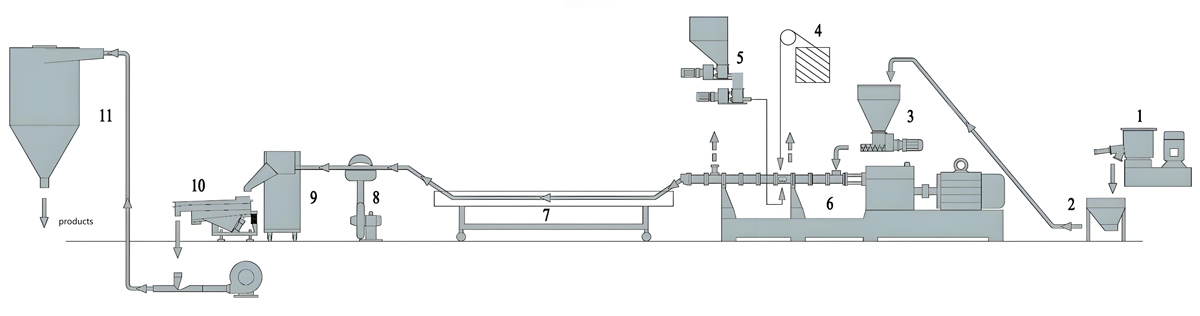
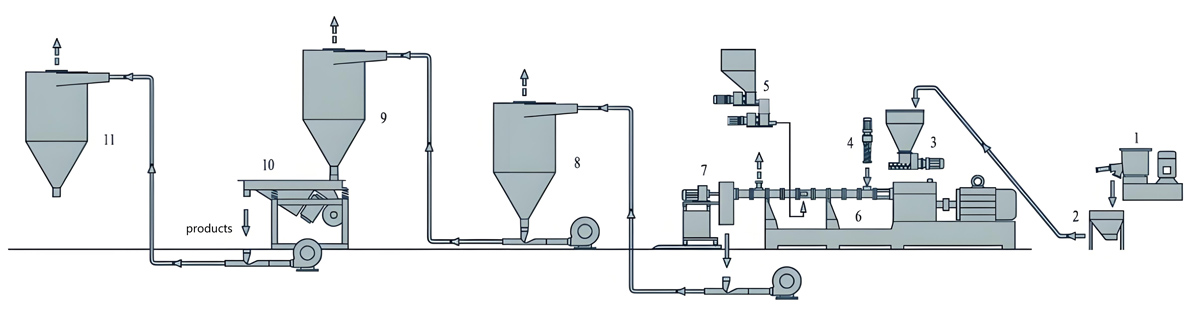
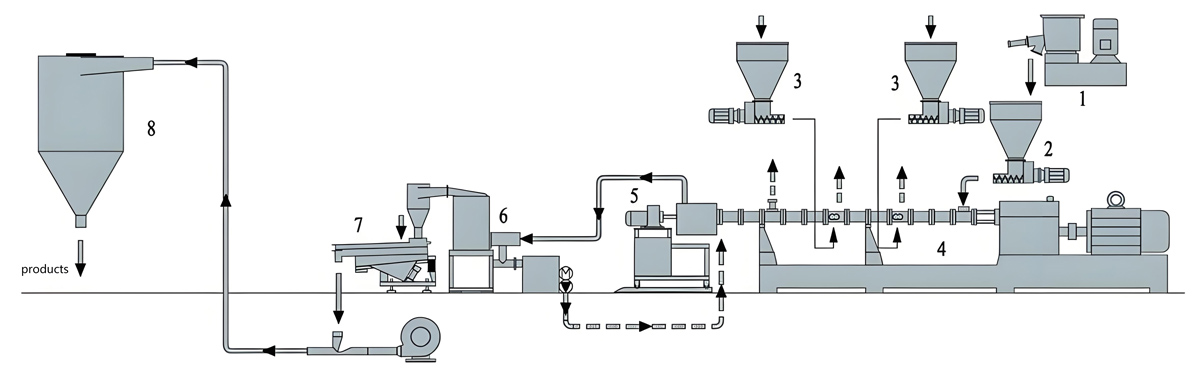
PETG 마스터배치 생산은 가수분해 및 열분해를 방지하기 위해 정밀한 순서를 따릅니다. 먼저 원료를 사전 건조해야 합니다. PETG는 흡습성이 있으며, 압출 중 분자량 감소를 방지하기 위해 수분 함량은 0.02% 미만이어야 합니다. 건조된 PETG 펠릿과 첨가제는 중량식으로 압출기에 공급됩니다. 정온식 트윈 스크류 압출기는 집중적인 전단 및 분산 혼합을 제공하기 위해 동회전(co-rotating) 구성으로 작동합니다. 용융 온도는 230°C에서 260°C 사이로 엄격하게 유지됩니다. 혼합 후, 용융물은 유압 스크린 체인저를 통과하여 젤(gel) 또는 미혼입자를 제거합니다. 마지막으로 스트랜드는 수조에서 냉각되고 커터에 의해 과립화됩니다. 펠릿은 응집을 방지하기 위해 포장 전에 다시 건조됩니다.
생산 장비 소개
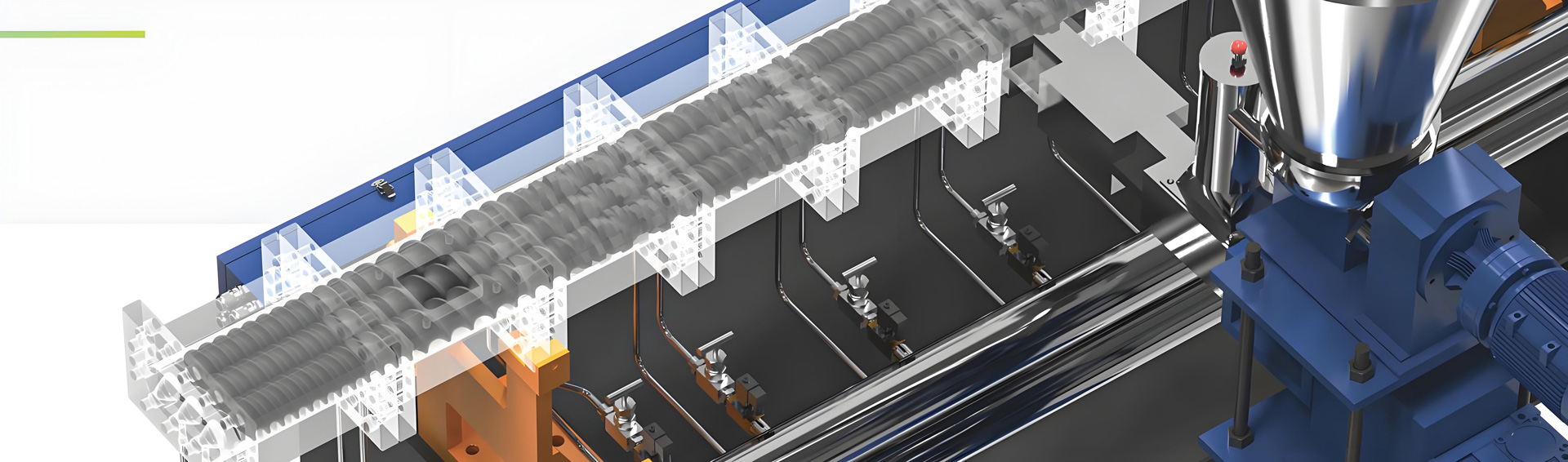
생산 라인의 핵심은 트윈 스크류 압출기입니다. PETG의 경우 Nanjing Kerke KTE 시리즈가 업계 표준입니다. KTE 시리즈는 정밀한 온도 프로파일링을 가능하게 하는 모듈식 배럴 설계를 특징으로 합니다. 스크류는 유리 섬유나 미네랄이 포함된 경우 마모 저항성을 위해 고속강(W6Mo5Cr4V2) 또는 바이메탈 소재로 제작됩니다. 압출기는 용융 중에 생성되는 수분 및 휘발성 부산물을 제거하기 위한 진공 탈가스 시스템을 갖추고 있습니다. 기어박스는 낮은 스크류 속도에서도 높은 토크 출력을 낼 수 있도록 설계되었으며, 이는 PETG의 전단 열을 최소화하는 데 중요합니다. 제어 시스템은 원격 모니터링 기능을 갖춘 Siemens PLC를 활용하여, PETG에 필요한 정온 정밀도를 유지하기 위해 운영자가 온도 존을 실시간으로 조정할 수 있게 합니다.
파라미터 설정
올바른 파라미터 설정은 PETG 마스터배치 품질에 매우 중요합니다. Nanjing Kerke KTE 시리즈의 경우 다음 파라미터를 권장합니다:
온도 프로파일
배럴은 8~10개의 존으로 나뉩니다. Zone 1(공급부): 180°C, Zone 2-3: 220°C, Zone 4-6(혼합부): 245°C – 255°C, Zone 7-8(계량부): 250°C – 260°C, 다이 헤드: 255°C. 분해를 방지하기 위해 온도는 270°C를 초과해서는 안 됩니다. 정온 제어 시스템은 변동이 ±1°C 미만임을 보장합니다.
스크류 속도 및 공급 속도
스크류 속도는 일반적으로 300~600 rpm 범위입니다. 더 높은 속도는 전단 열을 증가시키는데, 이는 PETG에 위험할 수 있습니다. 따라서 공급 속도는 배럴이 채워지지만 과압되지 않도록 유지하기 위해 속도와 동기화되어야 합니다. 토크는 최대 용량의 40~70% 사이로 유지되어야 합니다.
진공 압력
진공 탈가스 포트는 폴리머 미세 입자를 빨아들이지 않으면서 수분을 효과적으로 제거하기 위해 -0.08 MPa에서 -0.09 MPa 범위에서 작동해야 합니다.
장비 가격
Nanjing Kerke KTE 시리즈(PETG 적용) 참고 가격:
- 모델 KTE-65: $110,000 – $135,000 USD (출력 500-800 kg/h에 적합)
- 모델 KTE-75: $160,000 – $190,000 USD (출력 800-1200 kg/h에 적합)
- 모델 KTE-95: $240,000 – $290,000 USD (고토크, 충진 컴파운드에 적합)
참고: 가격에는 압출기, 기어박스, 모터 및 기본 제어 시스템이 포함되지만 건조기 및 칠러와 같은 부속 장비는 제외됩니다. 가격은 중국 난징 FOB 기준이며, 구성에 따라 변경될 수 있습니다.
Production Problems, Solutions, and Avoidance
Problem: Yellowing of Masterbatch Pellets
Cause Analysis: Yellowing in PETG is primarily caused by thermal oxidation or hydrolysis. If the barrel temperature is too high or the residence time is too long, the polymer chains break down, forming conjugated carbonyl groups that appear yellow. Additionally, moisture in the raw material accelerates hydrolysis at high temperatures.
Solution: Immediately reduce the barrel temperature by 10-15°C, specifically in the metering zones. Check the hopper loader to ensure the material is completely dry (dew point < -40°C). Increase the screw speed slightly to reduce residence time while maintaining output. Purge the barrel with a cleaning agent (PP or PE) if degradation is severe.
Avoidance Method: Implement strict drying protocols (4 hours at 120°C or 2 hours at 160°C in a dehumidifying dryer). Install temperature sensors with alarms that trigger if the thermostatic system deviates by more than 2°C. Use nitrogen purging in the hopper to prevent moisture re-absorption during processing.
Problem: Bubbles or Voids in Pellets
Cause Analysis: Bubbles indicate trapped moisture or volatiles. This occurs if the vacuum pump is not strong enough, the vacuum port is blocked by melt, or the material was not pre-dried sufficiently. Another cause is air entrainment in the feed throat if the feed zone is not starved properly.
Solution: Check the vacuum pump for leaks and ensure the vacuum line is clear. Increase the vacuum level to -0.09 MPa. Verify the dryer’s performance; perform a moisture test on the raw material. Reduce the feed rate to allow better degassing in the vacuum zone. Clean the venting port to ensure it is not clogged with polymer dust.
Avoidance Method: Schedule regular maintenance for the vacuum system. Ensure the screw design has a deep pitch in the feed section to allow gas escape before the melt seal forms. Use a side feeder for liquid additives or masterbatches to prevent air entrapment.
Problem: Poor Dispersion of Pigments
Cause Analysis: Poor dispersion results in “fish eyes” or color streaks. This is often due to insufficient shear stress or incorrect kneading block configuration. If the torque is too low, the mixing energy is inadequate. Alternatively, the temperature might be too low, preventing the carrier from melting properly to wet the pigment.
Solution: Reconfigure the screw elements. Add more kneading blocks in the mixing section (typically 3-4 sets of 45° or 90° staggered blocks). Increase the barrel temperature in the mixing zone by 5-10°C to lower viscosity. Increase the screw speed to raise torque to 60-70%.
Avoidance Method: Use pre-compounded pigment concentrates or surface-treated pigments that are easier to disperse. Conduct lab trials to determine the optimal screw configuration before full-scale production. Ensure the pigment particle size is below 10 microns before feeding.
Maintenance
Maintenance of the KTE series extruder is vital for longevity. Daily maintenance includes checking the lubrication oil level and temperature of the gearbox. Weekly checks involve inspecting the heating bands for proper function and cleaning the vacuum vent. Monthly maintenance requires greasing the bearings and checking screw wear. For PETG, which can leave carbon deposits, a monthly barrel cleaning using a specialized polymer cleaning compound is recommended. Every 6 months, the thrust bearing should be inspected, and the coupling alignment checked. Annual maintenance involves a complete gearbox oil change and inspection of the screw elements for wear or breakage.
FAQ
Q: Can a standard single screw extruder be used for PETG masterbatch?
A: While possible for simple color batches, a single screw extruder lacks the distributive and dispersive mixing of a twin screw. For high-quality PETG masterbatches, especially with additives or fillers, a co-rotating twin screw extruder like the Kerke KTE series is essential to ensure homogeneity and prevent degradation.
Q: What is the ideal moisture content for PETG before extrusion?
A: The moisture content should be strictly below 0.02% (500 ppm). Higher moisture will cause hydrolysis, reducing the intrinsic viscosity (IV) of the PETG and leading to brittle masterbatch pellets.
Q: How often should the screen changer be cleaned?
A: It depends on the cleanliness of the feed. Typically, the screen changer should be checked when the pressure gauge shows a rise of 10-15 bar above the baseline. For PETG with fillers, this might be every 4 to 8 hours. Use a continuous screen changer (melt filter) to minimize downtime.
결론
Producing PETG masterbatches requires a machine that offers precision thermal control and efficient mixing. The Nanjing Kerke KTE Series thermostatic twin screw extruder meets these requirements by providing stable temperature profiles and high torque at low speeds. By adhering to strict drying protocols, optimizing screw configuration, and maintaining the equipment rigorously, manufacturers can produce high-clarity, degradation-free PETG masterbatches suitable for demanding applications like 3D printing, packaging, and medical devices. The investment in a specialized KTE extruder is justified by the reduction in scrap rates and the consistent quality of the final product.