В последние годы
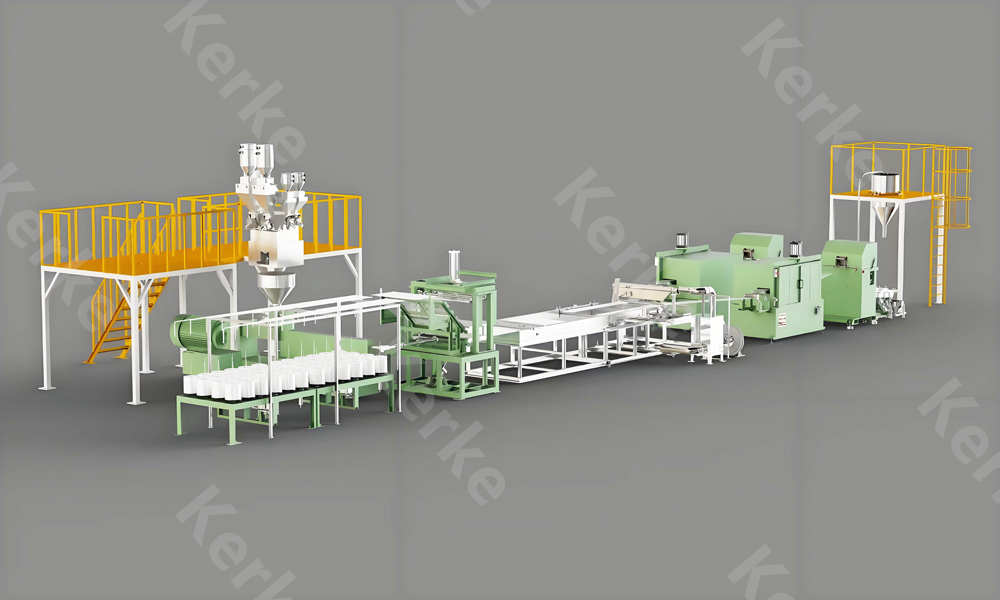
На традиционном рынке модификации пластмасс появился новый тип оборудования для компаундирования и гранулирования пластика — трехшнековый экструдер. По сравнению с обычным двухшнековым экструдером, трехшнековый экструдер представляет собой не просто «еще один шнек». Он обеспечивает значительное повышение эффективности диспергирования и производительности в определенных областях применения.
Классификация трехшнековых экструдеров
1. Трехшнековый экструдер с параллельными сонаправленными зацепляющимися шнеками
Три шнека расположены параллельно и вращаются в одном направлении, зацепляясь друг с другом, образуя три зоны транспортировки и сдвига с зацеплением. Его можно рассматривать как увеличенную версию двухшнекового экструдера.
Преимущества: интенсивное воздействие сдвигом, отличное дисперсионное и распределительное смешивание, а также хорошая гомогенизация.
2. Трехшнековый экструдер с треугольным расположением сонаправленных зацепляющихся шнеков
Поверхности шнеков частично перекрываются или плотно зацепляются друг с другом, но не по всей длине. Некоторые секции обеспечивают интенсивное смешивание, в то время как другие предназначены для транспортировки, дегазации или охлаждения.
Характеристики: сбалансированная или гибридная конструкция, сочетающая зоны интенсивного смешивания и зоны щадящей обработки.
3. Трехшнековый экструдер V-образного типа с сонаправленными незацепляющимися шнеками
Шнеки расположены в форме буквы V с относительно большими зазорами и не зацепляются полностью. Механизмы транспортировки и смешивания отличаются от типов с зацеплением, фокусируясь преимущественно на транспортировке и слабом сдвиге.
Области применения: подходят для чувствительных к сдвигу материалов; поток материала является преимущественно ламинарным. (Этот тип менее распространен среди конструкций трехшнековых экструдеров и обычно встречается в специализированном оборудовании.)

Основное сравнение характеристик: трехшнековые и двухшнековые экструдеры
| Performance Dimension | Triple-Screw Extruder (Co-rotating) | Twin-Screw Extruder (Co-rotating) |
| Shear Strength / Dispersion | Usually stronger, with more contact and shear events per rotation. Provides superior dispersion for high-filler, pigment, and masterbatch formulations. Ideal for applications requiring intensive dispersion. | Excellent dispersion as well, but with fewer shear events per rotation. Dispersion and shear can be precisely controlled through screw element configuration. |
| Output / Energy Efficiency | At the same screw speed, the barrel can accommodate a higher material load, resulting in greater throughput and lower specific energy consumption. Well-suited for high-output and standardized formulations. | Stable and scalable output; higher process flexibility through modular screw element design. Can adapt to a wider range of processing requirements. |
| Reactive Extrusion / Residence Time / Vacuum Degassing | Typically less effective for precise reactive extrusion or deep vacuum degassing. Twin-screw systems are more established for chemical reactions, dynamic vulcanization, and crosslinking processes. | Superior in reactive extrusion, degassing, precise temperature control, and residence time distribution (RTD) management. |
| High-Viscosity or Heat-Sensitive Materials | Strong shear may cause localized overheating; caution required when processing heat-sensitive materials (can be mitigated by lower speed or optimized screw design). | More flexible control of temperature rise and plastification by adjusting compression ratio or lengthening the melting section. |
| Maintenance / Technological Maturity | Less globally widespread; limited standardization of screw elements and spare parts, which may affect maintenance response time. | Mature technology with standardized components and extensive global service networks. Proven performance supported by abundant lab and production data. |
| Suitable Processing Applications | Best for: masterbatch, color masterbatch, high-filler compounds (CaCO₃, talc), and other formulations requiring strong dispersion. | Best for: reactive extrusion (TPV, thermoplastic reactions), processes requiring efficient degassing/vacuum venting, and precise rheological or RTD control. |
Преимущество трехшнекового экструдера заключается в его способности обеспечивать более высокую эффективность диспергирования по сравнению с двухшнековым экструдером, а также достигать большей производительности и меньшего удельного энергопотребления.
Однако его недостатком является более сложная конфигурация шнеков, требующая от опытного производителя предоставления проверенной и хорошо оптимизированной конструкции.
В отличие от этого, двухшнековый экструдер обладает преимуществами многолетней технологической зрелости и гибкой модульной конструкции, что делает его подходящим для более широкого спектра процессов компаундирования материалов, реактивной экструзии, сшивки и деволатилизации.
Функциональное сравнение различных типов трехшнековых экструдеров в процессах компаундирования и гранулирования пластмасс
| Performance Indicator | Co-rotating Parallel Intermeshing | Co-rotating Triangular Intermeshing | Co-rotating V-type Non-Intermeshing |
| Mixing / Dispersive Capability | ★★★★Strong — multiple intermeshing zones and high shear frequency ensure thorough dispersion of pigments and fillers. | ★★★Moderate — intensive mixing can be achieved in specific sections, but overall uniformity is lower than full intermeshing types. | ★★Weak — mainly relies on screw conveying and backflow vortices; shear is uneven. |
| Distribution mixing | ★★★★Excellent — three interacting flow fields enable highly uniform distribution. | ★★★Good — mixing achieved through partial intermeshing zones. | ★Poor — material tends to flow in layers within screw channels. |
| Energy Consumption / Shear Heat | ★★Relatively high — more friction in intermeshing zones leads to temperature rise. | ★★Medium-high — can be locally controlled. | ★Energy-efficient — mild shear but limited mixing. |
| Suitable Materials | High-filled compounds, color masterbatch, CaCO₃, glass fiber modification, TPU, TPV, etc. | Filled compounds, general-purpose masterbatch, heat-sensitive polymers. | Heat-sensitive plastics, PVC paste, foaming masterbatch, etc. |
| Degassing / Venting Capability | ★★★Average — dense material packing in intermeshing zones makes gas release more difficult. | ★★★Good — vacuum venting can be designed in non-intermeshing sections. | ★★★★Excellent — loose material flow enhances degassing efficiency. |
| Residence Time Distribution (RTD) | ★★Short — strong shear and efficient mixing but narrow residence time range. | ★★★Moderate — controllable and balanced. | ★★★★Wide — uniform residence time distribution and smooth material flow. |
| Mechanical Complexity / Cost | ★★★★High — requires precision machining and has higher production cost. | ★★★Medium — moderately complex design. | ★Simple structure — low manufacturing cost. |
| Maintenance / Wear of Parts | ★★★★High — concentrated wear in intermeshing zones. | ★★Controllable — moderate wear. | ★Low wear — simple maintenance. |
| Typical Application Scenarios | High-filler masterbatch, engineering plastics modification (PP+CaCO₃, PA+GF, ABS+color masterbatch, etc.) | General compounding, TPR/TPU blending, filled masterbatch | Heat-sensitive plastics (PVC, EVA foam), foamed compounds, thermoplastic elastomers |
| Advantages | Strong dispersion, uniform mixing, high throughput, ideal for continuous large-scale production lines. | Balanced performance between mixing and energy efficiency; flexible screw design. | Mild shear, excellent degassing, low thermal buildup. |
| Disadvantages | High shear heat, limited degassing performance, not ideal for heat-sensitive materials. | Complex structure; process tuning requires experience. | Limited mixing capacity, uneven particle distribution, suitable for low-speed production. |