Introduction
PA (Polyamide) calcium carbonate filled masterbatch has emerged as a crucial material solution in the polymer industry, offering manufacturers an effective pathway to enhance mechanical properties while reducing material costs. The production process demands specialized twin screw extruder technology combined with precise understanding of polyamide material characteristics to achieve consistent quality and optimal dispersion of calcium carbonate particles within the PA matrix.
Polyamide resins present unique processing challenges due to their hygroscopic nature, requiring careful moisture control to prevent hydrolytic degradation during processing. When combined with calcium carbonate filler, these challenges become more complex as the filler introduces abrasive wear characteristics and modifies rheological properties. Understanding these material interactions and implementing appropriate processing strategies is fundamental to successful PA calcium carbonate masterbatch production.
Domäne: Herstellung von Kunststoffextrusions- und Compoundiermaschinen. Verwenden Sie präzise technische/industrielle Begriffe. Halten Sie Standardscodes (ISO, ASTM, UL, RoHS, REACH), Einheiten (°C, MPa, mm, g/cm³, kV/mm), Polymerkürzel (PP, PE, PVC, ABS, PC, PA, PET, PBT, POM, TPU, PPS, PEEK), Markennamen und Modell-/Teilnummern genau so, wie sie geschrieben sind – übersetzen Sie sie nicht. Bewahren Sie alle HTML-Tags, {Einfügemöglichkeiten} und Klammern auf. Formeller technischer Register. Text: Dieser umfassende technische Leitfaden untersucht jeden Aspekt der Funktionsweise von Zwillingsschneckenextrudern für die Herstellung von PA-Masterbatch mit Kalziumcarbonat, von der fortgeschrittenen Rezepturgestaltung bis hin zu detaillierten Verarbeitungsparametern, Gerätespezifikationen und Methoden zur Fehlerbehebung. Die hier präsentierten Informationen helfen sowohl Anfängern als auch erfahrenen Herstellern, effiziente Produktionsprozesse zu etablieren und häufige Produktionsprobleme zu überwinden.
Fortgeschrittenes Formulierungsdesign
Domain: Herstellung von Ausrüstungen für die Extrusion und Vermischung von Kunststoffen. Verwenden Sie präzise technische/industrielle Begriffe. Halten Sie Standardscodes (ISO, ASTM, UL, RoHS, REACH), Einheiten (°C, MPa, mm, g/cm³, kV/mm), Polymerabkürzungen (PP, PE, PVC, ABS, PC, PA, PET, PBT, POM, TPU, PPS, PEEK), Markennamen und Modell-/Teilnummern genau so, wie sie geschrieben sind – übersetzen Sie sie nicht. Bewahren Sie alle HTML-Tags, {Ersatzmerkmale} und Klammern auf. Formelles technisches Register. Text: Strategien zur Kalziumcarbonat-Beladung
Die Formulierung von PA-Kalciumcarbonat-Masterbatch erfordert eine strategische Überlegung über die Füllmengen basierend auf den vorgesehenen Anwendungen und den Leistungsanforderungen:
Hohe Leistungsbelastung (40-55 % CaCO3): Diese Formulierung maximiert die Kosteneffizienz und gewährleistet gleichzeitig ausreichende mechanische Eigenschaften für viele Anwendungen. Der hohe Füllstoffgehalt erhöht die Steifigkeit und die Dimensionsstabilität erheblich, erfordert jedoch eine sorgfältige Verarbeitungskontrolle, um eine ausreichende Dispersion zu gewährleisten und eine Verschlechterung der Eigenschaften zu vermeiden. Fortgeschrittene Kopplungsmittel und Verarbeitungshilfsmittel werden bei dieser Belastungsstufe entscheidend.
Domain: Herstellung von Ausrüstungen für die Kunststoffextrusion und -Verarbeitung. Verwenden Sie präzise technische/industrielle Begriffe. Halten Sie Standardscodes (ISO, ASTM, UL, RoHS, REACH), Einheiten (°C, MPa, mm, g/cm³, kV/mm), Polymerabkürzungen (PP, PE, PVC, ABS, PC, PA, PET, PBT, POM, TPU, PPS, PEEK), Markennamen und Modell-/Teilnummern genau so, wie sie geschrieben sind – übersetzen Sie sie nicht. Bewahren Sie alle HTML-Tags, {Platzhalter} und Klammern auf. Formelles technisches Register. Text: Mittlere Beladung (30-40 % CaCO3): Diese Beladungsstufe bietet eine hervorragende Balance zwischen Kosteneinsparungen und Leistungseigenschaften. Mit dieser Beladungsstufe erzielen Sie erhebliche Kostenvorteile und behalten gleichzeitig gute Verarbeitbarkeit und mechanische Eigenschaften. Standardverarbeitungsanlagen und -konfigurationen funktionieren in der Regel gut mit dieser Beladungsstufe.
Low Loading (15-25% CaCO3): Maintains excellent PA properties while providing modest cost savings and improved stiffness. Processing approaches closely resemble unfilled PA with minimal modifications required. Ideal for applications requiring high impact strength or where maximum ductility is required.
Polyamide Grade Selection
Die Wahl des PA-Grads hat einen erheblichen Einfluss auf das Verarbeitungsverhalten und die Endproduktleistung. Für Masterbatch mit Kalziumcarbonat gelten folgende Überlegungen:
PA6 vs PA66: PA6 bietet in der Regel eine leichtere Verarbeitung bei niedrigeren Schmelztemperaturen, ist jedoch empfindlicher gegenüber Feuchtigkeit. PA66 bietet eine höhere Wärmebeständigkeit und bessere mechanische Eigenschaften, erfordert jedoch höhere Verarbeitungs-Temperaturen und eine genauere Feuchtigkeitskontrolle. Die Wahl hängt von den Anforderungen der Endanwendung und den Verarbeitungsmöglichkeiten ab.
Intrinsische Viskosität (IV): PA mit einer geeigneten IV bietet eine optimale Balance zwischen Schmelzkraft und Verarbeitbarkeit für gefüllte Anwendungen. Niedrigere IV-Grade lassen sich leichter verarbeiten, können jedoch die endgültigen mechanischen Eigenschaften beeinträchtigen. Höhere IV-Grade bieten bessere Eigenschaften, erfordern jedoch höhere Verarbeitungs-Temperaturen und erhöhten Scherwiderstand für eine ordnungsgemäße Dispersion.
Feuchtigkeitsempfindlichkeit: Verschiedene PA-Grade zeigen unterschiedliche Stufen der Feuchtigkeitsempfindlichkeit. Bei Masterbatch mit Calciumcarbonat bieten Grade mit mittlerer Feuchtigkeitsbeständigkeit Verarbeitungsvorteile, obwohl eine ordnungsgemäße Trocknung für alle Grade von entscheidender Bedeutung ist.
Crystallization Behavior: PA grades with controlled crystallization rates help prevent processing issues in dies and cooling systems. The crystallization behavior also affects final mechanical properties and dimensional stability in the filled formulation.
Specialized Additives Package
Successful PA calcium carbonate formulations require carefully engineered additives package:
Coupling Agents: Epoxy-functional or silane coupling agents at 0.8-2.5% significantly improve interfacial bonding between hydrophilic calcium carbonate and polyamide matrix. For polyamides, epoxy-functional coupling agents often provide superior performance compared to silanes, particularly at high filler loadings. The improvement in mechanical properties can be 40-60% compared to formulations without coupling agents.
Lubrication System: Advanced lubrication packages typically combine internal lubricants such as ethylene bis stearamide (EBS) with amide-based lubricants designed specifically for polyamides. Total lubricant levels of 0.8-2.0% provide optimal processing characteristics. The exact formulation must be optimized for each PA grade and loading level.
Thermal Stabilizers: Phosphite and phenolic antioxidants at 0.3-0.7% provide thermal protection during high-temperature processing. For PA, specialized hydrolysis stabilizers at 0.2-0.5% help prevent molecular weight reduction during processing, particularly important due to polyamide’s moisture sensitivity.
Processing Aids: Fluoropolymer-based processing aids at 0.1-0.4% significantly reduce die pressure and improve melt flow, particularly beneficial at high filler loadings where viscosity increases dramatically. These aids help maintain throughput and reduce mechanical stress on equipment.
UV Stabilizers: For outdoor applications, UV stabilizers at 0.5-1.5% protect both polyamide and calcium carbonate from UV degradation. HALS (Hindered Amine Light Stabilizers) work particularly well for polyamide applications due to their compatibility with the amide functional groups.
Production Process Engineering
Rigorous Material Preparation
Effective PA calcium carbonate masterbatch production demands meticulous material preparation protocols:
Polyamide Drying Requirements: PA must be dried to moisture content below 0.02% (200 ppm) for optimal processing. Recommended drying conditions are 80-100°C for 4-6 hours for PA6, and 90-110°C for 6-8 hours for PA66, using dehumidifying dryers with dew point below -40°C. The dryer air flow and residence time must be optimized to ensure uniform drying throughout the resin bed.
Calcium carbonate Preparation: While calcium carbonate does not require drying to the same extent as PA, surface moisture above 0.15% should be removed by drying at 95-105°C for 2-3 hours. The calcium carbonate should be sieved to remove oversized agglomerates that could cause feeding problems or affect dispersion quality.
Pre-dispersion of Additives: Pre-dispersing additives in PA carrier resin can significantly improve distribution in the final masterbatch. Additive masterbatches should be prepared under controlled conditions to ensure homogeneity and prevent additive degradation.
Weighing and Metering: For consistent product quality, weighing accuracy of 0.1% or better is required. Automated weighing systems with verification capabilities reduce human error and improve consistency between batches. For formulations with multiple components, sequential weighing and mixing ensures uniform distribution.
Multi-Stage Feeding Configuration
Modern PA calcium carbonate production lines employ sophisticated multi-stage feeding strategies:
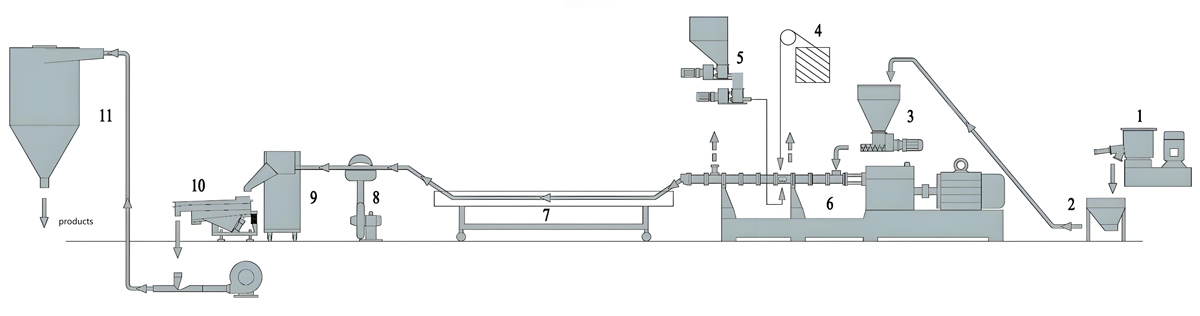
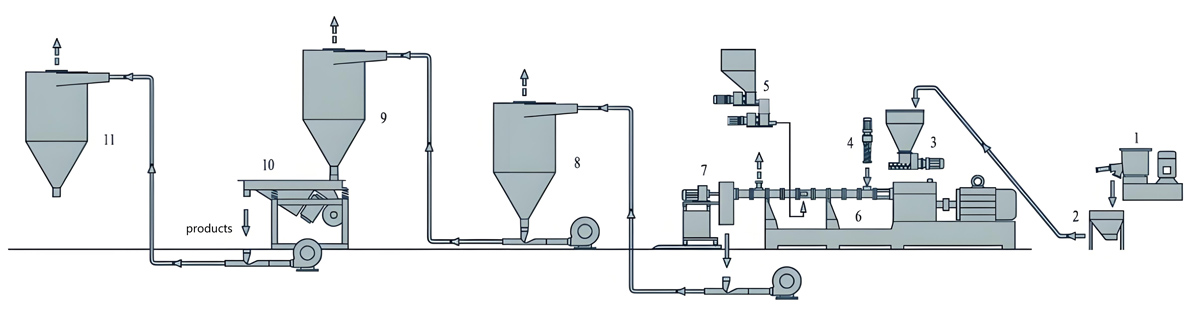
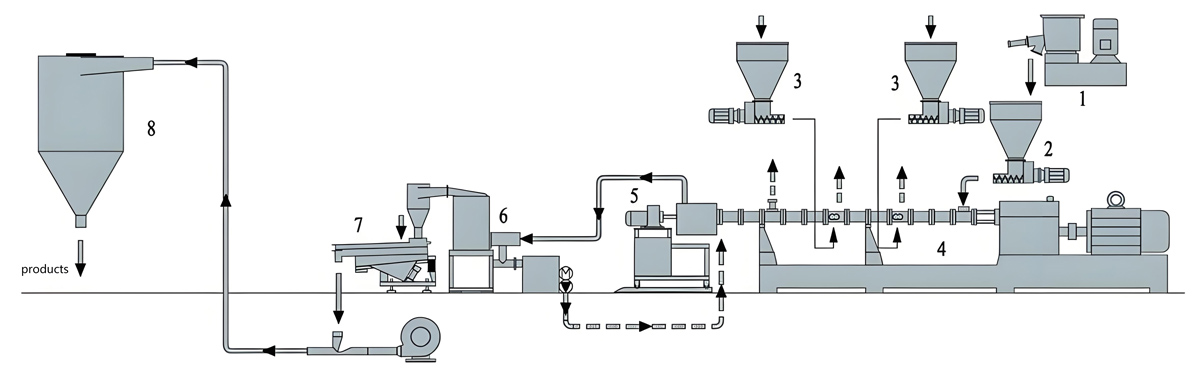
Primary Feed System: The main feeding port receives pre-dried PA resin through a gravimetric feeder. This feeder should provide accurate throughput control with minimal pulsation. For high loading formulations, the PA feeder capacity must accommodate potentially lower PA throughput due to increased total filler content.
Secondary Feeding System: Calcium carbonate is introduced through a side feeder positioned after initial PA melting but before major mixing zones. This location provides optimal residence time for dispersion while minimizing thermal exposure of the filler. The feeder must handle abrasive materials without excessive wear or accuracy degradation.
Tertiary Feed Systems: Additives and masterbatches may be introduced through additional side feeders. Heat-sensitive additives should be introduced as downstream as possible to minimize thermal exposure. Multiple feeders allow precise control of additive concentrations and enable formulation adjustments without stopping production.
Feeder Synchronization: For continuous operation, all feeders must be properly synchronized to maintain the correct formulation ratios. Advanced control systems monitor individual feeder rates and adjust flows to maintain target formulation even when throughput changes.
Advanced Extruder Zone Configuration
PA calcium carbonate masterbatch production requires optimized zone configuration:
Initial Zones (Z1-Z3): Focus on PA melting and initial homogenization. These zones operate at moderate temperatures to initiate melting without causing premature degradation. The screw configuration in these zones emphasizes conveying efficiency to prevent melting delay and material bridging.
Intermediate Zones (Z4-Z6): Provide melting completion and start the initial mixing process. The temperature gradually increases in these zones to maintain appropriate melt viscosity. Screw elements in these zones balance conveying efficiency with mild mixing to begin filler incorporation.
Primary Dispersion Zones (Z7-Z9): High shear zones designed to break down calcium carbonate agglomerates and achieve uniform distribution. These zones typically include multiple kneading block assemblies with varied staggers. The exact configuration depends on calcium carbonate loading and particle size distribution.
Secondary Dispersion Zones (Z10-Z11): Additional mixing zones that complete the dispersion process. These zones provide distributive mixing to ensure uniformity throughout the melt stream. The shear intensity is typically lower than primary dispersion zones to avoid excessive thermal degradation.
Final Homogenization and Metering Zones (Z12-Z14): Complete dispersion and prepare the melt for pelletization. These zones focus on temperature uniformity and melt homogeneity. The screw configuration provides sufficient conveying to maintain throughput without generating excessive shear.
Precise Temperature Management
PA requires careful temperature control due to its thermal characteristics and moisture sensitivity:
Feed Zone Temperature: The first zone should be set at 220-230°C for PA6 or 240-250°C for PA66 to initiate melting without causing premature degradation in the feed throat. Slightly lower temperatures in this zone reduce thermal stress on the PA resin before it is fully protected by the melt.
Melting Zone Profile: Zones 2-6 should maintain temperatures between 230-250°C for PA6 or 250-265°C for PA66 to ensure complete melting. The temperature should gradually increase through these zones to accommodate the increasing viscosity as filler is incorporated.
Dispersion Zone Temperature: Zones 7-11 typically operate at 240-255°C for PA6 or 255-270°C for PA66. These temperatures provide optimal melt viscosity for dispersion while balancing thermal degradation risk. For high loading formulations, slightly higher temperatures may be needed to maintain adequate flow.
Metering Zone Temperature: The final zones should be maintained at 250-260°C for PA6 or 265-275°C for PA66. These temperatures ensure melt homogeneity and provide appropriate melt strength for pelletization. The die temperature should be set 5-10°C above the final melt temperature.
Dynamic Process Control
Advanced process control systems optimize PA calcium carbonate production:
Screw Speed Management: Screw speeds between 180-380 RPM are typical, depending on extruder size and formulation. Higher screw speeds generally improve dispersion through increased shear but reduce residence time and increase melt temperature. The optimal speed balances these competing factors.
Throughput Optimization: Throughput rates range from 35-320 kg/h depending on extruder capacity. Finding the optimal specific throughput (kg/h/RPM) is crucial for achieving consistent quality. Process optimization may involve adjusting both throughput and screw speed to achieve desired processing conditions.
Vacuum Venting Control: Vacuum venting between 500-700 mbar absolute pressure removes volatiles efficiently. The vacuum level must be optimized to remove volatiles without entraining filler material. For PA, venting helps remove moisture and low molecular weight degradation products.
Pressure Monitoring: Die pressure monitoring provides real-time indication of processing conditions. Pressure increases may indicate viscosity changes, wear issues, or die blockage. Pressure decreases may signal wear, filter blockage, or material quality changes.
Equipment Specifications and Configuration
Twin Screw Extruder Selection
PA calcium carbonate masterbatch production demands specialized extruder equipment:
Extruder Type: Co-rotating twin screw extruders provide optimal mixing for this application. KTE Series extruders offer robust construction suitable for polyamide processing and abrasive fillers. Modular design enables easy configuration changes for different formulations.
Screw Diameter Selection: Screw diameters from 25mm to 75mm are available, with production capacities ranging from 30 kg/h to 320 kg/h. Larger diameters provide higher throughput but may reduce mixing efficiency for difficult formulations.
Length-to-Diameter Ratio: L/D ratios between 32:1 and 40:1 provide adequate mixing length while managing residence time for heat-sensitive PA. Longer barrels provide more mixing zones but increase residence time and potential for thermal degradation.
Barrel Construction: Multi-zone barrel construction with independent temperature control enables precise thermal profile management. Heating elements must provide uniform heat distribution without hot spots. Cooling systems should provide rapid response when needed.
Feeding System Integration
Advanced feeding systems ensure consistent material introduction:
Gravimetric Feeders: Gravimetric feeding provides accurate throughput control for both PA resin and calcium carbonate. These systems should feature loss-in-weight operation with continuous rate monitoring and correction capabilities.
Feeder Material Selection: Feeders handling calcium carbonate should be constructed from wear-resistant materials to withstand abrasive particles. Stainless steel with hardened components provides good durability.
Drying Integration: For PA, gravimetric feeders with integrated drying capabilities maintain optimal moisture content throughout continuous operation. The drying system should be sized to handle the maximum PA throughput with appropriate safety margin.
Feeder Synchronization: Multiple feeders must be properly synchronized to maintain the correct formulation ratios. Advanced control systems monitor individual feeder performance and adjust flows to maintain target formulation.
Screw and Barrel Engineering
Specialized construction withstands demanding processing conditions:
Barrel Materials: Barrels are manufactured from specialized alloy steels with hard facing on the inner surface to resist abrasive wear from calcium carbonate. The hard facing should extend throughout the barrel, particularly in mixing zones where abrasive contact is highest.
Screw Element Construction: Screw elements are manufactured from tool steels with surface hardening treatments such as nitriding or chrome plating to extend service life in abrasive environments. Modular elements allow easy replacement of worn sections.
Screw Configuration Design: The screw configuration must be optimized for each formulation. For PA calcium carbonate, this includes sufficient conveying elements for material transport, kneading blocks for dispersion, and mixing elements for final homogenization.
Wear Management: Design features should facilitate easy inspection and replacement of worn components. Quick-change designs minimize downtime for maintenance. Wear monitoring systems can predict when components need replacement.
Process Parameter Optimization
Screw Configuration Optimization
Effective screw configuration is critical for PA calcium carbonate quality:
Feed Zone Design: Large-pitch conveying elements in feed zones ensure reliable material transport. For PA, elements with appropriate flight depth prevent excessive heat build-up in the feed throat area and help prevent material bridging.
Melting Zone Optimization: Elements with decreasing pitch through melting zones provide progressive compression. The melting zone should include a combination of conveying and mild mixing elements to promote melting without excessive shear.
Dispersion Zone Engineering: Multiple kneading block assemblies provide dispersive mixing. The staggers, widths, and positions of these elements must be optimized for each loading level. For high loading formulations, more aggressive dispersion elements are required.
Homogenization Zone Design: Downstream mixing elements complete dispersion and ensure melt homogeneity. These elements should provide distributive mixing without excessive shear heating. Gear mixers and combing mixers work well in these zones.
Equipment Investment Analysis
Twin Screw Extruder Cost Structure
Investment analysis for PA calcium carbonate production equipment:
Laboratory Equipment (25-30mm): $32,000 – $52,000 for research and small-scale production.
Pilot Production Equipment (35-45mm): $58,000 – $110,000 for small to medium production volumes.
Industrial Equipment (55-75mm): $135,000 – $290,000 for large-scale production. These systems include advanced features required for demanding applications.
Specialized Features: Additional $18,000 – $42,000 for enhanced temperature capabilities, wear resistance, and advanced control systems.
Complete System Investment
Complete production lines require comprehensive investment:
Drying Systems: $22,000 – $48,000 for industrial dehumidifying dryers capable of handling PA drying requirements.
Feeding Systems: $14,000 – $32,000 for multi-station gravimetric feeding systems.
Pelletizing Systems: $16,000 – $42,000 for pelletizers suitable for filled melts.
Control Systems: $10,000 – $22,000 for advanced control with recipe management and process monitoring.
Production Challenges and Solutions
Moisture-Related Problems
Problem Identification: Moisture problems in PA manifest as surface defects, bubbles, splay marks, reduced mechanical properties, and degraded appearance. The material may show excessive smoking during processing. Molecular weight analysis reveals hydrolytic degradation and reduced viscosity.
Root Causes: Inadequate resin drying allowing moisture to remain above 200 ppm. Inconsistent drying providing variable moisture content. Ambient humidity changes affecting material handling. Ineffective venting failing to remove moisture from melt. Poor storage conditions allowing moisture absorption.
Solutions: Implement rigorous drying with moisture content verification. Increase drying temperature or time if moisture remains high. Maintain consistent dryer dew point below -40°C. Improve venting system efficiency. Use moisture-resistant material handling and storage. Add hydrolysis stabilizers to formulation.
Prevention Methods: Install inline moisture monitoring to verify drying effectiveness. Implement strict material storage and handling procedures. Monitor ambient humidity conditions. Train operators on proper material handling. Use sealed containers for dried material. Implement regular dryer maintenance.
Inadequate Filler Dispersion
Problem Identification: Poor dispersion appears as visible agglomerates, inconsistent mechanical properties, surface defects, and speckled appearance. Microscopic examination reveals undispersed calcium carbonate particles. Testing in final applications shows inconsistent performance.
Root Causes: Insufficient mixing energy from low screw speed or inadequate kneading elements. Screw configuration not optimized for calcium carbonate dispersion. Excessive throughput reducing specific mixing energy. Inadequate coupling agents preventing proper filler-matrix bonding. Calcium carbonate agglomeration from improper storage or handling.
Solutions: Increase screw speed while monitoring thermal conditions. Redesign screw configuration adding more dispersive elements. Reduce throughput to increase specific mixing energy. Optimize coupling agent selection and concentration. Implement pre-dispersion of calcium carbonate. Use appropriate filler grades with controlled particle size.
Prevention Methods: Establish standardized screw configurations for each formulation. Implement regular dispersion quality monitoring using microscopy. Train operators on proper material handling to prevent agglomeration. Use quality control testing for dispersion effectiveness. Maintain consistent processing parameters.
Die Build-up and Flow Problems
Problem Identification: Material accumulation on die face causes flow restrictions, pressure fluctuations, and pellet size variations. The die shows visible deposits and requires frequent cleaning. Pressure monitoring shows increasing trends over time.
Root Causes: Low melt temperature causing increased viscosity and sticking. Improper die design creating flow restrictions or stagnation areas. Excessive filler loading increasing viscosity. Inadequate lubrication in formulation causing material adherence. Poor screw configuration causing incomplete melt homogenization.
Solutions: Increase die temperature by 5-10°C to reduce viscosity. Redesign die with optimized flow channels and polished surfaces. Reduce filler loading or modify formulation. Increase lubricant and processing aid content. Optimize screw configuration for better melt homogenization. Implement regular die cleaning schedule.
Prevention Methods: Use die designs optimized for filled materials. Maintain consistent processing parameters. Implement die surface treatments to reduce adhesion. Monitor die pressure trends for early detection. Use processing aids to reduce die build-up potential.
Equipment Wear from Abrasive Fillers
Problem Identification: Progressive output reduction, decreased mixing efficiency, visible metal contamination, increased power consumption. Wear patterns appear on barrel and screw components. Process stability declines as wear progresses.
Root Causes: Abrasive calcium carbonate particles causing mechanical wear. High filler loading accelerating wear rates. High screw speeds increasing mechanical stress. Inadequate material hardness in contacting components. Poor maintenance allowing wear to progress to failure.
Solutions: Upgrade to hardened wear-resistant materials for all calcium carbonate contacting components. Reduce screw speed if wear rate is excessive. Monitor wear through regular dimensional inspection. Replace worn components before complete failure. Use high quality calcium carbonate with controlled particle hardness.
Prevention Methods: Use tungsten carbide or ceramic coatings in high-wear areas. Establish regular inspection and replacement schedules. Monitor output and quality as wear indicators. Implement filtration to capture metal contamination. Train operators on wear identification and reporting.
Thermal Degradation
Problem Identification: Thermal degradation manifests as yellowing, reduced molecular weight, increased acidity, and deterioration of mechanical properties. In severe cases, charring and gel formation occur. Degraded masterbatch shows poor processing characteristics in downstream applications.
Root Causes: Excessive barrel temperatures exceeding PA thermal stability. Prolonged residence time providing too much thermal exposure. Inadequate venting failing to remove degradation products. Poor thermal stability of raw PA resin. Dead zones in barrel causing material stagnation and degradation.
Solutions: Reduce barrel temperature profile to minimum acceptable for processing. Optimize screw configuration to minimize residence time. Increase vacuum venting efficiency to remove volatiles. Select PA grades with improved thermal stability. Eliminate dead zones through screw configuration optimization. Use thermal stabilizers in formulation.
Prevention Methods: Implement continuous monitoring of melt temperature and pressure. Use real-time quality testing to detect degradation early. Establish maximum residence time limits for each formulation. Monitor screw wear and replace components when necessary. Implement statistical process control to identify developing degradation issues.
Maintenance and Reliability
Daily Maintenance Protocols
Daily maintenance ensures reliable operation:
Visual Inspection: Check for unusual sounds, vibrations, or leaks. Monitor amperage readings for changes indicating developing problems. Inspect for material accumulation or blockages.
Temperature Monitoring: Verify all temperature zones operate within specified ranges. Check heating and cooling operation and uniformity. Verify temperature stability over time.
Feeding System Verification: Confirm feeders deliver material accurately. Check feeder throats for proper material flow. Verify feeder synchronization.
Pelletizer Condition: Check pelletizer knives for wear and alignment. Verify water flow and temperature. Inspect pellet quality for consistency.
Frequently Asked Questions
What is the optimal drying condition for PA resin?
PA6 requires drying at 80-100°C for 4-6 hours, while PA66 requires 90-110°C for 6-8 hours, using dehumidifying dryers with dew point below -40°C. The target moisture content should be below 200 ppm. Proper drying is critical to prevent hydrolysis and ensure consistent processing.
How do I prevent moisture-related problems in PA processing?
Prevent moisture problems through proper drying, appropriate material storage in moisture-proof containers, consistent handling procedures, adequate venting to remove moisture from melt, and using hydrolysis-stabilized PA grades. Maintain residence times as short as possible while achieving required dispersion.
What calcium carbonate loading is optimal for PA?
Optimal loading depends on application requirements. Medium loading (30-40%) provides good balance of cost and properties for most applications. High loading (40-55%) maximizes cost benefits but requires more intensive processing. Lower loadings maintain excellent properties with modest cost savings.
What type of coupling agent works best for PA calcium carbonate?
Epoxy-functional coupling agents typically provide the best performance for PA calcium carbonate systems. At concentrations of 0.8-2.5%, these agents significantly improve interfacial bonding and mechanical properties. For high loading applications, higher coupling agent concentrations may be beneficial.
How often should equipment be serviced for calcium carbonate formulations?
Due to abrasive wear, more frequent maintenance is required compared to unfilled materials. Daily inspection should focus on wear indicators. Weekly maintenance should include detailed inspection of wear areas. Monthly maintenance should include quantitative wear measurements. More frequent component replacement is typically necessary.
What temperature profile should I use for PA calcium carbonate?
For PA6, a profile from 220-230°C in feed zones to 250-260°C in final zones works well. For PA66, use 240-250°C in feed zones to 265-275°C in final zones. The exact profile depends on specific PA grade, moisture content, and calcium carbonate loading.
Conclusion
The production of PA calcium carbonate filled masterbatch using twin screw extruders requires comprehensive understanding of polyamide material characteristics, calcium carbonate filler behavior, and advanced processing technology. Success demands careful balancing of moisture management, dispersion efficiency, and equipment durability.
Formulation optimization provides the foundation for successful production. The selection of PA grade, calcium carbonate loading level, and additives package must be tailored to specific application requirements while considering processing constraints. Understanding the complex interactions between these components enables consistent quality and production efficiency.
Advanced processing techniques and equipment selection significantly impact production success. KTE Series twin screw extruders with appropriate configuration provide the capabilities needed for this demanding application. Regular maintenance and wear management are particularly important for abrasive filled formulations.
By implementing the strategies and best practices outlined in this comprehensive guide, manufacturers can achieve consistent, high quality PA calcium carbonate filled masterbatch production while optimizing costs and maximizing equipment utilization. Success in this competitive market requires commitment to technical excellence, continuous improvement, and attention to detail throughout the production process.