Domäne: Herstellung von Kunststoffextrusions- und Compoundiermaschinen. Verwenden Sie präzise technische/industrielle Begriffe. Halten Sie Standardscodes (ISO, ASTM, UL, RoHS, REACH), Einheiten (°C, MPa, mm, g/cm³, kV/mm), Polymerkürzel (PP, PE, PVC, ABS, PC, PA, PET, PBT, POM, TPU, PPS, PEEK), Markennamen und Modell-/Teilnummern genau so, wie sie geschrieben sind – übersetzen Sie sie nicht. Bewahren Sie alle HTML-Tags, {Einfügemöglichkeiten} und Klammern auf. Formeller technischer Register. Text: Einführung in feuchtigkeitsdichte Masterbatch
Feuchtigkeitsdichte Masterbatches sind spezielle Formulierungen, die die Wasserdichtigkeit und die Feuchtigkeitsschutzfähigkeit von Polymermaterialien deutlich verbessern. Diese hochentwickelten Masterbatches enthalten konzentrierte hydrophobe Mittel, Feuchtigkeitsbarrieren und wasserabweisende Additive, die Schutzbarrieren gegen Feuchtigkeitseintritte schaffen. Die Herstellung von feuchtigkeitsdichten Masterbatches erfordert industrielle Verarbeitungsanlagen, die in der Lage sind, die Funktionalität der Additive zu erhalten und gleichzeitig eine gleichmäßige Dispersion und präzise Granulationscharakteristiken zu erzielen.
Industrielle Doppelschneckenextruder bieten die robusten Verarbeitungsmöglichkeiten, die für die Herstellung von feuchtigkeitsdichten Masterbatches erforderlich sind. Diese Maschinen bieten hohe Drehmomentleistung, präzise Temperaturregelung und überlegene Mischungseigenschaften, die für die effektive Einbringung hydrophober Additive erforderlich sind. Die industriellen Doppelschneckenextruder der Serie KTE von Nanjing Kerke Extrusion Equipment Company sind hochmoderne Geräte, die speziell für anspruchsvolle Anwendungen mit feuchtigkeitsdichten Masterbatches entwickelt wurden, die außergewöhnliche Konsistenz und Zuverlässigkeit erfordern.
Verständnis der Mechanismen der Feuchtigkeitsbarriere
Die Feuchtigkeitspenetration in Polymermaterialien erfolgt durch verschiedene Mechanismen, einschließlich Diffusion, Kapillarwirkung und Feuchtigkeitsabsorption. Bei der Diffusion bewegen Wasser-Moleküle durch die Polymermatrix auf molekularer Ebene, angetrieben von Konzentrationsgradienten. Dieser Prozess ist besonders bedeutsam bei polaren Polymeren, die natürlicherweise Feuchtigkeit aufnehmen. Die Feuchtigkeitsabsorption beeinflusst die mechanischen Eigenschaften, die Dimensionsstabilität und die elektrischen Eigenschaften der Endprodukte.
Die Kapillarwirkung ermöglicht den Transport von Feuchtigkeit entlang von Schnittstellen, Hohlräumen und Unvollkommenheiten innerhalb der Polymerstruktur. Schlechte Mischung, Hohlräume und Phasengrenzen schaffen Wege für die Feuchtigkeitsmigration. Feuchtigkeitsdichte Masterbatches enthalten Additive, die diese Mechanismen durch hydrophobe Modifizierung, Erhöhung der Kristallinität und Reduzierung von Hohlräumen adressieren. Durch die Kenntnis dieser Feuchtigkeitseintrittswege ist eine gezielte Formulierungsplanung für optimale Schutzmaßnahmen möglich.
Chemie des hydrophoben Mittels
Hydrophobe Mittel reduzieren die Oberflächenenergie von Polymeren und schaffen wasserabweisende Eigenschaften. Silan-basierte Kupplungsmittel, einschließlich Alkylsilane und Fluorosilane, bieten hervorragende Hydrophobizität durch chemische Bindung an Polymerketten und Oberflächenmodifikation. Diese Mittel bilden dauerhafte hydrophobe Schichten, die Feuchtigkeitspenetration verhindern und ihre Wirksamkeit über längere Betriebszeiten behalten.
Fettsäurederivate, einschließlich Stearinsäure- und Ölsäurederivate, bieten kostengünstige Hydrophobizität für viele Anwendungen. Diese Fettsäureester wandern während der Verarbeitung und des Einsatzes auf Polymeroberflächen und bilden wasserabweisende Barrieren. Die Wirksamkeit von Fettsäurederivaten hängt von der Kompatibilität mit dem Basispolymer und den Verarbeitungsbedingungen ab. Die Polymerblendung mit intrinsisch hydrophoben Polymeren verbessert die allgemeine Feuchtigkeitsbeständigkeit durch die Steuerung der Phasenmorphologie.
Domäne: Herstellung von Ausrüstungen für die Kunststoffextrusion und -Verarbeitung. Verwenden Sie präzise technische/industrielle Begriffe. Halten Sie Standardscodes (ISO, ASTM, UL, RoHS, REACH), Einheiten (°C, MPa, mm, g/cm³, kV/mm), Polymerabkürzungen (PP, PE, PVC, ABS, PC, PA, PET, PBT, POM, TPU, PPS, PEEK), Markennamen und Modell-/Teilnummern genau so, wie sie geschrieben sind – übersetzen Sie sie nicht. Bewahren Sie alle HTML-Tags, {Platzhalter} und Klammern auf. Formelles technisches Register. Text: Nanopartikel Feuchtigkeitsbarrieren
Nanopartikeladditive schaffen labyrinthische Pfade, die die Feuchtigkeitsdiffusion durch Polymermatricen erheblich behindern. Montmorillonit-Nanopartikel, wenn sie korrekt exfoliert und dispergiert werden, bilden Barriere-Schichten, die die Feuchtigkeit umfahren muss, wodurch die Diffusionsraten drastisch reduziert werden. Die Oberflächenmodifizierung von Nanopartikeln mit hydrophoben Behandlungen verbessert die Kompatibilität und die Barriereeffektivität.
Silica-Nanopartikel, insbesondere hydrophobe Rauhfasersilica, bieten hervorragende Feuchtigkeitsbarriereeigenschaften durch die Oberflächenfläche und die hydrophobität. Graphen und Graphenoxid bieten außergewöhnliche Barriereeigenschaften aufgrund ihrer planaren Struktur und der Undurchlässigkeit für Gas- und Feuchtigkeitsmoleküle. Die Auswahl der Nanopartikel hängt von den Verarbeitungsanforderungen, der Polymerkompatibilität und den gewünschten Barriereleistungsniveaus ab.
Formulierungsdesign für feuchtigkeitsdichte Masterbatches
Für effektive feuchtigkeitsdichte Masterbatch-Rezepte ist eine sorgfältige Balance zwischen hydrophoben Mitteln, Nanopartikel-Barrieren, Verarbeitungshilfsmitteln und Basispolymeren erforderlich. Die Rezepturverhältnisse hängen vom Polymertyp, den Feuchtigkeitsbedingungen und den Schutzanforderungen ab. Typische Konzentrationsstufen für feuchtigkeitsdichte Masterbatch-Rezepte liegen zwischen 5 % und 30 % aktiver Inhaltsstoffbeladung, wobei die meisten Anwendungen auf einen hydrophoben Gehalt von 10 % bis 20 % setzen.
Auswahl des Basispolymers
Das Basispolymer dient als Träger für feuchtigkeitsdichte Additive und beeinflusst die Wirksamkeit der Formulierung erheblich. Das Basispolymer sollte eine gute Kompatibilität mit hydrophoben Mitteln, eine angemessene thermische Stabilität und eine minimale intrinsische Feuchtigkeitsabsorption aufweisen. Häufige Basispolymeren für feuchtigkeitsdichte Masterbatches sind Polyolefine, Polyester, Polyamide und verschiedene technische Polymeren, die für eine verbesserte Hydrophobität modifiziert wurden.
Domäne: Herstellung von Ausrüstungen für die Extrusion und Vermischung von Kunststoffen. Verwenden Sie präzise technische/industrielle Begriffe. Halten Sie Standardscodes (ISO, ASTM, UL, RoHS, REACH), Einheiten (°C, MPa, mm, g/cm³, kV/mm), Polymerkürzel (PP, PE, PVC, ABS, PC, PA, PET, PBT, POM, TPU, PPS, PEEK), Markennamen und Modell-/Teilnummern genau so, wie sie geschrieben sind – übersetzen Sie sie nicht. Bewahren Sie alle HTML-Tags, {Einfügemöglichkeiten} und Klammern auf. Formelles technisches Register. Text: Polyolefinbasen, einschließlich Polyethylen und Polypropylen, bieten eine hervorragende intrinsische Feuchtigkeitsbeständigkeit und Kompatibilität mit hydrophoben Additiven. Polyesterbasen erfordern eine sorgfältige Auswahl von Additiven, um die intrinsische Hydrophilie zu berücksichtigen und eine ausreichende Feuchtigkeitsbeständigkeit zu erreichen. Engineering-Polymerbasen erfordern spezielle Formulierungen für Anwendungen bei hohen Temperaturen und hohen Anforderungen an die Leistung. Der Basispolymer umfasst in der Regel 70 % bis 95 % der Masterbatch-Formulierung, abhängig von der Additivlast.
Hydrophobic Additive System Configuration
Moisture-proof additive systems typically combine hydrophobic agents, nanoparticle barriers, and compatibilizers for comprehensive protection. Silane coupling agent loading typically ranges from 2% to 8% of masterbatch formulation depending on required hydrophobicity level. Fatty acid derivative loading typically ranges from 3% to 10% depending on polymer compatibility and processing requirements.
Nanoparticle loading for barrier enhancement ranges from 1% to 8% depending on desired barrier performance and dispersion capabilities. Compatibilizer loading typically ranges from 1% to 5% for ensuring uniform nanoparticle dispersion and additive compatibility. Additive ratios must be optimized for synergistic effects, as some combinations demonstrate enhanced barrier performance while others show antagonistic interactions.
Domäne: Herstellung von Ausrüstungen für die Kunststoffextrusion und -Verarbeitung. Verwenden Sie präzise technische/industrielle Begriffe. Halten Sie Standardscodes (ISO, ASTM, UL, RoHS, REACH), Einheiten (°C, MPa, mm, g/cm³, kV/mm), Polymerabkürzungen (PP, PE, PVC, ABS, PC, PA, PET, PBT, POM, TPU, PPS, PEEK), Markennamen und Modell-/Teilnummern genau so, wie sie geschrieben sind – übersetzen Sie sie nicht. Bewahren Sie alle HTML-Tags, {Ersetzungen} und Klammern auf. Formelles technisches Register. Text: Verarbeitungshilfsmittel und Dispersionsmittel
Domain: Herstellung von Ausrüstungen für die Kunststoffextrusion und -Verarbeitung. Verwenden Sie präzise technische/industrielle Begriffe. Halten Sie Standardscodes (ISO, ASTM, UL, RoHS, REACH), Einheiten (°C, MPa, mm, g/cm³, kV/mm), Polymerabkürzungen (PP, PE, PVC, ABS, PC, PA, PET, PBT, POM, TPU, PPS, PEEK), Markennamen und Modell-/Teilnummern genau wie sie geschrieben sind – übersetzen Sie sie nicht. Bewahren Sie alle HTML-Tags, {Platzhalter} und Klammern auf. Formeller technischer Register. Text: Verarbeitungshilfsmittel und Modifikatoren verbessern die Feuchtigkeitsdichtigkeit des Masterbatchs und optimieren die Verarbeitbarkeit. Dispersionsmittel fördern die gleichmäßige Verteilung von hydrophoben Additiven und Nanopartikeln in der Polymermatrix. Schmierstoffe reduzieren die Schmelzviskosität und verbessern die Fließcharakteristiken, wodurch eine Verarbeitung mit hoher Additivlast möglich ist. Kopplungsmittel verbessern die Kompatibilität zwischen hydrophoben Additiven und der Polymerbasis.
Processing aids typically constitute 1% to 5% of formulation depending on additive loading and dispersion requirements. Dispersant selection considers additive surface characteristics and polymer type. Lubricant selection considers polymer compatibility and processing temperature requirements. Well-designed processing aid systems ensure consistent processing and uniform additive distribution critical for moisture protection.
Industrial Twin Screw Extruder Technology
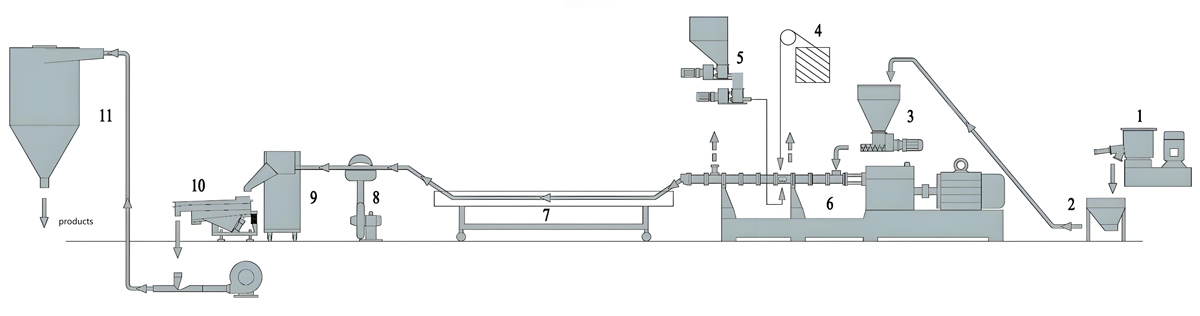
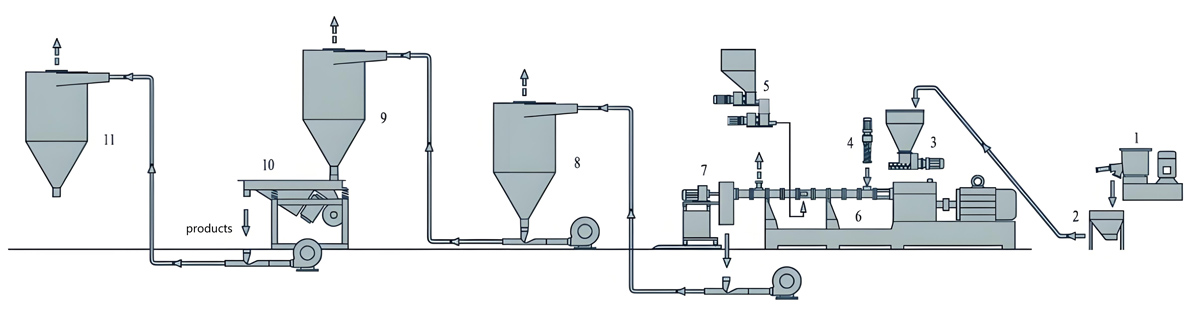
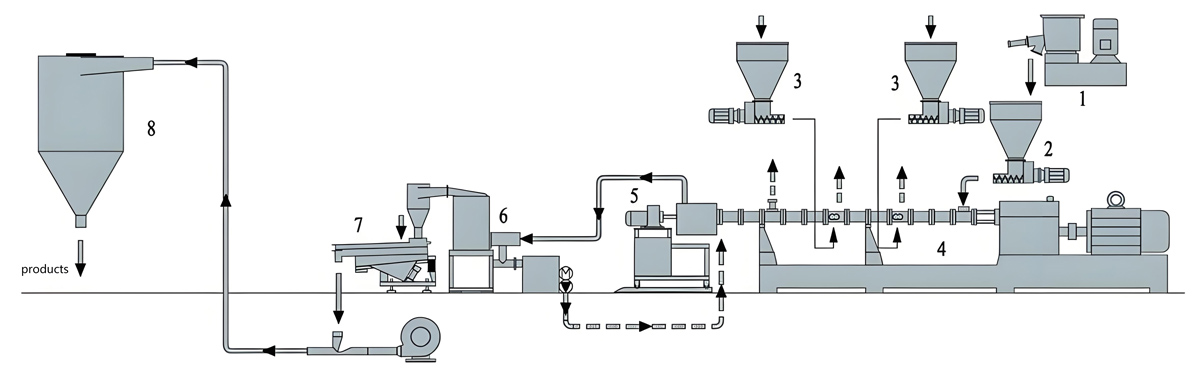
Industrielle Zwillingsschneckenextruder sind robuste Compoundiermaschinen mit Funktionen, die speziell für die Herstellung von feuchtigkeitsdichten Masterbatches geeignet sind. Diese Maschinen verfügen über leistungsstarke Antriebsysteme, moderne Mischfunktionen und Granulationsanlagen, die dafür sorgen, dass die Additive ihre Funktionalität behalten und ein konsistentes Produkt erzeugt wird. Die industriellen Zwillingsschneckenextruder der Serie KTE von Nanjing Kerke Extrusion Equipment Company bieten die erforderlichen Verarbeitungsmöglichkeiten für anspruchsvolle Anwendungen mit feuchtigkeitsdichten Masterbatches.
High-Torque-Antriebsysteme
Die Herstellung feuchtigkeitsdichter Masterbatch erfordert aufgrund der hohen Additivbelastung und der Viskositätseigenschaften ein erhebliches Drehmoment. Industrielle Extruder verfügen über leistungsstarke Antriebsanlagen, die das ständige Drehmoment liefern, das für eine konsistente Verarbeitung erforderlich ist. Durch die hohe Drehmomentleistung können viskose Formulierungen mit Nanopartikel-Additiven verarbeitet werden, die die Schmelzviskosität erheblich erhöhen.
Domain: Herstellung von Ausrüstungen für die Kunststoffextrusion und -Verarbeitung. Verwenden Sie präzise technische/industrielle Begriffe. Halten Sie Standardscodes (ISO, ASTM, UL, RoHS, REACH), Einheiten (°C, MPa, mm, g/cm³, kV/mm), Polymerkürzel (PP, PE, PVC, ABS, PC, PA, PET, PBT, POM, TPU, PPS, PEEK), Markennamen und Modell-/Teilnummern genau wie sie geschrieben sind – übersetzen Sie sie nicht. Bewahren Sie alle HTML-Tags, {Einfügemöglichkeiten} und Klammern auf. Formeller technischer Register. Text: Fortgeschrittene Antriebssysteme umfassen Direktantrieb- oder Getriebeverringerungskonfigurationen, die für hohe Drehmomentspezifikationen optimiert sind. Die Überwachung des Antriebssystems bietet Echtzeit-Drehmomentfeedback für die Prozesssteuerung und -optimierung. Eine ausreichende Drehmomentkapazität gewährleistet eine konsistente Verarbeitung trotz Formulierungsvariationen und Änderungen bei der Additivbeladung. Hochdrehmoment-Antriebssysteme sind für die Aufrechterhaltung einer konsistenten Produktqualität bei herausfordernden Formulierungen unerlässlich.
Advanced Mixing Capabilities
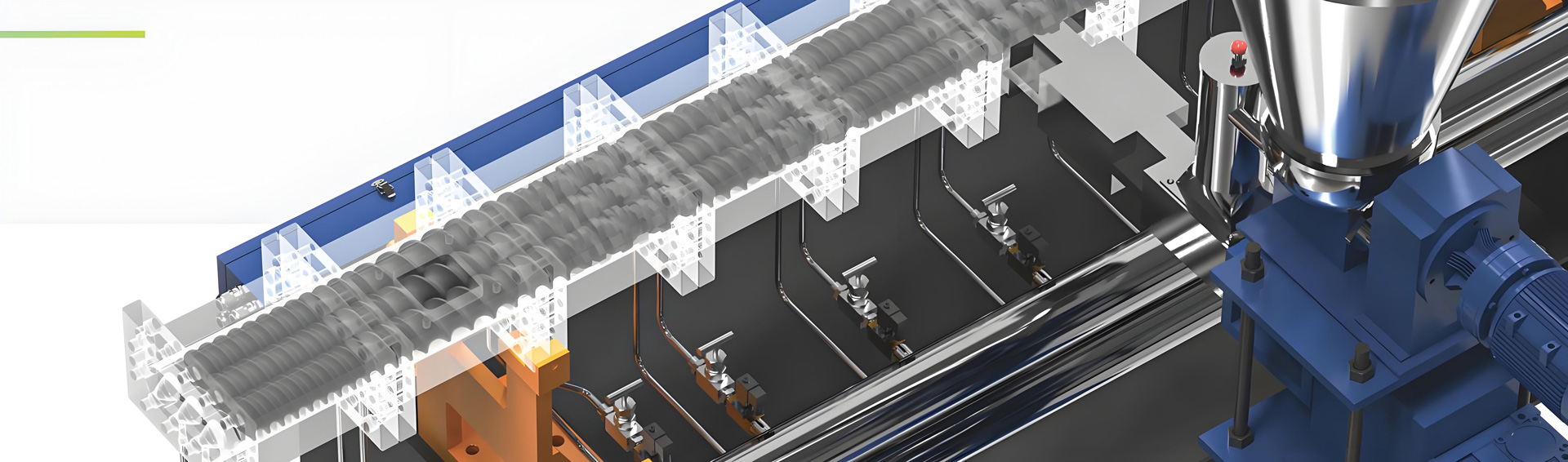
Industrielle Extruder bieten überlegene Mischfunktionen durch optimiertes Schraubendesign und modulare Konfigurationen. Mischkomponenten gewährleisten eine gleichmäßige Verteilung von hydrophoben Additiven und Nanopartikeln in der gesamten Polymermatrix und minimieren gleichzeitig die thermischen Belastungen, die sensible Komponenten beeinträchtigen könnten. Die Schraubenkonfiguration kann für spezifische Formulierungsanforderungen und Additivcharakteristiken optimiert werden.
Domain: Herstellung von Ausrüstungen für die Extrusion und Vermischung von Kunststoffen. Verwenden Sie präzise technische/industrielle Begriffe. Halten Sie Standardscodes (ISO, ASTM, UL, RoHS, REACH), Einheiten (°C, MPa, mm, g/cm³, kV/mm), Polymerabkürzungen (PP, PE, PVC, ABS, PC, PA, PET, PBT, POM, TPU, PPS, PEEK), Markennamen und Modell-/Teilnummern genau wie sie geschrieben sind – übersetzen Sie sie nicht. Bewahren Sie alle HTML-Tags, {Einfügemöglichkeiten} und Klammern auf. Formelles technisches Register. Text: Modulare Schraubendesigns ermöglichen kundenspezifische Mischkonfigurationen für verschiedene Additive und Beladungsstufen. Knetblöcke sorgen für eine dispergierende Mischung, um Nanopartikelagglomerate aufzulösen und eine gleichmäßige Dispersion zu erzielen. Spezielle Mischungselemente bieten eine distributive Mischung für eine gleichmäßige räumliche Verteilung von hydrophoben Mitteln. Die Optimierung der Schraubengeometrie bringt die Mischintensität in Balance mit der thermischen Schutzfunktion für sensible Additive.
Robuste Granulationssysteme
Die Granulationsqualität hat einen erheblichen Einfluss auf die feuchtigkeitsdichte Verarbeitung von Masterbatches, die Dispersion während der Endverarbeitung und die Funktionalität der Additive. Industrielle Extruder verfügen über robuste Granulationssysteme, darunter Strangpelletierer, Wasserringpelletierer oder Pelletierer mit einer Pelletierfläche, die für eine konsistente Pelletgröße, Form und Dichte ausgelegt sind. Eine konsistente Granulation gewährleistet eine gleichmäßige Dosierung der Additive während der Endverarbeitung des Produkts.
Strandpelletierer bieten eine präzise Steuerung der Pelletlänge durch Anpassungen der Schneidgeschwindigkeit und des Strangdurchmessers. Wasserringpelletierer bieten hohe Produktionsraten für Großbetriebe und gewährleisten dabei eine gleichbleibende Qualität. Facepelletierer bieten hervorragende Pelletqualität für hochwertige Anwendungen. Die Wahl des Granulationssystems hängt von den Produktionsvolumenanforderungen, dem Produktwert und den Überlegungen zur Nachbehandlung ab.
Production Process Overview
The production of moisture-proof masterbatches using industrial twin screw extruders involves sequential processing stages including material preparation, feeding, melting, mixing, and granulation. Each stage requires precise parameter control to achieve optimal additive dispersion while maintaining hydrophobic functionality and product consistency.
Material Preparation and Handling
Material preparation for moisture-proof masterbatch production requires attention to hydrophobic additive handling, moisture control, and pre-mixing protocols. Hydrophobic additives often require protection from moisture during storage and handling to preserve functionality. Some additives may absorb moisture from ambient conditions, reducing effectiveness.
Pre-mixing of hydrophobic additives with polymer base using high-intensity mixers can improve initial distribution and reduce processing requirements. Dry blending eliminates concentration gradients and reduces residence time demands in the extruder. Pre-mixing protocols must ensure adequate mixing without generating excessive heat that could degrade sensitive additives. Proper material preparation ensures consistent additive functionality.
Precision Feeding Systems
Feeding accuracy is critical for maintaining consistent hydrophobic additive concentrations and product performance. Industrial extruders typically utilize gravimetric feeders for major components and precision metering devices for high-value additives. Feeding accuracy within 0.5% is essential for maintaining consistent formulation ratios.
Gravimetric feeders provide continuous weight-based feeding with automatic compensation for material density variations. Loss-in-weight feeders offer the highest accuracy for additive introduction. Multiple feeding points enable introduction of temperature-sensitive additives at downstream locations where temperatures are lower. Feeding system consistency ensures product quality and performance consistency.
Melting and Plasticization
The melting zone achieves polymer transition from solid to molten state capable of incorporating hydrophobic additives. Temperature profiles in this zone must achieve complete melting while protecting sensitive additives from thermal degradation. Typical temperature settings for polyolefin-based moisture-proof masterbatches range from 170 to 185 degrees Celsius for initial barrel zones.
Barrel design and screw configuration in the melting zone emphasize gentle but efficient melting to minimize thermal stress on additives. Barrier screw designs can enhance melting efficiency while reducing residence time. Proper melting establishes foundation for subsequent mixing stages and significantly influences energy consumption and additive functionality.
Intensive Mixing and Distribution
The mixing zone ensures uniform distribution of hydrophobic additives and nanoparticles throughout the polymer matrix. Temperature in this zone must balance mixing requirements with additive thermal protection. Typical mixing zone temperatures range from 180 to 195 degrees Celsius for most polyolefin formulations.
Screw configuration in the mixing zone incorporates kneading blocks and mixing elements designed for optimal additive distribution without excessive shear. Forward-conveying kneading blocks provide moderate mixing and forward transport. Reverse-conveying elements create back-mixing zones that increase residence time and distribution uniformity. Mixing intensity must achieve uniform nanoparticle dispersion without generating excessive heat.
Processing Parameters and Optimization
Processing parameters for moisture-proof masterbatch production must optimize additive dispersion and functionality while achieving consistent product quality. Temperature profile, screw speed, throughput, and vacuum conditions all influence product quality and process efficiency.
Temperature Profile Configuration
Temperature profile configuration requires careful consideration of polymer thermal characteristics, additive thermal stability, and dispersion requirements. Typical temperature profiles for polyolefin moisture-proof masterbatches start at 170-180 degrees Celsius in feed zones, increase to 180-190 degrees Celsius in mixing zones, and maintain 185-195 degrees Celsius through die zones.
Additive thermal stability dictates maximum temperature limits. Some hydrophobic additives begin degrading above 200 degrees Celsius. Silane coupling agents generally demonstrate moderate thermal stability but may decompose at elevated temperatures over extended residence times. Temperature profile optimization should include testing of additive functionality after processing at various temperature settings.
Screw Speed and Throughput Optimization
Screw speed and throughput must be balanced to achieve optimal mixing while protecting additive functionality. Industrial extruders for moisture-proof masterbatch production typically operate at screw speeds from 120 to 250 rpm depending on screw size and formulation complexity. Higher screw speeds increase mixing intensity but reduce residence time.
Throughput rates typically range from 200 to 1500 kg/hr depending on machine size and formulation complexity. The throughput-to-speed ratio significantly influences residence time, mixing quality, and thermal exposure. Optimal feed rates for moisture-proof masterbatches typically fall between 5 and 15 kg/hr per cm of screw diameter.
Vacuum and Degassing
Vacuum venting removes volatiles, moisture, and entrapped air that can cause defects in moisture-proof masterbatches. Some additives may release small amounts of volatiles during processing that must be removed. Vacuum systems typically apply 30-70 mbar absolute pressure for effective degassing.
Vent port location must be optimized to avoid additive loss while achieving effective degassing. Some additive components have low molecular weight portions that could be extracted through vacuum vents. Vacuum level optimization balances effective degassing with additive retention. Multiple venting stages may be required for formulations releasing volatiles at different processing stages.
Equipment Investment and Cost Analysis
Investment in industrial twin screw extruders for moisture-proof masterbatch production represents significant capital expenditure requiring careful cost-benefit analysis. Understanding cost structure enables informed equipment selection.
Capital Investment Requirements
Industrial twin screw extruders for moisture-proof masterbatch production typically range in price from 110,000 to 380,000 US dollars depending on screw size, torque capacity, and configuration. Medium to large industrial extruders with 60-90mm screw diameters for capacities 300-1500 kg/hr typically cost 180,000 to 380,000 US dollars.
Configuration options significantly influence pricing. High torque drive systems add 15-25% to base machine cost. Advanced granulation systems including strand pelletizers with precision cutting add 15-25% to base cost. High-level automation including gravimetric feeding and integrated control adds 20-35% to base machine cost.
Operating Cost Considerations
Operating costs include energy consumption, labor, maintenance, and materials. Energy consumption for industrial extruders typically ranges from 0.12 to 0.22 kWh per kg of product depending on machine size and formulation complexity. Industrial equipment may demonstrate higher energy consumption due to high torque requirements but provides superior mixing capability.
Labor requirements vary based on automation level, with highly automated systems requiring minimal operator intervention. Maintenance costs typically represent 2.5-4.5% of initial investment annually when proper preventive maintenance is followed. Material costs represent the largest operating expense, with hydrophobic additives often accounting for 45-75% of material cost depending on formulation complexity.
Production Challenges and Solutions
Moisture-proof masterbatch production encounters specific challenges related to additive sensitivity, dispersion quality, and functionality retention. Understanding these challenges enables effective problem resolution.
Nanoparticle Agglomeration
Problem: Nanoparticle agglomeration results in inconsistent moisture protection, visible particles, or property variations. Poor dispersion compromises uniform protection and product quality.
Cause Analysis: Inadequate mixing intensity, inappropriate screw configuration, excessive throughput rates, or nanoparticle surface characteristics can cause agglomeration. High nanoparticle loading increases agglomeration tendencies. Insufficient residence time prevents complete deagglomeration. Poor pre-mixing leads to concentration gradients.
Solution and Prevention: Optimize screw configuration by adding appropriate kneading blocks or special mixing elements. Reduce throughput rates to increase residence time and mixing intensity. Ensure adequate pre-mixing to eliminate concentration gradients. Utilize dispersants or coupling agents to improve nanoparticle compatibility and distribution. Optimize nanoparticle surface modification for processing conditions. Regular screw maintenance ensures consistent mixing performance.
Additive Migration and Blooming
Problem: Additive migration manifests as surface blooming, reduced effectiveness over time, or contamination of processing equipment. Fatty acid derivatives and low molecular weight additives may migrate to polymer surfaces.
Cause Analysis: Excessive additive loading, poor compatibility with base polymer, or inadequate molecular weight can cause migration. Additives with lower molecular weight than base polymer tend to migrate toward surfaces. High temperatures during processing accelerate migration. Insufficient additive anchoring to polymer matrix leads to surface accumulation.
Solution and Prevention: Optimize additive loading to achieve required functionality while minimizing migration tendency. Select additives with appropriate molecular weight and compatibility with base polymer. Incorporate coupling agents or reactive additives that chemically bond to polymer matrix. Reduce processing temperatures to minimize thermal migration. Test formulations for migration characteristics during development.
Moisture Sensitivity During Storage
Problem: Moisture sensitivity manifests as reduced additive effectiveness, agglomeration, or processing difficulties during storage. Some hydrophobic additives may absorb moisture from ambient conditions during storage.
Cause Analysis: Poor storage conditions, inadequate packaging, or additive hygroscopicity introduces moisture during storage. Some additives demonstrate moisture absorption characteristics that reduce functionality. Moisture uptake can cause additive caking and processing difficulties. Extended storage periods increase moisture exposure risk.
Solution and Prevention: Implement controlled storage environments with low humidity conditions. Use moisture-barrier packaging including desiccants for sensitive additives. Monitor moisture content during storage and processing. Limit storage duration for moisture-sensitive additives. Include moisture stabilizers in formulations when necessary. Implement first-in-first-out inventory management to minimize storage time.
Granulation Quality Issues
Problem: Granulation quality variations manifest as inconsistent pellet size, shape irregularities, or density variations. Poor granulation quality affects handling, dosing accuracy, and dispersion during final processing.
Cause Analysis: Pelletizer maintenance issues, improper cutting blade alignment, inconsistent strand diameter, or variable melt properties cause granulation variations. Worn cutting blades or improper blade speed cause size variations. Inconsistent cooling or melt properties cause shape irregularities. Pelletizer feed rate variations cause overfilling or underfilling of cutting chamber.
Solution and Prevention: Maintain pelletizer cutting blades with regular replacement or sharpening. Ensure proper blade alignment and clearance. Maintain consistent strand diameter through process control. Monitor and control melt properties including temperature and viscosity. Optimize pelletizer feed rate for consistent filling. Implement automated pellet size monitoring and adjustment for consistent quality.
Maintenance and Equipment Optimization
Regular maintenance ensures consistent performance of industrial twin screw extruders and extends equipment life. Preventive maintenance programs must address drive systems, mixing components, granulation equipment, and auxiliary systems.
Drive System Maintenance
Drive system maintenance includes regular inspection of motor performance, gear reducer condition, and coupling alignment. High torque requirements place significant stress on drive components, making regular inspection essential. Lubrication system maintenance ensures proper gear lubrication and reduces wear.
Drive belt or coupling inspection identifies wear requiring replacement. Motor temperature monitoring detects developing problems. Torque output verification ensures consistent performance. Regular drive system maintenance prevents unexpected failures and maintains processing consistency critical for moisture-proof masterbatch quality.
Screw and Barrel Maintenance
Screw and barrel maintenance includes regular inspection of wear patterns, clearance measurements, and cleaning to remove additive deposits. Moisture-proof additives can leave residues that accumulate on screw elements and barrel surfaces. Regular cleaning prevents accumulation that could affect product quality or processing performance.
Clearance measurements track wear rates and predict when screw element or barrel replacement is necessary. Precise clearances are essential for mixing performance and process consistency. Worn screw elements should be replaced to maintain mixing quality. Barrel wear liners may require replacement after extended operation. Regular screw and barrel maintenance ensures consistent processing and product quality.
Granulation System Maintenance
Granulation system maintenance includes regular inspection of cutting blades, alignment verification, and examination of pellet quality. Cutting blade sharpness directly affects pellet quality and consistency. Blade alignment and clearance must be maintained for proper cutting action. Pellet quality inspection identifies developing problems before they cause significant quality issues.
Water ring pelletizers require maintenance of water systems including pumps, filtration, and temperature control. Strand pelletizers require maintenance of haul-off speed control and cutting chamber consistency. Die face pelletizers require maintenance of knife and die condition. Granulation system maintenance ensures consistent pellet quality essential for masterbatch handling and performance.
Quality Assurance and Testing
Comprehensive quality assurance protocols are essential for ensuring moisture-proof masterbatch performance and batch consistency. Testing should evaluate additive dispersion, moisture barrier effectiveness, and product consistency.
Moisture Absorption Testing
Moisture absorption testing evaluates masterbatch effectiveness by measuring moisture uptake under controlled humidity conditions. Samples are exposed to specified humidity levels for defined periods while monitoring weight gain. Moisture absorption rates quantify protection effectiveness and barrier performance.
Moisture absorption testing should be conducted at multiple humidity levels to establish performance across expected service conditions. Comparison to unprotected polymer samples quantifies protection effectiveness. Testing should simulate actual service conditions including temperature and humidity cycles. Performance verification ensures masterbatch meets application requirements.
Water Contact Angle Measurement
Water contact angle measurement assesses surface hydrophobicity by measuring the angle formed between water droplets and the polymer surface. Higher contact angles indicate greater hydrophobicity and water repellency. Contact angle measurements provide rapid evaluation of surface treatment effectiveness.
Contact angle testing should be performed on masterbatch samples and final products to verify performance transfer. Measurements should be taken at multiple locations to assess uniformity. Contact angle values typically decrease with additive degradation or migration, making contact angle useful for detecting processing effects on additive functionality.
Frequently Asked Questions
This section addresses common questions regarding moisture-proof masterbatch production using industrial twin screw extruders.
What is the optimal hydrophobic additive loading for moisture-proof masterbatches?
Optimal additive loading depends on polymer type, moisture exposure conditions, and protection requirements. Typical moisture-proof masterbatch concentration levels range from 10% to 20% hydrophobic additive content. Higher loading provides greater moisture resistance but increases cost and may affect processing characteristics. Lower loading reduces cost but may provide insufficient protection for demanding applications. Additive loading optimization requires evaluation of actual service conditions and performance requirements.
How does nanoparticle dispersion affect moisture barrier performance?
Nanoparticle dispersion is critical for moisture barrier effectiveness. Well-dispersed nanoparticles create tortuous pathways that significantly impede moisture diffusion. Agglomerated nanoparticles lose barrier effectiveness and create defects that facilitate moisture penetration. Proper screw configuration and processing conditions achieve uniform nanoparticle dispersion. Dispersion quality directly correlates with moisture barrier performance and should be verified through microscopy and barrier testing.
What processing parameters most significantly affect moisture-proof masterbatch quality?
Processing parameters significantly affecting quality include mixing intensity for nanoparticle dispersion, temperature profile for additive protection, and residence time for adequate distribution. Screw speed and throughput determine shear rate and residence time, affecting both dispersion quality and additive stability. Temperature profile must balance thermal requirements for processing with additive thermal protection. Screw configuration optimization addresses specific dispersion requirements while protecting additive functionality.
How can additive migration be minimized in moisture-proof masterbatches?
Additive migration minimization requires careful additive selection, loading optimization, and processing condition control. Selecting additives with appropriate molecular weight and polymer compatibility reduces migration tendency. Incorporating reactive additives that chemically bond to polymer matrix eliminates migration. Optimizing additive loading achieves required functionality without excess that could migrate. Processing temperature reduction minimizes thermal migration. Formulation testing for migration characteristics during development identifies optimal additive systems.
What quality tests verify moisture-proof masterbatch effectiveness?
Quality verification should include moisture absorption testing, water contact angle measurement, and visual inspection for dispersion quality. Moisture absorption testing measures protection effectiveness under controlled humidity exposure. Water contact angle measurement evaluates surface hydrophobicity and repellency. Visual inspection identifies agglomerates or dispersion problems. Additional tests may include water vapor transmission rate measurement, immersion testing, and pellet quality assessment. Comprehensive testing ensures masterbatch meets protection requirements.
How does moisture during storage affect moisture-proof masterbatch production?
Moisture during storage can cause additive agglomeration, reduced effectiveness, and processing difficulties. Moisture absorption by hydrophobic additives reduces functionality and creates processing problems. Proper storage conditions including low humidity environments and moisture-barrier packaging preserve additive effectiveness. Moisture content monitoring ensures consistent processing characteristics. First-in-first-out inventory management minimizes storage time and moisture exposure.
Conclusion and Best Practices
Moisture-proof masterbatch production using industrial twin screw extruders requires attention to formulation design, processing parameters, equipment capabilities, and quality assurance. The interplay between hydrophobic additive chemistry, processing conditions, and equipment capabilities determines final product performance and consistency.
Formulation optimization should begin with understanding moisture ingress mechanisms and protection requirements. Additive systems must address specific moisture penetration pathways relevant to application conditions. Processing aids improve compatibility and dispersion while protecting additive functionality. Formulation development should include moisture absorption testing to verify performance.
Equipment selection must address torque requirements for high additive loading and dispersion consistency. Industrial twin screw extruders with high torque drive systems, configurable mixing systems, and consistent granulation provide necessary capabilities. Equipment investment should consider production volume requirements, formulation complexity, and product value expectations.
Processing parameter optimization balances dispersion requirements with additive protection. Temperature profiles achieve adequate melting and mixing while maintaining additive functionality. Screw speed and throughput optimize residence time and mixing intensity. Vacuum venting removes volatiles without additive loss. Systematic parameter optimization through experimentation and testing establishes optimal conditions.
Quality assurance protocols should include comprehensive testing for additive dispersion, moisture barrier performance, and product consistency. Moisture absorption testing provides performance verification under controlled conditions. Water contact angle measurement enables rapid evaluation of surface hydrophobicity. Regular quality monitoring ensures batch-to-batch consistency.
Preventive maintenance programs maintain equipment performance and extend service life. Regular maintenance of drive systems ensures consistent torque output. Screw and barrel maintenance maintains mixing performance and product quality. Granulation system maintenance ensures consistent pellet quality. Maintenance protocols prevent unexpected downtime and quality problems.
Moisture-proof masterbatch production combines advanced hydrophobic chemistry, robust processing equipment, and comprehensive quality systems. Success requires integration of formulation expertise, processing knowledge, and quality assurance capabilities. The industrial twin screw extruder provides essential capabilities for producing consistent, high-performance moisture-proof masterbatches that enhance product durability and reliability across diverse applications.