
Einführung
ABS (Acrylonitrile Butadiene Styrene) resin is one of the most widely used engineering thermoplastics in the global plastics industry, serving as the base material for countless high-performance plastic products, ranging from automotive interior components and consumer electronics housings to medical device panels and children's toys. The integral mechanical properties, surface finish quality, and processing stability of ABS directly determine the overall performance of the final molded product as well as the cost efficiency of subsequent manufacturing operations.
To produce high-quality modified ABS compounds and masterbatches with uniform dispersion, consistent color, and precise dimensional stability, plastic processors must master the fundamental logic of formulation design, production process control, and, most critically, extrusion equipment selection. As a leading manufacturer of professional extrusion equipment with more than 20 years of industry-specific experience, Kerke provides turnkey production solutions tailored precisely to the high-wear, high-shear, and precise mixing requirements of ABS modification and blending production lines, with a focus on the industry-preferred high-torque double-screw extrusion system.
This guide covers all the essential aspects of ABS resin, from its basic definition, key advantages and major classifications, to practical applications, proven production formulas, optimized manufacturing processes, equipment selection criteria, real price factors, and recommendations for trusted suppliers. It is designed to help you make informed and cost-effective decisions for your ABS modification or blending production line.
1. Was ist ABS-Resin?
The ABS resin (Acrylonitrile Butadiene Styrene) is a synthetic thermoplastic made from three main monomers: acrylonitrile, butadiene and styrene. It is a versatile, amorphous engineering thermoplastic that balances the stiffness of styrene and acrylonitrile with the toughness of polybutadiene rubber. This unique molecular structure creates a material that combines exceptional mechanical strength, chemical resistance and processability, qualities that have made it a basic element in both general-purpose and high-performance industrial applications.
The precise ratio of these three monomers can be adjusted during production to create specialized grades of ABS, each tailored to specific application requirements. For example, increasing the acrylonitrile content improves chemical resistance and surface hardness, while a higher proportion of butadiene increases impact strength and low-temperature toughness. Adjusting the styrene content, in turn, improves processability and the aesthetic quality of the final product. This level of customization sets ABS apart from many other commodity plastics and explains its widespread use in demanding industries.
Generally supplied as cylindrical granules in ivory or pale yellow, ABS has a melting point ranging from 217°C to 237°C, with a thermal decomposition temperature starting at approximately 250°C. It is odorless, non-toxic and has extremely low moisture absorption, critical properties for maintaining consistent performance during high-temperature molding and extrusion. For both converters and end users, ABS represents a balanced and cost-effective solution that provides reliable performance without sacrificing design flexibility.
2. Hauptvorteile der ABS-Harz
ABS Resin hat sich zu dem bevorzugten Ingenieurkunststoff für hochwertige industrielle Anwendungen entwickelt, dank seines einzigartigen Gleichgewichts aus mechanischen Eigenschaften, ästhetischer Vielseitigkeit und Verarbeitungs-effizienz, Eigenschaften, die zusammen die Gesamtkosten für Hersteller und Endverbraucher senken. Seine wichtigsten Stärken zeigen sich vor allem in den folgenden sieben Bereichen:
- Domäne: Herstellung von Kunststoffextrusions- und Compoundiermaschinen. Verwenden Sie präzise technische/industrielle Begriffe. Halten Sie Standardscodes (ISO, ASTM, UL, RoHS, REACH), Einheiten (°C, MPa, mm, g/cm³, kV/mm), Polymerkürzel (PP, PE, PVC, ABS, PC, PA, PET, PBT, POM, TPU, PPS, PEEK), Markennamen und Modell-/Teilnummern genau wie sie geschrieben sind – übersetzen Sie sie nicht. Bewahren Sie alle HTML-Tags, {Einfügemöglichkeiten} und Klammern auf. Formeller technischer Register. Text: Hohe Schlagfestigkeit:ABS exhibits a 3 to 5 times higher impact strength than common commodity plastics, with an Izod impact strength with notch of 200 to 500 J/m. It maintains impressive toughness even at sub-zero temperatures; high-impact modified grades retain an Izod impact strength with notch of over 120 J/m at -40°C, far exceeding polypropylene (PP), which becomes brittle near the freezing point. This strength is due to its two-phase microstructure: a rigid continuous phase of styrene-acrylonitrile (SAN) absorbs the impact energy, while dispersed particles of polybutadiene rubber deform to prevent the propagation of cracks, which is critical for components that must withstand strong shocks or vibrations during use.
- Ausgezeichneter Leistung bei hohen Temperaturen:General-purpose ABS has a glass transition temperature (Tg) ranging from 85 °C to 110 °C, while specialized heat-resistant grades can maintain stable mechanical performance at temperatures up to 115 °C. For even more demanding applications, post-processing by annealing can further increase the Tg by 10 °C. This thermal stability prevents deformation, warping, or structural failures in components exposed to sustained high temperatures, such as automotive interior panels near heating systems or appliance housings containing motors and heat-generating circuits.
- Domäne: Herstellung von Kunststoffextrusions- und Compoundiermaschinen. Verwenden Sie präzise technische/industrielle Begriffe. Halten Sie Standardscodes (ISO, ASTM, UL, RoHS, REACH), Einheiten (°C, MPa, mm, g/cm³, kV/mm), Polymerabkürzungen (PP, PE, PVC, ABS, PC, PA, PET, PBT, POM, TPU, PPS, PEEK), Markennamen und Modell-/Teilnummern genau so, wie sie geschrieben sind – übersetzen Sie sie nicht. Bewahren Sie alle HTML-Tags, {Einfügemöglichkeiten} und Klammern auf. Formelles technisches Register. Text: Calidad Estética Superficial Premium:The styrene component of ABS gives it an exceptional surface gloss, with a Rockwell R hardness of 100 to 115, which is hard enough to withstand minor scratches and abrasions during assembly or daily use. In addition to its direct molding finish, ABS is also highly compatible with secondary processing, including painting, electroplating, UV coating, and hot stamping. This enables manufacturers to achieve high-end decorative or functional surfaces, from matte black automotive moldings to consumer electronics housings with a shiny metallic finish, without the need for costly post-processing or surface preparation.
- Domain: Herstellung von Kunststoffextrusions- und Compoundiermaschinen. Verwenden Sie präzise technische/industrielle Begriffe. Halten Sie Standardscodes (ISO, ASTM, UL, RoHS, REACH), Einheiten (°C, MPa, mm, g/cm³, kV/mm), Polymerabkürzungen (PP, PE, PVC, ABS, PC, PA, PET, PBT, POM, TPU, PPS, PEEK), Markennamen und Modell-/Teilnummern genau so, wie sie geschrieben sind – übersetzen Sie sie nicht. Bewahren Sie alle HTML-Tags, {Einfügemöglichkeiten} und Klammern auf. Formeller technischer Register. Text: Anpassbare Funktionsmerkmale:ABS can be blended with a wide range of additives, fillers and modifiers to precisely tailor its performance to the extreme requirements of each application. Flame retardant grades, for example, can achieve an UL 94 V-0 flammability rating with a thickness of just 1.5 mm, critical for use in electronic and electrical enclosures where fire safety is a priority. By incorporating conductive or antistatic additives, ABS can also be designed to dissipate static electricity or even provide electromagnetic shielding for sensitive electronic components. This customizability means that ABS can be optimized for use cases ranging from sterile medical equipment to explosion-proof industrial enclosures.
- Ausgezeichnete Verarbeitbarkeit:El ABS bietet moderate Schmelzfließfähigkeit und breite Verarbeitungsfenster, was ihn ideal für den standardmäßigen Prozess der Doppelwalzextrusion + Pelletisierung durch Wasserdüse macht. Es bietet eine hohe Dimensionsstabilität unter allen Verarbeitungsbedingungen mit einer Formschrumpfung von nur 0,4 % bis 0,7 %. Dies minimiert das Risiko von Verformungen, Dimensionsabweichungen oder Montagefehlern im Endprodukt, was für die Massenproduktion von Präzisionskomponenten von entscheidender Bedeutung ist.
- Gute chemische Stabilität:ABS exhibits excellent resistance to water, most inorganic salts, alkalis, and a wide range of dilute acids. It is also insoluble in most common alcohols and hydrocarbon solvents, which means that it will not degrade or lose structural integrity when exposed to typical cleaning agents, lubricants, or aqueous solutions during use. This broad chemical resistance makes it a reliable choice for components that require frequent disinfection, such as the housings of medical devices, or those exposed to splashes of mild chemicals in industrial environments.
- Domain: Herstellung von Kunststoffextrusions- und Compoundiermaschinen. Verwenden Sie präzise technische/industrielle Begriffe. Halten Sie Standardscodes (ISO, ASTM, UL, RoHS, REACH), Einheiten (°C, MPa, mm, g/cm³, kV/mm), Polymerkürzel (PP, PE, PVC, ABS, PC, PA, PET, PBT, POM, TPU, PPS, PEEK), Markennamen und Modell-/Teilnummern genau so, wie sie geschrieben sind – übersetzen Sie sie nicht. Bewahren Sie alle HTML-Tags, {Einfügemöglichkeiten} und Klammern auf. Formeller technischer Register. Text: Zuverlässiger elektrischer Isolationsleistung:ABS exhibits stable electrical insulation properties over a wide range of frequencies and environmental conditions. This means that it reliably resists the flow of electric current, making it a safe and cost-effective choice for insulating components in electrical and electronic equipment, from internal structural supports in household appliances to the enclosures of power tools and portable electronic devices.
3. Gängige Arten von ABS-Harz
Die ABS-Harz kann aus drei Hauptdimensionen nach ihren Leistungseigenschaften, der modifizierten Zusammensetzung und den Anwendungsanforderungen klassifiziert werden, um die Bedürfnisse der individuellen Produktion verschiedener Kunststoffprodukte zu erfüllen.
3.1 Klassifizierung nach Leistungsmerkmalen
Dies ist der am häufigsten verwendete Klassifizierungsrahmen in der ABS-Industrie, da er die Eigenschaften des Materials direkt mit den funktionalen Anforderungen der Endanwendung abgleicht. Die wichtigsten Typen auf dem Markt sind folgende:
- Allgemeiner Anwendungsbereich von ABS:It balances mechanical strength, impact resistance, and processability to serve as a cost-effective base for high-volume consumer applications. It is typically used in electronic device housings, small appliance components, toys, and general automotive interior parts. This grade accounts for 39.1% of the global ABS market, which is worth $13.5 billion in 2026.
- Domäne: Herstellung von Kunststoffextrusions- und Compoundiermaschinen. Verwenden Sie präzise technische/industrielle Begriffe. Halten Sie Standardscodes (ISO, ASTM, UL, RoHS, REACH), Einheiten (°C, MPa, mm, g/cm³, kV/mm), Polymerkürzel (PP, PE, PVC, ABS, PC, PA, PET, PBT, POM, TPU, PPS, PEEK), Markennamen und Modell-/Teilnummern genau so, wie sie geschrieben sind – übersetzen Sie sie nicht. Bewahren Sie alle HTML-Tags, {Einfügemöglichkeiten} und Klammern auf. Formelles technisches Register. Text: ABS de Alto Impacto:Formulated with a higher proportion of butadiene rubber to provide superior toughness, with an Izod impact strength of over 400 J/m. This grade is designed for components that must withstand heavy static or dynamic loads, such as automotive bumpers, door thresholds and motorcycle fenders. It is also commonly used in electric tool housings and industrial equipment components, where resistance to high-impact forces is an uncompromising requirement.
- Domain: Herstellung von Kunststoffextrusions-und Compoundiermaschinen. Verwenden Sie präzise technische/industrielle Begriffe. Halten Sie Standardscodes (ISO, ASTM, UL, RoHS, REACH), Einheiten (°C, MPa, mm, g/cm³, kV/mm), Polymerabkürzungen (PP, PE, PVC, ABS, PC, PA, PET, PBT, POM, TPU, PPS, PEEK), Markennamen und Modell-/Teilnummern genau so, wie sie geschrieben sind – übersetzen Sie sie nicht. Bewahren Sie alle HTML-Tags, {Einfügemöglichkeiten} und Klammern auf. Formelles technisches Register. Text: ABS Wärmebeständig:Designed to maintain stable mechanical performance at elevated temperatures, with an HDT of up to 115°C, 10 to 15°C higher than general-purpose ABS. This makes it ideal for components exposed to sustained heat during operation, such as automotive dashboard panels, appliance housing parts and internal components of hair dryers.
- ABS-Flammschutzmittel:Modified with halogenated or halogen-free flame retardants to achieve UL 94 V-0 or V-1 flammability ratings, with low smoke and low toxicity properties. This grade is specifically designed for applications with strict fire safety standards, including electronic enclosures, 5G communication equipment enclosures, and automotive interior components.
- ABS mit hohem Kontrast:Formulated to provide a smooth, high-gloss surface finish directly from the molding, eliminating the need for secondary surface treatments such as painting or polishing. It is widely used in high-end consumer applications where visual appeal is a key purchasing factor, including the outer housings of home appliances, smart speaker enclosures, laptop covers, and toy parts.
3.2 Klassifizierung nach modifizierter Zusammensetzung
To erfüllen die immer strengen Leistungsanforderungen von aufstrebenden Branchen wie Elektrofahrzeuge und 5G-Kommunikation, wird ABS häufig mit anderen Polymeren oder funktionalen Zusätzen vermischt, um die inherenten Einschränkungen von reinem ABS zu überwinden. Die wichtigsten handelsüblichen modifizierten ABS-Kompositen sind folgende:
- Domäne: Herstellung von Kunststoffextrusions- und Compoundiermaschinen. Verwenden Sie präzise technische/industrielle Begriffe. Halten Sie Standardscodes (ISO, ASTM, UL, RoHS, REACH), Einheiten (°C, MPa, mm, g/cm³, kV/mm), Polymerabkürzungen (PP, PE, PVC, ABS, PC, PA, PET, PBT, POM, TPU, PPS, PEEK), Markennamen und Modell-/Teilnummern genau so, wie sie geschrieben sind – übersetzen Sie sie nicht. Bewahren Sie alle HTML-Tags, {Einfügemöglichkeiten} und Klammern auf. Formelles technisches Register. Text: ABS-Alloys:ABS blends with other engineering polymers combine the best properties of both base materials. Common examples include ABS/PC (polymeric carbon) alloys, which balance the excellent processability of ABS with the exceptional rigidity and heat resistance of PC; and ABS/PBT (polybutylene terephthalate) alloys, which offer improved chemical resistance and dimensional stability under wet conditions.
- Domain: Herstellung von Ausrüstung für die Kunststoffextrusion und -Verarbeitung. Verwenden Sie präzise technische/industrielle Begriffe. Halten Sie Standardscodes (ISO, ASTM, UL, RoHS, REACH), Einheiten (°C, MPa, mm, g/cm³, kV/mm), Polymerkürzel (PP, PE, PVC, ABS, PC, PA, PET, PBT, POM, TPU, PPS, PEEK), Markennamen und Modell-/Teilnummern genau so wie sie geschrieben sind – übersetzen Sie sie nicht. Bewahren Sie alle HTML-Tags, {Ersetzungen} und Klammern auf. Formeller technischer Register. Text: ABS Rellenado:ABS wird mit anorganischen Zusatzstoffen wie Calciumcarbonat, Talk oder Glasfaser gemischt, um bestimmte Eigenschaften zu verbessern oder die Gesamtkosten des Materials zu senken. ABS, das mit Calciumcarbonat gefüllt ist, kann beispielsweise den Kosten des Endprodukts um 20 % bis 40 % reduzieren, ohne dabei die nötige mechanische Festigkeit für allgemeine Anwendungen zu beeinträchtigen.
- Domain: Herstellung von Kunststoffextrusions- und Compoundiermaschinen. Verwenden Sie präzise technische/industrielle Begriffe. Halten Sie Standardscodes (ISO, ASTM, UL, RoHS, REACH), Einheiten (°C, MPa, mm, g/cm³, kV/mm), Polymerkürzel (PP, PE, PVC, ABS, PC, PA, PET, PBT, POM, TPU, PPS, PEEK), Markennamen und Modell-/Teilnummern genau so, wie sie geschrieben sind – übersetzen Sie sie nicht. Bewahren Sie alle HTML-Tags, {Platzhalter} und Klammern auf. Formelles technisches Register. Text: ABS Reforzado:ABS, modifiziert mit hochfesten synthetischen Fasern, einschließlich Glasfaser, Kohlenstofffaser oder Aramidfaser, um die Zugfestigkeit, den Biegemodul und die Temperatur der thermischen Verformung deutlich zu erhöhen. Dieser modifizierte ABS wird typischerweise in strukturellen Automobilkomponenten und in Trägern für elektrische Geräte eingesetzt, wo er teurere Ingenieurmaterialien ersetzen kann, um die Systemkosten zu senken.
- Domain: Herstellung von Kunststoffextrusions-und Compoundiermaschinen. Verwenden Sie präzise technische/industrielle Begriffe. Halten Sie Standardscodes (ISO, ASTM, UL, RoHS, REACH), Einheiten (°C, MPa, mm, g/cm³, kV/mm), Polymerkürzel (PP, PE, PVC, ABS, PC, PA, PET, PBT, POM, TPU, PPS, PEEK), Markennamen und Modell-/Teilnummern genau so, wie sie geschrieben sind – übersetzen Sie sie nicht. Bewahren Sie alle HTML-Tags, {Einfügemöglichkeiten} und Klammern auf. Formeller technischer Register. Text: ABS Funcionalizado:ABS, gemischt mit speziellen Additiven, um spezifische funktionale Eigenschaften zu verleihen, die über den standardmäßigen mechanischen oder thermischen Leistungsstand hinausgehen. Dazu gehören antistatische, leitfähige, elektromagnetische Abschirmungs- oder sogar strahlungsbeständige Grade, die jeweils auf die strengen Betriebsanforderungen spezieller Branchen abgestimmt sind.
3.3 Klassifizierung nach Anwendungsbranche
The technical requirements of ABS vary significantly between subsequent industries, making this classification framework critical for material suppliers and converters to adjust product performance to the needs of the end user. The main application-specific grades are as follows:
- ABS de Grado Automotriz:A specialized modified grade designed to meet the unique demands of the automotive industry, with improved low-temperature toughness, heat resistance, and weatherability. It also requires excellent processability for manufacturing complex thin-wall components, as well as low volatility and odor emissions to meet global automotive interior air quality standards. This sector alone will account for more than 44% of global ABS consumption by 2026.
- Domain: Herstellung von Kunststoffextrusions- und Compoundiermaschinen. Verwenden Sie präzise technische/industrielle Begriffe. Halten Sie Standardscodes (ISO, ASTM, UL, RoHS, REACH), Einheiten (°C, MPa, mm, g/cm³, kV/mm), Polymerkürzel (PP, PE, PVC, ABS, PC, PA, PET, PBT, POM, TPU, PPS, PEEK), Markennamen und Modell-/Teilnummern genau wie sie geschrieben sind – übersetzen Sie sie nicht. Bewahren Sie alle HTML-Tags, {Einfügemöglichkeiten} und Klammern auf. Formelles technisches Register. Text: ABS für elektrische/elektronische Anwendungen:Formuliert mit überlegenen Eigenschaften in Bezug auf elektrische Isolierung, Dimensionsstabilität und Flammschutz, um die strengen Sicherheits- und Leistungsanforderungen der Elektro- und Elektronikindustrie zu erfüllen. Es muss auch mit sekundären Verarbeitungsprozessen wie Oberflächenbeschichtung und elektrostatischer Lackierung kompatibel sein, um sowohl funktionale als auch ästhetische Anforderungen zu erfüllen.
- ABS von medizinischem Grad:A specialized and highly purified grade that meets the strict international regulatory standards for medical devices, including ISO 10993 biocompatibility testing and FDA food contact safety requirements. It exhibits high resistance to commonly used high-level disinfectants (including 75% ethanol and disinfectants with 500 ppm available chlorine), without surface degradation or discoloration after repeated cycles of friction disinfection.
- Domain: Herstellung von Kunststoffextrusions- und Compoundiermaschinen. Verwenden Sie präzise technische/industrielle Begriffe. Halten Sie Standardscodes (ISO, ASTM, UL, RoHS, REACH), Einheiten (°C, MPa, mm, g/cm³, kV/mm), Polymerabkürzungen (PP, PE, PVC, ABS, PC, PA, PET, PBT, POM, TPU, PPS, PEEK), Markennamen und Modell-/Teilnummern genau so, wie sie geschrieben sind – übersetzen Sie sie nicht. Bewahren Sie alle HTML-Tags, {Einfügemöglichkeiten} und Klammern auf. Formeller technischer Register. Text: ABS-Grade für Spielzeug:It must be a food-safe and impact-resistant grade, formulated specifically for the toy manufacturing industry. It must meet stringent global safety standards, including the EU EN 71-3 standard and the US CPSIA regulations, which require low levels of volatile organic compound (VOC) emissions and no harmful substances that can be licked. It must also be tough enough to resist breaking into small, sharp pieces after an impact, reducing the risk of injury during use.
4. Hauptanwendungen der ABS-Harz
Die ABS-Harz ist ein unverzichtbarer Ingenieurkunststoff in nahezu allen Bereichen der Industrieproduktion und ihre wichtigsten Anwendungsbereiche konzentrieren sich auf die folgenden fünf Branchen:
4.1 Automobilindustrie
The automotive industry is currently the largest global end market for ABS resin, representing 33.2% of total global demand by 2026. This widespread adoption is driven by the unique combination of lightweight design flexibility, impact resistance, and heat resistance of ABS, properties that enable automotive manufacturers to reduce vehicle weight (and thus improve fuel efficiency or the range of electric vehicles) while maintaining safety and performance standards.
ABS is used in both interior and exterior automotive components, with the most common applications being instrument panel frames, door panel inserts, center console housings, air deflector grilles, and ventilation outlets. In these components, high-impact ABS grades are typically specified to meet occupant protection requirements in the event of a collision. For example, the instrument panel frames in the BMW 3 Series use a high-impact ABS composite material + glass fiber, which meets the impact performance requirements of global automotive safety standards. The growth of new energy vehicles has further expanded the application frontier for ABS resin. In electric vehicles, ABS is also used in battery pack protection housings and charging port covers, applications that require the material to withstand long-term environmental aging while providing sufficient electrical insulation and mechanical protection.
4.2 Elektroindustrie und Elektronik
The electrical and electronics industry is the second largest end market for ABS resin, accounting for 29.5% of global demand by 2026. This demand is driven primarily by the material’s excellent electrical insulation properties, dimensional stability, and adaptability to high-volume precision molding processes. In this industry, ABS is widely used to manufacture the casings and internal structural supports of large and small appliances, including refrigerators, washing machines, air conditioners, and rice cookers. It is also the material of choice for the outer casings of consumer electronics such as laptops, tablets, and mobile phones, as well as for the casings of 5G communication base stations and smart home devices.
In these applications, ABS is frequently modified to meet the stringent safety standards of the industry. For example, flame retardant grades of ABS are required for 5G base station enclosures to comply with fire safety regulations, while high-impact grades are specified for the internal structural frames of washing machines, which must withstand significant vibration stress during operation. The rapid growth of the global market for 5G infrastructure and smart home devices is expected to further drive demand for special grades of ABS, particularly high-flow and flame retardant grades that enable the thin-wall molding requirements of modern electronic device designs.
Domain: Herstellung von Ausrüstungen für die Kunststoffextrusion und -Verarbeitung. Verwenden Sie präzise technische/industrielle Begriffe. Halten Sie Standardscodes (ISO, ASTM, UL, RoHS, REACH), Einheiten (°C, MPa, mm, g/cm³, kV/mm), Polymerabkürzungen (PP, PE, PVC, ABS, PC, PA, PET, PBT, POM, TPU, PPS, PEEK), Markennamen und Modell-/Teilnummern genau so, wie sie geschrieben sind – übersetzen Sie sie nicht. Bewahren Sie alle HTML-Tags, {Einfügemöglichkeiten} und Klammern auf. Formeller technischer Register. Text: 4.3 Spielzeug- und Konsumgüterindustrie
The toy and consumer goods industry is the third largest end market for ABS resin, accounting for 13.1% of global demand by 2026, which is approximately USD 4.5 billion in market value. This widespread use is driven by the unique combination of ABS’ safety performance, impact resistance, and surface finish quality, all of which are critical requirements for children’s products and consumer goods.
The most common application of ABS in this sector is the manufacture of toys, where it is used to produce building blocks, car models, action figure accessories and a wide range of other children's products. For example, the interlocking plastic blocks produced by the Danish toy manufacturer Lego are made from a specially modified grade of high-transparency, high-impact ABS that meets the strict safety standards for toys in the EU and the US. Beyond toys, ABS is also widely used in consumer goods applications, such as the cases for electric toothbrushes, the covers for hair dryers, the handles of kitchen knives and the bodies of power tools. In these applications, ABS is often chosen for its ability to be molded into complex, ergonomic shapes with a high-quality surface finish, eliminating the need for costly secondary processing.
4.4 Industrie für medizinische Geräte
The medical device industry is one of the fastest-growing niche markets for ABS resin, with demand growing at an annual rate of more than 5%, significantly above the industry average. This growth is driven by the unique combination of sterilization resistance, mechanical strength, and design flexibility that medical-grade ABS offers, all of which are critical to the demanding manufacturing and use requirements of medical devices.
In this industry, ABS is widely used to manufacture the housings and external functional components of a wide range of diagnostic and therapeutic devices, including the main housings of portable patient monitors, handle components of surgical electric saws, housing panels of ultrasound machines, and covers of in vitro diagnostic equipment. For these applications, medical-grade ABS is typically specified to meet global regulatory standards, including ISO 10993 biocompatibility testing and FDA food contact safety requirements. This grade of ABS also exhibits high resistance to commonly used high-level disinfectants, without surface degradation or discoloration after repeated cycles of friction disinfection. For example, the Chinese medical device manufacturer Mindray uses a specialized, heat-resistant and galvanized grade of ABS for the control panels of its ultrasound systems. This material maintains stable performance even after more than 1,000 cycles of friction disinfection with 75% ethanol or disinfectants with 500 ppm available chlorine, and meets the industry's strict total organic carbon (TOC) precipitation requirements, with a TOC release level of less than 50 ppm.
4.5 Verpackungsindustrie
The packaging industry is a small but stable niche market for ABS resin, with demand growing steadily in line with the global expansion of the food and beverage, pharmaceutical, and consumer electronics sectors. In this industry, ABS is primarily used to manufacture specialized packaging components that require exceptional mechanical strength, impact resistance, or antistatic properties – features that commodity plastics such as polyethylene (PE) or polystyrene (PS) cannot always provide.
The most common applications of ABS in this sector are reusable and durable transport packaging components, including trays used to transport precision electronic components such as semiconductor wafers or surface-mount technology (SMT) parts, as well as reusable plastic transport boxes used to ship automotive parts between manufacturing facilities. In these applications, ABS is frequently modified to have antistatic or conductive properties, which are critical for preventing damage from electrostatic discharge (ESD) to sensitive electronic components during handling and transportation. Another key application of ABS in the packaging industry is the production of high-end specialized packaging containers, such as jars used for premium cosmetics or bottles used for high-end personal care products. In these use cases, ABS is often chosen for its ability to be molded into complex shapes with a high-quality, glossy surface finish, enhancing the perceived value of the products inside.
5. Empfohlene Formulierungen von ABS
Die Formel der ABS-Harz muss entsprechend dem Typ der Trägerharz, der Füllstoffmenge, den funktionalen Anforderungen und der tatsächlichen Verarbeitungsfähigkeit des Extrusionsgeräts individuell angepasst und optimiert werden. Folgend werden drei typische und ausgereifte Formulierungen vorgestellt, die perfekt auf die Hochleistungs-Doppelschneckenextrusionslinie von Kerke (L/D 40/44:1) mit Wasserdraht-Pelletierer ausgerichtet sind.
Domain: Herstellung von Ausrüstungen für die Kunststoffextrusion und -Verarbeitung. Verwenden Sie präzise technische/industrielle Begriffe. Halten Sie Standardscodes (ISO, ASTM, UL, RoHS, REACH), Einheiten (°C, MPa, mm, g/cm³, kV/mm), Polymerkürzel (PP, PE, PVC, ABS, PC, PA, PET, PBT, POM, TPU, PPS, PEEK), Markennamen und Modell-/Teilnummern genau so, wie sie geschrieben sind – übersetzen Sie sie nicht. Bewahren Sie alle HTML-Tags, {Einfügemöglichkeiten} und Klammern auf. Formeller technischer Register. Text: 5.1 Formel 1: ABS für allgemeine Anwendungen für Elektronikgehäuse
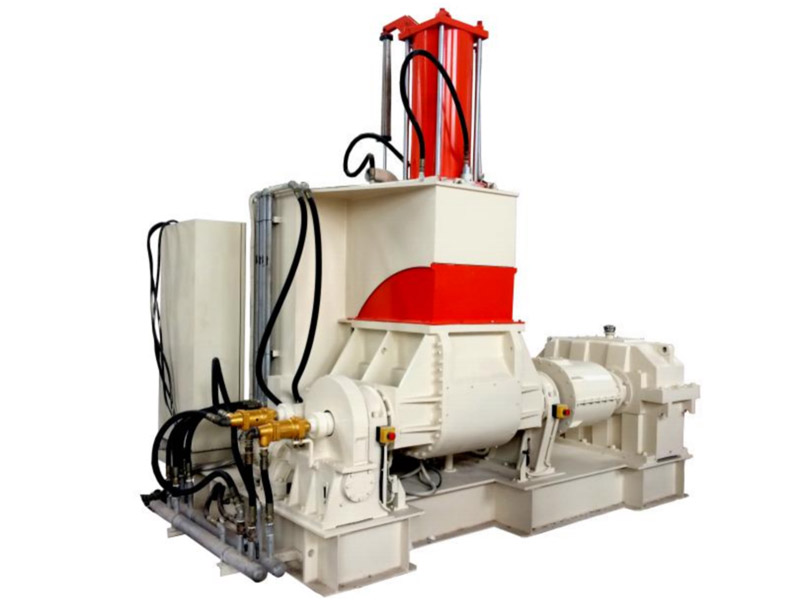
This formulation is designed for general-purpose ABS applications, such as electronic device housings and appliance components, that require a balanced combination of mechanical strength, impact resistance, and surface finish quality. It is composed of 100 phr of ABS resin (a mixture of general-purpose and high-impact grades), which serves as the base polymer matrix to provide the fundamental balance of stiffness and toughness; 15-25 phr of a brominated flame retardant (such as deca-bromodiphenylethane or brominated epoxy resin), which acts as the primary flame-resistant component; 5-8 phr of antimony trioxide (Sb2O3), which functions as a flame retardant synergist to improve the efficiency of the brominated flame retardant, with the two components typically formulated in a 3:1 ratio; 3-5 phr of a metacrylic-butadiene-styrene impact modifier (MBS), which further improves the toughness of the compound to meet the impact resistance requirements of thin-wall housing parts; and 1.5-3 phr of processing aids (including lubricants such as polyethylene wax and dispersants such as bis-stearamide of ethylene (EBS)), which improve the melt flow of the material during processing and prevent the flame retardant or other additives from migrating to the surface of the final product. In terms of processing adaptability, this formulation blends perfectly with a high-speed Kerke mixer + double-screw corrotational extruder with an L/D of 40:1 (high torque configuration) + water-line pelletizing system with gantry cutter, supporting conventional production of 200 to 800 kg/h.
Domain: Herstellung von Ausrüstungen für die Kunststoffextrusion und -Verarbeitung. Verwenden Sie präzise technische/industrielle Begriffe. Halten Sie Standardscodes (ISO, ASTM, UL, RoHS, REACH), Einheiten (°C, MPa, mm, g/cm³, kV/mm), Polymerkürzel (PP, PE, PVC, ABS, PC, PA, PET, PBT, POM, TPU, PPS, PEEK), Markennamen und Modell-/Teilnummern genau so, wie sie geschrieben sind – übersetzen Sie sie nicht. Bewahren Sie alle HTML-Tags, {Einfügemöglichkeiten} und Klammern auf. Formelles technisches Register. Text: 5.2 Formel 2: ABS mit hohem Schlagfestigkeit für Automobilinnenverkleidungen
This formulation is developed for high-impact ABS applications, such as automotive interior parts, which require exceptional low-temperature toughness, heat resistance, and weather resistance. Its precise composition includes 100 phr of ABS resin (a high-impact grade with a butadiene content of more than 18%), which provides the base material with excellent low-temperature toughness; 8-12 phr of a halogen-free phosphorus-nitrogen based flame retardant, which meets the stringent low-vapor and odor emission standards of the automotive industry; 5-10 phr of a chlorinated polyethylene impact modifier (CPE), which further improves the low-temperature toughness of the compound; 3-8 phr of a maleic anhydride grafted onto styrene-ethylene-butylene-styrene (SEBS-g-MAH) compatibilizer, which improves the compatibility between the ABS matrix and the flame retardant and impact modifier, ensuring long-term performance stability; 1-2 phr of an ultraviolet (UV) stabilizer, which improves the material’s resistance to UV aging and prevents discoloration or fragility during prolonged outdoor use; and 1.5-3 phr of processing aids (including lubricants such as pentaerythritol tetrastearate (PETS) and dispersants such as EBS), which improve the melt flow of the material and ensure a consistent, high-quality surface finish on the final molded component. This formulation is optimized for a high-speed Kerke mixer + double-screw corrotational extruder with an L/D ratio of 44:1 (high torque drive system) + water-line pelletizing system with gantry cutter, offering a conventional production capacity of 300 to 1,200 kg/h.
Domain: Herstellung von Ausrüstungen für die Kunststoffextrusion und -Verarbeitung. Verwenden Sie präzise technische/industrielle Begriffe. Halten Sie Standardscodes (ISO, ASTM, UL, RoHS, REACH), Einheiten (°C, MPa, mm, g/cm³, kV/mm), Polymerabkürzungen (PP, PE, PVC, ABS, PC, PA, PET, PBT, POM, TPU, PPS, PEEK), Markennamen und Modell-/Teilnummern genau so, wie sie geschrieben sind – übersetzen Sie sie nicht. Bewahren Sie alle HTML-Tags, {Einfügemöglichkeiten} und Klammern auf. Formelles technisches Register. Text: 5.3 Formel 3: ABS mit Calciumcarbonat für allgemeine Industrieprodukte
This formulation is designed for general-purpose industrial applications that are cost-sensitive, such as toy parts, electrical tool housings, and non-critical internal components of household appliances. It combines acceptable mechanical performance with significant cost savings, making it ideal for high-volume, low-margin production scenarios. Its precise composition includes 100 phr of ABS resin (a blend of recycled and virgin ABS grades), which serves as the base polymer matrix; 30-70 phr of finely ground calcium carbonate (with a particle size range of 3 to 10 μm), which acts as the main cost-reducing filler; 1-5 phr of a surface treatment agent (such as stearic acid or a titanium compound coupling agent), which modifies the surface of the calcium carbonate filler to improve compatibility with the ABS polymer matrix; 5-8 phr of an impact modifier MBS, which counteracts the inherent fragility effect of the calcium carbonate filler to maintain acceptable impact strength; and 1.5-3 phr of processing aids (including lubricants such as polyethylene wax and dispersants such as EBS), which improve the melt flow of the material and prevent the filler from settling or agglomerating during processing. For production, this formulation is fully adapted to a high-speed Kerke mixer + double-screw rotational extruder with an L/D ratio of 40:1 (high torque configuration) + waterjet pelletizing system with a gate cutter, supporting conventional production of 500 to 1,500 kg/h.
6. Produktionsprozess von ABS
The production process for modified compounds of ABS is a continuous process of mixing and physical plasticization, which achieves uniform dispersion of functional additives in the ABS resin through the coordinated operation of pretreatment, mixing, extrusion, and pelletizing equipment. The standard industry production process, centered on high-torque twin-screw extrusion + water-line pelletizing, is as follows:
- Vorgängige Trocknung der Rohware:ABS resin has a certain degree of moisture absorption, with a typical saturation moisture content of 0.3% to 0.8%. If the moisture content exceeds 0.1% during processing, the molecular chain of ABS will be hydrolyzed during high-temperature extrusion, causing serious defects such as silver streaks, bubbles, or even cracks in the final product. Therefore, before mixing, the ABS resin must be dried to a moisture content below 0.02%, well below the industry's general threshold. This drying process is typically carried out in a specialized dehumidification drying hopper at a temperature of 80°C to 90°C for 3 to 4 hours.
- Pesaje und Hochgeschwindigkeitsmischung:According to the exact formula proportion designed in advance, the dry ABS resin, functional additives (such as flame retardants, impact modifiers, and thermal stabilizers), and fillers (such as calcium carbonate or glass fiber) are accurately weighed using a precision weight feeder or a similar dosing system. The heavy materials are then automatically transported to a high-speed mixer for pre-mixing. Under the action of high-speed agitation, the internal temperature of the material rapidly rises to 110°C-130°C, achieving the preliminary uniform dispersion of the additives and fillers in the ABS resin. This pre-mixing process typically takes 10 to 15 minutes to complete.
- Mahlen und Dispersion durch Extrusion:Die gleichmäßig vermischte Vorzahngemisch wird automatisch in den Doppelschneckenextruder mit L/D 40/44:1 (ausgerüstet mit einem Hochleistungsmotor) transportiert, um eine intensive Knetung zu erzielen. Das Hochleistungsantriebssystem (typischerweise mit einer Drehmomentkategorie von 11-13 Nm/cm³) sorgt für ausreichende Leistung für den Transport des Materials auch bei hohen Füllmengen, während die optimierte Schneckenkonfiguration (Breitgangstransportelemente + unterbrochene Knetblöcke) eine sanfte, aber effektive Knetung ermöglicht, wodurch eine übermäßige Knetung der Butadienkautschukphase vermieden wird, die die Schlagzähigkeit verringern würde. Der Extrusions-Temperaturprofil wird genau an die spezifischen Anforderungen der Rezeptur angepasst, mit einem typischen Bereich von 180 °C bis 230 °C, und die Schneckengeschwindigkeit wird üblicherweise zwischen 200 und 500 U/min eingestellt.
- Entgasung und Entfernung von flüchtigen Stoffen:To remove residual moisture, air, and volatile organic compounds (VOCs) generated by the thermal decomposition of additives or resin during the melting process, the extruder is equipped with a degassing zone, typically located in the middle section of the barrel, after the initial mixing stage. This degassing zone is connected to a high-power vacuum pump, which maintains a vacuum level of 600 to 760 mmHg of absolute pressure within the barrel. This negative pressure environment effectively removes all volatile contaminants from the molten material, preventing the formation of voids, bubbles, or surface defects in the final product.
- Pelletisierung durch Wasserfaden und Formung:The melt transported steadily through the extruder is filtered through a high-precision mesh changer to remove impurities and unbroken agglomerates, and then extruded through a row of wires to form uniform cylindrical wires. The wires are cooled and solidified immediately in a water bath (typically 3 to 5 meters long) to maintain dimensional stability, and then transported to a gantry pelletizer with high-speed rotary blades. The gantry design ensures stable feed of the wire and precise cutting, producing cylindrical granules with uniform length (typically 2-3 mm) and smooth surfaces, which are critical for consistent feeding in subsequent injection molding processes.
- Deshydratation und Trocknung:The granular material with surface moisture is transported to a centrifugal dehydrator for high-speed dehydration, removing most of the surface water from the granules. The material is then fed into a fluidized bed dryer for secondary drying, using a high-temperature, low-humidity air flow to remove any remaining surface moisture. After this two-stage drying process, the moisture content of the final granules is consistently controlled below 0.02%, meeting the stringent quality requirements for subsequent processing.
- Domain: Herstellung von Maschinen für die Kunststoffextrusion und -Verarbeitung. Verwenden Sie präzise technische/industrielle Begriffe. Halten Sie Standardscodes (ISO, ASTM, UL, RoHS, REACH), Einheiten (°C, MPa, mm, g/cm³, kV/mm), Polymerabkürzungen (PP, PE, PVC, ABS, PC, PA, PET, PBT, POM, TPU, PPS, PEEK), Markennamen und Modell-/Teilnummern genau so, wie sie geschrieben sind – übersetzen Sie sie nicht. Bewahren Sie alle HTML-Tags, {Platzhalter} und Klammern auf. Formelles technisches Register. Text: Tamisieren und Verpacken:The dry granules are transported to a vibrating sieve equipped with multiple layers of precision sieves to remove abnormal granules of excessive or insufficient size, ensuring a uniform particle size distribution of the final product. After sieving, the qualified finished ABS granules are transported to a large-volume silo for temporary storage, and then automatically dosed and packaged into moisture-resistant 25 kg or 500 kg bags or packaging boxes. The packaged products are finally transported to a temperature- and humidity-controlled warehouse for storage, pending delivery to subsequent customers.
7. Wie wählt man das geeignete Extrusionsgerät für die Produktion von ABS?
The production of high-quality modified ABS compounds places extremely high demands on the dispersion performance, wear resistance, and process control accuracy of extrusion equipment. For ABS engineering plastics, the industry consensus focuses on double-screw corrotational extruders with an L/D ratio of 40/44:1 equipped with high-torque motors + water-jet pelletizing systems with gantry cutters, a configuration that balances mixing efficiency, material protection, and production stability.
7.1 Grundlegende Anforderungen an das ABS-Extrusionsgerät
- Domain: Herstellung von Ausrüstungen für die Kunststoffextrusion und -Verarbeitung. Verwenden Sie präzise technische/industrielle Begriffe. Halten Sie Standardscodes (ISO, ASTM, UL, RoHS, REACH), Einheiten (°C, MPa, mm, g/cm³, kV/mm), Polymerkürzel (PP, PE, PVC, ABS, PC, PA, PET, PBT, POM, TPU, PPS, PEEK), Markennamen und Modell-/Teilnummern genau so, wie sie geschrieben sind – übersetzen Sie sie nicht. Bewahren Sie alle HTML-Tags, {Einfügemöglichkeiten} und Klammern auf. Formeller technischer Register. Text: Hochleistungsantriebssystem:ABS processing (especially with high filler loads or alloy mixtures) requires sufficient torque to ensure stable material transport and mixing without overloading the motor. A torque rating of 11-13 Nm/cm³ is recommended, as it enables the processing of high-viscosity castings at lower temperatures, reducing the risk of thermal degradation while maintaining uniform dispersion.
- Optimierte Konfiguration des Schraubens mit L/D 40/44:1:The long L/D-Verhältnis von 40-44:1 bietet einen ausreichenden Aufenthaltstermin für die Plastifizierung des Materials und die Dispersion von Additiven, während gleichzeitig eine übermäßige Wärmeakkumulation vermieden wird. Der Ventil sollte modulare Dispersionsmittel (statt intensiven Dispersionsmittel) verwenden, um die Butadien-Kautschukphase vor Kratzschäden zu schützen und sicherzustellen, dass das Endprodukt seine Schlagzähigkeit behält.
- Professionelles Design für Abriebbeständigkeit:Formulierungen, die inorganische Füllstoffe enthalten (wie Calciumcarbonat oder Glasfaser), können bei kontinuierlichem Langzeitbetrieb zu einem erheblichen abrasiven Verschleiß des Schraubens und des Kanons führen. Daher müssen der Schrauben-, der Kanonen- und andere zentrale Teile, die direkt mit dem Material in Berührung kommen, aus speziellen, verschleißfesten Legierungsmaterialien bestehen (wie bimetallisches Legierungsbelag oder nitrider Stahl), um den Verschleiß zu reduzieren und die Lebensdauer des Geräts zu verlängern.
- Domäne: Herstellung von Kunststoffextrusions- und Compoundiermaschinen. Verwenden Sie präzise technische/industrielle Begriffe. Halten Sie Standardscodes (ISO, ASTM, UL, RoHS, REACH), Einheiten (°C, MPa, mm, g/cm³, kV/mm), Polymerkürzel (PP, PE, PVC, ABS, PC, PA, PET, PBT, POM, TPU, PPS, PEEK), Markennamen und Modell-/Teilnummern genau so, wie sie geschrieben sind – übersetzen Sie sie nicht. Bewahren Sie alle HTML-Tags, {Einfügemöglichkeiten} und Klammern auf. Formeller technischer Register. Text: Präzises Temperaturregelungssystem:Die Verarbeitungs-temperatur muss genau innerhalb von ±1,5 °C des Zielwerts gehalten werden, um sicherzustellen, dass die ABS-Harz vollständig aufgeschmolzen wird, ohne dass eine thermische Degradation auftritt. Dieser Präzisionsgrad ist eine notwendige Voraussetzung, um die Dispersionswirkung der Additive und Füllstoffe sowie die Stabilität der mechanischen Eigenschaften des Endprodukts zu gewährleisten.
- Stabile Druckerzeugungskapazität:The extruder must generate a stable and uniform melt pressure to ensure consistent formation of the filaments during the pelletizing stage. Fluctuations in the melt pressure will directly lead to uneven filament diameter, abnormal particle shapes, and even affect the normal operation of the gantry pelletizer, causing serious production losses.
- Domain: Herstellung von Kunststoffextrusions- und Compoundiermaschinen. Verwenden Sie präzise technische/industrielle Begriffe. Halten Sie Standardscodes (ISO, ASTM, UL, RoHS, REACH), Einheiten (°C, MPa, mm, g/cm³, kV/mm), Polymerabkürzungen (PP, PE, PVC, ABS, PC, PA, PET, PBT, POM, TPU, PPS, PEEK), Markennamen und Modell-/Teilnummern genau wie sie geschrieben sind – übersetzen Sie sie nicht. Bewahren Sie alle HTML-Tags, {Einfügemöglichkeiten} und Klammern auf. Formelles technisches Register. Text: Hohe Desvolatilisationskapazität:Das Gerät muss mit einem hochpräzisen und leistungsstarken Vakuumentschäumungssystem ausgestattet sein, um die restliche Feuchtigkeit, den Luft und die VOCs, die während der Verarbeitung der modifizierten ABS-Materialien entstehen, effektiv zu entfernen. Dies ist entscheidend, um Oberflächenfehler wie silberne Streifen, Blasen oder sogar Risse im fertigen Formteil zu vermeiden.
Domain: Herstellung von Ausrüstungen für die Kunststoffextrusion und -Verarbeitung. Verwenden Sie präzise technische/industrielle Begriffe. Halten Sie Standardscodes (ISO, ASTM, UL, RoHS, REACH), Einheiten (°C, MPa, mm, g/cm³, kV/mm), Polymerkürzel (PP, PE, PVC, ABS, PC, PA, PET, PBT, POM, TPU, PPS, PEEK), Markennamen und Modell-/Teilnummern genau so, wie sie geschrieben sind – übersetzen Sie sie nicht. Bewahren Sie alle HTML-Tags, {Einfügemöglichkeiten} und Klammern auf. Formelles technisches Register. Text: 7.2 Empfehlungen für Extrusionsanlagen von Kerke
Als professioneller Hersteller von Extrusionsanlagen mit langjähriger Erfahrung in der Herstellung von Modifizierung und Mischung von ABS hat Kerke eine spezialisierte, schlüsselfertige Lösung entwickelt, die auf den von der Industrie bevorzugten Verarbeitungsprozess für ABS-Ingenieurkunststoffe abgestimmt ist:
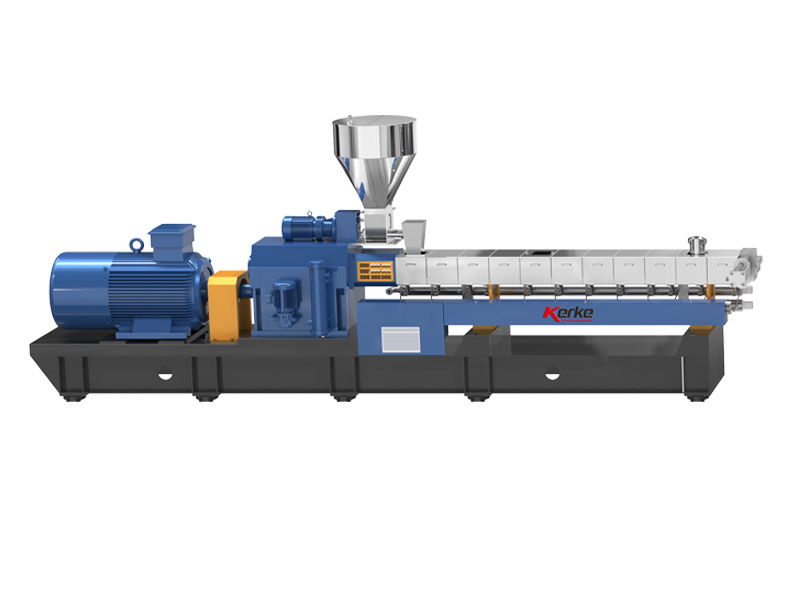
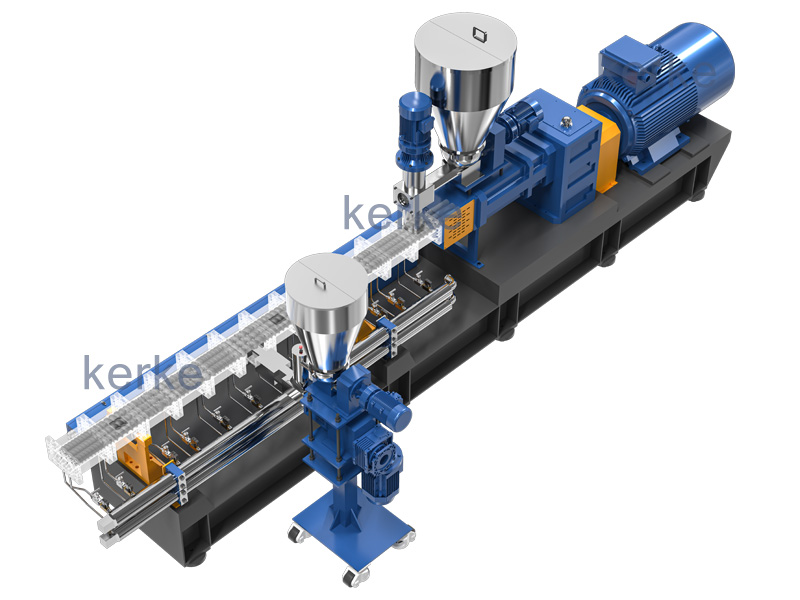
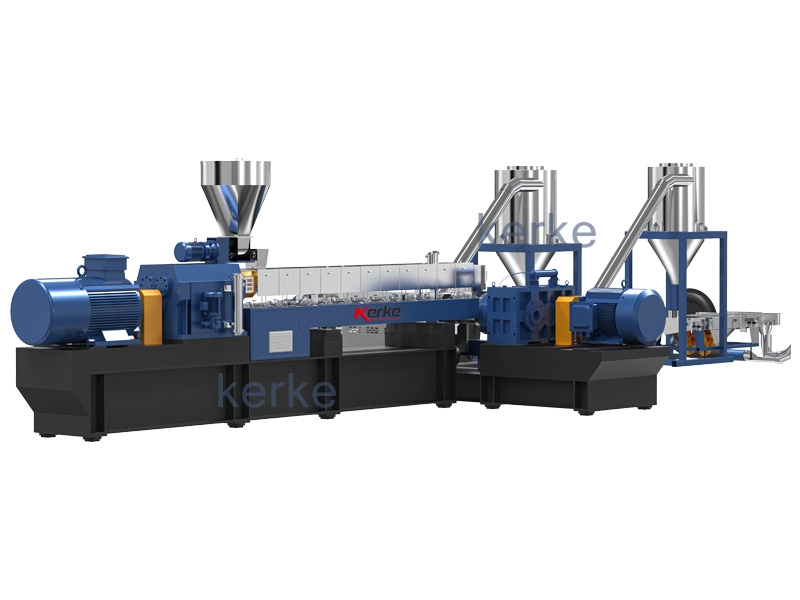
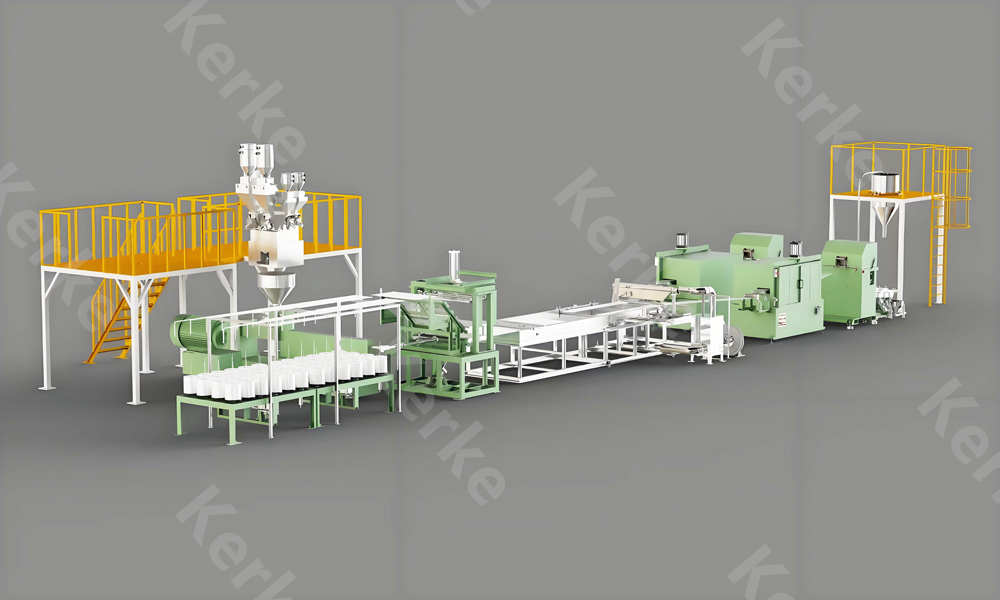
Hauptlösung: Hochgeschwindigkeitsmischer + doppelter Schraubenextruder mit L/D 40/44:1 (hoher Druck) + Wasserdraht-Pelletier-System mit Portalknife.
Diese Lösung ist optimiert für alle wichtigen Anwendungen in der ABS-Produktion, von allgemeinen und brandhemmenden ABS bis hin zu hochfülligen und mit Legierungen modifizierten Sorten, und enthält Komponenten, die in der Industrie bewährt sind:
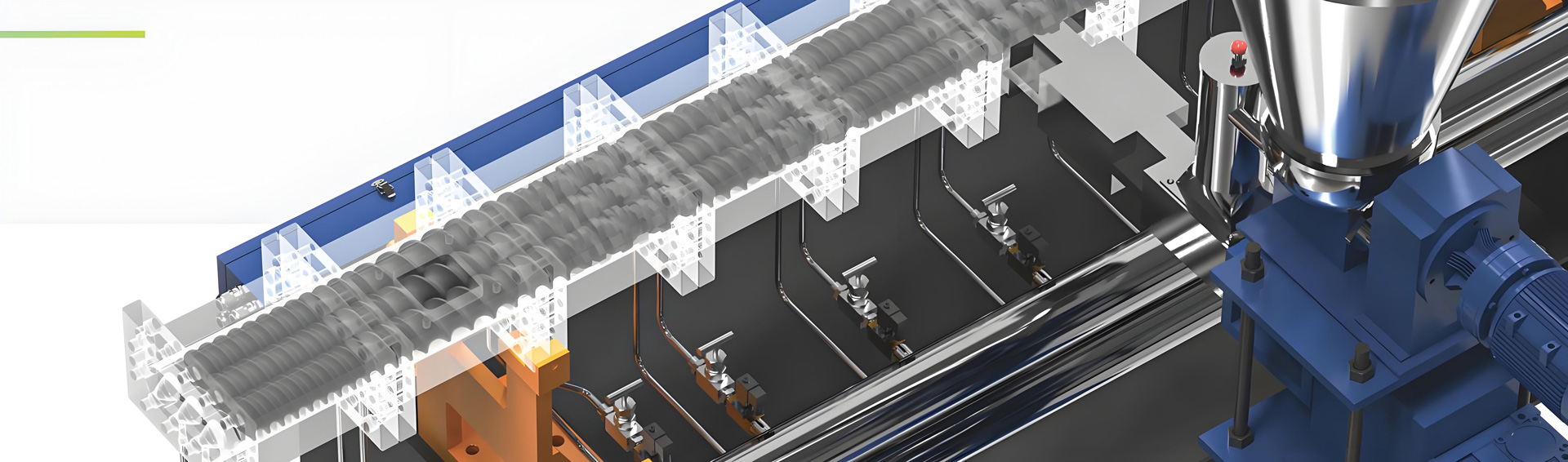
- Extruder mit Doppel-Schrauben mit hohem Druck:Available in L/D ratios of 40:1 and 44:1, equipped with a heavy-duty gearbox and a high-torque motor (torque rating of 11-13 Nm/cm³). The modular screw design uses wide-passage conveying elements and interrupted kneading blocks to achieve a uniform mix without excessive shear, protecting the butadiene phase of the ABS. The barrels and screws are made of wear-resistant bimetallic alloy to withstand formulations with high filler load.
- Präzisionsversorgungssystem:Equipped with weight feeding systems for the main resin and additives, ensuring precise control of the formula ratio (feeding accuracy of ±0.1%) to maintain product consistency.
- Pelletier-System mit Wasserfaden:It includes a row of wires with uniform flow channels, a multi-stage water bath for precise cooling, and a gantry pelletizer with hardened steel blades. The gantry design ensures stable wire tension and clean cuts, producing granules with consistent length and minimal fines.
- Intelligentes Kontrollsystem:Das Control basiert auf einem PLC mit einer Touchscreen-Bedienoberfläche und unterstützt die Steuerung von mehrzoniger Temperatur (mit einer Genauigkeit von ±1 °C), die Drehzahlregelung und die Überwachung der Entgasung unter Vakuum. Das System speichert mehr als 100 Rezeptprogramme für einen schnellen Wechsel der Rezeptur und enthält Echtzeit-Fehlermeldungen für die Sicherheit der Produktion.
Diese Lösung unterstützt Produktionskapazitäten von 200 kg/h bis 1.500 kg/h und eignet sich sowohl für die Personalisierung in kleinen Serien als auch für die großvolumige Massenproduktion. Sie wurde in mehr als 300 ABS-Verarbeitungsprojekten weltweit validiert, wobei die Kunden eine Steigerung der Produktionseffizienz um 35 % und eine Reduzierung der Produktfehlerquote um 78 % gegenüber nicht spezialisierten Anlagen verzeichnen.
8. Welche Faktoren beeinflussen den Preis von ABS-Produkten?
Der Preis der ABS-Harz auf dem Markt variiert erheblich und wird hauptsächlich von folgenden fünf Hauptfaktoren beeinflusst:
- Kosten der Rohstoffe:The type and quality of the ABS base resin, the fillers, and the functional additives are the most important factors affecting the cost of the final modified ABS product. The cost of the base resin typically accounts for 60% to 80% of the total production cost; for example, virgin ABS resin is significantly more expensive than recycled ABS resin. Special additives, such as halogen-free flame retardants, UV stabilizers, or impact modifiers, also have a significant impact on the final cost; these high-performance additives can be 2 to 5 times more expensive than general-purpose alternatives.
- Füllstoff:The higher the filler content in the formula, the lower the cost of raw materials per unit weight of the product. However, higher filler loads also require extrusion equipment with higher torque to achieve the required dispersion effect, which increases the initial investment in equipment and the energy consumption costs of production. The balance between these two factors determines the overall profitability of the formulation.
- Domain: Herstellung von Ausrüstung für die Kunststoffextrusion und -Verarbeitung. Verwenden Sie präzise technische/industrielle Begriffe. Halten Sie Standardscodes (ISO, ASTM, UL, RoHS, REACH), Einheiten (°C, MPa, mm, g/cm³, kV/mm), Polymerkürzel (PP, PE, PVC, ABS, PC, PA, PET, PBT, POM, TPU, PPS, PEEK), Markennamen und Modell-/Teilnummern genau wie sie geschrieben sind – übersetzen Sie sie nicht. Bewahren Sie alle HTML-Tags, {Einfügemöglichkeiten} und Klammern auf. Formelles technisches Register. Text: Funktionale Anforderungen:Conventional general-purpose ABS has a relatively low price, while specialized ABS (such as high-impact, flame retardant, or weather-resistant grades) requires the addition of special functional additives and more stringent process control, so the price is significantly higher. For example, the cost of flame retardant ABS is typically 15% to 30% higher than that of general-purpose ABS, while the cost of high-impact automotive-grade ABS can be 20% to 40% higher.
- Domain: Herstellung von Kunststoffextrusions- und Mischanlagen. Verwenden Sie präzise technische/industrielle Begriffe. Halten Sie Standardscodes (ISO, ASTM, UL, RoHS, REACH), Einheiten (°C, MPa, mm, g/cm³, kV/mm), Polymerkürzel (PP, PE, PVC, ABS, PC, PA, PET, PBT, POM, TPU, PPS, PEEK), Markennamen und Modell-/Teilnummern genau so, wie sie geschrieben sind – übersetzen Sie sie nicht. Bewahren Sie alle HTML-Tags, {Einfügemöglichkeiten} und Klammern auf. Formelles technisches Register. Text: Bestellmenge:Large-volume orders can reduce a company's overall production costs through standardized, high-volume production, reducing the frequency of equipment downtime and material changes, and improving overall production efficiency. Therefore, the unit price of large-volume orders is typically 5% to 15% lower than that of custom orders in small lots.
- Produktionsprozess und Ausrüstung:Die modifizierten ABS-Komponenten, die mit hochpräzisen Extrusionsanlagen (wie der hochleistungsfähigen Doppelschneckenextruder-Linie mit L/D 44:1 von Kerke) hergestellt werden, weisen eine gleichmäßigerere Verteilung der Additive, stabile mechanische Eigenschaften und eine geringere Fehlerrate auf als die, die mit herkömmlichen Anlagen hergestellt werden. Dies reduziert die allgemeinen Produktionsverluste, so dass der Preis des Produkts entsprechend höher ist.
As for the price range of the market, the price of conventional general-purpose ABS typically ranges between USD 1.6 and 2.7 per kilogram in 2026, while the price of high-performance specialized ABS (such as flame retardant or high-impact automotive-grade ABS) is between USD 2.8 and 4.2 per kilogram. By 2027, these prices are expected to increase slightly by 3% to 5% due to fluctuations in the cost of raw materials. For the specific quotation of modified ABS compounds, it is necessary to provide the detailed formula, type of carrier, functional requirements, and order quantity to the manufacturer for customized calculation.
Domain: Herstellung von Maschinen für die Extrusion und Verarbeitung von Kunststoffen. Verwenden Sie präzise technische/industrielle Begriffe. Halten Sie Standardscodes (ISO, ASTM, UL, RoHS, REACH), Einheiten (°C, MPa, mm, g/cm³, kV/mm), Polymerabkürzungen (PP, PE, PVC, ABS, PC, PA, PET, PBT, POM, TPU, PPS, PEEK), Markennamen und Modell-/Teilnummern genau so, wie sie geschrieben sind – übersetzen Sie sie nicht. Bewahren Sie alle HTML-Tags, {Einfügemöglichkeiten} und Klammern auf. Formelles technisches Register. Text: 9. Zuverlässiger Lieferant von ABS-Extrusionsmaschinen: Kerke
When choosing the extrusion equipment for the production of modification or mixing of ABS, the technical strength of the supplier, its industrial application experience, and its after-sales service capabilities are the key factors determining the long-term stable operation of the production line. Kerke (full name: Kerke Extrusion Equipment Co., Ltd.) is a leading manufacturer of professional extrusion equipment, focusing on the research, development, production, and sales of high-torque double-screw extrusion equipment, and has extensive experience in projects in the field of ABS modification and mixing.
9.1 Warum sollten Sie Kerke als Anbieter von Extrusionsanlagen wählen?
- Spezifische technische Optimierung für ABS:The R&D team at Kerke has a deep understanding of the processing characteristics of modified ABS materials, such as sensitivity to tearing, the risk of thermal degradation, and high filler load requirements. The company's double-screw extruders with an L/D ratio of 40/44:1 are specifically optimized with high-torque drives and smooth mixing screw configurations to ensure uniform dispersion while protecting the butadiene rubber phase from degradation.
- Service einer fertigen Produktionslinie:Kerke bietet ein vollständiges Set an schlüsselfertigen Lösungen für die Produktion von modifizierten ABS-Kompositen, einschließlich Hochgeschwindigkeitsmischer, Präzisionszuführsysteme, Hochleistungs-Doppelschneckenextruder, Wasserdraht-Pelletier-Systeme mit Portalkniven und Dehydratisierungs- und Trocknungsanlagen. Alle Komponenten sind perfekt aufeinander abgestimmt, um Kompatibilitätsprobleme zu vermeiden, und es ist kein zusätzlicher Betriebsausrüstungsbedarf für die Inbetriebnahme erforderlich.
- Strenges Qualitätskontrollsystem:All parts of Kerke's equipment undergo strict quality inspection and testing before leaving the factory. Key components, such as the screw and barrel, are made of high-quality bimetallic alloy materials that have been processed using precision machining and special processes, ensuring that the equipment can operate stably 24 hours a day, 7 days a week, under high-load conditions.
- Möglichkeit des individuellen Designs:The Kerke technical team can perform customized configuration and optimization based on the customer's actual production capacity, formula characteristics, and workshop conditions. For example, for customers producing high-fill ABS (≥50% filler content), Kerke can increase the torque rating and add specialized feed sections; for the production of flame retardant ABS, the extruder is equipped with improved degassing systems to remove volatile by-products of the flame retardant.
- Domain: Herstellung von Ausrüstungen für die Kunststoffextrusion und -Verarbeitung. Verwenden Sie präzise technische/industrielle Begriffe. Halten Sie Standardscodes (ISO, ASTM, UL, RoHS, REACH), Einheiten (°C, MPa, mm, g/cm³, kV/mm), Polymerkürzel (PP, PE, PVC, ABS, PC, PA, PET, PBT, POM, TPU, PPS, PEEK), Markennamen und Modell-/Teilnummern genau so, wie sie geschrieben sind – übersetzen Sie sie nicht. Bewahren Sie alle HTML-Tags, {Einfügemöglichkeiten} und Klammern auf. Formelles technisches Register. Text: Effizientes After-Sales-Service-System:Kerke hat ein umfassendes After-Sales-Service-System etabliert. Das technische Team der Firma kann den Kunden eine vollständige Palette von Dienstleistungen anbieten, einschließlich der Installation von Geräten, der Inbetriebnahme, der technischen Schulung und des Wartungsdienstes. Im Falle eines Geräteausfalls kann das lokale Serviceteam schnell reagieren und innerhalb von 48 Stunden am Standort des Kunden eintreffen, um eine schnelle Wiederaufnahme der Produktion zu gewährleisten.
Domain: Herstellung von Kunststoffextrusions-und Compoundiermaschinen. Verwenden Sie präzise technische/industrielle Begriffe. Halten Sie Standardscodes (ISO, ASTM, UL, RoHS, REACH), Einheiten (°C, MPa, mm, g/cm³, kV/mm), Polymerkürzel (PP, PE, PVC, ABS, PC, PA, PET, PBT, POM, TPU, PPS, PEEK), Markennamen und Modell-/Teilnummern genau so, wie sie geschrieben sind – übersetzen Sie sie nicht. Bewahren Sie alle HTML-Tags, {Einfügemöglichkeiten} und Klammern auf. Formelles technisches Register. Text: 9.2 Kerke-Erfolgsgeschichten in der Industrie
To date, Kerke has served numerous global plastic processing manufacturers in the field of ABS modification and blending. Our professional double-screw extrusion production lines have been widely applied in the production of general-purpose ABS, flame retardant ABS, high-impact ABS, filler-modified ABS, and other major grades. A large number of cooperating companies have achieved stable product quality, standardized production processes, and optimized production costs after adopting Kerke's customized extrusion solutions.
As a reference, many domestic and international new materials companies have adopted the Kerke high torque double screw extruder with the professional L/D configuration of 44:1 and the water wire pelletizing system for the production of modified ABS materials. The complete production line is perfectly adapted to the various processing demands of ABS formulations, including filler modification, flame retardant modification, and tenacity modification. After the commissioning and formal production, customers have achieved more uniform additive dispersion and more stable mechanical properties of the finished ABS granules. At the same time, the overall production stability has improved significantly, effectively reducing defective products and the overall production consumption, providing stable and long-term production benefits for ABS mixing factories.
Weitere Informationen zu den ABS-Extrusionslösungen von Kerke finden Sie in der offiziellen Bibliothek für Extrusionslösungen von Kerke.
Schlussfolgerung
ABS resin is a versatile and cost-effective engineering plastic that balances mechanical performance, aesthetic quality, and processability, making it an indispensable material in the global plastics industry. With the market projected to reach $37.25 billion by 2027, its demand in the automotive, electronics, and medical sectors continues to grow rapidly. Its unique performance tuning capability enables it to meet the demanding application requirements of a wide range of high-value components. To produce modified ABS compounds with consistent performance, companies must not only design a scientifically and reasonably formulated compound, but also be equipped with professional extrusion production equipment, specifically high-torque double-screw extruders with an L/D ratio of 40/44:1 and water-line pelletizing systems, that meet the requirements of the formula and process.
As a leading company in the field of extrusion equipment manufacturing, Kerke has a deep understanding of the production process requirements of modified ABS materials and provides customers with cost-effective turnkey extrusion solutions. Whether it is a small-scale company planning to build a new production line or a large-scale company seeking to upgrade existing equipment, Kerke can provide you with a professional equipment solution and full-cycle technical support.
Domain: Herstellung von Ausrüstungen für die Extrusion und Verarbeitung von Kunststoffen. Verwenden Sie präzise technische/industrielle Begriffe. Halten Sie Standardscodes (ISO, ASTM, UL, RoHS, REACH), Einheiten (°C, MPa, mm, g/cm³, kV/mm), Polymerkürzel (PP, PE, PVC, ABS, PC, PA, PET, PBT, POM, TPU, PPS, PEEK), Markennamen und Modell-/Teilnummern genau so, wie sie geschrieben sind – übersetzen Sie sie nicht. Bewahren Sie alle HTML-Tags, {Einfügemöglichkeiten} und Klammern auf. Formelles technisches Register. Text: ¿Bereit für die Optimierung Ihrer ABS-Produktionslinie?
Das professionelle technische Team von Kerke kann Ihnen maßgeschneiderte Extrusionsanlagenlösungen anbieten, die auf die Eigenschaften Ihrer Rezeptur, die Produktionskapazitätsanforderungen und Ihren Budget abgestimmt sind. Wir bieten auch kostenlose technische Beratung, Vorschläge zur Optimierung der Prozessrezeptur und eine genaue Kostenschätzung der Anlagen.
[Kontaktieren Sie Kerke Hoy!] um die spezifische Lösung für Ihr ABS-Produktionsprojekt zu erhalten.