Introduction
White masterbatch is one of the most widely used color concentrates in the plastics industry, with a global market size projected to reach $3.2 billion by 2028 according to Grand View Research. Used to impart bright, consistent white color to a wide range of plastic products, from packaging materials to automotive parts, white masterbatch offers numerous benefits over on-site pigment mixing, including improved color consistency, reduced waste, and enhanced processing efficiency.
High speed twin screw extruders have emerged as the preferred equipment for white masterbatch production due to their unique design and superior performance characteristics. Unlike conventional twin screw extruders, high speed models offer higher shear rates, better mixing efficiency, and faster processing, making them ideal for handling high concentrations of titanium dioxide pigment, which can be difficult to disperse uniformly.
This comprehensive guide provides detailed information on every aspect of white masterbatch production using high speed twin screw extruders, including formulation design, production processes, equipment selection, parameter optimization, troubleshooting, and maintenance best practices.
Formulation Ratios
The formulation ratio is a critical factor in determining the performance and cost-effectiveness of white masterbatch. The ideal ratio depends on the type of titanium dioxide, carrier resin, and intended application. Here are the most common formulation types and their typical ratios:
High-concentration White Masterbatch
High-concentration white masterbatch contains a high percentage of titanium dioxide pigment, typically used for dilution during final production. Typical formulations include:
Ultra-high concentration: 60-70% titanium dioxide + 30-40% carrier resin
High concentration: 50-60% titanium dioxide + 40-50% carrier resin
Standard concentration: 40-50% titanium dioxide + 50-60% carrier resin
Low concentration: 30-40% titanium dioxide + 60-70% carrier resin
The choice of ratio depends on factors such as titanium dioxide type, desired color intensity, and cost considerations. Rutile titanium dioxide typically requires lower concentrations due to its higher hiding power, while anatase titanium dioxide may need higher concentrations for optimal coverage.
Specialty White Masterbatch
Specialty white masterbatch formulations incorporate additional additives to enhance specific properties or meet unique application requirements. Common formulations include:
UV-stabilized white masterbatch: 40-50% titanium dioxide + 45-55% carrier resin + 5-10% UV stabilizer
Matte white masterbatch: 40-50% titanium dioxide + 50-60% carrier resin + 5-10% matting agent
High-gloss white masterbatch: 40-50% high-purity titanium dioxide + 50-60% carrier resin + 1-5% flow promoter
Optical brightening white masterbatch: 30-40% titanium dioxide + 55-65% carrier resin + 5-10% optical brightener
Carrier Resin Selection
The choice of carrier resin is critical to the performance of white masterbatch. Common carrier resins include:
Polyethylene (PE): Most widely used carrier resin for white masterbatch due to its low cost, good compatibility with most plastics, and excellent processing characteristics.
Polypropylene (PP): Used for applications requiring higher temperature resistance or better mechanical properties.
Polystyrene (PS): Used for applications requiring high gloss or transparency.
Engineering plastics: Used for specialized applications requiring specific performance characteristics, such as high heat resistance or chemical resistance.
Production Process
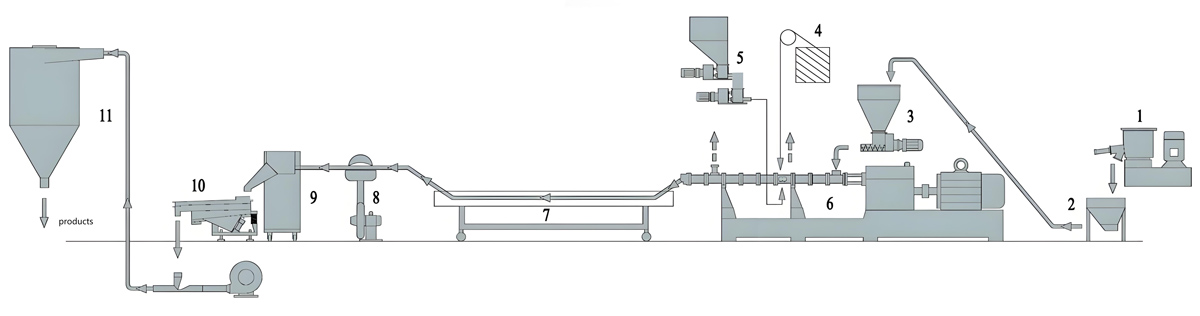
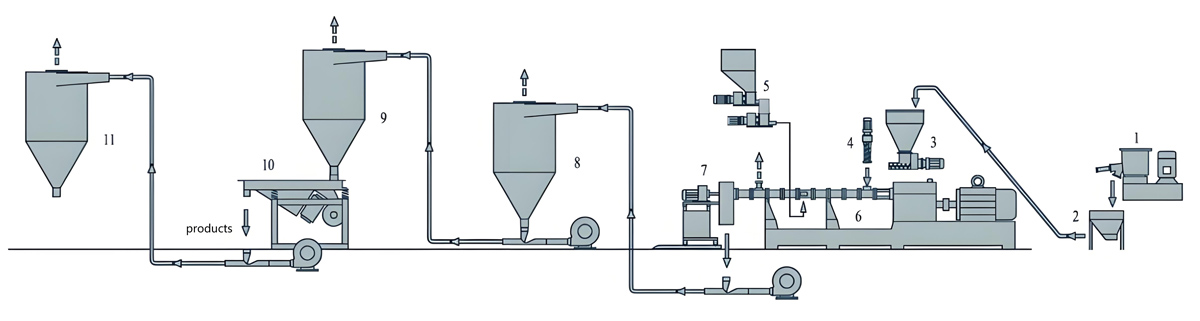
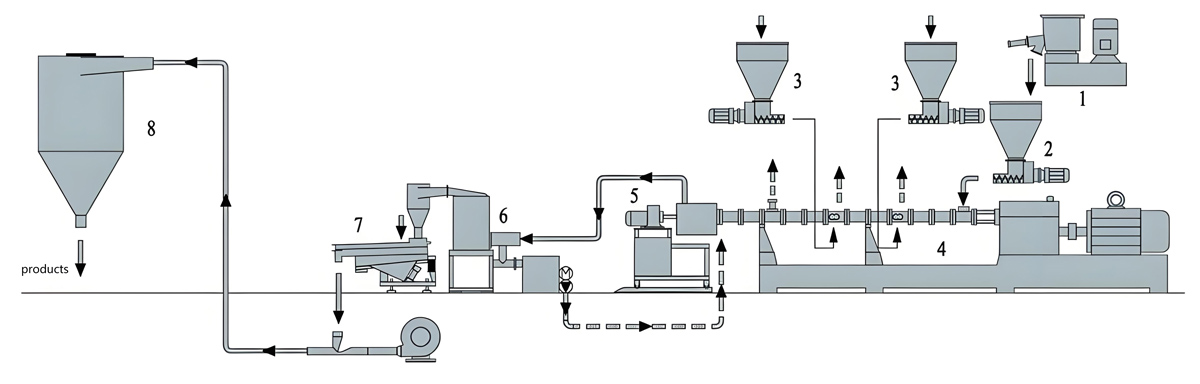
The production of white masterbatch using high speed twin screw extruders involves several interconnected stages, each requiring precise control to ensure consistent quality and performance:
1. Raw Material Preparation
Proper material preparation is essential to avoid processing issues and ensure uniform dispersion of titanium dioxide pigment. This stage includes:
Drying: Carrier resins must be dried to a moisture content of less than 0.05% before processing to prevent bubble formation and degradation. This typically involves using a dehumidifying dryer at 60-80°C for 3-6 hours, depending on the resin type.
Weighing: All components must be accurately weighed according to the formulation ratio. Automated weighing systems with precision load cells are recommended to ensure batch-to-batch consistency.
Pre-blending: Titanium dioxide pigment and carrier resin are mixed in a high-speed mixer to create a homogeneous pre-blend before feeding into the extruder. This helps improve initial dispersion and reduces the risk of pigment segregation.
2. Feeding System
The feeding system must provide consistent, controlled material flow into the extruder to ensure uniform mixing and processing. Options include:
Volumetric feeders: Suitable for low-precision applications where batch consistency is less critical.
Loss-in-weight feeders: Provide precise control of material flow rate, with accuracy typically within ±0.5%. This is the preferred option for high-quality masterbatch production.
Side feeders: Used for adding fillers or additives that may be difficult to feed through the main hopper, or for introducing heat-sensitive materials later in the process to minimize degradation.
3. Extrusion Process
The high speed twin screw extruder performs the critical functions of melting, mixing, and homogenizing the material. The process can be divided into several zones:
Feeding zone: Material is introduced into the extruder and conveyed forward by the rotating screws.
Compression zone: The screw channel depth decreases, increasing pressure and starting the melting process.
Melting zone: Heat from the barrel heaters and mechanical shear from the screws completely melt the polymer.
Mixing zone: Specialized screw elements create high shear forces to disperse titanium dioxide pigment uniformly throughout the polymer matrix.
Degassing zone: A vacuum port removes volatile gases, moisture, or byproducts from the melt.
Metering zone: The screw geometry ensures consistent melt pressure and flow rate into the die.
4. Pelletization
After exiting the extruder die, the molten polymer is formed into pellets through one of several methods:
Strand pelletization: The molten polymer is extruded through a die plate to form strands, which are cooled in a water bath, dried, and cut into pellets. This is the most common method for white masterbatch production.
Underwater pelletization: The molten polymer is cut into pellets immediately upon exiting the die, with the pellets being cooled and solidified in a water-filled chamber. This method offers faster cooling and reduced strand breakage.
Hot face pelletization: The molten polymer is cut into pellets above the melting point, with the pellets being cooled by air or water spray. This method is less common for white masterbatch due to the risk of pigment migration.
5. Post-Processing
The final stage of production includes:
Screening: Pellets are passed through vibrating screens to remove oversized or undersized particles.
Packaging: Pellets are packaged in moisture-resistant bags or containers to prevent reabsorption of moisture and maintain product quality.
Quality control: Samples are tested for properties such as color consistency, pigment dispersion, and melt flow index.
Production Equipment Introduction
High Speed Twin Screw Extruder
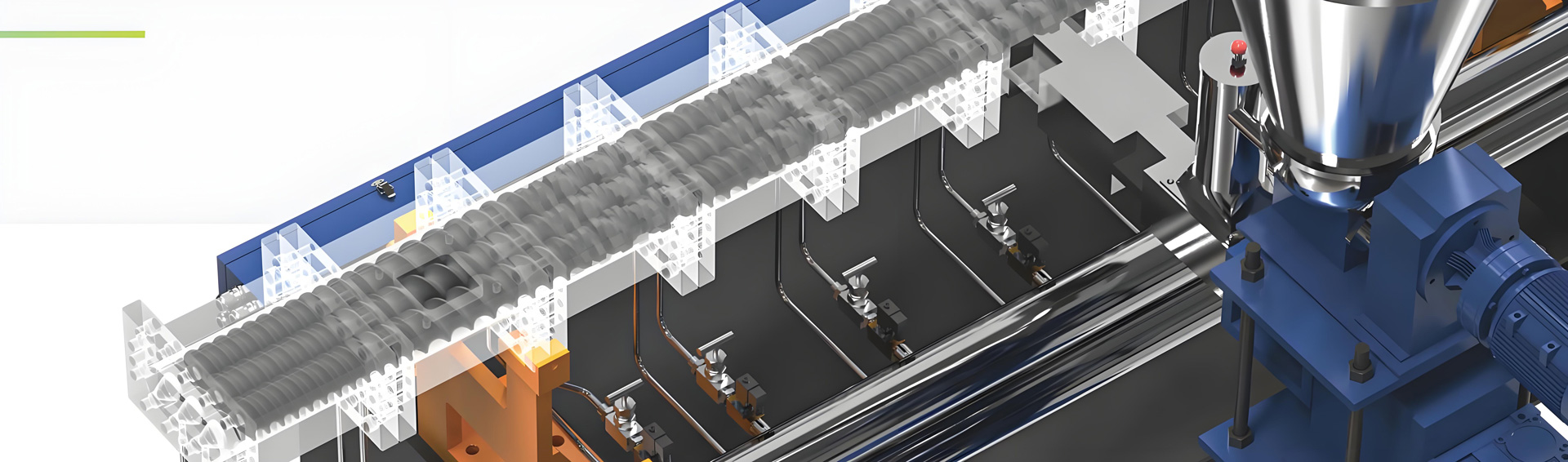
The high speed twin screw extruder is the core equipment in white masterbatch production. For this application, the KTE Series high speed twin screw extruder from Nanjing Kerke Extrusion Equipment Co., Ltd. is the preferred choice due to its advanced design and proven performance with titanium dioxide pigment.
Key features of the KTE Series high speed twin screw extruder include:
Intermeshing co-rotating design: Provides excellent mixing efficiency and self-wiping action, preventing material buildup and ensuring uniform temperature distribution.
Modular screw design: Allows for easy configuration changes to optimize processing for different formulations and production requirements.
Precise temperature control: Multiple heating/cooling zones with PID controllers maintain tight temperature tolerances critical for white masterbatch production.
High torque transmission: Handles the high viscosity of filled or reinforced formulations without stalling.
High speed capability: Operates at speeds up to 1000 rpm, providing superior mixing efficiency and faster processing.
Auxiliary Equipment
In addition to the high speed twin screw extruder, several auxiliary systems are required for a complete white masterbatch production line:
Drying system: Dehumidifying dryers with integrated hopper loaders ensure consistent moisture control.
Feeding system: Loss-in-weight feeders for precise material metering.
Pelletizing system: Strand or underwater pelletizer with integrated water bath and drying system.
Vacuum system: For degassing volatile compounds during extrusion.
Control system: PLC-based control system with HMI interface for easy operation and data logging.
Parameter Settings
Proper parameter setting is critical to achieving optimal results in white masterbatch production using high speed twin screw extruders. Here are the key parameters and their typical ranges:
Temperature Profile
The temperature profile depends on the type of carrier resin used. Typical temperature profiles for common carrier resins include:
Polyethylene (PE)
Feeding zone: 140-150°C
Compression zone: 150-160°C
Melting zone: 160-170°C
Mixing zone: 170-180°C
Degassing zone: 160-170°C
Metering zone: 150-160°C
Die: 140-150°C
Polypropylene (PP)
Feeding zone: 160-170°C
Compression zone: 170-180°C
Melting zone: 180-190°C
Mixing zone: 190-200°C
Degassing zone: 180-190°C
Metering zone: 170-180°C
Die: 160-170°C
Polystyrene (PS)
Feeding zone: 150-160°C
Compression zone: 160-170°C
Melting zone: 170-180°C
Mixing zone: 180-190°C
Degassing zone: 170-180°C
Metering zone: 160-170°C
Die: 150-160°C
The temperature profile should be adjusted based on factors such as carrier resin type, titanium dioxide concentration, and desired melt flow rate.
Screw Speed
Screw speed is a critical parameter in high speed twin screw extruders, affecting both mixing quality and production rate. Typical ranges for white masterbatch production are:
Low speed (200-400 rpm): For high-concentration formulations or applications requiring maximum mixing intensity.
Medium speed (400-600 rpm): Balances mixing quality and production rate for most applications.
High speed (600-1000 rpm): For high-throughput production of simple formulations with good flow properties.
Feed Rate
The feed rate must be matched to the screw speed and extruder capacity to ensure consistent melting and mixing. Typical feed rates for white masterbatch production range from 100 to 1000 kg/h, depending on extruder size and formulation complexity.
Vacuum Level
A vacuum level of 0.06-0.09 MPa is typically used in the degassing zone to remove moisture, volatile compounds, and byproducts from the melt. This helps prevent bubble formation in the final pellets and improves product quality.
Melt Pressure
Melt pressure should be monitored closely to ensure consistent die flow and prevent equipment damage. Typical melt pressure ranges for white masterbatch production are 50-150 bar.
Equipment Prices
The cost of a high speed twin screw extruder system for white masterbatch production varies depending on factors such as capacity, configuration, and level of automation. Here are typical price ranges in US dollars:
Basic Production Line (100-200 kg/h capacity)
KTE Series high speed twin screw extruder: $120,000-$180,000
Auxiliary equipment (dryer, feeder, pelletizer): $40,000-$60,000
Total system cost: $160,000-$240,000
Mid-range Production Line (200-500 kg/h capacity)
KTE Series high speed twin screw extruder: $200,000-$350,000
Auxiliary equipment: $60,000-$100,000
Total system cost: $260,000-$450,000
High-capacity Production Line (500-1000 kg/h capacity)
KTE Series high speed twin screw extruder: $350,000-$550,000
Auxiliary equipment: $100,000-$150,000
Total system cost: $450,000-$700,000
Fully Automated Production Line
KTE Series high speed twin screw extruder with integrated control system: $550,000-$800,000
Complete auxiliary equipment package: $150,000-$250,000
Total system cost: $700,000-$1,050,000
These prices include installation, training, and a 12-month warranty. Custom configurations or specialized equipment may cost more.
Potential Production Issues and Solutions
Despite careful planning, production issues can still occur in white masterbatch production using high speed twin screw extruders. Here are the most common problems, their causes, and recommended solutions:
Problem: Poor Titanium Dioxide Dispersion
Cause Analysis:
Poor titanium dioxide dispersion can result from:
Inadequate mixing intensity
Incorrect screw configuration
Improper feeding strategy
High viscosity difference between pigment and carrier resin
Use of low-quality or agglomerated titanium dioxide
Solutions:
Increase screw speed to improve mixing
Use more aggressive mixing elements (e.g., kneading blocks with narrow disk spacing)
Add a side feeder for titanium dioxide pigment to improve dispersion
Use a pre-blending step to break up pigment agglomerates
Switch to a higher-quality titanium dioxide with better dispersion characteristics
Prevention:
Select screw configurations appropriate for the formulation
Use loss-in-weight feeders for precise pigment metering
Test new formulations on a pilot scale before full production
Store titanium dioxide pigment properly to prevent agglomeration
Problem: Polymer Degradation
Cause Analysis:
Polymer degradation can occur due to:
Excessive barrel temperatures
High shear rates from aggressive screw configurations
Long residence time in the extruder
Inadequate drying of raw materials
Presence of contaminants in the feedstock
Solutions:
Reduce barrel temperatures by 5-10°C
Use less aggressive screw elements (e.g., replace kneading blocks with conveying elements)
Increase screw speed to reduce residence time
Improve drying process to ensure moisture content <0.05%
Implement strict quality control measures to remove contaminants
Prevention:
Monitor barrel temperatures closely during production
Use screw configurations optimized for white masterbatch production
Establish standard operating procedures for drying and processing
Regularly inspect raw materials for contaminants
Problem: Pellet Quality Issues
Cause Analysis:
Common pellet quality issues include:
Stringing: Molten polymer sticking between strands after exiting the die
Uneven pellet size: Variation in pellet length or diameter
Bubbles in pellets: Presence of trapped air or volatile gases
Contamination: Foreign particles in the final product
Solutions:
Stringing: Reduce die temperature or increase water bath temperature
Uneven pellet size: Adjust pelletizer blade speed or sharpen blades
Bubbles: Increase vacuum level in degassing zone or improve drying process
Contamination: Implement strict housekeeping procedures and use filtered air systems
Prevention:
Regularly maintain pelletizer blades and die plate
Monitor vacuum level and drying process closely
Implement quality control checks at every production stage
Store raw materials in clean, dry conditions
Problem: Low Production Rate
Cause Analysis:
Low production rate can result from:
Inadequate screw torque for the formulation
Poor feeding system performance
Excessive back pressure from the die
Inefficient heat transfer in the barrel
Wear of screw elements or barrel liners
Solutions:
Use a higher torque extruder for high-viscosity formulations
Upgrade to loss-in-weight feeders for better material flow control
Optimize die design to reduce back pressure
Clean barrel heaters and check for proper insulation
Replace worn screw elements or barrel liners
Prevention:
Select extruder size appropriate for production requirements
Maintain feeding system regularly to ensure consistent performance
Use die designs optimized for the specific formulation
Implement regular maintenance schedules to monitor wear
Maintenance and Care
Proper maintenance is essential to ensure long equipment life, consistent performance, and safe operation. Here are key maintenance practices for high speed twin screw extruders used in white masterbatch production:
Daily Maintenance
Clean barrel and screws: After each production run, purge the extruder with a cleaning compound or virgin resin to remove residual material and prevent cross-contamination.
Check temperature sensors: Verify that all temperature sensors are working correctly and providing accurate readings.
Inspect feed system: Check for material buildup or blockages in the feed hopper and feed throat.
Monitor lubrication system: Check oil levels and ensure proper lubrication of moving parts to prevent wear and extend equipment life.
Weekly Maintenance
Inspect drive system: Check for unusual noises or vibrations in the gearbox and motor, which may indicate wear or misalignment.
Clean filters: Clean or replace air filters in the dryer and vacuum system to ensure proper airflow and prevent contamination.
Check alignment: Verify that all machine components are properly aligned to reduce wear and ensure smooth operation.
Test safety interlocks: Ensure all safety features are functioning correctly to protect operators and equipment.
Monthly Maintenance
Calibrate sensors: Calibrate temperature, pressure, and flow sensors to ensure accurate readings and consistent processing.
Inspect screw elements: Check for wear or damage to screw elements and replace as needed to maintain mixing efficiency.
Clean cooling system: Flush and clean the cooling system to remove scale buildup and ensure efficient heat transfer.
Check electrical connections: Tighten all electrical connections and check for signs of overheating to prevent electrical failures.
Annual Maintenance
Complete system inspection: Conduct a comprehensive inspection of all machine components, including screws, barrels, gearbox, and motor.
Replace worn parts: Replace worn components such as seals, bearings, and drive belts to ensure reliable operation.
Perform performance testing: Run production tests to verify machine performance and make adjustments as needed to optimize processing.
Update software: Install any available software updates for the control system to improve functionality and performance.
FAQ
Q: What is the recommended moisture content for carrier resins before processing?
A: Carrier resins should be dried to a moisture content of less than 0.05% to prevent hydrolysis and degradation during processing. This typically requires drying at 60-80°C for 3-6 hours using a dehumidifying dryer, depending on the resin type.
Q: Can I use the same screw configuration for all white masterbatch formulations?
A: While a general-purpose screw configuration may work for many formulations, optimal results are achieved by using screw configurations tailored to specific formulation types. For example, high-concentration formulations may require more aggressive mixing elements than low-concentration formulations.
Q: How often should I replace screw elements?
A: The lifespan of screw elements depends on factors such as formulation type, production volume, and maintenance practices. For abrasive formulations containing high concentrations of titanium dioxide, screw elements may need replacement every 6-12 months. For non-abrasive formulations, they may last 2-3 years or more.
Q: What is the best way to clean the extruder between color changes?
A: The most effective cleaning method depends on the color change severity. For minor color changes, purging with virgin resin may be sufficient. For major color changes or when switching between light and dark colors, a commercial cleaning compound is recommended.
Q: How can I reduce polymer degradation during processing?
A: To reduce polymer degradation:
Ensure proper drying to minimize moisture content
Use a gentle temperature profile with minimal overheating
Reduce shear stress by using less aggressive screw configurations
Add antioxidants to the formulation to improve thermal stability
Minimize residence time in the extruder by optimizing screw speed and feed rate
Conclusion
White masterbatch production using high speed twin screw extruders is a complex process that requires careful attention to formulation, equipment selection, processing parameters, and maintenance. By following the guidelines outlined in this comprehensive guide, manufacturers can achieve consistent, high-quality results while maximizing production efficiency and minimizing downtime.
The KTE Series high speed twin screw extruder from Nanjing Kerke Extrusion Equipment Co., Ltd. offers the ideal combination of performance, flexibility, and reliability for this demanding application. With proper setup and operation, this equipment can help manufacturers produce high-quality white masterbatch that meets the stringent requirements of the plastics industry.
As the demand for consistent, high-quality white masterbatch continues to grow, mastering the art of production using high speed twin screw extruders will become increasingly important for companies looking to stay competitive in the evolving plastics industry. By investing in the right equipment, training personnel, and implementing best practices, manufacturers can position themselves for long-term success in this exciting market.