Introduction
Composite masterbatch plays a crucial role in the plastic industry by enabling the production of high-performance composite materials with enhanced mechanical, thermal, and electrical properties. By incorporating reinforcing fillers and other additives into a carrier resin, manufacturers can easily improve the performance of various polymers without compromising processability.
Co-rotating twin screw extruders have become the preferred technology for composite masterbatch production due to their superior mixing capabilities, temperature control, and flexibility in handling different materials. Nanjing Kerke Extrusion Equipment Co., Ltd. has established itself as a leading manufacturer of co-rotating twin screw extruders with their KTE Series, which offers exceptional performance in composite masterbatch production.
This article provides a comprehensive guide to using co-rotating twin screw extruders for composite masterbatch production, covering formulation, process parameters, equipment selection, troubleshooting, and maintenance.
Formula Proportions (Different Types)
The formulation of composite masterbatch varies depending on the type of polymer it will be used with, the desired level of reinforcement, and processing conditions. The key components of composite masterbatch include:
1. Reinforcing Fillers
Reinforcing fillers are the primary components responsible for improving the mechanical properties of plastic products. Common types include:
- Glass fibers
- Carbon fibers
- Mineral fillers (talc, calcium carbonate, mica)
- Natural fibers (wood flour, hemp, flax)
- Nanoparticles (clay, silica, carbon nanotubes)
Typical loading levels range from 20% to 60% in the masterbatch, depending on the specific filler and desired final concentration in the polymer product.
2. Carrier Resin
The carrier resin should be compatible with the target polymer and have good thermal stability. Common choices include low-density polyethylene (LDPE), linear low-density polyethylene (LLDPE), polypropylene (PP), and engineering plastics such as PA, PC, and ABS. The carrier resin typically constitutes 40-80% of the masterbatch formulation.
3. Compatibilizers
Compatibilizers are added to improve the interface between the reinforcing filler and the carrier resin, enhancing the dispersion of the filler and improving the mechanical properties of the composite. Common compatibilizers include maleic anhydride grafted polymers, silane coupling agents, and titanate coupling agents. Typical levels are 1-5% in the masterbatch.
4. Processing Aids
Processing aids such as lubricants and dispersants may be added to improve flow properties and ensure uniform distribution of reinforcing fillers. Typical levels are 0.5-2% in the masterbatch.
5. Additives
Additional additives may be included to enhance specific properties, such as antioxidants to prevent degradation, UV stabilizers to protect against weathering, or pigments to achieve specific color effects.
Example Formulations
PP-based glass fiber composite masterbatch:
- PP carrier resin: 50%
- Glass fibers: 45%
- Maleic anhydride grafted PP compatibilizer: 3%
- Processing aids: 1%
- Antioxidant: 1%
PE-based mineral filler composite masterbatch:
- LDPE carrier resin: 60%
- Talc filler: 35%
- Titanate coupling agent compatibilizer: 3%
- Processing aids: 1%
- Antioxidant: 1%
High-performance carbon fiber composite masterbatch:
- PA6 carrier resin: 40%
- Carbon fibers: 55%
- Silane coupling agent compatibilizer: 3%
- Processing aids: 1%
- UV stabilizer: 1%
Production Process
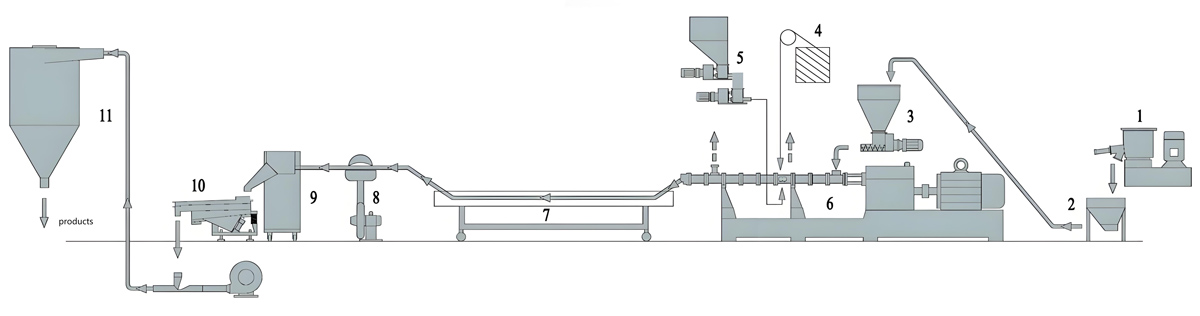
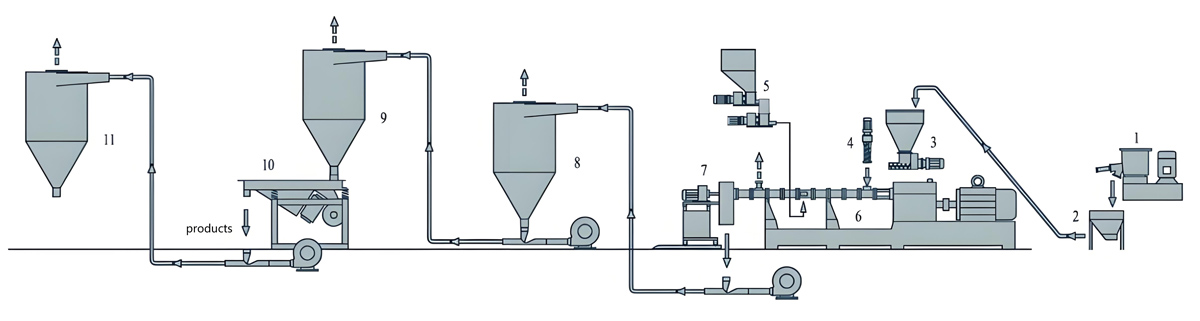
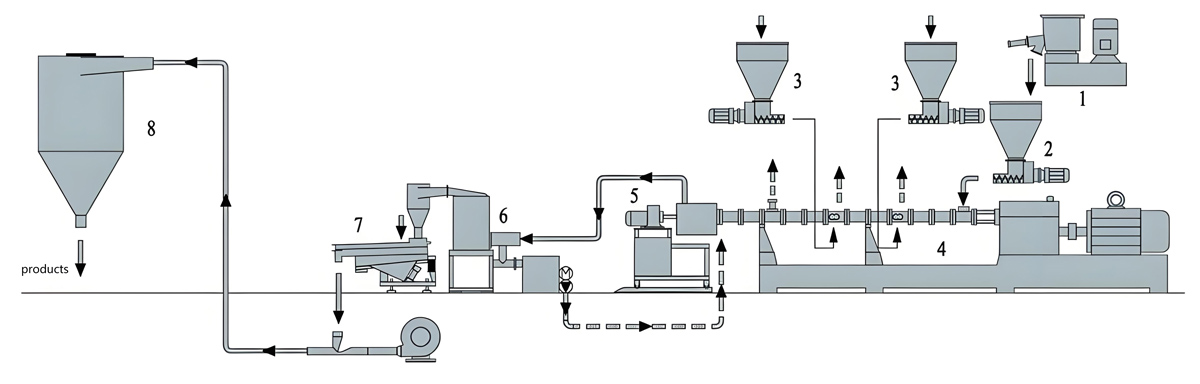
The production of composite masterbatch using a co-rotating twin screw extruder involves several key steps:
1. Raw Material Preparation
All raw materials must be properly dried and pre-treated to remove moisture and ensure consistent quality. Reinforcing fillers should be stored in a cool, dry place to prevent contamination and agglomeration. Carrier resins should be dried to a moisture content of less than 0.05% to avoid bubble formation during extrusion. For fiber-reinforced composites, fibers may need to be cut to a specific length before use.
2. Weighing and Mixing
Accurate weighing of all components is critical to ensure consistent batch quality. High-precision scales with accuracy of ±0.1% are recommended. The pre-mixing process should be done in a high-speed mixer to ensure uniform distribution of reinforcing fillers, compatibilizers, and other additives in the carrier resin.
3. Extrusion Compounding
The pre-mixed material is fed into the co-rotating twin screw extruder, where it undergoes melting, mixing, and compounding. The extruder’s screw design and processing parameters must be optimized to ensure proper dispersion of reinforcing fillers without causing excessive fiber breakage or degradation.
4. Cooling and Pelletizing
The molten compound is extruded through a die and cooled using a water bath or air cooling system. The cooled strands are then cut into pellets using a pelletizer. The pellets are typically 2-3 mm in diameter and length.
5. Quality Control and Packaging
Finished pellets are tested for filler concentration, dispersion quality, and physical properties. They are then packaged in moisture-proof bags or containers to protect against contamination and moisture absorption.
Production Equipment Introduction
The co-rotating twin screw extruder is the core equipment in composite masterbatch production. Nanjing Kerke’s KTE Series offers several models specifically designed for this application:
Kerke KTE Series Co-rotating Twin Screw Extruders
The KTE Series features co-rotating twin screws with modular design, allowing for easy customization of screw configurations to meet specific processing requirements. Key features include:
- High torque design for efficient mixing and compounding of high-filler-load materials
- Precise temperature control with multiple heating zones to prevent thermal degradation
- Advanced feeding system with side feeders for adding reinforcing fillers at specific locations in the extruder to minimize fiber breakage
- Compact design with easy access for maintenance
- Energy-efficient operation with low noise levels
Key Components
Extruder Barrel: The barrel is divided into multiple temperature zones to control the melting and processing of materials. Each zone can be independently controlled to optimize processing conditions and prevent thermal degradation of reinforcing fillers and other additives.
Screw Elements: The screw elements are designed to provide both distributive and dispersive mixing while minimizing fiber breakage. Different types of elements (conveying, kneading, mixing) can be combined to achieve the desired mixing intensity without causing excessive shear that could damage reinforcing fillers.
Feeding System: A precise feeding system with side feeders allows for the addition of reinforcing fillers at specific locations in the extruder, minimizing the residence time of fillers in the high-shear zones and reducing fiber breakage. Options include volumetric feeders, gravimetric feeders, and side feeders for adding specific components.
Die System: The die system shapes the molten material into strands for pelletizing. Different die configurations are available depending on the desired pellet size and shape. For fiber-reinforced composites, special die designs may be used to minimize fiber orientation and ensure uniform pellet properties.
Parameter Settings
Optimal parameter settings for composite masterbatch production depend on the specific formulation, extruder model, and desired product characteristics. The following are general guidelines:
Temperature Profile
The temperature profile should be set to ensure complete melting of the carrier resin while preventing thermal degradation of reinforcing fillers and other additives. A typical temperature profile for PP-based composite masterbatch might be:
- Zone 1 (Feed): 120-140°C
- Zone 2: 140-160°C
- Zone 3: 160-180°C
- Zone 4: 180-200°C
- Zone 5: 200-220°C
- Die: 220-230°C
Screw Speed
Screw speed affects the residence time and shear rate in the extruder. Typical screw speeds for composite masterbatch production range from 200-400 rpm. Higher speeds provide better mixing but may increase the risk of fiber breakage and thermal degradation.
Feed Rate
The feed rate should be balanced with the screw speed to maintain consistent material flow and prevent overloading the extruder. Typical feed rates range from 50-500 kg/h depending on the extruder size and model and the filler loading level.
Torque and Pressure
Torque and pressure readings provide important information about the processing conditions. Normal operating torque ranges from 50-80% of maximum for high-filler-load composites, while pressure at the die should be between 150-350 bar.
Equipment Price
The price of co-rotating twin screw extruders for composite masterbatch production varies depending on the model, size, and configuration. Nanjing Kerke’s KTE Series offers competitive pricing with the following approximate price ranges (in USD):
| Model | Screw Diameter (mm) | Output Range (kg/h) | Price Range (USD) |
|---|---|---|---|
| KTE-36B | 35.6 | 20-100 | 35,000-50,000 |
| KTE-50B | 50.5 | 80-200 | 50,000-75,000 |
| KTE-65B | 62.4 | 200-450 | 75,000-120,000 |
| KTE-75B | 71 | 300-800 | 120,000-180,000 |
| KTE-95B | 93 | 800-1500 | 180,000-280,000 |
Additional costs may include auxiliary equipment (feeders, pelletizers, cooling systems), installation, training, and after-sales service. It is recommended to contact Nanjing Kerke directly for a detailed quotation based on specific production requirements.
Production Process Problems and Solutions
Several common issues may arise during the production of composite masterbatch using co-rotating twin screw extruders. The following sections outline these problems, their causes, and recommended solutions:
Problem 1: Poor Dispersion of Reinforcing Fillers
Symptoms: Uneven distribution of reinforcing fillers in the masterbatch, leading to inconsistent mechanical properties in the final product.
Causes:
- Inadequate mixing in the extruder
- Insufficient pre-mixing of raw materials
- Filler agglomeration due to poor storage conditions or insufficient compatibilizer
- Incorrect screw configuration for the specific formulation
- Processing temperature too low, preventing proper wetting of fillers by the carrier resin
Solutions:
- Optimize screw configuration to include more kneading and mixing elements
- Improve pre-mixing process using a high-speed mixer
- Ensure proper storage of fillers to prevent agglomeration and use sufficient compatibilizer
- Adjust processing parameters (temperature, screw speed) to improve mixing efficiency and filler wetting
- Use filler surface treatment or coating to improve compatibility with the carrier resin
Prevention:
- Regularly inspect and maintain the extruder to ensure proper functioning
- Implement quality control measures to check dispersion quality in each batch
- Train operators on proper material handling and processing techniques
- Conduct regular testing of filler compatibility and dispersion quality
Problem 2: Excessive Fiber Breakage
Symptoms: Reduced fiber length in the masterbatch, leading to lower mechanical properties in the final product.
Causes:
- Excessive shear in the extruder due to incorrect screw configuration or high screw speed
- Improper feeding location of fibers, leading to excessive residence time in high-shear zones
- Die design causing excessive fiber breakage during extrusion
- Processing temperature too low, leading to high melt viscosity and increased shear stress on fibers
Solutions:
- Optimize screw configuration to reduce shear in the fiber feeding zone
- Use side feeders to add fibers at a later stage in the extruder, minimizing residence time in high-shear zones
- Modify die design to reduce fiber breakage during extrusion
- Adjust processing temperature to reduce melt viscosity and shear stress on fibers
- Use shorter fiber lengths or more flexible fibers that are less prone to breakage
Prevention:
- Regularly inspect and maintain the extruder to ensure proper functioning
- Implement quality control measures to check fiber length distribution in each batch
- Train operators on proper fiber feeding techniques and processing parameter optimization
- Conduct regular testing of fiber breakage under different processing conditions
Problem 3: Thermal Degradation of Materials
Symptoms: Discoloration of the masterbatch, reduced mechanical properties, or formation of volatile byproducts.
Causes:
- Processing temperature too high
- Residence time in the extruder too long
- Insufficient cooling after extrusion
- Contamination with metal ions or other impurities that catalyze degradation
- Use of incompatible additives that react with the carrier resin or fillers at high temperatures
Solutions:
- Reduce processing temperature while maintaining complete melting of the carrier resin
- Optimize screw configuration and processing parameters to reduce residence time
- Improve cooling system to reduce post-extrusion temperature
- Use materials with higher thermal stability and ensure proper cleaning of the extruder to remove contaminants
- Test additive compatibility at processing temperatures before full-scale production
Prevention:
- Regularly calibrate temperature sensors to ensure accurate temperature control
- Monitor material degradation through regular testing of mechanical properties and color
- Implement proper raw material handling and storage procedures to prevent contamination
- Train operators on proper processing techniques to avoid conditions that could cause thermal degradation
Maintenance and Care
Proper maintenance is essential to ensure the longevity and optimal performance of co-rotating twin screw extruders used in composite masterbatch production. The following maintenance procedures are recommended:
Daily Maintenance
- Check all lubrication points and add lubricant as needed
- Inspect temperature sensors and ensure accurate readings
- Clean the extruder barrel and screw after each production run to remove residual fillers that could cause wear or contamination in future batches
- Check for any unusual noises or vibrations during operation, which could indicate excessive wear or misalignment
- Record production data and operating parameters for future reference
Weekly Maintenance
- Inspect all electrical connections and tighten as needed
- Check the cooling system for leaks and ensure proper flow
- Inspect the feeding system for wear and damage, particularly in areas where abrasive fillers are handled
- Clean the pelletizer blades and ensure proper alignment
- Calibrate temperature and pressure sensors
Monthly Maintenance
- Inspect the screw elements for wear and replace as needed, particularly in high-shear zones where abrasive fillers are processed
- Check the barrel for signs of corrosion or wear, especially in areas where acidic or alkaline fillers are processed
- Inspect the gearbox oil level and quality, change if necessary
- Test all safety interlocks and emergency stop functions
- Perform a comprehensive cleaning of the entire production line
Annual Maintenance
- Complete disassembly and inspection of the extruder
- Replace worn or damaged components as needed, including screw elements, barrel liners, and feeding system parts
- Perform a full calibration of all sensors and controls
- Inspect and clean the electrical control cabinet
- Review maintenance records and update preventive maintenance schedule based on observed wear patterns and production requirements
FAQ
Q: What is the difference between co-rotating and counter-rotating twin screw extruders for composite masterbatch production?
A: Co-rotating twin screw extruders have screws that rotate in the same direction, providing high shear and mixing efficiency, making them ideal for processing composite masterbatch with high filler loads. Counter-rotating twin screw extruders have screws that rotate in opposite directions, providing lower shear and better conveying efficiency, making them more suitable for processing heat-sensitive materials or materials with low filler loads.
Q: How does the choice of carrier resin affect composite masterbatch performance?
A: The carrier resin must be compatible with the target polymer to ensure proper dispersion and performance. It should also have good thermal stability to withstand processing temperatures without degrading, and sufficient melt flow to allow proper wetting of reinforcing fillers. The choice of carrier resin also affects the mechanical properties of the final composite material, with engineering plastics such as PA and PC offering higher strength and stiffness than commodity plastics such as PE and PP.
Q: What is the typical concentration of reinforcing fillers in composite masterbatch?
A: Reinforcing filler concentrations in composite masterbatch typically range from 20-60%, depending on the specific filler type, desired final concentration in the polymer product, and processing capabilities of the extruder. Higher filler concentrations can provide greater mechanical property improvements but may also increase processing difficulty and reduce melt flow.
Q: How can I prevent excessive fiber breakage during composite masterbatch production?
A: To prevent excessive fiber breakage, use side feeders to add fibers at a later stage in the extruder to minimize residence time in high-shear zones, optimize screw configuration to reduce shear in the fiber feeding zone, adjust processing temperature to reduce melt viscosity and shear stress on fibers, and use shorter fiber lengths or more flexible fibers that are less prone to breakage.
Q: What is the expected lifespan of a co-rotating twin screw extruder for composite masterbatch production?
A: With proper maintenance and care, a co-rotating twin screw extruder can last 10-15 years or more. The actual lifespan depends on factors such as operating conditions, maintenance practices, frequency of use, and the type of materials being processed. Extruders processing abrasive fillers may experience more wear and require more frequent component replacement than those processing non-abrasive materials.
Conclusion
The production of high-quality composite masterbatch requires careful attention to formulation, processing conditions, and equipment selection. Co-rotating twin screw extruders, particularly Nanjing Kerke’s KTE Series, offer the ideal combination of mixing capabilities, temperature control, and flexibility for this application.
By understanding the key factors involved in composite masterbatch production and implementing proper processing techniques and maintenance procedures, manufacturers can consistently produce high-quality products that meet the demanding requirements of the plastic industry. Regular monitoring and optimization of production processes will help ensure maximum efficiency, product quality, and equipment longevity.