Introduction
Polyvinyl Alcohol (PVA) is a unique water-soluble polymer used in applications ranging from laundry bags to agricultural films. Manufacturing PVA masterbatches is challenging due to PVA’s high melting point, sensitivity to shear, and extreme hygroscopic nature. An “Integrated” twin screw extruder system is designed to handle these challenges by combining the extruder, feeding system, and downstream pelletizing into a synchronized, compact unit. This integration minimizes residence time and exposure to ambient humidity, which is critical for PVA. This article focuses on the production of PVA masterbatches using advanced twin screw technology, specifically the Nanjing Kerke KTE series, which offers the precise control needed for this difficult material.
Formulation Ratios (Different Types)
PVA masterbatches are typically used to impart water solubility or barrier properties to other polymers. The formulations differ based on the target application.
Water-Soluble Masterbatch (for Blown Film)
This is the most common type. The formulation usually consists of 60% to 80% PVA resin (with varying degrees of hydrolysis, typically 88% or 98%), 15% to 30% plasticizer (glycerol or sorbitol to reduce brittleness), and 5% to 10% additive package (anti-block agents, pigments). The high plasticizer content requires excellent mixing to prevent phase separation.
Barrier/Oxygen Scavenger Masterbatch
For multi-layer packaging, PVA is used as an oxygen barrier. The formulation includes 50% PVA, 40% clay or silica (for tortuosity), and 10% compatibilizer (like maleic anhydride grafted polyolefins) to help the PVA adhere to non-polar layers like PE or PP. The filler loading is high, demanding high torque from the extruder.
Biodegradable Compostable Masterbatch
PVA is often blended with starch or PLA. A typical ratio is 40% PVA, 40% Starch (modified), 15% PLA, and 5% processing aids. This formulation is highly sensitive to moisture and requires a vacuum system capable of handling high volatile loads.
Production Process
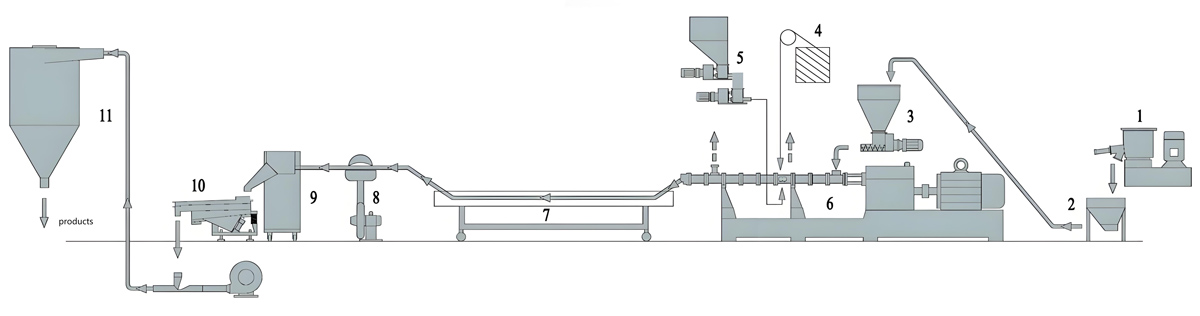
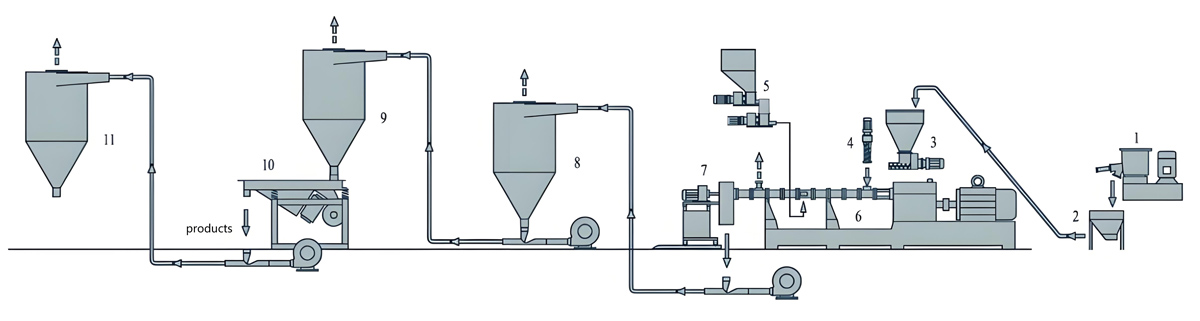
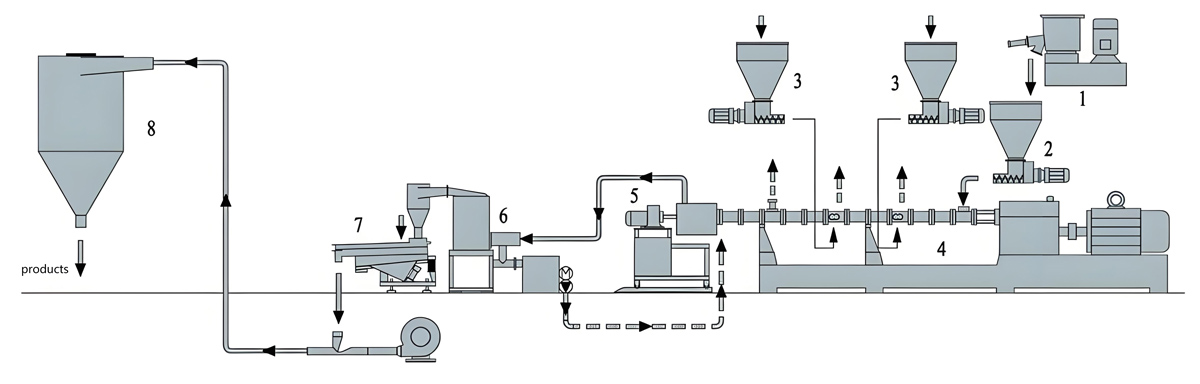
The manufacturing process for PVA masterbatch is distinct due to the material’s thermal instability. First, PVA pellets must be conditioned. Unlike PETG, PVA cannot be dried at high temperatures or it will cross-link. A specialized conditioning system that maintains humidity and temperature around 60-80°C is often used. The conditioned PVA is fed into the integrated twin screw extruder. The “Integrated” aspect implies a loss-in-weight feeder directly mounted on the extruder throat to prevent moisture absorption from the air. Inside the barrel, the material is melted at a relatively low temperature (160°C – 190°C) to avoid degradation. High shear sections are minimized; instead, distributive mixing is prioritized. The melt is filtered and sent to a water-ring pelletizer (underwater pelletizing is preferred for PVA to avoid sticking). The pellets are then packaged in moisture-proof bags immediately.
Production Equipment Introduction
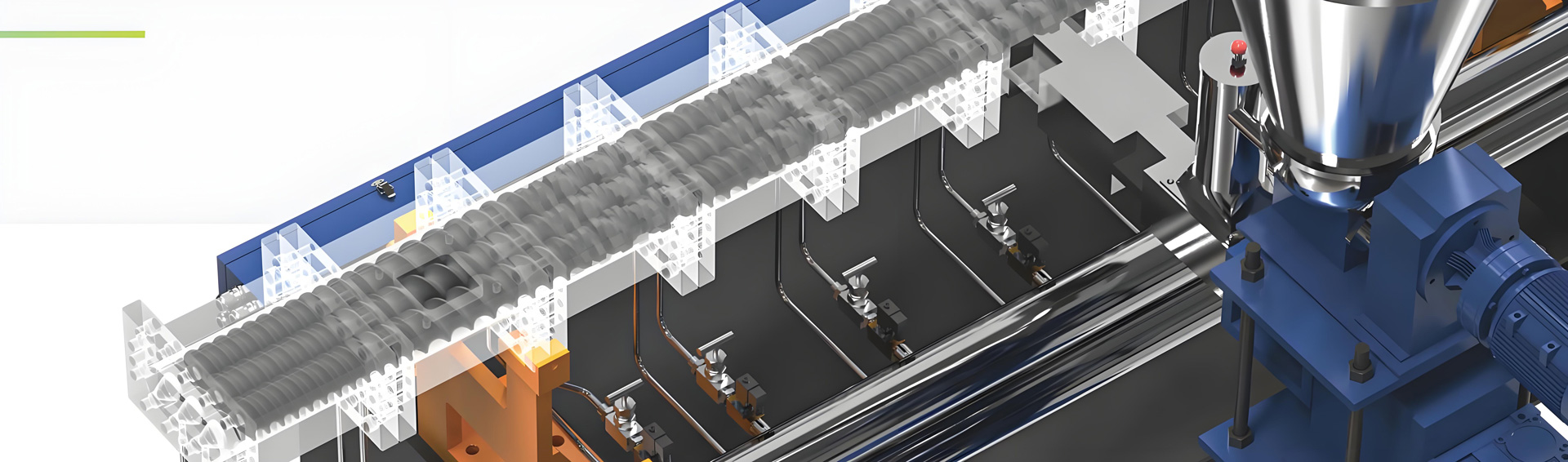
The centerpiece is the Nanjing Kerke KTE Series co-rotating twin screw extruder configured for PVA. The KTE series for PVA features a longer L/D ratio (typically 48:1 or 52:1) to provide sufficient residence time for melting without high shear. The barrel is equipped with high-capacity vacuum vents (often two stages) to remove the water vapor generated as PVA melts. The screws are designed with wide kneading blocks but low compression to prevent pressure build-up that could cause “melt fracture” or gel formation. The integrated control system manages the feeder, extruder speed, and pelletizer cutter speed in unison. If the extruder slows down, the feeder reduces rate automatically to prevent flooding. The gearbox is a high-precision unit designed for smooth operation at low speeds (100-400 rpm) to minimize shear heating.
Parameter Settings
Processing PVA requires a delicate balance of temperature, speed, and vacuum.
Temperature Profile
PVA melts sharply. The temperature must be kept low. Zone 1: 40°C (to prevent bridging), Zone 2-3: 120°C – 140°C, Zone 4-6: 160°C – 180°C, Zone 7-8: 170°C – 180°C, Die: 175°C. Exceeding 190°C will cause the PVA to degrade and discolor (turn brown/black).
Screw Configuration and Speed
Screw speed is kept relatively low, between 150 and 350 rpm. High speeds generate too much frictional heat. The torque should be moderate, around 50-60%. The screw elements should consist of forward conveying blocks and gentle kneading blocks (30° or 45° angle) rather than aggressive 90° blocks.
Vacuum System
A two-stage vacuum system is recommended. The first stage operates at -0.06 MPa to remove surface moisture, and the second stage at -0.09 MPa to remove bound water. The vacuum pump must have a high capacity for water vapor (gas ballast pump) to prevent oil contamination.
Equipment Price
Reference Price for Nanjing Kerke KTE Series (PVA Application):
- Model KTE-75 (Integrated System): $180,000 – $220,000 USD. Includes loss-in-weight feeders and vacuum system.
- Model KTE-95 (High Capacity): $260,000 – $320,000 USD. Designed for high filler loading and 2-stage vacuum.
Note: The “Integrated” option commands a premium due to the synchronized control software and auxiliary integration. Prices are FOB Nanjing.
Production Problems, Solutions, and Avoidance
Problem: Pellets Sticking Together (Blocking)
Cause Analysis: PVA is hygroscopic and sticky when warm. If the pellets are not cooled sufficiently or if there is residual moisture on the surface, they will agglomerate. This is common in water-bath pelletizing systems where the water temperature is too high or the drying cycle is insufficient.
Solution: Lower the temperature of the cooling water to below 15°C. Increase the residence time in the centrifugal dryer. If using a water-ring pelletizer, ensure the water flow rate is adequate. Add a small amount (0.5%) of anti-block agent (like talc or silica) to the formulation if permitted by the end-use application.
Avoidance Method: Use an underwater pelletizing system with a high-efficiency dryer. Ensure the final moisture content of the pellets is below 1% before packaging. Package immediately in aluminum-lined bags with desiccants. Avoid storing pellets in high-humidity environments.
Problem: Gels and Black Specks
Cause Analysis: PVA degrades rapidly if localized shear or temperature is too high. Gels are often caused by stagnant material in the barrel or cross-linked PVA. Black specks indicate carbonization due to overheating or metal-on-metal wear in the screw elements.
Solution: Reduce barrel temperatures by 10°C across the board. Purge the extruder thoroughly with a low-melting point polymer (like LDPE) to remove degraded material. Inspect screw elements for damage; replace any worn or damaged kneading blocks. Check heater bands for “runaway” heating (stuck in ON position).
Avoidance Method: Use a screw design with self-wiping capabilities to prevent stagnant zones. Install a melt temperature sensor in the die head as a safety interlock to shut down the heater if the melt exceeds 190°C. Regularly maintain the cooling fans on the barrel to prevent heat creep.
Problem: Poor Solubility of Final Masterbatch
Cause Analysis: If the PVA is over-heated or sheared too much during extrusion, it can lose its water-soluble properties due to degradation of the polymer chain or cross-linking. Another cause is poor dispersion of the plasticizer, leading to localized insoluble zones.
Solution: Optimize the mixing section. Ensure the plasticizer is added downstream where the temperature is lower to prevent volatilization. Reduce screw speed to minimize mechanical degradation. Test the solubility in a lab beaker before full production.
Avoidance Method: Use co-rotating screws which provide gentle but effective mixing compared to counter-rotating or single screw machines. Pre-blend the PVA and plasticizer in a high-speed mixer before feeding into the extruder to ensure initial distribution. Strictly control the residence time in the barrel.
Maintenance
PVA processing is demanding on maintenance. Because PVA can corrode steel if wet, the extruder must be cleaned and dried immediately after shutdown. The “purge” procedure is critical: flush with a non-corrosive, moisture-free polymer. The vacuum system requires frequent cleaning of the condensate trap to prevent water from being sucked back into the barrel. Heater bands should be checked weekly for proper contact with the barrel. The screw elements should be inspected for signs of corrosion or wear, especially if filled PVA compounds are run. The gearbox oil should be changed more frequently (every 3 months) due to the potential for moisture ingress.
FAQ
Q: Why is a twin screw extruder better than a single screw for PVA?
A: A single screw extruder relies on high friction to melt PVA, which causes severe degradation. A twin screw extruder, particularly the co-rotating KTE series, melts PVA through conductive heat and gentle shear, preserving the polymer’s solubility and mechanical properties.
Q: Can I use recycled PVA in the masterbatch?
A: Yes, but it must be cleaned and re-plasticized. Recycled PVA often has higher moisture content and degraded properties. It is usually limited to 10-20% of the formulation to avoid quality issues.
Q: What is the biggest challenge in PVA masterbatch production?
A: Moisture control is the biggest challenge. PVA absorbs water from the air instantly. The entire process—from feeding to packaging—must be isolated from ambient humidity, or the final product will be hazy, sticky, or brittle.
Conclusion
Manufacturing PVA masterbatches is a sophisticated process that demands equipment specifically tailored for heat-sensitive and hygroscopic polymers. The Nanjing Kerke KTE Series integrated twin screw extruder provides the necessary control over temperature, shear, and vacuum to produce high-quality PVA compounds. By focusing on low-temperature processing, efficient devolatilization, and rigorous moisture control, producers can overcome the inherent difficulties of PVA. The investment in an integrated system pays off through higher yields, reduced degradation, and a masterbatch that retains the critical water-soluble properties required by the market.