Introduction
Thermoplastic Polyester Elastomer (TPEE), commercially known as Hytrel, is a high-performance block copolymer combining the properties of rubber and plastic. It is used in automotive boots, cables, and industrial hoses. Producing TPEE masterbatches is challenging due to the material’s high melt viscosity, sensitivity to shear history, and tendency to stick to metal surfaces. A Co-rotating twin screw extruder is the industry standard for TPEE because it provides the high shear necessary to disperse additives in the viscous matrix while allowing precise control over temperature to prevent degradation. This article details the production of TPEE masterbatches using co-rotating technology, specifically the Nanjing Kerke KTE series, which offers the robustness required for processing these demanding elastomers.
Formulation Ratios (Different Types)
Color Masterbatch for TPEE
TPEE is naturally opaque/yellowish. Coloring requires high heat-stable pigments. Formulation: 30-40% Pigment (high loading due to opacity of TPEE), 60-70% TPEE carrier. Because TPEE is tough, dispersing agents (waxes or stearates) are crucial (1-2%) to prevent “orange peel” on the final molded part.
Reinforcing Filler Masterbatch
For stiffness improvement, carbon black or glass fibers are used. Formulation: 20-30% Carbon Black (conductive grade), 70-80% TPEE. Carbon black has a high structure and absorbs a lot of polymer, increasing viscosity significantly. The extruder must handle this high load without torque overload.
Flame Retardant TPEE Masterbatch
For electrical cable applications. Formulation: 50% TPEE, 30% Magnesium Hydroxide (MDH – requires high loading), 15% Synergist, 5% Processing Aid. MDH is a high-loading filler that makes the compound very stiff and abrasive.
Production Process
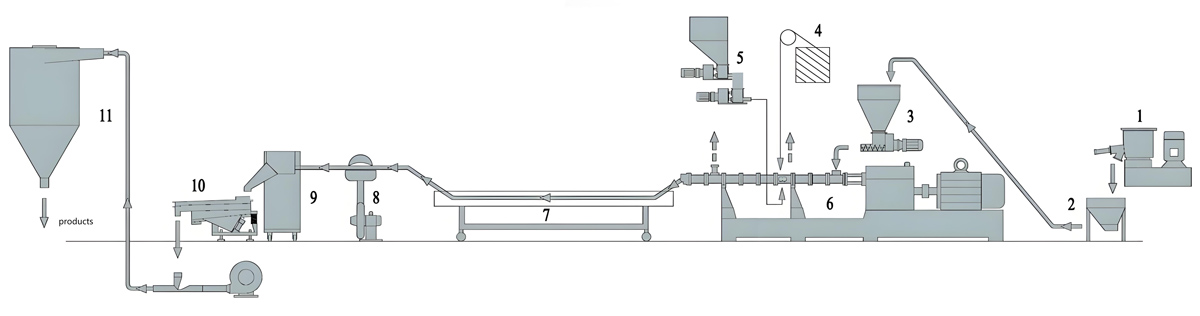
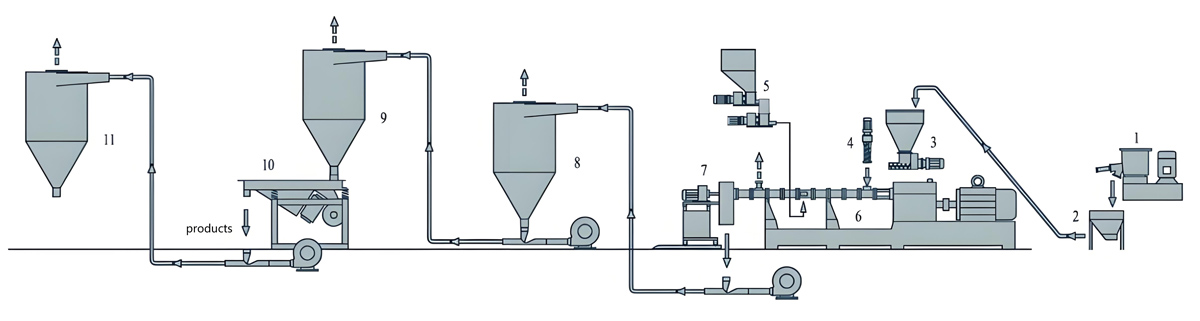
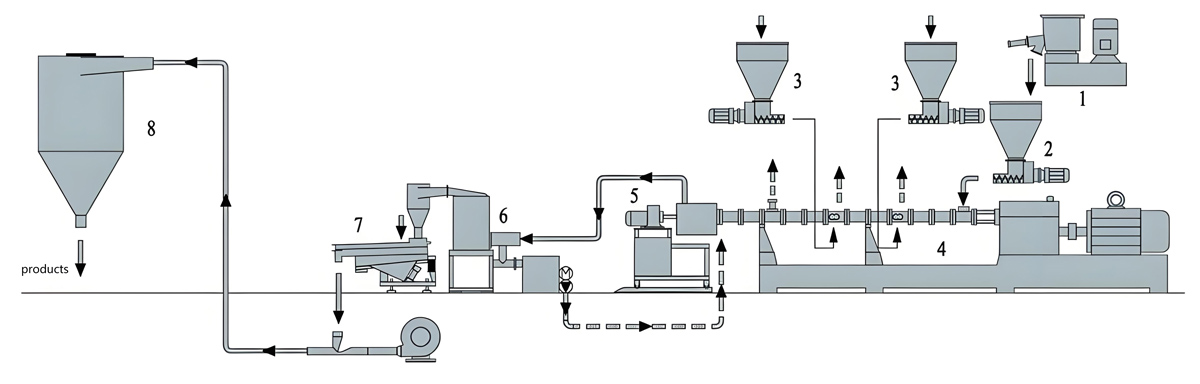
TPEE is hygroscopic and must be dried at 100°C-120°C for at least 4 hours before processing. The dried TPEE is fed into the co-rotating KTE extruder. The co-rotating screws intermesh and wipe the barrel wall, preventing the sticky TPEE from adhering and degrading. The process requires high shear in the mixing zone to break down TPEE’s crystalline structure and incorporate additives. Temperatures are maintained between 200°C and 240°C. Because TPEE has a wide processing window, careful control is needed to avoid under-melting (gels) or over-shearing (viscosity drop). The melt is filtered and pelletized. Due to TPEE’s “memory” (it tends to return to its original shape), water-ring pelletizing is often preferred over strand pelletizing to ensure consistent pellet shape. The pellets may require annealing (heat treatment) to relieve internal stresses.
Production Equipment Introduction
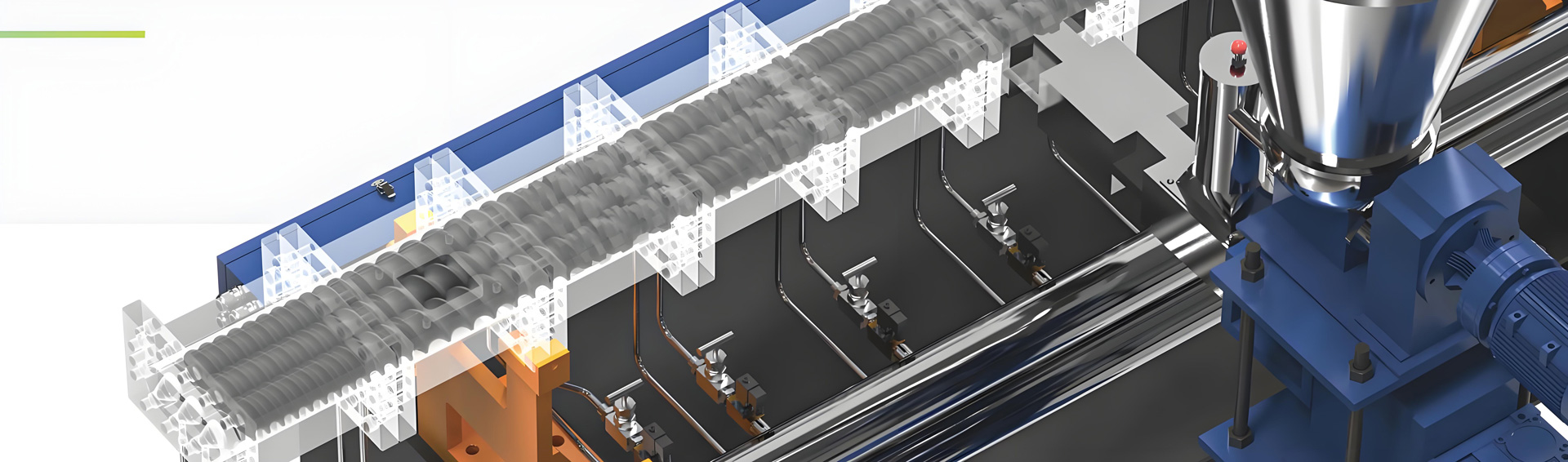
The Nanjing Kerke KTE Series Co-rotating extruder is the backbone of TPEE processing. “Co-rotating” means both screws turn in the same direction, which creates an intermeshing, wiping action ideal for sticky materials. The KTE series for TPEE features screws with special geometries: high-shear kneading blocks in the melting zone and toothed mixing elements for distributive mixing. The barrel is often nitrided or bimetallic to resist the abrasive nature of fillers like carbon black or MDH. The gearbox is designed for high inertia to handle the sudden torque changes when melting high-viscosity TPEE. The system includes a gear pump (optional but recommended for TPEE) to stabilize the flow and pressure before the die, ensuring uniform pellet density. The control system monitors melt pressure and temperature closely to detect “stick-slip” phenomena common with elastomers.
Parameter Settings
Temperature Profile
TPEE melts around 200°C but needs heat to flow. Zone 1: 120°C (to prevent bridging), Zone 2-3: 180°C – 200°C, Zone 4-6: 210°C – 230°C, Die: 220°C. Avoid exceeding 240°C to prevent ester bond degradation (loss of elasticity).
Screw Speed and Shear Rate
Co-rotating extruders run at medium speeds (300-600 rpm). The key is the shear rate. For TPEE, high shear is needed initially to melt, but excessive shear downstream can degrade the polymer chains, reducing the rebound resilience. Torque should be monitored; a sudden drop indicates degradation.
Vacuum System
A strong vacuum (-0.09 MPa) is essential to remove moisture. TPEE melts can hold significant moisture, which causes bubbles (splay) in the final product. A double-stage vacuum is often used for high-quality TPEE masterbatches.
Equipment Price
Reference Price for Nanjing Kerke KTE Series (TPEE Application):
- Model KTE-75 (Co-rotating): $170,000 – $200,000 USD. Standard configuration for TPEE.
- Model KTE-95 (Heavy Duty with Gear Pump): $280,000 – $340,000 USD. Includes melt pump and abrasion-resistant lining.
Note: The “Co-rotating” configuration is standard for KTE series. Prices vary based on abrasion resistance requirements (e.g., for carbon black). FOB Nanjing.
Production Problems, Solutions, and Avoidance
Problem: Sticky Pellets / Agglomeration
Cause Analysis: TPEE is an elastomer with inherent tackiness. If the pellet temperature is too high when it contacts the cutter or water, it will deform and stick. Another cause is insufficient cooling or anti-block agent in the formulation. High moisture content can also cause surface stickiness.
Solution: Use an underwater pelletizing system which cuts the melt stream directly into cold water, creating a “skin” on the pellet instantly. If using strand pelletizing, ensure the water bath is chilled (<10°C) and the strands are dried thoroughly. Add 0.5-1% inorganic anti-block agent (synthetic silica) to the formulation. Reduce the melt temperature by 10°C if possible.
Avoidance Method: Optimize the die face design; polished dies reduce adhesion. Do not let the extruder sit idle with hot material inside; purge immediately on shutdown. Use a release agent spray on the cutter face (automated system). Ensure the drying of TPEE is perfect; wet TPEE is much stickier than dry TPEE.
Problem: Viscosity Drop (Degradation)
Cause Analysis: TPEE is susceptible to mechanical degradation. If the shear rate is too high or the residence time is too long, the polymer chains break (chain scission). This results in a masterbatch with lower molecular weight, leading to poor mechanical properties in the final product (e.g., reduced tensile strength or elongation at break).
Solution: Reduce screw speed. Change the screw configuration to use less aggressive kneading blocks (e.g., 45° instead of 90°) in the metering zone. Lower the barrel temperature. Check if the cooling water on the barrel is sufficient; overheating barrels contribute to degradation. Perform a Melt Flow Rate (MFR) test; if MFR increases significantly, degradation has occurred.
Avoidance Method: Use a co-rotating extruder rather than counter-rotating or Banbury mixers, as co-rotating provides better control over shear. Install a melt temperature alarm that trips the heater if it exceeds 240°C. Minimize re-grind usage; re-grind TPEE has already been sheared and is more prone to further degradation. Use stabilizers specifically designed for polyesters (carbodiimides) to protect the end groups.
Problem: Gels / Unmelted Particles
Cause Analysis: TPEE is semi-crystalline and has a high melting point. If the heating capacity is insufficient or the mixing is poor, “gels” (unmelted polymer chunks) remain in the masterbatch. This is common when starting up or if the feed rate is too high for the available heat.
Solution: Increase the barrel temperature in the melting zone. Reduce the feed rate to allow more residence time for melting. Ensure the screw elements in the feeding zone are designed to maximize heat transfer (e.g., barrier flights). Check the heaters; if one zone is not working, the melting profile is disrupted. Purge the extruder to remove the gels.
Avoidance Method: Use a screw design with a strong melting section. Preheat the barrel to the set temperature for at least 30 minutes before feeding material. Use a hopper loader with a heating jacket to keep the pellets warm. For highly crystalline TPEE grades, consider adding a small amount of plasticizer to aid melting, if compatible with the end application.
Maintenance
TPEE maintenance focuses on preventing material buildup and managing wear. Because TPEE can carbonize on hot surfaces, the barrel and screws must be cleaned regularly with a reactive polymer cleaner. The screws should be inspected for “stick-slip” marks or corrosion. The gearbox needs frequent oil analysis because the high torque loads can generate metal particles. The thrust bearing is critical; any axial movement of the screws will cause rapid wear. For filled TPEE (carbon black/MDH), the barrel and screw tips should be hardened or coated with Stellite to resist abrasion. The die head should be polished regularly to prevent material drag-out.
FAQ
Q: What is the difference between Co-rotating and Counter-rotating for TPEE?
A: Co-rotating extruders have higher shear and self-wiping capability, which is better for sticky polymers like TPEE to prevent them from adhering to the roots of the screws. Counter-rotating extruders have lower shear and higher pressure, better for PVC powder but generally less suitable for TPEE masterbatches where dispersion is key.
Q: Can I use a single screw extruder for TPEE masterbatch?
A: It is difficult. Single screws rely on friction to melt, which generates excessive heat for TPEE, leading to degradation. They also lack the dispersive mixing needed for high-loading additives. A twin screw (co-rotating) is highly recommended for quality TPEE masterbatches.
Q: Why is underwater pelletizing preferred for TPEE?
A: TPEE pellets have a “memory” and tend to stick together if cut while warm. Underwater pelletizing cuts the melt strands directly into a water chamber, instantly cooling them and transporting them to a centrifuge dryer. This prevents agglomeration and produces perfect spherical pellets, essential for consistent feeding in downstream injection molding machines.
Conclusion
The production of TPEE masterbatches demands an extruder capable of handling high viscosity, sticky polymers, and high shear requirements without causing degradation. The Nanjing Kerke KTE Series Co-rotating Twin Screw Extruder is specifically engineered to meet these challenges with its robust gearbox, optimized screw geometry, and precise temperature control. By managing the delicate balance between sufficient shear for dispersion and avoiding mechanical degradation, manufacturers can produce high-performance TPEE masterbatches for demanding automotive and industrial applications. The investment in a co-rotating system ensures consistent melt quality, excellent additive dispersion, and the ability to process high-loading formulations that simpler machines cannot handle. Proper maintenance, especially regarding cleaning sticky residues and managing abrasion from fillers, is essential for long-term reliability and product quality.