Introduction
Automotive interior masterbatch production represents highly specialized segment of plastic compounding requiring precise control over color consistency, material properties, and processing characteristics to meet demanding automotive industry standards. High speed twin screw extruders have become essential equipment for automotive interior masterbatch manufacturing due to their ability to achieve superior mixing at high throughput rates while maintaining excellent product quality. The automotive interior applications including instrument panels, door panels, consoles, trim components, and seat components demand masterbatches with exceptional color consistency, thermal stability, UV resistance, and mechanical properties. Nanjing Kerke Extruder Equipment Company KTE Series high speed twin screw extruders provide advanced capabilities specifically optimized for automotive interior masterbatch production where high throughput, consistent quality, and material performance are critical requirements.
Automotive interior applications present unique challenges for masterbatch production due to stringent quality requirements from automotive manufacturers, demanding operating conditions in vehicle interiors including temperature extremes and UV exposure, and the need for exact color matching across multiple production batches and suppliers. Masterbatches for automotive interiors must provide consistent color appearance across large production volumes, maintain properties through automotive manufacturing processes including injection molding and painting, and perform reliably under long-term vehicle operating conditions. High speed twin screw extruders provide the mixing capabilities and throughput efficiency needed to produce automotive masterbatches meeting these demanding requirements at production volumes supporting automotive industry scale.
Market dynamics in automotive industry drive requirements for cost-effective production while maintaining quality standards that improve year over year. High speed extrusion technology enables production of automotive interior masterbatches at throughput rates reducing production costs while maintaining or improving quality. The automotive industry’s emphasis on lightweight materials and alternative fuel vehicles creates opportunities for specialized masterbatches requiring precise formulation and processing capabilities. KTE Series high speed twin screw extruders provide the speed, mixing efficiency, and process control needed to support automotive industry requirements for quality, cost, and innovation in interior components.
Formulation Ratios for Automotive Interior Masterbatch
Formulation development for automotive interior masterbatch must balance color development, processing requirements, thermal stability, UV resistance, and mechanical properties while meeting automotive industry specifications and cost targets.
Instrument panel masterbatch formulations typically incorporate carrier polymer at 85 to 95 percent, color pigments at 3 to 12 percent, UV stabilizers at 2 to 8 percent, and processing aids at 1 to 2 percent. Carrier polymer selection typically matches instrument panel materials including polycarbonate, ABS, polycarbonate-ABS blends, or polypropylene depending on vehicle platform and application requirements. Pigment selection focuses on automotive grade pigments with excellent light fastness and thermal stability required for instrument panel applications. UV stabilizer packages typically include UV absorbers for initial protection and hindered amine light stabilizers for long-term protection. Higher UV stabilizer loading up to 8 percent may be used for vehicles with extended sun exposure requirements.
Door panel masterbatch formulations include carrier polymer at 85 to 95 percent, color pigments at 5 to 15 percent, impact modifiers at 2 to 8 percent, and processing aids at 1 to 3 percent. Door panel materials vary by vehicle segment and include polypropylene for economy vehicles, ABS for mid-range vehicles, and higher-performance polymers for premium applications. Color requirements vary by interior color schemes with popular colors including black, gray, beige, and various metallic and wood-effect colors. Impact modifiers are often required to meet automotive interior impact requirements. Door panel masterbatches must survive painting processes without degradation or color shift requiring careful additive selection.
Console masterbatch formulations incorporate carrier polymer at 85 to 95 percent, color pigments at 5 to 15 percent, surface modifiers at 2 to 6 percent, and processing aids at 1 to 3 percent. Console materials often require scratch resistance and soft-touch properties requiring specialized additives. Color requirements may include metallic effects, pearl effects, or special effect colors creating premium appearance requirements. Surface modifiers including scratch-resistant additives and matting agents improve surface quality and durability. Console masterbatches must maintain appearance through vehicle assembly processes including installation and potential contact with other components.
Trim masterbatch formulations include carrier polymer at 88 to 96 percent, color pigments at 3 to 10 percent, UV stabilizers at 1 to 5 percent, and processing aids at 1 to 2 percent. Trim components including pillars, handles, and various interior fittings require color consistency with other interior components while meeting specific material requirements. UV stabilizer loading may be reduced compared to instrument panels depending on component location and exposure. Pigment selection must match exact interior color specifications requiring tight tolerance control. Trim masterbatches must maintain color through automotive assembly and vehicle use.
Seat component masterbatch formulations incorporate carrier polymer at 85 to 95 percent, color pigments at 3 to 12 percent, antimicrobial agents at 1 to 5 percent, and processing aids at 1 to 3 percent. Seat materials including polypropylene for seat backs and various polymers for seat components have specific color requirements. Antimicrobial agents may be required for seat applications requiring improved hygiene characteristics. Color must be consistent with interior color schemes and coordinate with fabric or leather components. Seat masterbatches must survive manufacturing processes including foam molding and assembly while maintaining color quality.
Special effect masterbatch formulations for automotive interiors incorporate special effect pigments at 5 to 30 percent, carrier polymer at 70 to 95 percent, dispersants at 2 to 5 percent, and processing aids at 1 to 3 percent. Special effects including metallic, pearlescent, and shimmer effects require high pigment loading levels and careful dispersion to achieve uniform appearance. Metallic pigments including aluminum flakes typically require 10 to 25 percent loading levels. Pearlescent pigments require 5 to 20 percent loading depending on effect intensity. Shimmer and sparkle pigments may require 5 to 15 percent loading. These high-loading formulations require intensive mixing and specialized processing approaches to achieve uniform appearance without pigment damage.
Carrier polymer selection for automotive interior masterbatch must match application requirements and provide appropriate processing characteristics. Polycarbonate carrier grades require careful selection of molecular weight and flow characteristics matching end-use materials. ABS carrier grades must match impact and thermal properties of end-use ABS materials. Polypropylene carrier grades should match melt flow and copolymer characteristics of end-use polypropylene materials. Carrier polymer must be compatible with end-use material to avoid property issues in final automotive components. Carrier selection also considers automotive manufacturer specifications and approval requirements.
Production Process for Automotive Interior Masterbatch
Automotive interior masterbatch production requires precise process control, excellent mixing, and high throughput capabilities to meet automotive industry quality and cost requirements. High speed twin screw extruders provide the performance needed for automotive masterbatch production.
Material preparation procedures for automotive masterbatch focus on ensuring material quality and consistency essential for meeting automotive specifications. Carrier polymers for automotive applications may require drying depending on polymer type and storage conditions. Polycarbonate carrier requires drying to 50 parts per million moisture content before processing to prevent degradation and bubbles. ABS typically requires drying to 0.1 to 0.2 percent moisture content. Polypropylene generally does not require drying but may benefit from conditioning for consistent temperature. Pigments and additives should be pre-screened and certified as automotive grade with appropriate documentation including certificates of analysis and automotive industry compliance certifications.
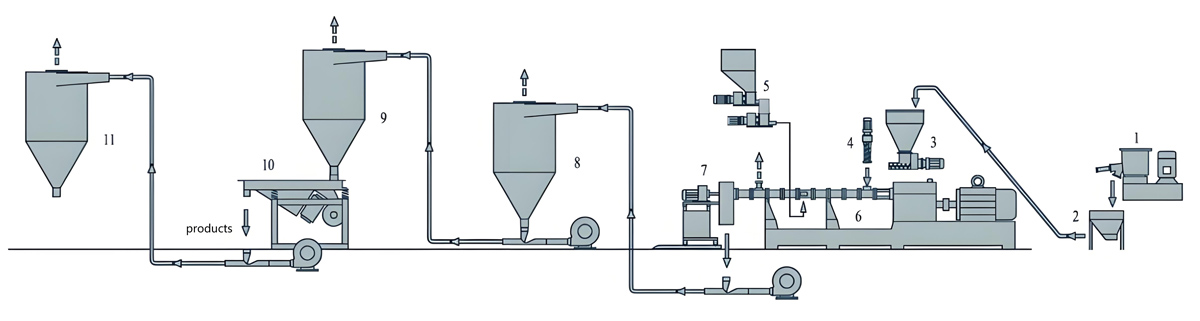
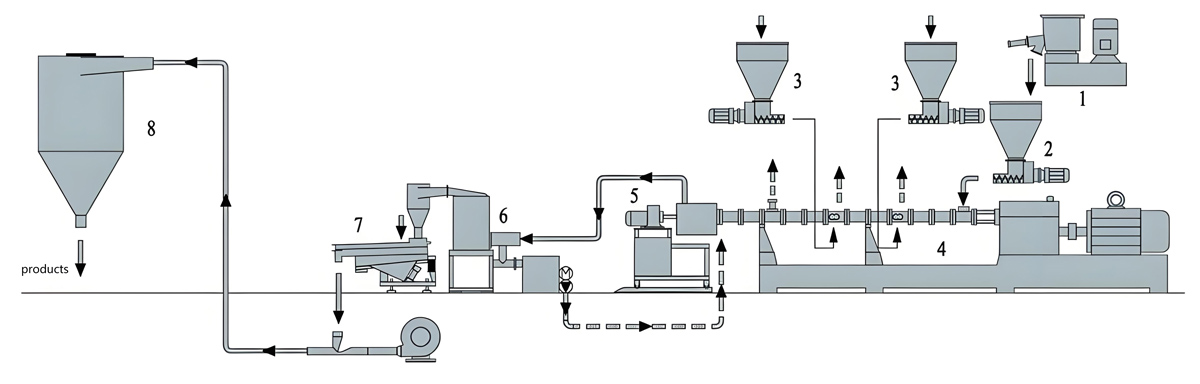
Feeding system accuracy is critical for automotive masterbatch where color consistency and material properties must meet exacting specifications. Gravimetric feeding systems with accuracy better than 0.3 percent of setpoint are recommended for automotive applications ensuring precise formulation ratios. Multiple feeder configurations enable separate feeding of carrier polymer, pigments, additives, and processing aids allowing individual optimization of feeding parameters. Loss-in-weight feeders provide continuous weight-based feeding compensating for material density variations. Feeding systems should include hysteresis compensation and vibration isolation for consistent feeding of low-density pigments and additives. Automated feeder calibration procedures ensure long-term feeding accuracy.
Extrusion temperature profiles for automotive masterbatch depend on carrier polymer type and additive loading. For polycarbonate-based masterbatch, typical temperature profiles range from 260 to 300 degrees Celsius with careful control to prevent thermal degradation. ABS-based masterbatch typically processes at 210 to 250 degrees Celsius. Polypropylene-based masterbatch processes at 200 to 240 degrees Celsius. Temperature control accuracy better than plus or minus1 degree Celsius is essential for maintaining consistent thermal history and color development. Temperature profiles should be optimized for each formulation to achieve proper melting without causing pigment degradation or thermal damage to additives.
Screw speed optimization for automotive masterbatch balances high throughput requirements with excellent mixing quality. High speed operation enables production rates supporting automotive industry volumes while maintaining quality. Typical screw speeds for automotive masterbatch range from 200 to 400 rpm depending on material characteristics and loading levels. For standard color masterbatch with 5 to 10 percent pigment loading, speeds of 250 to 350 rpm provide excellent mixing with high throughput. For special effect masterbatch with higher loading levels, speeds of 200 to 300 rpm ensure adequate mixing while maintaining throughput. Screw speed optimization considers material residence time, shear heating effects, and mixing requirements.
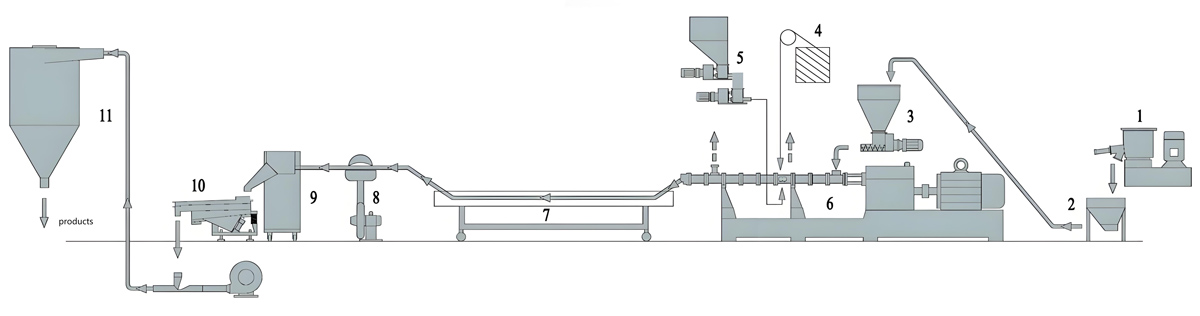
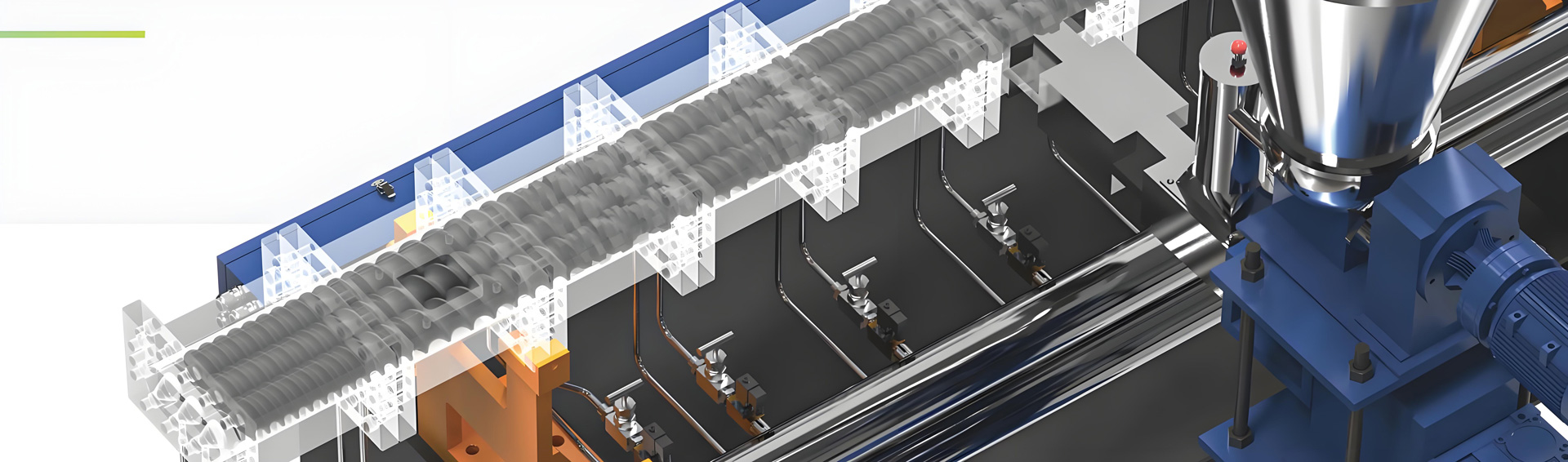
Mixing section design for automotive masterbatch ensures uniform pigment and additive distribution critical for color consistency and material properties. KTE Series high speed extruders feature modular screw configuration enabling customization for specific automotive applications. Mixing sections typically include kneading blocks for dispersive mixing and distributive mixing elements for uniform distribution. Multiple mixing zones along screw length provide staged mixing ensuring complete dispersion without excessive shear. Mixing section configuration is optimized based on pigment loading, additive types, and required mixing intensity. Automotive applications often require mixing sections providing both high dispersion and uniform distribution capabilities.
Vent and devolatilization remove moisture and volatiles that could cause defects in final masterbatch. Automotive polymers may contain residual moisture despite drying, requiring effective venting during extrusion. High speed extruders typically include two vent ports positioned along barrel length. First vent located after melting zone removes moisture and low-boiling volatiles. Second vent positioned near die removes any volatiles from additives or thermal degradation. Vent zones are designed with special geometries preventing material carryover between vents while maintaining material flow. Vacuum venting capabilities improve volatile removal for formulations with high volatile content.
Pelletizing system selection affects pellet quality and downstream processing in automotive component manufacturing. Strand pelletizing is commonly used for automotive masterbatches providing uniform cylindrical pellets suitable for injection molding. Strand die design should produce consistent strand diameter with excellent surface quality. Water bath temperature control must prevent thermal shock to hot strands which could affect pellet properties. Pelletizer knives must be sharp and properly aligned for clean pellet cutting minimizing fines and off-size pellets. Pellet size typically ranges from 2 to 3 mm in diameter with 2 to 4 mm length for automotive applications ensuring good flow in molding operations.
Production Equipment Introduction
High speed twin screw extruders for automotive interior masterbatch manufacturing incorporate specialized features designed to achieve high throughput while maintaining exceptional product quality required by automotive industry.
KTE Series high speed twin screw extruders from Nanjing Kerke Extruder Equipment Company provide advanced capabilities specifically optimized for automotive interior masterbatch applications. The co-rotating twin screw configuration provides excellent mixing characteristics essential for achieving uniform color and additive distribution. High speed capabilities enable screw speeds up to 500 rpm supporting production rates from 500 to 4000 kg per hour depending on extruder size and material. The extruders feature robust drive systems providing reliable high-speed operation with excellent speed control accuracy. Barrel and screw designs are optimized for high-speed processing while maintaining excellent material flow and mixing.
Drive systems for high speed operation provide exceptional performance and reliability. AC vector drives with high-efficiency motors provide precise speed control from 10 to 100 percent of maximum speed with accuracy better than 0.1 percent of setpoint. Drive power ranges from 100 to 1000 kW depending on extruder size and throughput requirements. High-speed bearings and lubrication systems ensure reliable operation at elevated speeds. Torque monitoring provides feedback on material conditions and mixing effectiveness. Drive systems include regenerative braking capabilities recovering energy during deceleration improving energy efficiency. Thermal management systems maintain proper bearing and motor temperatures during high-speed operation.
Barrel and screw construction for high speed automotive applications uses hardened materials to withstand increased wear at higher speeds. Nitrided or hard-faced barrel materials provide extended service life with abrasive pigments and additives. Screw elements are constructed from hardened tool steel or surface-treated materials providing wear resistance. Modular screw design enables configuration optimization and easy replacement of worn elements. Special surface treatments and coatings further extend service life in demanding automotive applications. Barrel heating systems with high-capacity heating elements maintain precise temperature control at high throughput rates.
Temperature control systems for high speed processing provide rapid response and excellent accuracy. Multi-zone electric heating with individual zone control typically includes 10 to 14 zones along barrel length providing adequate thermal management. Heating capacity up to 15 kW per zone ensures sufficient heating capability for high throughput rates. Cooling systems incorporate both air and water cooling with high-capacity water cooling for rapid temperature adjustment. Temperature control accuracy better than plus or minus0.5 degree Celsius ensures consistent thermal conditions. Advanced control algorithms provide rapid response to setpoint changes and compensation for thermal variations during high-speed operation.
Feeding systems for high speed operation are designed to handle increased throughput requirements while maintaining feeding accuracy. Gravimetric feeders with high capacity handling capabilities can deliver up to 2000 kg per hour of carrier polymer. Vibratory feeders and screw feeders provide accurate feeding of pigments and additives at high speeds. Feeder hysteresis compensation and vibration isolation ensure consistent feeding even at high throughput rates. Automated calibration procedures maintain feeding accuracy over extended operation. Feeder systems are integrated with extruder control enabling coordinated operation and automatic adjustment.
Pelletizing systems for high speed operation must handle increased production rates while maintaining pellet quality. High-speed strand pelletizers can handle up to 4000 kg per hour production rates. Pelletizer knives with precision balancing ensure clean cutting at high speeds. Strand cooling systems with increased capacity maintain proper strand cooling even at high throughput. Automatic knife sharpening or quick-change knife systems minimize downtime for knife maintenance. Pelletizing quality monitoring systems detect pellet size variations and automatically adjust cutting parameters. High-speed bagging systems can keep pace with production output.
Parameter Settings
Optimal parameter settings depend on specific formulation, carrier polymer, and production requirements. High speed operation requires careful optimization to balance throughput, quality, and energy consumption.
Temperature profile settings vary based on carrier polymer and additive loading for automotive applications. For polycarbonate-based masterbatch with 8 percent pigment loading, typical high-speed settings include feed zone at 240 to 260 degrees Celsius, compression zone at 260 to 280 degrees Celsius, mixing zone at 270 to 290 degrees Celsius, and die zone at 270 to 290 degrees Celsius. For ABS-based masterbatch with 10 percent pigment loading, settings include feed zone at 190 to 210 degrees Celsius, compression zone at 210 to 230 degrees Celsius, mixing zone at 220 to 240 degrees Celsius, and die zone at 220 to 240 degrees Celsius. Polypropylene-based masterbatch typically uses feed zone at 180 to 200 degrees Celsius, compression zone at 200 to 220 degrees Celsius, mixing zone at 210 to 230 degrees Celsius, and die zone at 210 to 230 degrees Celsius. High pigment loadings may require slightly increased temperatures to maintain appropriate viscosity for good mixing.
Screw speed settings for high speed operation balance throughput and mixing. For polycarbonate-based automotive masterbatch, typical screw speeds range from 200 to 350 rpm depending on pigment loading and mixing requirements. ABS-based masterbatch typically operates at 250 to 400 rpm. Polypropylene-based masterbatch can operate at 280 to 450 rpm. Higher speeds provide greater throughput but may reduce residence time and mixing effectiveness. Optimal screw speed depends on pigment dispersibility, additive types, and required color consistency. Special effect masterbatches with high loading may require lower speeds to ensure adequate dispersion.
Throughput settings for high speed operation depend on extruder capacity and material characteristics. For KTE Series extruders, typical throughput rates range from 500 to 4000 kg per hour depending on screw diameter and material. Extruders with 65 mm screw diameter typically achieve 800 to 1500 kg per hour. Extruders with 90 mm screw diameter achieve 1500 to 2800 kg per hour. Extruders with 130 mm screw diameter can achieve 2500 to 4000 kg per hour. Throughput should be set to maintain appropriate residence time typically ranging from 20 to 60 seconds for automotive masterbatch depending on formulation complexity and mixing requirements.
Feed rate settings for high speed operation must match target throughput while maintaining formulation accuracy. For gravimetric feeders, feed rate settings correspond to formulation percentages and target throughput. For 2000 kg per hour production rate with 90 percent carrier polymer and 8 percent pigment, carrier polymer feeder setpoint is 1800 kg per hour and pigment feeder setpoint is 160 kg per hour. Feeder tolerance should be maintained within plus or minus0.3 percent of setpoint to ensure formulation accuracy. At high throughput rates, feeder capacity becomes critical and feeders must be sized appropriately for required feeding rates.
Vent settings for high speed operation manage volatile removal and pressure control. First vent typically positioned at 50 to 60 percent of barrel length. Vent temperature setting should be 20 to 30 degrees Celsius above melt temperature to prevent condensation. Vent vacuum levels may range from atmospheric to 600 mm Hg absolute depending on volatile content and removal requirements. High throughput rates require larger vent capacity to remove volatiles from increased material flow. Vent filter design must handle increased gas flow without causing pressure buildup or material carryover.
Die settings for high speed operation ensure consistent strand formation at increased material flow rates. Die temperature setpoint should be 5 to 10 degrees Celsius above final zone temperature ensuring smooth flow through die. Die pressure will increase with throughput, typically ranging from 80 to 200 bar depending on material viscosity and throughput. Strand take-away speed must be coordinated with throughput to maintain proper strand tension and cooling. Strand diameter may need to be adjusted to accommodate higher flow rates while maintaining optimal strand characteristics for pelletizing.
Equipment Pricing
Equipment investment for high speed twin screw extruder systems varies based on production capacity, speed capabilities, and features required for automotive interior masterbatch production.
KTE Series high speed twin screw extruder base machine pricing depends on screw diameter and speed capabilities. Models with 65 mm screw diameter and high speed capabilities up to 500 rpm typically range from USD 120,000 to USD 160,000. Models with 90 mm screw diameter and high speed capabilities typically range from USD 180,000 to USD 240,000. Models with 130 mm screw diameter and high speed capabilities typically range from USD 320,000 to USD 450,000. Larger models with 150 to 200 mm screw diameter and high speed capabilities range from USD 500,000 to USD 800,000 depending on specific requirements.
Drive system upgrades for high speed operation add significant cost. Standard drive systems for normal speed operation may cost USD 20,000 to USD 40,000 as part of base machine. High-speed drive systems with enhanced bearings, improved lubrication, and regenerative braking add USD 15,000 to USD 35,000 to base machine cost. Drive system upgrades are essential for reliable high-speed operation and extended service life at elevated speeds.
Feeding systems for high speed operation require higher capacity and precision. Standard gravimetric feeding systems typically cost USD 12,000 to USD 30,000 depending on number of feeders and capacity. High-capacity feeding systems for throughput rates above 2000 kg per hour cost USD 25,000 to USD 50,000. Multiple feeder configurations for separate component feeding add USD 8,000 to USD 20,000 per additional feeder. High-speed feeding systems may require special designs for consistent low-density material feeding adding USD 5,000 to USD 15,000.
Pelletizing systems for high speed operation must handle increased production rates. Standard strand pelletizing systems typically cost USD 20,000 to USD 40,000. High-speed strand pelletizers capable of 3000 to 4000 kg per hour cost USD 35,000 to USD 60,000. Underwater pelletizing systems providing highest quality at high throughput cost USD 50,000 to USD 90,000. High-speed bagging systems capable of keeping pace with production output cost USD 20,000 to USD 45,000. Pelletizing system selection should balance throughput requirements, quality needs, and operational complexity.
Complete system costs including extruder, drive upgrades, feeding, pelletizing, and necessary ancillary equipment typically range from USD 200,000 to USD 900,000 for automotive interior masterbatch production. Medium capacity systems with 65 to 90 mm extruders and high speed capabilities typically range from USD 250,000 to USD 450,000. High-capacity systems with 130 to 200 mm extruders and comprehensive high-speed features typically range from USD 500,000 to USD 1,200,000. Additional costs for installation, training, and optimization typically add 10 to 15 percent to equipment costs. High-speed operation typically reduces cost per kilogram through improved throughput and efficiency providing return on investment within 1 to 2 years depending on production volume.
Production Problems and Solutions
Automotive interior masterbatch production may encounter various problems affecting quality, throughput, or equipment reliability. High speed operation presents unique challenges requiring specialized solutions.
Pigment dispersion problems manifest as streaks, specks, or inconsistent color development particularly problematic in automotive applications where color consistency is critical. This problem indicates inadequate mixing or pigment agglomeration during processing. Root causes may include insufficient mixing energy, inappropriate screw configuration, excessive throughput, or pigment incompatibility. High speed operation can sometimes reduce effective mixing time increasing dispersion challenges.
Solutions for pigment dispersion problems include screw configuration optimization with additional mixing elements or more intensive mixing zones. Reducing throughput increases residence time and mixing effectiveness but reduces high-speed benefits. Optimizing temperature profile to maintain appropriate viscosity improves mixing effectiveness. Using dispersants or surface-treated pigments can improve pigment dispersion characteristics. For high-speed operation, mixing section design becomes particularly important and may require specialized mixing elements providing high dispersion efficiency at reduced residence time. Avoiding dispersion problems requires proper screw configuration for high-speed operation, formulation optimization including dispersant selection, and parameter optimization balancing throughput and mixing quality.
Thermal degradation causing discoloration or property changes becomes more challenging at high throughput rates. Increased material throughput can create shear heating and reduce effective cooling increasing thermal stress on materials. Degraded automotive masterbatch can cause color shifts, property changes, and processing problems in automotive component manufacturing. Thermal degradation typically manifests as yellowing, darkening, or property changes detectable through testing.
Solutions for thermal degradation include temperature profile optimization reducing maximum temperatures while maintaining processing. Reducing screw speed slightly reduces shear heating and thermal stress but affects throughput. Enhanced cooling systems with improved cooling capacity maintain proper temperature at high throughput. Using thermal stabilizers in formulation provides protection against thermal stress. Barrel and screw design optimization reduces shear heating while maintaining mixing. For high-speed operation, thermal management becomes critical and may require specialized cooling capabilities and thermal management strategies. Avoiding thermal degradation requires understanding thermal limits of materials, implementing effective thermal management, and monitoring for early signs of degradation.
Pellet quality problems including size variation, fines, or off-shape pellets affect downstream processing in automotive component manufacturing. High throughput can challenge pelletizing systems maintaining consistent pellet quality. Root causes may include pelletizing equipment limitations, die wear, knife wear, or parameter imbalances. Pellet quality problems cause feeding problems in injection molding and can affect final component quality.
Solutions for pellet quality problems include using pelletizing equipment specifically designed for high-speed operation with appropriate capacity margins. Regular die inspection and replacement maintains consistent strand formation. Sharp and properly aligned knives ensure clean pellet cutting. Optimizing water bath temperature and flow provides consistent strand cooling. Automated pellet quality monitoring with automatic parameter adjustment maintains pellet quality at high throughput. Strand take-away systems with speed control maintain proper strand tension. For high-speed operation, pelletizing system selection must include appropriate capacity and capabilities for target throughput rates. Avoiding pellet quality problems requires proper pelletizing system sizing, regular maintenance, and process optimization ensuring consistent operation at high throughput.
Equipment wear and reduced reliability can occur at high operating speeds reducing equipment life and increasing maintenance costs. Higher speeds increase mechanical stress on components and increase wear rates. Automotive applications with abrasive pigments and additives create additional wear challenges. Equipment failures at high throughput rates cause significant production losses and delivery problems.
Solutions for equipment wear include using hardened materials for screws and barrels specifically designed for high-speed operation. Enhanced bearing and lubrication systems in drive systems provide extended life at elevated speeds. Regular maintenance schedules adapted for high-speed operation include more frequent component inspection and replacement. Predictive maintenance technologies monitoring equipment condition predict failures before they occur. Using wear-resistant screw elements and coatings extends service life. Spare parts inventory for critical components should be maintained to minimize downtime when components require replacement. Avoiding excessive equipment wear requires appropriate material selection, enhanced maintenance programs, and monitoring of equipment condition enabling preventive maintenance.
Color inconsistency between batches represents critical problem for automotive applications requiring exact color matching across multiple production runs. High throughput and efficient production must not compromise color consistency. Root causes may include parameter variations, material batch differences, equipment condition changes, or inadequate process control. Color inconsistency can cause automotive supplier quality failures and significant costs for rework or replacement.
Solutions for color consistency include implementing comprehensive material quality control ensuring material consistency between batches. Tight process control with parameter tolerances ensures consistent processing conditions. Regular calibration of temperature sensors, feeders, and other measurement devices maintains accuracy. Color measurement systems with objective color assessment enable consistency verification. Statistical process control identifies parameter trends before they cause color variation. Equipment condition monitoring detects performance changes affecting color quality. For high-speed operation, maintaining consistent parameters becomes more challenging and may require enhanced control capabilities. Avoiding color inconsistency requires comprehensive quality management system, tight parameter control, regular calibration, and color measurement systems ensuring objective assessment.
Maintenance and Care
High speed twin screw extruders for automotive applications require comprehensive maintenance programs adapted for high-speed operation and automotive industry quality requirements. Regular maintenance ensures consistent performance, extends equipment life, and maintains quality standards.
Daily maintenance tasks are critical for high-speed operation reliability. Operators should monitor equipment operation including vibration levels, bearing temperatures, drive system performance, and cooling system operation. Temperature readings should be checked for consistency across zones and with setpoints. Feeding system operation should be monitored for accuracy and consistency. Pelletizing operation should be observed for consistent pellet formation and minimal fines. Daily maintenance logs should record all observations, parameter readings, and any corrective actions. High-speed operation increases thermal and mechanical stress making daily monitoring particularly important.
Weekly maintenance tasks include more detailed inspection and preventive maintenance. Temperature sensor calibration verification ensures accuracy within required tolerances. Feeder calibration checks maintain formulation accuracy critical for automotive quality. Drive system inspection checks bearing condition, coupling integrity, and lubrication levels. Cooling system inspection ensures proper water flow, cooling capacity, and temperature control. Pelletizing system maintenance includes checking knife condition and alignment. Weekly maintenance provides opportunity to detect developing problems before they cause downtime.
Monthly maintenance tasks address more comprehensive inspection and maintenance. Screw and barrel inspection examines wear patterns with special attention to mixing elements where wear may affect quality. Drive system maintenance includes detailed bearing inspection, coupling condition check, and lubrication analysis. Cooling system maintenance includes cleaning heat exchangers, checking pump operation, and verifying cooling capacity. Feeding system cleaning and maintenance ensures consistent operation. Electrical system inspection checks for loose connections, proper ground connections, and adequate ventilation. Monthly maintenance helps prevent problems and ensures continued reliable high-speed operation.
Quarterly maintenance tasks involve more extensive maintenance requiring production downtime. Screw removal and detailed inspection provides comprehensive wear assessment. Barrel internal inspection examines condition and measures wear. Drive system overhaul may include bearing replacement, coupling service, and comprehensive lubrication system maintenance. Temperature control system calibration with reference standards ensures accuracy. Complete feeding system maintenance includes component cleaning, flow aid replacement, and calibration verification. Pelletizing system overhaul includes knife replacement or sharpening, die inspection, and system calibration. Quarterly maintenance provides thorough service supporting continued high-speed operation.
Semi-annual maintenance tasks represent comprehensive service requiring significant planning. Complete screw and barrel inspection determines need for reconditioning or replacement. Drive system rebuild including bearing replacement, gearbox service if applicable, and motor testing ensures long-term reliability. Temperature control system review includes heating element testing, cooling system overhaul, and control system tuning. Feeding system overhaul includes component replacement, flow system cleaning, and complete calibration. Pelletizing system rebuild includes knife replacement, die replacement if needed, and system calibration. Semi-annual maintenance supports continued reliable operation at high speeds and maintains quality capabilities.
Annual maintenance tasks represent the most comprehensive service requiring vendor involvement for major components. Complete screw and barrel service may involve reconditioning or replacement based on wear assessment and remaining service life prediction. Drive system major overhaul includes complete bearing replacement, gearbox rebuild, motor testing, and system balancing. Temperature control system major service includes heating element replacement, cooling system replacement if needed, and complete control system review. Complete system cleaning provides opportunity for deep cleaning and condition assessment. Annual maintenance supports validation requirements and ensures equipment continues meeting automotive industry standards.
FAQ
Q: What are the key advantages of high speed twin screw extruders for automotive interior masterbatch production?
A: High speed extruders provide superior throughput capabilities supporting automotive industry production volume requirements. High throughput reduces production costs per kilogram through improved efficiency. Advanced mixing capabilities at high speeds ensure excellent color consistency and additive distribution required for automotive quality standards. Energy efficiency per kilogram improves at higher throughput rates. Production flexibility enables quick response to automotive industry demand changes. KTE Series high speed extruders provide capabilities specifically optimized for automotive interior masterbatch applications requiring both high quality and high throughput.
Q: How does high speed operation affect automotive masterbatch quality?
A: High speed operation requires careful parameter optimization to maintain quality while achieving high throughput. Reduced residence time at high speeds may require enhanced mixing capabilities to ensure adequate dispersion. Increased shear heating requires effective thermal management to prevent thermal degradation. Feeding accuracy becomes more critical at high throughput rates requiring precise feeding systems. Pelletizing systems must be capable of maintaining pellet quality at high production rates. Proper equipment design and parameter optimization enables high speed operation while maintaining automotive quality standards. KTE Series extruders are specifically designed to maintain quality at high operating speeds.
Q: What is typical throughput for high speed automotive masterbatch production?
A: Throughput depends on extruder size and material characteristics. Extruders with 65 mm screw diameter typically achieve 800 to 1500 kg per hour. Extruders with 90 mm screw diameter achieve 1500 to 2800 kg per hour. Extruders with 130 mm screw diameter achieve 2500 to 4000 kg per hour. Larger extruders can achieve even higher throughput rates. Throughput should be optimized based on quality requirements and production needs. Higher throughput reduces production cost per kilogram but may require parameter optimization to maintain quality.
Q: What type of drive system is required for high speed operation?
A: High speed operation requires drive systems specifically designed for elevated speeds. AC vector drives with high-efficiency motors provide precise speed control at high operating speeds. Drive systems must include enhanced bearings with appropriate lubrication for high-speed operation. Regenerative braking capabilities improve energy efficiency during deceleration. Torque monitoring provides feedback on material conditions. Drive power must be adequate for material characteristics and throughput requirements. KTE Series high speed extruders use drive systems specifically selected and optimized for reliable high-speed operation.
Q: How often should screws and barrels be replaced in high speed automotive masterbatch production?
A: Service life depends on materials processed, operating conditions, and maintenance practices. Automotive applications with abrasive pigments typically reduce service life. Typical service life ranges from 2 to 4 years for high-speed operation with abrasive materials compared to 4 to 6 years for normal operation with less abrasive materials. Hardened and coated components can extend service life by 50 to 100 percent. Regular inspection and measurement of wear enables predictive replacement before quality problems occur. Maintenance programs should include regular wear measurement and service life prediction.
Q: What quality control measures are important for automotive interior masterbatch?
A: Important quality measures include color measurement with spectrophotometers ensuring exact color matching within automotive tolerances. Dispersion quality assessment through microscopy ensures uniform pigment distribution. Thermal analysis ensures materials meet thermal stability requirements. Mechanical property testing confirms material performance. Melt flow index testing ensures proper processing characteristics. Regular testing on samples from production batches ensures quality consistency. Quality management system documentation supports automotive supplier requirements. Quality data should be linked to production batches for traceability.
Q: How can production yield be improved in automotive masterbatch production?
A: Yield improvement starts with optimized processing parameters reducing off-specification material. Scrap recycling systems recover material from startup, shutdown, and process variations. Minimizing product transitions reduces transition material. Quality monitoring systems catching problems early minimize waste generation. High throughput operation spreads fixed costs across more production reducing per-kilogram overhead costs. Preventive maintenance prevents problems causing yield loss. Well-trained operators recognizing and correcting problems promptly improve overall yield. Overall, high-speed operation combined with quality-focused practices can achieve yields above 98 percent.
Q: What special considerations apply to automotive grade pigments and additives?
A: Automotive grade pigments and additives must meet automotive manufacturer specifications for performance and reliability. Certificates of analysis and automotive compliance documentation are required. Pigments must provide excellent light fastness and thermal stability for vehicle interior conditions. Additives must survive automotive manufacturing processes including injection molding and painting. Regulatory compliance including automotive substance restrictions must be verified. Supplier reliability and consistency is critical for maintaining quality. Material qualification testing should confirm suitability for automotive applications. KTE Series extruders can process automotive grade materials meeting demanding automotive requirements.
Conclusion
High speed twin screw extruders provide essential capabilities for automotive interior masterbatch production enabling high throughput operation while maintaining the exceptional quality required by automotive industry standards. The advanced mixing, high throughput capabilities, and process control features of modern high speed extruders address the demanding requirements of automotive applications where quality consistency, cost efficiency, and production volume are critical. KTE Series high speed twin screw extruders from Nanjing Kerke Extruder Equipment Company offer specialized capabilities specifically optimized for automotive interior masterbatch production.
Successful implementation of high speed extrusion for automotive masterbatch requires comprehensive approach addressing equipment selection, formulation development, process optimization, quality management, and maintenance. Proper equipment selection balances throughput requirements with quality capabilities. Formulation development considers automotive industry specifications and processing requirements at high throughput. Process optimization ensures parameter settings achieve quality targets while maximizing throughput. Quality management systems ensure consistency and compliance with automotive standards. Maintenance programs adapted for high-speed operation ensure continued reliability.
The investment in high speed extrusion technology provides significant returns through improved throughput, reduced production costs per kilogram, and enhanced capability to meet automotive industry volume requirements. While high speed operation presents challenges in parameter optimization, thermal management, and equipment wear, properly designed and maintained systems can achieve excellent quality at production rates supporting automotive industry scale. By selecting appropriate high speed equipment, optimizing processes for high-speed operation, implementing comprehensive quality systems, and maintaining equipment properly, automotive masterbatch producers can meet the demanding quality and volume requirements of automotive interior applications.