Introduction
Electronic component masterbatch production represents highly specialized segment in plastic compounding requiring exceptional cleanliness, corrosion resistance, and precise control over electrical properties. Stainless steel twin screw extruders have become essential equipment for electronic component masterbatch manufacturing due to their corrosion resistance, cleanroom compatibility, and ability to maintain material purity required for electronic applications. Electronic component applications including housings, connectors, insulators, casings, and internal components demand masterbatches with precise electrical properties, excellent thermal stability, flame resistance, and contamination-free processing. Nanjing Kerke Extruder Equipment Company KTE Series stainless steel twin screw extruders provide advanced capabilities specifically optimized for electronic component masterbatch production where material purity, electrical properties, and reliability are critical requirements.
Electronic applications present unique challenges for masterbatch production due to stringent purity requirements, electrical property specifications, flame resistance requirements, and contamination sensitivity. Masterbatches for electronic applications must provide specific electrical conductivity or insulation properties, maintain consistent electrical performance, resist flame propagation according to safety standards, and survive harsh operating conditions including temperature extremes and electrical stress. Stainless steel extrusion enables production of these technically demanding masterbatches while maintaining the material purity essential for electronic applications. The corrosion resistance and cleanability of stainless steel construction support the contamination-free processing required for electronic component manufacturing.
Market dynamics in electronic industry drive continuous improvement requirements including miniaturization, higher performance, increased reliability, and cost reduction while meeting increasingly stringent quality and reliability standards. Stainless steel extrusion technology enables production of electronic component masterbatches meeting these demanding requirements while maintaining production efficiency. The electronics industry’s emphasis on contamination control, material purity, and electrical property consistency creates requirements for specialized processing equipment. KTE Series stainless steel twin screw extruders provide the corrosion resistance, cleanability, and precision control needed to support electronic industry requirements for electronic component masterbatch production.
Formulation Ratios for Electronic Component Masterbatch
Formulation development for electronic component masterbatch must balance electrical properties, flame resistance, thermal stability, processing requirements, and cost-effectiveness while meeting electronic industry specifications and reliability requirements.
Conductive masterbatch formulations typically incorporate conductive fillers at 5 to 40 percent, carrier polymer at 60 to 95 percent, dispersants at 1 to 5 percent, and processing aids at 1 to 2 percent. Conductive fillers include carbon black, carbon fibers, carbon nanotubes, graphene, metal powders, or metal-coated particles depending on required conductivity level. Carbon black at 10 to 20 percent provides moderate conductivity suitable for electrostatic discharge protection. Carbon fibers at 10 to 30 percent provide higher conductivity with anisotropic properties. Metal powders including silver, nickel, or copper at 5 to 15 percent provide high conductivity but increase cost significantly. Conductivity requirements determine appropriate filler type and loading level.
Antistatic masterbatch formulations incorporate antistatic agents at 2 to 15 percent, carrier polymer at 85 to 98 percent, and processing aids at 1 to 2 percent. Antistatic agents provide temporary or permanent antistatic protection depending on type. Migratory antistatic agents at 5 to 15 percent provide temporary protection but may migrate over time. Permanent antistatic agents including conductive polymers at 2 to 8 percent provide long-term protection. Antistatic masterbatch for electronic packaging typically uses 5 to 10 percent loading. Applications requiring permanent antistatic properties use conductive filler systems rather than antistatic agents for long-term reliability.
Flame retardant masterbatch formulations include flame retardants at 10 to 40 percent, synergists at 2 to 10 percent, carrier polymer at 55 to 88 percent, and processing aids at 1 to 3 percent. Electronic component applications require flame retardancy to meet safety standards including UL94 V-0, V-1, or V-2 ratings. Halogenated flame retardants at 15 to 35 percent provide effective flame retardancy but face regulatory restrictions. Halogen-free alternatives including phosphorus-based, nitrogen-based, or mineral fillers at 20 to 40 percent provide environmentally friendly options. Synergists including antimony trioxide at 2 to 8 percent enhance halogenated flame retardant effectiveness. Flame retardant loading depends on polymer type, required rating, and application requirements.
Thermally conductive masterbatch formulations incorporate thermally conductive fillers at 10 to 50 percent, carrier polymer at 50 to 90 percent, coupling agents at 1 to 3 percent, and processing aids at 1 to 2 percent. Thermally conductive fillers include aluminum oxide, boron nitride, aluminum nitride, or graphite depending on thermal conductivity requirements. Aluminum oxide at 20 to 40 percent provides moderate thermal conductivity. Boron nitride at 15 to 35 percent provides high thermal conductivity with electrical insulation. Aluminum nitride at 10 to 25 percent provides excellent thermal conductivity but is moisture sensitive. Thermal conductivity requirements and electrical insulation needs determine appropriate filler type and loading level.
UV resistant masterbatch for electronic applications include UV stabilizers at 3 to 12 percent, light stabilizers at 1 to 5 percent, carrier polymer at 85 to 96 percent, and processing aids at 1 to 2 percent. Electronic components exposed to light require UV protection to prevent degradation and maintain electrical properties. UV absorbers provide immediate protection while hindered amine light stabilizers provide long-term protection. Higher loading levels are required for severe UV exposure conditions. Carrier polymer must be compatible with electronic processing requirements and environmental conditions. Electronic applications requiring transparency may use UV absorbers with minimal color effect.
Radio frequency interference shielding masterbatch formulations incorporate conductive fillers at 10 to 35 percent, magnetic fillers at 5 to 20 percent, carrier polymer at 50 to 85 percent, and dispersants at 2 to 5 percent. RFI shielding requires both conductive and magnetic properties to effectively shield against electromagnetic interference. Conductive fillers including silver-coated particles, nickel, or carbon-based materials provide electrical conductivity. Magnetic fillers including ferrite powders provide magnetic permeability. Loading levels depend on required shielding effectiveness and frequency range. Higher shielding requirements require higher total loading levels up to 50 percent combined fillers.
Carrier polymer selection for electronic component masterbatch must match end-use polymer and provide appropriate electrical properties. Polycarbonate carrier grades must match molecular weight and electrical properties of end-use polycarbonate. Polypropylene carrier should match dielectric properties and thermal stability of end-use polypropylene. ABS carrier should match impact properties and electrical characteristics. For high-performance applications, engineering polymers including polyamide, PBT, or PPO may be used as carriers. Carrier polymer must provide appropriate electrical properties including dielectric strength, volume resistivity, and dielectric constant matching application requirements.
Production Process for Electronic Component Masterbatch
Electronic component masterbatch production requires exceptional contamination control, precise formulation accuracy, and specialized processing to maintain electrical properties. Stainless steel twin screw extruders provide the cleanability and corrosion resistance needed for electronic applications.
Material preparation procedures for electronic masterbatch focus on preventing contamination and maintaining material purity. Carrier polymers for electronic applications may require drying depending on polymer type and moisture sensitivity. Engineering polymers including polycarbonate, polyamide, and PBT typically require drying to moisture content below 50 parts per million to prevent electrical property degradation. Conductive fillers and additives should be pre-screened and certified as electronic grade with appropriate certificates of analysis. Materials should be handled in controlled environments preventing contamination from dust, moisture, or foreign particles. Pre-mixing of solid components may be used but must consider sensitivity of electronic-grade materials to contamination.
Feeding system precision is critical for electronic masterbatch where electrical properties depend on precise formulation ratios. Gravimetric feeding systems with accuracy better than 0.2 percent of setpoint are recommended for electronic applications ensuring precise conductive filler and additive loading. Multiple feeder configurations enable separate feeding of carrier polymer, conductive fillers, flame retardants, and processing aids allowing individual optimization of feeding conditions. Loss-in-weight feeders provide continuous weight-based feeding compensating for density variations. Feeding systems should include dust enclosures and containment to prevent contamination of cleanroom environments. Feeder calibration should be performed regularly to maintain accuracy essential for electrical property consistency.
Extrusion temperature profiles for electronic masterbatch depend on carrier polymer type and filler loading. For polycarbonate-based electronic masterbatch, temperature profiles range from 260 to 300 degrees Celsius with careful control to prevent thermal degradation affecting electrical properties. Polyamide-based masterbatch typically processes at 240 to 280 degrees Celsius. PBT-based masterbatch processes at 230 to 270 degrees Celsius. High filler loadings may require increased temperatures to maintain appropriate viscosity for processing. Temperature control accuracy better than plus or minus1 degree Celsius is essential for maintaining consistent thermal history and preventing electrical property variation. Temperature profiles must avoid thermal degradation of conductive fillers or flame retardants.
Screw speed optimization for electronic masterbatch balances dispersion requirements with gentle handling of sensitive fillers. Conductive fillers including carbon fibers, nanotubes, or metal powders can be damaged by excessive shear affecting electrical properties. Typical screw speeds for electronic masterbatch range from 100 to 250 rpm depending on material characteristics and filler sensitivity. For carbon fiber masterbatch, speeds of 100 to 150 rpm minimize fiber breakage preserving conductivity. For carbon black masterbatch, speeds of 150 to 250 rpm provide adequate dispersion. Screw speed optimization considers filler sensitivity, dispersion requirements, and electrical property preservation.
Mixing section design for electronic masterbatch ensures uniform filler distribution while preserving filler properties. KTE Series stainless steel extruders feature modular screw configuration enabling customization for specific electronic applications. Mixing sections typically include kneading blocks for dispersive mixing and distributive mixing elements for uniform filler distribution. For conductive fillers, mixing intensity must balance achieving uniform distribution with preserving filler structure. Multiple mixing zones along screw length provide staged mixing ensuring complete dispersion without excessive shear. Mixing section configuration is optimized based on filler type, loading level, and electrical property requirements.
Vent and devolatilization remove moisture and volatiles that could affect electrical properties. Electronic polymers are particularly sensitive to moisture which can significantly affect dielectric properties. Stainless steel extruders typically include two vent ports positioned along barrel length. First vent located after melting zone removes moisture and low-boiling volatiles. Second vent positioned near die removes any volatiles from additives or thermal degradation. Vacuum venting capabilities improve volatile removal for formulations with sensitive electrical properties. Vent zones are designed with special geometries preventing material carryover while maintaining material flow.
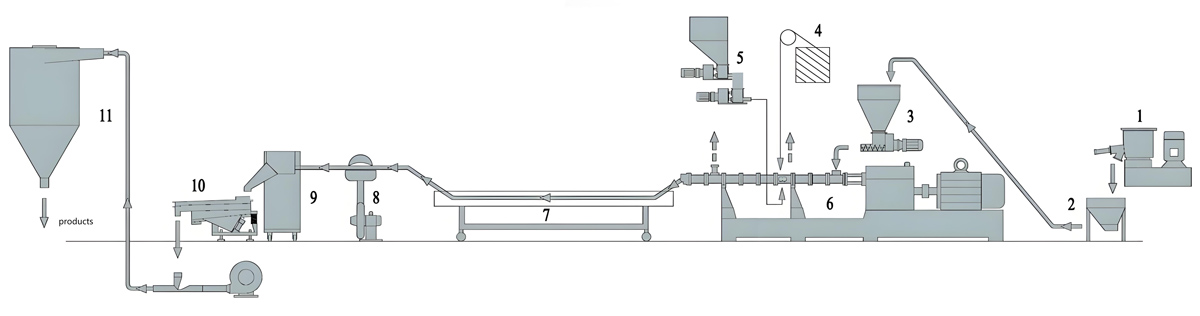
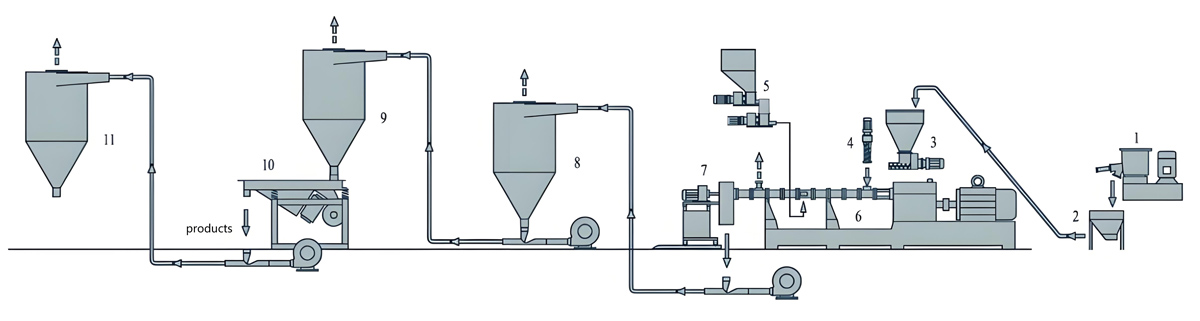
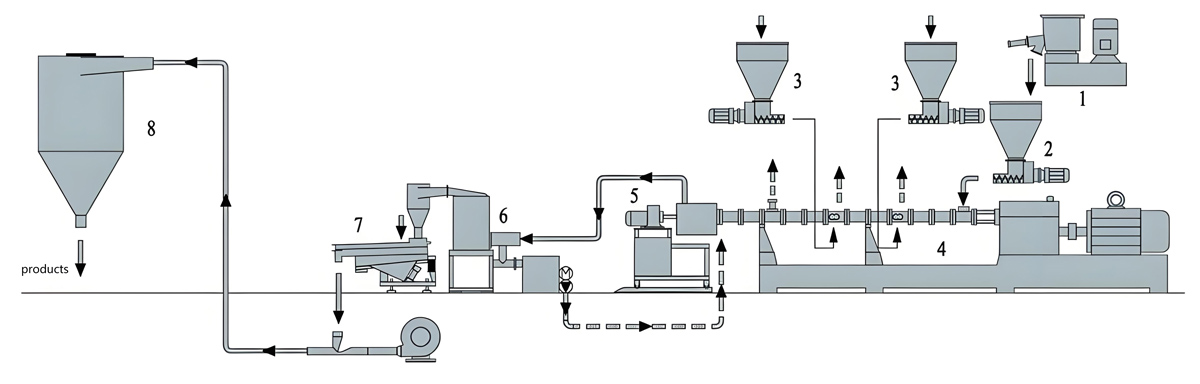
Pelletizing system selection affects pellet quality and electrical properties in electronic component manufacturing. Strand pelletizing is commonly used for electronic masterbatches providing uniform cylindrical pellets. Strand die design should produce consistent strand diameter with excellent surface quality. Water bath temperature control must prevent thermal shock to hot strands which could affect electrical properties. Pelletizer knives must be sharp and properly aligned for clean pellet cutting minimizing fines. Underwater pelletizing may be used for applications requiring very high pellet quality or handling of shear-sensitive fillers. Pellet size typically ranges from 2 to 4 mm in diameter for electronic applications ensuring good flow in molding operations.
Production Equipment Introduction
Stainless steel twin screw extruders for electronic component masterbatch manufacturing incorporate specialized features designed to provide corrosion resistance, contamination control, and precise process control required for electronic applications.
KTE Series stainless steel twin screw extruders from Nanjing Kerke Extruder Equipment Company provide comprehensive capabilities specifically optimized for electronic component masterbatch applications. The co-rotating twin screw configuration provides excellent mixing characteristics essential for achieving uniform filler distribution required for electrical property consistency. Stainless steel construction provides corrosion resistance essential for processing conductive fillers and flame retardants that may be corrosive to standard materials. Cleanroom-compatible designs enable production in controlled environments required for electronic applications. The extruders feature precise process control capabilities maintaining parameter stability essential for electrical property consistency.
Stainless steel construction provides corrosion resistance and cleanability critical for electronic applications. Barrel and screw components are constructed from stainless steel alloys including 316L or 304 grades providing excellent corrosion resistance to halogenated flame retardants, conductive fillers, and other aggressive materials. Surface finishes are polished to Ra values less than 0.4 micrometers for easy cleaning and contamination control. All-welded construction eliminates crevices and areas where contamination could accumulate. Stainless steel construction supports cleanroom compatibility with materials meeting cleanroom outgassing and particle generation requirements.
Cleanroom-compatible design enables production in controlled environments required for electronic applications. Equipment surfaces are designed for easy cleaning with minimal horizontal surfaces where particles could accumulate. Smooth transitions and rounded corners facilitate cleaning and prevent particle accumulation. Sealed drive systems and bearings prevent lubricant contamination of product area. Electrical components are located away from product area or sealed to prevent contamination. Cleanroom-compatible designs enable classification according to ISO cleanliness standards typically supporting Class 100000 to Class 10000 environments.
Temperature control system for electronic applications provides exceptional accuracy and stability. Multi-zone electric heating with individual zone control typically includes 10 to 14 zones along barrel length providing precise thermal management. Heating capacity up to 15 kW per zone ensures adequate heating capability for high-temperature engineering polymers. Cooling systems incorporate both air and water cooling with responsive temperature regulation. Temperature control accuracy better than plus or minus0.5 degree Celsius ensures consistent thermal conditions critical for electrical property consistency. Advanced control algorithms provide rapid response to setpoint changes and compensation for thermal variations.
Feeding system precision is critical for electronic masterbatch formulation accuracy. Gravimetric feeding systems provide accuracy better than 0.2 percent of setpoint ensuring precise conductive filler and additive loading. Multiple feeder configurations enable separate feeding of different components allowing individual optimization. Feeder hysteresis compensation and vibration isolation ensure consistent feeding of low-density conductive fillers. Automated calibration procedures maintain long-term feeding accuracy. Feeding systems include dust containment preventing contamination of cleanroom environments. Feeder integration with extruder control enables coordinated operation and automatic adjustment.
Process control system provides precise parameter control essential for electrical property consistency. PLC-based control systems with touch screen interfaces provide operator interaction and system monitoring. Process monitoring includes temperature profiles, screw speed, motor load, feed rates, and pressure readings. Data logging capabilities record processing parameters for batch traceability and electrical property correlation. Alarm systems alert operators to parameter deviations that could affect electrical properties. Advanced systems may implement statistical process control monitoring parameter trends and detecting shifts before electrical property variation occurs.
Parameter Settings
Optimal parameter settings depend on specific formulation, carrier polymer, and electrical property requirements. Stainless steel extruders enable precise parameter control with recipe storage for consistency.
Temperature profile settings vary based on carrier polymer and filler loading for electronic applications. For polycarbonate-based conductive masterbatch with 20 percent carbon fiber loading, typical settings include feed zone at 240 to 260 degrees Celsius, compression zone at 260 to 280 degrees Celsius, mixing zone at 270 to 290 degrees Celsius, and die zone at 270 to 290 degrees Celsius. For polyamide-based masterbatch with 15 percent carbon black loading, settings include feed zone at 220 to 240 degrees Celsius, compression zone at 240 to 260 degrees Celsius, mixing zone at 250 to 270 degrees Celsius, and die zone at 250 to 270 degrees Celsius. High filler loadings may require slightly increased temperatures to maintain appropriate viscosity. Temperature settings must avoid thermal degradation of conductive fillers or flame retardants.
Screw speed settings balance dispersion requirements with filler property preservation. For carbon fiber masterbatch, typical screw speeds range from 100 to 150 rpm to minimize fiber breakage preserving conductivity. For carbon black masterbatch, speeds of 150 to 250 rpm provide adequate dispersion. For metal powder masterbatch, speeds of 100 to 200 rpm prevent excessive milling of metal particles. For conductive polymer masterbatch, speeds of 120 to 220 rpm provide dispersion without degradation. Optimal screw speed depends on filler type, sensitivity, and required electrical property consistency.
Feed rate settings for electronic masterbatch must match target throughput while maintaining formulation accuracy. For gravimetric feeders, feed rate settings correspond to formulation percentages and target throughput. For 1000 kg per hour production rate with 85 percent carrier polymer and 15 percent conductive filler, carrier polymer feeder setpoint is 850 kg per hour and conductive filler feeder setpoint is 150 kg per hour. Feeder tolerance should be maintained within plus or minus0.2 percent of setpoint to ensure electrical property consistency. Feed rate settings must maintain appropriate residence time typically ranging from 30 to 90 seconds depending on formulation complexity.
Vent settings manage moisture removal critical for electrical properties. First vent typically positioned at 50 to 60 percent of barrel length. Vent temperature setting should be 15 to 25 degrees Celsius above melt temperature to prevent condensation. Vent vacuum level should be set to achieve required moisture removal typically ranging from atmospheric to 600 mm Hg absolute. Vacuum venting is particularly important for electronic applications where moisture significantly affects electrical properties. Vent filter status monitoring alerts operators when filters require cleaning to maintain vacuum effectiveness.
Die settings ensure consistent strand formation and pellet quality. Die temperature setpoint should be 5 to 10 degrees Celsius above final zone temperature ensuring smooth flow through die. Die pressure will depend on formulation viscosity and throughput typically ranging from 80 to 200 bar. Strand take-away speed must be coordinated with throughput to maintain proper strand tension for uniform pellet cutting. Strand diameter should be optimized for pelletizing system and downstream processing requirements.
Pelletizer settings ensure consistent pellet size and quality. Knife speed setpoint determines pellet length with higher speeds producing shorter pellets. Knife sharpness and proper alignment ensure clean cutting minimizing fines. Strand speed control through take-away rollers ensures consistent tension. Pelletizer gap settings ensure proper knife to die alignment. For electronic applications, pellet size uniformity is particularly important for consistent molding and electrical properties.
Equipment Pricing
Equipment investment for stainless steel twin screw extruder systems varies based on stainless steel construction level, cleanroom compatibility, and specific features required for electronic component masterbatch production.
KTE Series stainless steel twin screw extruder base machine pricing depends on stainless steel construction extent and equipment size. Models with 65 mm screw diameter and partial stainless steel construction including barrel and critical zones typically range from USD 110,000 to USD 140,000. Models with 90 mm screw diameter and comprehensive stainless steel construction typically range from USD 160,000 to USD 210,000. Models with 110 mm screw diameter and full stainless steel construction including complete product contact surfaces typically range from USD 230,000 to USD 300,000. Large capacity models with 130 to 150 mm screw diameter and full stainless steel construction range from USD 320,000 to USD 500,000 depending on cleanroom compatibility and specific requirements.
Stainless steel construction features significantly affect total investment. Partial stainless steel construction covering barrel and critical zones adds USD 25,000 to USD 40,000 to base machine cost. Full stainless steel construction including all product contact surfaces adds USD 45,000 to USD 75,000. High-purity stainless steel alloys for critical applications add USD 15,000 to USD 30,000. Specialized surface finishes for cleanroom compatibility add USD 8,000 to USD 18,000. Stainless steel construction provides essential corrosion resistance and cleanability for electronic applications.
Cleanroom-compatible design features add to total investment. Sealed drive systems preventing contamination add USD 12,000 to USD 22,000. Cleanroom-optimized electrical components and wiring add USD 8,000 to USD 15,000. Specialized cleaning and decontamination features add USD 10,000 to USD 20,000. Cleanroom documentation and certification support add USD 5,000 to USD 12,000. Cleanroom compatibility is essential for many electronic masterbatch applications.
Feeding systems for electronic applications require precision and contamination control. High-precision gravimetric feeding systems with accuracy better than 0.2 percent typically cost USD 15,000 to USD 35,000 depending on number of feeders and capacity. Dust containment systems for cleanroom compatibility add USD 8,000 to USD 18,000 per feeder. Multiple feeder configurations for separate component feeding add USD 10,000 to USD 20,000 per additional feeder. Feeding system calibration and documentation support electronic application requirements.
Pelletizing systems for electronic applications vary based on quality requirements and contamination control. Strand pelletizing systems with stainless steel contact parts typically cost USD 25,000 to USD 50,000. Underwater pelletizing systems providing highest quality with cleanroom compatibility cost USD 45,000 to USD 80,000. Stainless steel water bath systems for cleanroom compatibility add USD 10,000 to USD 20,000. Pelletizing system selection should balance quality requirements, contamination control, and cleanroom compatibility.
Complete system costs including extruder, stainless steel features, feeding, pelletizing, and necessary ancillary equipment typically range from USD 200,000 to USD 800,000 for electronic component masterbatch production. Medium capacity systems with 65 to 90 mm extruders and comprehensive stainless steel construction typically range from USD 250,000 to USD 400,000. High-capacity systems with 110 to 150 mm extruders and full cleanroom compatibility typically range from USD 450,000 to USD 900,000. Additional costs for cleanroom installation, validation, and certification typically add 15 to 25 percent to equipment costs. Stainless steel construction and cleanroom compatibility provide essential capabilities for electronic applications justifying premium investment.
Production Problems and Solutions
Electronic component masterbatch production may encounter various problems affecting electrical properties, contamination levels, or processing quality. Stainless steel extruders provide contamination control and precision addressing many electronic-specific challenges.
Electrical property variation between batches represents significant problem for electronic applications where consistency is critical. This problem manifests as noticeable changes in conductivity, resistivity, dielectric strength, or other electrical properties between production runs despite using same formulation. Root causes may include formulation variation, parameter deviations, conductive filler damage, or contamination. Electrical property variation can cause electronic component failures, reliability issues, and customer quality problems.
Solutions for electrical property variation include implementing comprehensive material quality control ensuring conductive filler and additive consistency. Precise gravimetric feeding with accuracy better than 0.2 percent ensures formulation accuracy critical for electrical properties. Parameter control with tight tolerance ensures consistent processing conditions affecting electrical properties. Screw configuration optimization preserves conductive filler structure preventing property degradation. Contamination control through stainless steel construction and cleanroom processing prevents property variation from foreign material. Statistical process control monitoring parameter trends identifies shifts before electrical property variation occurs. Avoiding electrical property variation requires comprehensive quality management, precise feeding, parameter control, contamination prevention, and statistical monitoring.
Conductive filler damage during processing reduces electrical performance. Carbon fibers can break reducing conductivity pathways. Carbon nanotubes can be damaged reducing effectiveness. Metal powders can be milled affecting conductivity. Filler damage manifests as reduced electrical performance compared to expected values based on formulation. Root causes include excessive shear during mixing, inappropriate screw configuration, or excessive temperature causing thermal degradation.
Solutions for conductive filler damage include screw configuration optimization using mixing elements providing adequate dispersion with minimal shear. Reducing screw speed decreases shear and thermal stress on sensitive fillers. Temperature profile optimization minimizing maximum temperatures prevents thermal degradation. Using shear-resistant filler grades improves processing robustness. Monitoring electrical properties during processing detects filler damage early. For particularly sensitive fillers, alternative mixing approaches including distributive mixing elements may be preferable. Avoiding filler damage requires understanding filler sensitivity limits, appropriate screw configuration, and careful parameter optimization.
Contamination affecting electrical properties presents serious problem for electronic applications. Contamination can come from equipment corrosion, foreign particles, or inappropriate materials. Stainless steel construction prevents corrosion-related contamination. Contamination manifests as unexpected changes in electrical properties, visual defects, or testing failures. Electronic applications have zero tolerance for certain types of contamination that could cause component failures.
Solutions for contamination problems include using full stainless steel construction preventing corrosion-related contamination. Implementing comprehensive cleaning procedures between material changes ensures removal of previous materials. Material handling systems designed for minimal contamination risk including closed conveying and storage systems. Cleanroom processing environments prevent external contamination. Regular equipment inspection identifies potential contamination sources. Material qualification and incoming inspection prevent contamination from raw materials. Avoiding contamination requires stainless steel construction, cleanroom processing, comprehensive cleaning procedures, and material quality control.
Moisture-related property degradation affects electrical properties significantly. Moisture absorption by engineering polymers or hygroscopic fillers can dramatically alter electrical properties including dielectric strength and resistivity. This problem manifests as unexpected changes in electrical properties, bubble formation, or processing difficulties. Electronic polymers are particularly sensitive to moisture requiring thorough drying and effective venting.
Solutions for moisture-related problems include thorough drying of hygroscopic materials before processing to moisture content below 50 parts per million. Effective venting systems remove moisture during processing. Vacuum venting improves moisture removal for sensitive applications. Temperature profile optimization prevents moisture entrapment. Material storage in controlled humidity environments prevents moisture absorption. Regular moisture content testing of incoming and processed materials ensures compliance. Monitoring electrical properties provides early indication of moisture-related problems. Avoiding moisture problems requires comprehensive drying procedures, effective venting, controlled storage, and moisture monitoring.
Flame retardant degradation during processing reduces effectiveness and can cause electrical property changes. Thermal degradation of flame retardants may produce corrosive byproducts affecting electrical properties. Degradation manifests as reduced flame retardancy, color changes, or property changes. Electronic applications require consistent flame retardancy for safety compliance making degradation particularly problematic.
Solutions for flame retardant degradation include temperature profile optimization minimizing thermal exposure time. Reducing screw speed reduces thermal stress. Using thermally stable flame retardant grades provides processing robustness. Vent systems remove degradation products preventing further degradation. Screw configuration optimization reduces mechanical heating. Monitoring flame retardancy through testing ensures consistency. For formulations particularly prone to degradation, alternative flame retardant systems may provide better stability. Avoiding flame retardant degradation requires understanding thermal limits, temperature optimization, and appropriate flame retardant selection.
Maintenance and Care
Stainless steel twin screw extruders for electronic applications require comprehensive maintenance programs preserving stainless steel condition, contamination control, and electrical property consistency. Regular maintenance ensures continued cleanroom compatibility and electrical property performance.
Daily maintenance tasks focus on contamination monitoring and basic equipment care. Operators should monitor equipment cleanliness looking for any contamination buildup or foreign particles. Temperature readings should be checked for consistency and proper operation. Feeding system operation should be monitored for accuracy and containment. Vent system operation should ensure proper vacuum levels and filter condition. Daily cleaning procedures should be performed according to validated cleaning protocols for electronic applications. Daily maintenance logs should record cleanliness observations, parameter readings, and any corrective actions.
Weekly maintenance tasks include more detailed inspection and calibration. Temperature sensor calibration verification ensures accuracy within required tolerances critical for electrical property consistency. Feeder calibration checks maintain feeding accuracy essential for formulation precision. Stainless steel surfaces should be inspected for corrosion or damage requiring attention. Vent filter inspection and cleaning as needed maintains vacuum performance. Electrical system inspection checks for proper ground connections and appropriate shielding preventing electromagnetic interference. Weekly maintenance provides opportunity to detect problems before they affect electrical properties.
Monthly maintenance tasks address more comprehensive inspection and preventive maintenance. Screw and barrel inspection examines wear patterns with attention to stainless steel surfaces. Feeding system maintenance includes cleaning feeder components, checking flow aids, and verifying proper operation. Drive system inspection checks motor operation, coupling condition, and vibration levels. Temperature control system inspection includes heating element continuity testing and cooling system operation. Pelletizing system maintenance includes knife condition and alignment. Monthly maintenance helps prevent problems and ensures continued reliable operation.
Quarterly maintenance tasks involve more extensive maintenance requiring production downtime. Screw removal and detailed inspection provides comprehensive assessment of stainless steel condition and wear. Drive system maintenance may include motor bearing replacement, coupling service, and lubrication system service. Temperature control system calibration with reference standards ensures accuracy. Feeding system overhaul includes component cleaning, flow system verification, and complete calibration. Pelletizing system overhaul includes knife replacement or sharpening, die inspection, and system calibration. Quarterly maintenance provides thorough service supporting continued cleanroom compatibility.
Semi-annual maintenance tasks represent comprehensive service requiring significant planning and possibly vendor support. Complete screw and barrel inspection determines need for reconditioning or replacement based on wear assessment and stainless steel condition. Drive system overhaul including motor bearing replacement, coupling service, and comprehensive testing ensures long-term reliability. Temperature control system review includes heating element replacement, cooling system overhaul, and complete control system calibration. Feeding system overhaul includes component replacement, flow system cleaning, and complete calibration. Semi-annual maintenance supports continued reliability and cleanroom compatibility.
Annual maintenance tasks represent most comprehensive service supporting validation requirements and electronic industry compliance. Complete screw and barrel service may involve reconditioning or replacement based on wear assessment. Drive system major overhaul ensures continued reliable operation. Temperature control system major service may include component replacement and complete system optimization. Complete system cleaning provides opportunity for deep cleaning and validation of cleaning procedures. Annual maintenance supports continued compliance with electronic industry requirements and cleanroom standards.
FAQ
Q: Why is stainless steel construction important for electronic component masterbatch production?
A: Stainless steel construction provides corrosion resistance essential for processing conductive fillers and flame retardants that may be corrosive to standard materials. Cleanability of stainless steel supports contamination control required for electronic applications. All-welded stainless steel construction eliminates crevices where contamination could accumulate. Stainless steel surfaces can be polished to very smooth finishes facilitating cleaning and minimizing particle generation. Stainless steel construction enables cleanroom compatibility with materials meeting outgassing and particle generation standards. Overall, stainless steel construction is essential for maintaining material purity and contamination control in electronic component masterbatch production.
Q: What level of cleanliness is required for electronic component masterbatch production?
A: Cleanliness requirements depend on specific electronic application but typically require ISO Class 100000 to Class 10000 environments. Critical electronic applications may require Class 1000 or better. Cleanroom requirements include controlled particle counts, temperature, humidity, and air exchange rates. Equipment must be designed for cleanroom compatibility with smooth surfaces, sealed components, and appropriate materials. Personnel practices including gowning and behavior protocols are critical. Cleanroom certification documentation supports electronic customer requirements. Cleanroom level is determined based on electronic component sensitivity and customer specifications.
Q: How does formulation accuracy affect electrical properties in electronic masterbatch?
A: Formulation accuracy is critical for electrical properties because conductivity, resistivity, dielectric strength, and other electrical properties depend directly on conductive filler and additive loading levels. Small variations in conductive filler concentration can cause significant changes in electrical properties. For example, one percent variation in carbon black loading can change conductivity by 10 to 50 percent depending on formulation. Flame retardant loading affects both flame retardancy and electrical properties. Precise gravimetric feeding with accuracy better than 0.2 percent of setpoint is typically required for electronic applications to maintain electrical property consistency.
Q: What are the challenges in processing conductive fillers for electronic applications?
A: Conductive fillers present multiple processing challenges including sensitivity to shear damage affecting electrical properties, tendency to agglomerate requiring careful dispersion, abrasive nature causing equipment wear, and potential for electrical shorting if not properly isolated. Carbon fibers are particularly sensitive to shear and can break during mixing reducing conductivity. Carbon nanotubes require careful dispersion while maintaining structure. Metal powders can be milled reducing particle size and affecting conductivity. Stainless steel construction prevents corrosion from conductive fillers. Proper screw configuration and parameter optimization preserve filler structure while achieving adequate dispersion.
Q: How does moisture affect electrical properties in electronic masterbatch?
A: Moisture can dramatically affect electrical properties including reducing dielectric strength, increasing conductivity, and causing property variation. Engineering polymers used in electronic applications are often hygroscopic and can absorb significant moisture if not properly dried. Moisture absorption during storage or processing can cause property changes affecting final electronic component performance. Moisture can also cause bubble formation during processing creating defects. Thorough drying to moisture content below 50 parts per million is typically required. Effective venting removes moisture during processing. Storage in controlled humidity environments prevents moisture absorption. Moisture monitoring ensures compliance with specifications.
Q: What maintenance is most important for maintaining electrical property consistency?
A: Most important maintenance for electrical property consistency includes regular calibration of temperature sensors and feeders ensuring parameter accuracy, stainless steel surface maintenance preventing corrosion and contamination, screw and barrel inspection preserving mixing effectiveness, vent system maintenance ensuring moisture removal, and cleaning procedures validated for electronic applications. Parameter calibration is particularly important as electrical properties depend directly on processing conditions and formulation accuracy. Stainless steel condition affects contamination risk which can dramatically affect electrical properties. Regular inspection and preventive maintenance prevent problems before they affect electrical properties.
Q: What cleanroom certification is required for electronic component masterbatch production?
A: Cleanroom certification requirements depend on customer specifications and electronic application sensitivity. Common certifications include ISO 14644 cleanroom classification from Class 100000 to Class 1000 depending on requirements. Some customers require cleanroom validation documentation including particle count monitoring, airflow verification, and cleaning protocol validation. Cleanroom behavior and gowning protocols are typically included in certification requirements. Documentation supporting cleanroom compliance includes air quality monitoring records, cleaning procedures, maintenance logs, and personnel training records. Certification level is determined based on electronic component sensitivity and customer quality requirements.
Q: How can electrical properties be monitored and controlled during production?
A: Electrical properties can be monitored through periodic testing of production samples comparing to specification limits. Inline monitoring can measure bulk resistivity or conductivity providing real-time feedback. Statistical process control of processing parameters including temperature, screw speed, feeder accuracy, and residence time helps maintain conditions producing consistent electrical properties. Formulation accuracy monitoring through gravimetric feeding ensures precise additive loading. Historical correlation between processing parameters and electrical properties enables optimization and prediction. Customer specification limits define acceptable ranges for electrical properties requiring monitoring and control.
Conclusion
Stainless steel twin screw extruders provide essential capabilities for electronic component masterbatch production enabling contamination-free processing while maintaining exceptional electrical property control required by electronic industry standards. The corrosion resistance, cleanroom compatibility, and precise process control features of modern stainless steel extruders address the demanding requirements of electronic applications where material purity, electrical properties, and reliability are critical. KTE Series stainless steel twin screw extruders from Nanjing Kerke Extruder Equipment Company offer specialized capabilities specifically optimized for electronic component masterbatch production.
Successful implementation of stainless steel extrusion for electronic masterbatch requires comprehensive approach addressing equipment selection, formulation development, contamination control, parameter optimization, and maintenance. Proper equipment selection balances stainless steel construction level with cleanroom requirements and production capacity. Formulation development considers electrical property requirements while maintaining processability. Contamination control through stainless steel construction, cleanroom processing, and validated cleaning procedures ensures material purity. Parameter optimization ensures electrical property consistency while maintaining production efficiency. Maintenance programs preserve stainless steel condition and electrical property consistency.
The investment in stainless steel extrusion technology provides significant returns through capability to produce electronic component masterbatches meeting demanding quality and reliability standards. While stainless steel construction represents significant investment compared to standard extruders, the corrosion resistance, cleanroom compatibility, and contamination control capabilities are essential for electronic applications. By implementing stainless steel twin screw extrusion technology, electronic masterbatch producers can meet the stringent purity, electrical property, and reliability requirements of electronic component manufacturing supporting high-performance electronic applications.