Introduction
Masterbatch drying and granulation represent critical processes in plastic compounding industry, ensuring material quality, consistent flow properties, and optimal performance in downstream applications. Twin screw extruders have become essential equipment for these processes due to their superior mixing capabilities, precise temperature control, and efficient material handling characteristics. The granulation process converts wet or moisture-sensitive materials into free-flowing granules suitable for storage, transportation, and further processing. This comprehensive guide explores all aspects of masterbatch drying and granulation using twin screw extruders, from material preparation through final pelletizing.
Modern twin screw extruders designed for masterbatch drying and granulation incorporate advanced features including venting systems, vacuum degassing, and specialized screw configurations. The drying function removes moisture and volatiles from materials preventing defects in final applications. Granulation function produces uniform pellets with controlled size distribution optimizing downstream processing. The integrated drying-granulation process reduces material handling steps, improves energy efficiency, and maintains material quality throughout processing.
The selection of appropriate twin screw extruder for masterbatch drying and granulation depends on multiple factors including moisture content, material properties, required drying efficiency, and granulation quality specifications. Different materials require different drying conditions and processing parameters. Understanding the complete production system enables operators to achieve consistent quality while maximizing production efficiency and energy utilization.
Formulation Ratios (Different Types)
Formulation development for masterbatch drying and granulation requires careful consideration of material ratios, drying requirements, and granulation characteristics. The formulation affects processing conditions, drying efficiency, and final product quality. Different material types require specific formulation approaches based on moisture content, thermal sensitivity, and physical properties.
Moisture Content Formulations
Moisture content in masterbatch materials varies significantly based on material type and storage conditions. Hygroscopic materials including nylon, polycarbonate, and polyesters typically contain 0.2-0.5% moisture requiring intensive drying. Less hygroscopic materials including polyolefins typically contain 0.05-0.1% moisture requiring moderate drying. Formulation planning must account for initial moisture content when determining drying parameters and residence time requirements.
The drying efficiency depends on initial moisture content and target moisture level for final product. Typical target moisture levels for engineering plastic masterbatches range below 0.02% for sensitive applications. High moisture content materials require longer drying times or higher temperatures to achieve target moisture levels. Formulation adjustments including drying agents may be necessary for materials with excessive moisture content. Understanding moisture content enables proper drying process design and parameter selection.
Carrier Resin Formulations
Carrier resin selection for masterbatch drying and granulation considers both processing characteristics and final application requirements. Engineering plastic carriers including PA, PC, and PET require careful drying to prevent hydrolytic degradation during processing. These materials typically require drying temperatures 80-120C for 3-6 hours depending on initial moisture and part thickness requirements. Polyolefin carriers including PE and PP require less intensive drying with temperatures 60-80C for 2-4 hours.
Carrier resin melt flow index affects granulation characteristics and drying requirements. Low MFI resins below 2 g/10min require higher drying temperatures to remove moisture from crystalline structures. High MFI resins above 20 g/10min dry more easily but may require lower temperatures to prevent thermal degradation. The carrier resin selection affects energy consumption during drying with higher melting resins requiring more energy. Balancing drying requirements with final application properties ensures optimal carrier selection.
Additive Formulations
Additives in masterbatch formulations affect drying and granulation characteristics. Drying agents including desiccants and moisture scavengers reduce drying requirements but may affect material properties. Antioxidants and thermal stabilizers protect materials during high-temperature drying processes. Flow enhancers improve granulation characteristics by reducing melt viscosity. Lubricants aid in granulation by reducing friction between pellets and equipment surfaces.
Specific additive types address different formulation requirements. Hydrolysis stabilizers for moisture-sensitive materials protect during processing even with residual moisture. Heat stabilizers protect materials during elevated temperature drying. Processing aids improve flow characteristics during granulation. Antistatic agents prevent static electricity issues during handling. The additive package must be balanced to achieve desired effects without compromising drying efficiency or granulation quality.
Pigment Formulations
Pigment formulations for masterbatch drying and granulation consider pigment moisture sensitivity and thermal stability. Inorganic pigments including titanium dioxide typically have low moisture content but may contain adsorbed surface moisture requiring drying. Organic pigments may have higher moisture content depending on manufacturing and storage conditions. Special effect pigments including pearlescent and metallic types require careful drying to prevent moisture-induced defect formation.
Pigment loading affects drying behavior with higher pigment loadings increasing moisture content requiring longer drying times. Pigment surface chemistry influences moisture adsorption and removal characteristics. Some pigments may require special drying conditions to prevent moisture retention. Formulation planning must consider pigment-specific drying requirements to achieve target moisture levels without compromising pigment quality or color characteristics.
Regrind and Recycled Material Formulations
Regrind and recycled materials in masterbatch formulations present special drying challenges due to potential moisture contamination from processing or storage. Post-consumer recycled materials typically contain higher moisture content 0.5-2.0% requiring extensive drying. Post-industrial regrind may contain 0.1-0.5% moisture depending on handling conditions. These materials often require higher drying temperatures and longer residence times compared to virgin materials.
Formulation with recycled materials may require additional drying agents or processing aids to compensate for higher moisture content. Material testing including moisture content analysis and drying behavior evaluation essential before formulation. Moisture content variation in recycled materials may require drying process adjustments to maintain consistent final product moisture. Understanding recycled material characteristics enables proper drying process design and formulation optimization.
Production Process
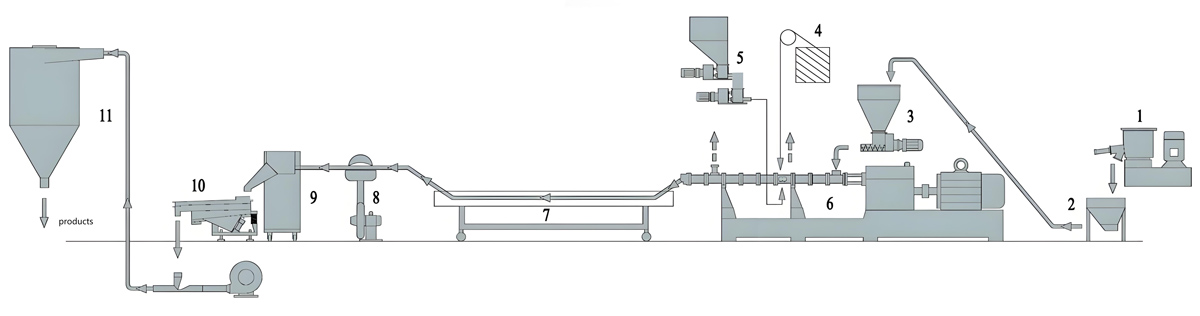
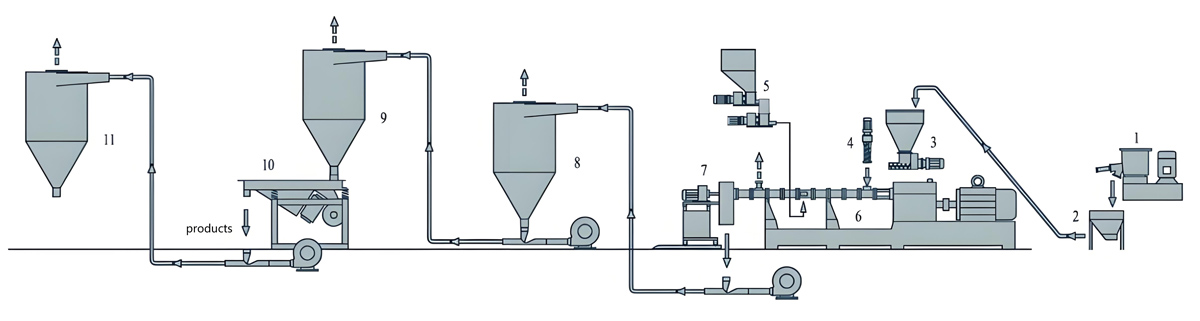
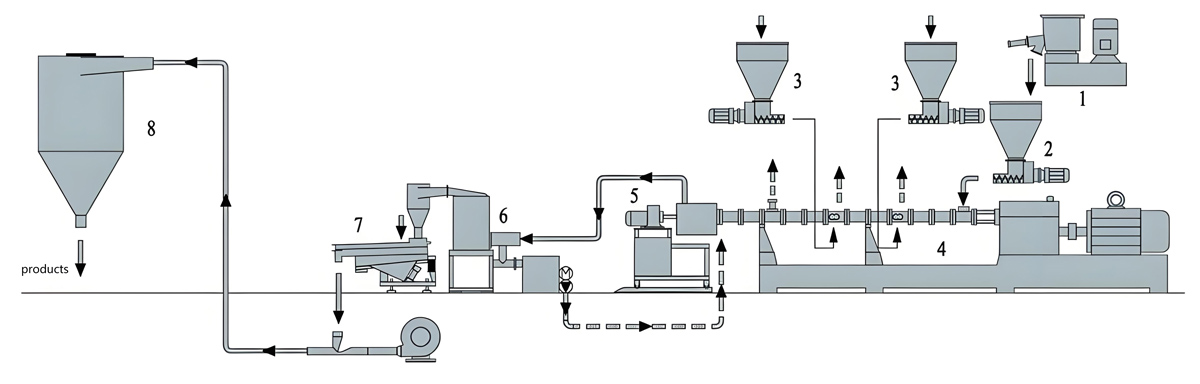
Masterbatch drying and granulation production process involves multiple stages from material preparation through final pelletizing. Understanding each stage enables proper process control and quality assurance. The integrated nature of twin screw extruder operation for drying and granulation requires careful coordination of drying sections with granulation sections to achieve optimal results.
Material Preparation
Material preparation represents critical first step ensuring consistent feeding and drying performance. Raw materials including carrier resin, pigments, and additives require proper handling and storage before processing. Moisture content verification through Karl Fischer titration or moisture analysis establishes baseline drying requirements. Material segregation based on moisture content enables appropriate drying intensity allocation for different materials.
Pre-drying of highly moisture-sensitive materials may be necessary before entering main extruder. Pre-drying temperatures typically 60-80C for 2-4 hours depending on material type and initial moisture. Material inspection including visual examination for moisture damage or contamination prevents processing problems. Proper material preparation ensures efficient drying operation and consistent final product quality.
Feeding System Operation
Feeding system for masterbatch drying and granulation must handle materials with varying moisture contents and flow characteristics. Gravimetric feeders provide precise material delivery enabling accurate drying calculations. Multiple feeder systems allow separate feeding of materials with different drying requirements. Pre-mixing of materials before feeding may be necessary to achieve uniform drying conditions.
Feeder maintenance ensures consistent material flow without bridging or starvation. Moisture content variations in fed materials may require feed rate adjustments to maintain consistent drying load. Feed system design considers material flow characteristics including angle of repose and bulk density affected by moisture content. Proper feeding ensures consistent load on drying and granulation sections.
Drying Zone Operation
Drying zone in twin screw extruder removes moisture and volatiles from materials through thermal and mechanical action. Initial drying sections operate at temperatures 10-30C above material glass transition temperature ensuring moisture removal without thermal degradation. Screw configuration in drying zone includes conveying elements with minimal mixing to prevent material degradation while allowing heat transfer.
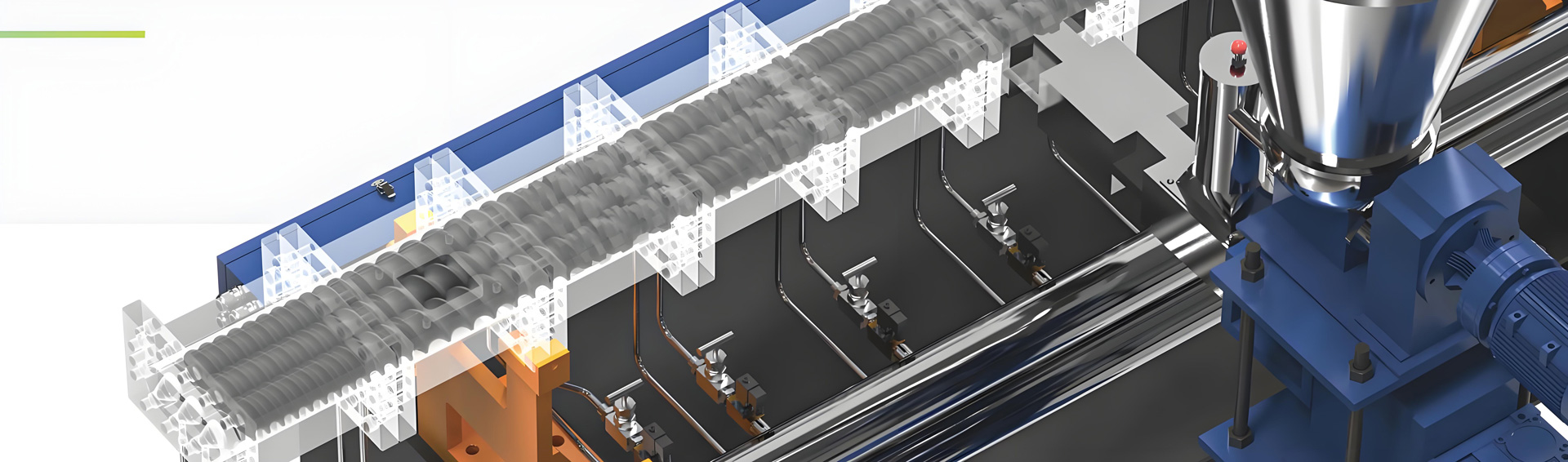
Venting ports positioned along drying zone allow moisture and volatiles to escape from melt. Open vents operate at atmospheric pressure removing bulk moisture. Vacuum vents enhance drying by reducing partial pressure of water vapor improving moisture removal efficiency. Multiple venting stages may be necessary for materials with high initial moisture content. Drying zone temperature and venting coordination optimize moisture removal efficiency.
Vacuum Degassing System
Vacuum degassing system enhances moisture removal for materials with stringent drying requirements. Vacuum levels typically 50-500 mbar depending on material and moisture content. Lower vacuum levels achieve more thorough drying but require more energy and robust equipment design. Vacuum system capacity must handle moisture vapor generation rate from drying process.
Vacuum degassing location typically positioned after initial drying when most moisture has been released. Multiple vacuum stages may be employed for materials with very high moisture content. Vacuum system maintenance including condensate removal and pump servicing ensures consistent vacuum levels. Proper vacuum degassing significantly improves drying efficiency compared to atmospheric venting alone.
Granulation Zone Configuration
Granulation zone converts dried materials into uniform granules suitable for handling and storage. Melt from drying zone enters granulation section where it is formed into strands or pellets. Temperature in granulation zone maintained to ensure proper melt flow for pellet formation. Screw configuration includes mixing elements for homogenization followed by conveying elements to die face.
Die design for granulation varies based on pelletizing method. Strand dies produce multiple melt strands for subsequent cutting. Water ring dies produce pellets directly into water bath. Die hole diameter and number determine pellet size and production rate. Proper die design ensures consistent pellet size and shape for optimal downstream processing.
Pelletizing and Cooling
Pelletizing system converts melt into uniform granules with controlled size distribution. Strand pelletizing involves cutting cooled strands into pellets of specified length. Water bath cooling temperature controlled 30-50C for polyolefins and 40-60C for engineering plastics ensuring proper solidification. Strand pull speed synchronized with extruder throughput preventing strand stretching or accumulation.
Underwater pelletizing offers alternative producing spherical pellets with excellent heat transfer. Melt cut directly into water producing uniform pellets with smooth surfaces. Pellet sizing through screen selection ensures desired size distribution. Pellet drying after water-based pelletizing removes surface moisture preventing clumping. Proper pelletizing ensures consistent granule quality for storage and downstream use.
Production Equipment Introduction
Modern twin screw extruders for masterbatch drying and granulation feature specialized design elements. The KTE Series twin screw extruder from Nanjing Kerke Extrusion Equipment Company offers excellent performance for drying and granulation applications. These extruders incorporate multiple venting zones for moisture removal and advanced screw configurations for efficient granulation.
Equipment specifications include barrel L/D ratio typically 40:1 to 60:1 providing sufficient length for both drying and granulation. Screw diameters range from 35mm to 90mm accommodating production capacities from 100 kg/hr to 2000 kg/hr. Specialized venting systems include atmospheric vents, vacuum vents, and condensate removal systems. Control systems feature temperature and vacuum control enabling precise drying process management.
Parameter Settings
Optimal parameter settings for masterbatch drying and granulation depend on material characteristics and quality requirements. Temperature profiles, vacuum levels, and processing speeds require careful adjustment to achieve target moisture levels while maintaining material quality. Understanding parameter effects enables process optimization for specific materials and formulations.
Drying Temperature Profile
Drying temperature profile along extruder barrel affects moisture removal efficiency and material quality. Feed zone temperature typically set 20-30C below material glass transition temperature to prevent premature melting while allowing heat penetration. Initial drying zone temperature 10-20C above Tg promoting moisture removal without thermal degradation. Final drying zone temperature 20-40C above Tg ensuring complete moisture removal before granulation.
Temperature profiles vary by material type. Polyamide carriers require drying temperatures 80-120C depending on PA type. Polycarbonate carriers require 100-140C drying temperatures. Polyester carriers require 110-150C. Polyolefin carriers require lower temperatures 60-100C. Temperature profile must prevent thermal degradation while ensuring complete moisture removal. Gradual temperature increase prevents thermal shock to materials.
Vacuum Level Settings
Vacuum level settings control moisture removal efficiency in degassing zones. Atmospheric venting in initial drying zones removes bulk moisture without vacuum. Vacuum levels in subsequent zones typically 100-300 mbar for moderate drying requirements. High vacuum levels below 50 mbar used for materials with stringent moisture requirements. Multiple vacuum stages with progressive vacuum levels optimize drying efficiency.
Vacuum system sizing must accommodate moisture vapor generation rate. Insufficient vacuum capacity leads to moisture carryover into granulation zone. Excessive vacuum capacity wastes energy without proportional benefit. Optimal vacuum level balances drying efficiency with energy consumption. Vacuum system monitoring ensures consistent vacuum levels throughout operation.
Residence Time Control
Residence time in drying zones affects moisture removal and material quality. Typical residence time for drying 1-4 minutes depending on initial moisture and target moisture levels. Longer residence times improve drying but increase thermal exposure. Shorter residence times reduce thermal degradation but may compromise drying efficiency.
Residence time control through screw speed and feed rate adjustment. Lower screw speeds increase residence time improving drying. Higher feed rates decrease residence time potentially compromising drying. Optimal residence time balances drying requirements with thermal stability. Residence time measurement through tracer methods or calculation ensures consistent operation.
Granulation Temperature Settings
Granulation temperature affects pellet quality and formation characteristics. Melt temperature at die typically 20-30C above drying zone temperature ensuring proper flow. Too low temperature causes poor pellet formation and irregular shapes. Too high temperature causes thermal degradation and excessive sagging of strands. Temperature must maintain consistent throughout granulation process.
Granulation temperature varies by material type. Polyolefins granulate at 180-240C depending on specific grade. Polyamides require 220-280C. Polycarbonate requires 260-300C. Polyester requires 260-290C. Temperature selection considers both drying requirements and granulation characteristics. Consistent temperature ensures uniform pellet quality.
Cooling Temperature Settings
Cooling temperature after granulation affects pellet solidification and quality. Water bath temperature for strand pelletizing 30-50C for polyolefins and 40-60C for engineering plastics. Underwater pelletizing water temperature 20-40C ensuring rapid solidification. Too hot cooling causes pellet deformation and sticking. Too cold cooling causes thermal shock and cracking.
Cooling rate control through water temperature and flow rate adjustment. Adequate water flow ensures uniform cooling preventing temperature gradients in pellets. Cooling time must ensure complete solidification before pellet handling. Proper cooling prevents pellet agglomeration and ensures free-flowing characteristics.
Equipment Price
Equipment pricing for masterbatch drying and granulation systems varies based on capacity, configuration, and specialized features. Understanding price factors enables proper budgeting for production facilities. Complete system pricing includes extruder, venting systems, and auxiliary equipment.
Extruder Pricing
Twin screw extruder pricing for drying and granulation varies by size and features. Medium capacity extruders 35-50mm screw diameter for 200-800 kg/hr cost $45,000-120,000. Large capacity extruders 65-90mm screw diameter for 1000-2000 kg/hr cost $120,000-350,000. KTE Series extruders offer competitive pricing with specialized venting features.
Additional features increase base price. Multiple venting zones add $8,000-15,000 per vent. Vacuum systems add $12,000-25,000 depending on capacity and vacuum level. Specialized drying screw configurations add $5,000-10,000. Material upgrades for moisture resistance add 10-20% to base cost.
Complete System Pricing
Complete drying and granulation system includes extruder, venting, pelletizing, and auxiliary equipment. Medium capacity systems 200-800 kg/hr cost $80,000-200,000. Large capacity systems 1000-2000 kg/hr cost $200,000-500,000. System pricing typically 2-3 times extruder cost.
Auxiliary equipment costs vary. Gravimetric feeder systems cost $10,000-25,000. Vacuum systems with condensate removal cost $15,000-35,000. Pelletizing systems cost $15,000-40,000. Material handling and storage add $20,000-50,000. Complete system enables automated operation reducing labor requirements.
Installation and Operating Costs
Installation costs for drying and granulation systems $8,000-30,000 depending on complexity. Electrical installation $10,000-30,000 for power requirements. Vacuum system installation adds $5,000-15,000. Installation includes commissioning and startup support.
Operating costs include energy consumption for heating and vacuum. Drying energy consumption 0.3-0.6 kWh/kg depending on initial moisture content. Vacuum system energy consumption 0.1-0.3 kWh/kg. Total operating costs $0.05-0.15 per kg excluding materials. Energy efficiency optimization reduces operating costs.
Production Problems and Solutions
Production problems in masterbatch drying and granulation affect moisture content, pellet quality, and process efficiency. Understanding problems, causes, and solutions enables effective troubleshooting and prevention.
Insufficient Moisture Removal
Insufficient moisture removal results in pellets with moisture content above specifications causing defects in downstream processing. Causes include inadequate drying temperature, insufficient residence time, ineffective venting, or vacuum system problems. Low drying temperatures prevent complete moisture removal from material. Short residence time limits moisture exposure to drying conditions. Clogged vents prevent moisture escape from extruder.
Solutions begin with temperature adjustment increasing drying zone temperatures 10-20C above initial settings. Increasing residence time through reduced screw speed or feed rate provides more drying time. Venting system inspection and cleaning removes blockages. Vacuum system service restores proper vacuum levels. Moisture content testing after drying verifies effectiveness of adjustments.
Preventive measures include regular vent system maintenance preventing blockages. Temperature monitoring ensures proper drying temperatures. Residence time calculation and control prevents insufficient drying. Material moisture content testing enables appropriate drying parameter selection. Regular vacuum system maintenance ensures consistent performance.
Pellet Quality Issues
Pellet quality issues including irregular shapes, voids, and surface defects affect handling and downstream processing. Causes include improper granulation temperature, inadequate cooling, moisture carryover, or die design problems. Incorrect granulation temperature causes poor melt flow and irregular pellet formation. Inadequate cooling causes pellet deformation and agglomeration. Moisture carryover causes bubbles and voids in pellets.
Solutions include adjusting granulation temperature 10-20C to achieve proper melt flow. Increasing cooling water flow or reducing water temperature improves solidification. Venting and vacuum system optimization prevents moisture carryover. Die cleaning or replacement improves pellet formation. Pellet size sorting removes defective pellets from production.
Preventive measures include regular temperature calibration ensuring proper granulation conditions. Cooling system maintenance ensures consistent cooling performance. Regular vent system cleaning prevents moisture carryover. Die inspection and maintenance ensures proper pellet formation. Quality control sampling catches pellet quality issues before customer problems.
Material Degradation
Material degradation during drying causes color changes, property loss, and performance issues. Causes include excessive temperature, long residence time, oxygen exposure, or shear heating. High drying temperatures exceed material thermal stability limits. Long residence time increases thermal exposure. Oxidation occurs when oxygen enters venting systems. High shear generates additional heat degrading material.
Solutions involve reducing drying temperatures 10-20C below degrading levels. Reducing residence time through increased screw speed or decreased feed rate minimizes thermal exposure. Inert gas purging of venting systems prevents oxidation. Screw configuration optimization reduces shear heating. Stabilizer addition in formulation improves thermal resistance.
Preventive measures include temperature monitoring ensuring operation within material limits. Residence time measurement prevents excessive thermal exposure. Inert gas systems installed in venting prevent oxidation. Regular screw inspection prevents wear increasing shear heating. Material selection considering thermal stability prevents degradation issues.
Equipment Overload
Equipment overload during drying and granulation causes motor trips, shutdowns, and potential damage. Causes include material bridging in feeder, excessive feed rate, moisture accumulation, or vent blockage. Material bridging causes inconsistent feeding leading to screw overload. Excessive feed rate overloads drive motor. Moisture accumulation in venting systems causes backpressure. Vent blockage causes pressure buildup.
Solutions include feeder adjustment preventing bridging through hopper agitation or conditioning. Feed rate reduction decreases material load on extruder. Vent system cleaning removes moisture accumulation. Vent blockage clearing restores proper pressure. Load monitoring prevents operation beyond equipment limits.
Preventive measures include feeder design preventing material bridging. Feed rate control systems prevent overfeeding. Regular vent system maintenance prevents blockage. Load monitoring systems provide early warning of overload conditions. Operator training recognizes early overload indicators.
Maintenance
Regular maintenance ensures drying and granulation system performance and reliability. Preventive maintenance schedules address component wear and prevent failures. Proper maintenance extends equipment life and maintains consistent product quality.
Daily Maintenance
Daily maintenance includes visual inspection of equipment for leaks, unusual sounds, or vibrations. Temperature verification ensures all zones operate at set points. Vacuum level checking ensures proper degassing performance. Feed system inspection ensures consistent material flow. Pelletizing system inspection ensures proper cutting and pellet quality.
Daily cleaning procedures prevent material buildup and cross-contamination. Vent port cleaning prevents blockages. Die cleaning ensures proper pellet formation. Pelletizing system cleaning removes debris affecting pellet quality. Proper cleaning ensures consistent drying and granulation performance.
Weekly Maintenance
Weekly maintenance includes more detailed inspection and service. Vent system inspection for blockages or accumulation. Vacuum system performance verification ensures proper vacuum levels. Screw inspection through ports for wear or material buildup. Feeder calibration verification ensures accurate material delivery. Temperature sensor verification ensures accurate readings.
Weekly lubrication of bearings, gears, and moving components. Electrical system inspection for loose connections or damage. Safety device verification ensures proper function. Documentation review ensures maintenance tasks completed properly. Weekly maintenance prevents minor issues from developing into major problems.
Monthly Maintenance
Monthly maintenance addresses components requiring periodic service. Vacuum pump service including oil change and filter replacement. Condensate system cleaning and maintenance. Screw and barrel inspection for wear or damage. Feeder disassembly and cleaning removes accumulated material. Pelletizing cutter inspection and replacement if worn.
Monthly lubrication including bearing replacement if specified. Drive system service ensures proper power transmission. Electrical system testing detects developing issues. Calibration verification of sensors ensures accurate process control. Monthly maintenance provides detailed condition assessment.
Quarterly Maintenance
Quarterly maintenance provides comprehensive equipment evaluation. Complete vent system disassembly and cleaning. Vacuum pump overhaul or replacement based on condition. Screw removal and inspection for wear measurement. Complete feeder service and calibration. Pelletizing system overhaul ensuring optimal performance.
Lubrication system service including oil changes and filter replacement. Drive system service including gearbox service. Electrical system service including control system calibration. Safety system testing ensures proper function. Quarterly maintenance opportunity for major component service.
Annual Maintenance
Annual maintenance provides complete equipment evaluation and major service. Complete equipment teardown for thorough inspection. Screw and barrel replacement based on wear measurements. Complete bearing replacement prevents unexpected failures. Drive system overhaul including gearbox rebuild. Control system update and calibration.
Structural inspection ensures equipment stability and alignment. Vacuum system overhaul ensures performance. Complete electrical system service ensures reliability. Documentation update including maintenance records. Annual maintenance opportunity for upgrades and capacity planning.
FAQ
Frequently asked questions address common concerns in masterbatch drying and granulation operations.
How do I determine required drying time for my material?
Required drying time depends on initial moisture content, target moisture level, and material characteristics. Materials with high initial moisture 0.5%+ require longer drying times 3-6 hours. Low moisture materials 0.1% or less require 1-2 hours. Engineering plastics with higher glass transition temperatures require longer times than polyolefins. Testing with moisture analyzers before and after drying determines actual drying requirements. Residence time calculations based on throughput and extruder length provide theoretical drying time. Trial production runs optimize drying time for specific materials.
What vacuum level should I use for drying?
Vacuum level selection depends on material moisture sensitivity and drying requirements. Materials requiring very low moisture below 0.02% typically need vacuum levels below 50 mbar. Moderate drying requirements to 0.05% typically use 100-200 mbar. Less stringent requirements may use atmospheric venting without vacuum. Lower vacuum levels provide more thorough drying but increase energy consumption and equipment complexity. Material testing with different vacuum levels determines optimal setting for specific requirements.
How often should I clean venting systems?
Venting system cleaning frequency depends on material type and moisture content. High moisture materials or materials producing volatiles require weekly cleaning. Standard materials typically monthly cleaning adequate. Low moisture materials may only need quarterly cleaning. Visual inspection provides guidance with visible material accumulation indicating need for cleaning. Regular vent cleaning prevents blockages and maintains drying efficiency. Documented cleaning schedules ensure consistent maintenance.
What causes pellet agglomeration?
Pellet agglomeration results from inadequate cooling, moisture carryover, or improper pelletizing parameters. Inadequate cooling leaves pellets partially melted causing sticking. Moisture carryover causes surface tackiness promoting agglomeration. Improper cutting creates fines that promote clumping. Temperature too high causes pellets to deform and stick together. Solutions include improving cooling, optimizing drying to prevent carryover, adjusting cutting parameters, and reducing temperature. Proper drying and granulation prevents agglomeration.
How do I verify drying effectiveness?
Drying effectiveness verification involves moisture content measurement and material testing. Karl Fischer titration provides accurate moisture measurement to 0.001% sensitivity. Loss on drying (LOD) testing provides moisture content measurement. Material property testing including mechanical properties reveals moisture-related issues. Downstream processing testing identifies moisture-related defects. Regular moisture content monitoring ensures consistent drying performance. Establishing moisture content specifications and control limits ensures product quality.
Summary
Masterbatch drying and granulation using twin screw extruders requires careful attention to material characteristics, drying parameters, and equipment maintenance. Successful production depends on understanding material requirements, equipment capabilities, and quality standards. The KTE Series twin screw extruders from Nanjing Kerke Extrusion Equipment Company provide excellent performance for drying and granulation with advanced venting systems.
Key success factors include proper material preparation, appropriate drying parameters, and regular equipment maintenance. Process optimization balances drying efficiency with energy consumption and material quality. Quality control including moisture content monitoring and pellet quality verification ensures product meets specifications. Continuous improvement through monitoring and optimization enhances performance over time.
Investing in appropriate equipment based on production requirements provides foundation for successful operations. Understanding total cost of ownership including initial investment, operating costs, and maintenance enables proper planning. Training of operators ensures equipment operation at optimal performance. Implementation of preventive maintenance programs reduces downtime and extends equipment life. Strategic planning supports future growth and capacity expansion.
Masterbatch drying and granulation present opportunities for producing high-quality materials with consistent properties. Success requires attention to detail, process control, and quality assurance. Continuous learning about new materials and technologies maintains competitive advantage. Partnership with equipment manufacturers provides access to expertise and support. Commitment to quality and efficiency ensures long-term success in drying and granulation operations.