1. Introduction
Cross-linked Polyethylene (PE-X) is a high-performance thermoplastic used in underfloor heating systems, hot/cold water supply pipes, and industrial fluid transfer lines—valued for its excellent chemical resistance, creep resistance, and ability to withstand temperatures up to 110°C (PE-Xb/PE-Xc grades). PE-X masterbatches (concentrated blends of crosslinking aids, antioxidants, colorants, heat stabilizers, and PE-X carrier resin) are essential for consistent PE-X pipe production, as even minor variations in additive dosage can compromise crosslinking efficiency and pipe performance.
Traditional twin screw extruders for PE-X masterbatch production suffer from inconsistent feeding accuracy (±1–2% error), leading to uneven additive dispersion, inconsistent crosslinking degrees (gel content), and high material waste. Precision feeding twin screw extruders—specifically Kerke’s KTE Series (Kerke Twin Extruder, engineered for PE-X masterbatch making)—solve this issue with ultra-precise loss-in-weight feeding systems (±0.05% accuracy), ensuring uniform additive distribution and repeatable PE-X masterbatch quality. This guide covers all aspects of PE-X masterbatch production with precision feeding extruders, including formula ratios, production processes, equipment specs, parameter settings, pricing, troubleshooting, and maintenance—focused on Kerke’s industry-leading KTE Series.
The global PE-X pipe market is projected to grow at a CAGR of 5.8% from 2024 to 2030, driven by demand for energy-efficient heating systems in Europe, North America, and Asia-Pacific. As regulatory standards for PE-X pipe performance (e.g., DIN 16892, ASTM F876) become stricter, the need for precision feeding extruders for PE-X masterbatch production has surged—Kerke’s KTE Series has been installed in over 400 production lines worldwide, delivering 99.5% batch-to-batch consistency for PE-X masterbatches.
2. Formula Ratios (Different Types of PE-X Masterbatches)
PE-X masterbatches are categorized by their functional additives, with the carrier resin being virgin PE-X pellets (density 0.94–0.95 g/cm³, MFR 0.5–1.0 g/10min at 190°C/2.16kg) to ensure compatibility with pipe-grade PE-X. Below are optimized formula ratios for PE-X masterbatch types, tailored for precision feeding extruders (critical for maintaining exact additive dosages):
2.1 PE-X Crosslinking Aid Masterbatch (PE-Xa/PE-Xb Grades)
Crosslinking aid masterbatches enable controlled crosslinking of PE-X (peroxide-based for PE-Xa, silane-based for PE-Xb). The formula ratio (by weight) is:
- PE-X carrier resin: 80–82%
- Dicumyl peroxide (DCP, 40% active content): 5–6% (PE-Xa) / Vinyltrimethoxysilane (VTMS): 8–10% (PE-Xb)
- Catalyst (dibutyltin dilaurate): 1–2% (PE-Xb only)
- Processing aid (EVA wax): 2–3%
- Antioxidant blend (1010+168): 2–3%
- Stabilizer (calcium stearate): 1–2%
Key note: Precision feeding is critical here—even 0.1% variation in DCP/VTMS dosage changes PE-X gel content by 2–3%, leading to pipe failure. The KTE Series’ ±0.05% feeding accuracy ensures consistent crosslinking (target gel content: 65–75% for PE-Xa, 60–70% for PE-Xb).
2.2 PE-X Antioxidant Masterbatch (Heat-Resistant Grade)
Antioxidant masterbatches prevent PE-X oxidation during extrusion and long-term high-temperature service. The formula ratio (by weight) is:
- PE-X carrier resin: 85–87%
- Primary antioxidant (1076, hindered phenol): 4–5%
- Secondary antioxidant (DLTDP, thioester): 5–6%
- Metal deactivator (MD 1024): 1–2%
- Lubricant (PE wax): 1–2%
Key note: Precision feeding of antioxidants avoids under-dosing (oxidation) or over-dosing (reduced crosslinking efficiency) — the KTE Series’ multi-hopper precision feeders handle powder/liquid additives separately for maximum accuracy.
2.3 PE-X Color Masterbatch (Underfloor Heating Pipes)
Color masterbatches for PE-X pipes (typically red/blue for hot/cold water) comply with food contact standards (EU 10/2011, FDA 21 CFR 177). The formula ratio (by weight) is:
- PE-X carrier resin: 75–80%
- Pigment (Pigment Red 170 for red / Phthalocyanine blue 15:4 for blue): 3–5%
- Titanium dioxide (rutile R-960): 10–15%
- Dispersant (oxidized PE wax): 2–3%
- UV stabilizer (UV-328): 1–2%
- Antioxidant blend: 0.5–1%
Key note: Precision feeding of pigments ensures uniform color consistency (ΔE < 1) across PE-X pipe batches—critical for aesthetic and quality control requirements.
2.4 PE-X Heat Stabilizer Masterbatch (High-Temperature PE-Xc)
Heat stabilizer masterbatches enhance PE-Xc (electron beam crosslinked) resistance to thermal degradation. The formula ratio (by weight) is:
- PE-X carrier resin: 82–84%
- HALS stabilizer (UV-770): 3–4%
- Heat stabilizer (Ca/Zn composite): 5–6%
- Antioxidant (1010+168 blend): 4–5%
- Processing aid (PP wax): 1–2%
Key note: The KTE Series’ precision feeding system maintains stabilizer dosage within ±0.05%, preventing PE-Xc pipe brittleness at high temperatures (110°C continuous use).
3. Production Process
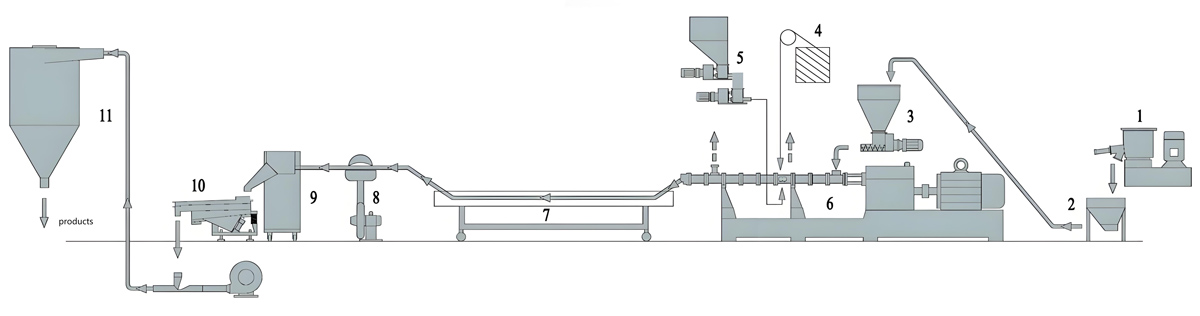
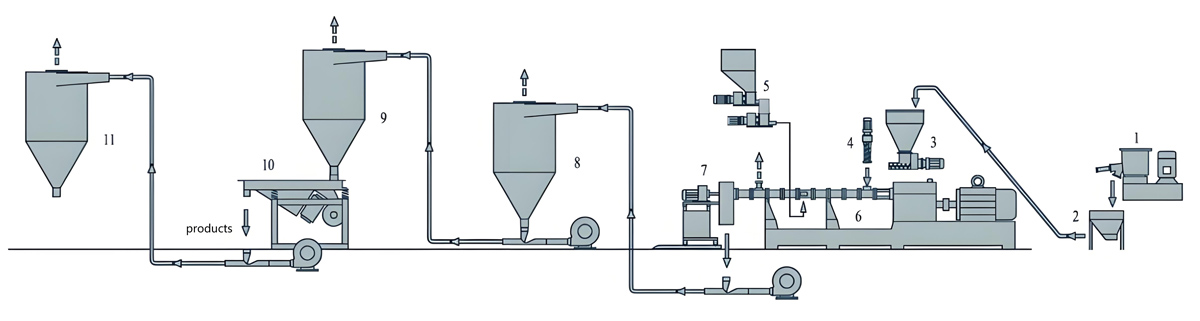
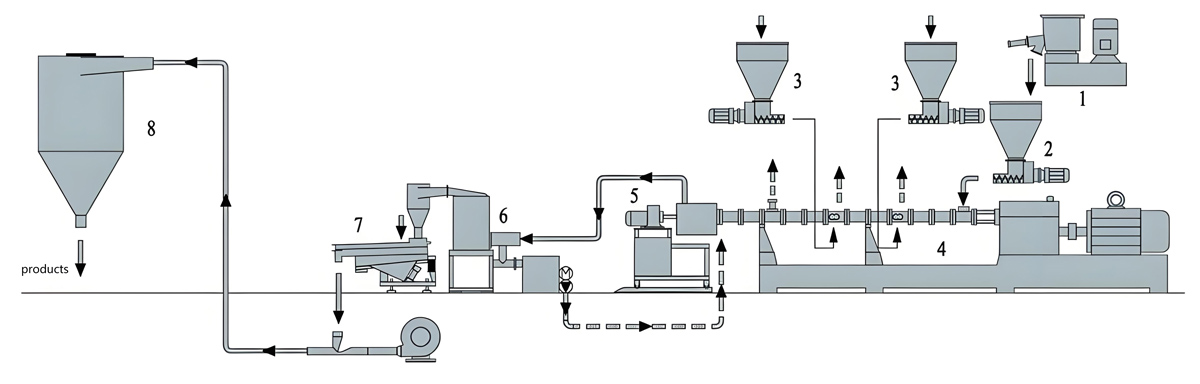
PE-X masterbatch production with precision feeding twin screw extruders (Kerke KTE Series) follows 8 optimized steps, with precision feeding as the core of process control:
3.1 Raw Material Preprocessing
Preprocessing eliminates moisture/impurities that disrupt precision feeding and masterbatch quality:
- PE-X resin drying: Dry in a dehumidifying dryer at 70–80°C for 2–3 hours (moisture <0.02% to avoid peroxide decomposition).
- Additive drying: Powder additives (antioxidants, stabilizers) dried at 90–100°C for 3–4 hours (moisture <0.03%).
- Impurity removal: Pass all materials through a 60-mesh screen (finer than PP-R to prevent feeder jamming).
3.2 Material Pre-Mixing
Pre-mixing prepares materials for precision feeding (critical for powder/liquid additive uniformity):
- Add PE-X carrier resin to a high-speed mixer (600–800 rpm) and mix at low speed (200 rpm) for 1 minute.
- Add liquid additives (waxes, catalysts) and mix at 400 rpm for 2 minutes to coat resin pellets.
- Add solid additives (pigments, antioxidants) and mix at 700 rpm for 4–5 minutes (temperature <45°C to avoid DCP decomposition).
- Cool mixture to <30°C in a cooling mixer to prevent agglomeration (blocks precision feeders).
3.3 Precision Feeding (Core Step)
The Kerke KTE Series uses a multi-channel loss-in-weight precision feeder (±0.05% accuracy) to feed materials into the extruder—this is the defining feature of the system:
- Main feeder (PE-X resin + pre-mix): Set rate based on extruder model (30–50 kg/h for KTE-36, 90–120 kg/h for KTE-50).
- Secondary precision feeders (critical additives like DCP/VTMS): Separate feeders with ±0.05% accuracy to dose high-value additives independently.
- Feeder synchronization: All feeders are synchronized with extruder screw speed (via PLC) to avoid over/under-feeding (causes torque spikes and inconsistent quality).
3.4 Twin Screw Extrusion
Extrusion is optimized for PE-X’s thermal sensitivity and precision additive distribution:
- Feeding zone (150–160°C): Material is conveyed forward (low temperature to protect DCP/VTMS).
- Compression zone (160–170°C): Material is compressed and melted (gentle shear to avoid peroxide decomposition).
- Mixing zone (170–180°C): High-shear kneading blocks ensure uniform additive dispersion (critical for crosslinking aids).
- Degassing zone (175–180°C): Vacuum (-0.07 to -0.08 MPa) removes volatiles (prevents bubbles in masterbatch).
- Metering zone (170–175°C): Stable pressure extrusion (avoids additive segregation).
3.5 Strand Die & Cooling
- Die temperature: 170–175°C (low enough to prevent premature crosslinking of PE-X).
- Cooling bath: 20–25°C, water flow 0.8–1.0 m/s (uniform cooling to avoid strand warping).
3.6 Pelletizing
- Cutter speed: 350–450 rpm (synchronized with extruder output to produce 2.5–3.0 mm pellets).
- Blade gap: 0.1–0.2 mm (clean cuts to avoid pellet dust, which clogs precision feeders downstream).
3.7 Drying & Sieving
- Drying: Hot air dryer at 50–60°C for 1–2 hours (moisture <0.03% to protect precision feeders).
- Sieving: 10/20 mesh screens (remove oversized/undersized pellets to ensure consistent feeding in PE-X pipe production).
3.8 Packaging
- Moisture-proof 25 kg bags (batch-labeled with additive dosage for traceability).
- Storage: Dry warehouse (20–25°C, humidity <50%)—critical for peroxide-based PE-Xa masterbatches (shelf life 6 months).
4. Production Equipment Introduction
The Kerke KTE Series precision feeding twin screw extruder is the core of PE-X masterbatch production, with auxiliary equipment optimized for precision and consistency:
4.1 Core Equipment: Kerke KTE Series Precision Feeding Twin Screw Extruder
4.1.1 Precision Feeding System (Key Feature)
- Multi-channel loss-in-weight feeders: 2–4 independent feeders (1 for main resin, 1–3 for critical additives like DCP/VTMS).
- Accuracy: ±0.05% (vs. ±1–2% for conventional feeders) — calibrated with load cells (0.1g resolution).
- Material compatibility: Handles pellets, powders, and liquid additives (e.g., catalysts) with dedicated feeder types.
- PLC synchronization: Feeder speed linked to extruder screw speed/torque (automatic adjustment to maintain dosage).
4.1.2 Screw & Barrel
- Screw diameter: 36mm (KTE-36), 50mm (KTE-50), 65mm (KTE-65) (L/D ratio 40:1).
- Material: Bimetallic alloy (WC-Co coating, 65 HRC) — wear-resistant for PE-X masterbatches with high pigment loading.
- Low-shear mixing elements: Gentle shear to protect peroxide additives (avoids premature decomposition).
4.1.3 Drive & Temperature Control
- Servo motor drive: ±1 rpm speed accuracy (stable screw speed for consistent feeding).
- PID temperature control: ±0.5°C accuracy (prevents PE-X degradation and peroxide decomposition).
- Heat recovery system: Recycles barrel waste heat (reduces energy consumption by 15–20%).
4.1.4 Control System
- Siemens S7-1500 PLC + touchscreen: Real-time monitoring of feeder dosage, screw speed, temperature, and torque.
- Data logging: Stores batch data (additive dosage, energy use, quality) for 2+ years (complies with ISO 9001).
- Alarm system: Triggers alerts for feeder errors (>0.1% dosage deviation) or temperature spikes (>185°C).
4.2 Auxiliary Equipment
- High-speed mixer (100–500 L): Variable speed (0–1000 rpm) with jacket cooling (prevents additive decomposition).
- Dehumidifying dryer (50–200 m³/h): Reduces PE-X resin moisture to <0.02% (avoids feeder jamming).
- Precision pelletizer: Carbide blades (replaced every 4 months) for clean pellet cuts.
- Vibrating sieve: VFD-driven (adjustable speed) to avoid pellet breakage (critical for precision feeding).
5. Parameter Settings
Optimal parameters for the Kerke KTE Series (focused on precision feeding and PE-X thermal stability):
5.1 General Precision Feeding Principles
- Feeder rate: Match to screw speed (avoid material starvation/accumulation — causes ±0.5%+ dosage errors).
- Temperature: Keep as low as possible (150–180°C) to protect peroxide additives.
- Screw speed: 250–350 rpm (60–70% of max speed — balances mixing and energy efficiency).
5.2 Parameter Settings for Different PE-X Masterbatches
5.2.1 PE-Xa Crosslinking Aid Masterbatch (KTE-50)
- Main feeder rate: 90–110 kg/h (PE-X resin + pre-mix)
- DCP feeder rate: 4.5–5.5 kg/h (±0.05% accuracy)
- Screw speed: 280–320 rpm
- Temperature zones (feed → die): 150°C, 160°C, 170°C, 175°C, 170°C, 165°C
- Vacuum degree: -0.07 MPa
- Torque: 55–65% (normal range)
5.2.2 PE-Xb Crosslinking Aid Masterbatch (KTE-50)
- Main feeder rate: 85–105 kg/h
- VTMS feeder rate: 8–10 kg/h (±0.05% accuracy)
- Catalyst feeder rate: 1–2 kg/h (±0.05% accuracy)
- Screw speed: 300–340 rpm
- Temperature zones: 155°C, 165°C, 175°C, 180°C, 175°C, 170°C
- Vacuum degree: -0.08 MPa
- Torque: 60–70%
5.2.3 PE-X Color Masterbatch (KTE-50)
- Main feeder rate: 95–115 kg/h
- Pigment feeder rate: 3–5 kg/h (±0.05% accuracy)
- Screw speed: 320–360 rpm
- Temperature zones: 150°C, 160°C, 170°C, 175°C, 170°C, 165°C
- Vacuum degree: -0.07 MPa
- Torque: 50–60%
6. Equipment Price
2024 FOB Nanjing (USD) prices for Kerke KTE Series precision feeding extruders (excluding shipping/taxes/installation):
6.1 Kerke KTE Series Base Prices
6.1.1 KTE-36 (36mm screw, 2 precision feeders)
- Standard configuration: $55,000–$65,000
- Enhanced (4 feeders + data logging): $65,000–$75,000
- Output: 30–50 kg/h (PE-Xa masterbatch)
6.1.2 KTE-50 (50mm screw, 2 precision feeders)
- Standard configuration: $90,000–$105,000
- Enhanced (4 feeders + heat recovery): $105,000–$120,000
- Output: 90–120 kg/h (PE-Xb masterbatch)
6.1.3 KTE-65 (65mm screw, 3 precision feeders)
- Standard configuration: $135,000–$155,000
- Enhanced (4 feeders + CE/FDA certification): $155,000–$175,000
- Output: 150–200 kg/h (PE-Xc masterbatch)
6.2 Auxiliary Equipment Prices
- High-speed mixer (200 L): $9,000–$13,000
- Dehumidifying dryer (100 m³/h): $8,000–$11,000
- Precision pelletizer + cooling bath: $6,000–$9,000
- Dryer + sieve: $4,500–$7,000
- Automatic packaging machine: $3,500–$5,500
Total auxiliary cost: $31,000–$45,500
6.3 Total Production Line Investment
- Small-scale (KTE-36): $90,000–$110,000
- Medium-scale (KTE-50): $130,000–$160,000
- Large-scale (KTE-65): $190,000–$220,000
7. Production Problems, Solutions & Prevention
Most PE-X masterbatch quality issues stem from feeding inaccuracy—below are key problems and fixes:
7.1 Problem 1: Inconsistent PE-X Gel Content
Problem Description
Gel content varies by >5% between batches (target: 65–75% for PE-Xa), leading to pipe failure under pressure.
Reason Analysis
- Precision feeder calibration drift (±0.1%+ dosage error).
- Feeder hopper bridging (uneven material flow).
- Extruder temperature spikes (decomposes DCP/VTMS).
Solution
- Recalibrate precision feeders (use certified weights) — done weekly for critical additives.
- Install vibrators on feeder hoppers (prevents bridging).
- Lower extruder temperature by 5–10°C and check PID calibration.
Prevention
- Calibrate feeders weekly (document results).
- Clean feeder hoppers daily (remove agglomerates).
- Set temperature alarms at 185°C (PE-Xa) / 190°C (PE-Xb).
7.2 Problem 2: Precision Feeder Jamming
Problem Description
Feeders stop feeding (causes extruder starvation and torque drops).
Reason Analysis
- Pellet dust/clumps (from poor pelletizing).
- Moisture in raw materials (causes agglomeration).
- Feeder screw wear (reduces material flow).
Solution
- Clean feeder screws/hop hoppers (use compressed air).
- Re-dry raw materials (moisture <0.02%).
- Replace worn feeder screws (wear limit: 0.3 mm).
Prevention
- Sieve masterbatch pellets before feeding (20-mesh screen).
- Maintain warehouse humidity <50%.
- Inspect feeder screws monthly for wear.
7.3 Problem 3: PE-X Masterbatch Discoloration
Problem Description
Masterbatch is yellow/brown (indicates PE-X oxidation).
Reason Analysis
- Under-dosing of antioxidants (feeder error).
- Extruder temperature too high (>185°C).
- Expired antioxidants (shelf life exceeded).
Solution
- Verify antioxidant feeder dosage (recalibrate if needed).
- Lower extruder temperature by 10–15°C.
- Replace expired antioxidants (use fresh stock).
Prevention
- Track antioxidant batch numbers/shelf life.
- Monitor feeder dosage in real time (PLC alerts for under-dosing).
8. Maintenance & Care
Maintenance focuses on preserving precision feeding accuracy (the core of the KTE Series):
8.1 Daily Maintenance
- Clean precision feeder hoppers/screws (remove dust/clumps).
- Check feeder load cell calibration (verify with 1kg weight).
- Inspect extruder temperature sensors (accuracy ±0.5°C).
- Record feeder dosage data (for batch traceability).
8.2 Weekly Maintenance
- Recalibrate all precision feeders (full calibration with 0.1g resolution).
- Lubricate feeder/extruder screws (food-grade lubricant).
- Clean extruder degassing filter (maintains vacuum efficiency).
8.3 Monthly Maintenance
- Inspect feeder screw wear (measure with micrometer).
- Calibrate extruder PID temperature control.
- Test PLC alarm system (feeder error/temperature spike alerts).
8.4 Annual Overhaul
- Replace feeder load cells (if accuracy drifts >0.05%).
- Overhaul extruder screw/barrel (replace worn elements).
- Validate entire system with third-party accuracy testing (ISO 9001 compliance).
9. FAQ
9.1 Q1: How does precision feeding improve PE-X masterbatch quality?
A1: Precision feeding (±0.05% accuracy) ensures additive dosages are exact—this maintains consistent crosslinking (gel content), color uniformity, and antioxidant protection. Conventional feeders (±1–2% error) cause batch-to-batch variation that leads to pipe failure in field use.
9.2 Q2: Can the KTE Series handle both powder and liquid additives?
A2: Yes—dedicated precision feeders for powders (e.g., antioxidants) and liquids (e.g., catalysts) ensure accurate dosing of all additive types, critical for PE-Xb masterbatches (silane + liquid catalyst).
9.3 Q3: What is the payback period for the KTE Series vs. conventional extruders?
A3: 12–18 months—precision feeding reduces material waste (5–8% less scrap) and eliminates rework (due to inconsistent quality). For a medium-scale line (100 kg/h, 8h/day, 250 days/year), annual savings = $25,000–$30,000 (waste + rework).
9.4 Q4: How to store PE-Xa masterbatches (peroxide-based) to preserve quality?
A4: Store in a cool (20–25°C), dry (humidity <50%) warehouse—peroxides decompose at >30°C, reducing crosslinking efficiency. Shelf life is 6 months; use FIFO (first-in-first-out) inventory management.
9.5 Q5: What warranty is offered for the KTE Series precision feeders?
A5: 3 years for precision feeders/load cells (core components), 2 years for the entire extruder. Kerke provides global 48-hour response for feeder calibration/repairs.
10. Summary
Precision feeding twin screw extruders (Kerke KTE Series) are essential for high-quality PE-X masterbatch production—especially for crosslinkable PE-Xa/PE-Xb/PE-Xc grades where additive dosage accuracy directly impacts pipe performance. The KTE Series’ ±0.05% feeding accuracy eliminates batch-to-batch variation, reduces waste/rework, and ensures compliance with strict PE-X pipe standards (DIN 16892, ASTM F876).
This guide has covered PE-X masterbatch formulas (tailored for crosslinking aids, antioxidants, color, and heat stabilizers), production processes (optimized for precision feeding), equipment specs (KTE Series core features), parameter settings, pricing, troubleshooting, and maintenance. By following these guidelines, manufacturers can produce consistent PE-X masterbatches that meet global quality standards, with a short payback period for the precision feeding investment.
As demand for PE-X pipes grows (driven by energy-efficient heating systems), precision feeding extruders will remain the gold standard for PE-X masterbatch production—Kerke’s KTE Series (Kerke Twin Extruder) combines technical excellence, precision, and durability to deliver long-term value for manufacturers.