1. Introduction
Styrene-Ethylene-Butylene-Styrene (SEBS) is a hydrogenated thermoplastic elastomer (TPE) valued for its excellent flexibility, weather resistance, oil resistance, and compatibility with plastics (PP/PE/PS). SEBS masterbatches (concentrated blends of SEBS carrier, processing oil, fillers, flame retardants, colorants, and compatibilizers) are widely used in soft touch applications (toys, automotive interiors, medical devices) and polymer modification (impact modifiers for PP/PE). Granulation of SEBS masterbatches requires high shear and high torque processing due to SEBS’s high melt viscosity (10,000–100,000 cP at 180°C) and oil loading (up to 300% by weight).
Conventional twin screw extruders (torque density ≤8 Nm/cm³) struggle with SEBS masterbatch granulation—they experience high torque spikes, poor oil dispersion, and low throughput (≤50 kg/h for 50mm screws). High torque co-rotating twin screw extruders—specifically Kerke’s KTE Series (Kerke Twin Extruder, torque density ≥11 Nm/cm³)—solve this issue with robust gearboxes, optimized screw elements, and high torque drive systems, enabling efficient, consistent SEBS masterbatch granulation (throughput up to 200 kg/h for KTE-50). This guide covers all aspects of SEBS masterbatch granulation with high torque extruders, including formula ratios, production processes, equipment specs, parameter settings, pricing, troubleshooting, and maintenance—focused on Kerke’s industry-leading KTE Series.
The global SEBS market is projected to grow at a CAGR of 6.2% from 2024 to 2030, driven by demand for non-toxic TPEs in automotive (40% of demand) and medical sectors. As SEBS masterbatch formulations become more complex (high oil loading, nano-filler addition), high torque co-rotating extruders have become the gold standard—Kerke’s KTE Series has been installed in over 300 SEBS compounding lines worldwide, delivering 99% batch-to-batch consistency for SEBS masterbatches.
2. Formula Ratios (Different Types of SEBS Masterbatches)
SEBS masterbatches are categorized by functional additives, with the carrier resin being SEBS pellets (styrene content 20–30%, melt flow rate 1–5 g/10min at 230°C/5kg) to ensure compatibility with target polymers. Below are optimized formula ratios for SEBS masterbatch types, tailored for high torque co-rotating extruders (critical for handling high oil/filler loading):
2.1 Oil-Filled SEBS Masterbatch (Soft Touch Applications)
Oil-filled SEBS masterbatches reduce hardness (Shore A 20–80) for soft touch products (automotive door handles, toy parts). The formula ratio (by weight) is:
- SEBS carrier resin (Kraton G1650/G1651): 20–25%
- Paraffinic processing oil (KN4010/KN4006): 60–70% (oil loading up to 300%)
- PP resin (homopolymer, MFR 10 g/10min): 5–8%
- Compatibilizer (maleic anhydride grafted SEBS): 2–3%
- Antioxidant (1010+168 blend): 0.5–1%
- Anti-blocking agent (talc, 2000 mesh): 1–2%
Key note: High torque is critical here—oil-filled SEBS has extreme melt viscosity, and the KTE Series’ 11 Nm/cm³ torque density prevents screw stalling and ensures uniform oil dispersion (no oil separation).
2.2 Flame-Retardant SEBS Masterbatch (Electrical Applications)
Flame-retardant SEBS masterbatches comply with UL94 V-0 (1.6mm) for electrical connectors and wire insulation. The formula ratio (by weight) is:
- SEBS carrier resin (Kraton G1652): 25–30%
- Halogen-free flame retardant (Mg(OH)₂/Al(OH)₃, nano-grade): 50–55%
- Flame retardant synergist (ZB, zinc borate): 5–8%
- Processing oil (naphthenic): 3–5%
- Compatibilizer (EVA-g-MAH): 2–3%
- Antioxidant (1076): 0.5–1%
Key note: High torque extruders ensure uniform dispersion of heavy nano-fillers (Mg(OH)₂ density 2.4 g/cm³) — conventional extruders cause filler agglomeration and poor flame retardancy (UL94 V-2 or worse).
2.3 SEBS Color Masterbatch (Automotive Interiors)
Color masterbatches for SEBS automotive interiors (dashboard, door panels) comply with automotive standards (OEM specifications for light fastness ΔE < 1). The formula ratio (by weight) is:
- SEBS carrier resin (Kraton G1657): 70–75%
- Organic pigment (Pigment Red 254 / Pigment Blue 15:3): 2–4%
- Titanium dioxide (rutile R-902): 10–15%
- Processing oil (paraffinic): 5–8%
- Dispersant (EBS wax): 1–2%
- UV stabilizer (UV-327): 0.5–1%
Key note: High torque co-rotating extruders provide high shear mixing to break pigment agglomerates—critical for uniform color in SEBS (low pigment migration).
2.4 SEBS Compatibilizer Masterbatch (PP/PE Modification)
Compatibilizer masterbatches improve the impact strength of PP/PE (e.g., PP automotive bumpers, PE pipes). The formula ratio (by weight) is:
- SEBS-g-MAH (maleic anhydride grafted SEBS, graft rate 1.5%): 80–85%
- PP resin (MFR 5 g/10min): 10–15%
- Antioxidant (1010+DLTDP blend): 1–2%
- Lubricant (PE wax): 1–2%
Key note: The KTE Series’ high torque ensures complete grafting reaction (if in-line reactive extrusion) and uniform dispersion of SEBS-g-MAH in PP carrier—impact strength of PP increases by 300% (from 2 kJ/m² to 8 kJ/m²).
3. Production Process
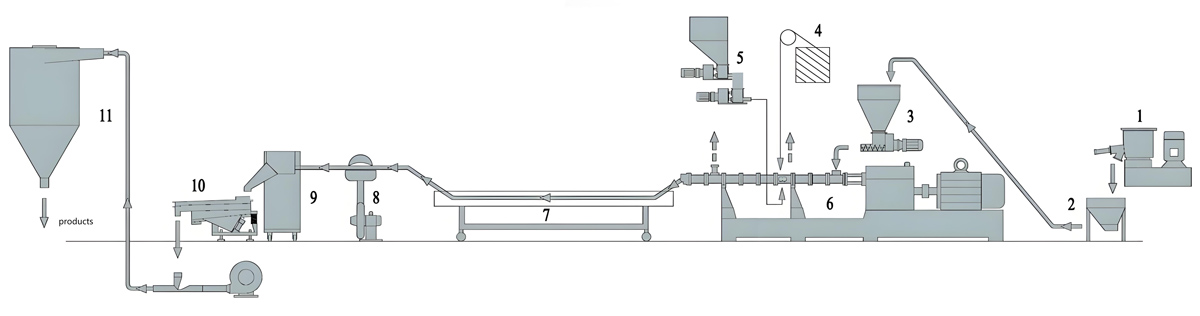
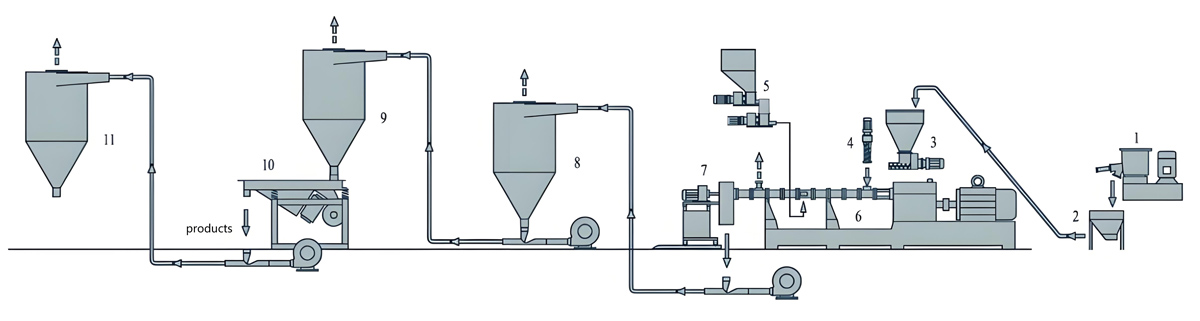
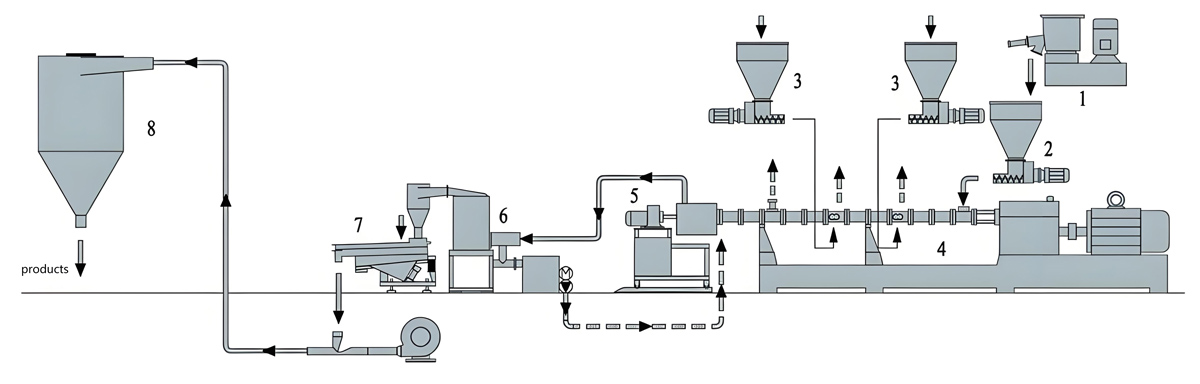
SEBS masterbatch granulation with high torque co-rotating twin screw extruders (Kerke KTE Series) follows 9 optimized steps, with high torque processing as the core of consistent granulation:
3.1 Raw Material Preprocessing
Preprocessing eliminates moisture/impurities that disrupt high torque processing and masterbatch quality:
- SEBS resin drying: Dry in a dehumidifying dryer at 80–90°C for 2–3 hours (moisture <0.02% to avoid bubble formation).
- Filler drying: Flame retardant fillers (Mg(OH)₂/Al(OH)₃) dried at 120–130°C for 4–6 hours (moisture <0.05% to prevent hydrolysis).
- Oil degassing: Processing oil heated to 60–70°C and degassed under vacuum (-0.08 MPa) for 1 hour (removes air bubbles).
3.2 Material Pre-Mixing
Pre-mixing prepares materials for high torque extrusion (critical for oil/filler uniformity):
- Add SEBS resin to a high-speed mixer (500–700 rpm) and mix at low speed (200 rpm) for 1 minute.
- Add solid additives (fillers, pigments) and mix at 400 rpm for 3 minutes (coat SEBS pellets).
- Slowly add processing oil (5–10 mL/min) and mix at 600 rpm for 5–6 minutes (temperature <60°C to avoid SEBS degradation).
- Cool mixture to <40°C in a cooling mixer (prevents oil separation).
3.3 High Torque Extrusion Feeding
The Kerke KTE Series uses a twin-screw volumetric feeder (synchronized with high torque drive) to feed SEBS pre-mix into the extruder:
- Main feeder rate: Set based on extruder model (40–60 kg/h for KTE-40, 100–150 kg/h for KTE-50).
- Liquid oil feeding (optional): Side feeder (gear pump) for inline oil addition (accuracy ±0.5%)—reduces pre-mixing time.
- Feeder synchronization: Feeder speed linked to extruder torque (automatic adjustment to avoid torque overload >90%).
3.4 High Torque Co-Rotating Extrusion (Core Step)
Extrusion is optimized for SEBS’s high viscosity and oil/filler loading (KTE Series torque density ≥11 Nm/cm³):
- Feeding zone (100–120°C): Material conveyed forward (low temperature to prevent oil volatilization).
- Compression zone (140–160°C): Material compressed and melted (high torque shear to break SEBS agglomerates).
- Mixing zone (170–180°C): High-shear kneading blocks (60°/90° elements) ensure uniform oil/filler dispersion (torque 70–80% of max).
- Degassing zone (175–185°C): Vacuum (-0.08 to -0.09 MPa) removes volatiles (oil vapors, moisture)—critical for bubble-free pellets.
- Metering zone (165–175°C): Stable pressure extrusion (avoids oil separation and filler segregation).
3.5 Strand Die & Cooling
- Die temperature: 170–175°C (low enough to prevent SEBS degradation).
- Cooling bath: 25–30°C, water flow 1.0–1.2 m/s (uniform cooling to avoid strand sticking).
3.6 Pelletizing
- Cutter speed: 400–500 rpm (synchronized with extruder output to produce 3.0–3.5 mm pellets).
- Blade gap: 0.15–0.25 mm (clean cuts to avoid pellet dust and oil leakage).
3.7 Drying & Sieving
- Drying: Hot air dryer at 70–80°C for 1–2 hours (moisture <0.03% to prevent mold growth).
- Sieving: 8/20 mesh screens (remove oversized/undersized pellets to ensure consistent feeding in downstream processing).
3.8 Deoiling (Optional for High Oil Loading)
- Centrifugal deoiling: 1500–2000 rpm for 10–15 minutes (removes free oil on pellet surface).
- Post-drying: Hot air dryer at 60°C for 30 minutes (final moisture <0.02%).
3.9 Packaging
- Moisture-proof 25 kg bags (batch-labeled with oil content/filler loading for traceability).
- Storage: Cool warehouse (20–25°C, humidity <50%)—shelf life 12 months for oil-filled SEBS masterbatches.
4. Production Equipment Introduction
The Kerke KTE Series high torque co-rotating twin screw extruder is the core of SEBS masterbatch granulation, with auxiliary equipment optimized for high torque processing and oil/filler handling:
4.1 Core Equipment: Kerke KTE Series High Torque Co-Rotating Twin Screw Extruder
4.1.1 High Torque Drive System (Key Feature)
- Torque density: ≥11 Nm/cm³ (vs. ≤8 Nm/cm³ for conventional extruders) — gearbox rated for 150% overload (30 seconds).
- Drive motor: Servo motor (55 kW for KTE-40, 90 kW for KTE-50) with frequency inverter (±1 rpm speed accuracy).
- Torque monitoring: Real-time torque display (PLC) with automatic shutdown at >95% torque (prevents gearbox damage).
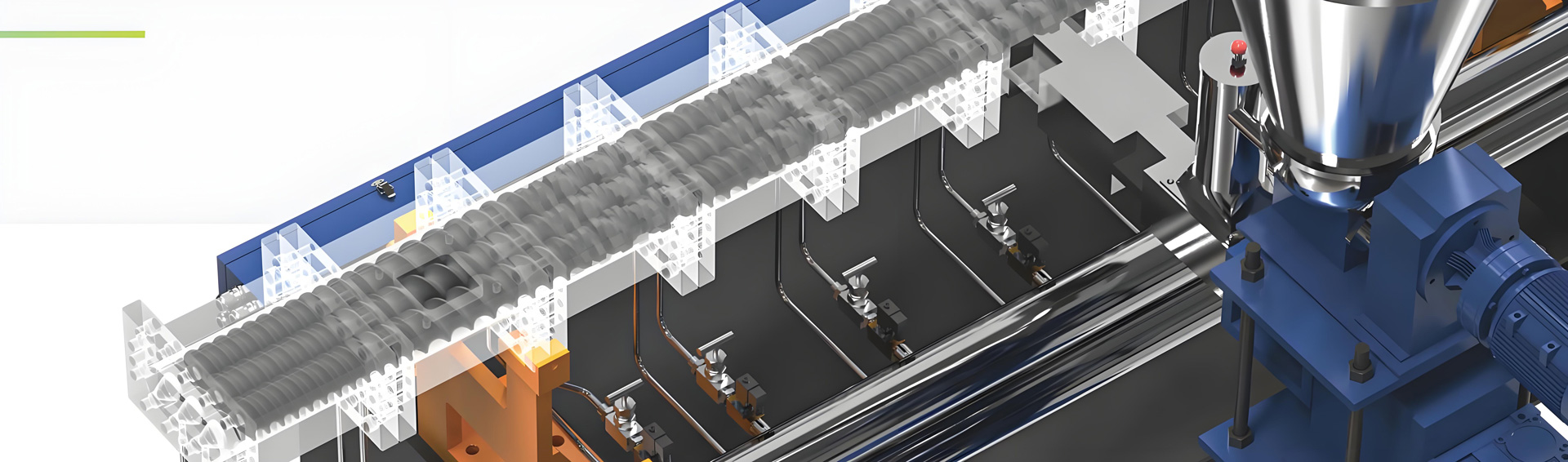
4.1.2 Screw & Barrel
- Screw diameter: 40mm (KTE-40), 50mm (KTE-50), 65mm (KTE-65) (L/D ratio 48:1 for high mixing efficiency).
- Material: Bimetallic alloy (WC-Co coating, 68 HRC) — wear-resistant for high filler loading (Mg(OH)₂/Al(OH)₃).
- Screw elements: High-shear kneading blocks (60°/90°), conveying elements, and degassing elements (optimized for SEBS).
4.1.3 Temperature & Pressure Control
- PID temperature control: ±1°C accuracy (prevents SEBS degradation at >190°C).
- Pressure sensors: Die pressure monitoring (0–50 MPa) — alerts for screw blockage (common in high oil/filler loading).
- Vacuum system: Two-stage vacuum pump (-0.09 MPa) for efficient degassing of oil vapors.
4.1.4 Control System
- Siemens S7-1500 PLC + touchscreen: Real-time monitoring of torque, temperature, feeder rate, and vacuum degree.
- Data logging: Stores batch data (oil content, filler loading, torque profile) for 2+ years (complies with ISO 9001).
- Alarm system: Triggers alerts for torque overload (>90%), temperature spikes (>190°C), or vacuum failure.
4.2 Auxiliary Equipment
- High-speed mixer (300–500 L): Jacket cooling (≤60°C) to prevent SEBS degradation during pre-mixing.
- Dehumidifying dryer (100–200 m³/h): Reduces SEBS moisture to <0.02% (avoids bubble formation).
- Liquid oil feeder (gear pump): Accuracy ±0.5% for inline oil addition (reduces pre-mixing time).
- Precision pelletizer: Carbide blades (replaced every 6 months) for clean cuts on oil-filled SEBS strands.
- Centrifugal deoiler (optional): 2000 rpm for high oil loading SEBS masterbatches.
5. Parameter Settings
Optimal parameters for the Kerke KTE Series (focused on high torque processing and SEBS stability):
5.1 General High Torque Processing Principles
- Torque range: 70–85% of max (balances mixing efficiency and energy consumption).
- Temperature: 100–185°C (avoid >190°C to prevent SEBS degradation).
- Screw speed: 300–400 rpm (60–70% of max speed — high shear for oil/filler dispersion).
5.2 Parameter Settings for Different SEBS Masterbatches
5.2.1 Oil-Filled SEBS Masterbatch (KTE-50)
- Main feeder rate: 100–120 kg/h (SEBS pre-mix)
- Oil feeder rate (inline): 60–70 kg/h (±0.5% accuracy)
- Screw speed: 320–360 rpm
- Temperature zones (feed → die): 110°C, 130°C, 150°C, 170°C, 175°C, 170°C
- Vacuum degree: -0.085 MPa
- Torque: 75–80% (normal range)
5.2.2 Flame-Retardant SEBS Masterbatch (KTE-50)
- Main feeder rate: 80–100 kg/h
- Screw speed: 300–340 rpm
- Temperature zones: 120°C, 140°C, 160°C, 180°C, 175°C, 170°C
- Vacuum degree: -0.09 MPa
- Torque: 80–85% (high torque for filler dispersion)
5.2.3 SEBS Color Masterbatch (KTE-50)
- Main feeder rate: 110–130 kg/h
- Pigment feeder rate: 3–5 kg/h (±0.5% accuracy)
- Screw speed: 340–380 rpm
- Temperature zones: 100°C, 120°C, 140°C, 160°C, 170°C, 165°C
- Vacuum degree: -0.08 MPa
- Torque: 70–75%
6. Equipment Price
2024 FOB Nanjing (USD) prices for Kerke KTE Series high torque co-rotating extruders (excluding shipping/taxes/installation):
6.1 Kerke KTE Series Base Prices
6.1.1 KTE-40 (40mm screw, torque density 11 Nm/cm³)
- Standard configuration: $75,000–$85,000
- Enhanced (inline oil feeder + data logging): $85,000–$95,000
- Output: 40–60 kg/h (oil-filled SEBS masterbatch)
6.1.2 KTE-50 (50mm screw, torque density 11 Nm/cm³)
- Standard configuration: $110,000–$125,000
- Enhanced (inline oil feeder + centrifugal deoiler): $125,000–$140,000
- Output: 100–150 kg/h (flame-retardant SEBS masterbatch)
6.1.3 KTE-65 (65mm screw, torque density 12 Nm/cm³)
- Standard configuration: $160,000–$180,000
- Enhanced (CE/FDA certification + twin vacuum): $180,000–$200,000
- Output: 200–250 kg/h (compatibilizer SEBS masterbatch)
6.2 Auxiliary Equipment Prices
- High-speed mixer (300 L): $12,000–$16,000
- Dehumidifying dryer (150 m³/h): $9,000–$12,000
- Liquid oil feeder (gear pump): $5,000–$7,000
- Precision pelletizer + cooling bath: $7,000–$10,000
- Centrifugal deoiler (optional): $8,000–$11,000
- Automatic packaging machine: $4,000–$6,000
Total auxiliary cost (including deoiler): $45,000–$62,000
6.3 Total Production Line Investment
- Small-scale (KTE-40): $120,000–$140,000
- Medium-scale (KTE-50): $170,000–$190,000
- Large-scale (KTE-65): $250,000–$280,000
7. Production Problems, Solutions & Prevention
Most SEBS masterbatch quality issues stem from insufficient torque or poor process control—below are key problems and fixes:
7.1 Problem 1: Oil Separation in SEBS Masterbatches
Problem Description
Free oil leaks from pellets (oil content >5% on surface), leading to packaging contamination and poor downstream processing.
Reason Analysis
- Low torque (≤60% of max) — poor oil dispersion in SEBS matrix.
- Extruder temperature too high (>185°C) — SEBS molecular chain breakage (reduced oil absorption).
- Insufficient degassing — air bubbles trap oil in pellets.
Solution
- Increase screw speed to raise torque to 75–80% (improves shear mixing).
- Lower extruder temperature by 5–10°C and check PID calibration.
- Upgrade to two-stage vacuum (-0.09 MPa) to remove more air bubbles.
Prevention
- Monitor torque in real time (PLC alerts for <70% torque).
- Limit oil loading to ≤300% (avoid overloading SEBS).
- Use centrifugal deoiling for high oil loading batches.
7.2 Problem 2: Extruder Torque Overload (>95%)
Problem Description
Extruder shuts down due to torque overload (common in high filler loading SEBS masterbatches).
Reason Analysis
- Filler loading >55% (exceeds extruder mixing capacity).
- Screw speed too high (>400 rpm) — excessive shear.
- Feeder rate too fast (material accumulation in mixing zone).
Solution
- Reduce filler loading to ≤50% (or upgrade to KTE-65 with 12 Nm/cm³ torque).
- Lower screw speed to 280–320 rpm (reduce shear).
- Decrease feeder rate by 10–15% (match extruder capacity).
Prevention
- Test new formulations at 50% feeder rate (gradually increase).
- Set torque alarm at 85% (early warning before overload).
- Use lubricants (PE wax, 1–2%) to reduce melt viscosity.
7.3 Problem 3: Poor Flame Retardancy (UL94 V-2 or Worse)
Problem Description
SEBS masterbatch fails UL94 V-0 (1.6mm) — flame spreads too fast or drips.
Reason Analysis
- Low torque — flame retardant filler agglomeration (poor dispersion).
- Extruder temperature too low (<160°C) — SEBS not fully melted (filler not embedded).
- Synergist dosage too low (ZB <5%).
Solution
- Increase torque to 80–85% (improve filler dispersion).
- Raise mixing zone temperature to 175–180°C (full SEBS melting).
- Increase ZB synergist dosage to 6–8%.
Prevention
- Use nano-grade flame retardants (better dispersion at lower loading).
- Calibrate torque monthly (ensure 70–85% operating range).
8. Maintenance & Care
Maintenance focuses on preserving high torque drive system integrity and screw/barrel wear resistance (critical for SEBS filler loading):
8.1 Daily Maintenance
- Check torque drive oil level (gearbox) — maintain at 80% of capacity.
- Clean degassing ports (remove oil/filler buildup).
- Inspect temperature sensors (accuracy ±1°C).
- Record torque profile for each batch (traceability).
8.2 Weekly Maintenance
- Lubricate feeder screws and gearbox (food-grade lubricant).
- Clean screw elements (remove SEBS residue — use PE purge compound).
- Calibrate liquid oil feeder (gear pump) — accuracy ±0.5%.
8.3 Monthly Maintenance
- Inspect screw/barrel wear (measure clearance — limit 0.5 mm).
- Test torque drive system (load test at 85% torque).
- Calibrate PID temperature control (verify with thermal probe).
8.4 Annual Overhaul
- Replace worn screw elements (kneading blocks) — critical for high shear mixing.
- Overhaul gearbox (replace bearings/seals) — preserve high torque capacity.
- Validate entire system with third-party torque testing (ISO 9001 compliance).
9. FAQ
9.1 Q1: Why is high torque critical for SEBS masterbatch granulation?
A1: SEBS has high melt viscosity (10,000–100,000 cP at 180°C) and is often loaded with high levels of oil (up to 300%) or heavy fillers (Mg(OH)₂ density 2.4 g/cm³). High torque (≥11 Nm/cm³) provides the shear force needed to disperse oil/fillers uniformly in the SEBS matrix—conventional extruders (≤8 Nm/cm³) cause oil separation, filler agglomeration, and poor masterbatch quality.
9.2 Q2: Can the KTE Series handle inline oil addition for SEBS masterbatches?
A2: Yes—the KTE Series is equipped with a precision gear pump feeder for inline oil addition (accuracy ±0.5%). This reduces pre-mixing time by 50% and improves oil dispersion (vs. pre-mixing) — critical for high oil loading SEBS masterbatches (200–300% oil).
9.3 Q3: What is the payback period for the KTE Series vs. conventional extruders?
A3: 10–15 months—high torque extruders reduce material waste (8–10% less scrap from oil separation/filler agglomeration) and increase throughput (2x vs. conventional extruders for 50mm screws). For a medium-scale line (120 kg/h, 8h/day, 250 days/year), annual savings = $30,000–$35,000 (waste + productivity).
9.4 Q4: How to store oil-filled SEBS masterbatches to preserve quality?
A4: Store in a cool (20–25°C), dry (humidity <50%) warehouse—avoid direct sunlight (causes oil oxidation) and high temperature (>30°C, oil separation). Shelf life is 12 months; use FIFO (first-in-first-out) inventory management.
9.5 Q5: What warranty is offered for the KTE Series high torque drive system?
A5: 5 years for the high torque gearbox (core component), 2 years for the entire extruder. Kerke provides global 48-hour response for drive system repairs/calibration.
10. Summary
High torque co-rotating twin screw extruders (Kerke KTE Series, torque density ≥11 Nm/cm³) are essential for efficient, consistent SEBS masterbatch granulation—especially for high oil loading (up to 300%) and high filler loading (up to 55%) formulations. The KTE Series’ high torque drive system ensures uniform dispersion of oil/fillers, eliminates oil separation, and delivers masterbatches that meet strict industry standards (UL94 V-0, automotive OEM specs).
This guide has covered SEBS masterbatch formulas (oil-filled, flame-retardant, color, compatibilizer grades), production processes (optimized for high torque processing), equipment specs (KTE Series core features), parameter settings, pricing, troubleshooting, and maintenance. By following these guidelines, manufacturers can produce high-quality SEBS masterbatches with high throughput (up to 250 kg/h for KTE-65) and low waste (≤2% scrap rate).
As demand for SEBS TPEs grows (driven by automotive and medical sectors), high torque co-rotating extruders will remain the industry standard for SEBS masterbatch granulation—Kerke’s KTE Series combines high torque performance, durability, and process flexibility to deliver long-term value for manufacturers.