Introduction to Acid-Resistant Masterbatch
Acid-resistant masterbatches represent specialized formulations designed to significantly enhance the chemical resistance of polymer materials against acidic environments and corrosive substances. These advanced masterbatches incorporate concentrated acid-resistant additives, corrosion inhibitors, and neutralizing agents that create protective barriers against acid penetration and chemical attack. The production of acid-resistant masterbatches requires automated processing equipment capable of maintaining additive functionality while achieving uniform dispersion and precise granulation characteristics.
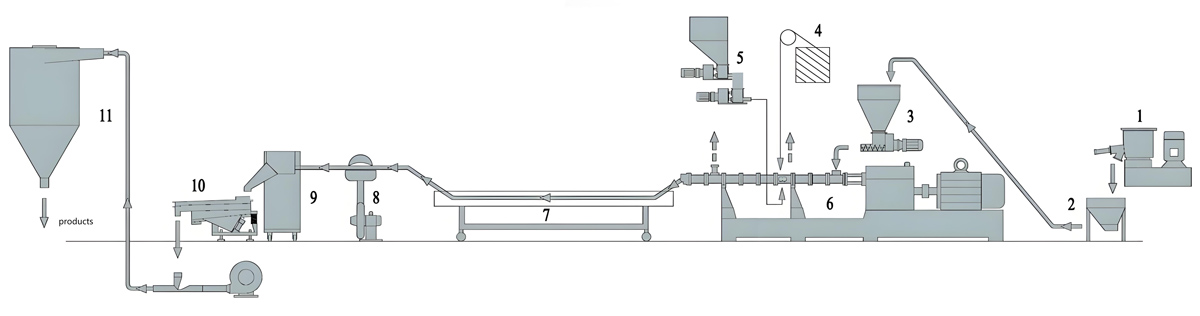
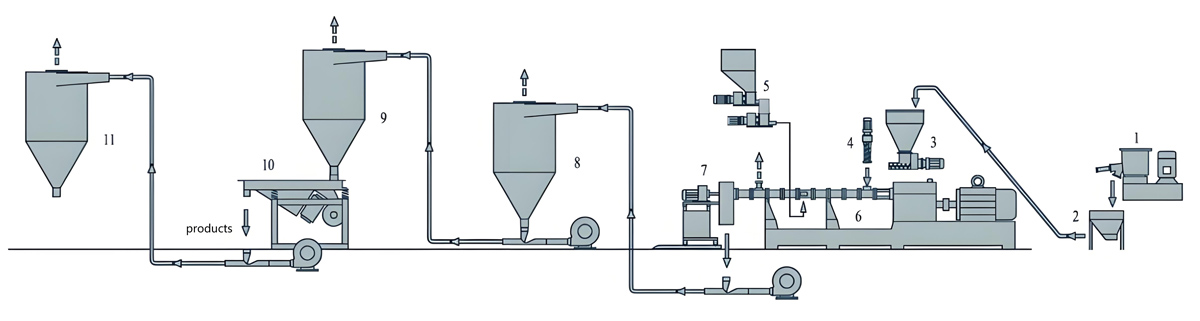
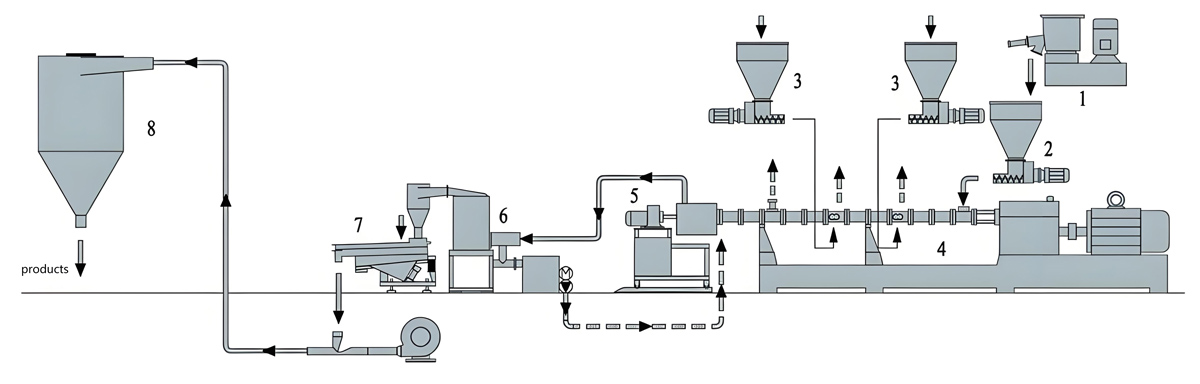
Automatic twin screw extruders provide the advanced processing capabilities necessary for acid-resistant masterbatch manufacturing. These machines offer automated feeding systems, precise temperature control, and superior mixing performance essential for incorporating acid-resistant additives effectively. Nanjing Kerke Extrusion Equipment Company KTE Series automatic twin screw extruders represent advanced equipment designed specifically for demanding acid-resistant masterbatch applications requiring exceptional consistency and operational efficiency.
Understanding Acid Resistance Mechanisms
Acid attack on polymer materials occurs through multiple mechanisms including chemical degradation, hydrolysis, and catalytic oxidation. Strong acids can break polymer chains through hydrolysis of ester or amide linkages, significantly reducing molecular weight and mechanical properties. Acid environments catalyze oxidation reactions that degrade polymer structure over extended exposure periods. Understanding these acid attack mechanisms enables targeted formulation design for optimal protection.
Acid penetration occurs through diffusion processes where acid molecules migrate into the polymer matrix. Once inside, acid molecules attack susceptible chemical bonds and functional groups. Acid-resistant masterbatches incorporate additives that neutralize acids, create barrier layers, and modify polymer chemistry to resist chemical attack. The combination of barrier formation and chemical modification provides comprehensive acid resistance.
Alkaline Additive Chemistry
Alkaline additives function by neutralizing acidic compounds before they can attack polymer chains. Calcium carbonate, magnesium hydroxide, and basic metal oxides provide acid neutralization capacity through chemical reaction with acidic species. These materials buffer acidic environments and maintain neutral pH conditions within the polymer matrix. The neutralization reaction consumes acid molecules and prevents degradation of polymer chains.
Basic metal oxides including magnesium oxide and zinc oxide provide high neutralization capacity while maintaining compatibility with many polymer types. Selection of alkaline additives considers acid type, concentration, and exposure conditions. Neutralization capacity must be balanced with processing requirements and final product properties. Alkaline additives also contribute to fire retardancy and thermal stability.
Corrosion Inhibitor Systems
Corrosion inhibitors function by forming protective layers on polymer surfaces and interfering with acid attack mechanisms. Organic corrosion inhibitors adsorb onto polymer surfaces creating barriers that resist acid penetration. Inhibitors may also complex with metal catalysts that accelerate acid-catalyzed degradation reactions. Multi-component inhibitor systems provide comprehensive protection across various acid types and concentrations.
Corrosion inhibitor selection depends on acid type, temperature conditions, and polymer chemistry. Some inhibitors work through sacrificial reactions that consume acid molecules. Others form protective films that prevent acid contact with polymer. Effective inhibitors must maintain functionality across exposure durations and varying acid concentrations. Combination approaches often provide superior performance compared to single inhibitor systems.
Formulation Design for Acid-Resistant Masterbatches
Effective acid-resistant masterbatch formulations require careful balance of alkaline additives, corrosion inhibitors, processing aids, and base polymers. Formulation ratios depend on acid type, acid concentration, and resistance requirements. Typical acid-resistant masterbatch concentration levels range from 8% to 35% active ingredient loading, with most applications utilizing 15% to 28% acid-resistant content.
Base Polymer Selection
The base polymer serves as carrier for acid-resistant additives and significantly influences formulation effectiveness. The base polymer should demonstrate inherent chemical resistance, good compatibility with alkaline additives, and appropriate thermal stability. Common base polymers for acid-resistant masterbatches include polypropylene, polyethylene, fluoropolymers, and various engineering polymers with inherent acid resistance.
Polypropylene bases provide good chemical resistance and compatibility with alkaline additives. Polyethylene bases offer moderate acid resistance but may require higher additive loading for demanding conditions. Fluoropolymer bases provide exceptional inherent acid resistance but require careful additive selection due to high processing temperatures. Engineering polymer bases demand specialized formulations for high-performance acid exposure applications. Base polymer typically constitutes 65% to 92% of masterbatch formulation depending on additive loading.
Acid-Resistant Additive System Configuration
Acid-resistant additive systems typically combine alkaline neutralizers, corrosion inhibitors, and stabilizers for comprehensive protection. Calcium carbonate loading typically ranges from 5% to 15% of masterbatch formulation depending on acid concentration and neutralization requirements. Magnesium hydroxide loading typically ranges from 3% to 12% depending on acid type and buffering capacity requirements.
Corrosion inhibitor loading typically ranges from 2% to 8% for providing surface protection and interference with acid attack mechanisms. Stabilizer loading may range from 0.5% to 3% for maintaining additive functionality during processing and service. Additive ratios must be optimized for synergistic effects, as some combinations demonstrate enhanced acid resistance while others show antagonistic interactions.
Processing Aids and Compatibilizers
Processing aids and modifiers improve acid-resistant masterbatch processability and enhance additive dispersion. Compatibilizers promote uniform distribution of alkaline additives and corrosion inhibitors throughout the polymer matrix. Lubricants reduce melt viscosity and improve flow characteristics, enabling processing with high additive loading. Coupling agents enhance compatibility between acid-resistant additives and polymer base.
Processing aids typically constitute 1% to 6% of formulation depending on additive loading and dispersion requirements. Compatibilizer selection considers additive surface characteristics and polymer type. Lubricant selection considers polymer compatibility and processing temperature requirements. Well-designed processing aid systems ensure consistent processing and uniform additive distribution critical for acid resistance.
Automatic Twin Screw Extruder Technology
Automatic twin screw extruders represent advanced compounding equipment with capabilities specifically suited for acid-resistant masterbatch production. These machines incorporate automated feeding systems, process control capabilities, and advanced mixing elements designed to maintain additive functionality while producing consistent product. Nanjing Kerke Extrusion Equipment Company KTE Series automatic twin screw extruders provide the processing capabilities necessary for demanding acid-resistant masterbatch applications.
Automated Feeding Systems
Acid-resistant masterbatch production requires precise feeding accuracy and automation to ensure consistent additive concentrations. Automatic extruders feature integrated gravimetric feeding systems with automated control that enable precise dosing of all formulation components. Automated feeding reduces human error and ensures consistent formulation ratios batch after batch.
Gravimetric feeders provide continuous weight-based feeding with automatic compensation for material density variations. Automated control systems monitor feed rates and adjust parameters to maintain consistent throughput. Multiple feeding points enable introduction of additives at optimal processing locations. Automated feeding systems ensure product quality and performance consistency while reducing labor requirements.
Advanced Mixing Capabilities
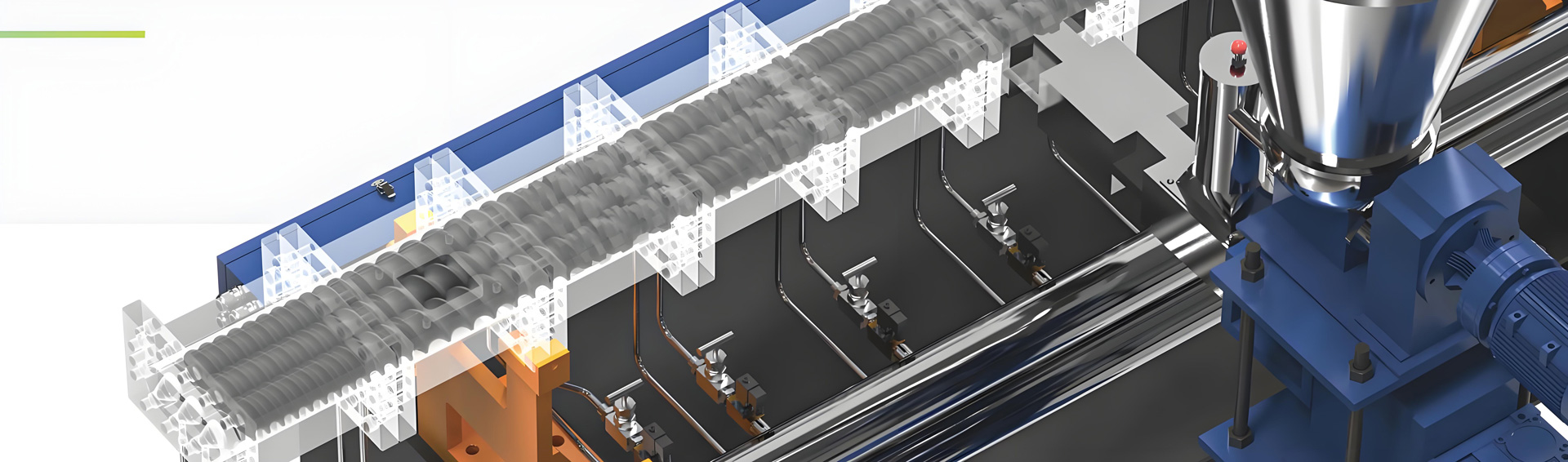
Automatic extruders provide superior mixing capabilities through optimized screw design and modular configuration options. Mixing elements ensure uniform distribution of alkaline additives and corrosion inhibitors throughout the polymer matrix while minimizing thermal stress that could degrade sensitive components. Screw configuration can be optimized for specific formulation requirements and additive characteristics.
Modular screw designs enable customized mixing configurations for different additive types and loading levels. Kneading blocks provide dispersive mixing to break down additive agglomerates and achieve uniform dispersion. Special mixing elements provide distributive mixing for uniform spatial distribution of acid-resistant components. Screw geometry optimization balances mixing intensity with thermal protection for sensitive additives.
Consistent Granulation Systems
Granulation quality significantly affects acid-resistant masterbatch handling, dispersion during final processing, and additive functionality. Automatic extruders incorporate advanced granulation systems including strand pelletizers, water ring pelletizers, or die face pelletizers designed for consistent pellet size, shape, and density. Consistent granulation ensures uniform additive dosing during final product processing.
Strand pelletizers provide precise control over pellet length through automatic cutting speed and strand diameter adjustments. Water ring pelletizers offer high production rates for large-scale operations while maintaining consistency. Die face pelletizers provide excellent pellet quality for high-value applications. Granulation system selection depends on production volume requirements, product value, and downstream handling considerations.
Production Process Overview
The production of acid-resistant masterbatches using automatic twin screw extruders involves sequential processing stages including material preparation, automated feeding, melting, mixing, and granulation. Each stage requires precise parameter control to achieve optimal additive dispersion while maintaining acid-resistant functionality and product consistency.
Material Preparation and Storage
Material preparation for acid-resistant masterbatch production requires attention to additive handling, moisture control, and storage protocols. Alkaline additives often require protection from moisture and carbon dioxide absorption during storage to preserve neutralization capacity. Some additives may react with atmospheric components reducing effectiveness.
Proper storage conditions maintain additive functionality throughout production cycles. Sealed containers with desiccants preserve alkaline additive capacity. First-in-first-out inventory management minimizes storage time and additive degradation. Pre-mixing of additives with polymer base using automated mixers can improve initial distribution. Proper material handling ensures consistent additive functionality.
Automated Feeding and Metering
Feeding accuracy and automation are critical for maintaining consistent acid-resistant additive concentrations. Automatic extruders utilize gravimetric feeders with integrated control for major components and precision metering devices for high-value additives. Automated feeding accuracy within 0.5% ensures consistent formulation ratios.
Gravimetric feeders provide continuous weight-based feeding with automatic compensation for material density variations. Automated control enables precise feed rate adjustment based on process conditions. Multiple feeding points enable introduction of additives at downstream locations where mixing conditions are optimal. Automated feeding ensures product quality consistency while reducing manual intervention.
Melting and Plasticization
The melting zone achieves polymer transition from solid to molten state capable of incorporating acid-resistant additives. Temperature profiles in this zone must achieve complete melting while protecting sensitive additives from thermal degradation. Typical temperature settings for polyolefin-based acid-resistant masterbatches range from 175 to 190 degrees Celsius for initial barrel zones.
Barrel design and screw configuration in the melting zone emphasize gentle but efficient melting to minimize thermal stress on additives. Barrier screw designs can enhance melting efficiency while reducing residence time. Proper melting establishes foundation for subsequent mixing stages and significantly influences energy consumption and additive functionality.
Intensive Mixing and Distribution
The mixing zone ensures uniform distribution of alkaline additives and corrosion inhibitors throughout the polymer matrix. Temperature in this zone must balance mixing requirements with additive thermal protection. Typical mixing zone temperatures range from 185 to 200 degrees Celsius for most polyolefin formulations.
Screw configuration in the mixing zone incorporates kneading blocks and mixing elements designed for optimal additive distribution without excessive shear. Forward-conveying kneading blocks provide moderate mixing and forward transport. Reverse-conveying elements create back-mixing zones that increase residence time and distribution uniformity. Mixing intensity must achieve uniform additive dispersion without generating excessive heat.
Processing Parameters and Optimization
Processing parameters for acid-resistant masterbatch production must optimize additive dispersion and functionality while achieving consistent product quality. Temperature profile, screw speed, throughput, and vacuum conditions all influence product quality and process efficiency.
Temperature Profile Configuration
Temperature profile configuration requires careful consideration of polymer thermal characteristics, additive thermal stability, and dispersion requirements. Typical temperature profiles for polyolefin acid-resistant masterbatches start at 175-185 degrees Celsius in feed zones, increase to 185-195 degrees Celsius in mixing zones, and maintain 190-205 degrees Celsius through die zones.
Additive thermal stability dictates maximum temperature limits. Some corrosion inhibitors begin degrading above 210 degrees Celsius. Alkaline additives generally demonstrate good thermal stability but may decompose at elevated temperatures over extended residence times. Temperature profile optimization should include testing of additive functionality after processing at various temperature settings.
Screw Speed and Throughput Optimization
Screw speed and throughput must be balanced to achieve optimal mixing while protecting additive functionality. Automatic extruders for acid-resistant masterbatch production typically operate at screw speeds from 125 to 275 rpm depending on screw size and formulation complexity. Higher screw speeds increase mixing intensity but reduce residence time.
Throughput rates typically range from 180 to 1300 kg/hr depending on machine size and formulation complexity. The throughput-to-speed ratio significantly influences residence time, mixing quality, and thermal exposure. Optimal feed rates for acid-resistant masterbatches typically fall between 6 and 15 kg/hr per cm of screw diameter.
Vacuum and Degassing
Vacuum venting removes volatiles, moisture, and entrapped air that can cause defects in acid-resistant masterbatches. Some additives may release small amounts of volatiles during processing that must be removed. Vacuum systems typically apply 30-70 mbar absolute pressure for effective degassing.
Vent port location must be optimized to avoid additive loss while achieving effective degassing. Some additive components have low molecular weight portions that could be extracted through vacuum vents. Vacuum level optimization balances effective degassing with additive retention. Multiple venting stages may be required for formulations releasing volatiles at different processing stages.
Equipment Investment and Cost Analysis
Investment in automatic twin screw extruders for acid-resistant masterbatch production represents significant capital expenditure requiring careful cost-benefit analysis. Understanding cost structure enables informed equipment selection.
Capital Investment Requirements
Automatic twin screw extruders for acid-resistant masterbatch production typically range in price from 140,000 to 450,000 US dollars depending on screw size, automation level, and configuration. Medium to large automatic extruders with 60-90mm screw diameters for capacities 300-1300 kg/hr typically cost 220,000 to 450,000 US dollars.
Configuration options significantly influence pricing. Automated feeding systems with gravimetric control add 20-30% to base machine cost. Advanced granulation systems including strand pelletizers with automatic cutting add 15-25% to base cost. High-level automation including integrated control and monitoring adds 25-35% to base machine cost.
Operating Cost Considerations
Operating costs include energy consumption, labor, maintenance, and materials. Energy consumption for automatic extruders typically ranges from 0.11 to 0.21 kWh per kg of product depending on machine size and formulation complexity. Automated equipment may demonstrate slightly higher energy consumption due to additional systems but provides superior operational efficiency.
Labor requirements are significantly reduced through automation, with minimal operator intervention for routine operation. Maintenance costs typically represent 2.5-4.5% of initial investment annually when proper preventive maintenance is followed. Material costs represent the largest operating expense, with corrosion inhibitors and specialty additives often accounting for 45-70% of material cost depending on formulation complexity.
Production Challenges and Solutions
Acid-resistant masterbatch production encounters specific challenges related to additive sensitivity, dispersion quality, and functionality retention. Understanding these challenges enables effective problem resolution.
Additive Neutralization Capacity Loss
Problem: Neutralization capacity loss manifests as reduced acid resistance, compromised protection, and premature product failure in acidic environments. Alkaline additives lose capacity through moisture absorption, carbon dioxide absorption, or thermal degradation during processing.
Cause Analysis: Improper storage conditions allowing moisture or carbon dioxide absorption reduce alkaline additive capacity. Excessive processing temperatures cause thermal degradation of alkaline compounds. Extended residence times at elevated temperatures accelerate additive degradation. Inadequate packaging or storage conditions expose additives to air and humidity.
Solution and Prevention: Implement proper storage conditions with sealed containers and desiccants. Use first-in-first-out inventory management to minimize storage time. Optimize processing temperatures to minimize thermal degradation while achieving adequate mixing. Reduce residence time through optimized screw configuration and throughput rates. Monitor additive neutralization capacity through testing. Replace additives when capacity drops below acceptable levels.
Poor Additive Dispersion
Problem: Poor additive dispersion results in inconsistent acid resistance, localized weak points, or property variations. Non-uniform distribution compromises protection and creates product failures in acidic service conditions.
Cause Analysis: Inadequate mixing intensity, inappropriate screw configuration, excessive throughput rates, or additive surface characteristics can cause poor dispersion. High additive loading increases dispersion difficulties. Insufficient residence time prevents complete distribution. Poor pre-mixing leads to concentration gradients. Inadequate compatibilizer use results in poor additive wetting.
Solution and Prevention: Optimize screw configuration by adding appropriate kneading blocks or mixing elements. Reduce throughput rates to increase residence time and mixing intensity. Ensure adequate pre-mixing to eliminate concentration gradients. Utilize compatibilizers to improve additive compatibility and distribution. Implement automated feeding with proper sequencing to optimize mixing conditions. Regular screw maintenance ensures consistent mixing performance.
Corrosion Inhibitor Degradation
Problem: Corrosion inhibitor degradation manifests as reduced surface protection, increased acid attack, and premature product failure. Inhibitors may degrade thermally during processing or lose effectiveness during service.
Cause Analysis: Excessive processing temperatures cause thermal decomposition of organic corrosion inhibitors. Insufficient inhibitor loading results in inadequate surface coverage. Incompatibility with base polymer reduces inhibitor effectiveness. Processing conditions may affect inhibitor migration to product surfaces. Extended service exposure depletes inhibitor capacity.
Solution and Prevention: Optimize temperature profile to protect inhibitor thermal stability. Ensure adequate inhibitor loading to achieve required surface coverage. Select inhibitors compatible with base polymer and processing conditions. Optimize processing conditions to promote uniform inhibitor distribution. Consider multiple inhibitor types for enhanced protection. Test inhibitor effectiveness after processing and during service conditions.
Granulation Quality Variations
Problem: Granulation quality variations manifest as inconsistent pellet size, shape irregularities, or density variations. Poor granulation quality affects handling, dosing accuracy, and dispersion during final processing.
Cause Analysis: Pelletizer maintenance issues, improper cutting blade alignment, inconsistent strand diameter, or variable melt properties cause granulation variations. Worn cutting blades or improper blade speed cause size variations. Inconsistent cooling or melt properties cause shape irregularities. Pelletizer feed rate variations cause overfilling or underfilling of cutting chamber. Automated system malfunctions affect consistency.
Solution and Prevention: Maintain pelletizer cutting blades with regular replacement or sharpening. Ensure proper blade alignment and clearance. Maintain consistent strand diameter through process control. Monitor and control melt properties including temperature and viscosity. Optimize pelletizer feed rate for consistent filling. Implement automated pellet size monitoring and adjustment. Maintain automated system calibration.
Maintenance and Equipment Optimization
Regular maintenance ensures consistent performance of automatic twin screw extruders and extends equipment life. Preventive maintenance programs must address automation systems, mixing components, granulation equipment, and auxiliary systems.
Automation System Maintenance
Automation system maintenance includes regular calibration of sensors, verification of control programming, and inspection of electrical connections. Feeding system calibration ensures accurate dosing and formulation consistency. Temperature sensors require periodic calibration for accurate temperature measurement and control.
Control system inspection identifies developing issues with displays, controllers, or communication interfaces. Electrical connection inspection ensures reliable operation and prevents downtime. Software and firmware updates should be applied as needed. Automation system maintenance is critical for maintaining consistent processing critical for acid-resistant masterbatch quality.
Screw and Barrel Maintenance
Screw and barrel maintenance includes regular inspection of wear patterns, clearance measurements, and cleaning to remove additive deposits. Acid-resistant additives can leave residues that accumulate on screw elements and barrel surfaces. Regular cleaning prevents accumulation that could affect product quality or processing performance.
Clearance measurements track wear rates and predict when screw element or barrel replacement is necessary. Precise clearances are essential for mixing performance and process consistency. Worn screw elements should be replaced to maintain mixing quality. Barrel wear liners may require replacement after extended operation. Regular screw and barrel maintenance ensures consistent processing and product quality.
Feeding System Maintenance
Feeding system maintenance includes regular inspection of feeders, calibration verification, and examination of feeding accuracy. Feeder calibration ensures consistent material dosing and formulation ratios. Weight sensor inspection identifies developing accuracy issues that could affect product quality.
Feeding mechanism inspection ensures reliable material delivery and prevents feeding interruptions. Hopper and flow system inspection prevents material buildup and feeding inconsistencies. Feeding system maintenance is essential for maintaining formulation consistency critical for acid-resistant masterbatch performance.
Quality Assurance and Testing
Comprehensive quality assurance protocols are essential for ensuring acid-resistant masterbatch performance and batch consistency. Testing should evaluate additive dispersion, acid resistance effectiveness, and neutralization capacity.
Acid Immersion Testing
Acid immersion testing evaluates masterbatch effectiveness by exposing samples to acid solutions for specified periods while monitoring property changes and visual appearance. Samples are immersed in various acid types and concentrations at controlled temperatures for defined periods. Weight changes, dimensional changes, and mechanical property retention quantify acid resistance effectiveness.
Acid immersion testing should be conducted with acid types and concentrations relevant to actual service conditions. Testing at elevated temperatures accelerates evaluation and simulates harsh conditions. Comparison to unprotected polymer samples quantifies protection effectiveness. Performance verification ensures masterbatch meets application requirements.
Neutralization Capacity Testing
Neutralization capacity testing measures the ability of additives to neutralize acidic compounds through standardized titration procedures. Testing measures the amount of acid that can be neutralized by a given mass of masterbatch. Neutralization capacity indicates additive functionality and acid resistance potential.
Neutralization capacity testing should be performed on masterbatch samples to verify additive effectiveness. Comparison to specifications ensures adequate protection capacity. Neutralization capacity typically decreases with additive degradation, making this test useful for monitoring additive functionality. Regular testing ensures consistent protection levels.
Frequently Asked Questions
This section addresses common questions regarding acid-resistant masterbatch production using automatic twin screw extruders.
What is the optimal alkaline additive loading for acid-resistant masterbatches?
Optimal alkaline additive loading depends on acid type, acid concentration, and protection requirements. Typical acid-resistant masterbatch alkaline additive loading ranges from 8% to 27% depending on formulation complexity. Higher loading provides greater neutralization capacity but increases cost and may affect processing characteristics. Lower loading reduces cost but may provide insufficient protection for demanding acid conditions. Loading optimization requires evaluation of actual service acid conditions and protection requirements.
How does automation improve acid-resistant masterbatch quality?
Automation improves quality through precise feeding accuracy, consistent parameter control, and reduced human error. Automated feeding systems ensure exact formulation ratios batch after batch. Precise temperature control maintains consistent thermal exposure protecting additive functionality. Automated parameter adjustment responds to process variations maintaining quality. Process monitoring enables early detection of issues preventing quality problems.
What processing parameters most significantly affect acid-resistant masterbatch quality?
Processing parameters significantly affecting quality include mixing intensity for additive dispersion, temperature profile for additive protection, and residence time for adequate distribution. Screw speed and throughput determine shear rate and residence time affecting both dispersion quality and additive stability. Temperature profile must balance thermal requirements for processing with additive thermal protection. Screw configuration optimization addresses specific dispersion requirements while protecting additive functionality.
How can neutralization capacity be maintained during storage?
Neutralization capacity maintenance requires proper storage conditions, inventory management, and additive protection. Store alkaline additives in sealed containers with desiccants to prevent moisture absorption. Protect from carbon dioxide exposure through proper sealing. Implement first-in-first-out inventory management to minimize storage time. Monitor capacity regularly and replace additives when capacity drops. Consider protective packaging for extended storage requirements.
What quality tests verify acid-resistant masterbatch effectiveness?
Quality verification should include acid immersion testing, neutralization capacity measurement, and visual inspection for dispersion quality. Acid immersion testing measures protection effectiveness under controlled acid exposure conditions. Neutralization capacity testing evaluates additive functionality and acid neutralization capability. Visual inspection identifies agglomerates or dispersion problems. Additional tests may include weight change measurement, mechanical property retention, and pellet quality assessment. Comprehensive testing ensures masterbatch meets acid resistance requirements.
How does corrosion inhibitor selection affect acid resistance?
Corrosion inhibitor selection significantly influences acid resistance effectiveness. Different inhibitors work through various mechanisms including surface film formation, sacrificial reaction, and acid complexing. Inhibitor compatibility with base polymer affects distribution and effectiveness. Inhibitor concentration determines surface coverage and protection level. Inhibitor stability affects performance duration. Optimal inhibitor selection considers acid type, polymer chemistry, and service conditions for maximum protection.
Conclusion and Best Practices
Acid-resistant masterbatch production using automatic twin screw extruders requires attention to formulation design, processing parameters, equipment capabilities, and quality assurance. The interplay between alkaline additive chemistry, corrosion inhibitor systems, processing conditions, and equipment capabilities determines final product performance and consistency.
Formulation optimization should begin with understanding acid attack mechanisms and protection requirements. Additive systems must address specific acid exposure pathways relevant to application conditions. Processing aids improve compatibility and dispersion while protecting additive functionality. Formulation development should include acid immersion testing to verify performance.
Equipment selection must address automation requirements for consistent processing and operational efficiency. Automatic twin screw extruders with automated feeding systems, precise control capabilities, and consistent granulation provide necessary capabilities. Equipment investment should consider production volume requirements, formulation complexity, and operational efficiency expectations.
Processing parameter optimization balances dispersion requirements with additive protection. Temperature profiles achieve adequate melting and mixing while maintaining additive functionality. Screw speed and throughput optimize residence time and mixing intensity. Vacuum venting removes volatiles without additive loss. Systematic parameter optimization through experimentation and testing establishes optimal conditions.
Quality assurance protocols should include comprehensive testing for additive dispersion, acid resistance performance, and neutralization capacity. Acid immersion testing provides performance verification under controlled conditions. Neutralization capacity testing enables evaluation of additive functionality. Regular quality monitoring ensures batch-to-batch consistency.
Preventive maintenance programs maintain equipment performance and extend service life. Regular maintenance of automation systems ensures consistent feeding and parameter control. Screw and barrel maintenance maintains mixing performance and product quality. Feeding system maintenance ensures formulation consistency. Maintenance protocols prevent unexpected downtime and quality problems.
Acid-resistant masterbatch production combines advanced chemical protection systems, automated processing equipment, and comprehensive quality systems. Success requires integration of formulation expertise, processing knowledge, and quality assurance capabilities. The automatic twin screw extruder provides essential capabilities for producing consistent, high-performance acid-resistant masterbatches that enhance product durability and reliability across diverse acidic applications.