Introduction to Film Grade Masterbatch
Film grade masterbatches represent specialized formulations designed to enhance the properties and processing characteristics of polymer films across diverse applications. These advanced masterbatches incorporate slip agents, antiblock additives, antistatic compounds, and optical enhancers that improve film clarity, processing performance, and end-use functionality. The production of film grade masterbatches requires processing equipment capable of maintaining additive functionality while achieving uniform dispersion and precise granulation characteristics.
Co-rotating twin screw extruders provide the advanced processing capabilities necessary for film grade masterbatch manufacturing. These machines offer gentle mixing characteristics, precise temperature control, and superior dispersion performance essential for incorporating film additives effectively. Nanjing Kerke Extrusion Equipment Company KTE Series co-rotating twin screw extruders represent advanced equipment designed specifically for demanding film grade masterbatch applications requiring exceptional consistency and surface quality.
Understanding Film Grade Additive Requirements
Film applications demand masterbatches with specific characteristics including excellent dispersion, high clarity, and consistent additive distribution. Slip agents reduce friction between film layers and processing equipment, improving processing efficiency and preventing blocking. Antiblock additives create surface texture that prevents film layers from sticking together during storage and handling. Antistatic compounds prevent static charge accumulation that attracts dust and causes handling problems.
Optical enhancers improve film clarity and gloss by controlling light transmission and reflection. These additives modify refractive index and reduce light scattering within the film matrix. Film grade masterbatches must maintain additive functionality while achieving excellent dispersion that prevents visible defects and ensures consistent optical properties.
Slip Agent Chemistry
Slip agents function by migrating to polymer surfaces and reducing friction between contacting surfaces. Fatty acid amides including erucamide and oleamide represent common slip agent chemistries that demonstrate excellent compatibility with polyolefins. These molecules have polar head groups that anchor to polymer chains and non-polar tails that provide low-friction surfaces.
Erucamide offers superior high-temperature stability and long-lasting slip characteristics. Oleamide provides faster initial slip but may demonstrate reduced permanence at elevated temperatures. Slip agent selection depends on processing temperatures, required slip levels, and end-use conditions. Proper slip agent loading ensures optimal processing performance without affecting film properties.
Antiblock Additive Systems
Antiblock additives function by creating microscopic surface protrusions that prevent complete contact between film layers. Silica, natural minerals, and synthetic antiblock particles represent common antiblock chemistries. These particles create controlled surface roughness that allows air between film layers, preventing blocking.
Silica antiblock additives provide controlled particle size distribution and excellent optical characteristics. Natural mineral antiblocks offer cost-effective solutions but may affect clarity. Synthetic antiblocks provide engineered particle characteristics for specific applications. Antiblock particle size, shape, and concentration significantly influence effectiveness and optical properties.
Formulation Design for Film Grade Masterbatches
Effective film grade masterbatch formulations require careful balance of slip agents, antiblock additives, antistatic compounds, and base polymers. Formulation ratios depend on film type, processing conditions, and performance requirements. Typical film grade masterbatch concentration levels range from 5% to 25% active ingredient loading, with most applications utilizing 8% to 18% additive content.
Base Polymer Selection
The base polymer serves as carrier for film additives and significantly influences formulation effectiveness. The base polymer should demonstrate excellent clarity, compatibility with additive systems, and appropriate melt characteristics for film processing. Common base polymers for film grade masterbatches include polyolefins, polyester, and specialty film resins.
Polyolefin bases including LLDPE and LDPE provide excellent clarity and compatibility with slip and antiblock additives. Polyester bases require careful additive selection to maintain optical quality. Specialty film bases demand specialized formulations for high-clarity applications. Base polymer typically constitutes 75% to 95% of masterbatch formulation depending on additive loading.
Film Additive System Configuration
Film additive systems typically combine slip agents, antiblock particles, and antistatic compounds for comprehensive performance enhancement. Slip agent loading typically ranges from 2% to 8% of masterbatch formulation depending on required friction reduction. Antiblock additive loading typically ranges from 2% to 6% depending on blocking resistance requirements.
Antistatic compound loading may range from 1% to 4% for preventing static charge accumulation. Additive ratios must be optimized for synergistic effects, as some combinations demonstrate enhanced performance while others show antagonistic interactions. Slip agents provide surface lubrication while antiblock particles prevent blocking.
Processing Aids and Dispersants
Processing aids and modifiers improve film grade masterbatch processability and enhance additive dispersion. Dispersants promote uniform distribution of antiblock particles throughout the polymer matrix. Lubricants reduce melt viscosity and improve flow characteristics, enabling processing with high additive loading. Coupling agents enhance compatibility between additives and polymer base.
Processing aids typically constitute 1% to 4% of formulation depending on additive loading and dispersion requirements. Dispersant selection considers additive surface characteristics and polymer type. Lubricant selection considers polymer compatibility and processing temperature requirements. Well-designed processing aid systems ensure consistent processing and uniform additive distribution critical for film quality.
Co-Rotating Twin Screw Extruder Technology
Co-rotating twin screw extruders represent advanced compounding equipment with capabilities specifically suited for film grade masterbatch production. These machines incorporate gentle mixing characteristics, precise distribution capabilities, and advanced temperature control designed to maintain additive functionality while producing consistent product. Nanjing Kerke Extrusion Equipment Company KTE Series co-rotating twin screw extruders provide the processing capabilities necessary for demanding film grade masterbatch applications.
Gentle Mixing Characteristics
Film grade masterbatch production requires gentle mixing to maintain additive functionality while achieving uniform distribution. Co-rotating extruders feature screw designs that provide dispersive mixing without excessive shear that could degrade sensitive additives. The intermeshing screw design creates gentle mixing zones that protect additive integrity.
Co-rotating screws provide self-wiping action that maintains consistent material transport. Mixing zones incorporate kneading blocks with optimized geometry for gentle dispersive mixing. The gentle mixing characteristics prevent additive degradation while achieving excellent distribution. This is particularly important for slip agents and antistatic compounds that may be shear-sensitive.
Superior Dispersion Performance
Superior dispersion is critical for film grade masterbatches to prevent visible defects and ensure consistent optical properties. Co-rotating extruders provide excellent dispersive mixing through optimized screw configurations and residence time distribution. Multiple mixing zones ensure complete deagglomeration of antiblock particles and uniform distribution of slip agents.
Modular screw designs enable customization of mixing intensity for different additive types. Kneading block configurations provide optimal dispersive energy for particle deagglomeration. Residence time distribution ensures adequate mixing without over-processing. Superior dispersion performance ensures consistent optical quality and additive effectiveness.
Precision Temperature Control
Precision temperature control maintains additive functionality while ensuring consistent melting and processing. Co-rotating extruders feature independent zone temperature control with accuracy within 0.5 degrees Celsius. This precision prevents thermal degradation of sensitive additives while ensuring consistent polymer melting and processing characteristics.
Advanced temperature control systems utilize proportional-integral-derivative (PID) algorithms with auto-tuning capabilities for optimal performance across operating ranges. Multiple heating and cooling zones enable precise temperature profile configuration. Temperature sensors positioned throughout the barrel provide real-time feedback to control systems. Precision temperature control ensures consistent product quality and additive functionality.
Production Process Overview
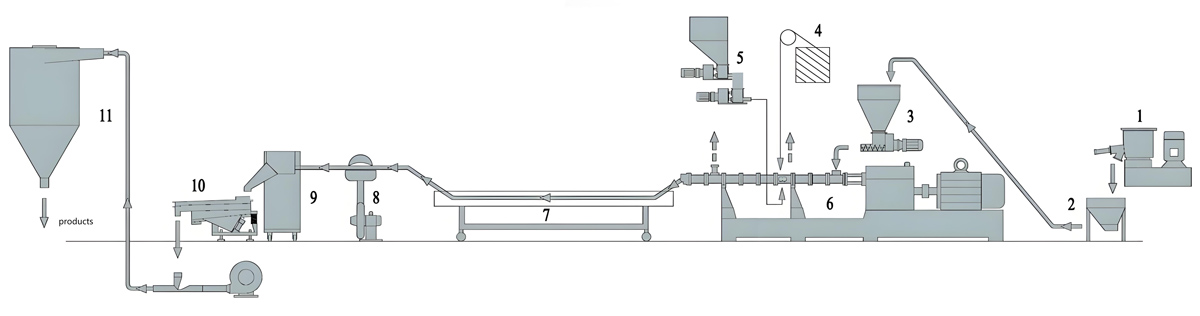
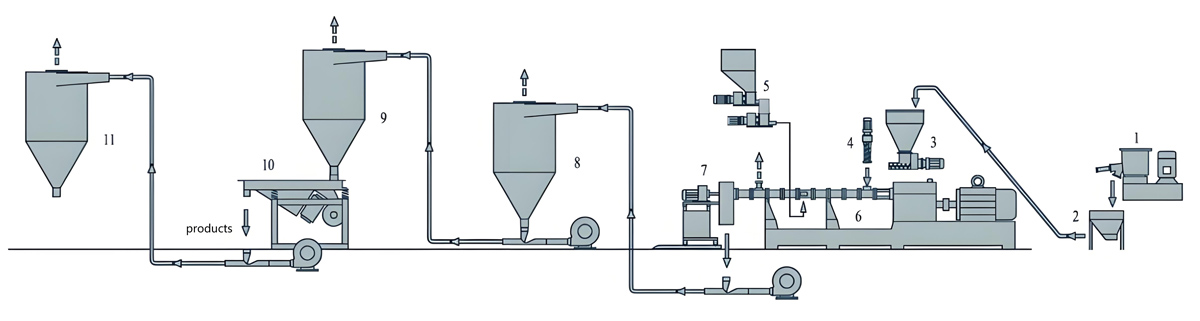
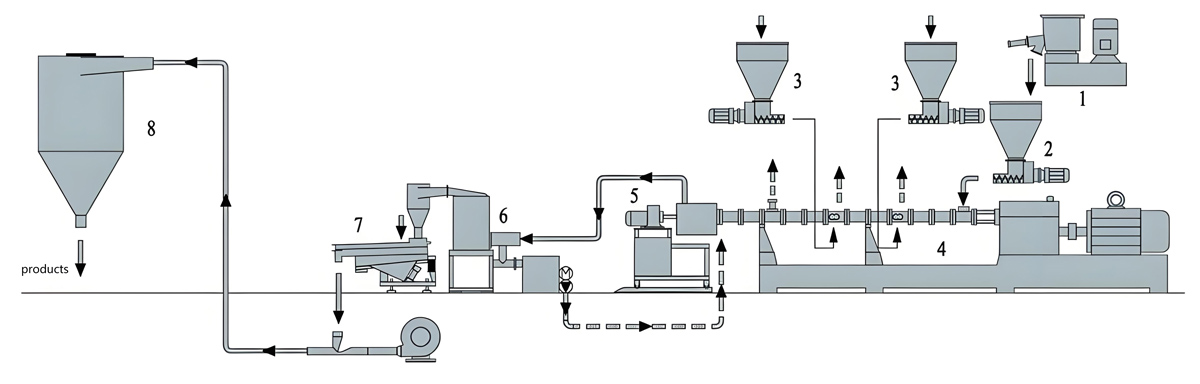
The production of film grade masterbatches using co-rotating twin screw extruders involves sequential processing stages including material preparation, feeding, melting, mixing, and granulation. Each stage requires precise parameter control to achieve optimal additive dispersion while maintaining film additive functionality and product consistency.
Material Preparation and Handling
Material preparation for film grade masterbatch production requires attention to additive handling, moisture control, and particle size control. Slip agents and antiblock additives often require protection from moisture during storage to maintain functionality. Some additives may agglomerate if not properly handled.
Pre-mixing of film additives with polymer base using high-intensity mixers can improve initial distribution and reduce processing requirements. Dry blending eliminates concentration gradients and reduces residence time demands in the extruder. Pre-mixing protocols must ensure adequate mixing without generating excessive heat that could degrade sensitive additives. Proper material preparation ensures consistent additive functionality.
Precision Feeding Systems
Feeding accuracy is critical for maintaining consistent film additive concentrations and product performance. Co-rotating extruders typically utilize gravimetric feeders for major components and precision metering devices for high-value additives. Feeding accuracy within 0.5% is essential for maintaining consistent formulation ratios.
Gravimetric feeders provide continuous weight-based feeding with automatic compensation for material density variations. Loss-in-weight feeders offer the highest accuracy for additive introduction. Multiple feeding points enable introduction of temperature-sensitive additives at downstream locations. Feeding system consistency ensures product quality and performance consistency.
Melting and Plasticization
The melting zone achieves polymer transition from solid to molten state capable of incorporating film additives. Temperature profiles in this zone must achieve complete melting while protecting sensitive additives from thermal degradation. Typical temperature settings for polyolefin-based film grade masterbatches range from 160 to 180 degrees Celsius for initial barrel zones.
Barrel design and screw configuration in the melting zone emphasize gentle but efficient melting to minimize thermal stress on additives. Barrier screw designs can enhance melting efficiency while reducing residence time. Proper melting establishes foundation for subsequent mixing stages and significantly influences energy consumption and additive functionality.
Gentle Mixing and Distribution
The mixing zone ensures uniform distribution of film additives throughout the polymer matrix. Temperature in this zone must balance mixing requirements with additive thermal protection. Typical mixing zone temperatures range from 175 to 190 degrees Celsius for most polyolefin formulations.
Screw configuration in the mixing zone incorporates kneading blocks and mixing elements designed for optimal additive distribution without excessive shear. Forward-conveying kneading blocks provide gentle mixing and forward transport. Reverse-conveying elements create back-mixing zones that increase residence time and distribution uniformity. Mixing intensity must achieve uniform additive dispersion while protecting additive integrity.
Processing Parameters and Optimization
Processing parameters for film grade masterbatch production must optimize additive dispersion and functionality while achieving consistent product quality. Temperature profile, screw speed, throughput, and vacuum conditions all influence product quality and process efficiency.
Temperature Profile Configuration
Temperature profile configuration requires careful consideration of polymer thermal characteristics, additive thermal stability, and dispersion requirements. Typical temperature profiles for polyolefin film grade masterbatches start at 160-175 degrees Celsius in feed zones, increase to 175-185 degrees Celsius in mixing zones, and maintain 180-190 degrees Celsius through die zones.
Additive thermal stability dictates maximum temperature limits. Some slip agents begin degrading above 210 degrees Celsius. Antiblock additives generally demonstrate good thermal stability but may affect processing viscosity. Temperature profile optimization should include testing of additive functionality after processing at various temperature settings.
Screw Speed and Throughput Optimization
Screw speed and throughput must be balanced to achieve optimal mixing while protecting additive functionality. Co-rotating extruders for film grade masterbatch production typically operate at screw speeds from 150 to 300 rpm depending on screw size and formulation complexity. Higher screw speeds increase mixing intensity but reduce residence time.
Throughput rates typically range from 200 to 1500 kg/hr depending on machine size and formulation complexity. The throughput-to-speed ratio significantly influences residence time, mixing quality, and thermal exposure. Optimal feed rates for film grade masterbatches typically fall between 6 and 16 kg/hr per cm of screw diameter.
Vacuum and Degassing
Vacuum venting removes volatiles, moisture, and entrapped air that can cause defects in film grade masterbatches. Some additives may release small amounts of volatiles during processing that must be removed. Vacuum systems typically apply 30-70 mbar absolute pressure for effective degassing.
Vent port location must be optimized to avoid additive loss while achieving effective degassing. Some additive components have low molecular weight portions that could be extracted through vacuum vents. Vacuum level optimization balances effective degassing with additive retention. Multiple venting stages may be required for formulations releasing volatiles at different processing stages.
Equipment Investment and Cost Analysis
Investment in co-rotating twin screw extruders for film grade masterbatch production represents significant capital expenditure requiring careful cost-benefit analysis. Understanding cost structure enables informed equipment selection.
Capital Investment Requirements
Co-rotating twin screw extruders for film grade masterbatch production typically range in price from 130,000 to 420,000 US dollars depending on screw size, precision level, and configuration. Medium to large co-rotating extruders with 60-90mm screw diameters for capacities 300-1500 kg/hr typically cost 210,000 to 420,000 US dollars.
Configuration options significantly influence pricing. Precision temperature control systems with multiple zones add 15-25% to base machine cost. Advanced granulation systems including strand pelletizers with precision cutting add 15-25% to base cost. High-level automation including gravimetric feeding and integrated control adds 20-30% to base machine cost.
Operating Cost Considerations
Operating costs include energy consumption, labor, maintenance, and materials. Energy consumption for co-rotating extruders typically ranges from 0.09 to 0.18 kWh per kg of product depending on machine size and formulation complexity. Co-rotating equipment demonstrates excellent energy efficiency due to gentle mixing characteristics.
Labor requirements vary based on automation level, with gentle mixing reducing the need for frequent operator intervention. Maintenance costs typically represent 2-4% of initial investment annually when proper preventive maintenance is followed. Material costs represent the largest operating expense, with slip agents and specialty additives often accounting for 50-75% of material cost depending on formulation complexity.
Production Challenges and Solutions
Film grade masterbatch production encounters specific challenges related to additive sensitivity, dispersion quality, and optical properties. Understanding these challenges enables effective problem resolution.
Slip Agent Migration Issues
Problem: Slip agent migration manifests as inconsistent slip levels, surface blooming, or processing difficulties. Excessive migration can cause slip agent depletion from bulk material and surface accumulation affecting film properties.
Cause Analysis: Excessive slip agent loading, poor compatibility with base polymer, or inadequate molecular weight can cause migration. Slip agents with lower molecular weight than base polymer tend to migrate toward surfaces. High temperatures during processing accelerate migration. Insufficient additive anchoring to polymer matrix leads to surface accumulation.
Solution and Prevention: Optimize slip agent loading to achieve required slip characteristics while minimizing migration. Select slip agents with appropriate molecular weight and compatibility with base polymer. Incorporate coupling agents that enhance slip agent retention. Reduce processing temperatures to minimize thermal migration. Test formulations for migration characteristics during development. Implement surface testing to detect migration issues.
Antiblock Particle Agglomeration
Problem: Antiblock particle agglomeration results in visible defects, inconsistent antiblocking performance, or film quality issues. Poor dispersion compromises uniform antiblocking and creates surface defects.
Cause Analysis: Inadequate mixing intensity, inappropriate screw configuration, excessive throughput rates, or particle surface characteristics can cause agglomeration. High antiblock loading increases agglomeration tendencies. Insufficient residence time prevents complete deagglomeration. Poor pre-mixing leads to concentration gradients. Inadequate dispersant use results in poor particle wetting.
Solution and Prevention: Optimize screw configuration by adding appropriate kneading blocks or mixing elements. Reduce throughput rates to increase residence time and mixing intensity. Ensure adequate pre-mixing to eliminate concentration gradients. Utilize dispersants to improve antiblock particle compatibility and distribution. Optimize particle size distribution for processing conditions. Implement proper dispersant selection and loading. Regular screw maintenance ensures consistent mixing performance.
Antistatic Compound Effectiveness Loss
Problem: Antistatic compound effectiveness loss manifests as static charge accumulation, dust attraction, or handling problems. Antistatic compounds may lose functionality over time or under certain conditions.
Cause Analysis: Antistatic compounds may migrate to surfaces and be lost through abrasion or contact. Some antistatic compounds demonstrate humidity dependence and lose effectiveness in dry environments. Processing conditions may affect antistatic compound distribution. Insufficient loading results in inadequate antistatic effect.
Solution and Prevention: Optimize antistatic compound loading to achieve required antistatic effect. Select antistatic compounds with appropriate permanence for application conditions. Consider humidity-dependent compounds for dry environments or humidity-independent compounds for general applications. Ensure adequate distribution through optimized mixing. Test antistatic effectiveness under actual service conditions.
Granulation Quality Variations
Problem: Granulation quality variations manifest as inconsistent pellet size, shape irregularities, or density variations. Poor granulation quality affects handling, dosing accuracy, and dispersion during film processing.
Cause Analysis: Pelletizer maintenance issues, improper cutting blade alignment, inconsistent strand diameter, or variable melt properties cause granulation variations. Worn cutting blades or improper blade speed cause size variations. Inconsistent cooling or melt properties cause shape irregularities. Pelletizer feed rate variations cause overfilling or underfilling of cutting chamber.
Solution and Prevention: Maintain pelletizer cutting blades with regular replacement or sharpening. Ensure proper blade alignment and clearance. Maintain consistent strand diameter through process control. Monitor and control melt properties including temperature and viscosity. Optimize pelletizer feed rate for consistent filling. Implement automated pellet size monitoring and adjustment for consistent quality.
Maintenance and Equipment Optimization
Regular maintenance ensures consistent performance of co-rotating twin screw extruders and extends equipment life. Preventive maintenance programs must address mixing systems, temperature control components, granulation equipment, and auxiliary systems.
Screw System Maintenance
Screw system maintenance includes regular inspection of wear patterns, clearance measurements, and cleaning to remove additive deposits. Film additives can leave residues that accumulate on screw elements and barrel surfaces. Regular cleaning prevents accumulation that could affect product quality or processing performance.
Clearance measurements track wear rates and predict when screw element replacement is necessary. Precise clearances are essential for gentle mixing and product consistency. Worn screw elements should be replaced to maintain mixing quality. Screw element inspection ensures consistent gentle mixing characteristics.
Temperature Control System Maintenance
Temperature control system maintenance includes regular calibration of sensors, inspection of heating elements, and verification of cooling system performance. Temperature sensor calibration ensures accurate temperature measurement and control. Heating element inspection identifies degraded elements requiring replacement.
Cooling system inspection including pumps, heat exchangers, and control valves ensures adequate cooling capacity. PID controller tuning ensures optimal temperature control response and stability. Regular temperature control maintenance is critical for maintaining additive functionality and film quality.
Granulation System Maintenance
Granulation system maintenance includes regular inspection of cutting blades, alignment verification, and examination of pellet quality. Cutting blade sharpness directly affects pellet quality and consistency. Blade alignment and clearance must be maintained for proper cutting action. Pellet quality inspection identifies developing problems before they cause significant quality issues.
Water ring pelletizers require maintenance of water systems including pumps, filtration, and temperature control. Strand pelletizers require maintenance of haul-off speed control and cutting chamber consistency. Die face pelletizers require maintenance of knife and die condition. Granulation system maintenance ensures consistent pellet quality essential for masterbatch handling and film processing.
Quality Assurance and Testing
Comprehensive quality assurance protocols are essential for ensuring film grade masterbatch performance and batch consistency. Testing should evaluate additive dispersion, optical properties, and functional performance.
Film Optical Quality Testing
Film optical quality testing evaluates masterbatch effectiveness by processing film samples and measuring optical properties including haze, gloss, and clarity. Samples are processed under controlled conditions and tested using standardized optical measurement equipment. Haze values, gloss levels, and clarity indices quantify optical performance.
Optical quality testing should be conducted on films processed under conditions relevant to actual production. Comparison to specification limits ensures optical quality meets application requirements. Testing across multiple production runs identifies consistency issues. Performance verification ensures masterbatch meets film optical quality requirements.
Slip and Antiblock Performance Testing
Slip performance testing measures the coefficient of friction of film samples to verify slip agent effectiveness. Antiblock performance testing measures blocking resistance by stacking film samples under controlled pressure and measuring force required to separate layers. These tests quantify functional performance of slip and antiblock additives.
Performance testing should be conducted under conditions relevant to actual service and storage conditions. Comparison to unprotected polymer samples quantifies additive effectiveness. Testing at various temperatures identifies temperature-dependent performance characteristics. Performance verification ensures masterbatch meets film functional requirements.
Frequently Asked Questions
This section addresses common questions regarding film grade masterbatch production using co-rotating twin screw extruders.
What is the optimal slip agent loading for film grade masterbatches?
Optimal slip agent loading depends on film type, processing conditions, and slip requirements. Typical film grade masterbatch slip agent loading ranges from 2% to 8% depending on formulation complexity. Higher loading provides greater slip but may cause migration issues or affect film properties. Lower loading may provide insufficient slip for high-speed processing. Loading optimization requires evaluation of actual processing conditions and slip requirements.
Why is co-rotating screw configuration preferred for film grade masterbatch production?
Co-rotating screw configuration provides gentle mixing characteristics that protect sensitive film additives while achieving uniform dispersion. The self-wiping action maintains consistent material transport without excessive shear. Precise distribution capabilities ensure excellent optical quality. Temperature control consistency maintains additive functionality. These characteristics make co-rotating extruders ideal for film grade masterbatch production.
What processing parameters most significantly affect film grade masterbatch quality?
Processing parameters significantly affecting quality include mixing intensity for additive dispersion, temperature profile for additive protection, and residence time for adequate distribution. Screw speed and throughput determine shear rate and residence time affecting both dispersion quality and additive stability. Temperature profile must balance thermal requirements for processing with additive thermal protection. Screw configuration optimization addresses specific dispersion requirements while protecting additive integrity.
How can antiblock dispersion be improved in film grade masterbatches?
Antiblock dispersion improvement requires optimization of mixing conditions, dispersant selection, and processing parameters. Screw configuration with appropriate kneading blocks provides gentle dispersive mixing for particle deagglomeration. Dispersant selection and loading enhance antiblock particle wetting and compatibility. Reduced throughput rates increase residence time for improved dispersion. Pre-mixing eliminates concentration gradients. Regular screw maintenance ensures consistent mixing performance.
What quality tests verify film grade masterbatch effectiveness?
Quality verification should include film optical quality testing, slip and antiblock performance testing, and visual inspection for dispersion quality. Optical quality testing measures haze, gloss, and clarity characteristics. Performance testing evaluates slip and antiblock functionality. Visual inspection identifies agglomerates or dispersion problems. Additional tests may include antistatic effectiveness measurement, pellet quality assessment, and additive migration testing. Comprehensive testing ensures masterbatch meets film quality requirements.
How does slip agent molecular weight affect performance?
Slip agent molecular weight significantly influences performance characteristics including migration tendency, permanence, and effectiveness. Higher molecular weight slip agents demonstrate reduced migration and increased permanence but may provide slower initial slip. Lower molecular weight agents offer faster initial slip but may migrate more readily and demonstrate reduced permanence at elevated temperatures. Molecular weight selection must balance initial effectiveness with long-term performance for specific application requirements.
Conclusion and Best Practices
Film grade masterbatch production using co-rotating twin screw extruders requires attention to formulation design, processing parameters, equipment capabilities, and quality assurance. The interplay between slip agent chemistry, antiblock particle systems, processing conditions, and gentle mixing characteristics determines final product performance and consistency.
Formulation optimization should begin with understanding film application requirements and additive functionality. Additive systems must address specific processing and end-use requirements for different film types. Processing aids improve compatibility and dispersion while protecting additive functionality. Formulation development should include film processing and optical quality testing.
Equipment selection must address gentle mixing requirements for additive protection and excellent dispersion. Co-rotating twin screw extruders with precise temperature control, superior dispersion performance, and consistent granulation provide necessary capabilities. Equipment investment should consider production volume requirements, optical quality standards, and processing characteristics.
Processing parameter optimization balances dispersion requirements with additive protection. Temperature profiles achieve adequate melting and mixing while maintaining additive functionality. Screw speed and throughput optimize residence time and gentle mixing. Vacuum venting removes volatiles without additive loss. Systematic parameter optimization through experimentation and testing establishes optimal conditions.
Quality assurance protocols should include comprehensive testing for additive dispersion, optical properties, and functional performance. Film optical quality testing provides performance verification under processing conditions. Slip and antiblock performance testing evaluates functional effectiveness. Regular quality monitoring ensures batch-to-batch consistency.
Preventive maintenance programs maintain equipment performance and extend service life. Regular maintenance of screw systems ensures gentle mixing characteristics. Temperature control maintenance maintains additive functionality. Granulation system maintenance ensures consistent pellet quality. Maintenance protocols prevent unexpected downtime and quality problems.
Film grade masterbatch production combines advanced additive chemistry, gentle mixing processing equipment, and comprehensive quality systems. Success requires integration of formulation expertise, processing knowledge, and quality assurance capabilities. The co-rotating twin screw extruder provides essential capabilities for producing consistent, high-quality film grade masterbatches that enhance processing performance and film properties across diverse applications.