Introduction to Injection Molding Grade Masterbatch
Injection molding grade masterbatches represent versatile formulations designed to enhance the properties and processing characteristics of polymers used in injection molding applications. These advanced masterbatches incorporate colorants, processing aids, fillers, and performance additives that improve color consistency, flow characteristics, mechanical properties, and dimensional stability for products ranging from consumer goods to industrial components. The production of injection molding grade masterbatches requires processing equipment capable of maintaining additive functionality while achieving uniform dispersion and precise granulation characteristics with exceptional flexibility for diverse formulations.
Variable speed twin screw extruders provide the advanced processing capabilities necessary for injection molding masterbatch manufacturing with superior operational flexibility. These machines offer adjustable screw speeds, optimized processing parameters, and versatile configuration options designed to maintain additive functionality while accommodating diverse formulation requirements and processing conditions. Nanjing Kerke Extrusion Equipment Company KTE Series variable speed twin screw extruders represent advanced equipment designed specifically for demanding injection molding masterbatch applications requiring exceptional flexibility and granulation quality.
Understanding Injection Molding Requirements
Injection molding applications demand masterbatches with specific characteristics including excellent flow properties, color consistency, thermal stability, and mechanical property enhancement. Colorants provide consistent color matching across injection molding runs and multiple molds. Processing aids improve flow characteristics and reduce cycle times. Fillers enhance mechanical properties and reduce material costs. Performance additives provide specific functionality including flame retardancy and UV resistance.
Injection molding masterbatches must maintain additive functionality while achieving excellent dispersion that prevents color streaks and ensures uniform properties across molded components. The production process must accommodate diverse formulation requirements while maintaining consistent product quality meeting injection molding industry specifications.
Flow Properties and Processability
Injection molding requires excellent flow properties to fill molds completely and produce detailed parts. Flow characteristics determine mold filling behavior, cycle time, and part quality. Process aids and flow enhancers improve flow by reducing viscosity and improving polymer mobility. Good flow properties enable production of complex geometries and thin-walled components.
Flow properties influence injection pressure, filling time, and final part quality. Injection molding applications include consumer products, automotive components, medical devices, and industrial parts. Each application has specific flow requirements based on part geometry and molding parameters. Proper flow characteristics ensure consistent molding performance and high-quality parts.
Granulation Quality and Consistency
Granulation quality significantly affects feeding consistency and processing performance during injection molding. Uniform pellet size and shape ensure consistent feeding into injection molding machines. Consistent granulation prevents flow variations and processing instabilities. Granulation quality influences masterbatch distribution and final part consistency.
Granulation requirements include pellet size distribution, pellet shape, and surface characteristics. Uniform pellets enable consistent let-down ratios and processing conditions. Consistent granulation ensures masterbatch performance and product quality. Granulation quality requirements vary by injection molding application and feeding systems.
Formulation Design for Injection Molding Masterbatches
Effective injection molding masterbatch formulations require careful balance of colorants, processing aids, fillers, and base polymers. Formulation ratios depend on part type, application requirements, and processing conditions. Typical injection molding masterbatch concentration levels range from 8% to 30% active ingredient loading, with most applications utilizing 12% to 25% additive content.
Base Polymer Selection
The base polymer serves as carrier for injection molding additives and significantly influences formulation effectiveness. The base polymer should demonstrate excellent compatibility with additive systems, appropriate rheological characteristics for processing, and suitable mechanical properties. Common base polymers for injection molding masterbatches include PP, PE, ABS, PC, and PS.
PP provides good chemical resistance and processing characteristics for consumer products. ABS provides excellent surface finish and impact resistance for automotive components. PC provides excellent clarity and thermal stability for medical devices. PE provides good flexibility and processability for packaging applications. Base polymer typically constitutes 70% to 92% of masterbatch formulation depending on additive loading.
Injection Molding Additive System Configuration
Injection molding additive systems typically combine colorants, processing aids, fillers, and performance additives for comprehensive performance enhancement. Colorant loading typically ranges from 5% to 15% of masterbatch formulation depending on color strength requirements and final let-down ratio. Processing aid loading typically ranges from 2% to 10% for flow enhancement and cycle time reduction.
Filler loading typically ranges from 5% to 30% for cost reduction and property enhancement. Performance additive loading varies significantly based on specific functionality requirements. Additive ratios must be optimized for synergistic effects, as some combinations demonstrate enhanced processing performance while others show antagonistic interactions.
Variable Speed Twin Screw Extruder Technology
Variable speed twin screw extruders represent advanced compounding equipment with capabilities specifically suited for injection molding masterbatch production. These machines incorporate adjustable screw speed control, flexible processing parameters, and versatile configuration options designed to maintain additive functionality while accommodating diverse formulation requirements.
Adjustable Screw Speed Control
Variable speed twin screw extruders feature adjustable screw speed control enabling optimization for different formulations and processing requirements. Screw speed control enables adjustment of residence time, shear rate, and throughput based on formulation characteristics. Variable speed enables processing of diverse formulations without equipment changes.
Adjustable screw speed typically ranges from 50 to 400 RPM depending on machine size and formulation requirements. Higher screw speeds increase throughput and shear rate but reduce residence time. Lower screw speeds increase residence time for improved mixing but reduce throughput. Variable speed enables optimal processing for each formulation. Proper screw speed selection ensures optimal granulation quality.
Flexible Processing Parameter Adjustment
Variable speed control enables flexible adjustment of processing parameters including temperature profile, screw configuration, and throughput. Processing parameters can be optimized for each formulation without equipment modification. Variable speed control accommodates formulation variations and processing condition changes.
Flexible parameter adjustment enables rapid changeover between different formulations. Processing optimization for each formulation improves product quality and efficiency. Variable speed control provides operational flexibility for diverse production requirements. Flexible parameter adjustment enables production optimization for specific applications.
Versatile Configuration Options
Variable speed extruders offer versatile configuration options including screw element selection, barrel length adjustment, and feeding system options. Configuration versatility enables equipment adaptation to specific formulation requirements. Versatile configurations provide processing flexibility without requiring multiple machines.
Screw configuration can be optimized for specific mixing requirements. Barrel length adjustment enables processing of formulations with different residence time requirements. Feeding system options accommodate different additive characteristics and feeding strategies. Versatile configuration ensures equipment flexibility and processing capability.
Production Process Overview
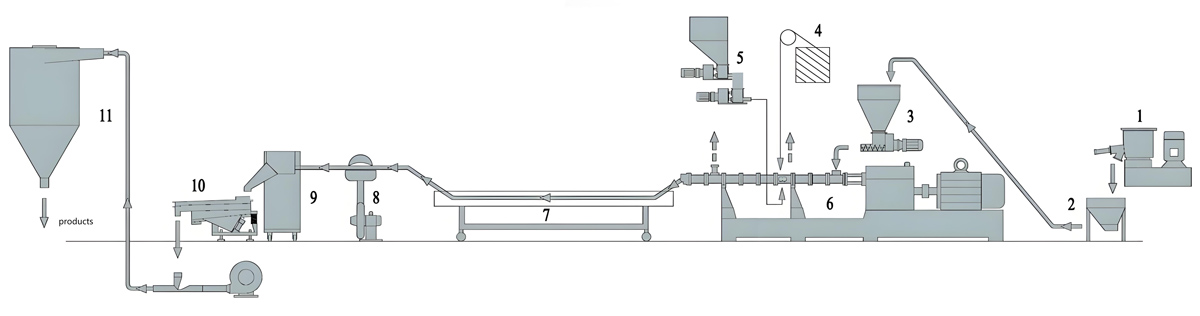
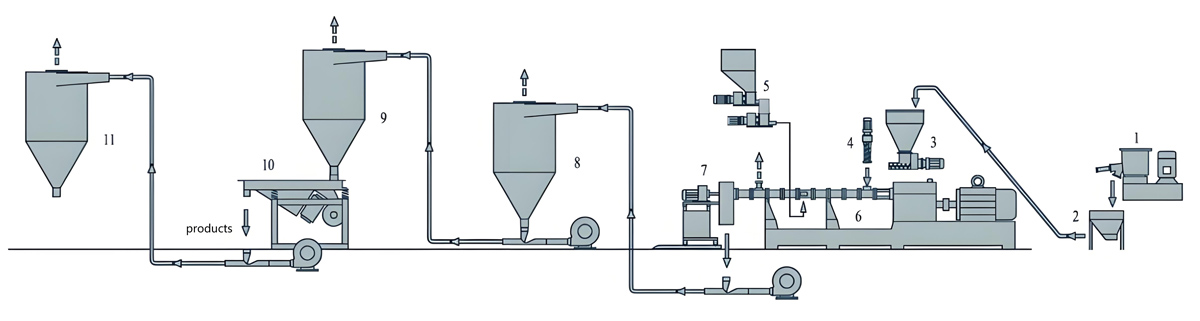
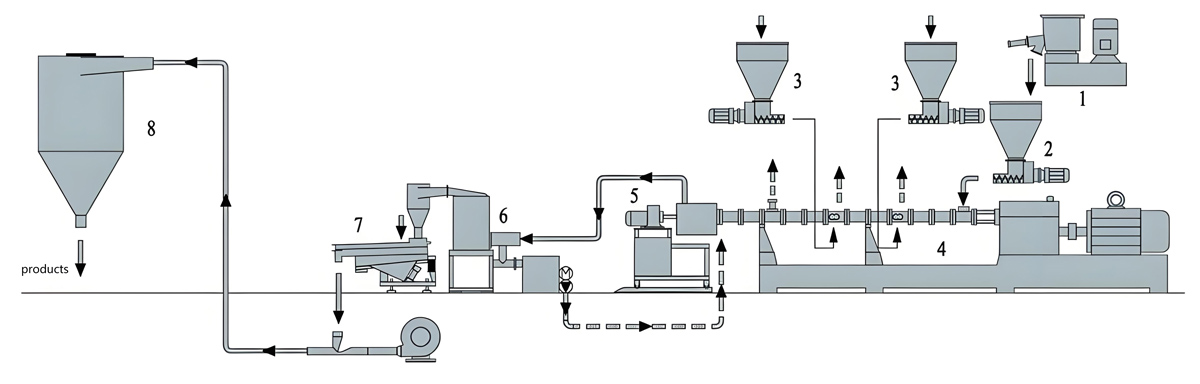
The production of injection molding masterbatches using variable speed twin screw extruders involves sequential processing stages including material preparation, feeding, melting, mixing, and granulation. Each stage requires parameter optimization to achieve optimal additive dispersion and granulation quality while maintaining injection molding additive functionality.
Material Preparation and Handling
Material preparation for injection molding masterbatch production requires attention to additive handling, moisture control, and particle size distribution. Processing aids and performance additives often require protection from moisture during storage to maintain functionality. Some additives may agglomerate if not properly handled.
Pre-mixing of injection molding additives with polymer base using high-intensity mixers can improve initial distribution and reduce processing requirements. Pre-mixing eliminates concentration gradients and promotes consistent feeding. Pre-mixing protocols must ensure adequate mixing without generating excessive heat that could degrade sensitive additives. Proper material preparation ensures consistent additive functionality and flexible processing.
Flexible Feeding Systems
Feeding accuracy and flexibility influence additive distribution and processing flexibility. Variable speed extruders typically utilize flexible gravimetric feeding systems. Feeding accuracy within 0.5% is essential for maintaining consistent formulation ratios and enabling rapid formulation changes.
Feeding system design accommodates different additive types and characteristics. Multiple feeding points enable introduction of temperature-sensitive additives at downstream locations. Flexible feeding enables rapid changeover between formulations. Flexible feeding systems ensure consistent product quality and operational flexibility.
Variable Speed Melting and Mixing
The melting zone achieves polymer transition from solid to molten state with variable speed optimization. Temperature profiles in this zone must achieve complete melting while protecting sensitive additives. Screw speed influences melting efficiency and residence time. Typical temperature settings for polyolefin-based injection molding masterbatches range from 180 to 200 degrees Celsius for initial barrel zones.
Variable speed enables optimization of melting process for different formulations. Higher speeds increase melting rate but reduce residence time. Lower speeds provide longer residence time for improved melting of difficult formulations. Screw speed optimization considers material characteristics and processing requirements. Proper variable speed melting establishes foundation for mixing stages and granulation.
Processing Parameters and Optimization
Processing parameters for injection molding masterbatch production must optimize additive dispersion and functionality while maximizing flexibility and granulation quality. Temperature profile, screw speed, throughput, and parameter control all influence product quality and processing flexibility.
Temperature Profile Optimization
Temperature profile optimization requires consideration of polymer thermal characteristics, additive thermal stability, and processing flexibility requirements. Typical temperature profiles for polyolefin injection molding masterbatches start at 180-195 degrees Celsius in feed zones, increase to 195-215 degrees Celsius in mixing zones, and maintain 200-225 degrees Celsius through die zones.
Additive thermal stability dictates maximum temperature limits. Some processing aids and performance additives are temperature sensitive. Temperature profile optimization should balance thermal requirements for processing with additive thermal protection. Variable speed control enables temperature profile adjustment for different formulations. Lower temperature profiles reduce degradation risk and maintain additive functionality.
Screw Speed Optimization for Granulation
Screw speed significantly influences granulation quality and processing efficiency. Higher screw speeds increase throughput but may reduce granulation quality. Lower screw speeds improve mixing and granulation quality but reduce throughput. Optimal screw speed balances productivity with granulation quality requirements.
Screw speed optimization considers formulation characteristics and granulation requirements. Variable speed enables adjustment for different formulations and quality requirements. Screw speed typically ranges from 150 to 350 RPM depending on machine size and formulation. Proper screw speed selection ensures optimal granulation quality and processing efficiency.
Equipment Investment and Cost Analysis
Investment in variable speed twin screw extruders for injection molding masterbatch production represents significant capital expenditure requiring careful cost-benefit analysis. Understanding cost structure and flexibility benefits enables informed equipment selection.
Capital Investment Requirements
Variable speed twin screw extruders for injection molding masterbatch production typically range in price from 145,000 to 420,000 US dollars depending on screw size, capacity, and speed control capabilities. Mid-range variable speed models typically cost 180,000 to 280,000 US dollars for capacities 500-1000 kg/hr.
Variable speed features significantly influence pricing. Advanced speed control systems add 8-12% to base machine cost. Flexible configuration options add 10-15% to base machine cost. Versatile feeding systems add 5-10% to base cost. Variable speed features provide operational flexibility and processing capability for diverse formulations.
Flexibility Benefits Analysis
Variable speed and flexible processing provide significant benefits through equipment versatility and formulation adaptability. Variable speed enables processing of diverse formulations without equipment changes. Flexible parameter adjustment enables rapid optimization for specific applications. Processing flexibility increases production capability and market responsiveness.
Operational flexibility enables efficient production of diverse product lines. Rapid changeover between formulations reduces downtime and increases productivity. Processing capability without equipment changes reduces capital investment requirements. Flexibility benefits provide competitive advantage in dynamic injection molding markets.
Production Challenges and Solutions
Injection molding masterbatch production encounters specific challenges related to granulation quality, flow property consistency, and formulation flexibility. Understanding these challenges enables effective problem resolution.
Granulation Quality Variability
Problem: Granulation quality variability manifests as inconsistent pellet size, shape variations, or surface defects. Variable granulation quality affects feeding consistency and processing performance during injection molding.
Cause Analysis: Inconsistent processing conditions, screw speed variations, or die design issues cause granulation variability. Parameter fluctuations create inconsistent granulation conditions. Screw speed variations affect pellet formation and cutting. Die design issues cause pellet shape and size variations.
Solution and Prevention: Optimize screw speed and processing parameters for consistent granulation. Maintain consistent processing conditions through precise parameter control. Ensure proper die design and maintenance for uniform pellet formation. Test granulation quality after processing. Regular die maintenance ensures consistent granulation quality. Parameter monitoring identifies granulation variability.
Flow Property Inconsistency
Problem: Flow property inconsistency manifests as variable viscosity, injection pressure changes, or filling problems. Inconsistent flow properties compromise injection molding quality and processing stability.
Cause Analysis: Inadequate dispersion of processing aids, concentration variations, or thermal history differences cause flow inconsistency. Poor dispersion creates areas with different flow characteristics. Concentration fluctuations from feeding variations create property differences. Thermal history variations affect polymer rheology.
Solution and Prevention: Ensure uniform processing aid dispersion through optimized mixing. Maintain precise feeding to prevent concentration fluctuations. Control thermal history through consistent processing parameters. Test flow properties after processing. Use processing aids with good dispersion characteristics. Regular quality monitoring identifies flow property variations.
Formulation Changeover Challenges
Problem: Formulation changeover challenges manifest as extended downtime, cross-contamination, or quality transition issues. Difficult changeovers reduce productivity and increase costs.
Cause Analysis: Inadequate cleaning procedures, configuration limitations, or process inflexibility cause changeover challenges. Incomplete cleaning causes cross-contamination between formulations. Configuration limitations require extensive adjustments for new formulations. Process inflexibility prevents rapid parameter changes.
Solution and Prevention: Implement efficient cleaning procedures for rapid changeover. Utilize variable speed and flexible parameter adjustment for rapid optimization. Use modular configuration options to reduce changeover time. Standardize changeover procedures to minimize downtime. Flexible equipment design enables rapid formulation changes. Regular procedure optimization improves changeover efficiency.
Maintenance and Equipment Optimization
Regular maintenance ensures consistent performance of variable speed twin screw extruders and maintains processing flexibility. Preventive maintenance programs must address speed control systems, mixing components, and configuration elements.
Speed Control System Maintenance
Speed control system maintenance focuses on maintaining precise screw speed control and operational flexibility. Regular inspection identifies speed control issues requiring correction. Drive system maintenance ensures consistent speed accuracy. Control system maintenance ensures parameter flexibility.
Speed control accuracy monitoring tracks screw speed consistency and identifies variations. Regular maintenance prevents speed control degradation through proper maintenance of drive components. Flexible operation practices maintain optimal speed control capability. Regular speed control system maintenance ensures consistent processing flexibility.
Mixing Component Maintenance
Mixing components including screw elements, barrels, and kneading blocks require regular inspection to maintain mixing quality and granulation consistency. Wear increases variability and reduces mixing effectiveness. Regular inspection ensures consistent mixing across different formulations.
Maintenance should consider variable speed operation characteristics and typical wear patterns. Screw element replacement maintains mixing effectiveness and granulation quality. Barrel wear monitoring ensures consistent processing. Regular mixing component maintenance ensures consistent product quality and processing flexibility.
Quality Assurance and Testing
Comprehensive quality assurance protocols are essential for ensuring injection molding masterbatch performance and consistency. Testing should evaluate flow properties, granulation quality, and dispersion quality.
Flow Property Testing
Flow property testing evaluates masterbatch effect on polymer processing characteristics. Melt flow index testing measures viscosity characteristics. Rheological testing determines flow behavior under processing conditions. Injection molding trials verify actual processing performance.
Flow property testing should be conducted on representative samples processed through injection molding. Testing should evaluate flow under conditions simulating actual molding parameters. Regular testing ensures consistent flow properties. Flow property testing ensures masterbatch meets injection molding processing requirements.
Granulation Quality Testing
Granulation quality testing evaluates pellet characteristics including size distribution, shape, and surface quality. Pellet size analysis determines consistency and uniformity. Visual inspection evaluates shape and surface defects. Granulation quality significantly affects feeding consistency and processing performance.
Granulation testing should measure pellet size distribution and identify outliers. Visual inspection should identify surface defects and shape irregularities. Regular testing ensures consistent granulation quality. Granulation quality testing ensures masterbatch meets injection molding feeding requirements.
Frequently Asked Questions
This section addresses common questions regarding injection molding masterbatch production using variable speed twin screw extruders.
What is advantage of variable speed?
Variable speed provides processing flexibility by enabling optimization for different formulations. Screw speed adjustment enables optimization of residence time, shear rate, and throughput. Variable speed enables processing of diverse formulations without equipment changes. Flexible parameter adjustment enables rapid formulation optimization. Variable speed provides operational flexibility and production capability. Variable speed enables efficient production of diverse product lines.
What granulation quality is required?
Injection molding masterbatches require consistent granulation quality including uniform pellet size and shape. Pellet size distribution should be narrow with minimal outliers. Pellet shape should be consistent and free of defects. Granulation quality significantly affects feeding consistency and processing performance. Uniform pellets enable consistent let-down ratios and processing conditions. Granulation quality requirements vary by injection molding application and feeding systems.
How does variable speed affect mixing?
Variable speed enables optimization of mixing characteristics for different formulations. Higher screw speeds increase shear rate and reduce residence time. Lower screw speeds provide longer residence time for improved mixing. Variable speed enables adjustment of mixing intensity based on formulation requirements. Screw speed optimization ensures adequate dispersion while maintaining granulation quality. Variable speed provides mixing flexibility without equipment changes.
What maintenance is required for variable speed?
Variable speed maintenance includes regular drive system inspection, speed control system maintenance, and flexibility monitoring. Drive system maintenance ensures consistent speed accuracy. Speed control system maintenance ensures parameter flexibility. Regular maintenance prevents speed control degradation through proper maintenance of drive components. Variable speed maintenance ensures consistent processing flexibility and speed control accuracy.
How are flow properties verified?
Flow property verification uses melt flow index testing, rheological testing, and injection molding trials. Melt flow index testing measures viscosity characteristics. Rheological testing determines flow behavior under processing conditions. Injection molding trials verify actual processing performance. Testing should be conducted on representative samples processed through injection molding. Regular testing ensures consistent flow properties. Flow property verification ensures masterbatch meets injection molding processing requirements.
Conclusion and Best Practices
Injection molding masterbatch production using variable speed twin screw extruders requires attention to formulation design, processing parameters, equipment capabilities, and granulation quality. The interplay between processing aid chemistry, additive systems, processing conditions, and variable speed capabilities determines final product quality and flexibility.
Formulation optimization should begin with understanding injection molding application requirements and flow specifications. Processing aids enhance flow characteristics and reduce cycle times. Colorants provide consistent appearance and branding. Fillers reduce cost and enhance properties. Formulation development should include testing for variable speed processing compatibility.
Equipment selection must address processing flexibility and granulation quality requirements. Variable speed twin screw extruders with adjustable speed control, flexible parameter adjustment, and versatile configuration options provide necessary capabilities. Equipment investment should consider production requirements, flexibility benefits, and total cost of ownership including production capability.
Processing parameter optimization balances dispersion requirements with flexibility objectives. Temperature profiles achieve adequate melting and mixing while protecting sensitive additives. Screw speed optimization balances productivity with granulation quality. Variable speed enables optimization for different formulations. Systematic parameter optimization through experimentation and testing establishes optimal conditions.
Quality assurance protocols should include comprehensive testing for flow properties, granulation quality, and dispersion quality. Flow property testing verifies processing characteristics. Granulation quality testing ensures feeding consistency. Regular quality monitoring ensures batch-to-batch consistency and processing performance.
Preventive maintenance programs maintain equipment performance and processing flexibility. Regular maintenance focused on speed control ensures processing flexibility. Speed control system maintenance ensures parameter flexibility. Maintenance protocols ensure consistent product quality and processing flexibility.
Injection molding masterbatch production combines advanced processing chemistry, variable speed processing equipment, and comprehensive quality systems. Success requires integration of formulation expertise, processing knowledge, and flexibility understanding. The variable speed twin screw extruder provides essential capabilities for producing consistent, high-quality injection molding masterbatches that meet processing, quality, and performance requirements.