Introduction to PES Masterbatch Production
PES masterbatch production represents a critical segment of the high-performance polymer additives industry, serving applications in aerospace, automotive, electronics, and advanced material manufacturing where thermal stability and chemical resistance are paramount. Polyethersulfone masterbatches enable the efficient incorporation of pigments, fillers, and functional additives into PES base polymers while maintaining the exceptional material properties that make PES valuable for demanding applications. The production process requires specialized equipment capable of handling high processing temperatures typically ranging from 340 to 400 degrees Celsius while maintaining precise control over material homogeneity and additive dispersion.
The multi-screw barrel twin screw extruder has emerged as the preferred technology for PES masterbatch production due to its superior mixing capabilities, precise temperature control, and ability to handle the high viscosity of PES polymer melts. Unlike conventional single-screw extruders that may struggle with the demanding processing requirements of high-temperature engineering polymers, multi-screw barrel configurations provide multiple mixing zones that ensure thorough additive dispersion without excessive thermal exposure that could degrade the PES matrix. This specialized equipment enables production of PES masterbatches with consistent quality and performance characteristics required for critical applications.
Market demand for PES masterbatches continues growing as manufacturers seek to enhance material properties while reducing processing costs and improving production efficiency. The global engineering plastic masterbatch market has experienced compound annual growth rates exceeding 8% over the past five years, with PES-based masterbatches representing approximately 12% of this market segment. Manufacturers investing in advanced multi-screw barrel twin screw extruder technology position themselves to capture this growing market opportunity while achieving competitive advantages through superior product quality and production efficiency.
Formulation Ratios for PES Masterbatch Production
PES masterbatch formulations vary significantly based on the intended application, additive type, and concentration requirements. Pigment-based masterbatches typically contain 15 to 50 percent pigment by weight, depending on color strength requirements and the specific pigment’s tinting strength. For organic pigments with high tinting strength, concentrations of 15 to 25 percent generally provide adequate coloration, while inorganic pigments may require concentrations of 35 to 50 percent to achieve comparable color intensity. The balance of the formulation consists of PES base polymer with additional processing aids and stabilizers as needed for specific processing conditions.
Filler-based PES masterbatches incorporate mineral fillers such as glass fiber, carbon fiber, or mineral powders at concentrations ranging from 30 to 70 percent by weight. Glass fiber reinforced PES masterbatches typically contain 40 to 60 percent fiber content, depending on the required mechanical properties and processing characteristics. Higher fiber concentrations provide improved mechanical properties but may increase melt viscosity and processing difficulty. Carbon fiber masterbatches usually contain 20 to 40 percent carbon fiber due to the high cost and superior conductivity properties of carbon fibers.
Functional additive masterbatches for PES include flame retardants, UV stabilizers, antistatic agents, and processing aids at concentrations ranging from 5 to 40 percent depending on the additive’s effectiveness and required performance levels. Flame retardant masterbatches for PES typically contain 20 to 35 percent brominated or phosphorus-based flame retardant systems, while UV stabilizer masterbatches require 10 to 25 percent active stabilizer content. These functional masterbatches enable manufacturers to enhance PES performance characteristics without requiring complex in-house additive handling and dispersion capabilities.
Production Process for PES Masterbatch
The PES masterbatch production process begins with precise material preparation and pre-drying operations that are critical for achieving consistent quality. PES resin is highly hygroscopic and must be thoroughly dried before processing to prevent hydrolytic degradation that can significantly reduce molecular weight and mechanical properties. Drying typically requires temperatures of 150 to 170 degrees Celsius for 4 to 6 hours under dehumidified air with dew point below minus 40 degrees Celsius. Inadequate drying can cause molecular weight reduction of 20 to 50 percent, resulting in inferior masterbatch performance and potential processing problems for end users.
Material feeding operations require precise dosing of PES base resin and additives according to formulation ratios while maintaining consistent feed rates throughout the production run. Gravimetric feeding systems provide the necessary accuracy for high-performance masterbatch production, maintaining feed rate accuracy within plus or minus 0.5 percent. Volumetric feeders may be used for less critical applications but typically cannot provide the accuracy required for consistent PES masterbatch quality. The feeding system must handle both free-flowing powders and potentially challenging additive forms such as fibers, liquid additives, or pigment pastes.
Mixing and dispersion occur within the multi-screw barrel twin screw extruder where multiple mixing zones ensure thorough additive distribution throughout the PES matrix. The multi-screw barrel configuration provides superior distributive mixing compared to conventional twin-screw extruders, with multiple kneading elements and mixing sections that create extensive surface renewal and intimate contact between polymer and additives. This advanced mixing capability enables production of masterbatches with uniform additive distribution even at high additive concentrations and with challenging additive types that tend to agglomerate or require extensive dispersion.
Temperature control throughout the extrusion process maintains PES within its optimal processing window while preventing thermal degradation that can reduce molecular weight and performance properties. The extrusion profile typically starts at 320 to 340 degrees Celsius in the feed zone, gradually increasing to 360 to 400 degrees Celsius in the mixing zones, and maintaining 350 to 380 degrees Celsius through the die zone. Precise temperature control within plus or minus 2 degrees Celsius is essential for consistent quality and prevention of thermal degradation that can occur rapidly at these elevated processing temperatures.
Production Equipment Introduction
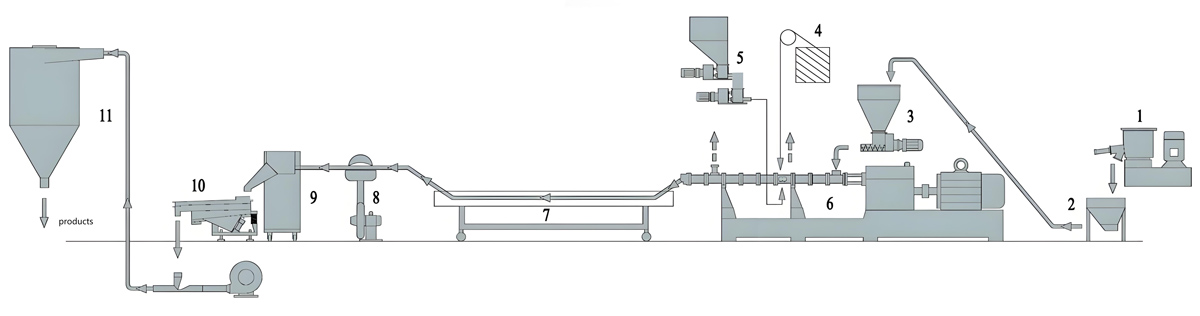
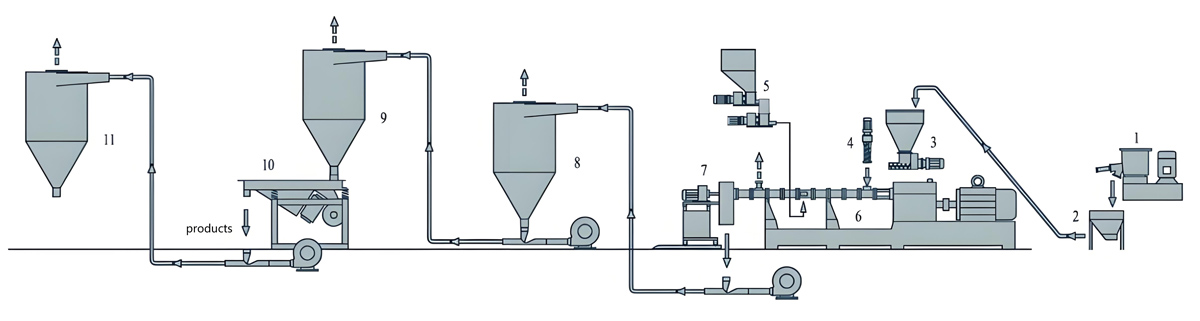
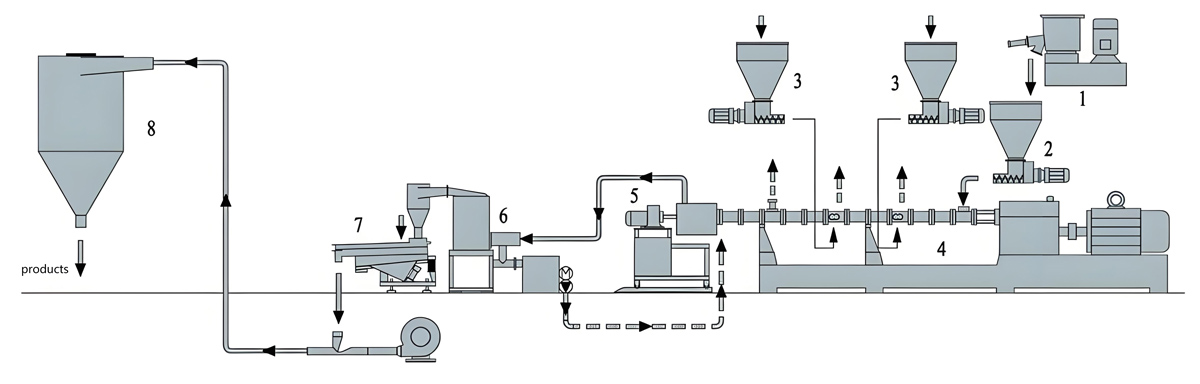
The KTE Series multi-screw barrel twin screw extruder from Nanjing Kerke Extrusion Equipment Company represents the industry benchmark for PES masterbatch production, offering specialized configurations optimized for high-temperature engineering polymer processing. The KTE Series features a multi-screw barrel design that incorporates multiple parallel screw channels within a single barrel, providing superior mixing efficiency and temperature control compared to conventional twin-screw designs. This innovative configuration enables production of PES masterbatches with exceptional additive dispersion and consistent quality while maintaining the high processing temperatures required for PES processing.
The KTE Series screw design specifically addresses the challenging processing characteristics of PES polymer, with optimized screw geometry that provides adequate conveying capacity while generating sufficient distributive mixing for thorough additive dispersion. The screw configuration typically includes conveying sections for material transport, kneading blocks for intensive mixing, and reverse-conveying elements that create additional mixing through backflow and recirculation. The modular screw design enables customization of screw configuration based on specific formulation requirements and processing conditions, allowing optimization for different masterbatch types and additive characteristics.
Heating and cooling systems on the KTE Series extruder provide exceptional temperature control essential for PES processing. The multi-screw barrel design incorporates independent temperature control zones for each screw channel, enabling precise thermal management of the mixing process. Barrel heating typically employs ceramic band heaters with individual PID control for each zone, providing rapid response to temperature variations and maintaining uniform temperature distribution across the barrel. Cooling systems including air blowers or liquid cooling maintain temperature stability in zones where exothermic reactions from additive incorporation may cause localized temperature increases.
The drive system for the KTE Series extruder provides the necessary torque and speed control required for PES masterbatch production. High-performance AC or servo drives with power ratings from 75 to 400 kilowatts depending on extruder size and production capacity provide the necessary torque for processing high-viscosity PES melts. Variable speed control with accuracy within plus or minus 0.5 RPM enables precise control over residence time and shear history, critical for maintaining consistent product quality across different formulations and processing conditions.
Parameter Settings for PES Masterbatch Production
Screw speed settings significantly influence mixing intensity, residence time, and thermal history of the PES masterbatch production process. Typical screw speeds range from 100 to 400 RPM depending on extruder size, formulation viscosity, and desired mixing intensity. Higher screw speeds increase distributive mixing intensity and reduce residence time but also increase shear heating that can raise melt temperature. The optimal screw speed balances mixing requirements with thermal limitations, typically ranging from 150 to 250 RPM for most PES masterbatch applications. Fine-tuning of screw speed based on specific formulation requirements enables optimization of additive dispersion while preventing excessive shear heating.
Temperature profile settings must maintain PES within its optimal processing window while providing sufficient thermal energy for melting and mixing. A typical temperature profile for PES masterbatch production starts at 320 to 340 degrees Celsius in the feed zone, gradually increases to 360 to 390 degrees Celsius through the mixing zones, and maintains 350 to 380 degrees Celsius through the die. The number of temperature zones typically ranges from 6 to 10 zones depending on extruder length, with each zone independently controlled to maintain the desired temperature gradient. Monitoring of actual melt temperature using pressure and temperature sensors provides feedback for temperature profile optimization.
Back pressure settings influence mixing intensity, residence time distribution, and melt homogeneity in the extrusion process. Typical back pressure values for PES masterbatch production range from 50 to 200 bar, depending on formulation viscosity and desired mixing characteristics. Higher back pressure increases mixing intensity and residence time but also increases energy consumption and may raise melt temperature through increased shear heating. Back pressure adjustment through die restriction or flow restriction valves provides a means to fine-tune mixing characteristics without changing screw speed or temperature profile.
Feed rate settings determine production capacity and influence residence time and mixing characteristics. Typical feed rates for PES masterbatch production range from 50 to 500 kilograms per hour depending on extruder size and formulation viscosity. The optimal feed rate balances production capacity requirements with mixing needs, maintaining adequate residence time for thorough additive dispersion without excessive thermal exposure. Feed rate accuracy within plus or minus 1 percent is essential for maintaining consistent product quality and additive concentration across the production run.
Equipment Pricing
Investment in multi-screw barrel twin screw extrusion equipment for PES masterbatch production represents a substantial capital commitment that varies based on production capacity, automation level, and specific configuration requirements. Complete production lines including extruder, feeding systems, pelletizing equipment, and auxiliary systems typically range from $250,000 to $1,800,000 depending on capacity and configuration. Small-capacity systems processing 50 to 150 kilograms per hour typically cost $250,000 to $450,000, while medium-capacity systems processing 150 to 400 kilograms per hour range from $450,000 to $900,000. Large-capacity systems processing 400 to 1,200 kilograms per hour require investments of $900,000 to $1,800,000.
The KTE Series multi-screw barrel twin screw extruder itself represents the primary equipment investment, typically comprising 60 to 70 percent of total production line costs. KTE Series extruders range in price from $150,000 for small 40mm diameter units to $650,000 for large 120mm diameter units, depending on screw configuration, drive system, and temperature control capabilities. The specialized multi-screw barrel design adds approximately 30 to 40 percent cost premium compared to conventional twin-screw extruders of equivalent capacity, but provides substantial benefits in mixing efficiency and product quality that justify the additional investment for high-performance masterbatch production.
Additional equipment costs include gravimetric feeding systems ranging from $30,000 to $80,000 depending on the number of components and accuracy requirements, pelletizing equipment ranging from $25,000 to $70,000 depending on pellet type and capacity, and auxiliary systems including cooling systems, material handling, and control systems adding $40,000 to $150,000 depending on automation level. Installation costs typically add 5 to 10 percent to equipment costs, while operator training and startup services add an additional 3 to 5 percent.
Production Problems and Solutions
Thermal degradation of PES polymer represents a significant production problem that can occur due to excessive processing temperatures, extended residence time, or inadequate drying before processing. Thermal degradation manifests as discoloration, molecular weight reduction, and diminished mechanical properties in the final masterbatch. The primary cause of thermal degradation in PES processing is processing temperature exceeding the polymer’s thermal stability limit of approximately 410 degrees Celsius, typically resulting from improper temperature profile settings, inadequate cooling capacity, or exothermic reactions from additive incorporation.
Solution and prevention of thermal degradation begins with strict temperature control throughout the process. Monitoring of actual melt temperature using melt pressure and temperature sensors provides direct feedback on thermal conditions within the extruder. Implementation of closed-loop temperature control with rapid response to temperature variations prevents overheating. Regular calibration of temperature sensors and controllers ensures accurate temperature measurement and control. For exothermic formulations, reduction of screw speed or feed rate may be necessary to manage heat generation while maintaining adequate mixing.
Inadequate additive dispersion represents another significant production problem that manifests as streaking, inconsistent color, or non-uniform performance in the final masterbatch. Poor dispersion typically results from insufficient mixing intensity, improper screw configuration, or inadequate residence time for the specific formulation. The multi-screw barrel design of the KTE Series extruder provides superior mixing compared to conventional extruders, but proper screw configuration selection remains essential for optimal dispersion with challenging additive types or high additive concentrations.
Solution for inadequate additive dispersion begins with optimization of screw configuration for the specific formulation requirements. Increasing the number and intensity of kneading blocks, adding distributive mixing elements, or adjusting screw length-to-diameter ratio can enhance mixing effectiveness. For formulations requiring particularly intensive mixing, increase of residence time through reduced screw speed or feed rate may be necessary. Analysis of dispersion quality through microtome sections or pigment extraction tests provides objective assessment of mixing effectiveness and guides parameter optimization.
Moisture-related problems including bubble formation, surface defects, and hydrolytic degradation occur when PES is not adequately dried before processing or when moisture ingress occurs during processing. PES is highly hygroscopic and can absorb 0.3 to 0.5 percent moisture from ambient conditions within hours of exposure. Inadequate drying results in hydrolytic degradation that reduces molecular weight and causes bubble formation during extrusion as water vaporizes at processing temperatures.
Solution for moisture-related problems begins with comprehensive drying procedures before processing. Dehumidifying dryers with dew point below minus 40 degrees Celsius and temperatures of 150 to 170 degrees Celsius for 4 to 6 hours provide thorough drying. Maintenance of closed material handling systems after drying prevents moisture reabsorption. Monitoring of moisture content using online moisture sensors provides verification of adequate drying and detection of moisture ingress during processing. For facilities with high ambient humidity, nitrogen purging of feed systems may be necessary to prevent moisture reabsorption.
Additive degradation during processing can occur when pigments, fillers, or functional additives are not thermally stable at PES processing temperatures. Organic pigments and certain functional additives may degrade at temperatures above 350 degrees Celsius, resulting in color shifts, reduced additive effectiveness, or generation of degradation products. This problem is particularly challenging when producing masterbatches with high additive concentrations where thermal exposure time is extended.
Solution for additive degradation includes selection of additives with thermal stability ratings above the processing temperatures required for PES. For formulations requiring thermally sensitive additives, reduction of processing temperature through optimized screw design or use of processing aids that reduce melt viscosity can be beneficial. Reduction of residence time through increased feed rate or optimized screw configuration minimizes thermal exposure. In some cases, addition of thermal stabilizers to the formulation can protect sensitive additives during processing, though this increases formulation cost and complexity.
Maintenance and Maintenance
Regular maintenance of the multi-screw barrel twin screw extruder is essential for maintaining consistent product quality and preventing equipment failure. Screw and barrel wear should be monitored regularly through measurement of clearances and inspection of surface condition. Typical clearance between screw flight and barrel inner surface should be maintained within 0.1 to 0.3 millimeters depending on extruder size and formulation. Excessive clearances reduce mixing effectiveness and can cause material degradation due to increased shear heating at the barrel surface.
Screw wear patterns provide diagnostic information about processing conditions and potential problems. Wear concentrated in the feed zone may indicate abrasive additives or inadequate material lubrication, while wear in mixing zones may indicate excessive shear stress or abrasive fillers. Regular inspection of screw wear patterns enables early detection of formulation problems or processing conditions that may require adjustment. Screw reclamation through hardfacing or replacement is recommended when clearances exceed acceptable limits.
Temperature control system maintenance includes regular calibration of temperature sensors and verification of heater element operation. Temperature sensors should be calibrated annually using reference temperature standards to ensure accuracy within plus or minus 1 degree Celsius. Heater elements should be tested for proper operation and replaced as needed to prevent uneven heating or cold spots in critical zones. Maintenance of cooling systems including blowers, liquid circulation pumps, and cooling water treatment prevents temperature control problems that can cause product quality issues.
Drive system maintenance includes regular inspection of gearboxes, bearings, and coupling elements. Gearbox oil should be analyzed quarterly for wear particles and contamination, with oil changes performed according to manufacturer recommendations typically every 6 to 12 months. Bearing temperatures should be monitored during operation, with temperatures exceeding 80 degrees Celsius indicating potential lubrication problems or bearing wear. Coupling alignment should be checked annually to prevent vibration and premature wear of drive system components.
Feeding system maintenance ensures accurate and consistent material delivery to the extruder. Gravimetric feeder calibration should be performed monthly using standard test weights to verify feed accuracy within plus or minus 0.5 percent. Feeder discharge mechanisms including screws, rotary valves, or vibratory feeders should be inspected for wear and proper operation. For liquid additive feeders, pump calibration and line cleaning prevent inconsistent additive delivery and potential contamination of the masterbatch formulation.
Frequently Asked Questions
What is the minimum residence time required for adequate additive dispersion in PES masterbatch production? Adequate residence time varies significantly based on additive type and concentration, but typical residence times range from 1 to 3 minutes for well-designed multi-screw barrel twin screw extruders. Pigment-based masterbatches typically require 1 to 2 minutes residence time for adequate dispersion, while fiber-reinforced masterbatches may require 2 to 3 minutes to achieve uniform fiber distribution without fiber breakage. Optimization of residence time should balance mixing requirements against thermal degradation concerns.
How can processing temperatures be reduced to minimize thermal degradation while maintaining adequate melt flow? Several approaches enable reduction of processing temperatures for PES while maintaining adequate processability. Selection of lower molecular weight PES grades provides lower melt viscosity and reduced processing temperature requirements. Incorporation of processing aids at 1 to 3 percent concentration reduces melt viscosity and enables processing at 10 to 20 degrees lower temperatures. Optimization of screw configuration for enhanced distributive mixing enables adequate melting and dispersion at lower temperatures than aggressive kneading block configurations that generate excessive shear heating.
What is the typical energy consumption for PES masterbatch production on multi-screw barrel twin screw extruders? Energy consumption for PES masterbatch production typically ranges from 0.5 to 1.2 kilowatt-hours per kilogram of output, depending on formulation viscosity, processing temperature, and extruder efficiency. Higher temperature processing required for PES contributes to increased energy consumption compared to lower temperature polymers. Optimization of screw configuration and processing parameters can reduce energy consumption by 10 to 20 percent while maintaining product quality, providing significant cost savings for high-volume production.
How does multi-screw barrel design improve mixing compared to conventional twin-screw extruders? The multi-screw barrel design provides multiple independent mixing zones within a single barrel, creating significantly increased surface renewal and distributive mixing compared to conventional twin-screw configurations. This design enables thorough additive dispersion in shorter residence times and with less shear heating than conventional extruders requiring aggressive kneading blocks to achieve comparable mixing. The independent screw channels allow different mixing regimes in different zones, enabling optimization for the specific dispersion requirements of different additive types.
What are the quality control parameters that should be monitored during PES masterbatch production? Critical quality control parameters include additive concentration accuracy, additive dispersion quality, melt flow index consistency, and color consistency. Additive concentration should be verified through analytical techniques such as ash content for fillers, pigment extraction for colorants, or spectroscopic analysis for functional additives. Dispersion quality should be assessed through microscopy, pigment extraction testing, or mechanical property testing on test specimens. Melt flow index should be measured on each batch to ensure consistency and detect potential thermal degradation.
Conclusion
Multi-screw barrel twin screw extruder technology represents the optimal solution for high-quality PES masterbatch production, providing the mixing efficiency, temperature control, and processing capability required for demanding high-temperature engineering polymer applications. The KTE Series from Nanjing Kerke Extrusion Equipment Company offers specialized configurations specifically engineered for PES processing, enabling manufacturers to achieve superior product quality and production efficiency while managing the challenging processing characteristics of this high-performance polymer.
Successful PES masterbatch production requires attention to multiple critical factors including thorough material drying, precise temperature control, optimized screw configuration, and careful parameter settings for each formulation. The investment in advanced multi-screw barrel technology provides substantial returns through superior product quality, reduced scrap rates, and the ability to compete in the growing high-performance masterbatch market. As demand for PES-based materials continues expanding in automotive, aerospace, and electronics applications, manufacturers with advanced production capabilities will be well-positioned to capture market opportunities and achieve sustainable growth.