Introduction
Polylactic acid (PLA) and poly(butylene succinate-co-adipate) (PBSA) represent leading biodegradable polymers offering sustainable alternatives for packaging, disposable products, and agricultural applications. PLA provides excellent transparency, stiffness, and processability while PBSA offers enhanced flexibility, toughness, and biodegradation characteristics. Masterbatch production for PLA/PBSA materials demands specialized equipment capable of handling their unique thermal properties, moisture sensitivity, and processing requirements while maintaining material integrity for biodegradable applications.
Quick change barrel twin screw extruders have emerged as ideal solutions for PLA/PBSA masterbatch production due to their flexibility to handle multiple biodegradable polymer types with minimal changeover time. The ability to rapidly change barrels allows efficient production of different masterbatch formulations without extended downtime, critical for manufacturers serving diverse markets with various PLA and PBSA grades. The global biodegradable plastics market continues expanding rapidly, projected to reach USD 25.5 billion by 2029, with PLA and PBSA commanding significant market share driving demand for specialized production equipment.
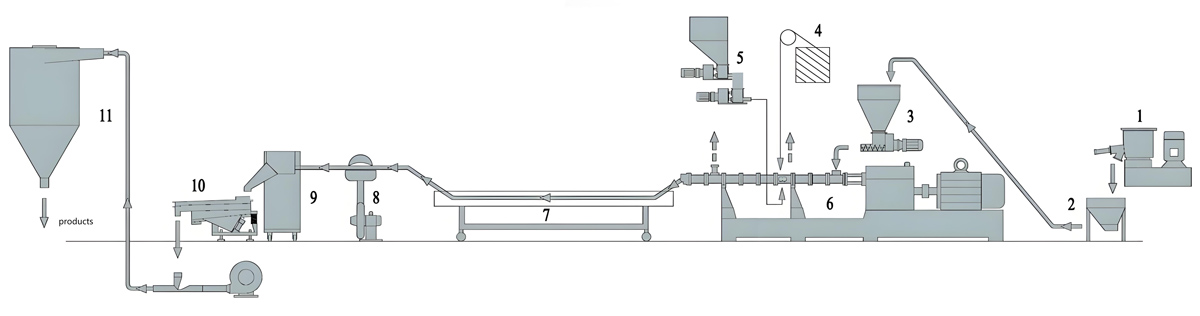
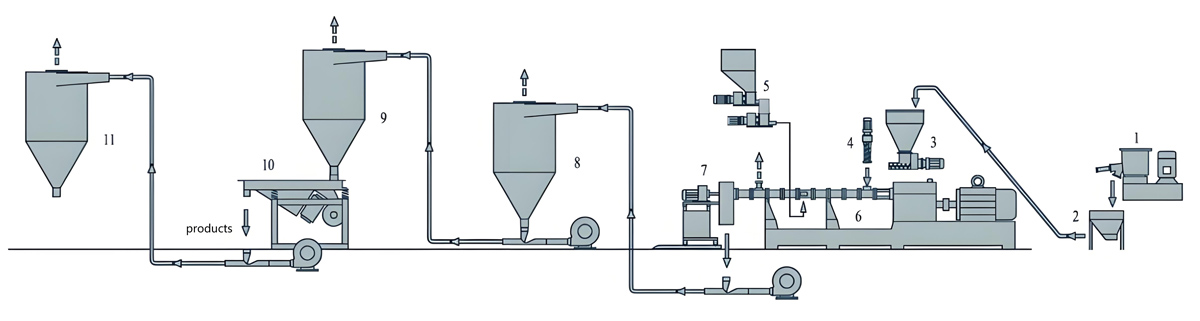
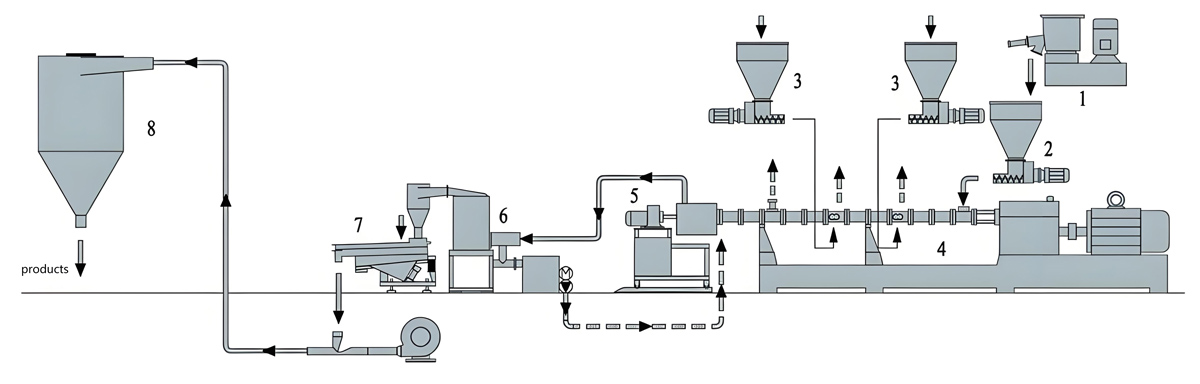
KTE Series quick change barrel twin screw extruders specifically engineered for biodegradable polymer masterbatch production incorporate advanced quick-change mechanisms, precise temperature control systems, and optimized screw configurations that accommodate PLA and PBSA processing requirements. The equipment delivers throughput capabilities ranging from 40 to 1200 kg per hour, enabling scalable production from pilot scale through full manufacturing capacity. The quick change barrel design enables rapid switching between different polymer types, color formulations, or functional additive masterbatches, maximizing production flexibility and equipment utilization.
Formulation Ratios
PLA Color Masterbatch Formulations
PLA color masterbatch formulations must accommodate the material’s transparency characteristics and thermal degradation tendency requiring careful pigment selection and formulation design. Standard PLA color masterbatch formulations include colorant concentrations ranging from 5 to 45% depending on target application requirements and desired opacity. Carrier resin typically constitutes 40-90% of total composition, with PLA serving as the carrier matrix ensuring compatibility and maintaining biodegradable characteristics in final products.
High concentration color masterbatch formulations (30-45% pigment) for PLA applications require specialized dispersing agents at 10-14% concentration to achieve adequate pigment dispersion at elevated loading levels. These formulations typically use inorganic pigments including titanium dioxide for white or selected organic pigments designed for PLA compatibility. Carrier resin content decreases to 35-55% in high pigment loading formulations, with the balance comprising processing aids, nucleating agents, and dispersants specifically selected for PLA thermal stability.
Medium concentration formulations (15-25% pigment) represent the most common loading level for PLA masterbatch production, balancing handling characteristics with economic efficiency and color intensity requirements. These formulations typically contain 8-11% dispersing agents selected for PLA compatibility and thermal stability, 5-7% processing aids including nucleating agents and slip agents, with PLA carrier resin comprising 58-82% of total composition. The moderate pigment loading enables excellent dispersion quality while maintaining adequate melt flow characteristics for downstream processing.
Low concentration formulations (5-10% pigment) facilitate easy metering and excellent dispersion quality particularly important for transparent or light-colored PLA applications requiring minimal opacity. These formulations typically use 5-6% dispersing agents, 4-6% processing aids including crystallization control agents, with PLA carrier resin constituting 85-91% of total composition. The low pigment loading enables excellent color development, transparency maintenance, and uniformity while providing flexibility for dilution to various end-product concentrations.
PBSA Functional Masterbatch Formulations
PBSA functional masterbatch formulations focus on delivering specific performance characteristics including anti-blocking, anti-static, reinforcement, or degradation control tailored to PBSA material properties. Anti-blocking masterbatch formulations typically contain 18-38% active additive, 10-13% dispersing agents, 6-9% processing aids, with PBSA carrier resin comprising 41-66% of total composition. The additive concentration depends on target performance requirements and intended application loading levels.
Reinforcement masterbatch for PBSA incorporates fillers or fibers to enhance mechanical properties, reduce cost, or improve dimensional stability. Common reinforcement agents include calcium carbonate, talc, cellulose fibers, or mineral fillers selected for compatibility with biodegradable requirements. These formulations typically contain 25-50% reinforcement agent, 11-15% dispersing agents, 6-9% coupling agents and processing aids, with PBSA carrier resin constituting 27-58% of formulation.
Processing aid masterbatch formulations for PBSA optimize flow characteristics, reduce melt viscosity, and improve processability for complex geometries or thin-walled applications. These formulations typically contain 12-26% processing aids (including natural waxes, esters, or flow enhancers), 9-11% dispersing agents, 5-7% stabilizers, with PBSA carrier resin constituting 57-74% of total composition. The processing aid selection considers biodegradable requirements and compatibility with PBSA material characteristics.
PLA/PBSA Composite Masterbatch Formulations
PLA/PBSA composite masterbatch formulations combine both biodegradable polymers to achieve balanced properties including improved flexibility, enhanced toughness, and optimized degradation characteristics. Typical formulations use PLA/PBSA ratios ranging from 80/20 to 20/80 depending on target properties and application requirements. Colorant or functional additives comprise 5-35% of formulation, with dispersing agents at 9-13% and processing aids at 5-9% tailored to the blend characteristics.
Crystallization control masterbatch formulations for PLA/PBSA blends manage crystallization rates and properties affecting final product characteristics. These formulations typically contain 8-20% nucleating agents or crystallization modifiers, 9-11% dispersing agents, 5-7% processing aids, with PLA/PBSA blend carrier constituting 63-78% of total composition. The crystallization control additives improve cycle times, mechanical properties, and dimensional stability in processed products.
Compatibilizer masterbatch formulations for PLA/PBSA blends enhance interface adhesion between the two polymers, improving mechanical properties and phase stability. These formulations typically contain 12-25% compatibilizers (including block copolymers, reactive compatibilizers, or specialized additives), 9-12% dispersing agents, 5-7% processing aids, with PLA/PBSA blend carrier constituting 56-74% of total composition. The compatibilizer selection depends on blend ratio and target property improvements.
Production Process
Material Preparation and Pre-Drying
PLA materials require thorough pre-drying before masterbatch production due to their moisture sensitivity and tendency for hydrolytic degradation during processing. PLA typically requires drying at 80-90 degrees Celsius for 4-6 hours to achieve moisture content below 0.02%, though PLA grades vary in moisture sensitivity with some requiring more aggressive drying. Proper drying prevents molecular weight reduction, discoloration, and mechanical property degradation that would compromise product quality and biodegradable performance.
PBSA materials also demonstrate moisture sensitivity requiring pre-drying before masterbatch production, though typically less sensitive than PLA. PBSA usually requires drying at 75-85 degrees Celsius for 3-5 hours to achieve moisture content below 0.025%. Adequate drying prevents processing defects, bubbles, and property degradation that would affect masterbatch quality and final product performance. The drying conditions may vary depending on PBSA grade and formulation.
Pigment and additive pre-mixing ensures uniform distribution before extrusion, improving dispersion quality and reducing processing time. Powder pigments and additives should be pre-mixed in high-speed blenders for 6-10 minutes to achieve homogeneous distribution. Larger agglomerates may require preliminary grinding using jet mills or air classification mills to achieve particle sizes below 18 microns for optimal dispersion quality in PLA/PBSA matrices.
Feeding and Metering
Precision feeding systems ensure accurate formulation ratios throughout PLA/PBSA masterbatch production, critical for maintaining consistent product quality and biodegradable properties. Gravimetric feeders provide superior accuracy compared to volumetric systems, maintaining feeding accuracy within plus or minus 0.4% for critical formulations requiring precise additive concentrations. The feeding system must handle materials with varying flow characteristics including PLA and PBSA pellets, powder pigments, and potentially fibrous additives.
Multi-component feeding systems enable separate feeding of different material streams, allowing flexible formulation adjustments and optimal processing conditions. PLA/PBSA masterbatch production typically uses separate feeders for biodegradable carrier resins, pigments, and functional additives. This approach enables individual optimization of feeding parameters for each material stream, improving overall dispersion quality and processing efficiency while maintaining formulation accuracy.
Feeding rate optimization considers screw design, L/D ratio, and desired throughput while maintaining adequate residence time for mixing. For PLA/PBSA masterbatch production, feeding rates typically range from 12-150 kg per hour per feeding zone depending on machine size and formulation complexity. The feeding rate should be coordinated with screw speed to maintain optimal fill ratio between 60-80%, ensuring adequate mixing and residence time while preventing excessive residence that could cause thermal degradation.
Melting and Mixing
Melting zone temperature profiling must accommodate the thermal characteristics of PLA and PBSA while ensuring complete melting and homogenization without degradation. Temperature profiles typically start at 150-170 degrees Celsius in the feeding zone for PLA-based formulations, increasing to 160-180 degrees Celsius in the transition zone, and reaching 170-190 degrees Celsius in the metering zone. PBSA formulations typically use slightly lower temperatures starting at 145-165 degrees Celsius, increasing to 155-175 degrees Celsius, and reaching 165-185 degrees Celsius in the metering zone.
Mixing intensity optimization balances dispersion quality with preservation of biodegradable polymer properties. Twin screw extruders with quick change barrel capability provide excellent mixing through their screw geometry that creates controlled mixing zones without excessive heat generation. The screw configuration typically includes conveying elements in the feeding zone, followed by optimized kneading blocks and mixing elements in the transition and metering zones that provide adequate dispersion for pigments and additives.
Vacuum venting in the metering zone removes volatiles, entrapped air, and moisture, improving product quality and preventing defects such as bubbles or surface imperfections. Vacuum levels typically range from 500-700 mmHg (absolute pressure 200-300 mmHg) for PLA/PBSA masterbatch production. The vent port should be positioned after complete melting and mixing, typically in the latter 1/3 of barrel length, to ensure effective removal of volatiles while maintaining material quality.
Pelletizing and Cooling
Pelletizing system selection depends on production volume, product requirements, and PLA/PBSA material characteristics. Strand pelletizing represents the most common method for PLA/PBSA masterbatch, offering good quality pellets suitable for most applications. The extrudate passes through water cooling baths maintained at 15-25 degrees Celsius for 2-4 meters length depending on throughput, then enters strand cutters with knife-edge gap settings optimized for biodegradable polymer characteristics.
Water ring pelletizing offers advantages for higher production volumes, providing faster throughput and reduced floor space requirements. The water ring system uses circulating water at 10-20 degrees Celsius to solidify the extrudate as it exits the die, followed by centrifugal separation and drying. Water ring pelletizing for PLA/PBSA requires careful water quality management and appropriate die design to accommodate biodegradable polymer flow characteristics.
Pellet cooling and drying after cutting prevents agglomeration and ensures stable storage characteristics. Cooling systems may include air cooling on vibrating conveyors with air temperatures of 20-30 degrees Celsius, or combination water spray and air cooling systems. For PLA masterbatch, thorough drying after pelletizing may be required to remove surface moisture that could affect downstream processing or cause hydrolytic degradation during storage.
Production Equipment Introduction
KTE Series Quick Change Barrel Extruder Features
KTE Series quick change barrel twin screw extruders specifically engineered for biodegradable polymer masterbatch production incorporate advanced design features that optimize performance for PLA/PBSA processing while enabling rapid changeover between different formulations. The quick change barrel design allows barrel replacement within 30-60 minutes without screw removal, enabling efficient switching between PLA and PBSA formulations or different color masterbatches. This flexibility is critical for manufacturers serving diverse biodegradable polymer markets.
Temperature control systems in KTE Series extruders provide precise temperature regulation across all barrel zones, essential for maintaining consistent processing of PLA and PBSA materials with narrow processing windows. The temperature control system uses high-efficiency cartridge heaters with multi-point thermocouple feedback, maintaining temperature stability within plus or minus 0.8 degrees Celsius of setpoints. Individual zone control allows optimization of thermal profiles along barrel length for each polymer type.
Drive systems on KTE Series extruders deliver consistent torque output with efficiency ratings exceeding 87%, reducing energy consumption during PLA/PBSA masterbatch production. The drive system typically uses AC vector drives with power ratings from 15 kW for smaller models to 280 kW for production-scale equipment. Torque transducers and advanced amperage monitoring provide real-time feedback on processing conditions, enabling adjustments to maintain optimal performance.
Quick Change Barrel Mechanism
Quick change barrel design in KTE Series extruders enables rapid barrel replacement without screw removal, minimizing changeover time between different polymer types or formulations. The quick change mechanism typically uses hydraulic or mechanical locking systems that secure barrel to the frame and drive housing while maintaining proper alignment. Barrel change times typically range from 30-60 minutes depending on system size and operator experience, representing significant time savings compared to traditional systems requiring complete teardown.
Barrel alignment systems ensure proper screw-to-barrel clearance and concentricity after barrel changes, critical for maintaining processing consistency and preventing equipment damage. The alignment system typically includes locating pins, alignment fixtures, and verification procedures to ensure precise barrel positioning. Proper alignment prevents screw wear, maintains processing consistency, and extends equipment service life.
Multiple barrel options enable production of various PLA/PBSA formulations with dedicated barrels optimized for specific polymer types or formulations. Manufacturers may maintain separate barrels for PLA processing, PBSA processing, and specialized formulations requiring different screw configurations or barrel L/D ratios. The quick change capability enables efficient switching between barrels based on production requirements.
Barrel and Screw Design
Barrel construction in KTE Series quick change extruders uses high-grade nitrided steel with excellent wear resistance and thermal conductivity. Barrel bore diameter ranges from 22 mm for pilot scale equipment to 130 mm for high production capacity machines. The L/D ratio of 42:1 provides adequate length for complete melting, mixing, and homogenization while maintaining reasonable residence time for sensitive biodegradable polymers. The barrel design incorporates quick change mounting interfaces and temperature control elements.
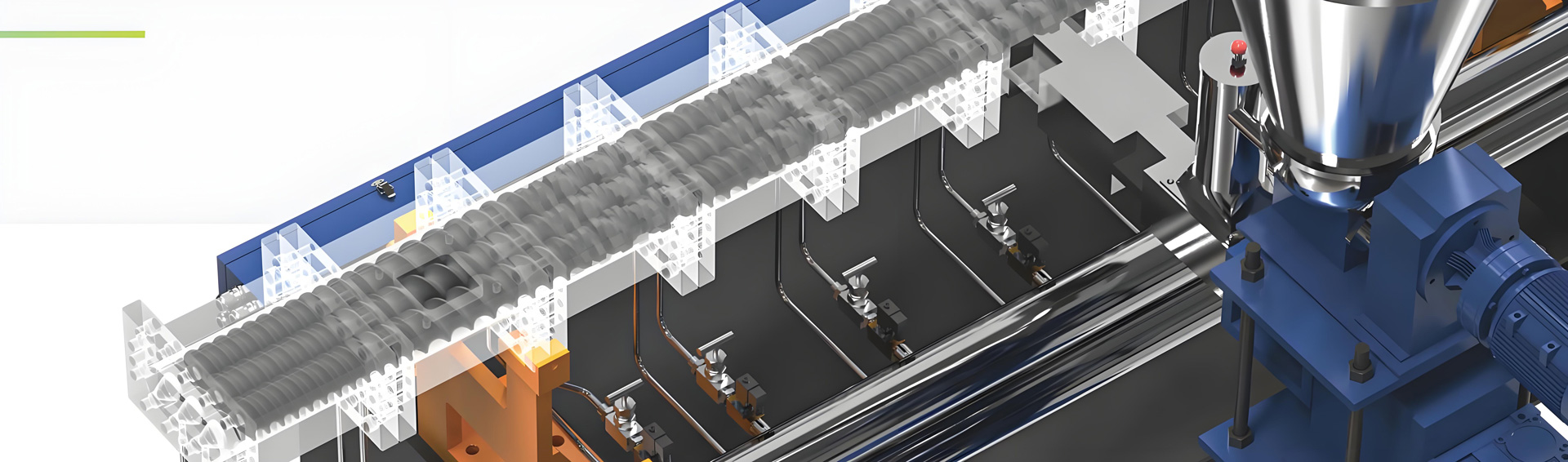
Screw configuration in KTE Series extruders enables optimization for specific PLA/PBSA masterbatch formulations and processing requirements. The twin screw design features intermeshing flights that provide excellent distributive mixing while generating controlled shear. Modular screw elements allow configuration optimization including conveying elements, kneading blocks, mixing elements, and reverse conveying elements tailored to specific formulation requirements. Different screw configurations may be maintained for PLA versus PBSA processing.
Screw material selection considers wear resistance, thermal conductivity, and corrosion resistance for biodegradable polymer processing. Standard screw material uses nitrided steel with specialized surface hardening to Rockwell C 60-65 for excellent wear resistance. For applications with abrasive pigments or fillers, tungsten carbide or ceramic coating options provide extended service life. The screw hardness and wear resistance maintain consistent processing performance over extended production runs.
Parameter Settings
Temperature Profile
Temperature profile optimization for PLA masterbatch production requires careful consideration of material thermal properties, formulation characteristics, and specific PLA grade requirements. Standard temperature profiles for PLA color masterbatch include zone temperatures starting at 155-175 degrees Celsius in the feeding zone, increasing to 165-185 degrees Celsius in the transition zones, and reaching 175-195 degrees Celsius in the metering zones. Die temperatures typically set 5-10 degrees Celsius above metering zone temperature to ensure proper flow and pellet formation.
PBSA masterbatch production requires slightly lower temperature profiles due to the material’s different thermal characteristics and processing requirements. Temperature profiles for PBSA typically start at 145-165 degrees Celsius in the feeding zone, increase to 155-175 degrees Celsius in transition zones, and reach 165-185 degrees Celsius in metering zones. The reduced temperature profile accommodates PBSA material characteristics while maintaining adequate melt flow for processing and pigment dispersion.
PLA/PBSA blend masterbatch production uses intermediate temperature profiles that accommodate both materials’ thermal characteristics and optimize compatibility. Temperature profiles for blends typically start at 150-170 degrees Celsius in feeding zones, increase to 160-180 degrees Celsius in transition zones, and reach 170-190 degrees Celsius in metering zones. The specific temperature settings depend on blend ratio, specific PLA and PBSA grades, and formulation complexity, requiring optimization based on processing trials.
Screw Speed and Throughput
Screw speed optimization balances mixing efficiency, residence time, throughput requirements, and material thermal sensitivity. For PLA color masterbatch, screw speeds typically range from 60-115 rpm depending on machine size and formulation characteristics. Higher screw speeds increase throughput but may reduce residence time and increase shear heating, potentially affecting dispersion quality or causing degradation of PLA materials. The optimal screw speed achieves target throughput while maintaining adequate residence time for complete mixing and dispersion.
PBSA masterbatch production typically allows slightly different screw speed ranges due to the material’s different rheological characteristics. Screw speeds for PBSA formulations typically range from 65-120 rpm, providing adequate mixing while maintaining appropriate shear levels for PBSA materials. The screw speed optimization considers PBSA grade, formulation complexity, and desired throughput requirements.
Throughput optimization considers formulation complexity, equipment capacity, and quality requirements for PLA/PBSA masterbatch production. For standard color masterbatch formulations, throughput typically ranges from 40-1200 kg per hour depending on equipment size and formulation. Complex formulations with high pigment loading, multiple additives, or functional masterbatch with high additive loading may require reduced throughput to maintain dispersion quality and prevent processing issues.
Changeover Procedures
Barrel changeover procedures for quick change systems involve systematic steps to ensure proper barrel replacement, alignment, and startup. The changeover process typically begins with system shutdown and cooling to safe temperatures. Once cooled, the barrel unlocking mechanism is released, allowing barrel removal. The removed barrel should be cleaned and prepared for future use. The new barrel is positioned using alignment features, locked in place, and temperature control systems reconnected.
Alignment verification after barrel change ensures proper screw-to-barrel clearance and concentricity. Verification may include measurement of clearances at multiple positions along screw length, visual inspection for proper alignment, and test runs to verify processing characteristics. Proper alignment prevents screw wear, maintains processing consistency, and prevents equipment damage. Alignment should be documented for each barrel to track wear patterns.
Material changeover procedures include purging of previous material from the system, cleaning of material contact surfaces, and preparation for new formulation. For PLA to PBSA changeovers, thorough cleaning prevents cross-contamination that could affect processing or product quality. Purging typically involves running clean carrier resin through the system until visually clean, followed by specialized purging compounds if needed. The cleaning process should address all material contact surfaces including feeders, barrel, vent systems, and pelletizing equipment.
Equipment Pricing
KTE Series Quick Change Extruder Pricing
KTE Series quick change barrel twin screw extruder pricing varies based on size, configuration, quick change mechanism sophistication, and included auxiliary equipment. Pilot scale models with 22-32 mm barrel diameter and throughput capacity of 12-50 kg per hour typically range from USD 38,000 to USD 65,000. These compact quick change systems are ideal for research and development, formulation optimization, and small-scale production of PLA/PBSA masterbatch formulations requiring flexibility.
Mid-range production models with 50-75 mm barrel diameter and throughput capacity of 150-500 kg per hour typically range from USD 95,000 to USD 220,000. These systems include robust quick change mechanisms, larger drive motors, enhanced temperature control, and integrated auxiliary equipment suitable for commercial production. The pricing includes extruder with quick change barrel capability, advanced control system, and standard auxiliary equipment.
Full production models with 100-130 mm barrel diameter and throughput capacity of 500-1200 kg per hour typically range from USD 250,000 to USD 600,000. These production-scale quick change systems include advanced features such as automated barrel change assistance, integrated quality monitoring, and sophisticated control systems. The pricing varies based on specific configuration, number of additional barrels, and included auxiliary equipment packages.
Additional Barrel Pricing
Additional barrels for quick change systems enable production flexibility with dedicated barrels optimized for specific polymer types or formulations. Barrel pricing varies based on size, L/D ratio, heating configuration, and temperature control element integration. Additional barrels typically cost USD 15,000 to USD 55,000 depending on size and configuration, representing significant but worthwhile investment for production flexibility.
Barrel configuration options include different L/D ratios for varying residence time requirements, specialized heating zones for unique temperature profiles, or different bore diameters for varying throughput capacities. Manufacturers may maintain dedicated barrels for PLA processing, PBSA processing, and specialized formulations requiring unique screw configurations. The investment in additional barrels provides significant production flexibility and rapid changeover capabilities.
Complete barrel assemblies including heating elements, temperature sensors, and mounting hardware provide plug-and-play capability for quick change systems. These complete assemblies enable rapid barrel replacement without need for component transfer or reconfiguration, maximizing changeover efficiency. The additional investment in complete assemblies versus barrel-only options provides significant time savings during changeovers.
Complete Production Line Pricing
Complete PLA/PBSA masterbatch production lines including quick change extruder, feeding system, drying equipment, cooling system, pelletizing system, and multiple barrels provide turnkey solutions for flexible manufacturing operations. Pilot scale complete lines with capacity of 12-50 kg per hour typically range from USD 75,000 to USD 140,000. These complete quick change systems include all necessary equipment for small-scale production with multiple formulation capability.
Mid-range production lines with capacity of 150-500 kg per hour typically range from USD 220,000 to USD 500,000. These complete quick change lines include appropriately sized extruder with quick change capability, multiple barrels, gravimetric feeding system, material drying equipment, water cooling system, pelletizing equipment, and control system integration. The complete line approach ensures compatibility between components and streamlined installation.
High production capacity quick change lines with throughput of 500-1200 kg per hour typically range from USD 550,000 to USD 1,800,000 depending on configuration, number of additional barrels, and automation level. These comprehensive quick change systems include large-capacity extruders, multiple dedicated barrels, multi-component feeding systems, automated material handling, integrated quality monitoring, and advanced process control. The investment reflects production capacity, flexibility requirements, and automation features.
Production Problems and Solutions
Thermal Degradation of PLA
Thermal degradation of PLA during masterbatch production causes discoloration (typically yellowing), reduced molecular weight, decreased mechanical properties, and potential processing failures. PLA demonstrates thermal sensitivity with degradation beginning around 200 degrees Celsius, making temperature control critical for successful masterbatch production while maintaining material properties and biodegradable performance characteristics.
Causes of PLA thermal degradation include excessive temperature settings above degradation thresholds, extended residence time, excessive shear heating, inadequate venting of volatile degradation products, or material already degraded before processing. Temperature settings above 195 degrees Celsius in processing zones accelerate molecular weight breakdown and cause discoloration. Extended residence time through overfilling the screw or low throughput increases thermal exposure accelerating degradation.
Solutions for PLA thermal degradation begin with temperature profile optimization. Reducing zone temperatures to minimum levels required for melting and processing reduces thermal stress on PLA. Keeping maximum zone temperature below 185-190 degrees Celsius prevents degradation while maintaining adequate processing. Implementing temperature gradients where early zones operate at lower temperatures reduces overall thermal exposure. Using shorter L/D barrels where appropriate reduces residence time and thermal exposure.
Residence time optimization prevents excessive thermal exposure that leads to PLA degradation. Adjusting screw speed to achieve optimal fill ratio between 60-80% maintains reasonable residence time while ensuring adequate mixing and dispersion. Reducing throughput without appropriately adjusting screw speed overfills the screw and increases residence time. Implementing proper venting removes volatile degradation products that can catalyze further degradation.
Preventive measures include implementing strict temperature monitoring with alarms for excursions above setpoints, using fresh, non-degraded PLA materials, implementing proper material storage preventing degradation before processing, and establishing maximum residence time limits based on material thermal stability. Screw configuration optimization provides adequate mixing with minimal shear heating. Regular maintenance ensures proper temperature control system function.
Moisture-Related Defects
Moisture-related defects in PLA/PBSA masterbatch production cause bubbles, surface imperfections, splay marks, and hydrolytic degradation of polymer properties. Both PLA and PBSA demonstrate moisture sensitivity requiring thorough drying before processing to prevent moisture-related issues that affect product quality and biodegradable performance characteristics.
Causes of moisture-related defects include inadequate pre-drying of materials, moisture absorption during storage or handling, insufficient drying capacity for production throughput, humidity in processing environment, or condensation in equipment. Inadequate pre-drying leaves residual moisture above processing thresholds. Moisture absorption during storage occurs when materials are not properly sealed or stored in humid environments. Insufficient drying capacity cannot maintain adequate drying for production throughput.
Solutions for moisture-related defects begin with improving pre-drying effectiveness. Increasing drying temperature to recommended 80-90 degrees Celsius range and extending drying time to 4-6 hours ensures adequate moisture removal for PLA. Implementing moisture verification using Karl Fischer titration or moisture analyzers before processing confirms achievement of target moisture levels. For high throughput operations, increasing dryer capacity or adding parallel dryers ensures adequate drying capacity.
Processing environment control reduces moisture re-absorption during material handling and processing. Maintaining processing environment humidity below 50% relative humidity minimizes moisture pickup. Implementing material handling procedures that minimize exposure to humid air reduces moisture absorption. Using dehumidified air in conveying systems when necessary prevents moisture contamination during material transfer.
Preventive measures include proper storage of PLA/PBSA materials in moisture-barrier packaging with desiccant, implementing FIFO inventory management preventing extended storage times, maintaining controlled humidity storage environment, and implementing moisture monitoring throughout material handling chain. Establishing moisture specifications for all incoming materials prevents receipt of already moist materials.
Poor Pigment Dispersion
Poor pigment dispersion in PLA/PBSA masterbatch production causes streaks, color inconsistency, reduced pigment effectiveness, and surface defects in final products. Achieving uniform pigment distribution in biodegradable polymer matrices presents unique challenges due to material properties and thermal sensitivity. Poor dispersion affects both aesthetic quality and functional performance of the masterbatch.
Causes of poor pigment dispersion include inadequate screw configuration for PLA/PBSA materials, insufficient dispersant levels or inappropriate dispersant selection, excessive pigment loading exceeding dispersant capacity, improper pigment particle size, or insufficient residence time for complete dispersion. Biodegradable polymers may require different screw configurations compared to traditional polymers to achieve adequate mixing without causing thermal degradation.
Solutions for poor pigment dispersion begin with screw configuration optimization for PLA/PBSA materials. Implementing screw configurations with specialized kneading blocks provides appropriate mixing intensity. Adding distributive mixing elements downstream of mixing zones improves overall dispersion. Optimizing kneading block arrangement creates effective distributive mixing while controlling shear to prevent thermal degradation. For complex formulations, implementing reverse conveying elements extends residence time.
Dispersant optimization includes selecting dispersants specifically designed for biodegradable polymer matrices. Standard dispersants effective for traditional polymers may not perform well in PLA/PBSA materials due to differences in surface energy and thermal stability. Increasing dispersant concentration to 12-14% of formulation improves pigment wetting and prevents agglomeration. Testing dispersant types specifically designed for biodegradable polymers identifies optimal compatibility and performance.
Preventive measures include maintaining appropriate pigment particle size below 18 microns for optimal dispersion, implementing quality monitoring to detect dispersion issues early, and establishing optimal processing parameters for each formulation. Regular screw wear monitoring and replacement maintains mixing effectiveness. Quick change barrel capability enables maintaining dedicated screw configurations for different formulations.
Crystallization Control Issues
Crystallization control issues in PLA/PBSA masterbatch production cause processing difficulties, inconsistent product properties, and dimensional stability problems in final products. PLA is semi-crystalline requiring proper crystallization control for optimal processing and product performance. PBSA crystallization behavior also affects processing characteristics and final product properties.
Causes of crystallization control issues include inadequate nucleating agent levels, inappropriate cooling rates, insufficient thermal control during processing, or formulation incompatibility affecting crystallization behavior. PLA requires proper nucleation for controlled crystallization during processing and in final products. Inadequate nucleation leads to slow crystallization affecting cycle times and product properties. Inappropriate cooling rates cause variable crystallinity affecting product consistency.
Solutions for crystallization control begin with nucleating agent optimization. Adding 2-5% nucleating agents specifically designed for PLA accelerates crystallization and provides controlled crystallization behavior. Selecting appropriate nucleating agents for specific PLA grades and processing requirements optimizes crystallization characteristics. Testing nucleating agent types identifies optimal effectiveness for specific formulations and processing conditions.
Cooling system optimization ensures controlled crystallization during pelletizing and final product processing. Implementing controlled cooling profiles rather than rapid quenching provides more consistent crystallization behavior. For PLA masterbatch, controlling cooling rate during pelletizing affects pellet crystallinity and downstream processing characteristics. Cooling water temperature control within 15-25 degrees Celsius range provides appropriate cooling rates for most applications.
Processing temperature optimization affects crystallization behavior in final products. Maintaining proper melt temperature and cooling profile during processing influences crystallinity development. For applications requiring specific crystallinity levels, implementing controlled thermal cycles during processing optimizes crystallization characteristics. Temperature profiling based on material crystallization requirements provides consistent results.
Preventive measures include implementing nucleating agent quality control, maintaining consistent cooling conditions, and establishing processing parameters optimized for desired crystallization characteristics. Regular monitoring of product crystallinity through DSC or similar techniques verifies consistent crystallization behavior. Quick change barrel capability enables maintaining dedicated processing conditions for formulations with specific crystallization requirements.
Changeover Time Issues
Changeover time issues in quick change barrel systems reduce production efficiency and increase downtime between formulation changes. While quick change systems significantly reduce changeover time compared to traditional systems, changeover time still represents important production efficiency consideration affecting overall productivity and cost structure.
Causes of changeover time issues include inadequate preparation for changeover, lack of operator training on quick change procedures, equipment design limitations slowing barrel exchange, inadequate documentation of changeover procedures, or material handling inefficiencies during changeover. Inadequate preparation including material staging and barrel readiness prolongs changeover time. Lack of training causes operators to use inefficient procedures or make mistakes requiring rework.
Solutions for changeover time issues begin with implementing comprehensive changeover preparation procedures. Pre-staging materials, barrels, and tools before planned changeovers reduces time required. Developing detailed changeover checklists ensures all necessary steps are completed efficiently. Training operators on optimized changeover procedures improves efficiency and reduces errors. Implementing standardized changeover procedures across operators ensures consistent performance.
Quick change system optimization includes evaluating current changeover times and identifying bottlenecks. Time studies of actual changeover procedures reveal specific steps requiring improvement. Implementing improvements such as better lifting equipment, improved barrel handling fixtures, or streamlined procedures reduces changeover time. Documenting optimized procedures and training all operators ensures consistent improved performance.
Preventive measures include regular operator training and refresher courses on changeover procedures, implementing preventive maintenance to prevent equipment malfunctions during changeover, and establishing changeover performance metrics and continuous improvement programs. Quick change system design considerations including ergonomic barrel handling, automated assistance, and optimized changeover sequences minimize changeover time. Regular review and update of changeover procedures maintains optimal performance.
Maintenance and Care
Daily Maintenance Procedures
Daily maintenance procedures for PLA/PBSA masterbatch production equipment ensure reliable operation and prevent unexpected downtime. These routine tasks address the unique requirements of quick change barrel systems and biodegradable polymer processing. Implementing comprehensive daily maintenance procedures reduces emergency repairs, extends equipment service life, and maintains consistent product quality.
Visual inspection before startup should check quick change barrel locking mechanisms, verify temperature control system connections, and examine all electrical connections for security. Checking barrel locking system integrity ensures proper barrel fixation during operation. Inspecting all safety guards and interlock switches ensures proper operation. Examining all fluid lines for leaks prevents system contamination and maintains proper operation.
Temperature control system verification includes checking zone temperature indicators for accuracy, verifying temperature stability during startup, and checking alarm setpoints. Calibrating temperature sensors ensures accurate temperature measurement and control. For quick change systems, verifying temperature sensor connections after barrel changes ensures proper temperature control. Inspecting heater elements prevents temperature control issues.
Feeding system cleaning and inspection should occur daily or between product changeovers. Emptying feeder hoppers and removing residual materials prevents cross-contamination. Inspecting feeder components for wear or material buildup ensures proper feeding accuracy. Cleaning feed screens prevents buildup restricting material flow. Checking quick change interfaces for material buildup ensures proper barrel fit.
Weekly Maintenance Tasks
Weekly maintenance tasks provide deeper inspection and maintenance beyond daily procedures, addressing potential issues before they cause equipment failure or quality problems. These tasks require more time but provide significant value in preventing major issues in PLA/PBSA masterbatch production.
Screw and barrel inspection should include checking for wear patterns, excessive clearances, or material buildup. Measuring screw flight clearances at multiple positions along screw length identifies wear distribution. Inspecting barrel bore for scoring, grooving, or material adhesion identifies potential causes of quality issues. Documenting wear measurements enables prediction of replacement requirements.
Quick change mechanism inspection includes checking locking system components, alignment features, and barrel mounting interfaces. Inspecting locking pins, hydraulic cylinders, or mechanical fasteners ensures proper operation. Checking alignment features for wear or damage maintains proper barrel positioning. Lubricating moving components as specified maintains smooth operation and prevents wear.
Pelletizing equipment inspection and maintenance should check cutting knife sharpness, knife edge gap settings, drive system condition, and cooling system operation. Sharpening or replacing worn knives ensures clean pellet cutting. Checking knife rotation speed calibration ensures proper pellet length. Inspecting water ring system or cooling baths for proper flow and temperature prevents pellet quality issues. Cleaning pelletizing equipment removes material buildup.
Monthly Maintenance Requirements
Monthly maintenance requirements provide comprehensive inspection and maintenance addressing components requiring less frequent attention. These tasks typically require longer time windows and may require partial equipment shutdown but are essential for maintaining quick change systems in optimal condition.
Complete drive system inspection should include motor condition assessment, coupling inspection, gearbox oil analysis, and drive belt or chain inspection. Checking motor bearings for vibration or unusual wear prevents motor failures. Inspecting coupling alignment and condition prevents drivetrain damage. Gearbox oil analysis identifies wear particles indicating potential problems.
Control system verification should include checking all electrical connections for security, testing all safety interlocks for proper function, verifying control system calibration, and testing alarm systems. Tightening electrical connections prevents loose connections causing intermittent problems. Testing safety interlocks ensures proper protection and regulatory compliance. Verifying control system calibration maintains processing parameter accuracy.
Complete barrel assembly maintenance includes inspecting heating elements, temperature sensors, and mounting interfaces. Testing heating elements for proper operation prevents temperature control issues. Verifying temperature sensor accuracy ensures proper temperature regulation. Inspecting mounting interfaces for wear or damage ensures proper barrel fit and alignment. Replacing worn components maintains quick change system performance.
Annual Maintenance Overhaul
Annual maintenance overhaul for PLA/PBSA masterbatch production equipment provides comprehensive inspection and replacement of worn components, restoring equipment to optimal condition. The annual overhaul represents significant time commitment but provides substantial value in preventing unexpected downtime and extending equipment service life.
Complete screw and barrel inspection includes dimensional measurement of critical components, wear pattern analysis, and replacement as needed. Measuring screw diameter at multiple positions quantifies wear and determines replacement requirements. Measuring barrel bore diameter identifies wear and potential quality problems. Documenting measurements enables trend analysis and prediction of future replacement requirements.
Complete quick change mechanism rebuild includes replacing all wearing components in locking system, inspecting and replacing alignment features, and verifying all mounting interfaces. Replacing worn locking pins, fasteners, and hydraulic components prevents unexpected mechanism failures. Replacing worn alignment features maintains proper barrel positioning. Verifying all mounting interfaces ensures reliable barrel changeover performance.
Complete drive system rebuild or replacement based on inspection findings ensures reliable operation for coming year. Motor bearing replacement prevents motor failures. Coupling replacement ensures proper torque transmission. Gearbox rebuild including bearing and seal replacement prevents unexpected failures. Complete system alignment ensures proper operation and minimizes wear.
FAQ
What are the optimal drying conditions for PLA and PBSA before masterbatch production?
Optimal drying conditions for PLA typically require 80-90 degrees Celsius for 4-6 hours to achieve moisture content below 0.02%. PBSA drying typically requires 75-85 degrees Celsius for 3-5 hours to achieve moisture content below 0.025%. Moisture content should be verified using Karl Fischer titration or moisture analyzers before processing. Inadequate drying causes hydrolytic degradation leading to molecular weight reduction and property degradation. Drying requirements may vary based on specific material grades and formulations.
How does quick change barrel design benefit PLA/PBSA masterbatch production?
Quick change barrel design provides multiple benefits including rapid switching between PLA and PBSA formulations, reduced changeover downtime, dedicated barrels for different polymer types or formulations, and improved production flexibility. Barrel change times typically range from 30-60 minutes compared to several hours for traditional systems. The capability to maintain multiple barrels optimized for specific applications enables efficient production of diverse biodegradable polymer masterbatches.
What temperature range is appropriate for PLA masterbatch production?
Appropriate temperature range for PLA masterbatch production depends on specific PLA grade and formulation requirements. PLA typically processes between 175-195 degrees Celsius maximum barrel temperature. Temperature profiles should start at lower temperatures in feeding zones (150-170 degrees Celsius) and increase gradually to maximum temperatures in metering zones. Processing at minimum temperatures required for adequate melting and mixing helps prevent thermal degradation. Some PLA grades may require different temperature ranges based on molecular weight and thermal stability.
How can I control crystallization in PLA masterbatch?
Controlling crystallization in PLA masterbatch involves adding nucleating agents (typically 2-5%), optimizing cooling rates during pelletizing and processing, maintaining consistent processing temperatures, and selecting appropriate PLA grades for desired crystallinity. Nucleating agents accelerate crystallization and provide controlled crystallization behavior. Controlled cooling profiles rather than rapid quenching provide more consistent crystallinity. Processing temperature optimization affects final product crystallinity characteristics.
What causes PLA degradation during masterbatch production?
PLA degradation during masterbatch production typically results from excessive temperatures above 195-200 degrees Celsius, extended residence time, excessive shear heating, moisture causing hydrolytic degradation, or material already degraded before processing. Thermal degradation causes discoloration, molecular weight reduction, and property loss. Implementing proper drying, temperature control, residence time optimization, and screw configuration prevents degradation. Keeping processing temperatures as low as possible while maintaining adequate melt flow is critical.
How often should barrels be replaced in quick change systems?
Barrel replacement frequency depends on operating conditions, material characteristics, and maintenance practices but typically occurs every 3-5 years for regular PLA/PBSA masterbatch production. More frequent replacement may be required for abrasive formulations or high-temperature operation. Barrels showing excessive wear beyond acceptable clearances should be replaced regardless of schedule. Maintaining multiple barrels and tracking wear enables planned replacement preventing unexpected failures.
What is typical changeover time for quick change barrel systems?
Typical changeover time for quick change barrel systems ranges from 30-60 minutes depending on system size, operator experience, and preparation level. This compares to several hours for traditional extruder changeover requiring complete teardown. Well-prepared changeovers with trained operators, staged materials and tools, and optimized procedures achieve the fastest changeover times. Continuous improvement programs can further reduce changeover time through procedure optimization and equipment design improvements.
How do I prevent moisture-related defects in PLA/PBSA masterbatch?
Preventing moisture-related defects requires thorough pre-drying of materials, proper storage in moisture-barrier packaging with desiccant, controlled humidity storage environment, moisture verification before processing, and proper material handling minimizing exposure to humid air. Implementing FIFO inventory management prevents extended storage. Maintaining drying equipment capacity matching production throughput ensures adequate drying. Karl Fischer verification confirms moisture levels meet requirements.
What are the advantages of having multiple barrels for quick change systems?
Having multiple barrels provides advantages including dedicated barrels optimized for specific polymer types (PLA vs PBSA), barrels configured for different formulations or color masterbatches, reduced changeover time through pre-configured barrels, extended barrel life through reduced change frequency, and improved production flexibility. Maintaining separate barrels for different applications prevents cross-contamination and enables optimal screw configurations for each application.
How can I improve dispersion quality in PLA masterbatch?
Improving dispersion quality in PLA masterbatch involves selecting dispersants specifically designed for biodegradable polymers, optimizing screw configuration for PLA materials, maintaining appropriate pigment particle size below 18 microns, ensuring adequate residence time for dispersion, and using appropriate dispersant concentrations (10-14%). Screw configuration with specialized kneading blocks provides appropriate mixing while controlling shear to prevent thermal degradation. Testing dispersant types identifies optimal compatibility and performance.
Conclusion
Quick change barrel twin screw extruders represent the optimal solution for flexible PLA/PBSA masterbatch production, enabling rapid switching between different biodegradable polymer types and formulations while maintaining excellent processing performance. The quick change capability reduces changeover time from hours to 30-60 minutes, dramatically improving production efficiency and equipment utilization. The ability to maintain dedicated barrels optimized for specific applications enables production of diverse masterbatch formulations without compromising quality or performance.
Successful PLA/PBSA masterbatch production requires comprehensive understanding of biodegradable polymer characteristics including thermal sensitivity, moisture requirements, and crystallization behavior. Formulation considerations must account for unique dispersion requirements in biodegradable polymer matrices, requiring specialized dispersants and processing aids. Equipment configuration including quick change barrel design, screw configurations, and temperature control systems must be matched to formulation requirements. Processing parameters including temperature profiles, screw speed, and residence time require optimization for each specific formulation.
KTE Series quick change barrel twin screw extruders specifically engineered for biodegradable polymer processing provide the foundation for flexible PLA/PBSA masterbatch production. The equipment design incorporates rapid changeover capability, advanced temperature control, and screw configurations optimized for biodegradable polymer characteristics. Equipment pricing varies widely based on size, configuration, and number of additional barrels, with complete production lines ranging from USD 75,000 for pilot systems to over USD 1,800,000 for high capacity flexible systems.
The expanding biodegradable plastics market creates significant opportunities for specialized PLA/PBSA masterbatch producers. As environmental regulations and consumer preferences drive adoption of biodegradable materials, masterbatch producers investing in quick change barrel equipment and process knowledge position themselves for growth in this expanding market. The combination of processing flexibility and material properties makes PLA/PBSA increasingly attractive for diverse applications, creating sustained demand for high quality masterbatch production capabilities.