Introduction
PBS (Polybutylene Succinate) and PHA (Polyhydroxyalkanoates) represent the forefront of biodegradable polymer development, offering sustainable alternatives to conventional plastics in packaging, agricultural films, and disposable products. Masterbatch production for these biodegradable polymers demands specialized equipment capable of handling their unique rheological characteristics while maintaining uniform dispersion of pigments, additives, and reinforcing agents. High efficiency counter rotating twin screw extruders have emerged as the preferred solution for PBS/PHA masterbatch granulation, providing excellent distributive mixing, controlled residence time, and gentle material handling essential for preserving polymer properties.
The global biodegradable plastics market continues expanding rapidly, projected to reach USD 15.3 billion by 2028 with PBS and PHA commanding significant market share. This growth drives demand for masterbatch production equipment capable of delivering consistent quality while maintaining cost effectiveness. Counter rotating twin screw extruders address these requirements through their unique screw geometry that provides exceptional mixing efficiency without excessive shear that could degrade sensitive biodegradable polymers.
KTE Series counter rotating twin screw extruders specifically designed for PBS/PHA masterbatch production incorporate advanced features including precise temperature control zones, modular screw configurations, and optimized L/D ratios that accommodate the thermal sensitivity of these materials. The equipment delivers throughput capabilities ranging from 50 to 2000 kg per hour, enabling scalable production from pilot scale through full manufacturing capacity.
Formulation Ratios
PBS Color Masterbatch Formulations
PBS color masterbatch formulations typically involve colorant concentrations ranging from 5 to 50% depending on target end-product loading and application requirements. Standard formulations use carrier resin comprising 40-90% of total composition, with PBS serving as the carrier matrix for optimal compatibility. Dispersing agents constitute 5-15% of formulation, improving pigment wetting and distribution while preventing agglomeration during processing.
High concentration color masterbatch (50% pigment) formulations for PBS applications require specialized dispersing agents at 10-12% concentration to achieve adequate pigment dispersion at high loadings. These formulations typically use titanium dioxide white, carbon black, or organic pigments depending on target color requirements. Carrier resin content decreases to 35-40% in high pigment loading formulations, with the balance consisting of processing aids and stabilizers.
Medium concentration formulations (15-30% pigment) offer the most common loading level for PBS masterbatch production, balancing handling characteristics with economic efficiency. These formulations typically contain 10-12% dispersing agents, 5-8% processing aids, with PBS carrier resin comprising 55-70% of total composition. The moderate pigment loading enables excellent dispersion quality while maintaining acceptable melt flow properties for downstream processing.
Low concentration formulations (5-10% pigment) facilitate easy metering and excellent dispersion quality but require larger masterbatch quantities in final products. These formulations typically use 5-6% dispersing agents, 3-5% processing aids, with PBS carrier resin constituting 80-92% of total composition. The low pigment loading enables excellent color development and consistency while providing flexibility for dilution to various end-product concentrations.
PHA Functional Masterbatch Formulations
PHA functional masterbatch formulations focus on delivering specific performance characteristics including anti-blocking, slip, anti-static, or nucleating properties. Anti-blocking masterbatch formulations typically contain 20-40% active additive, 10-15% dispersing agents, 5-10% processing aids, with PHA carrier resin comprising 35-65% of total composition. The additive concentration depends on target performance requirements and intended application loading levels.
Nucleating agent masterbatch for PHA improves crystallization rate and mechanical properties, typically containing 10-30% nucleating agent, 8-12% dispersing agents, 5-8% processing aids, with PHA carrier resin constituting 50-77% of formulation. Common nucleating agents include talc, calcium carbonate, or specialized organic nucleating compounds that enhance crystal formation and improve transparency or mechanical properties.
Slip agent masterbatch formulations for PHA reduce friction between polymer surfaces, enabling improved processing and performance. These formulations typically contain 15-25% slip agent (such as erucamide or oleamide), 8-12% dispersing agents, 5-8% processing aids, with PHA carrier resin constituting 55-72% of total composition. The slip agent concentration depends on target surface energy and intended application requirements.
PBS/PHA Composite Masterbatch Formulations
PBS/PHA composite masterbatch formulations combine both polymers to achieve balanced properties including improved mechanical strength, enhanced barrier properties, and optimized degradation characteristics. Typical formulations use PBS/PHA ratios ranging from 80/20 to 20/80 depending on target properties. Colorant or functional additives comprise 5-40% of formulation, with dispersing agents at 8-15% and processing aids at 5-10%.
Rheology modifier masterbatch formulations for PBS/PHA blends help optimize flow characteristics for downstream processing while maintaining material properties. These formulations typically contain 10-25% rheology modifiers, 8-12% dispersing agents, 5-8% processing aids, with PBS/PHA blend carrier constituting 57-77% of total composition. The rheology modifiers may include processing aids, flow enhancers, or viscosity modifiers tailored to specific processing requirements.
Reinforcement masterbatch formulations for PBS/PHA incorporate fillers or fibers to enhance mechanical properties, thermal stability, or cost reduction. Common reinforcement agents include calcium carbonate, talc, glass fibers, or natural fibers. These formulations typically contain 20-50% reinforcement agent, 10-15% dispersing agents, 5-10% processing aids and coupling agents, with PBS/PHA blend carrier constituting 25-65% of total composition.
Production Process
Material Preparation and Pre-Drying
PBS and PHA materials require careful pre-drying before masterbatch production due to their moisture sensitivity. PBS typically requires drying at 80-90 degrees Celsius for 4-6 hours to achieve moisture content below 0.02%, while PHA materials often require more aggressive drying at 70-80 degrees Celsius for 6-8 hours to achieve similar moisture levels due to their higher moisture absorption characteristics. Proper drying prevents hydrolytic degradation during processing and ensures consistent product quality.
Pigment and additive pre-mixing ensures uniform distribution before extrusion, improving dispersion quality and reducing processing time. Powder pigments and additives should be pre-mixed in high-speed blenders for 5-10 minutes to achieve homogeneous distribution. Larger particles or agglomerates may require preliminary grinding using hammer mills or air classification mills to achieve particle sizes below 20 microns for optimal dispersion quality.
Carrier resin drying depends on material form. PBS resin in pellet form typically requires 3-4 hours at 80-85 degrees Celsius, while flake or powder forms may require extended drying times of 4-6 hours. PHA materials demonstrate higher moisture affinity, typically requiring drying times of 6-8 hours at 70-75 degrees Celsius regardless of form. Moisture content should be verified using Karl Fischer titration or moisture analyzers to confirm achievement of target levels below 0.02% before processing.
Feeding and Metering
Precision feeding systems ensure accurate formulation ratios throughout masterbatch production, critical for maintaining consistent product quality. Gravimetric feeders provide superior accuracy compared to volumetric systems, maintaining feeding accuracy within plus or minus 0.5% for critical formulations requiring precise additive concentrations. The feeding system should maintain consistent material flow even with varying material characteristics including powder pigments, flake polymers, or pellet carriers.
Multi-component feeding systems enable separate feeding of different material streams, allowing flexible formulation adjustments and optimal processing conditions. PBS/PHA masterbatch production typically uses separate feeders for carrier resin, pigments, and additives. This approach enables individual optimization of feeding parameters for each material stream, improving overall dispersion quality and processing efficiency.
Feeding rate optimization considers screw design, L/D ratio, and desired throughput while maintaining adequate residence time for mixing. For PBS/PHA masterbatch production, feeding rates typically range from 10-200 kg per hour per feeding zone depending on machine size. The feeding rate should be coordinated with screw speed to maintain optimal fill ratio between 60-80%, ensuring adequate mixing while preventing excessive residence time that could degrade sensitive biodegradable polymers.
Melting and Mixing
Melting zone temperature profiling must accommodate the thermal sensitivity of PBS and PHA while ensuring complete melting and homogenization. Temperature profiles typically start at 140-160 degrees Celsius in the feeding zone, increasing to 150-170 degrees Celsius in the transition zone, and reaching 160-180 degrees Celsius in the metering zone. These temperatures remain below degradation thresholds for PBS and PHA while providing sufficient thermal energy for melting and mixing.
Mixing intensity optimization balances dispersion quality with material property preservation. Counter rotating twin screw extruders provide excellent mixing through their unique screw geometry that creates elongational flow rather than excessive shear. The screw configuration typically includes conveying elements in the feeding zone, followed by kneading blocks and mixing elements in the transition and metering zones. This configuration provides distributive mixing without generating excessive shear that could degrade PBS and PHA polymers.
Vacuum venting in the metering zone removes volatiles and entrapped air, improving product quality and preventing defects. Vacuum levels typically range from 500-700 mmHg (absolute pressure 200-300 mmHg) for PBS/PHA masterbatch production. The vent port should be positioned after complete melting and mixing, typically in the latter 1/3 of the barrel length, to ensure effective removal of volatiles without material loss.
Pelletizing and Cooling
Pelletizing system selection depends on production volume, product requirements, and downstream handling considerations. Strand pelletizing represents the most common method for PBS/PHA masterbatch, offering good quality pellets suitable for most applications. The extrudate passes through water cooling baths maintained at 15-25 degrees Celsius for 2-4 meters length depending on throughput, then enters strand cutters with knife-edge gap settings optimized for material characteristics.
Water ring pelletizing offers advantages for higher production volumes, providing faster throughput and reduced floor space requirements. The water ring system uses circulating water at 10-20 degrees Celsius to solidify the extrudate as it exits the die, followed by centrifugal separation and drying. Water ring pelletizing requires careful control of water temperature, flow rate, and centrifuge settings to achieve consistent pellet size and shape.
Pellet cooling after cutting prevents agglomeration and ensures stable storage characteristics. Cooling systems may include air cooling on vibrating conveyors, water spray cooling, or combination systems depending on production volume and material characteristics. For PBS/PHA masterbatch, air cooling at 15-25 degrees Celsius for 5-10 minutes typically provides adequate cooling while preventing moisture absorption that could affect downstream processing.
Production Equipment Introduction
KTE Series Counter Rotating Twin Screw Extruder Features
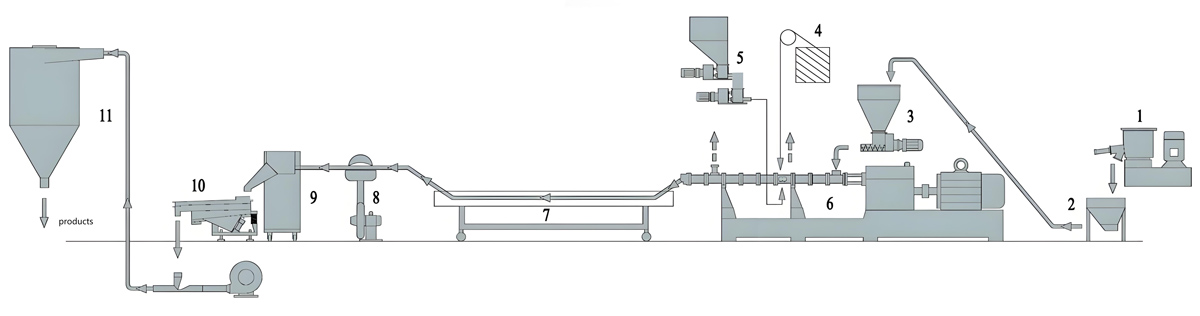
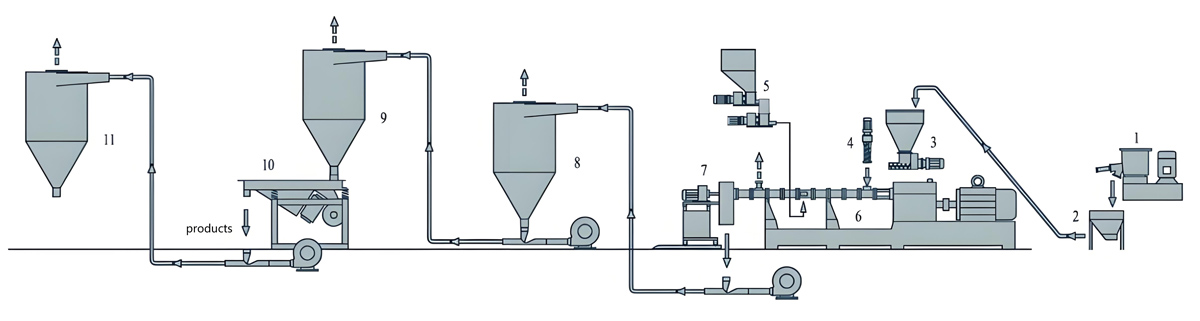
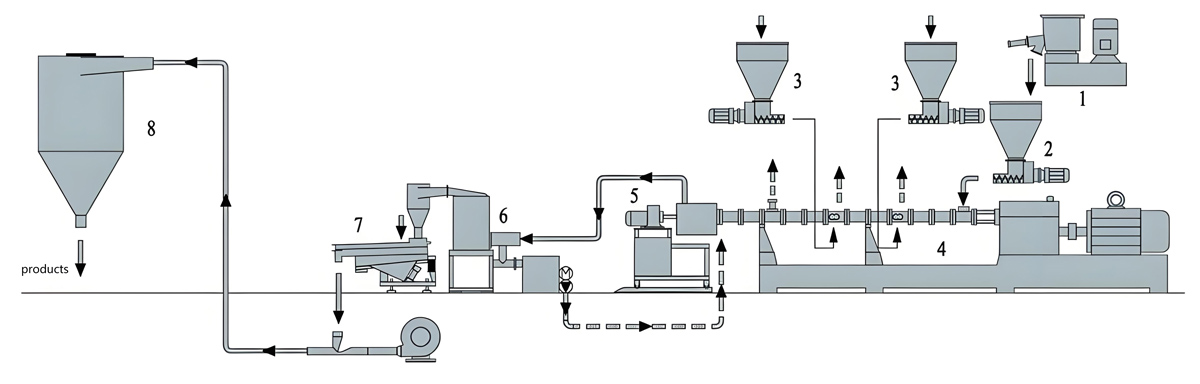
KTE Series counter rotating twin screw extruders specifically engineered for biodegradable polymer masterbatch production incorporate advanced design features that optimize performance for PBS/PHA processing. The counter rotating screw configuration provides superior mixing efficiency compared to co-rotating designs while generating less shear, preserving molecular weight and thermal stability of sensitive biodegradable polymers. The modular screw design enables customization for specific formulation requirements and processing conditions.
Temperature control systems in KTE Series extruders provide precise temperature regulation across all barrel zones, critical for maintaining material properties during PBS/PHA processing. The temperature control system uses cartridge heaters with thermocouple feedback, maintaining temperature stability within plus or minus 1 degree Celsius of setpoints. Individual zone control allows optimization of thermal profiles along the barrel length, accommodating specific material requirements and processing conditions.
Drive systems on KTE Series extruders deliver consistent torque output with efficiency ratings exceeding 85%, reducing energy consumption during production. The drive system typically uses AC vector drives with power ratings from 15 kW for smaller models to 250 kW for production-scale equipment. Torque transducers and amperage monitoring provide real-time feedback on processing conditions, enabling adjustments to maintain optimal performance.
Barrel and Screw Design
Barrel construction in KTE Series extruders uses high-grade nitrided steel with excellent wear resistance and thermal conductivity. Barrel bore diameter ranges from 20 mm for pilot scale equipment to 150 mm for high production capacity machines. The L/D ratio of 40:1 provides adequate length for complete melting, mixing, and homogenization while maintaining reasonable residence time for sensitive biodegradable polymers.
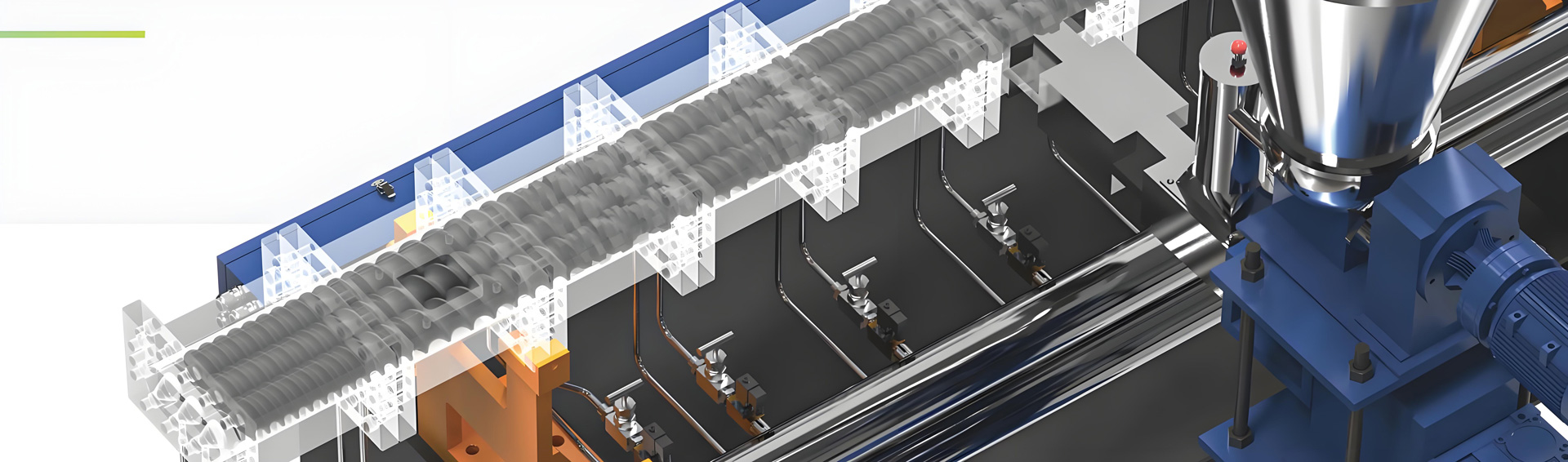
Screw configuration in KTE Series extruders enables optimization for specific masterbatch formulations and processing requirements. The counter rotating screw design features intermeshing flights that provide excellent distributive mixing without excessive shear. Modular screw elements allow configuration optimization including conveying elements, kneading blocks, mixing pins, and reverse conveying elements tailored to specific formulation requirements.
Screw material selection considers wear resistance, thermal conductivity, and corrosion resistance for biodegradable polymer processing. Standard screw material uses nitrided steel with surface hardening to Rockwell C 60-65 for excellent wear resistance. For applications with abrasive pigments or fillers, tungsten carbide or ceramic coating options provide extended service life. The screw hardness and wear resistance maintain consistent processing performance over extended production runs.
Feeding and Auxiliary Equipment
Feeding systems for KTE Series extruders include gravimetric or volumetric feeders with capacity matched to machine throughput. Standard gravimetric feeders provide plus or minus 0.5% feeding accuracy, critical for maintaining consistent formulation ratios in masterbatch production. The feeding system includes material hoppers with level indicators, flow aids for powders, and material conditioning options for moisture-sensitive materials.
Auxiliary equipment packages for PBS/PHA masterbatch production include material drying systems, cooling equipment, and pelletizing systems integrated with the extruder. Material drying systems use desiccant dehumidifiers or vacuum dryers with capacity matching extruder throughput. Cooling systems include water baths, chillers, and air cooling systems sized appropriately for production requirements and ambient conditions.
Control systems on KTE Series extruders provide comprehensive monitoring and adjustment capabilities for all processing parameters. The PLC-based control system includes touchscreen HMI interfaces, data logging, and alarm functions. Ethernet connectivity enables remote monitoring and integration with plant-wide control systems. Recipe management functions enable quick changeover between different formulations with minimal setup time.
Parameter Settings
Temperature Profile
Temperature profile optimization for PBS masterbatch production requires careful consideration of material thermal properties and formulation characteristics. Standard temperature profiles for PBS color masterbatch include zone temperatures starting at 140-150 degrees Celsius in the feeding zone, increasing to 150-165 degrees Celsius in the transition zones, and reaching 160-175 degrees Celsius in the metering zones. Die temperatures typically set 5-10 degrees Celsius above metering zone temperature to ensure proper flow and pellet formation.
PHA masterbatch production requires slightly lower temperature profiles due to the material’s greater thermal sensitivity. Temperature profiles for PHA typically start at 130-140 degrees Celsius in the feeding zone, increase to 140-155 degrees Celsius in transition zones, and reach 150-165 degrees Celsius in metering zones. The reduced temperature profile prevents thermal degradation while maintaining adequate melt flow for processing.
PBS/PHA blend masterbatch production uses intermediate temperature profiles that accommodate both materials’ thermal characteristics. Temperature profiles for blends typically start at 135-150 degrees Celsius in feeding zones, increase to 145-160 degrees Celsius in transition zones, and reach 155-170 degrees Celsius in metering zones. The specific temperature settings depend on blend ratio and material thermal properties, requiring optimization based on processing trials.
Screw Speed and Throughput
Screw speed optimization balances mixing efficiency, residence time, and throughput requirements. For PBS color masterbatch, screw speeds typically range from 60-120 rpm depending on machine size and formulation characteristics. Higher screw speeds increase throughput but may reduce residence time, potentially affecting dispersion quality for complex formulations. The optimal screw speed achieves target throughput while maintaining adequate residence time for complete mixing and dispersion.
PHA masterbatch production typically requires slightly lower screw speeds due to the material’s shear sensitivity. Screw speeds for PHA formulations typically range from 50-100 rpm, providing adequate mixing while minimizing thermal stress. The reduced screw speed combined with counter rotating geometry provides gentle mixing that preserves PHA molecular weight and prevents degradation.
Throughput optimization considers formulation complexity, equipment capacity, and production requirements. For standard color masterbatch formulations, throughput typically ranges from 50-200 kg per hour depending on equipment size. Complex formulations with high pigment loading or multiple additives may require reduced throughput to maintain dispersion quality. Production scheduling should balance efficiency requirements with quality considerations for optimal results.
Vacuum and Venting Parameters
Vacuum level optimization ensures effective removal of volatiles without material loss. For PBS/PHA masterbatch production, vacuum levels typically range from 500-700 mmHg absolute pressure (200-300 mmHg absolute). Higher vacuum levels improve volatile removal but may increase the risk of fine particles being drawn through the vent. Vacuum port sizing and positioning influence effectiveness, with vent ports typically located in the latter 1/3 of barrel length.
Vent port configuration depends on material characteristics and volatile content. Standard vent ports use staggered openings 3-5 mm wide with total area equivalent to 10-15% of barrel cross-section. For materials with high volatile content, multiple vent ports with staged vacuum levels may improve volatile removal while minimizing material loss. Vent port cleaning intervals depend on material characteristics and processing conditions, typically requiring cleaning every 8-12 hours of operation.
Back pressure settings affect mixing intensity and residence time. For PBS/PHA masterbatch production, back pressure typically maintained between 20-40 bar depending on formulation and throughput. Higher back pressure increases mixing intensity but may increase shear heating and thermal stress on sensitive biodegradable polymers. Back pressure optimization through die design and screen pack selection achieves desired mixing characteristics without excessive thermal degradation.
Equipment Pricing
KTE Series Extruder Pricing
KTE Series counter rotating twin screw extruder pricing varies based on size, configuration, and included auxiliary equipment. Pilot scale models with 20-30 mm barrel diameter and throughput capacity of 10-50 kg per hour typically range from USD 25,000 to USD 45,000. These compact systems are ideal for research and development, formulation optimization, and small-scale production.
Mid-range production models with 50-75 mm barrel diameter and throughput capacity of 100-500 kg per hour typically range from USD 65,000 to USD 150,000. These systems include more robust construction, larger drive motors, and integrated auxiliary equipment suitable for commercial production. The pricing includes basic extruder, control system, and standard auxiliary equipment.
Full production models with 100-150 mm barrel diameter and throughput capacity of 500-2000 kg per hour typically range from USD 180,000 to USD 450,000. These production-scale systems include advanced features such as automated material handling, integrated quality monitoring, and sophisticated control systems. The pricing varies based on specific configuration and included auxiliary equipment packages.
Complete Production Line Pricing
Complete PBS/PHA masterbatch production lines including extruder, feeding system, drying equipment, cooling system, and pelletizing system provide turnkey solutions for manufacturing operations. Pilot scale complete lines with capacity of 10-50 kg per hour typically range from USD 50,000 to USD 90,000. These complete systems include all necessary equipment for small-scale production with minimal setup requirements.
Mid-range production lines with capacity of 100-500 kg per hour typically range from USD 150,000 to USD 350,000. These complete lines include appropriately sized extruder, gravimetric feeding system, material drying equipment, water cooling system, pelletizing equipment, and control system integration. The complete line approach ensures compatibility between components and streamlined installation.
High production capacity lines with throughput of 500-2000 kg per hour typically range from USD 400,000 to USD 1,200,000 depending on configuration and automation level. These comprehensive systems include large-capacity extruders, multi-component feeding systems, automated material handling, integrated quality monitoring, and advanced process control. The investment reflects production capacity and automation features that reduce labor costs and improve quality consistency.
Auxiliary Equipment Pricing
Gravimetric feeding systems with multiple feeding heads range from USD 12,000 to USD 45,000 depending on number of feeders and capacity. These feeding systems provide critical accuracy for maintaining formulation consistency, justifying the investment through reduced material waste and improved product quality. Higher capacity systems with advanced features such as bulk density compensation and automated recipe changeover command premium pricing.
Material drying systems including dehumidifier dryers, hopper dryers, and vacuum dryers range from USD 8,000 to USD 35,000 depending on capacity and configuration. For PBS/PHA masterbatch production, drying systems must handle hygroscopic materials effectively, making quality drying systems essential investment. Desiccant dehumidifier dryers provide reliable performance for continuous drying requirements typical of production operations.
Cooling and pelletizing systems including water baths, strand cutters, or water ring pelletizers range from USD 15,000 to USD 60,000 depending on throughput and configuration. The cooling and pelletizing system choice depends on production volume, product requirements, and floor space considerations. Water ring pelletizers offer higher capacity in smaller footprint but require careful water quality management for biodegradable polymers.
Production Problems and Solutions
Poor Pigment Dispersion
Poor pigment dispersion represents one of the most common quality issues in PBS/PHA masterbatch production, manifesting as pigment streaks, color inconsistency, or reduced pigment effectiveness in end products. The problem typically results from insufficient mixing intensity, inadequate pigment wetting, or excessive pigment loading that exceeds dispersant capacity. Poor dispersion affects both aesthetic quality and functional performance of the masterbatch, requiring identification and correction to maintain product specifications.
Causes of poor pigment dispersion include inadequate screw configuration for distributive mixing, insufficient residence time, improper pigment particle size, insufficient dispersant levels, or inappropriate temperature profile. The counter rotating twin screw geometry provides excellent mixing capabilities, but improper screw element selection or configuration can reduce effectiveness. Insufficient dispersant levels prevent effective pigment wetting and distribution, leading to agglomeration and poor dispersion quality.
Solutions for poor pigment dispersion begin with screw configuration optimization. Adding or repositioning kneading blocks improves distributive mixing, while mixing elements enhance dispersive mixing for breaking pigment agglomerates. Increasing dispersant concentration to 12-15% of formulation improves pigment wetting and prevents agglomeration. For complex formulations requiring extended mixing, reducing screw speed or increasing L/D ratio improves residence time and mixing effectiveness.
Preventive measures include maintaining appropriate pigment particle size below 20 microns for optimal dispersion, ensuring proper dispersant levels in formulation, and implementing regular quality monitoring to detect dispersion issues early. Process optimization trials should establish optimal screw configuration and processing parameters for each formulation, then document these parameters for consistent execution. Regular screw wear monitoring and replacement maintains mixing effectiveness over equipment lifecycle.
Thermal Degradation
Thermal degradation of PBS and PHA during masterbatch production causes discoloration, reduced molecular weight, decreased mechanical properties, and processing difficulties in downstream applications. The thermal sensitivity of biodegradable polymers makes them particularly susceptible to degradation during processing, requiring careful temperature control and residence time management to preserve material properties.
Causes of thermal degradation include excessive temperature settings, extended residence time, excessive shear heating, poor venting of volatile degradation products, or material degradation before processing. Temperature settings above material degradation thresholds accelerate molecular weight breakdown. Extended residence time through overfilling the screw or low throughput increases thermal exposure. Excessive shear from high screw speeds or aggressive screw elements generates localized heating that accelerates degradation.
Solutions for thermal degradation begin with temperature profile optimization. Reducing zone temperatures to minimum levels required for melting and processing reduces thermal stress. For PBS, reducing maximum zone temperature to 170-175 degrees Celsius from higher settings may prevent degradation. For PHA, maintaining maximum temperature below 165 degrees Celsius is critical. Implementing temperature gradients where early zones operate at lower temperatures reduces overall thermal exposure.
Residence time optimization prevents excessive thermal exposure. Adjusting screw speed to achieve optimal fill ratio between 60-80% maintains reasonable residence time while ensuring adequate mixing. Reducing throughput without adjusting screw speed overfills the screw and increases residence time. Implementing proper venting removes volatile degradation products that catalyze further degradation. Vacuum levels of 600-700 mmHg effectively remove volatiles while minimizing material loss.
Preventive measures include implementing strict temperature monitoring with alarms for excursions above setpoints, maintaining proper venting system operation, and using fresh, non-degraded material. Regular material testing verifies absence of degradation before processing. Screw configuration optimization provides adequate mixing with minimal shear heating. Preventive maintenance ensures proper temperature control system function and prevents localized overheating.
Inconsistent Pellet Size
Inconsistent pellet size affects downstream processing, material handling, and dosing accuracy for masterbatch applications. Variability in pellet size leads to uneven metering, inconsistent feeding, and variable masterbatch concentration in final products. The problem typically results from improper pelletizing equipment settings, inconsistent melt characteristics, or temperature variations affecting extrudate properties.
Causes of inconsistent pellet size include worn or damaged cutting knives, improper knife edge gap settings, inconsistent die swell due to temperature fluctuations, variable melt pressure causing die flow variations, or inconsistent cooling of extrudate strands. Cutting knife wear creates uneven cutting surfaces leading to variable pellet lengths. Temperature fluctuations change melt viscosity and die swell, affecting strand diameter and resulting pellet size.
Solutions for inconsistent pellet size begin with pelletizing equipment maintenance and adjustment. Regular knife inspection and replacement ensures sharp cutting edges. Proper knife edge gap setting typically between 0.05-0.15 mm depending on material and strand diameter ensures clean cuts. Calibrating knife rotation speed to match strand haul-off speed maintains consistent pellet length. For strand pelletizing, ensuring proper strand cooling before cutting prevents deformation and irregular pellet shape.
Temperature stabilization reduces melt viscosity variations affecting pellet size. Implementing tighter temperature control within plus or minus 0.5 degree Celsius of setpoints minimizes die swell variations. Adjusting die temperature to maintain consistent strand diameter across the die width ensures uniform feeding to the cutter. Maintaining consistent melt pressure through steady feeding and screw speed prevents flow variations affecting strand diameter.
Preventive measures include implementing preventive maintenance schedules for pelletizing equipment, regular calibration of cutting speed and strand haul-off speed, and temperature monitoring to detect variations before they affect product quality. Die design considerations including proper land length and manifold geometry promote uniform flow across the die width. Cooling system optimization ensures consistent strand temperature and properties before cutting.
Vent Blockage
Vent blockage in PBS/PHA masterbatch production reduces volatile removal efficiency, potentially causing product defects, increased degradation, or processing difficulties. Fine material accumulation in vent ports gradually reduces effectiveness, eventually blocking the vent completely and requiring production interruption for cleaning. The problem typically results from fine particles entrained in melt, inadequate vent port sizing, or inappropriate processing parameters generating excessive fines.
Causes of vent blockage include excessive screw speed creating fine particles, inadequate vent port sizing for material characteristics, improper vent positioning in barrel, excessive back pressure forcing material into vent, or material characteristics including low melt strength allowing fines generation. High screw speeds generate fines through excessive shear and turbulence. Inadequate vent port sizing cannot effectively prevent fine particles from entering vent chamber.
Solutions for vent blockage begin with processing parameter optimization. Reducing screw speed to optimal range for material characteristics reduces fines generation. Adjusting back pressure to 20-40 bar range prevents excessive material flow into vent port. Implementing proper vent sizing with opening area of 10-15% of barrel cross-section provides adequate capacity while preventing particle entrainment. Vent port positioning in the latter 1/3 of barrel length after complete melting reduces fines generation potential.
Vent port design modifications reduce blockage frequency for problematic formulations. Installing vent screen with mesh size selected based on material characteristics prevents particle entry while allowing vapor escape. Implementing vent port heaters prevents condensation and material accumulation. For applications with persistent vent blockage, considering vent port with vent diverter or blow-back capability improves reliability.
Preventive measures include regular vent inspection and cleaning during scheduled maintenance, monitoring vent pressure differential for early blockage detection, and implementing processing parameters optimized to minimize fines generation. Material quality control ensures absence of excessive fines in raw materials. Screw wear monitoring prevents increased fines generation as screw flights wear and increase clearances.
Material Feeding Issues
Material feeding issues including inconsistent feeding, bridging, or feed interruptions affect formulation consistency and product quality in PBS/PHA masterbatch production. Feeding problems cause formulation drift, requiring either product rejection or reprocessing, and reducing overall production efficiency. The issues typically result from material characteristics, feeder design limitations, or environmental factors affecting material flow.
Causes of material feeding issues include poor flowability of powder pigments or additives, moisture absorption causing material clumping, feeder hopper design promoting bridging, inadequate flow aids, or environmental conditions affecting material properties. Powder materials with low bulk density and high angle of repose are particularly prone to bridging and inconsistent feeding. Moisture absorption increases material cohesiveness and promotes clumping in feeder hoppers.
Solutions for material feeding issues begin with material handling optimization. Implementing proper material storage in climate-controlled conditions prevents moisture absorption and clumping. Installing flow aids such as vibrators, air pads, or mechanical agitators in feeder hoppers prevents bridging and promotes consistent flow. Selecting feeder designs optimized for powder materials with steep hopper angles and smooth surfaces improves feeding consistency.
Feeder optimization includes appropriate sizing for material characteristics and throughput requirements. Oversized feeders for low flow rates provide poor control, while undersized feeders cannot maintain required feed rates. Implementing gravimetric feeding with bulk density compensation provides improved accuracy for powders with variable bulk density. Regular feeder calibration ensures maintained accuracy over service life.
Preventive measures include implementing regular feeder maintenance and cleaning to prevent material accumulation and degradation, monitoring environmental conditions in feeding area, and establishing material specifications for flow characteristics. Material quality control ensures receipt of materials meeting flowability specifications. Feeder software upgrades including advanced algorithms for bulk density variation compensation improve feeding accuracy for difficult materials.
Maintenance and Care
Daily Maintenance Procedures
Daily maintenance procedures ensure reliable operation and prevent unexpected downtime in PBS/PHA masterbatch production. These routine tasks require minimal time but provide significant value in maintaining equipment performance and product quality consistency. Implementing comprehensive daily maintenance procedures reduces emergency repairs and extends equipment service life.
Visual inspection of equipment before startup should check for obvious damage, loose connections, or abnormal conditions. Checking all electrical connections for security prevents electrical issues during operation. Inspecting all safety guards and interlock switches ensures proper function and operator safety. Examining all fluid lines for leaks prevents system contamination and maintains proper operation.
Temperature control system verification includes checking zone temperature indicators for accuracy using portable thermometers or reference thermocouples. Verifying temperature stability during startup ensures proper control system function. Checking alarm setpoints ensures proper protection against temperature excursions that could cause material degradation or equipment damage.
Feeding system cleaning and inspection should occur daily or between product changeovers. Emptying feeder hoppers and removing residual material prevents cross-contamination between formulations. Inspecting feeder components for wear or damage ensures proper feeding accuracy. Cleaning feed screens prevents buildup that could restrict material flow and affect feeding consistency.
Weekly Maintenance Tasks
Weekly maintenance tasks provide deeper inspection and maintenance beyond daily procedures, addressing potential issues before they cause equipment failure or quality problems. These tasks require more time than daily procedures but remain manageable during scheduled production windows and provide significant value in preventing major issues.
Screw and barrel inspection should include checking for wear patterns, excessive clearances, or damage. Measuring screw flight clearances at multiple positions along screw length identifies wear distribution. Inspecting barrel bore for scoring, grooving, or other damage identifies potential causes of quality issues. Documenting wear measurements enables prediction of replacement requirements and prevents unexpected failures.
Temperature control system calibration includes verifying temperature indicator accuracy against reference standards. Recalibrating thermocouples and temperature controllers as needed ensures accurate temperature control. Checking heater resistance identifies failing heaters before complete failure. Verifying solid state relay operation ensures proper heater control and prevents temperature control issues.
Pelletizing equipment inspection and maintenance should check cutting knife sharpness, knife edge gap settings, and drive system condition. Sharpening or replacing worn knives ensures clean pellet cutting and consistent pellet size. Checking knife rotation speed calibration ensures proper pellet length. Inspecting drive belts or gears for wear prevents unexpected breakdowns during production.
Monthly Maintenance Requirements
Monthly maintenance requirements provide comprehensive inspection and maintenance addressing components requiring less frequent attention. These tasks typically require longer time windows and may require partial disassembly but are essential for maintaining equipment in optimal condition and preventing major failures.
Drive system inspection should include motor condition assessment, coupling inspection, and gearbox oil analysis. Checking motor bearings for vibration or unusual wear prevents motor failures. Inspecting coupling alignment and condition prevents drivetrain damage. Gearbox oil analysis identifies wear particles, contamination, or degradation indicating potential problems requiring attention.
Control system verification should include checking all electrical connections for security, testing all safety interlocks for proper function, and verifying control system calibration. Tightening electrical connections prevents loose connections causing intermittent problems. Testing safety interlocks ensures proper protection and compliance with safety regulations. Verifying control system calibration maintains processing parameter accuracy and product consistency.
Complete cleaning of vent ports and vent chambers removes accumulated material preventing vent blockage and reduced performance. Vent port cleaning may require vent screen replacement or vent diverter cleaning. Cleaning all temperature control components including heater elements and thermowells maintains accurate temperature control. Inspecting all seals and gaskets prevents leaks and ensures proper operation.
Annual Maintenance Overhaul
Annual maintenance overhaul provides comprehensive inspection and replacement of worn components, restoring equipment to optimal condition and preventing major failures. The annual overhaul represents significant time commitment but provides substantial value in preventing unexpected downtime and extending equipment service life.
Complete screw and barrel inspection includes dimensional measurement of critical components, wear pattern analysis, and replacement as needed. Measuring screw diameter at multiple positions quantifies wear and determines replacement requirements. Measuring barrel bore diameter identifies wear and potential quality problems. Documenting measurements enables trend analysis and prediction of future replacement requirements.
Complete drive system rebuild or replacement based on inspection findings ensures reliable operation for coming year. Motor bearing replacement prevents motor failures during production. Coupling replacement ensures proper torque transmission. Gearbox rebuild including bearing and seal replacement prevents unexpected failures. Complete system alignment ensures proper operation and minimizes wear.
Control system update and calibration ensures current software versions and accurate parameter control. Updating PLC and HMI software provides latest features and bug fixes. Calibrating all control inputs and outputs ensures accurate control of processing parameters. Testing all safety systems ensures proper operation and regulatory compliance.
FAQ
What are the optimal temperature settings for PBS masterbatch production?
Optimal temperature settings for PBS masterbatch production depend on specific formulation and equipment characteristics but typically follow a gradient from 140-150 degrees Celsius in the feeding zone to 160-175 degrees Celsius in the metering zone. Die temperature typically set 5-10 degrees Celsius above the highest barrel zone temperature. The specific temperatures should be optimized based on melt flow characteristics, pigment loading, and additive requirements. Starting temperatures at the lower end of the recommended range and gradually increasing as needed helps prevent thermal degradation while achieving adequate processing characteristics.
How does counter rotating twin screw design benefit PBS/PHA masterbatch production?
Counter rotating twin screw design provides several benefits for PBS/PHA masterbatch production compared to co-rotating designs. The counter rotation creates elongational flow that provides excellent distributive mixing without excessive shear stress on sensitive biodegradable polymers. This mixing mechanism preserves molecular weight and thermal stability better than high-shear designs while still achieving uniform pigment and additive dispersion. The lower shear generation reduces thermal stress and degradation potential for PBS and PHA materials. The counter rotating geometry also provides excellent pumping efficiency and throughput capacity, enabling higher production rates compared to co-rotating designs with similar screw diameter.
What moisture levels are required for PBS and PHA materials before processing?
PBS and PHA materials require moisture content below 0.02% (200 ppm) before processing to prevent hydrolytic degradation during masterbatch production. PBS typically achieves this moisture level through drying at 80-90 degrees Celsius for 4-6 hours depending on material form and initial moisture content. PHA materials, with higher moisture affinity, typically require drying at 70-80 degrees Celsius for 6-8 hours. Moisture content should be verified using Karl Fischer titration or moisture analyzers before processing. Inadequate drying leads to molecular weight reduction, discoloration, and degradation of material properties during processing.
How can I improve pigment dispersion in PBS masterbatch?
Improving pigment dispersion in PBS masterbatch involves multiple approaches addressing formulation, equipment configuration, and processing parameters. Screw configuration optimization including adding kneading blocks or mixing elements improves distributive and dispersive mixing. Increasing dispersant concentration to 12-15% of formulation improves pigment wetting and prevents agglomeration. Reducing pigment particle size below 20 microns through pre-grinding improves dispersion quality. Optimizing processing parameters including screw speed and residence time provides adequate mixing time for complete dispersion. Regular screw inspection and replacement maintains mixing effectiveness as equipment wears.
What causes thermal degradation in PBS/PHA masterbatch production?
Thermal degradation in PBS/PHA masterbatch production typically results from excessive temperature exposure, extended residence time, excessive shear heating, or inadequate venting of volatile degradation products. Temperature settings above material degradation thresholds accelerate molecular weight breakdown. Extended residence time through overfilling the screw or low throughput increases thermal exposure. Excessive shear from high screw speeds or aggressive screw elements generates localized heating. Inadequate venting allows volatile degradation products to remain in the melt, catalyzing further degradation. Material already degraded before processing accelerates degradation during processing. Proper temperature control, residence time optimization, shear management, and venting prevent thermal degradation.
How often should cutting knives be replaced in pelletizing systems?
Cutting knife replacement frequency depends on material characteristics, throughput, and quality requirements but typically ranges from 2000-4000 hours of operation for PBS/PHA masterbatch production. Worn knives cause inconsistent pellet size, ragged pellet edges, and increased power consumption in pelletizing equipment. Regular knife inspection should occur weekly or during maintenance shutdowns to assess knife condition. Measuring knife edge radius indicates wear, with replacement recommended when edge radius exceeds 0.1-0.15 mm depending on quality requirements. Keeping spare knives on hand enables quick replacement during scheduled maintenance windows, preventing production delays.
What maintenance is required for vent systems in PBS/PHA masterbatch production?
Vent system maintenance includes regular cleaning of vent ports, vent screens, and vent chambers to remove accumulated material. Cleaning frequency depends on material characteristics and processing parameters but typically occurs daily or weekly for most PBS/PHA applications. Vent screen inspection for damage or wear should occur during cleaning, with replacement as needed. Vent port heaters require inspection to ensure proper function and prevent condensation. Vacuum pump or venting system maintenance follows manufacturer recommendations typically including oil changes and filter replacement every 500-1000 hours of operation. Proper vent maintenance ensures effective volatile removal and prevents vent blockage issues.
How can I reduce vent blockage in PBS/PHA masterbatch production?
Reducing vent blockage in PBS/PHA masterbatch production involves multiple approaches addressing processing parameters, vent design, and material characteristics. Optimizing screw speed to optimal range for material characteristics reduces fines generation that block vents. Adjusting back pressure to appropriate range of 20-40 bar prevents excessive material flow into vent port. Implementing proper vent sizing with opening area of 10-15% of barrel cross-section provides adequate capacity. Installing vent screens with mesh size selected based on material characteristics prevents particle entry. Vent port positioning in the latter 1/3 of barrel after complete melting reduces fines generation potential. Regular vent cleaning and inspection prevents material accumulation that could lead to blockage.
What factors affect throughput in PBS/PHA masterbatch production?
Multiple factors affect throughput in PBS/PHA masterbatch production including formulation complexity, equipment size and configuration, processing parameters, and quality requirements. Complex formulations with high pigment loading or multiple additives typically require reduced throughput to maintain dispersion quality. Equipment size and screw configuration influence maximum throughput capacity, with larger screw diameters and appropriate L/D ratios enabling higher throughput. Screw speed affects throughput but must be balanced against mixing requirements and material thermal sensitivity. Temperature settings and residence time requirements affect achievable throughput. Quality requirements including pellet size consistency and dispersion quality may limit throughput. Process optimization identifies the maximum throughput maintaining product quality and processing stability.
How do I prevent cross-contamination between different masterbatch formulations?
Preventing cross-contamination between different masterbatch formulations requires systematic cleaning procedures and material handling practices. Complete purging of all material contact surfaces between formulation changes removes residual material from previous production. Purging typically involves running clean carrier resin through the system until visually clean, followed by specific purging compounds for difficult materials if needed. Feeder system cleaning includes emptying all hoppers and disassembling feed components for thorough cleaning. Pelletizing system cleaning removes residual material from cooling baths, cutters, and collection systems. Material handling practices including dedicated storage containers and proper labeling prevent mixing errors. Implementing color coding for different formulations reduces potential for errors. Documentation of cleaning procedures ensures consistent execution and traceability.
Conclusion
High efficiency counter rotating twin screw extruders represent the optimal solution for PBS/PHA masterbatch granulation, providing excellent mixing performance while preserving the sensitive properties of biodegradable polymers. The unique counter rotating screw geometry delivers superior distributive mixing compared to co-rotating designs while generating less shear, reducing thermal stress on PBS and PHA materials. This combination of mixing efficiency and gentle material handling enables production of high quality masterbatch with consistent dispersion and preserved polymer properties.
Successful PBS/PHA masterbatch production requires attention to multiple critical factors including proper material preparation, optimized formulation design, appropriate equipment configuration, and precise parameter control. Formulation considerations including pigment particle size, dispersant selection, and additive compatibility directly affect dispersion quality and processing characteristics. Equipment configuration including screw design, L/D ratio, and venting capacity must be matched to formulation requirements and production goals. Processing parameters including temperature profile, screw speed, and vacuum levels require optimization for each specific formulation to achieve target quality while maintaining production efficiency.
KTE Series counter rotating twin screw extruders specifically engineered for biodegradable polymer processing provide the foundation for successful PBS/PHA masterbatch production. The equipment design incorporates features optimized for the thermal sensitivity and rheological characteristics of biodegradable polymers while delivering the mixing performance required for complex masterbatch formulations. Equipment pricing varies widely based on size and configuration, with complete production lines ranging from USD 50,000 for pilot systems to over USD 1,000,000 for high capacity automated lines, enabling scalable investment based on production requirements and business scale.
Continued growth in the biodegradable plastics market drives increasing demand for PBS/PHA masterbatch production equipment and expertise. As environmental regulations and consumer preferences drive adoption of biodegradable materials, masterbatch producers investing in appropriate equipment and process knowledge position themselves for growth in this expanding market. The combination of environmental benefits and processing advantages makes PBS/PHA materials increasingly attractive for diverse applications, creating significant opportunities for specialized masterbatch production.