Introduction
Thermoplastic polyurethane (TPU) and thermoplastic rubber (TPR) represent versatile thermoplastic elastomer materials combining the processing advantages of thermoplastics with the elastic properties of rubbers. These materials find extensive applications in automotive components, footwear, consumer goods, and industrial products due to their excellent elasticity, abrasion resistance, and weather resistance. Masterbatch production for TPU/TPR composites requires specialized equipment capable of handling the unique material characteristics including moisture sensitivity, thermal degradation tendencies, and processing challenges associated with elastomeric materials.
Sealed type twin screw extruders have emerged as the preferred solution for TPU/TPR composite masterbatch manufacturing due to their ability to provide controlled processing environments, excellent mixing performance, and protection against atmospheric contamination. The sealed barrel design prevents moisture absorption and oxygen exposure during processing, critical for maintaining material properties in moisture-sensitive TPU/TPR materials. The global thermoplastic elastomer market continues experiencing robust growth, projected to reach USD 35.8 billion by 2028, driving demand for specialized masterbatch production equipment capable of delivering consistent quality while meeting cost targets.
KTE Series sealed type twin screw extruders specifically engineered for TPU/TPR masterbatch production incorporate advanced design features addressing the unique processing requirements of these elastomeric materials. The equipment provides hermetic sealing capabilities ensuring controlled atmosphere processing, advanced temperature control systems enabling precise thermal management, and optimized screw configurations delivering excellent mixing without excessive shear that could degrade sensitive elastomeric polymers. Throughput capabilities range from 30 to 1500 kg per hour, enabling production scale from pilot through commercial manufacturing.
Formulation Ratios
TPU Color Masterbatch Formulations
TPU color masterbatch formulations accommodate the material’s transparency characteristics and require careful pigment selection to avoid affecting mechanical properties and transparency requirements. Standard TPU color masterbatch formulations include colorant concentrations ranging from 3 to 40% depending on target application requirements and color intensity. Carrier resin typically constitutes 45-90% of total composition, with TPU serving as the carrier matrix to ensure compatibility and maintain elastomeric properties in final products.
High concentration color masterbatch formulations (30-40% pigment) for TPU applications require special dispersing agents at 8-12% concentration to achieve adequate pigment dispersion at elevated loading levels. These formulations typically use organic pigments selected for compatibility with TPU chemistry and transparency requirements where applicable. Carrier resin content decreases to 35-55% in high pigment loading formulations, with the balance comprising processing aids, UV stabilizers, and dispersants specifically selected for TPU compatibility.
Medium concentration formulations (10-25% pigment) represent the most common loading level for TPU masterbatch production, balancing handling characteristics with economic efficiency and color development requirements. These formulations typically contain 8-10% dispersing agents selected for TPU compatibility, 5-7% processing aids including processing oils or slip agents, with TPU carrier resin comprising 60-77% of total composition. The moderate pigment loading enables excellent dispersion quality while maintaining adequate melt flow characteristics for downstream processing.
Low concentration formulations (3-8% pigment) facilitate easy metering and excellent dispersion quality particularly important for transparent or light-colored TPU applications. These formulations typically use 5-6% dispersing agents, 3-5% processing aids including antioxidants and processing stabilizers, with TPU carrier resin constituting 82-89% of total composition. The low pigment loading enables excellent color development and uniformity while providing flexibility for dilution to various end-product concentrations without significantly affecting material properties.
TPR Functional Masterbatch Formulations
TPR functional masterbatch formulations focus on delivering specific performance characteristics including anti-static, flame retardancy, reinforcement, or processing improvements tailored to TPR material characteristics. Anti-static masterbatch formulations typically contain 15-35% conductive additive such as carbon black or conductive fibers, 10-14% dispersing agents, 5-8% processing aids, with TPR carrier resin comprising 43-70% of total composition. The additive concentration depends on target resistivity requirements and intended application loading levels.
Flame retardant masterbatch for TPR incorporates halogen-free flame retardants meeting environmental and safety requirements. These formulations typically contain 20-40% flame retardant system (often including phosphorus-based or inorganic flame retardants), 10-12% dispersing agents, 5-8% synergists and stabilizers, with TPR carrier resin constituting 40-65% of formulation. The flame retardant concentration depends on target flame rating (UL94 V-0, V-1, V-2) and intended application loading levels.
Reinforcement masterbatch formulations for TPR incorporate fillers or fibers to enhance mechanical properties, reduce material cost, or improve processing characteristics. Common reinforcement agents include calcium carbonate, talc, glass fibers, or mineral fillers. These formulations typically contain 25-55% reinforcement agent, 10-14% dispersing agents, 6-10% coupling agents and processing aids, with TPR carrier resin constituting 21-59% of total composition. The reinforcement concentration depends on target property improvements and cost reduction objectives.
TPU/TPR Composite Masterbatch Formulations
TPU/TPR composite masterbatch formulations combine both elastomeric materials to achieve balanced properties including enhanced elasticity, improved abrasion resistance, and optimized processing characteristics. Typical formulations use TPU/TPR ratios ranging from 70/30 to 30/70 depending on target properties and application requirements. Colorant or functional additives comprise 5-35% of formulation, with dispersing agents at 8-14% and processing aids at 5-10% tailored to the blend characteristics.
Processing aid masterbatch formulations for TPU/TPR blends help optimize flow characteristics, reduce melt viscosity, and improve processability for complex geometries or thin-walled applications. These formulations typically contain 12-28% processing aids (including processing oils, waxes, or flow enhancers), 8-10% dispersing agents, 5-7% stabilizers, with TPU/TPR blend carrier constituting 55-75% of total composition. The processing aid selection considers compatibility with both TPU and TPR components while maintaining elastomeric properties.
Adhesion promoter masterbatch formulations for TPU/TPR blends enhance compatibility with other materials in multi-component applications or improve bonding to substrates. These formulations typically contain 15-30% adhesion promoters (including silanes, maleic anhydride grafted polymers, or specialized compatibilizers), 8-12% dispersing agents, 5-7% processing aids, with TPU/TPR blend carrier constituting 51-72% of total composition. The adhesion promoter selection depends on target substrate and application requirements.
Production Process
Material Preparation and Pre-Drying
TPU materials demonstrate significant moisture sensitivity requiring thorough pre-drying before masterbatch production to prevent hydrolytic degradation during processing. TPU typically requires drying at 80-100 degrees Celsius for 6-8 hours to achieve moisture content below 0.02%, with polyester-based TPU requiring more aggressive drying compared to polyether-based types due to higher hydrolysis susceptibility. Proper drying prevents molecular weight reduction, discoloration, and mechanical property degradation that would compromise product quality.
TPR materials generally exhibit lower moisture sensitivity than TPU but still benefit from pre-drying to remove surface moisture and ensure consistent processing. TPR typically requires drying at 70-85 degrees Celsius for 3-5 hours to achieve moisture content below 0.05%, though requirements vary depending on specific TPR formulation and storage conditions. Adequate drying prevents surface defects, bubbles, and processing inconsistencies that would affect masterbatch quality.
Pigment and additive pre-mixing ensures uniform distribution before extrusion, improving dispersion quality and reducing processing time. Powder pigments and additives should be pre-mixed in high-speed blenders for 8-12 minutes to achieve homogeneous distribution. Larger agglomerates may require preliminary grinding using jet mills or air classification mills to achieve particle sizes below 15 microns for optimal dispersion quality in TPU/TPR matrices.
Feeding and Metering
Precision feeding systems ensure accurate formulation ratios throughout TPU/TPR masterbatch production, critical for maintaining consistent product quality and elastomeric properties. Gravimetric feeders provide superior accuracy compared to volumetric systems, maintaining feeding accuracy within plus or minus 0.3% for critical formulations requiring precise additive concentrations. The feeding system must handle materials with varying flow characteristics including pellets, powders, and potentially sticky TPU materials.
Multi-component feeding systems enable separate feeding of different material streams, allowing flexible formulation adjustments and optimal processing conditions. TPU/TPR masterbatch production typically uses separate feeders for elastomeric carrier resins, pigments, and functional additives. This approach enables individual optimization of feeding parameters for each material stream, improving overall dispersion quality and processing efficiency while maintaining formulation accuracy.
Feeding rate optimization considers screw design, L/D ratio, and desired throughput while maintaining adequate residence time for mixing. For TPU/TPR masterbatch production, feeding rates typically range from 8-180 kg per hour per feeding zone depending on machine size and formulation complexity. The feeding rate should be coordinated with screw speed to maintain optimal fill ratio between 65-85%, ensuring adequate mixing and residence time while preventing excessive shear that could degrade elastomeric materials.
Melting and Mixing
Melting zone temperature profiling must accommodate the thermal characteristics of TPU and TPR while ensuring complete melting and homogenization without degradation. Temperature profiles typically start at 150-170 degrees Celsius in the feeding zone for TPU-based formulations, increasing to 165-185 degrees Celsius in the transition zone, and reaching 175-195 degrees Celsius in the metering zone. TPR formulations typically use slightly lower temperatures starting at 140-160 degrees Celsius, increasing to 155-175 degrees Celsius, and reaching 165-185 degrees Celsius in the metering zone.
Mixing intensity optimization balances dispersion quality with preservation of elastomeric properties. Sealed type twin screw extruders provide excellent mixing through their unique screw geometry that creates controlled shear zones without excessive heat generation. The screw configuration typically includes gentle conveying elements in the feeding zone to prevent excessive shear heating, followed by optimized kneading blocks and mixing elements in the transition and metering zones that provide adequate dispersion for pigments and additives.
Vacuum venting in the metering zone removes volatiles, entrapped air, and moisture, improving product quality and preventing defects such as bubbles or surface imperfections. Vacuum levels typically range from 550-750 mmHg (absolute pressure 150-250 mmHg) for TPU/TPR masterbatch production. The vent port should be positioned after complete melting and mixing, typically in the latter 1/3 of barrel length, to ensure effective removal of volatiles while maintaining material quality.
Pelletizing and Cooling
Pelletizing system selection depends on production volume, product requirements, and TPU/TPR material characteristics. Strand pelletizing represents the most common method for TPU/TPR masterbatch, offering good quality pellets suitable for most applications. The extrudate passes through water cooling baths maintained at 20-30 degrees Celsius for 2-3 meters length depending on throughput, then enters strand cutters with knife-edge gap settings optimized for elastomeric material characteristics that may be more prone to sticking than rigid polymers.
Water ring pelletizing offers advantages for higher production volumes, providing faster throughput and reduced floor space requirements. The water ring system uses circulating water at 15-25 degrees Celsius to solidify the extrudate as it exits the die, followed by centrifugal separation and drying. Water ring pelletizing for TPU/TPR requires careful water quality management to prevent material contamination and appropriate die design to accommodate elastomeric flow characteristics.
Pellet cooling and drying after cutting prevents agglomeration and ensures stable storage characteristics. Cooling systems may include air cooling on vibrating conveyors with air temperatures of 20-30 degrees Celsius, or combination water spray and air cooling systems. For TPU masterbatch, thorough drying after pelletizing is essential to remove surface moisture that could affect downstream processing, requiring additional drying time or dedicated drying equipment after pelletizing.
Production Equipment Introduction
KTE Series Sealed Type Twin Screw Extruder Features
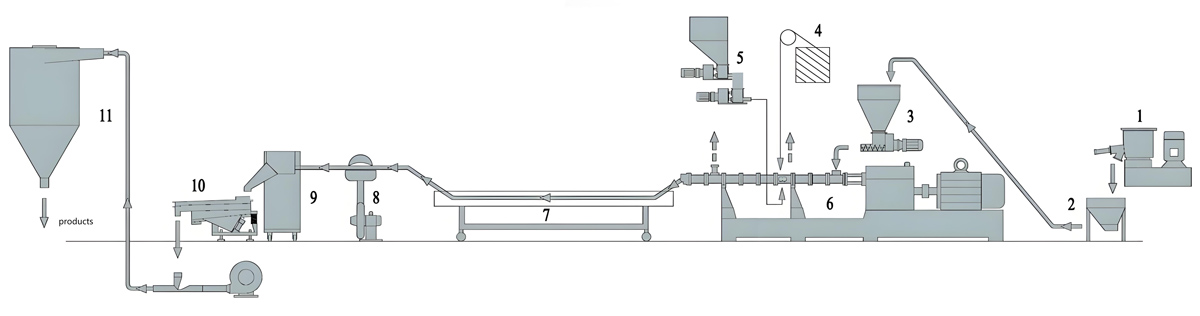
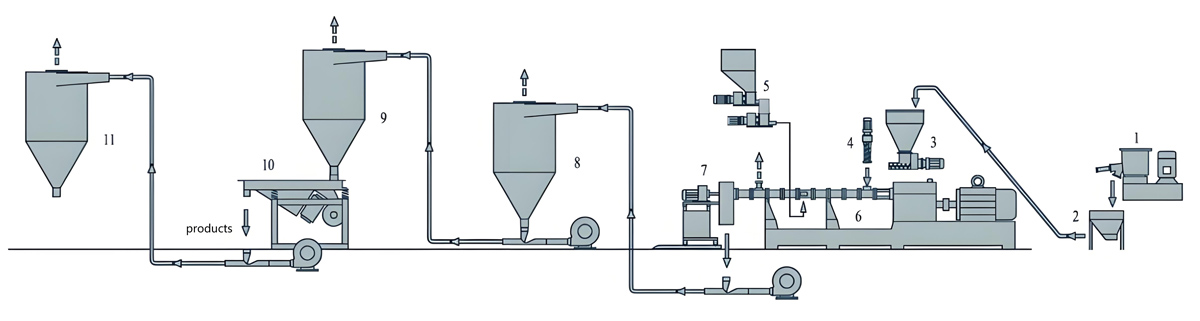
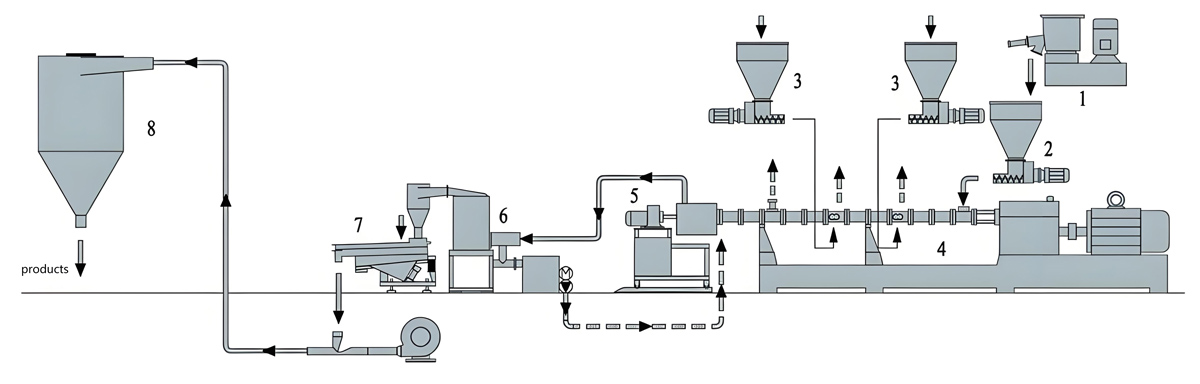
KTE Series sealed type twin screw extruders specifically engineered for thermoplastic elastomer masterbatch production incorporate advanced design features that optimize performance for TPU/TPR processing. The sealed barrel design provides hermetic sealing preventing atmospheric contamination and moisture absorption during processing, critical for maintaining material properties in moisture-sensitive TPU materials. The sealed environment also enables inert gas purging options for oxygen-sensitive formulations requiring additional protection.
Temperature control systems in KTE Series extruders provide precise temperature regulation across all barrel zones, essential for maintaining consistent processing of TPU/TPR materials with narrow processing windows. The temperature control system uses high-efficiency cartridge heaters with multi-point thermocouple feedback, maintaining temperature stability within plus or minus 0.5 degrees Celsius of setpoints. Individual zone control allows optimization of thermal profiles along barrel length, accommodating specific material requirements and formulation characteristics.
Drive systems on KTE Series extruders deliver consistent torque output with efficiency ratings exceeding 88%, reducing energy consumption during TPU/TPR masterbatch production. The drive system typically uses AC vector drives with power ratings from 18 kW for smaller models to 300 kW for production-scale equipment. Torque transducers and advanced amperage monitoring provide real-time feedback on processing conditions, enabling adjustments to maintain optimal performance while protecting equipment from overload conditions.
Barrel and Screw Design
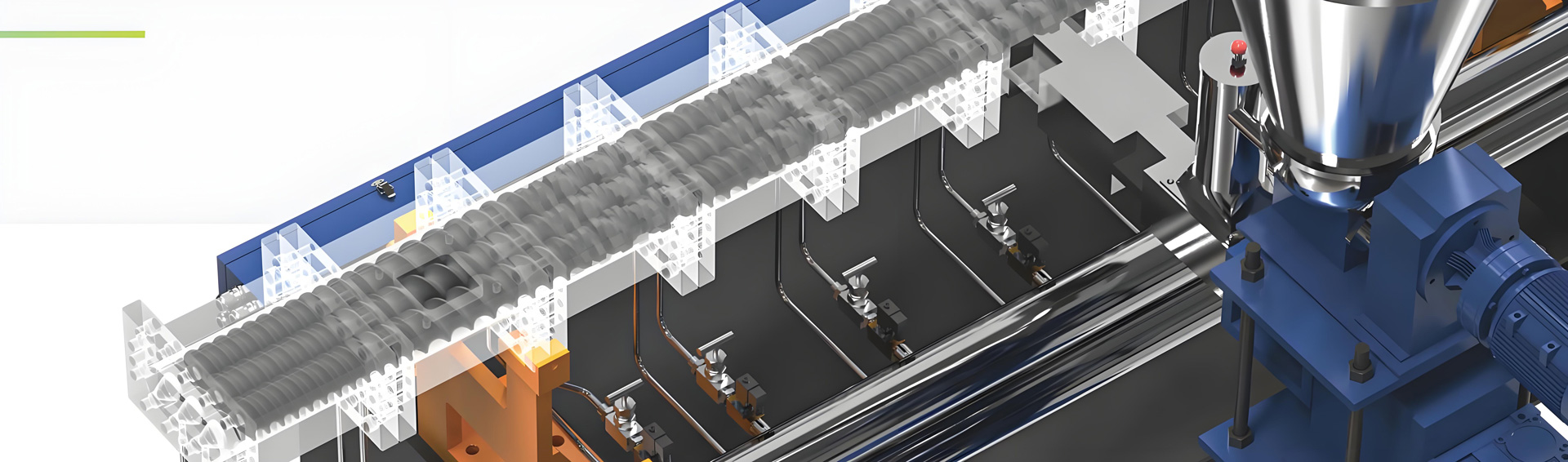
Barrel construction in KTE Series sealed extruders uses high-grade nitrided steel with excellent wear resistance and thermal conductivity. Barrel bore diameter ranges from 25 mm for pilot scale equipment to 140 mm for high production capacity machines. The L/D ratio of 44:1 provides adequate length for complete melting, mixing, and homogenization while maintaining reasonable residence time for sensitive elastomeric materials. The sealed barrel construction includes specialized sealing at drive end and die end to maintain hermetic conditions.
Screw configuration in KTE Series extruders enables optimization for specific TPU/TPR masterbatch formulations and processing requirements. The counter rotating screw design features intermeshing flights that provide excellent distributive mixing while generating controlled shear. Modular screw elements allow configuration optimization including gentle conveying elements in feeding zones, specialized kneading blocks for elastomeric materials, mixing elements optimized for pigment dispersion, and reverse conveying elements for enhanced mixing tailored to specific formulation requirements.
Screw material selection considers wear resistance, thermal conductivity, and corrosion resistance for elastomeric material processing. Standard screw material uses nitrided steel with specialized surface hardening to Rockwell C 62-65 for excellent wear resistance against abrasive pigments and fillers. For applications with high filler loading or abrasive additives, tungsten carbide or ceramic coating options provide extended service life. The screw hardness and wear resistance maintain consistent processing performance over extended production runs.
Feeding and Auxiliary Equipment
Feeding systems for KTE Series sealed extruders include gravimetric or volumetric feeders with capacity matched to machine throughput and material characteristics. Standard gravimetric feeders provide plus or minus 0.3% feeding accuracy, critical for maintaining consistent formulation ratios in TPU/TPR masterbatch production. The feeding system includes material hoppers with level indicators, specialized flow aids for powders and potentially sticky TPU materials, and material conditioning options for moisture-sensitive elastomeric materials.
Auxiliary equipment packages for TPU/TPR masterbatch production include material drying systems, cooling equipment, pelletizing systems, and inert gas purging systems integrated with the extruder. Material drying systems use desiccant dehumidifiers or vacuum dryers with capacity matching extruder throughput, with special attention to TPU moisture sensitivity requiring more aggressive drying conditions. Cooling systems include water baths, chillers, and air cooling systems sized appropriately for production requirements.
Control systems on KTE Series extruders provide comprehensive monitoring and adjustment capabilities for all processing parameters essential for TPU/TPR masterbatch production. The PLC-based control system includes touchscreen HMI interfaces, advanced data logging, and alarm functions for parameter excursions. Ethernet connectivity enables remote monitoring and integration with plant-wide control systems. Recipe management functions enable quick changeover between different TPU/TPR formulations with minimal setup time.
Parameter Settings
Temperature Profile
Temperature profile optimization for TPU masterbatch production requires careful consideration of material thermal properties, formulation characteristics, and specific TPU type (polyester or polyether). Standard temperature profiles for polyester TPU color masterbatch include zone temperatures starting at 155-175 degrees Celsius in the feeding zone, increasing to 170-190 degrees Celsius in the transition zones, and reaching 180-200 degrees Celsius in the metering zones. Die temperatures typically set 5-10 degrees Celsius above metering zone temperature to ensure proper flow and pellet formation.
TPR masterbatch production requires slightly lower temperature profiles due to the material’s different thermal characteristics and generally lower melting points. Temperature profiles for TPR typically start at 140-160 degrees Celsius in the feeding zone, increase to 155-175 degrees Celsius in transition zones, and reach 165-185 degrees Celsius in metering zones. The reduced temperature profile accommodates TPR material characteristics while maintaining adequate melt flow for processing and pigment dispersion.
TPU/TPR blend masterbatch production uses intermediate temperature profiles that accommodate both materials’ thermal characteristics and optimize compatibility. Temperature profiles for blends typically start at 145-170 degrees Celsius in feeding zones, increase to 160-185 degrees Celsius in transition zones, and reach 170-195 degrees Celsius in metering zones. The specific temperature settings depend on blend ratio, specific TPU and TPR grades, and formulation complexity, requiring optimization based on processing trials.
Screw Speed and Throughput
Screw speed optimization balances mixing efficiency, residence time, throughput requirements, and material sensitivity. For TPU color masterbatch, screw speeds typically range from 50-100 rpm depending on machine size and formulation characteristics. Higher screw speeds increase throughput but may reduce residence time and increase shear heating, potentially affecting dispersion quality for complex formulations or causing degradation of sensitive TPU materials. The optimal screw speed achieves target throughput while maintaining adequate residence time for complete mixing and dispersion.
TPR masterbatch production typically allows slightly higher screw speeds due to the material’s different rheological characteristics and generally lower thermal sensitivity. Screw speeds for TPR formulations typically range from 60-110 rpm, providing adequate mixing while maintaining appropriate shear levels for TPR materials. The screw speed optimization considers TPR grade, formulation complexity, and desired throughput requirements.
Throughput optimization considers formulation complexity, equipment capacity, and quality requirements for TPU/TPR masterbatch production. For standard color masterbatch formulations, throughput typically ranges from 30-1500 kg per hour depending on equipment size and formulation. Complex formulations with high pigment loading, multiple additives, or functional masterbatch with high additive loading may require reduced throughput to maintain dispersion quality and prevent processing issues. Production scheduling should balance efficiency requirements with quality considerations.
Vacuum and Sealing Parameters
Vacuum level optimization ensures effective removal of volatiles, moisture, and entrapped air without affecting material quality. For TPU/TPR masterbatch production, vacuum levels typically range from 550-750 mmHg absolute pressure (150-250 mmHg absolute). Higher vacuum levels improve volatile and moisture removal but may increase the risk of fine particles being drawn through the vent or affect elastomeric material flow characteristics. Vacuum port sizing and positioning influence effectiveness, with vent ports typically located in the latter 1/3 of barrel length after complete melting.
Sealed barrel operation maintains controlled atmosphere conditions preventing moisture absorption and oxygen exposure during processing. The sealed system requires careful monitoring of internal pressure and may incorporate inert gas purging for formulations requiring oxygen-free processing. Inert gas (typically nitrogen) purging rates depend on system volume and processing conditions, typically maintaining 0.5-1.5 system volume exchanges per hour to maintain oxygen levels below 1% for sensitive formulations.
Vent port configuration depends on material characteristics and volatile content. Standard vent ports use staggered openings 4-6 mm wide with total area equivalent to 12-18% of barrel cross-section for TPU/TPR processing. For materials with high moisture or volatile content, multiple vent ports with staged vacuum levels may improve removal efficiency while minimizing material loss. Vent port cleaning intervals depend on material characteristics and processing conditions, typically requiring cleaning every 6-10 hours of operation.
Equipment Pricing
KTE Series Sealed Extruder Pricing
KTE Series sealed type twin screw extruder pricing varies based on size, configuration, sealing requirements, and included auxiliary equipment. Pilot scale models with 25-35 mm barrel diameter and throughput capacity of 15-60 kg per hour typically range from USD 32,000 to USD 55,000. These compact sealed systems are ideal for research and development, formulation optimization, and small-scale production of TPU/TPR masterbatch formulations requiring controlled atmosphere processing.
Mid-range production models with 55-80 mm barrel diameter and throughput capacity of 150-600 kg per hour typically range from USD 85,000 to USD 195,000. These systems include more robust construction, larger drive motors, enhanced sealing systems, and integrated auxiliary equipment suitable for commercial production. The pricing includes sealed extruder with hermetic barrel, advanced control system, and standard auxiliary equipment for TPU/TPR processing.
Full production models with 100-140 mm barrel diameter and throughput capacity of 600-1500 kg per hour typically range from USD 220,000 to USD 520,000. These production-scale sealed systems include advanced features such as automated material handling, integrated moisture control systems, inert gas purging capability, and sophisticated control systems. The pricing varies based on specific sealing configuration, automation level, and included auxiliary equipment packages.
Complete Production Line Pricing
Complete TPU/TPR masterbatch production lines including sealed extruder, feeding system, drying equipment, cooling system, pelletizing system, and inert gas purging provide turnkey solutions for manufacturing operations. Pilot scale complete lines with capacity of 15-60 kg per hour typically range from USD 65,000 to USD 120,000. These complete sealed systems include all necessary equipment for small-scale production with controlled atmosphere conditions requiring minimal setup requirements.
Mid-range production lines with capacity of 150-600 kg per hour typically range from USD 200,000 to USD 450,000. These complete sealed lines include appropriately sized extruder with hermetic sealing, gravimetric feeding system, material drying equipment specifically sized for TPU moisture sensitivity, water cooling system, pelletizing equipment, inert gas purging system, and control system integration. The complete line approach ensures compatibility between components and streamlined installation.
High production capacity sealed lines with throughput of 600-1500 kg per hour typically range from USD 480,000 to USD 1,500,000 depending on configuration, sealing requirements, and automation level. These comprehensive sealed systems include large-capacity extruders, multi-component feeding systems, automated material handling, integrated moisture control, advanced inert gas management, integrated quality monitoring, and advanced process control. The investment reflects production capacity, sealing requirements, and automation features.
Auxiliary Equipment Pricing
Gravimetric feeding systems with multiple feeding heads specifically designed for elastomeric materials range from USD 15,000 to USD 55,000 depending on number of feeders and capacity. These feeding systems provide critical accuracy for maintaining formulation consistency in TPU/TPR masterbatch production, justifying the investment through reduced material waste and improved product quality. Higher capacity systems with advanced features including specialized hoppers for TPU materials and automated recipe changeover command premium pricing.
Material drying systems specifically sized for TPU moisture sensitivity including dehumidifier dryers, hopper dryers, and vacuum dryers range from USD 12,000 to USD 45,000 depending on capacity and configuration. For TPU/TPR masterbatch production, drying systems must handle polyester TPU’s high moisture affinity, making quality drying systems essential investment. Desiccant dehumidifier dryers with dew point capability to minus 40 degrees Celsius provide reliable performance for continuous drying requirements.
Inert gas purging systems including nitrogen generators, storage tanks, and distribution systems range from USD 18,000 to USD 65,000 depending on system capacity and purity requirements. These systems enable controlled atmosphere processing for oxygen-sensitive formulations or enhanced protection for moisture-sensitive TPU materials. Nitrogen generators provide continuous supply eliminating tank rental costs for high-purity requirements, while tank-based systems offer lower initial investment for lower volume requirements.
Production Problems and Solutions
Moisture-Related Processing Issues
Moisture-related processing issues represent one of the most significant challenges in TPU masterbatch production, manifesting as bubbles, surface defects, molecular weight degradation, or mechanical property reduction. TPU materials, particularly polyester-based types, demonstrate high moisture absorption and hydrolysis sensitivity, making moisture control critical for successful masterbatch production. Moisture during processing causes hydrolytic degradation leading to reduced molecular weight, altered mechanical properties, and potentially complete processing failure in severe cases.
Causes of moisture-related issues include inadequate pre-drying of TPU materials, moisture absorption during storage or handling, insufficient drying capacity for production throughput, humidity in processing environment, or condensation in equipment. Inadequate pre-drying leaves residual moisture above the 0.02% threshold required for processing. Moisture absorption during storage occurs when TPU materials are not properly sealed or stored in humid environments. Insufficient drying capacity cannot maintain adequate drying for production throughput requirements.
Solutions for moisture-related issues begin with improving pre-drying effectiveness. Increasing drying temperature to recommended 80-100 degrees Celsius range for TPU and extending drying time to 6-8 hours ensures adequate moisture removal. Implementing moisture verification using Karl Fischer titration or moisture analyzers before processing confirms achievement of target moisture levels. For high throughput operations, increasing dryer capacity or adding parallel dryers ensures adequate drying capacity for production requirements.
Sealed extruder operation provides additional protection against moisture re-absorption during processing. Maintaining hermetic sealing integrity prevents atmospheric moisture ingress during processing. Implementing inert gas purging with dry nitrogen creates positive pressure excluding atmospheric moisture. Monitoring internal humidity and oxygen levels in sealed system provides early warning of sealing integrity issues. Regular inspection and replacement of seals maintains hermetic conditions.
Preventive measures include proper storage of TPU materials in moisture-barrier packaging with desiccant, implementing FIFO inventory management preventing extended storage times, maintaining controlled humidity storage environment below 50% relative humidity, and implementing moisture monitoring throughout material handling chain. Establishing moisture specifications for all incoming materials prevents receipt of already moist materials that would exceed drying capacity.
Poor Pigment Dispersion
Poor pigment dispersion in TPU/TPR masterbatch production causes streaks, color inconsistency, reduced pigment effectiveness, and surface defects in final products. The elastomeric nature of TPU and TPR materials presents unique dispersion challenges compared to rigid polymers, requiring specialized approaches to achieve uniform pigment distribution while maintaining material properties. Poor dispersion affects both aesthetic quality and functional performance of the masterbatch.
Causes of poor pigment dispersion in TPU/TPR materials include inadequate screw configuration for elastomeric materials, insufficient dispersant levels or inappropriate dispersant selection for elastomeric matrices, excessive pigment loading exceeding dispersant capacity, improper pigment particle size, or insufficient residence time for complete dispersion. Elastomeric materials often require different screw configurations compared to rigid polymers to achieve adequate mixing without excessive shear that could degrade elastomeric properties.
Solutions for poor pigment dispersion begin with screw configuration optimization for TPU/TPR materials. Implementing screw configurations with specialized kneading blocks optimized for elastomeric materials provides appropriate mixing intensity. Adding distributive mixing elements downstream of mixing zones improves overall dispersion without excessive shear. Optimizing kneading block arrangement with staggered angles creates effective distributive mixing. For complex formulations, implementing reverse conveying elements extends residence time and enhances mixing effectiveness.
Dispersant optimization includes selecting dispersants specifically designed for elastomeric polymer matrices. Standard dispersants effective for rigid polymers may not perform well in TPU/TPR materials due to differences in surface energy and compatibility. Increasing dispersant concentration to 12-14% of formulation improves pigment wetting and prevents agglomeration in elastomeric matrices. Testing dispersant types specifically designed for thermoplastic elastomers identifies optimal compatibility and performance.
Preventive measures include maintaining appropriate pigment particle size below 15 microns for optimal dispersion in elastomeric matrices, implementing quality monitoring to detect dispersion issues early through colorimetric measurement or microscopic analysis, and establishing optimal processing parameters for each formulation through systematic testing. Regular screw wear monitoring and replacement maintains mixing effectiveness as equipment wears. Preventive maintenance of seals in sealed extruders prevents material flow issues that could affect mixing.
Material Degradation
Material degradation in TPU/TPR masterbatch production causes discoloration, molecular weight reduction, decreased mechanical properties, altered processing characteristics, and potential complete processing failure in severe cases. Both TPU and TPR materials demonstrate thermal sensitivity requiring careful temperature control and processing parameter management to prevent degradation while achieving adequate processing for masterbatch production.
Causes of material degradation include excessive temperature settings above material degradation thresholds, extended residence time, excessive shear from inappropriate screw design or screw speed, inadequate venting of volatile degradation products, oxygen exposure during processing, or contamination from degraded material. Temperature settings above material degradation thresholds accelerate molecular weight breakdown and cause discoloration. Extended residence time through overfilling screw or low throughput increases thermal exposure and degradation potential.
Solutions for material degradation begin with temperature profile optimization. Reducing zone temperatures to minimum levels required for melting and processing reduces thermal stress on sensitive elastomeric materials. For polyester TPU, keeping maximum zone temperature below 195-200 degrees Celsius prevents excessive thermal degradation. For polyether TPU, maximum temperatures below 185-190 degrees Celsius provide adequate processing with reduced degradation risk. Implementing temperature gradients where early zones operate at lower temperatures reduces overall thermal exposure.
Residence time optimization prevents excessive thermal exposure that leads to degradation. Adjusting screw speed to achieve optimal fill ratio between 65-85% maintains reasonable residence time while ensuring adequate mixing and dispersion. Reducing throughput without appropriately adjusting screw speed overfills the screw and increases residence time, increasing degradation risk. Implementing proper venting removes volatile degradation products that can catalyze further degradation.
Sealed extruder operation with inert gas purging prevents oxidation degradation during processing. Maintaining hermetic sealing integrity excludes oxygen from processing environment. Implementing nitrogen purging with oxygen levels maintained below 1% provides significant protection against oxidative degradation for sensitive formulations. Regular monitoring of oxygen levels in sealed system confirms effective purging operation. Seal inspection and replacement maintains hermetic conditions preventing oxygen ingress.
Preventive measures include implementing strict temperature monitoring with alarms for excursions above setpoints, using fresh, non-degraded materials, implementing proper material storage preventing degradation before processing, and establishing maximum residence time limits based on material thermal stability. Screw configuration optimization provides adequate mixing with minimal shear heating and thermal stress. Preventive maintenance ensures proper temperature control system function and prevents localized overheating.
Sticking and Adhesion Issues
Sticking and adhesion issues in TPU/TPR masterbatch production cause material buildup on processing equipment, reduced throughput, quality defects, and increased downtime for cleaning. The elastomeric nature of TPU and TPR materials increases tendency to stick to metal surfaces compared to rigid polymers, particularly at elevated temperatures. Sticking issues affect processing efficiency, product quality, and equipment maintenance requirements.
Causes of sticking and adhesion issues include excessive processing temperatures exceeding material tack temperature range, insufficient cooling before cutting, inappropriate die or barrel surface finish, inadequate release agents or processing aids, or screw configuration creating excessive residence time at elevated temperatures. Temperatures exceeding material tack range significantly increase sticking tendency. Insufficient cooling before cutting causes pellet agglomeration and sticking in pelletizing equipment.
Solutions for sticking issues begin with temperature optimization. Reducing processing temperatures to minimum levels required for adequate flow reduces material tackiness and sticking tendency. Identifying the material’s tack temperature range and maintaining processing 10-20 degrees Celsius below this range reduces sticking issues. For materials with narrow processing windows, implementing temperature gradient with cooler cutting zone reduces sticking in pelletizing area.
Surface treatment and coating of processing equipment can significantly reduce sticking issues. Barrel and die coatings with low surface energy materials such as PTFE or specialized ceramic coatings provide release characteristics. Regular polishing of die surfaces maintains low surface finish reducing material adhesion. For chronic sticking issues, implementing water-cooled cutting chambers or water ring pelletizing reduces temperature at cutting point minimizing sticking.
Processing aid optimization includes adding 3-5% processing aids such as waxes, silicones, or specialized release agents specifically designed for elastomeric materials. These processing aids reduce surface energy and improve release characteristics without significantly affecting final product properties. Testing different processing aid types identifies optimal balance between processing improvement and final product performance.
Preventive measures include implementing regular cleaning schedules to prevent material buildup, monitoring processing parameters for trends indicating increased sticking tendency, and establishing standard operating procedures for startup and shutdown that minimize sticking. Equipment design considerations including polished surfaces, adequate cooling capacity, and appropriate die geometry reduce sticking tendency. Regular maintenance of cooling systems ensures adequate temperature control preventing sticking issues.
Inconsistent Melt Flow
Inconsistent melt flow during TPU/TPR masterbatch production causes product quality variations, processing difficulties, and throughput instability. Melt flow variations manifest as inconsistent pellet size, varying color intensity, and dispersion quality variations between production batches. Maintaining consistent melt flow is critical for achieving repeatable product quality and stable processing conditions.
Causes of inconsistent melt flow include temperature fluctuations, feeding inconsistencies, formulation variations, screw wear affecting processing characteristics, or material lot-to-lot variations. Temperature fluctuations cause viscosity changes directly affecting melt flow and throughput. Feeding inconsistencies alter formulation ratios and melt characteristics. Formulation variations from raw material differences cause flow behavior changes. Screw wear increases clearances reducing mixing and pumping efficiency.
Solutions for inconsistent melt flow begin with temperature stabilization. Implementing tighter temperature control within plus or minus 0.5 degrees Celsius of setpoints minimizes viscosity variations. Calibrating temperature sensors ensures accurate temperature measurement and control. Inspecting heater elements and replacing degraded components prevents temperature instability. Optimizing temperature controller PID parameters improves response time and stability.
Feeding system optimization ensures consistent formulation ratios and throughput. Calibrating gravimetric feeders maintains accuracy within plus or minus 0.3% for consistent formulation. Implementing bulk density compensation for powder materials accounts for density variations affecting feeding accuracy. Regular feeder maintenance and calibration prevents drift over time affecting consistency. Optimizing feeder hopper flow characteristics prevents bridging or inconsistent feeding.
Formulation consistency measures include establishing material specifications for key properties affecting melt flow including melt flow index, molecular weight distribution, and additive content. Implementing material testing before use verifies compliance with specifications and prevents processing from out-of-specification materials. Material lot management and traceability allows identification of problematic material lots and prevents repeated use.
Preventive measures include implementing preventive maintenance schedules for temperature control systems and feeding equipment, establishing material receiving testing procedures, and implementing process monitoring with statistical process control to detect variations before they affect product quality. Regular screw inspection and measurement monitors wear affecting processing characteristics. Material handling procedures prevent contamination or mixing errors that would affect formulation consistency.
Maintenance and Care
Daily Maintenance Procedures
Daily maintenance procedures for TPU/TPR masterbatch production equipment ensure reliable operation and prevent unexpected downtime. These routine tasks address the unique requirements of sealed extruder systems and elastomeric material processing. Implementing comprehensive daily maintenance procedures reduces emergency repairs, extends equipment service life, and maintains consistent product quality.
Visual inspection before startup should check all sealing systems for integrity, verify vacuum or inert gas system connections, and examine all electrical connections for security. Checking sealing gaskets at barrel ends and vent ports ensures hermetic sealing condition. Inspecting all safety guards and interlock switches ensures proper operation. Examining all fluid lines for leaks prevents system contamination and maintains proper operation of cooling and sealing systems.
Temperature control system verification includes checking zone temperature indicators for accuracy using portable thermometers or reference thermocouples, verifying temperature stability during startup ensures proper control system function, and checking alarm setpoints ensures protection against temperature excursions that could cause material degradation. For sealed systems, monitoring internal temperature at multiple points ensures uniform heating throughout sealed barrel.
Feeding system cleaning and inspection should occur daily or between product changeovers. Emptying feeder hoppers and removing residual TPU/TPR materials prevents cross-contamination between formulations. Inspecting feeder components for wear or material buildup ensures proper feeding accuracy. Cleaning feed screens prevents buildup that could restrict material flow and affect feeding consistency. Checking for material sticking or bridging in feeder hoppers enables proactive cleaning.
Weekly Maintenance Tasks
Weekly maintenance tasks provide deeper inspection and maintenance beyond daily procedures, addressing potential issues before they cause equipment failure or quality problems. These tasks require more time but provide significant value in preventing major issues in TPU/TPR masterbatch production.
Screw and barrel inspection should include checking for wear patterns, excessive clearances, or material buildup. Measuring screw flight clearances at multiple positions along screw length identifies wear distribution. Inspecting barrel bore for scoring, grooving, or material adhesion identifies potential causes of quality issues. Documenting wear measurements enables prediction of replacement requirements and prevents unexpected failures.
Sealing system inspection and maintenance includes checking all gaskets and seals for wear or damage, testing vacuum system integrity for leaks, and verifying inert gas purging system operation. Replacing worn seals maintains hermetic sealing condition. Testing vacuum pump performance ensures adequate vacuum levels for venting. Checking inert gas purging system for leaks and verifying oxygen levels confirms proper operation for sealed atmosphere processing.
Pelletizing equipment inspection and maintenance should check cutting knife sharpness, knife edge gap settings, drive system condition, and cooling system operation. Sharpening or replacing worn knives ensures clean pellet cutting. Checking knife rotation speed calibration ensures proper pellet length. Inspecting water ring system or cooling baths for proper flow and temperature prevents pellet quality issues. Cleaning pelletizing equipment removes material buildup affecting performance.
Monthly Maintenance Requirements
Monthly maintenance requirements provide comprehensive inspection and maintenance addressing components requiring less frequent attention. These tasks typically require longer time windows and may require partial equipment shutdown but are essential for maintaining sealed extruder systems in optimal condition.
Complete drive system inspection should include motor condition assessment, coupling inspection, gearbox oil analysis, and drive belt or chain inspection. Checking motor bearings for vibration or unusual wear prevents motor failures during production. Inspecting coupling alignment and condition prevents drivetrain damage. Gearbox oil analysis identifies wear particles, contamination, or degradation indicating potential problems requiring attention.
Control system verification should include checking all electrical connections for security, testing all safety interlocks for proper function, verifying control system calibration, and testing alarm systems for proper operation. Tightening electrical connections prevents loose connections causing intermittent problems. Testing safety interlocks ensures proper protection and regulatory compliance. Verifying control system calibration maintains processing parameter accuracy.
Complete vent and vacuum system maintenance includes vent port cleaning, vacuum pump inspection and oil change, and system leak testing. Vent port cleaning removes material buildup preventing vent blockage and reduced performance. Vacuum pump oil change maintains pump performance and prevents contamination. System leak testing using appropriate methods identifies leaks compromising vacuum or sealed atmosphere operation.
Annual Maintenance Overhaul
Annual maintenance overhaul for TPU/TPR masterbatch production equipment provides comprehensive inspection and replacement of worn components, restoring equipment to optimal condition and preventing major failures. The annual overhaul represents significant time commitment but provides substantial value in preventing unexpected downtime.
Complete screw and barrel inspection includes dimensional measurement of critical components, wear pattern analysis, and replacement as needed. Measuring screw diameter at multiple positions quantifies wear and determines replacement requirements. Measuring barrel bore diameter identifies wear and potential quality problems. Documenting measurements enables trend analysis and prediction of future replacement requirements.
Complete sealing system rebuild includes replacing all gaskets and seals, testing vacuum or inert gas systems, and verifying hermetic sealing capability. Replacing all seals at annual intervals prevents unexpected seal failures. Testing vacuum pump performance and rebuilding as needed maintains venting capability. Verifying oxygen levels under sealed conditions confirms system integrity.
Complete drive system rebuild or replacement based on inspection findings ensures reliable operation for coming year. Motor bearing replacement prevents motor failures. Coupling replacement ensures proper torque transmission. Gearbox rebuild including bearing and seal replacement prevents unexpected failures. Complete system alignment ensures proper operation and minimizes wear on all components.
FAQ
What are the optimal drying conditions for TPU before masterbatch production?
Optimal drying conditions for TPU depend on TPU type (polyester or polyether) and initial moisture content. Polyester TPU typically requires drying at 80-100 degrees Celsius for 6-8 hours to achieve moisture content below 0.02% (200 ppm). Polyether TPU is less moisture sensitive and typically requires drying at 75-90 degrees Celsius for 4-6 hours. Moisture content should be verified using Karl Fischer titration or moisture analyzers before processing. Inadequate drying causes hydrolytic degradation leading to molecular weight reduction and property degradation.
How does sealed barrel design benefit TPU/TPR masterbatch production?
Sealed barrel design provides multiple benefits for TPU/TPR masterbatch production including prevention of moisture absorption during processing, exclusion of oxygen preventing oxidative degradation, capability for inert gas purging for oxygen-sensitive formulations, and controlled atmosphere processing for consistent quality. The hermetic sealing maintains controlled conditions critical for moisture-sensitive TPU materials. The sealed environment also enables process optimization without environmental variables affecting processing consistency.
What temperature range is appropriate for TPU masterbatch production?
Appropriate temperature range for TPU masterbatch production depends on specific TPU grade and formulation requirements. Polyester TPU typically processes between 175-200 degrees Celsius maximum barrel temperature, while polyether TPU processes between 165-190 degrees Celsius maximum. Temperature profiles should start at lower temperatures in feeding zones (150-175 degrees Celsius) and increase gradually to maximum temperatures in metering zones. Processing at minimum temperatures required for adequate melting and mixing helps prevent thermal degradation.
How can I improve dispersion quality in TPU masterbatch?
Improving dispersion quality in TPU masterbatch involves selecting dispersants specifically designed for elastomeric matrices, optimizing screw configuration for TPU materials, maintaining appropriate pigment particle size below 15 microns, and ensuring adequate residence time for dispersion. Dispersant selection for elastomeric materials differs from rigid polymers due to different surface energy and compatibility requirements. Screw configuration with specialized kneading blocks optimized for elastomeric materials provides appropriate mixing without excessive shear.
What causes TPU degradation during masterbatch production?
TPU degradation during masterbatch production typically results from excessive temperatures above material degradation thresholds, extended residence time, excessive shear heating, moisture causing hydrolytic degradation, or oxygen exposure causing oxidative degradation. Polyester TPU is particularly susceptible to hydrolysis from residual moisture. Thermal degradation causes discoloration, molecular weight reduction, and property loss. Implementing proper drying, temperature control, residence time optimization, and sealed atmosphere processing prevents degradation.
How often should seals be replaced in sealed extruder systems?
Seal replacement frequency depends on operating conditions, material characteristics, and maintenance practices but typically occurs every 6-12 months for regular TPU/TPR masterbatch production. More frequent replacement may be required for abrasive formulations or high-temperature operation. Seals showing visible wear, compression set, or leaking during operation should be replaced immediately regardless of schedule. Maintaining spare seals enables replacement during scheduled maintenance preventing unexpected downtime.
What maintenance is required for vacuum systems in TPU/TPR masterbatch production?
Vacuum system maintenance includes regular vent port cleaning, vacuum pump oil changes, filter replacement, and system leak testing. Vent port cleaning typically occurs weekly or more frequently depending on material characteristics to prevent blockage. Vacuum pump oil changes follow manufacturer recommendations typically every 500-1000 hours of operation. Filter replacement depends on operating conditions and manufacturer specifications. System leak testing should occur monthly to identify and repair leaks before they affect processing.
How do I prevent sticking issues with TPU masterbatch?
Preventing sticking issues with TPU masterbatch involves optimizing processing temperatures below material tack range, implementing appropriate cooling before cutting, using low surface energy coatings on processing surfaces, adding processing aids or release agents, and maintaining proper die and barrel surface finish. Identifying material tack temperature range and maintaining processing 10-20 degrees Celsius below this range significantly reduces sticking. Adding 3-5% processing aids specifically designed for elastomeric materials improves release characteristics.
What are the advantages of inert gas purging in sealed extruders?
Inert gas purging in sealed extruders provides multiple advantages including prevention of oxidative degradation for oxygen-sensitive formulations, reduced moisture content through displacement of humid air, controlled atmosphere for consistent processing, and protection for moisture-sensitive TPU materials. Nitrogen purging maintains oxygen levels below 1% providing significant protection against oxidation. The positive pressure created by purging excludes atmospheric moisture preventing moisture absorption during processing.
How can I improve melt flow consistency in TPU/TPR masterbatch production?
Improving melt flow consistency requires stabilizing temperature control within tight tolerances, maintaining consistent feeding accuracy, establishing material specifications for key properties, implementing regular equipment maintenance, and monitoring processing parameters with statistical process control. Temperature control within plus or minus 0.5 degrees Celsius minimizes viscosity variations. Gravimetric feeding with plus or minus 0.3% accuracy maintains consistent formulation. Material testing ensures receipt of consistent raw materials.
Conclusion
Sealed type twin screw extruders represent the optimal solution for TPU/TPR composite masterbatch manufacturing, providing controlled processing environments that address the unique requirements of moisture-sensitive and oxidation-prone thermoplastic elastomers. The hermetic sealing capability prevents moisture absorption and oxygen exposure during processing, critical for maintaining TPU material properties and preventing degradation. The combination of controlled atmosphere processing with excellent mixing performance enables production of high quality masterbatch with consistent dispersion and preserved elastomeric properties.
Successful TPU/TPR masterbatch production requires comprehensive understanding of material characteristics including moisture sensitivity, thermal degradation thresholds, and processing requirements specific to elastomeric materials. Formulation considerations must account for different dispersion requirements in elastomeric matrices compared to rigid polymers, requiring specialized dispersants and processing aids. Equipment configuration including screw design, sealing systems, and venting capacity must be matched to formulation requirements and processing goals. Processing parameters including temperature profiles, screw speed, and vacuum or inert gas purging require optimization for each specific formulation.
KTE Series sealed type twin screw extruders specifically engineered for thermoplastic elastomer processing provide the foundation for successful TPU/TPR masterbatch production. The equipment design incorporates hermetic sealing, advanced temperature control, and screw configurations optimized for elastomeric material characteristics while delivering the mixing performance required for complex masterbatch formulations. Equipment pricing varies widely based on size, configuration, and sealing requirements, with complete production lines ranging from USD 65,000 for pilot systems to over USD 1,500,000 for high capacity sealed systems, enabling scalable investment based on production requirements.
The growing demand for thermoplastic elastomers across diverse industries including automotive, footwear, consumer goods, and industrial applications creates significant opportunities for specialized TPU/TPR masterbatch producers. As material formulations become more sophisticated and quality requirements more stringent, masterbatch producers investing in appropriate sealed extruder equipment and process knowledge position themselves for growth in this expanding market. The combination of processing advantages and material properties makes TPU/TPR increasingly attractive for demanding applications, creating sustained demand for high quality masterbatch production capabilities.