Introduction
Plastic softening masterbatch production represents a critical segment in the polymer additive industry, enabling manufacturers to modify the flexibility and processing characteristics of plastic materials. Automatic lubrication twin screw extruders provide the advanced equipment capabilities necessary for efficient, consistent production of softening masterbatch formulations. These sophisticated extruders incorporate automated lubrication systems that significantly enhance equipment reliability, reduce maintenance requirements, and enable continuous operation over extended production periods.
Softening masterbatch formulations typically contain high concentrations of plasticizers, softening agents, and lubricants that reduce polymer hardness and improve flexibility. These formulations are particularly valuable for applications requiring soft, flexible plastics such as medical tubing, flexible packaging, and consumer goods. The production process presents unique challenges due to the lubricating nature of the formulation components, which can affect processing behavior and equipment wear.
Automatic lubrication systems integrated into twin screw extruders provide continuous, precise lubrication of critical bearing surfaces, gearboxes, and drive components. This automated lubrication eliminates manual lubrication requirements, reduces human error, and ensures optimal lubrication under all operating conditions. The KTE Series twin screw extruders from Kerke Extrusion Equipment Company incorporate advanced automatic lubrication systems that enhance equipment reliability and reduce operating costs.
Formulation Proportions (Different Types)
Plastic softening masterbatch formulations vary significantly based on the target application, base polymer type, and desired softening degree. Formulation development requires careful balancing of softening agents with compatibility modifiers and stabilizers to achieve desired performance without compromising other material properties.
Phthalate-Based Softening Masterbatch
Phthalate-based formulations represent the most widely used softening masterbatch type for general-purpose applications. These formulations typically contain 30% to 50% phthalate plasticizers such as dioctyl phthalate (DOP), diisononyl phthalate (DINP), or dibutyl phthalate (DBP) blended with a compatible carrier resin.
Polyvinyl chloride (PVC) applications typically employ formulations with 35% to 45% phthalate plasticizers. These formulations achieve Shore A hardness values ranging from 60 to 90 depending on the specific phthalate type and concentration. The phthalate content must be balanced with thermal stabilizers to prevent degradation during processing, typically requiring 2% to 4% stabilizers.
For polyolefin applications such as polyethylene or polypropylene, compatibility enhancers are required due to the limited compatibility between phthalates and polyolefins. These formulations typically include 30% to 40% phthalates combined with 5% to 10% compatibilizers such as maleic anhydride grafted polyolefins.
Non-Phthalate Softening Masterbatch
Non-phthalate formulations address regulatory concerns regarding phthalate plasticizers, particularly for food contact, medical, and children’s products. These formulations contain 30% to 50% alternative plasticizers such as dioctyl terephthalate (DOTP), diisononyl cyclohexane-1,2-dicarboxylate (DINCH), or acetyl tributyl citrate (ATBC).
Food packaging applications require DOTP-based formulations with 35% to 45% plasticizer content. DOTP provides similar softening performance to phthalates with improved regulatory approval for food contact applications. These formulations require careful attention to thermal stability, as DOTP may degrade at elevated temperatures if not properly protected with stabilizers.
Medical applications requiring biocompatibility typically employ DINCH-based formulations with 30% to 40% DINCH content. DINCH offers excellent toxicological profiles but may require compatibility enhancers for certain polymer types. These formulations often include 3% to 5% biocompatibility modifiers and 2% to 4% thermal stabilizers.
Polyester-Based Softening Masterbatch
Polyester-based formulations provide excellent permanence and resistance to migration, particularly valuable for applications requiring long-term performance. These formulations contain 25% to 40% polyester-based plasticizers such as polycaprolactone, polyethylene adipate, or other copolyester plasticizers.
Automotive interior applications requiring resistance to temperature cycling and chemical exposure often employ formulations with 30% to 35% polyester plasticizers. These formulations provide excellent long-term softening performance with minimal migration or volatilization. The polyester content must be combined with 5% to 8% compatibility enhancers for optimal dispersion.
Outdoor applications requiring UV resistance typically include 2% to 4% UV stabilizers in addition to the 30% to 40% polyester plasticizer content. The combination provides comprehensive performance in demanding environments. These formulations often require thermal stabilizers at 3% to 5% to prevent degradation during processing.
Epoxy-Based Softening Masterbatch
Epoxy-based formulations provide excellent compatibility and migration resistance for specific polymer systems, particularly PVC and some polyurethanes. These formulations typically contain 25% to 35% epoxy-based plasticizers such as epoxidized soybean oil (ESBO), epoxidized linseed oil, or other epoxy-functionalized plasticizers.
PVC applications requiring low migration and good thermal stability often employ formulations with 30% to 35% ESBO content. These formulations provide secondary heat stabilization in addition to softening effects. The epoxy content can be combined with 2% to 4% primary heat stabilizers to achieve comprehensive thermal protection.
For applications requiring both softening and improved impact resistance, epoxy-based formulations may be combined with 5% to 10% impact modifiers. The combined approach provides multifunctional performance while maintaining good processing characteristics.
Citrate-Based Softening Masterbatch
Citrate-based formulations offer excellent biodegradability and regulatory acceptance for sensitive applications. These formulations contain 30% to 45% citrate plasticizers such as acetyl tributyl citrate (ATBC), tributyl citrate (TBC), or acetyl triethyl citrate (ATEC).
Medical applications requiring biocompatibility and low toxicity often employ ATBC-based formulations with 35% to 45% plasticizer content. These formulations provide excellent softening performance with favorable toxicological profiles. However, ATBC shows higher volatility than phthalates, requiring careful attention to processing temperature and residence time.
Biodegradable plastic applications may employ citrate-based formulations with 30% to 40% plasticizer content to maintain overall material biodegradability. These formulations often include 2% to 4% processing aids to improve extrudability and reduce the risk of plasticizer volatilization during processing.
Production Process
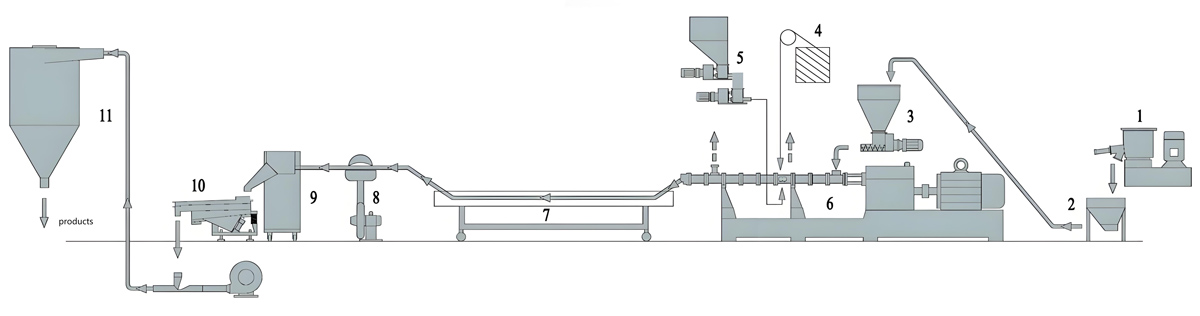
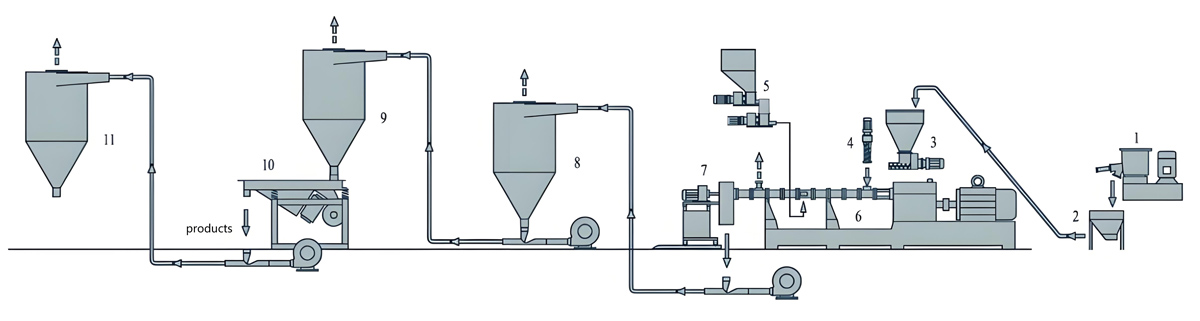
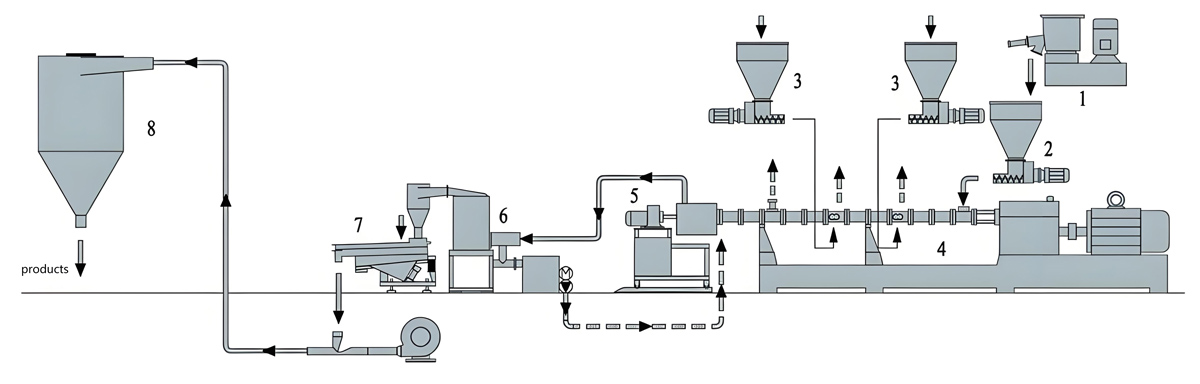
The production process for plastic softening masterbatch requires careful attention to temperature control, residence time, and feeding accuracy to achieve optimal dispersion of plasticizers while preventing degradation or volatilization. Automatic lubrication systems enhance equipment reliability for continuous operation.
Material Preparation and Drying
Carrier resins must be dried to appropriate moisture levels before processing to prevent hydrolysis and ensure optimal processing. Polyolefin resins typically require moisture content below 0.05%, achieved through dehumidifying drying at 70-90°C for 2-3 hours. PVC resins may require drying at 50-70°C for 1-2 hours, depending on resin grade and moisture sensitivity.
Plasticizers and other liquid components should be filtered to remove any particulate contamination before introduction to the extruder. Filtration through 10-25 micron filters helps prevent nozzle blockages and equipment contamination. Liquid components should be stored in temperature-controlled environments to maintain consistent viscosity and prevent phase separation.
Premixing of solid additives such as thermal stabilizers, UV stabilizers, and compatibility enhancers is recommended to ensure uniform distribution. High-speed mixing at 800-1200 RPM for 3-5 minutes typically achieves adequate premixing while avoiding excessive heat generation that could cause premature reaction.
Feeding System Configuration
Softening masterbatch production requires multiple feeding points to accommodate different material types. Carrier resins and solid additives are typically fed through the main hopper using gravimetric feeders with accuracy within ±0.5%. Liquid plasticizers are introduced through liquid injection ports located in the melting zone using precision metering pumps.
Feeding rates must be carefully coordinated to maintain consistent formulation ratios throughout production. The total plasticizer content of 30-50% requires precise liquid feeding, typically using pumps with flow control accuracy within ±1% of setpoint. The liquid injection point should be located where the polymer is partially melted but not fully dispersed to ensure efficient plasticizer incorporation.
For formulations containing multiple liquid components, separate injection ports may be required to prevent premature reaction or incompatibility. The automatic lubrication system provides reliable equipment operation despite the lubricating nature of the formulation, reducing the risk of bearing wear or drive system issues.
Melting and Plasticizing Stage
The initial melting and plasticizing stage must achieve complete polymer melting without excessive thermal exposure that could cause plasticizer degradation. Temperature profiles typically start at 140-160°C in the feeding zone, progressing to 170-190°C in the melting zone. The exact temperatures depend on the specific polymer and plasticizer types.
For PVC-based formulations, lower temperature profiles are required to prevent PVC degradation. Typical PVC melting temperatures range from 150-170°C, with careful attention to residence time to prevent thermal degradation. The automatic lubrication system ensures consistent screw operation despite the thermal sensitivity of PVC.
For polyolefin-based formulations, higher temperatures up to 200-220°C may be employed. However, formulations containing volatile plasticizers require temperature optimization to prevent plasticizer loss. The automatic lubrication system maintains equipment performance even when processing at the upper temperature limits required for polyolefins.
Plasticizer Incorporation and Dispersion
The plasticizer incorporation zone represents the critical stage where liquid plasticizers are dispersed throughout the polymer matrix. This zone typically comprises 8-12 barrel diameters and is equipped with intense mixing elements to achieve homogeneous plasticizer distribution.
Mixing intensity must be sufficient to break up plasticizer droplets and achieve uniform dispersion without generating excessive shear heating that could degrade sensitive plasticizers. Screw configuration typically includes kneading blocks at staggered angles to provide both dispersive and distributive mixing.
The automatic lubrication system is particularly valuable during this high-shear mixing stage, as it ensures continuous lubrication of drive components under high torque loads. This reduces equipment wear and enables consistent mixing performance over extended production runs.
Vacuum Degassing
Softening masterbatch formulations often contain volatile components or entrapped air that must be removed to prevent defects in the final product. Vacuum degassing at 20-30 mbar in the dedicated vent zone removes volatile components and air bubbles.
For formulations containing high-volatility plasticizers such as ATBC or TBC, careful control of vacuum level and location is critical. Excessive vacuum or vacuum applied too early in the process can cause plasticizer extraction and loss. The vent zone should be located after plasticizer dispersion is complete but before the die zone.
The automatic lubrication system provides reliable operation of vacuum pump drive systems, ensuring consistent vacuum levels throughout production. This helps maintain consistent product quality and prevents variations in plasticizer content due to vacuum fluctuations.
Pelletizing and Cooling
After extrusion through the die, strands are cooled in a water bath maintained at 20-30°C before pelletizing. Cooling must be rapid enough to solidify the strands but gradual enough to prevent thermal shock that could cause surface defects or internal stresses.
Pelletizing equipment must be designed to handle the soft, lubricated nature of softening masterbatch formulations. Strand cutters with sharp blades and appropriate tension control prevent strand stretching and pellet irregularities. The automatic lubrication system ensures consistent pelletizer operation despite the challenging material properties.
Dried pellets should be screened to remove fines and oversized particles before packaging. The screening process should be gentle to avoid pellet damage that could result from the soft nature of the masterbatch. Proper packaging in moisture-barrier bags prevents moisture absorption that could affect performance.
Production Equipment Introduction
Automatic lubrication twin screw extruders incorporate sophisticated lubrication systems that provide continuous, automatic lubrication of critical components. These systems enhance equipment reliability and reduce maintenance requirements, making them ideal for continuous softening masterbatch production.
KTE Series Automatic Lubrication Extruders
The KTE Series twin screw extruders from Kerke Extrusion Equipment Company include models with fully automatic lubrication systems. The KTE-45AL model with 45mm screw diameter provides production capacities from 200-400 kg/hr for softening masterbatch formulations. The KTE-60AL model with 60mm screw diameter achieves 400-700 kg/hr. The KTE-75AL model with 75mm screw diameter provides 600-1000 kg/hr.
All automatic lubrication models feature L/D ratios of 40:1 to 44:1, providing sufficient mixing length for softening formulations. The automatic lubrication systems serve the main gearbox, thrust bearings, side feeder drives, and pelletizer drives, ensuring comprehensive coverage of all critical lubrication points.
Automatic Lubrication System Design
Modern automatic lubrication systems employ centralized lubrication pumps that deliver precise amounts of lubricant to multiple lubrication points through metering valves. The system operates continuously or in timed intervals depending on the specific equipment design and operating conditions.
Lubricant delivery rates are typically calibrated based on operating conditions such as screw speed, torque load, and ambient temperature. Advanced systems adjust delivery rates automatically based on real-time monitoring of operating parameters, ensuring optimal lubrication under all conditions.
The lubrication system includes reservoir level monitoring, flow monitoring, and pressure monitoring to ensure proper operation. Alarms alert operators to low lubricant levels, flow restrictions, or pressure anomalies that could indicate problems requiring attention.
Lubricant Selection and Management
Selection of appropriate lubricants is critical for automatic lubrication system performance. High-performance synthetic lubricants with appropriate viscosity, thermal stability, and extreme pressure properties are typically specified for gearbox and bearing applications. The specific lubricant type depends on the equipment design and operating conditions.
Lubricant change intervals are extended compared to manual lubrication systems due to the controlled delivery and reduced contamination. Typical change intervals range from 2000-4000 hours of operation, depending on the specific lubricant and operating conditions. The automatic system reduces lubricant consumption by delivering precise amounts rather than over-lubricating common with manual systems.
Lubricant reservoirs typically range from 5-20 liters capacity depending on equipment size and number of lubrication points. Reservoir level indicators and alarms ensure operators are alerted before lubricant levels become critically low, preventing inadequate lubrication.
System Monitoring and Control
Modern automatic lubrication systems incorporate comprehensive monitoring and control features that enable operators to verify proper system operation. Digital displays show lubrication system status, including pump operation, flow rates to individual lubrication points, reservoir levels, and pressure readings.
Alarm systems alert operators to potential problems such as low lubricant levels, pump failures, flow restrictions, or pressure anomalies. The alarms provide early warning of developing problems, enabling corrective action before equipment damage occurs.
Advanced systems may integrate with the main extruder control system, providing centralized monitoring of lubrication system status along with other process parameters. This integration enables comprehensive equipment monitoring from a single interface.
Advantages of Automatic Lubrication
Automatic lubrication provides numerous advantages over manual lubrication methods. Continuous lubrication eliminates the risk of inadequate lubrication between manual lubrication intervals. Precise metering ensures optimal lubricant quantity at each point, preventing both under-lubrication and over-lubrication.
Reduced maintenance requirements result from consistent, appropriate lubrication that extends component life. Automatic systems eliminate the risk of missed lubrication points or lubrication at incorrect intervals common with manual systems. This reduces maintenance downtime and extends time between component replacements.
Improved equipment reliability results from consistent, optimal lubrication under all operating conditions. The automatic system adjusts to varying operating conditions, ensuring appropriate lubrication regardless of production rate, torque load, or ambient conditions. This reliability is particularly valuable for continuous operation required in commercial softening masterbatch production.
Parameter Settings
Optimal parameter settings for softening masterbatch production must balance dispersion quality with plasticizer preservation. The automatic lubrication system enables reliable operation over a wide parameter range.
Temperature Profile Optimization
Temperature profiles for softening masterbatch vary based on polymer type and plasticizer thermal stability. For PVC-based formulations with phthalate plasticizers, typical profiles include: feed zone 150°C, melting zone 165°C, plasticizer incorporation zone 170-175°C, vacuum zone 175°C, and die zone 170-175°C.
Polyolefin-based formulations with non-phthalate plasticizers such as DOTP may employ higher profiles: feed zone 160°C, melting zone 180°C, plasticizer incorporation zone 190-200°C, vacuum zone 195°C, and die zone 190°C. However, formulations with volatile plasticizers require lower temperatures to prevent plasticizer loss.
Temperature control accuracy within ±1°C is important to prevent plasticizer degradation. The automatic lubrication system ensures consistent equipment operation across the required temperature range, preventing thermal variations that could affect product quality.
Screw Speed Selection
Screw speed optimization for softening masterbatch must balance dispersion quality with residence time control. Typical screw speeds range from 200-400 RPM depending on equipment size and formulation characteristics. Higher speeds provide better mixing but increase residence time reduction and shear heating.
For formulations requiring high dispersion quality such as those with compatibility enhancers or multiple plasticizers, higher screw speeds (300-400 RPM) may be beneficial. For formulations with volatile or thermally sensitive plasticizers, lower speeds (200-250 RPM) reduce residence time and thermal exposure.
The automatic lubrication system maintains consistent operation across the screw speed range, preventing the lubrication problems that could occur with manual systems when operating speeds change significantly.
Feeding Rate Control
Feeding rate accuracy is critical for maintaining consistent plasticizer content. Main feeder rates typically range from 50-500 kg/hr depending on equipment size and production requirements. Liquid plasticizer feeders typically deliver 15-250 kg/hr based on formulation requirements.
Feeding accuracy within ±0.5% for main feeders and ±1% for liquid feeders is typically required for consistent product quality. The automatic lubrication system prevents feeding equipment lubrication problems that could affect feeder accuracy.
Feeding rate optimization requires balancing production throughput with adequate residence time for plasticizer dispersion. Higher throughput rates reduce residence time but may compromise dispersion quality if not properly balanced with screw speed and screw configuration.
Vacuum Level Control
Vacuum level optimization depends on the volatile content of the formulation and the required degree of degassing. Typical vacuum levels range from 20-30 mbar for general applications, while formulations with high volatile content may require 10-15 mbar to achieve adequate degassing.
However, vacuum level must be balanced against the risk of plasticizer extraction. Excessive vacuum can strip volatile plasticizers from the melt, causing composition changes and product quality problems. The vacuum location must be after plasticizer dispersion is complete but before final melt formation.
The automatic lubrication system ensures reliable vacuum pump operation, maintaining consistent vacuum levels throughout production runs. This prevents variations in degassing effectiveness that could affect product quality.
Die Design and Pressure
Die design for softening masterbatch must accommodate the lubricated nature of the material and ensure uniform strand formation. Die pressures typically range from 40-80 bar depending on formulation viscosity and production rate. Higher pressures improve strand uniformity but increase energy consumption.
Die hole diameters typically range from 2-4 mm with 4-8 holes per die depending on production rate and pellet size requirements. The die must be designed to provide equal flow through all holes, preventing strand size variations.
The automatic lubrication system ensures consistent die operation by providing proper lubrication to die drive components. This helps maintain uniform flow and prevents the strand irregularities that could result from equipment variations.
Equipment Pricing
Investment in automatic lubrication twin screw extruder equipment includes the extruder with lubrication system, auxiliary equipment, and installation costs. The automatic lubrication capability adds value but also increases initial investment.
Main Extruder Cost
KTE Series automatic lubrication twin screw extruders represent premium equipment with advanced lubrication systems. The KTE-45AL model with 45mm screw diameter typically costs from $280,000 to $380,000. The KTE-60AL model with 60mm screw diameter ranges from $420,000 to $580,000. The KTE-75AL model with 75mm screw diameter typically costs from $650,000 to $880,000.
These prices include the complete extruder with automatic lubrication system, main control panel, and standard features. Additional options such as advanced monitoring systems, specialized feeding equipment, or enhanced vacuum capabilities add to the base price.
Lubrication System Components
The automatic lubrication system represents a significant portion of the total equipment cost. Central lubrication pump systems with metering valves and distribution lines cost from $15,000 to $35,000 depending on the number of lubrication points and system sophistication.
Lubricant monitoring and alarm systems add $5,000 to $12,000 depending on the level of monitoring and integration with the main control system. Advanced systems with automatic adjustment based on operating conditions represent the upper end of this range.
Initial lubricant charge and installation accessories typically add $3,000 to $8,000 depending on equipment size and lubricant capacity requirements.
Auxiliary Equipment
Complete production lines require auxiliary equipment in addition to the main extruder. Material drying systems cost from $25,000 to $60,000 depending on capacity and drying requirements. Feeding systems including main feeder and liquid injection pumps cost from $40,000 to $90,000.
Pelletizing systems with strand cutters and cooling equipment cost from $35,000 to $75,000. Vacuum systems for degassing cost from $20,000 to $45,000 depending on pump capacity and vacuum level requirements.
Total Investment
Complete production lines for softening masterbatch including automatic lubrication extruder and all auxiliary equipment typically represent investments from $500,000 to $1,200,000. The specific investment depends on production capacity, level of automation, and specific equipment options selected.
Installation, commissioning, and initial operator training typically add 8% to 12% to the base equipment cost. These costs should be included when planning total capital investment.
Production Problems and Solutions
Softening masterbatch production presents unique challenges due to the lubricating nature of formulation components and the thermal sensitivity of plasticizers. Automatic lubrication systems help address equipment-related problems but other issues require attention.
Plasticizer Volatilization
Problem Description: Plasticizer loss during processing causes composition changes and reduced softening effectiveness. This problem appears as changes in plasticizer content measured by analytical testing or variations in product hardness.
Causes: Excessive processing temperature causes plasticizer evaporation. Extended residence time at elevated temperatures increases volatilization. Excessive vacuum in degassing zone extracts plasticizers from the melt. Inadequate condensing of volatiles in vacuum system allows plasticizer loss.
Solutions: Reduce temperature profile, particularly in melting and plasticizer incorporation zones. Increase throughput rate or reduce screw speed to decrease residence time. Adjust vacuum level to the minimum required for adequate degassing. Install efficient condensing system to recover volatiles from vacuum system.
Prevention Methods: Establish maximum temperature limits based on plasticizer volatility specifications. Monitor plasticizer content regularly to detect losses before they affect product quality. Install automatic vacuum level control to maintain optimal degassing conditions. Use condensing systems with appropriate refrigerant temperatures for efficient volatile recovery.
Inadequate Plasticizer Dispersion
Problem Description: Non-uniform distribution of plasticizer throughout the polymer matrix causes inconsistent softening performance and visible defects in final products. This problem often accompanies insufficient mixing or inappropriate screw configuration.
Causes: Insufficient mixing elements in plasticizer incorporation zone. Screw speed too low to generate adequate shear for droplet breakup. Plasticizer injection point located too far upstream or downstream. Temperature profile too low to maintain appropriate melt viscosity for mixing.
Solutions: Increase mixing element density in plasticizer incorporation zone. Optimize screw speed to achieve appropriate mixing intensity. Relocate plasticizer injection point to optimal location. Adjust temperature profile to provide appropriate viscosity for mixing.
Prevention Methods: Develop screw configurations optimized for plasticizer dispersion. Establish standard screw configurations for each formulation type. Monitor product hardness and dispersion quality regularly. Implement process control based on melt viscosity or other dispersion indicators.
Component Wear from Lubricating Formulations
Problem Description: Premature wear of screw elements, barrel liners, and other processing components caused by the lubricating nature of softening formulations. This appears as increased clearances, reduced mixing efficiency, and eventual product quality problems.
Causes: Plasticizer and other lubricating components reduce boundary lubrication on metal surfaces. High plasticizer content reduces friction needed for certain mixing elements. Inadequate mixing element design for lubricated materials. Operation at high speeds with lubricated materials.
Solutions: Use wear-resistant materials for screw elements and barrel liners. Optimize screw configuration for lubricated materials. Reduce operating speed to acceptable levels. Implement regular monitoring of component clearances.
Prevention Methods: Select equipment designed for lubricated materials. Implement regular inspection and monitoring of component condition. Use appropriate screw configurations optimized for softening formulations. Establish replacement schedules based on actual wear rather than fixed time intervals.
Material Slip in Feeding Zone
Problem Description: Lubricating materials slip on barrel surfaces in the feeding zone, causing feeding instability and throughput variations. This problem appears as fluctuations in feed rate and production rate despite constant feeder settings.
Causes: Low coefficient of friction of lubricated materials on metal surfaces. Smooth barrel surfaces in feeding zone. Inappropriate screw element design for feeding lubricated materials. Material pre-coating with lubricants before reaching extruder.
Solutions: Use grooved or textured barrel surfaces in feeding zone. Employ special feeding elements with better grip. Optimize material handling to prevent pre-lubrication. Adjust screw element design to improve material grip.
Prevention Methods: Select equipment with appropriate feeding zone design for lubricated materials. Monitor feed rate consistency and adjust as needed. Implement material handling procedures that prevent pre-lubrication. Use feeder designs optimized for lubricated materials.
Sticking in Cooling System
Problem Description: Strands stick together in cooling water bath or to cooling system components, causing processing problems and product defects. This problem often occurs with highly lubricated formulations.
Causes: Inadequate cooling water flow causes soft strands to stick. Insufficient cooling bath length allows strands to remain soft. Plasticizer migration to strand surface increases stickiness. Water bath design causes strand contact and sticking.
Solutions: Increase cooling water flow rate. Extend cooling bath length to ensure complete solidification. Optimize formulation to reduce plasticizer migration. Improve cooling bath design to prevent strand contact.
Prevention Methods: Monitor cooling water temperature and flow rate. Use adequate cooling bath length for formulation requirements. Develop formulations with appropriate plasticizer migration characteristics. Implement proper water bath design with appropriate strand separation.
Lubrication System Failures
Problem Description: Automatic lubrication system failures can cause inadequate lubrication and equipment damage. These failures may be gradual or sudden and require immediate attention to prevent equipment damage.
Causes: Lubricant reservoir runs dry. Pump failure or motor problems. Clogged lubricant lines or metering valves. Electrical system failures. Lubricant contamination causing system blockage.
Solutions: Refill lubricant reservoir immediately. Replace failed pump or repair motor. Clear blocked lines or replace metering valves. Repair electrical system. Drain contaminated lubricant and refill with fresh lubricant.
Prevention Methods: Monitor lubricant reservoir level regularly and refill before reaching critically low levels. Perform regular lubrication system maintenance including pump inspection and line clearing. Monitor lubrication system alarms and address problems immediately. Use appropriate lubricant types and prevent contamination.
Maintenance and Care
Automatic lubrication twin screw extruders require comprehensive maintenance programs that address both the lubrication system and general equipment maintenance. The automatic system reduces manual lubrication requirements but requires specific maintenance procedures.
Daily Maintenance Procedures
Daily maintenance should include verification of automatic lubrication system operation. Check lubricant reservoir levels and refill if necessary. Verify that lubrication system pumps are operating and that lubricant is flowing to all lubrication points. Check for any lubricant leaks and address immediately.
Monitor lubrication system alarms and indicators. Address any alarms indicating low lubricant levels, pump failures, flow restrictions, or pressure anomalies. Document all observations and maintenance actions in maintenance logs.
Perform general equipment inspection including checking for unusual noises, vibrations, or temperature indications. Verify that all safety systems are functioning properly.
Weekly Maintenance Activities
Weekly maintenance should include detailed inspection of lubrication system components. Check lubricant filters and clean or replace if necessary. Inspect lubrication lines and metering valves for leaks or damage. Verify that lubricant flow rates to individual lubrication points are within specified ranges.
Perform lubricant quality checks including visual inspection for contamination, viscosity measurement if appropriate, and testing for water contamination if the system is exposed to moisture. Replace lubricant if contamination is detected or if the lubricant has exceeded its service life.
Check automatic lubrication system control and monitoring systems. Verify that alarms are functioning properly and that system settings are appropriate for current operating conditions.
Monthly Maintenance Tasks
Monthly maintenance should include lubrication system pump inspection and testing. Check pump operation, inspect seals and bearings, and verify that the pump delivers appropriate pressure and flow. Perform pump maintenance or repairs as indicated by inspection results.
Inspect lubrication system reservoirs for signs of contamination, corrosion, or other problems. Clean reservoirs as necessary and replace worn components. Verify that reservoir vents and breathers are functioning properly.
Review lubrication system performance data including delivery rates, operating hours, and maintenance history. Use this data to optimize maintenance intervals and identify potential problems before they cause failures.
Quarterly Maintenance Requirements
Quarterly maintenance should include complete lubrication system overhaul if operating hours warrant it. This may include pump rebuild or replacement, line replacement, and metering valve replacement. Perform lubricant sampling and laboratory analysis to determine condition and remaining service life.
Inspect all lubricated components including gearboxes, bearings, and other points receiving automatic lubrication. Check for signs of inadequate lubrication, excessive wear, or other problems. Address any issues identified during inspection.
Review automatic lubrication system settings and adjust based on operating experience. Optimize lubrication intervals and delivery rates based on actual component condition and operating conditions.
Semi-Annual and Annual Maintenance
Semi-annual maintenance should include comprehensive lubrication system inspection and testing. Perform complete system pressure testing to verify integrity of lines, connections, and components. Replace components showing signs of wear or approaching end of service life.
Annual maintenance should include complete lubricant replacement regardless of condition to ensure fresh lubricant and remove any accumulated contaminants. Perform complete system inspection and replacement of any components showing wear or approaching end of expected service life.
Review automatic lubrication system performance over the past year and optimize settings and maintenance procedures based on this experience. Update maintenance schedules and procedures based on actual performance and component condition.
FAQ
What are the main advantages of automatic lubrication for softening masterbatch production?
Automatic lubrication provides continuous, consistent lubrication that eliminates the risk of inadequate lubrication between manual intervals. Precise metering ensures optimal lubricant quantity at each point, preventing both under-lubrication and over-lubrication. This results in extended component life, reduced maintenance downtime, and improved equipment reliability. Automatic lubrication is particularly valuable for continuous operation required in commercial production.
How do I prevent plasticizer volatilization during processing?
Preventing plasticizer volatilization requires careful temperature control, residence time optimization, and appropriate vacuum system design. Use the lowest effective temperature profile based on plasticizer thermal stability specifications. Optimize throughput and screw speed to minimize residence time at elevated temperatures. Use appropriate vacuum levels and efficient condensing systems to recover volatiles. Regular monitoring of plasticizer content helps detect losses before they affect product quality.
What causes inadequate plasticizer dispersion and how do I correct it?
Inadequate dispersion typically results from insufficient mixing elements in the plasticizer incorporation zone, inappropriate screw speed, or suboptimal plasticizer injection point location. Solutions include increasing mixing element density, optimizing screw speed for appropriate mixing intensity, and relocating injection point. Temperature profile optimization to provide appropriate melt viscosity also improves dispersion. Regular monitoring of product hardness and dispersion quality helps identify problems early.
How often should lubricant be replaced in automatic lubrication systems?
Lubricant replacement intervals vary based on operating conditions and lubricant type. Synthetic lubricants typically require replacement every 2000-4000 hours of operation, while mineral oil lubricants may require more frequent replacement. Regular lubricant analysis helps determine remaining service life and optimize replacement intervals. More frequent replacement may be required for high-temperature operations or when processing lubricating materials that could contaminate the lubricant.
What maintenance does the automatic lubrication system require?
Daily maintenance includes checking reservoir levels and verifying system operation. Weekly maintenance includes inspecting filters, lines, and metering valves. Monthly maintenance includes pump inspection and lubricant quality checks. Quarterly maintenance may include system overhaul and lubricant sampling. Annual maintenance typically includes complete lubricant replacement and comprehensive system inspection. Regular monitoring of system alarms and performance helps identify problems early.
How do I prevent material slip in the feeding zone?
Preventing material slip requires appropriate equipment design and operating procedures. Select equipment with grooved or textured barrel surfaces in the feeding zone designed for lubricated materials. Use feeding elements optimized for lubricated materials with good gripping characteristics. Prevent material pre-lubrication through proper material handling. Monitor feed rate consistency and adjust as needed. Use feeder systems designed for lubricated materials.
What are typical production capacities for softening masterbatch?
Production capacities vary based on equipment size and formulation characteristics. KTE-45AL models with 45mm screws typically produce 200-400 kg/hr. KTE-60AL models with 60mm screws produce 400-700 kg/hr. KTE-75AL models with 75mm screws produce 600-1000 kg/hr. The specific capacity depends on formulation viscosity, plasticizer content, and desired residence time. Higher plasticizer content formulations typically allow higher production rates.
How do I select the appropriate temperature profile?
Temperature profile selection depends on polymer type and plasticizer thermal stability. PVC-based formulations require lower temperatures, typically 150-175°C, to prevent degradation. Polyolefin-based formulations may tolerate higher temperatures, up to 200-220°C, depending on plasticizer type. Formulations with volatile plasticizers require lower temperatures to prevent plasticizer loss. The profile should be optimized for complete melting and plasticizer dispersion without excessive thermal exposure.
What is the return on investment for automatic lubrication equipment?
Return on investment for automatic lubrication equipment comes from multiple sources including extended component life, reduced maintenance downtime, improved product quality consistency, and reduced labor requirements for lubrication. The typical payback period for automatic lubrication capability ranges from 12 to 24 months depending on production volume and operating conditions. The benefits increase over time as component life extensions accumulate and maintenance optimization is achieved.
Conclusion
Automatic lubrication twin screw extruders provide advanced capabilities essential for efficient, consistent production of plastic softening masterbatch. The KTE Series automatic lubrication models from Kerke Extrusion Equipment Company incorporate sophisticated lubrication systems that enhance equipment reliability, reduce maintenance requirements, and enable continuous operation.
Success in softening masterbatch production requires understanding of plasticizer mechanisms, formulation development based on application requirements, and optimization of processing parameters to achieve appropriate dispersion while preserving plasticizer content. Automatic lubrication systems provide the equipment reliability necessary for commercial production of these demanding formulations.
As industries continue demanding specialized softening materials for applications ranging from medical devices to flexible packaging, the market for softening masterbatch will continue growing. Manufacturers who invest in advanced automatic lubrication equipment and develop comprehensive process expertise will maintain competitive advantages in this technically demanding market segment.