Introduction
PET calcium carbonate filled masterbatch has become an essential component in polymer industry, offering manufacturers an effective solution to enhance material performance while controlling production costs. The manufacturing process demands sophisticated twin screw extruder technology combined with precise process control to achieve consistent quality and optimal dispersion of calcium carbonate particles within the PET matrix.
The unique properties of PET, including its high melting point, sensitivity to moisture, and tendency to hydrolyze, present specific challenges when processing filled masterbatch. Understanding these characteristics and implementing appropriate processing strategies is crucial for successful production. This detailed guide explores every aspect of twin screw extruder operation for PET calcium carbonate filled masterbatch manufacturing, from initial formulation to final quality control.
Calcium carbonate serves as an excellent filler for PET applications, providing improved stiffness, reduced material costs, and enhanced dimensional stability. However, achieving uniform dispersion while preventing PET degradation requires specialized equipment configurations and optimized processing parameters. The information presented here will help producers establish efficient manufacturing processes and overcome common production challenges.
Formulation Ratios for PET Calcium Carbonate Filled Masterbatch
Calcium Carbonate Loading Variations
The formulation of PET calcium carbonate filled masterbatch varies according to the intended application and performance requirements. Standard loading levels typically range from 15% to 60% by weight, with specific formulations designed for different end uses:
Low Concentration (15-25% CaCO3): This formulation maintains excellent clarity and mechanical properties while providing modest cost savings. Suitable for applications where transparency and surface finish are critical, such as packaging materials and clear consumer products.
Medium Concentration (30-40% CaCO3): The most commonly used range in industrial applications. This concentration provides significant cost reduction while maintaining acceptable mechanical properties and processability. Ideal for automotive components, household goods, and industrial parts.
High Concentration (45-60% CaCO3): Designed for maximum cost efficiency in applications where mechanical properties are less critical. This formulation requires careful processing control to maintain adequate dispersion and prevent property deterioration. Suitable for pipe extrusion, profile applications, and construction materials.
PET Resin Selection and Considerations
PET grade selection is critical for masterbatch quality and processing behavior. For calcium carbonate filled masterbatch, PET resins with intrinsic viscosity (IV) between 0.60-0.80 dl/g are typically preferred. Higher viscosity grades provide better melt strength but require higher processing temperatures and may increase residence time demands.
The PET resin should have low initial moisture content and good thermal stability to withstand the additional shear stress from filler incorporation. PET copolymers containing minor amounts of CHDM or IPA can improve processing characteristics for filled applications.
Specialized Additives Package
Successful PET calcium carbonate formulations include carefully selected additives to enhance processing and final product performance:
Coupling Agents: Epoxy-functional or silane coupling agents at 0.5-2% improve interfacial adhesion between hydrophilic calcium carbonate and hydrophobic PET matrix. This enhancement significantly improves mechanical properties, particularly impact strength and tensile modulus.
Lubrication System: Internal lubricants such as ethylene bis stearamide (EBS) or erucamide at 0.5-1.5% reduce friction during processing, improving output rates and reducing equipment wear. These additives also help prevent die build-up and improve surface finish.
Processing Aids: Fluoropolymer-based processing aids at 0.1-0.3% enhance melt flow characteristics and reduce die pressure, particularly beneficial at high filler loadings where viscosity increases significantly.
Stabilization Package: Antioxidants, UV stabilizers, and hydrolysis stabilizers at 0.3-0.8% total provide necessary protection during processing and extend product service life. Hydrolysis stabilizers are particularly important for PET to prevent chain scission during processing.
Nucleating Agents: At 0.1-0.3%, nucleating agents can improve crystallization behavior of PET, potentially enhancing mechanical properties and reducing cycle times in subsequent molding operations.
Production Process Overview
Material Preparation and Pre-Processing
Effective PET calcium carbonate masterbatch production begins with rigorous material preparation. PET resin requires thorough drying to reduce moisture content below 0.005% (50 ppm) to prevent hydrolytic degradation during processing. Typical drying conditions are 140-150°C for 4-6 hours using dehumidifying dryers.
Calcium carbonate should be evaluated for moisture content, with surface moisture above 0.2% requiring drying at 100-110°C for 2-3 hours. All additives must be pre-weighed accurately according to formulation and pre-mixed to ensure uniform distribution before feeding.
Feeding Strategy and Material Introduction
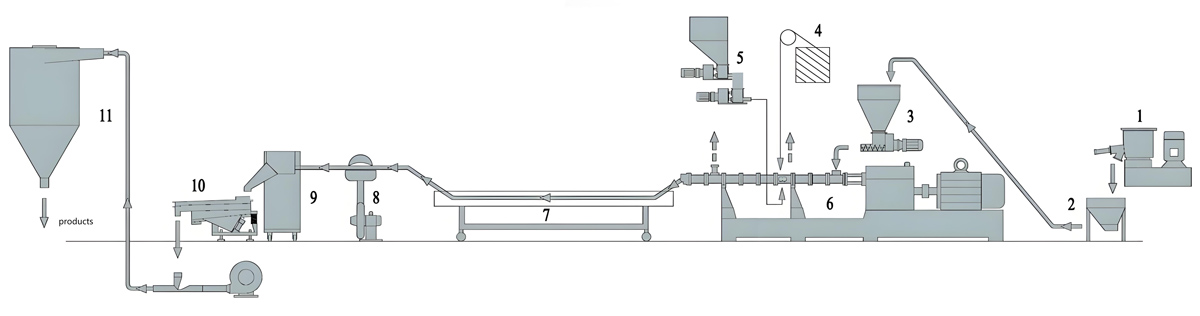
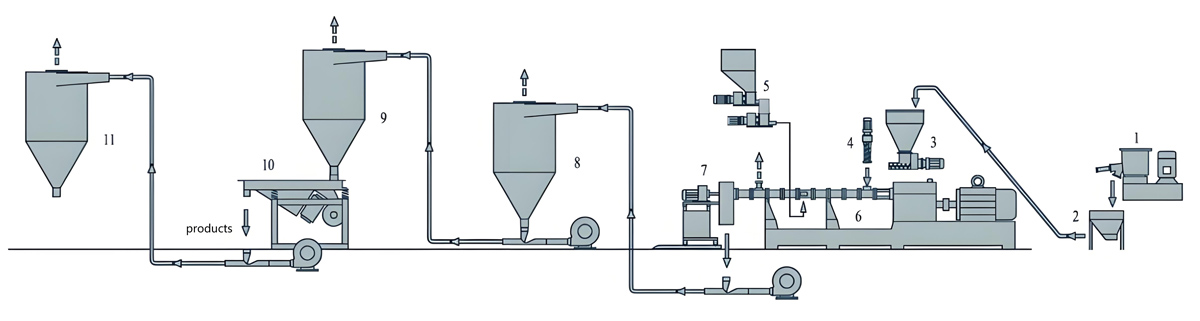
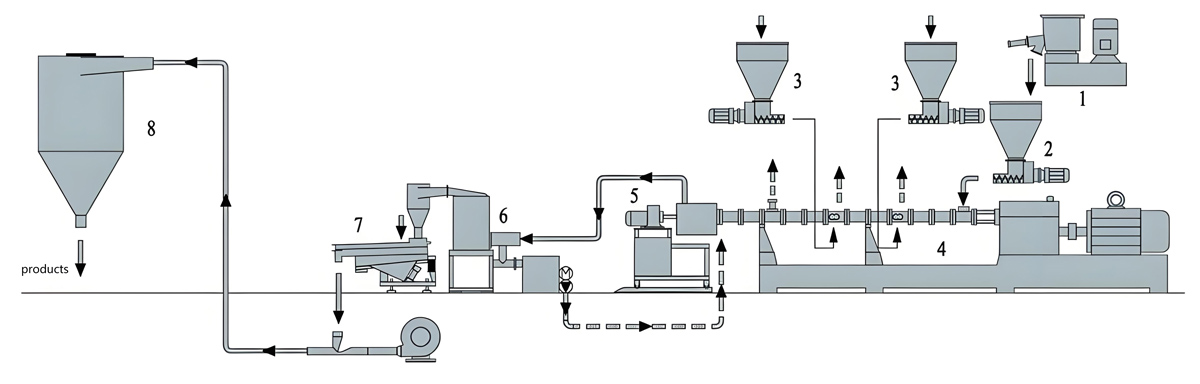
Modern production lines employ sophisticated feeding systems to ensure precise material metering. The primary feeding port receives the dried PET resin, typically through a gravimetric feeder for accurate throughput control. Downstream side feeders introduce the calcium carbonate and additives at optimal locations in the extrusion process.
Side feeding of fillers offers several advantages including reduced thermal exposure of sensitive additives, improved dispersion control, and prevention of premature filler degradation that could occur in high temperature melting zones.
Extruder Zone Configuration
PET calcium carbonate masterbatch production typically utilizes twin screw extruders with 10-14 processing zones. Zone configuration is optimized for the specific processing requirements:
Initial Zones (1-3): Focus on PET melting and initial homogenization. These zones operate at relatively high temperatures to ensure complete melting of PET before filler introduction.
Melting and Early Mixing Zones (4-6): Provide initial melting completion and start the mixing process. Screw elements in these zones balance conveying efficiency with gentle mixing.
Dispersion Zones (7-10): High shear zones designed to break down calcium carbonate agglomerates and achieve uniform distribution within the PET matrix. These zones typically include kneading blocks and other dispersive mixing elements.
Final Homogenization and Metering Zones (11-14): Complete dispersion and prepare the melt for pelletization. These zones focus on temperature uniformity and melt homogeneity.
Temperature Profile Optimization
PET requires careful temperature management due to its high melting point and thermal sensitivity. A typical temperature profile for PET calcium carbonate masterbatch production:
Zone 1 (Feed): 245-255°C
Zone 2-3 (Melting): 250-260°C
Zone 4-6 (Early Mixing): 255-265°C
Zone 7-10 (Dispersion): 260-270°C
Zone 11-14 (Metering/Die): 265-275°C
Die temperature should be maintained 5-10°C above the final melt temperature to ensure smooth flow. The exact profile may vary based on PET grade, filler loading, and throughput requirements.
Screw Speed and Throughput Management
Screw speed significantly influences mixing quality and production efficiency. For PET calcium carbonate masterbatch, screw speeds between 150-300 RPM are typical, balancing dispersion quality with thermal considerations. Higher screw speeds generally improve dispersion through increased shear but reduce residence time and increase melt temperature through viscous heating.
Throughput rates range from 30-250 kg/h depending on extruder size and formulation. Finding the optimal balance between screw speed and throughput (specific throughput) is crucial for achieving consistent quality and production efficiency.
Pelletization System Configuration
Strand or water ring pelletizers are commonly used for PET calcium carbonate masterbatch. Strand pelletizers offer better process control but require more space and water usage. Water ring pelletizers provide compact operation and immediate solidification but may produce less uniform pellet size at very high viscosities.
The pelletization system must handle higher melt temperatures and potentially higher viscosities compared to unfilled PET. Pellets should be cooled rapidly to prevent crystallization that could affect subsequent processing.
Production Equipment Specifications
Twin Screw Extruder Selection
The production of PET calcium carbonate filled masterbatch requires specialized twin screw extruder equipment designed to handle high processing temperatures and abrasive fillers. KTE Series twin screw extruders are particularly suitable for this application due to their robust construction and temperature management capabilities.
Extruder Design Features
KTE Series extruders for PET applications feature co-rotating twin screw configurations with L/D ratios between 32:1 and 40:1, providing adequate mixing length while managing residence time for heat-sensitive PET. Screw diameters range from 25mm to 75mm, corresponding to production capacities from 25 kg/h to 300 kg/h.
The barrel construction includes reinforced heating zones capable of reaching 300°C to handle PET melting requirements. The heating system provides precise temperature control with minimal overshoot, critical for preventing PET thermal degradation.
Feeding System Integration
Advanced feeding systems include separate gravimetric feeders for PET resin and calcium carbonate to maintain precise formulation control. The PET feeder typically includes integrated drying capability to maintain resin moisture content below critical levels during continuous operation.
Side feeding systems enable introduction of calcium carbonate at optimal locations in the extruder, reducing thermal exposure and improving dispersion efficiency. These systems are designed to handle abrasive materials without excessive wear.
Screw and Barrel Construction
Barrel and screw components are manufactured from hardened materials to withstand abrasive calcium carbonate and high processing temperatures. Barrel liners feature specialized coatings to reduce wear and improve thermal transfer efficiency. Screw elements are constructed from tool steel with surface hardening treatments to extend service life.
The modular screw design allows optimization of element configuration for specific processing requirements, with particular attention to dispersion elements that provide adequate shear while minimizing excessive temperature rise.
Temperature Control System
Precise temperature control is achieved through electric heating zones with multiple heating cartridges per zone for uniform heat distribution. PID controllers with advanced algorithms provide precise temperature regulation with minimal fluctuation. The control system includes multiple thermocouples per zone for redundancy and improved accuracy.
Cooling systems utilize both air and water cooling capabilities, with automatic control providing rapid temperature adjustment when needed. This dual cooling approach handles both routine operation and emergency cooling requirements.
Die and Pelletizing Equipment
The die system typically features multi-strand designs optimized for filled PET melt characteristics. Flow channels are designed to minimize pressure drop while ensuring uniform distribution across strands. Die faces are manufactured from hardened materials to withstand abrasive filler wear.
Water ring pelletizers include adjustable knife assemblies to maintain consistent pellet size. Water temperature control systems maintain optimal pellet solidification conditions. Automatic deburring and filtration systems remove pellet strings and maintain water quality.
Parameter Optimization Guide
Screw Configuration Strategies
Effective screw configuration for PET calcium carbonate masterbatch incorporates specialized elements:
Melting Zone Elements: Large-pitch conveying elements in feed zones ensure reliable material transport and prevent bridging. These elements are designed to handle high-friction PET resin.
Transition Zone Design: Elements with decreasing pitch provide compression and melting efficiency. The transition zone typically includes a mix of conveying and mild mixing elements.
Dispersion Zone Configuration: Multiple kneading block assemblies with varied staggers provide dispersive mixing. For calcium carbonate, 60° staggered blocks provide aggressive dispersion. The number and position of these elements depend on filler loading and required dispersion quality.
Homogenization Zone: Downstream gear mixers or combing mixers complete dispersion and ensure melt homogeneity. These elements provide distributive mixing without excessive shear heating.
Temperature Profile Optimization
Temperature profiles must balance complete PET melting and mixing with prevention of thermal degradation. Higher temperatures improve filler wetting and reduce melt viscosity but increase the risk of PET hydrolysis and degradation. The optimal profile depends on specific PET grade, moisture content, and calcium carbonate loading.
For moisture-sensitive PET, the temperature profile may be slightly lower to reduce thermal stress, particularly in final zones where residence time is longer. Adding hydrolysis stabilizers can enable higher processing temperatures if needed for improved dispersion.
Throughput and Screw Speed Optimization
The specific throughput (kg/h/RPM) significantly influences mixing quality and thermal conditions. Lower specific throughput generally improves dispersion by providing more mixing energy per unit material but increases residence time and may increase thermal degradation risk.
Finding the optimal balance requires monitoring both dispersion quality and material properties. Process parameters should be documented and controlled within tight tolerances to ensure consistent product quality.
Vacuum Venting Configuration
PET processing releases acetaldehyde and other volatiles that must be removed to prevent product quality issues. Vacuum venting between 500-700 mbar absolute pressure removes these volatiles efficiently. The vent port location follows major mixing zones where volatiles are released but provides sufficient residence time for venting before discharge.
Multiple vent ports may be used for high-volatility formulations, with staged venting providing improved removal efficiency. The vent system should include filtration to prevent filler material from being extracted.
Equipment Investment Analysis
Twin Screw Extruder Cost Structure
Investment costs for twin screw extruders vary based on capacity and configuration complexity:
Laboratory Scale (25-30mm screw): $30,000 – $50,000
Pilot Production (35-45mm screw): $55,000 – $100,000
Industrial Scale (55-75mm screw): $130,000 – $280,000
Specialized PET Processing Features: $15,000 – $40,000 additional for enhanced temperature capabilities and moisture control systems.
Auxiliary Equipment Costs
Complete production lines require significant auxiliary investment:
Drying Systems: $20,000 – $45,000 for dehumidifying dryers capable of handling PET requirements.
Feeding Systems: $12,000 – $30,000 for gravimetric feeding with multiple feeder stations.
Pelletizing Systems: $15,000 – $40,000 for strand or water ring systems suitable for filled PET.
Control Systems: $8,000 – $20,000 for advanced control with recipe management.
Environmental Controls: $10,000 – $25,000 for temperature and humidity control.
Total Production Line Investment
Complete PET calcium carbonate masterbatch production lines typically range from $95,000 for small capacity systems to over $450,000 for large-scale industrial installations. Additional investment may be required for quality control equipment, warehousing, and material handling systems.
Production Challenges and Solutions
PET Hydrolysis and Degradation
Problem Identification: PET hydrolysis manifests as yellowing, reduced molecular weight, increased acidity, and deterioration of mechanical properties. The masterbatch may show viscosity reduction and poor processing characteristics in subsequent applications.
Root Causes: Inadequate resin drying allowing hydrolysis during processing. Excessive barrel temperatures accelerating degradation. Overly long residence time providing thermal stress exposure. Poor venting failing to remove acetaldehyde and moisture. Raw material instability in PET resin or additives.
Solutions: Implement rigorous drying with moisture content verification below 50 ppm. Reduce barrel temperature profile to minimum required for processing. Optimize throughput to minimize residence time. Increase vacuum venting efficiency. Use hydrolysis-stabilized PET grades. Add stabilizers to formulation to extend thermal stability.
Prevention Methods: Install inline moisture monitoring to verify drying effectiveness. Use real-time melt viscosity monitoring to detect degradation early. Establish maximum residence time limits. Implement regular quality testing for molecular weight and color. Train operators on proper material handling and processing procedures.
Inadequate Filler Dispersion
Problem Identification: Poor dispersion appears as visible agglomerates, surface defects, inconsistent mechanical properties, and speckled appearance in final products. The masterbatch may show poor performance in subsequent processing operations.
Root Causes: Insufficient mixing energy due to low screw speed or inadequate kneading elements. Screw configuration not optimized for high aspect ratio fillers. Excessive throughput reducing specific mixing energy. Incorrect filler introduction point reducing residence time in dispersion zones. Filler agglomeration from improper storage or handling.
Solutions: Increase screw speed while monitoring thermal conditions. Redesign screw configuration adding more dispersive elements. Reduce throughput to increase specific mixing energy. Move filler introduction to earlier zone for longer dispersion time. Implement pre-dispersion of calcium carbonate before feeding. Use coupling agents to reduce required mixing energy.
Prevention Methods: Implement regular dispersion quality monitoring using microscopy. Establish standardized screw configurations for each formulation. Train operators on proper material handling to prevent agglomeration. Use appropriate filler grades with controlled particle size distribution. Implement quality control testing for dispersion effectiveness.
Die Build-up and Flow Issues
Problem Identification: Material accumulation on die face causing flow restrictions, pressure fluctuations, and pellet size variations. The die may show visible deposits and require frequent cleaning.
Root Causes: Low melt temperature causing increased viscosity. Improper die design creating flow restrictions. Excessive filler loading increasing viscosity. Inadequate lubrication in formulation. Poor screw configuration causing insufficient melt homogenization.
Solutions: Increase die temperature by 5-10°C. Redesign die with larger flow channels or improved geometry. Reduce filler loading or modify formulation. Increase lubricant content. Optimize screw configuration for better melt homogenization. Implement regular die cleaning schedule.
Prevention Methods: Use die designs optimized for filled materials. Maintain consistent processing parameters. Implement die surface treatments to reduce adhesion. Use processing aids in formulation to reduce die build-up. Monitor die pressure for early detection of flow issues.
Equipment Wear and Abrasion
Problem Identification: Progressive output reduction, decreased mixing efficiency, visible metal contamination, increased power consumption. Wear patterns appear on barrel and screw components.
Root Causes: Abrasive calcium carbonate particles causing mechanical wear. High filler loading accelerating wear rates. High screw speeds increasing mechanical stress. Inadequate material hardness in contacting components. Poor maintenance allowing wear to progress.
Solutions: Implement regular wear monitoring through dimensional inspection. Replace worn components before complete failure. Upgrade to harder materials such as tungsten carbide coatings. Reduce screw speed if wear rate is excessive. Optimize formulation to reduce abrasive effects if possible.
Prevention Methods: Use hardened wear-resistant materials for all calcium carbonate contacting components. Establish regular inspection and replacement schedules. Monitor output and quality as wear indicators. Use high quality filler with controlled particle hardness. Install filtration to capture metal contamination.
Color and Appearance Issues
Problem Identification: Inconsistent color, yellowing, or surface defects in masterbatch pellets. The material may show hazy or speckled appearance indicating processing problems.
Root Causes: PET thermal degradation causing yellowing. Inadequate dispersion creating visible particles. Contamination from equipment wear. Poor mixing of colorants if used. Overheating in specific zones creating hot spots.
Solutions: Reduce processing temperatures to prevent degradation. Improve dispersion through screw configuration optimization. Identify and eliminate contamination sources. Optimize mixing of colorants. Address hot spots through temperature control improvement.
Prevention Methods: Implement color quality control testing. Monitor processing parameters continuously. Use appropriate colorants designed for high temperature processing. Maintain equipment cleanliness. Train operators on visual quality inspection.
Maintenance and Operational Guidelines
Daily Maintenance Protocols
Daily maintenance ensures reliable operation and prevents unexpected downtime:
Visual Inspection: Check for unusual sounds, vibrations, or leaks during operation. Monitor amperage readings for changes indicating developing problems.
Temperature Monitoring: Verify all temperature zones operate within specified ranges. Check for proper heating and cooling operation and uniformity.
Feeding System Verification: Confirm feeders deliver material accurately at set rates. Clean feeder throats and ensure proper material flow.
Pelletizer Condition: Check pelletizer knives for wear and proper alignment. Verify water flow and temperature control in pelletizing system.
Housekeeping: Maintain clean equipment and work area to prevent contamination.
Weekly Maintenance Activities
Weekly maintenance addresses medium-term equipment needs:
Screw and Barrel Inspection: If feasible, visually inspect screw elements for wear patterns. Check barrel for signs of scoring or excessive wear.
Lubrication System: Apply lubrication according to manufacturer specifications. Check gearboxes for proper oil levels and condition.
Electrical System Check: Verify all electrical connections are secure. Test emergency stop systems and safety interlocks.
Cooling System Maintenance: Clean cooling system filters and check water quality. Inspect cooling lines for leaks or flow restrictions.
Control System Verification: Calibrate sensors and verify control system accuracy. Update process recipes if needed.
Monthly Maintenance Requirements
Monthly maintenance includes comprehensive equipment evaluation:
Complete Mechanical Inspection: Perform detailed inspection of all mechanical components. Check alignment of drives, gears, and bearings.
Seal and Gasket Assessment: Replace seals and gaskets showing wear or damage. Check all joints for leaks or potential failure points.
Sensor Calibration: Calibrate temperature, pressure, and speed sensors for accuracy. Document calibration results and trends.
Safety System Testing: Perform comprehensive testing of all safety systems including emergency stops, guards, and interlocks.
Documentation Review: Update maintenance logs based on findings. Review equipment performance trends and identify developing issues.
Annual Maintenance Overhaul
Annual maintenance provides complete equipment evaluation and refurbishment:
Complete Disassembly: Disassemble major components for thorough inspection and cleaning. Identify all worn or damaged parts.
Wear Measurement: Quantitatively measure screw and barrel wear. Compare to original specifications and assess remaining service life.
Drive System Inspection: Test motors, gearboxes, and couplings for wear and proper operation. Replace worn bearings, seals, or gears as needed.
Control System Upgrade: Update control systems with latest software and hardware. Replace obsolete components.
Complete Documentation: Update all technical documentation including drawings, manuals, and maintenance records based on overhaul findings.
Troubleshooting Guide
Common operational problems require systematic diagnostic approaches:
Output Decrease: Check for worn screw elements or barrel wear. Verify feeder calibration and material flow. Examine melt filters for blockage. Assess raw material quality changes.
Quality Deterioration: Analyze processing parameter deviations. Check dispersion quality through sampling. Evaluate raw material consistency. Inspect pelletizer condition for wear.
Power Consumption Increase: Examine gearbox and drive condition. Check for screw or barrel binding. Assess material viscosity changes. Verify proper lubrication.
Temperature Control Problems: Check heating element operation and connections. Verify cooling system function including water flow and temperature. Examine sensor calibration and operation.
Moisture Issues: Verify dryer operation and dryer air dew point. Check resin moisture content. Examine venting system efficiency. Assess ambient humidity conditions.
Operational Excellence and Best Practices
Optimization Strategies
Continuous improvement in PET calcium carbonate masterbatch production requires systematic optimization approaches:
Process Parameter Optimization: Establish baseline parameters for each formulation. Perform Design of Experiments to identify optimal conditions. Document and control critical parameters.
Quality Monitoring Systems: Implement inline and offline quality testing. Monitor key quality indicators such as dispersion quality, color, and viscosity. Use statistical process control to detect trends.
Equipment Performance Tracking: Monitor equipment performance metrics including output, energy consumption, and downtime. Track wear rates and maintenance needs. Identify opportunities for improvement.
Operator Training and Development: Develop comprehensive training programs covering operation, maintenance, and troubleshooting. Cross-train operators on multiple positions. Encourage operator involvement in continuous improvement initiatives.
Advanced Processing Techniques
Advanced techniques can enhance production efficiency and product quality:
In-line Monitoring: Install real-time monitoring systems for melt pressure, temperature, and viscosity. Use data for process control and early problem detection.
Advanced Screw Configurations: Utilize specialized screw elements for specific processing challenges. Implement experimental configurations for difficult formulations.
Automation Integration: Automate feeder control, temperature profile adjustments, and pelletizer speed. Implement recipe management for consistent operation across product changes.
Energy Optimization: Implement energy monitoring and optimization strategies. Recover waste heat where possible. Optimize motor and drive efficiency.
Environmental and Safety Considerations
PET calcium carbonate masterbatch production requires attention to environmental and safety aspects:
Emissions Control: Implement appropriate ventilation and emission control systems. Monitor and control volatile organic compound emissions. Ensure compliance with environmental regulations.
Noise Control: Provide hearing protection for operators. Implement noise reduction measures for loud equipment. Regularly monitor noise levels and maintain equipment.
Heat Management: Provide adequate ventilation in processing areas. Implement cooling systems for operator comfort. Monitor and control ambient temperature.
Material Handling: Establish safe material handling procedures for calcium carbonate dust. Implement dust collection systems. Use appropriate personal protective equipment.
Emergency Preparedness: Develop and practice emergency procedures for equipment malfunctions, fire, and chemical releases. Maintain safety equipment including fire suppression systems and first aid supplies.
Frequently Asked Questions
What is the optimal drying condition for PET resin?
PET resin requires drying at 140-150°C for 4-6 hours using a dehumidifying dryer. The target moisture content should be below 50 ppm to prevent hydrolysis during processing. Higher moisture contents significantly increase the risk of degradation and require longer drying times.
How do I prevent PET hydrolysis during processing?
Prevent hydrolysis through proper drying, appropriate temperature profiles, adequate venting to remove volatiles, and using hydrolysis-stabilized PET grades. Maintain residence times as short as possible while still achieving required dispersion. Monitor melt viscosity as an indicator of molecular weight degradation.
What calcium carbonate loading is optimal for PET?
Optimal loading depends on application requirements. For most applications, 30-40% calcium carbonate provides good balance of cost and properties. Higher loadings up to 60% are possible but may compromise mechanical properties and require more intensive processing. Lower loadings of 15-25% maintain excellent properties with modest cost savings.
What type of twin screw extruder works best?
Co-rotating twin screw extruders with L/D ratios between 32:1 and 40:1 provide the best balance of mixing and residence time control for PET. KTE Series extruders offer robust construction suitable for high temperature processing and abrasive fillers. Modular screw design allows configuration optimization for specific requirements.
How important is screw configuration for dispersion?
Screw configuration is critical for achieving proper calcium carbonate dispersion in PET. Proper configuration includes adequate kneading blocks in dispersion zones, appropriate conveying elements for material transport, and homogenizing elements for final melt quality. Configuration must be optimized for each formulation and loading level.
What are common signs of poor dispersion?
Poor dispersion manifests as visible agglomerates or specks, inconsistent mechanical properties, surface defects, and poor color uniformity. Microscopic examination reveals undispersed filler particles. Testing masterbatch in final applications shows inconsistent processing and property performance.
How often should equipment be serviced?
Equipment should receive daily visual inspection and basic checks. Weekly lubrication and more thorough inspection are recommended. Monthly maintenance includes detailed inspection and sensor calibration. Annual overhauls provide complete evaluation and refurbishment. Actual service frequency depends on operating conditions and equipment usage.
Can I produce PET calcium carbonate masterbatch at high throughput?
High throughput production is possible but requires proper equipment sizing and process optimization. Larger extruders with appropriate screw configuration can achieve throughputs of 200-300 kg/h. High throughput may require trade-offs between production rate and dispersion quality that must be balanced for specific applications.
What temperature profile should I use?
A typical profile starts at 245-255°C in feed zones and increases to 265-275°C in final zones. The exact profile depends on PET grade, moisture content, and filler loading. Higher loadings may require slightly higher temperatures to maintain adequate melt flow, but excessive temperatures increase degradation risk.
How do I handle PET degradation?
Handle degradation by identifying the root cause through analysis of processing conditions, material quality, and equipment condition. Common solutions include reducing processing temperatures, improving drying efficiency, adjusting residence time, and using more thermally stable materials. Regular quality testing helps detect degradation early.
Conclusion
The successful production of PET calcium carbonate filled masterbatch using twin screw extruders demands comprehensive understanding of material characteristics, processing requirements, and equipment capabilities. Success requires balancing multiple factors including moisture management, thermal control, dispersion efficiency, and equipment maintenance.
Proper formulation provides the foundation for quality masterbatch production. The selection of PET grade, calcium carbonate loading level, and additives package must be optimized for specific application requirements. Understanding the interaction between these components and processing parameters enables consistent quality and production efficiency.
Equipment selection and maintenance significantly impact production success. KTE Series twin screw extruders offer the high temperature capability and robust construction needed for PET processing. Regular maintenance prevents unexpected downtime and extends equipment service life, particularly important for abrasive filled formulations.
Troubleshooting skills and systematic problem solving enable rapid resolution of production issues. Understanding root causes and implementing effective solutions maintains consistent product quality and production efficiency. Continuous monitoring and analysis of production data supports ongoing improvement efforts.
By implementing the strategies and best practices outlined in this comprehensive guide, manufacturers can achieve consistent, high quality PET calcium carbonate filled masterbatch production while optimizing costs and maximizing equipment utilization. Success in this competitive market requires attention to detail, continuous improvement, and commitment to quality excellence.