Introduction
PET CaCO3 masterbatch represents one of the most technically demanding applications in polymer processing due to the unique characteristics of PET and the challenges associated with high filler loading. The production process requires sophisticated twin screw extruder technology combined with precise process control to achieve consistent quality and optimal dispersion of calcium carbonate particles within the PET matrix.
The fundamental challenge in PET CaCO3 masterbatch manufacturing lies in balancing competing requirements: PET needs high processing temperatures to melt properly but is susceptible to thermal degradation and hydrolysis, while calcium carbonate requires substantial mechanical energy for dispersion but increases abrasive wear and melt viscosity. Understanding these interdependencies and implementing appropriate processing strategies is crucial for successful production.
This comprehensive technical guide explores every aspect of twin screw extruder operation for PET CaCO3 masterbatch manufacturing, from advanced formulation chemistry to detailed processing parameters, equipment specifications, and troubleshooting methodologies. The information presented here will help both novice and experienced producers establish efficient manufacturing processes and overcome common production challenges.
Advanced Formulation Strategies
Calcium Carbonate Loading Optimization
The formulation of PET CaCO3 masterbatch requires careful consideration of loading levels based on target applications. Each loading range presents distinct processing challenges and optimization requirements:
Ultra-High Loading (50-60% CaCO3): This formulation maximizes cost efficiency but requires specialized processing approaches. The high filler content significantly increases melt viscosity and abrasive wear, demanding reinforced equipment components and specialized screw designs. Nucleating agents and coupling agents become critical to maintain acceptable mechanical properties.
High Loading (40-50% CaCO3): The optimal range for many industrial applications providing substantial cost benefits while maintaining processability. This loading requires balanced screw configuration with adequate dispersive elements and optimized throughput. Processing temperatures may need slight elevation to manage increased viscosity.
Medium Loading (30-40% CaCO3): Provides good balance of cost reduction and processing efficiency. Standard twin screw extruder configurations generally work well with this loading. Good mechanical properties are maintained with minimal processing modifications.
Low Loading (15-25% CaCO3): Maintains excellent PET properties while providing modest cost savings. Processing approaches closely resemble unfilled PET with minimal modifications required. Ideal for applications requiring high transparency or surface finish.
PET Resin Selection Criteria
PET resin selection significantly impacts processing behavior and final product quality. For CaCO3 filled masterbatch, the following factors must be considered:
Intrinsic Viscosity (IV): PET with IV between 0.65-0.75 dl/g typically provides optimal balance of melt strength and processability for filled applications. Higher IV resins improve melt strength but require higher processing temperatures and increased shear for proper dispersion.
Thermal Stability: Choose PET grades with proven thermal stability at high processing temperatures. This characteristic becomes particularly important when processing high filler loadings that require longer residence times or higher temperatures.
Moisture Tolerance: Some PET grades offer improved tolerance to residual moisture, providing an additional safety margin in processing. However, proper drying remains critical regardless of grade selection.
Crystallization Behavior: PET grades with controlled crystallization rates help prevent processing issues. Fast crystallizing grades may cause solidification problems in dies and cooling systems, while slow crystallizing grades may affect final product properties.
Advanced Additives Package
Successful PET CaCO3 formulations require carefully engineered additives package:
Coupling Agents: Epoxy-functional coupling agents at 0.8-2.0% significantly improve interfacial bonding between hydrophilic calcium carbonate and hydrophobic PET matrix. The improvement in mechanical properties can be 30-50% compared to formulations without coupling agents. For high loading applications, dual coupling agent systems may provide superior results.
Lubrication System: Advanced lubrication packages typically combine internal lubricants such as ethylene bis stearamide (EBS) with processing aids like fluoropolymer concentrates. Total lubricant levels of 0.8-2.0% provide optimal processing characteristics. The exact formulation must be optimized for each loading level to balance flow improvement with potential negative effects on final properties.
Thermal Stabilizers: Phosphite and phenolic antioxidants at 0.3-0.6% provide thermal protection during high-temperature processing. For PET, specialized hydrolysis stabilizers at 0.2-0.4% help prevent molecular weight reduction and maintain IV during processing.
Nucleating Agents: At 0.1-0.3%, nucleating agents improve crystallization behavior of PET in the filled formulation. This improvement can enhance stiffness, heat deflection temperature, and dimensional stability. Different nucleating agents work optimally at different calcium carbonate loadings.
Processing Aids: Fluoropolymer-based processing aids at 0.1-0.3% significantly reduce die pressure and improve melt flow, particularly beneficial at high filler loadings where viscosity increases dramatically. These aids help maintain throughput and reduce mechanical stress on equipment.
UV Stabilizers: For outdoor applications, UV stabilizers at 0.5-1.5% protect both PET and calcium carbonate from UV degradation. The choice of UV absorber depends on the specific application environment and expected service life.
Production Process Engineering
Advanced Material Preparation
Effective PET CaCO3 masterbatch production requires sophisticated material preparation protocols:
PET Drying Protocols: PET must be dried to moisture content below 0.004% (40 ppm) for optimal processing. Recommended drying conditions are 145-155°C for 4-6 hours using dehumidifying dryers with dew point below -40°C. The dryer air velocity and residence time must be optimized to ensure uniform drying throughout the resin bed. For very high loading formulations, stricter drying to below 30 ppm may be beneficial.
Calcium carbonate Preparation: While calcium carbonate itself does not require drying to the same extent as PET, surface moisture above 0.15% should be removed by drying at 95-105°C for 2-3 hours. The calcium carbonate should be sieved to remove oversized agglomerates that could cause feeding problems or affect dispersion quality.
Additive Masterbatches: Pre-dispersing additives in PET carrier resin can significantly improve distribution in the final masterbatch. Additive masterbatches should be prepared under controlled conditions to ensure homogeneity and prevent additive degradation.
Weighing Accuracy: For consistent product quality, weighing accuracy of 0.1% or better is required. Automated weighing systems with verification capabilities reduce human error and improve consistency between batches.
Multi-Stage Feeding Configuration
Modern PET CaCO3 production lines employ sophisticated multi-stage feeding strategies:
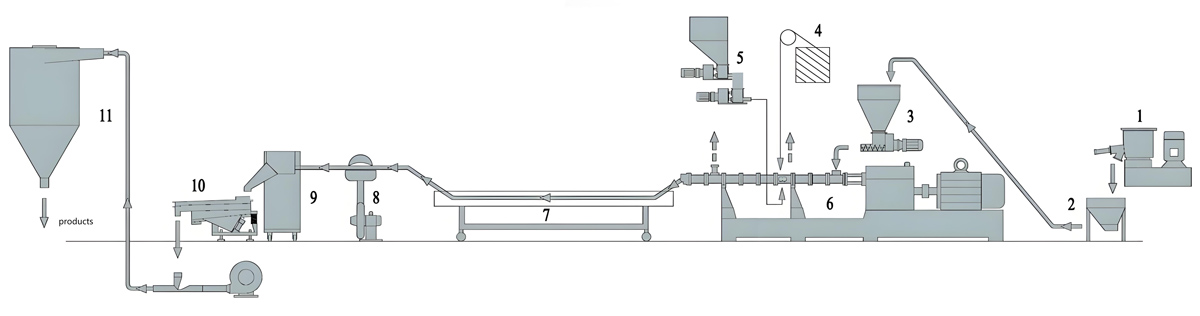
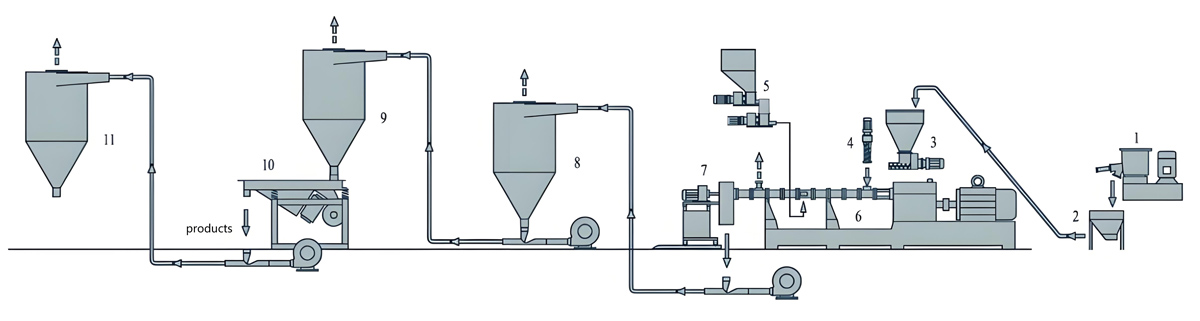
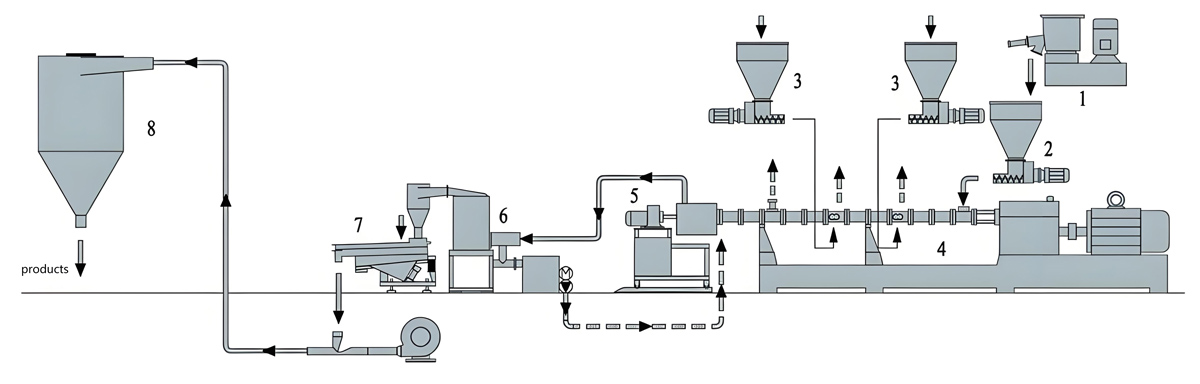
Primary Feed System: The main feeding port receives pre-dried PET resin through a gravimetric feeder. This feeder should provide accurate throughput control with minimal pulsation. For high loading formulations, the PET feeder capacity must accommodate potentially lower PET throughput due to increased total filler content.
Secondary Feeding System: Calcium carbonate is introduced through a side feeder positioned after initial PET melting but before major mixing zones. This location provides optimal residence time for dispersion while minimizing thermal exposure of the filler. The feeder must handle abrasive materials without excessive wear or accuracy degradation.
Tertiary Feed Systems: Additives and masterbatches may be introduced through additional side feeders. Heat-sensitive additives should be introduced as downstream as possible to minimize thermal exposure. Multiple feeders allow precise control of additive concentrations and enable formulation adjustments without stopping production.
Feeder Synchronization: For continuous operation, all feeders must be properly synchronized to maintain the correct formulation ratios. Advanced control systems monitor individual feeder rates and adjust flows to maintain target formulation even when throughput changes.
Advanced Extruder Zone Configuration
PET CaCO3 masterbatch production requires optimized zone configuration:
Initial Zones (Z1-Z3): Focus on PET melting and initial homogenization. These zones operate at relatively high temperatures to ensure complete melting of PET before filler introduction. The screw configuration in these zones emphasizes conveying efficiency to prevent melting delay.
Intermediate Zones (Z4-Z6): Provide melting completion and start the initial mixing process. The temperature gradually increases in these zones to maintain appropriate melt viscosity. Screw elements in these zones balance conveying efficiency with mild mixing to begin filler incorporation.
Primary Dispersion Zones (Z7-Z9): High shear zones designed to break down calcium carbonate agglomerates and achieve uniform distribution. These zones typically include multiple kneading block assemblies with varied staggers. The exact configuration depends on calcium carbonate loading and particle size distribution.
Secondary Dispersion Zones (Z10-Z11): Additional mixing zones that complete the dispersion process. These zones provide distributive mixing to ensure uniformity throughout the melt stream. The shear intensity is typically lower than primary dispersion zones to avoid excessive thermal degradation.
Final Homogenization and Metering Zones (Z12-Z14): Complete dispersion and prepare the melt for pelletization. These zones focus on temperature uniformity and melt homogeneity. The screw configuration provides sufficient conveying to maintain throughput without generating excessive shear.
Precise Temperature Management
PET requires meticulous temperature control due to its thermal sensitivity:
Feed Zone Temperature: The first zone should be set at 245-250°C to initiate melting without causing premature degradation in the feed throat. Slightly lower temperatures in this zone reduce thermal stress on the PET resin before it is fully protected by the melt.
Melting Zone Profile: Zones 2-6 should maintain temperatures between 250-265°C to ensure complete melting. The temperature should gradually increase through these zones to accommodate the increasing viscosity as filler is incorporated.
Dispersion Zone Temperature: Zones 7-11 typically operate at 260-270°C. These temperatures provide optimal melt viscosity for dispersion while balancing the thermal degradation risk. For high loading formulations, slightly higher temperatures may be needed to maintain adequate flow.
Metering Zone Temperature: The final zones should be maintained at 265-275°C. These temperatures ensure melt homogeneity and provide appropriate melt strength for pelletization. The die temperature should be set 5-10°C above the final melt temperature.
Temperature Uniformity: Temperature variation within each zone should be kept within plus or minus 2°C to ensure consistent processing. Hot spots can cause localized degradation, while cold spots can lead to incomplete melting or dispersion problems.
Dynamic Process Control
Advanced process control systems optimize PET CaCO3 production:
Screw Speed Management: Screw speeds between 150-350 RPM are typical, depending on extruder size and formulation. Higher screw speeds generally improve dispersion through increased shear but reduce residence time and increase melt temperature. The optimal speed balances these competing factors.
Throughput Optimization: Throughput rates range from 30-300 kg/h depending on extruder capacity. Finding the optimal specific throughput (kg/h/RPM) is crucial for achieving consistent quality. Process optimization may involve adjusting both throughput and screw speed to achieve the desired processing conditions.
Vacuum Venting Control: Vacuum venting between 400-650 mbar absolute pressure removes volatiles efficiently. The vacuum level must be optimized to remove volatiles without entraining filler material. For high loading formulations, staged venting may be beneficial.
Pressure Monitoring: Die pressure monitoring provides real-time indication of processing conditions. Pressure increases may indicate viscosity changes, wear issues, or die blockage. Pressure decreases may signal wear, filter blockage, or material quality changes.
Equipment Specifications and Configuration
Twin Screw Extruder Selection
PET CaCO3 masterbatch production demands specialized extruder equipment:
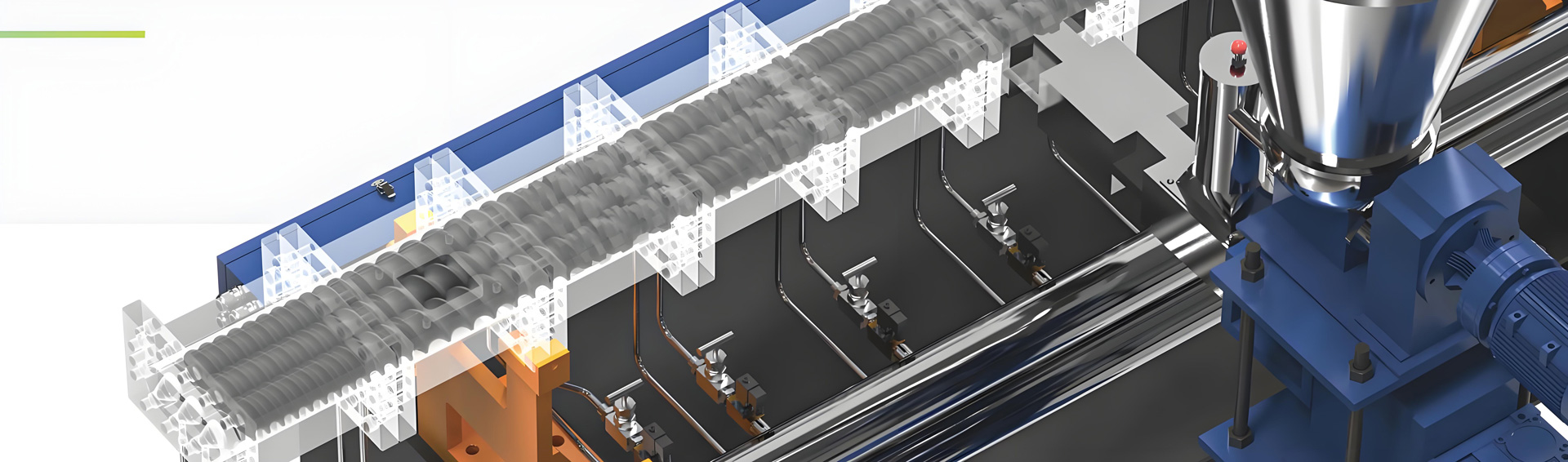
Extruder Type: Co-rotating twin screw extruders provide optimal mixing for this application. The KTE Series offers robust construction suitable for high temperature processing and abrasive fillers. Modular design enables easy configuration changes for different formulations.
Screw Diameter Selection: Screw diameters from 25mm to 75mm are available, with production capacities ranging from 25 kg/h to 300 kg/h. Larger diameters provide higher throughput but may reduce mixing efficiency for difficult formulations.
Length-to-Diameter Ratio: L/D ratios between 32:1 and 40:1 provide adequate mixing length while managing residence time for heat-sensitive PET. Longer barrels provide more mixing zones but increase residence time and potential for thermal degradation.
Barrel Construction: Multi-zone barrel construction with independent temperature control enables precise thermal profile management. Heating elements must provide uniform heat distribution without hot spots. Cooling systems should provide rapid response when needed.
Feeding System Integration
Advanced feeding systems ensure consistent material introduction:
Gravimetric Feeders: Gravimetric feeding provides accurate throughput control for both PET resin and calcium carbonate. These systems should feature loss-in-weight operation with continuous rate monitoring and correction capabilities.
Feeder Material Selection: Feeders handling calcium carbonate should be constructed from wear-resistant materials to withstand abrasive particles. Stainless steel with hardened components provides good durability.
Drying Integration: For PET, gravimetric feeders with integrated drying capabilities maintain optimal moisture content throughout continuous operation. The drying system should be sized to handle the maximum PET throughput with appropriate safety margin.
Feeder Synchronization: Multiple feeders must be properly synchronized to maintain the correct formulation ratios. Advanced control systems monitor individual feeder performance and adjust flows to maintain target formulation.
Screw and Barrel Engineering
Specialized construction withstands demanding processing conditions:
Barrel Materials: Barrels are manufactured from specialized alloy steels with hard facing on the inner surface to resist abrasive wear from calcium carbonate. The hard facing should extend throughout the barrel, particularly in mixing zones where abrasive contact is highest.
Screw Element Construction: Screw elements are manufactured from tool steels with surface hardening treatments such as nitriding or chrome plating to extend service life in abrasive environments. Modular elements allow easy replacement of worn sections.
Screw Configuration Design: The screw configuration must be optimized for each formulation. For PET CaCO3, this includes sufficient conveying elements for material transport, kneading blocks for dispersion, and mixing elements for final homogenization.
Wear Management: Design features should facilitate easy inspection and replacement of worn components. Quick-change designs minimize downtime for maintenance. Wear monitoring systems can predict when components need replacement.
Temperature Control Systems
Advanced temperature control maintains consistent processing conditions:
Heating System Design: Multiple heating cartridges per zone provide uniform heat distribution. The total heating capacity should be 30-50% above the theoretical requirement to allow for rapid warm-up and compensation for heat loss.
Cooling System Design: Both air and water cooling capabilities provide flexible temperature control. The cooling system should be capable of maintaining zone temperatures within specified tolerance under maximum heat load conditions.
Control Algorithm: Advanced PID control algorithms provide precise temperature regulation with minimal overshoot. Self-tuning algorithms adapt to changing process conditions and maintain optimal control throughout operation.
Temperature Monitoring: Multiple thermocouples per zone provide redundancy and improve accuracy. Real-time temperature monitoring enables early detection of developing thermal issues.
Pelletization System
The pelletization system completes the production process:
Die Design: Multi-strand dies with optimized flow channels minimize pressure drop while ensuring uniform distribution across strands. Die faces should be manufactured from hardened materials to withstand abrasive wear.
Strand Pelletizers: Strand pelletizers provide excellent process control and pellet quality. The water bath must maintain appropriate temperature to solidify strands without causing excessive crystallization. Strand guides should be designed to prevent tangling and breakage.
Water Ring Pelletizers: Water ring pelletizers provide compact operation and immediate solidification. The cutter head should be adjustable to maintain consistent pellet size. The cutting chamber should be designed to minimize pellet breakage.
Pellet Drying: Regardless of pelletization method, the pellets must be thoroughly dried before packaging. Drying at 80-90°C for 2-3 hours removes surface moisture and prevents condensation during storage.
Process Parameter Optimization
Screw Configuration Optimization
Effective screw configuration is critical for PET CaCO3 quality:
Feed Zone Design: Large-pitch conveying elements in feed zones ensure reliable material transport. For PET, elements with appropriate flight depth prevent excessive heat build-up in the feed throat area.
Melting Zone Optimization: Elements with decreasing pitch through melting zones provide progressive compression. The melting zone should include a combination of conveying and mild mixing elements to promote melting without excessive shear.
Dispersion Zone Engineering: Multiple kneading block assemblies provide dispersive mixing. The staggers, widths, and positions of these elements must be optimized for each loading level. For high loading formulations, more aggressive dispersion elements are required.
Homogenization Zone Design: Downstream mixing elements complete dispersion and ensure melt homogeneity. These elements should provide distributive mixing without excessive shear heating. Gear mixers and combing mixers work well in these zones.
Configuration Variations: Different formulations may require different configurations. High loading formulations may need more dispersive elements, while lower loadings may require more conveying elements for better throughput.
Temperature Profile Engineering
Optimized temperature profiles balance competing requirements:
Low Temperature Profiles: Slightly lower temperatures reduce thermal degradation risk but may increase melt viscosity and require higher screw speeds for adequate mixing. This approach may be preferred for formulations with marginal thermal stability.
High Temperature Profiles: Higher temperatures improve melt flow and dispersion but increase degradation risk. This approach may work for thermally stable formulations but requires careful monitoring of product quality.
Optimized Profiles: The optimal profile provides adequate melt flow and mixing while minimizing thermal stress. The exact profile depends on specific PET grade, moisture content, and calcium carbonate loading.
Profile Adjustment: Temperature profiles should be adjusted based on real-time process monitoring. Variations in melt pressure or product quality may indicate the need for profile optimization.
Throughput and Screw Speed Optimization
Optimal balance between throughput and screw speed maximizes efficiency:
High Throughput Operation: Maximum throughput provides best production efficiency but may compromise dispersion quality and increase thermal degradation risk. The throughput limit is reached when product quality begins to suffer.
High Screw Speed Operation: Higher screw speeds improve mixing quality but reduce residence time and increase melt temperature through viscous heating. The maximum useful speed depends on the formulation and equipment capabilities.
Optimal Operation Point: The optimal operating point balances throughput, screw speed, and product quality. This point typically provides 70-85% of maximum throughput while maintaining excellent product quality.
Process Monitoring: Continuous monitoring of product quality and process parameters helps identify the optimal operating point. Adjustments should be made gradually while monitoring quality indicators.
Equipment Investment Analysis
Twin Screw Extruder Cost Structure
Investment analysis for PET CaCO3 production equipment:
Laboratory Equipment (25-30mm): $35,000 – $55,000 for research and small-scale production.
Pilot Production Equipment (35-45mm): $60,000 – $115,000 for small to medium production volumes.
Industrial Equipment (55-75mm): $140,000 – $300,000 for large-scale production. These systems include advanced features required for demanding applications.
Specialized Features: Additional $20,000 – $45,000 for enhanced temperature capabilities, wear resistance, and advanced control systems.
Complete System Investment
Complete production lines require comprehensive investment:
Drying Systems: $25,000 – $50,000 for industrial dehumidifying dryers capable of handling PET drying requirements.
Feeding Systems: $15,000 – $35,000 for multi-station gravimetric feeding systems.
Pelletizing Systems: $18,000 – $45,000 for pelletizers suitable for high viscosity filled melts.
Control Systems: $12,000 – $25,000 for advanced control with recipe management and process monitoring.
Environmental Control: $12,000 – $30,000 for temperature and humidity control in production areas.
Total Investment: Complete systems range from $120,000 for small capacity installations to over $500,000 for large-scale production lines.
Production Challenges and Solutions
Thermal Degradation
Problem Identification: Thermal degradation in PET manifests as yellowing, reduced molecular weight, increased acidity, and deterioration of mechanical properties. In severe cases, charring and gel formation occur. Degraded masterbatch shows poor processing characteristics in downstream applications.
Root Causes: Excessive barrel temperatures exceeding PET thermal stability. Prolonged residence time providing too much thermal exposure. Inadequate venting failing to remove degradation products. Poor thermal stability of raw PET resin. Dead zones in barrel causing material stagnation and degradation.
Solutions: Reduce barrel temperature profile to minimum acceptable for processing. Optimize screw configuration to minimize residence time. Increase vacuum venting efficiency to remove volatiles. Select PET grades with improved thermal stability. Eliminate dead zones through screw configuration optimization. Use thermal stabilizers in formulation.
Prevention Methods: Implement continuous monitoring of melt temperature and pressure. Use real-time quality testing to detect degradation early. Establish maximum residence time limits for each formulation. Monitor screw wear and replace components when necessary. Implement statistical process control to identify developing degradation issues.
Poor Filler Dispersion
Problem Identification: Poor dispersion appears as visible agglomerates, inconsistent mechanical properties, surface defects, and speckled appearance. Microscopic examination reveals undispersed calcium carbonate particles. Testing in final applications shows inconsistent performance.
Root Causes: Insufficient mixing energy from low screw speed or inadequate kneading elements. Screw configuration not optimized for calcium carbonate dispersion. Excessive throughput reducing specific mixing energy. Inadequate coupling agents preventing proper filler-matrix bonding. Calcium carbonate agglomeration from improper storage or handling.
Solutions: Increase screw speed while monitoring thermal conditions. Redesign screw configuration adding more dispersive elements. Reduce throughput to increase specific mixing energy. Optimize coupling agent selection and concentration. Implement pre-dispersion of calcium carbonate. Use appropriate filler grades with controlled particle size.
Prevention Methods: Establish standardized screw configurations for each formulation. Implement regular dispersion quality monitoring using microscopy. Train operators on proper material handling to prevent agglomeration. Use quality control testing for dispersion effectiveness. Maintain consistent processing parameters.
Die Build-up and Flow Problems
Problem Identification: Material accumulation on die face causes flow restrictions, pressure fluctuations, and pellet size variations. The die shows visible deposits and requires frequent cleaning. Pressure monitoring shows increasing trends over time.
Root Causes: Low melt temperature causing increased viscosity and sticking. Improper die design creating flow restrictions or stagnation areas. Excessive filler loading increasing viscosity. Inadequate lubrication in formulation causing material adherence. Poor screw configuration causing incomplete melt homogenization.
Solutions: Increase die temperature by 5-10°C to reduce viscosity. Redesign die with optimized flow channels and polished surfaces. Reduce filler loading or modify formulation. Increase lubricant and processing aid content. Optimize screw configuration for better melt homogenization. Implement regular die cleaning schedule.
Prevention Methods: Use die designs optimized for high viscosity filled materials. Maintain consistent processing parameters. Implement die surface treatments to reduce adhesion. Monitor die pressure trends for early detection. Use processing aids to reduce die build-up potential.
Equipment Wear from Abrasive Fillers
Problem Identification: Progressive output reduction, decreased mixing efficiency, visible metal contamination, increased power consumption. Wear patterns appear on barrel and screw components. Process stability declines as wear progresses.
Root Causes: Abrasive calcium carbonate particles causing mechanical wear. High filler loading accelerating wear rates. High screw speeds increasing mechanical stress. Inadequate material hardness in contacting components. Poor maintenance allowing wear to progress to failure.
Solutions: Upgrade to hardened wear-resistant materials for all calcium carbonate contacting components. Reduce screw speed if wear rate is excessive. Monitor wear through regular dimensional inspection. Replace worn components before complete failure. Use high quality calcium carbonate with controlled particle hardness.
Prevention Methods: Use tungsten carbide or ceramic coatings in high-wear areas. Establish regular inspection and replacement schedules. Monitor output and quality as wear indicators. Implement filtration to capture metal contamination. Train operators on wear identification and reporting.
Moisture-Related Problems
Problem Identification: Surface defects, bubbles, splay marks, poor transparency, and degraded mechanical properties indicate moisture problems. The material may show excessive smoke during processing. Molecular weight analysis shows hydrolytic degradation.
Root Causes: Inadequate resin drying allowing moisture to remain above 40 ppm. Inconsistent drying providing variable moisture content. Ambient humidity changes affecting material handling. Ineffective venting failing to remove moisture from melt. Poor storage conditions allowing moisture absorption.
Solutions: Implement rigorous drying with moisture content verification. Increase drying temperature or time if moisture remains high. Maintain consistent dryer dew point below -40°C. Improve venting system efficiency. Use moisture-resistant material handling and storage. Add hydrolysis stabilizers to formulation.
Prevention Methods: Install inline moisture monitoring to verify drying effectiveness. Implement strict material storage and handling procedures. Monitor ambient humidity conditions. Train operators on proper material handling. Use sealed containers for dried material. Implement regular dryer maintenance.
Viscosity and Processing Issues
Problem Identification: Unstable processing, surging, inconsistent output, poor pellet quality, and difficulty in downstream processing. Melt pressure shows significant fluctuation. Temperature profiles become difficult to control.
Root Causes: Variable raw material quality causing viscosity changes. Inconsistent formulation ratios. Temperature control problems causing viscosity variations. Degradation causing molecular weight reduction. Incomplete melting or mixing.
Solutions: Implement strict raw material quality control. Maintain precise feeder calibration and monitoring. Repair temperature control system problems. Address degradation through process optimization. Optimize screw configuration for complete melting and mixing.
Prevention Methods: Implement statistical process control for key parameters. Monitor raw material quality before use. Maintain consistent processing conditions. Regularly calibrate and maintain equipment. Use viscosity monitoring to detect changes early.
Maintenance and Reliability
Daily Maintenance Protocols
Daily maintenance ensures reliable operation:
Visual Inspection: Check for unusual sounds, vibrations, or leaks. Monitor amperage readings for changes indicating developing problems. Inspect for material accumulation or blockages.
Temperature Monitoring: Verify all temperature zones operate within specified ranges. Check heating and cooling operation and uniformity. Verify temperature stability over time.
Feeding System Verification: Confirm feeders deliver material accurately. Check feeder throats for proper material flow. Verify feeder synchronization.
Pelletizer Condition: Check pelletizer knives for wear and alignment. Verify water flow and temperature. Inspect pellet quality for consistency.
Housekeeping: Maintain clean equipment and work area to prevent contamination. Remove any material spills immediately.
Weekly Maintenance
Weekly maintenance addresses medium-term needs:
Screw and Barrel Inspection: Visually inspect accessible areas for wear. Check barrel for signs of scoring. Monitor output for changes indicating wear.
Lubrication: Apply lubrication according to manufacturer specifications. Check gearbox oil levels and condition. Inspect bearings for proper operation.
Electrical System: Verify all electrical connections are secure. Test emergency stop systems. Check safety interlocks operation.
Cooling System: Clean cooling system filters. Check water quality. Inspect for leaks or flow restrictions.
Control System: Calibrate sensors. Verify control accuracy. Review process parameter logs for anomalies.
Monthly Maintenance
Monthly maintenance provides comprehensive evaluation:
Mechanical Inspection: Perform detailed inspection of all mechanical components. Check alignment and wear. Verify proper fastening of all components.
Seal and Gasket Assessment: Replace worn seals and gaskets. Check all joints for leaks. Inspect sealing surfaces.
Sensor Calibration: Calibrate temperature, pressure, and speed sensors. Document calibration results. Track calibration trends.
Safety Systems: Perform comprehensive testing of all safety systems. Test emergency stops and alarms. Inspect guards and safety devices.
Documentation: Update maintenance logs. Review equipment performance trends. Identify developing issues requiring attention.
Annual Maintenance
Annual maintenance includes complete evaluation:
Complete Disassembly: Disassemble major components for thorough inspection. Clean all parts. Identify worn or damaged components.
Wear Measurement: Quantitatively measure screw and barrel wear. Compare to specifications. Assess remaining service life.
Drive System: Test motors, gearboxes, and couplings. Replace worn bearings, gears, or seals. Verify proper alignment.
Control System: Update software and hardware. Replace obsolete components. Verify system functionality.
Documentation: Update all technical documentation. Record maintenance history. Plan maintenance for upcoming year.
Troubleshooting Guide
Systematic approaches to common problems:
Output Decrease: Check for worn screw elements or barrel wear. Verify feeder calibration and operation. Examine filters for blockage. Assess raw material quality. Check drive system condition.
Quality Deterioration: Analyze processing parameter deviations. Check dispersion quality through sampling. Evaluate raw material consistency. Inspect pelletizer condition. Review maintenance history.
Power Consumption Increase: Examine gearbox and drive condition. Check for screw or barrel binding. Assess viscosity changes. Verify proper lubrication. Check for mechanical issues.
Temperature Control Problems: Check heating element operation. Verify cooling system function. Examine sensor calibration and operation. Check control system operation.
Moisture Issues: Verify dryer operation and dew point. Check resin moisture content. Examine venting system. Assess ambient humidity. Check material storage.
Advanced Best Practices
Process Optimization
Continuous improvement strategies:
Parameter Optimization: Establish baseline parameters for each formulation. Perform systematic optimization experiments. Document and control critical parameters.
Quality Monitoring: Implement comprehensive quality testing. Monitor key indicators including dispersion, color, viscosity, and molecular weight. Use statistical process control.
Performance Tracking: Monitor equipment performance metrics. Track output, energy consumption, and downtime. Identify improvement opportunities.
Operator Development: Provide comprehensive training. Cross-train operators on multiple positions. Encourage participation in improvement initiatives.
Advanced Techniques
Advanced processing methods:
In-line Monitoring: Install real-time monitoring for melt pressure, temperature, and viscosity. Use data for process control. Enable early problem detection.
Advanced Configurations: Utilize specialized screw elements for specific challenges. Implement experimental configurations. Optimize for each formulation.
Automation: Automate feeder control and temperature adjustments. Implement recipe management. Enable consistent operation across changes.
Energy Optimization: Monitor and optimize energy consumption. Recover waste heat. Improve motor and drive efficiency.
Quality Assurance
Comprehensive quality systems:
Raw Material Control: Implement incoming material testing. Establish quality specifications. Monitor supplier consistency.
Process Control: Maintain consistent processing conditions. Monitor critical parameters. Implement corrective actions when needed.
Product Testing: Perform regular product testing. Monitor key quality indicators. Track quality trends over time.
Customer Feedback: Collect and analyze customer feedback. Use feedback for continuous improvement. Address issues promptly.
Frequently Asked Questions
What is the optimal drying condition for PET in CaCO3 masterbatch?
PET for CaCO3 masterbatch requires drying at 145-155°C for 4-6 hours using dehumidifying dryers with dew point below -40°C. The target moisture content should be below 40 ppm, with stricter standards of below 30 ppm for very high loading formulations. Proper drying is critical to prevent hydrolysis and ensure consistent processing.
How do I choose between different calcium carbonate loadings?
Calcium carbonate loading selection depends on application requirements. Medium loading (30-40%) provides good balance of cost and properties for most applications. High loading (40-50%) maximizes cost benefits but requires more intensive processing. Low loading (15-25%) maintains excellent properties with modest savings. Consider final product requirements, processing capabilities, and cost targets when selecting loading level.
What type of coupling agent works best for PET CaCO3?
Epoxy-functional coupling agents typically provide the best performance for PET CaCO3 systems. At concentrations of 0.8-2.0%, these agents significantly improve interfacial bonding and mechanical properties. For very high loading applications, dual coupling agent systems may provide superior results. The exact choice depends on specific calcium carbonate grade and PET resin.
How do I reduce die build-up in high viscosity CaCO3 formulations?
Reduce die build-up by increasing die temperature by 5-10°C, using processing aids at 0.1-0.3%, optimizing lubricant content, ensuring proper melt homogenization, and implementing regular cleaning schedules. Die design optimization with polished surfaces and appropriate flow channels also helps prevent build-up.
What maintenance schedule is required for CaCO3 filled masterbatch production?
Due to abrasive wear, more frequent maintenance is required compared to unfilled materials. Daily inspection should focus on wear indicators. Weekly maintenance should include detailed inspection of wear areas. Monthly maintenance should include quantitative wear measurements. More frequent component replacement is typically necessary compared to unfilled material processing.
How can I achieve consistent dispersion across batches?
Achieve consistent dispersion through standardized screw configurations for each formulation, strict control of processing parameters, regular quality monitoring, consistent raw material quality, and proper operator training. Process control systems with automated parameter adjustment help maintain consistency across batches.
What are the signs of PET degradation during processing?
Signs of degradation include yellowing, reduced molecular weight, increased acidity, bubble formation, splay marks, poor transparency, excessive smoke, and deteriorated mechanical properties. Real-time monitoring of melt temperature, pressure, and viscosity helps detect degradation early.
How do I balance throughput and quality?
Balance throughput and quality by establishing the optimal operating point that provides 70-85% of maximum throughput while maintaining excellent quality. This requires systematic optimization of both throughput and screw speed. Continuous quality monitoring ensures quality is maintained as throughput varies.
What temperature profile works best for high loading CaCO3 formulations?
High loading formulations typically require slightly elevated temperatures to manage increased viscosity. A profile starting at 245-250°C and ending at 270-275°C works well. The exact profile should be optimized based on specific PET grade, calcium carbonate characteristics, and equipment capabilities.
How do I reduce equipment wear from abrasive CaCO3?
Reduce wear through use of hardened wear-resistant materials for all CaCO3 contacting components, appropriate screw speed optimization, regular inspection and maintenance, use of high quality calcium carbonate with controlled hardness, and implementation of filtration to capture wear particles before they cause additional damage.
Conclusion
The production of PET CaCO3 masterbatch using twin screw extruders represents a sophisticated manufacturing challenge that demands comprehensive understanding of polymer chemistry, processing technology, and equipment engineering. Success requires careful balancing of multiple competing factors including thermal management, dispersion efficiency, and equipment durability.
Formulation optimization provides the foundation for successful production. The selection of PET grade, calcium carbonate loading level, and additives package must be tailored to specific application requirements while considering processing constraints. Understanding the complex interactions between these components enables consistent quality and production efficiency.
Advanced processing techniques and equipment selection significantly impact production success. KTE Series twin screw extruders with appropriate configuration provide the high temperature capability and robust construction needed for this demanding application. Regular maintenance and wear management are particularly important for abrasive filled formulations.
Continuous improvement through systematic optimization and advanced monitoring enables producers to maintain competitive advantage. Understanding root causes of production issues and implementing effective solutions maintains consistent product quality and production efficiency.
By implementing the strategies and best practices outlined in this comprehensive guide, manufacturers can achieve consistent, high quality PET CaCO3 masterbatch production while optimizing costs and maximizing equipment utilization. Success in this competitive market requires commitment to technical excellence, continuous improvement, and attention to detail throughout the production process.