Ethylene-vinyl acetate copolymers combined with calcium carbonate fillers have revolutionized the plastics manufacturing industry by offering an ideal solution for cost reduction while maintaining material performance. The production of EVA CaCO3 filled masterbatch through twin screw extrusion technology has become an essential process for manufacturers seeking to optimize material costs without compromising quality. This comprehensive guide delves into the technical intricacies of manufacturing EVA calcium carbonate masterbatch, providing manufacturers with critical insights into formulation science, processing technology, equipment specifications, and operational excellence strategies essential for competitive production.
Introduction
Ethylene-vinyl acetate copolymers have established themselves as versatile materials in the polymer industry, finding applications across diverse sectors including footwear, packaging, wire insulation, automotive components, and consumer goods. The polar nature of EVA, resulting from vinyl acetate groups in the polymer chain, provides exceptional compatibility with mineral fillers like calcium carbonate, enabling high filler loadings while maintaining acceptable mechanical properties. This intrinsic compatibility, combined with EVA’s inherent flexibility, transparency, and low-temperature performance characteristics, makes it an ideal matrix for calcium carbonate incorporation.
The economic advantages of calcium carbonate filled EVA masterbatch are substantial and multifaceted. Material cost reduction represents the most obvious benefit, with calcium carbonate costing significantly less than virgin EVA resin. Beyond pure cost savings, properly incorporated calcium carbonate can enhance certain material properties including increased stiffness, improved dimensional stability, and enhanced thermal conductivity that facilitates faster processing in downstream applications. The ability to tailor filler content to specific application requirements enables manufacturers to optimize material performance for diverse end-use requirements while managing material costs effectively.
Twin screw extrusion technology has emerged as the preferred method for EVA CaCO3 masterbatch production due to its superior mixing capabilities and precise control over processing parameters. Co-rotating twin screw extruders provide excellent distributive and dispersive mixing, essential for achieving homogeneous distribution of calcium carbonate particles throughout the EVA matrix. The modular design of modern twin screw extruders enables customization of screw configurations and barrel sections to optimize performance for specific EVA formulations and production requirements. This flexibility, combined with advanced control systems, allows manufacturers to achieve consistent product quality while maximizing production efficiency.
The market demand for EVA CaCO3 filled materials continues to grow across multiple industries, driven by increasing cost pressures and the need for materials with enhanced performance characteristics. Manufacturers face the challenge of balancing cost reduction through filler incorporation with maintaining the essential properties that make EVA valuable in specific applications. This optimization requires deep understanding of EVA polymer chemistry, calcium carbonate characteristics, and their interaction during the compounding process. Advanced twin screw extrusion technology, when properly configured and operated, provides the means to meet these competing objectives while maintaining production economics.
Formulation Ratios (Different Types)
The formulation of EVA CaCO3 filled masterbatch encompasses a broad spectrum of compositions designed to meet diverse application requirements and economic objectives. Different calcium carbonate loading levels are employed based on the specific balance between cost reduction targets and property maintenance requirements. Standard formulations for commercial applications typically range from 45% to 70% calcium carbonate content by weight, with specific ratios selected after careful consideration of application performance requirements, processing constraints, and cost objectives.
Standard loading formulations containing 55-65% calcium carbonate constitute the most widely used approach for general-purpose EVA applications. These formulations typically comprise 60% calcium carbonate, 38-42% EVA resin, 1-2% processing aids, and optionally 0.5-1% coupling agents or dispersants. The EVA resin selected for these formulations typically contains 15-25% vinyl acetate, providing an optimal balance between flexibility, calcium carbonate compatibility, and mechanical performance. Higher vinyl acetate content enhances the polar character of the polymer, improving filler wetting and dispersion while reducing crystallinity that may affect certain mechanical properties. The calcium carbonate used in standard formulations typically has a median particle size of 1.5-2.5 microns with controlled particle size distribution to achieve good dispersion while maintaining acceptable surface finish and optical clarity.
High loading formulations with calcium carbonate content ranging from 68-78% are employed when maximum material cost reduction constitutes the primary production objective. These masterbatches present significant processing challenges requiring extensive optimization of both formulation and processing parameters. The formulation composition typically includes 72% calcium carbonate, 23-27% EVA resin, 2-3% processing aids, and potentially 2-4% coupling agents to enhance filler-matrix interaction. Processing aids including low molecular weight polyethylene, waxes, or fatty acid esters may be incorporated at elevated levels (3-5%) to maintain acceptable melt flow and reduce viscosity increase associated with high filler content. The calcium carbonate used in high loading formulations often has a carefully engineered bimodal particle size distribution to improve packing density and reduce viscosity increase while maintaining adequate dispersion. Surface treatment with stearic acid or specialized coupling agents may be employed to enhance compatibility and dispersion quality.
Low loading formulations containing 40-50% calcium carbonate are designed for applications where minimal impact on EVA flexibility, clarity, or mechanical properties is required. These formulations prioritize maintaining excellent processability and mechanical performance while still providing meaningful cost benefits. The carrier EVA resin typically has a vinyl acetate content in the range of 18-28% to maintain mechanical properties and crystallinity appropriate for the intended application. The formulation may include property enhancers such as impact modifiers or flexibilizers at 2-6% loading to compensate for any reduction in toughness or flexibility resulting from filler incorporation. The calcium carbonate used in low loading formulations often has a smaller particle size, typically 0.8-1.5 microns, and tighter size distribution to ensure uniform dispersion and maintain optical clarity and surface quality in finished products. Surface treatment becomes increasingly critical at lower loadings to ensure optimal dispersion and prevent particle agglomeration.
Specialized formulations for specific applications may incorporate additional functional additives beyond the basic calcium carbonate filler and carrier resin. For outdoor applications requiring enhanced weatherability, UV stabilizers, light stabilizers, and antioxidants tailored for exterior service may be included in the formulation. For flame retardant applications, appropriate flame retardant additives such as aluminum trihydrate, magnesium hydroxide, or phosphorus-based systems may be incorporated while maintaining the cost benefits of calcium carbonate filling. For applications requiring improved electrical properties, specialized additives may be included to enhance dielectric performance. Each functional addition requires careful evaluation of compatibility with both the EVA matrix and calcium carbonate filler, along with assessment of processing requirements and potential interference with the primary functions of the masterbatch.
Production Process
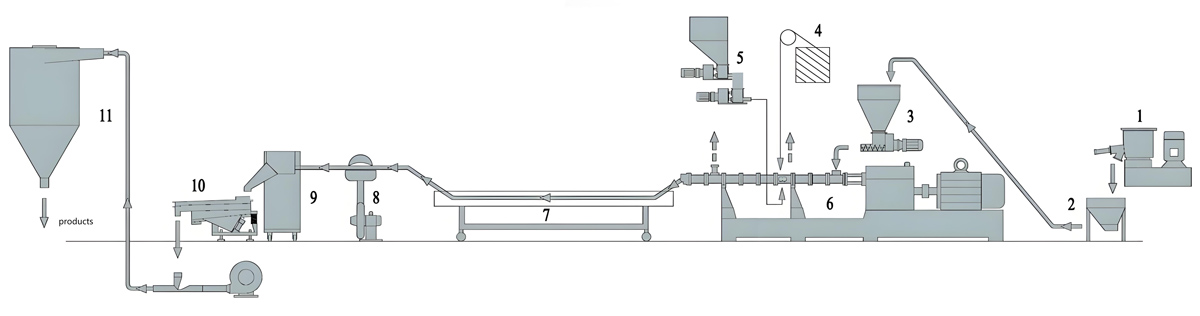
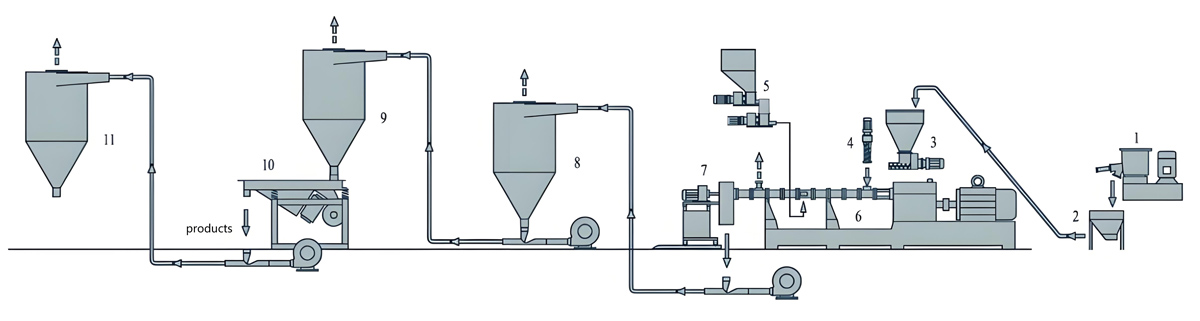
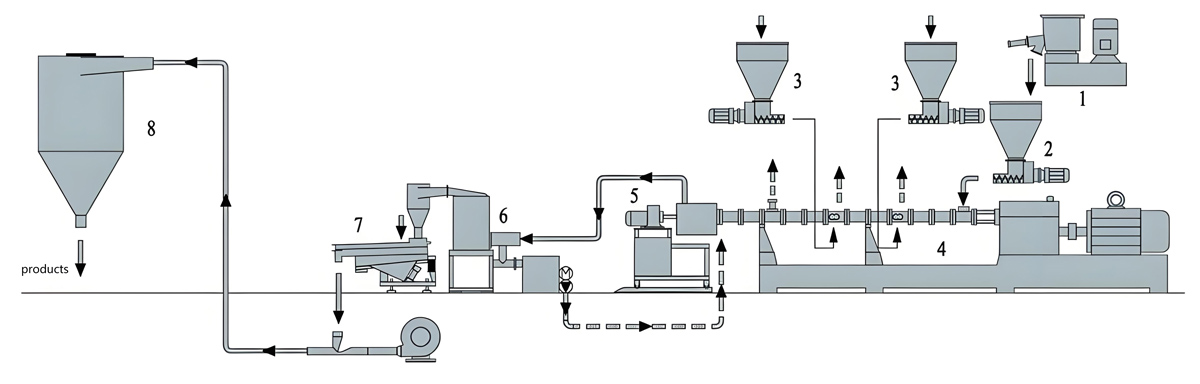
The production process for EVA CaCO3 filled masterbatch follows a carefully controlled sequence that begins with comprehensive raw material preparation and proceeds through compounding, cooling, and pelletizing. Each stage of the process requires precise control and monitoring to ensure consistent product quality and optimal performance characteristics. The twin screw extruder serves as the central processing unit, providing the mixing, melting, and dispersion capabilities necessary for high-quality masterbatch production while accommodating the unique processing characteristics of EVA polymers and the challenges of high calcium carbonate loading.
Raw material preparation constitutes the foundation of the production process and significantly influences final product quality. Calcium carbonate must be thoroughly dried to moisture content below 0.08% to prevent void formation, surface defects, and potential hydrolytic degradation during processing. The drying process typically employs desiccant dryers or dehumidifying hopper dryers at temperatures of 85-105°C for 3-5 hours, depending on initial moisture content, particle size, and surface treatment. Pre-blending of all solid components, including calcium carbonate, EVA resin granules, processing aids, and any other additives, ensures homogeneous distribution before introduction to the extruder. The pre-blending process typically occurs in high-intensity mixers or ribbon blenders operating at controlled speeds to achieve thorough mixing while preventing temperature rise that could cause premature melting or degradation of the EVA resin. Weighing accuracy of all components must be verified to maintain formulation integrity, with tolerance typically maintained within ±0.15% of target weight for critical components.
The compounding process within the twin screw extruder occurs through multiple distinct functional zones, each optimized for specific processing requirements. The feed zone ensures consistent introduction of pre-blended materials into the extruder barrel, with proper feeding design preventing material bridging or feeding irregularities. Progressive melting zones gradually heat the EVA to its processing temperature range of 135-175°C, depending on vinyl acetate content and formulation complexity. EVA processing temperatures vary significantly with vinyl acetate content, with higher vinyl acetate content reducing crystallinity and enabling lower processing temperatures, while lower vinyl acetate content increases crystallinity and requires higher processing temperatures. The melting process typically occurs over the first 4-5 barrel sections, with temperature gradually increasing from 135°C in the first zone to 155-165°C in the final melting zones, ensuring complete melting while preventing thermal degradation.
Dispersion zones incorporate specialized screw elements designed to break down calcium carbonate agglomerates and distribute particles uniformly throughout the EVA matrix. These zones typically include kneading blocks with various stagger angles to provide both dispersive and distributive mixing. The high shear forces in kneading blocks break apart agglomerates and ensure individual particle wetting by the polymer matrix, while the conveying and mixing elements provide distributive mixing to achieve uniform particle distribution throughout the melt. For high loading formulations, multiple mixing zones may be employed to provide sufficient dispersion energy without exceeding thermal limits. The placement of mixing zones must be carefully optimized to occur after adequate polymer melting has been achieved while preventing excessive shear heating that could cause thermal degradation of the EVA polymer.
The EVA matrix, with its polar vinyl acetate groups, exhibits excellent compatibility with calcium carbonate compared to non-polar polyolefins. This inherent compatibility facilitates dispersion and reduces the requirement for extensive surface treatment or coupling agents compared to other polymer-filler systems. However, achieving optimal dispersion still requires appropriate screw configuration and processing conditions tailored to the specific EVA grade and calcium carbonate characteristics. The viscosity of EVA melts is typically moderate, requiring careful balance between dispersive mixing energy and residence time to achieve adequate dispersion without excessive thermal exposure. Screw speed and screw configuration must be optimized to achieve the appropriate balance for each specific formulation.
Vent zones may be incorporated into the barrel design to remove volatile components, moisture, entrained air, and any low molecular weight components from the melt. The vent zone is typically positioned after complete melting has occurred and before the final die section. A vacuum pump connected to the vent zone creates reduced pressure, typically 0.06-0.09 MPa absolute, to facilitate removal of volatiles. While EVA typically releases fewer volatiles compared to some other polymers, effective venting can significantly improve product quality by removing residual moisture from calcium carbonate, any degradation products that may form during processing, and entrained air that could cause defects in the final product. The vent zone also serves to degas the melt, reducing potential void formation during downstream processing.
After exiting the extruder die, the molten masterbatch undergoes rapid cooling before pelletizing. Strand die systems are commonly employed, with multiple strands of extruded material passing through a water bath for controlled cooling. The water temperature is typically maintained at 15-25°C to provide rapid but uniform cooling that prevents formation of internal stresses while solidifying the material sufficiently for pelletizing. EVA’s relatively low melting point and good heat transfer characteristics facilitate rapid cooling, allowing for efficient pelletizing operations. After cooling, the strands pass through a strand pelletizer that cuts the material into uniformly sized pellets, typically 2.5-4mm in length. Alternative pelletizing systems including underwater pelletizing and water ring pelletizing may be employed for formulations requiring rapid solidification or where strand formation presents challenges.
Production Equipment Introduction
The twin screw extruder constitutes the core equipment for EVA CaCO3 filled masterbatch production, offering superior performance characteristics compared to single screw alternatives. Co-rotating twin screw extruders are particularly well-suited for EVA compounding applications due to their positive displacement characteristics, excellent mixing efficiency, and ability to handle high filler loadings while maintaining consistent product quality. The modular construction of modern twin screw extruders enables flexible configuration of screw elements and barrel sections to optimize performance for specific EVA formulations and production requirements, providing manufacturers with the ability to adapt to changing product requirements.
Feeding systems play a critical role in EVA masterbatch production, ensuring consistent material introduction into the extruder. Gravimetric feeders provide precise control of individual component feed rates, essential for maintaining accurate formulation ratios and product consistency. For calcium carbonate feeding, loss-in-weight feeders are commonly employed due to their accuracy and ability to handle low-bulk-density powders with varying bulk density characteristics. These feeders continuously measure the weight of material in the hopper and adjust feed rate to maintain constant mass flow despite variations in bulk density caused by settling, humidity changes, or particle size variations. Multi-stream feeding systems allow controlled introduction of different components at various points along the barrel length, enabling optimization of dispersion and minimization of residence time for thermal-sensitive additives. Liquid additive injection systems enable accurate metering of liquid processing aids, lubricants, or coupling agents at precisely controlled locations within the barrel, enhancing formulation flexibility.
The barrel and screw configuration of the twin screw extruder must be carefully designed to accommodate the specific requirements of EVA CaCO3 masterbatch production. Standard screw configurations for EVA applications typically include conveying elements with appropriate flight depth and pitch for material transport, kneading blocks with various stagger angles for dispersive mixing, and mixing elements for distributive mixing. The screw design for EVA must provide adequate dispersive mixing energy to break apart calcium carbonate agglomerates while managing the moderate melt viscosity and thermal characteristics of EVA polymers. The length-to-diameter ratio (L/D) of the extruder typically ranges from 32:1 to 40:1 for masterbatch applications, providing sufficient mixing length while maintaining manageable residence times to prevent thermal degradation. The sequence and placement of screw elements significantly affect mixing efficiency, dispersion quality, thermal history, and ultimately product quality.
Nanjing Kerke Extrusion Equipment Company offers KTE Series twin screw extruders specifically designed for masterbatch production applications including EVA formulations. These machines feature modular barrel sections with precise temperature control through independent heating and cooling zones, enabling optimal thermal management throughout the process. The barrel construction typically includes high-quality alloy steel with good thermal conductivity to ensure uniform temperature distribution and minimize temperature gradients. The KTE Series incorporates advanced screw geometries optimized for masterbatch processing, providing excellent mixing performance while maintaining appropriate shear intensity for EVA polymers. Screw elements are typically constructed from premium tool steel with appropriate surface treatments to maintain dimensional accuracy and provide good wear resistance against calcium carbonate abrasion.
The drive system of the extruder must provide sufficient torque to handle the viscosity of EVA melts, particularly at elevated calcium carbonate loadings where viscosity increases significantly. Modern extruders employ AC or DC variable speed drives with closed-loop control to maintain precise screw speed despite load variations during processing. The gearbox must be designed to handle the high radial loads imposed by twin screw operation while providing smooth power transmission and minimal backlash. Gearboxes for masterbatch applications typically use hardened gears, high-quality bearings, and adequate lubrication systems to ensure long service life under demanding operating conditions. The drive system should be sized with appropriate safety margins to handle temporary overload conditions while maintaining reliable operation and preventing premature failure.
Downstream equipment complements the extruder to form a complete production line for EVA masterbatch. Strand die systems with water bath cooling are commonly used for EVA masterbatch pelletizing. Die design must provide uniform flow distribution across all strands to ensure consistent cooling and pellet quality. The die configuration, including orifice size, land length, and manifold design, must be optimized for the specific formulation viscosity and throughput requirements. Water bath systems require careful design to provide adequate cooling capacity for the relatively low melting point of EVA while preventing excessive water uptake by the pellets. Pelletizing equipment must be matched to production throughput and provide consistent pellet size and shape without generating excessive fines. Conveying systems, storage silos, and packaging equipment complete the production line, ensuring efficient material handling and product delivery while protecting the masterbatch from moisture contamination and physical damage.
Parameter Settings
Optimal parameter settings are fundamental to successful EVA CaCO3 filled masterbatch production and vary based on specific formulation, equipment design, and desired output quality. Temperature profiles represent critical parameters for EVA processing, though EVA generally has relatively wide processing windows compared to more temperature-sensitive polymers like PVC. Typical EVA processing temperatures range from 135°C in the feed zone to 155-175°C in the die zone for standard vinyl acetate content formulations. The temperature profile should be designed to provide progressive melting of the EVA resin while maintaining temperature well below the degradation threshold throughout the process.
For standard EVA CaCO3 masterbatch formulations with 55-65% calcium carbonate loading and EVA with 15-25% vinyl acetate content, a typical temperature profile would be: feed zone 135-145°C, zones 2-4 (melting zones) 145-160°C, zones 5-6 (mixing zones) 155-165°C, zones 7-8 (final zones) 160-170°C, and die 165-175°C. Higher vinyl acetate content EVA grades (25-40% VA) with lower crystallinity typically process at lower temperatures, potentially 10-15°C lower across all zones. Lower vinyl acetate content EVA grades (9-15% VA) with higher crystallinity require higher processing temperatures to ensure complete melting, potentially 5-10°C higher across all zones. Calcium carbonate loading also influences temperature requirements, with higher loadings typically requiring slightly higher temperatures in later zones to maintain adequate melt flow and prevent excessive pressure buildup. The temperature profile should be optimized based on melt pressure, motor current, and product quality measurements, with adjustments made to achieve stable operation.
Screw speed significantly influences mixing efficiency, residence time, shear intensity, and product quality. Typical screw speeds for EVA CaCO3 masterbatch production range from 220 to 380 RPM, depending on extruder size and formulation complexity. Higher screw speeds increase shear rates and dispersive mixing but also increase mechanical heating and reduce residence time. For EVA applications, screw speed must provide adequate mixing energy while maintaining melt temperature within acceptable ranges and providing sufficient residence time for complete dispersion of calcium carbonate particles. The moderate viscosity of EVA melts compared to some other polymers may require higher screw speeds to achieve adequate dispersive mixing. Screw speed optimization should consider the relationship between screw speed, melt temperature, pressure, and product quality, as these parameters are interdependent and affect each other.
Throughput rates must be matched to equipment capacity and formulation requirements to achieve optimal performance. Operating at excessive throughput can result in inadequate mixing and poor dispersion, while operating below optimal capacity may result in excessive thermal history and potential polymer degradation. Typical throughput rates for KTE Series twin screw extruders in EVA CaCO3 masterbatch applications range from 220 to 850 kg/h, depending on model size and formulation characteristics. The specific throughput capacity depends on screw diameter, L/D ratio, screw configuration, formulation viscosity, and desired dispersion quality. Feed rate consistency is critical for maintaining uniform product quality, particularly for formulations with precise additive requirements where small variations in component ratios can affect dispersion quality and product performance.
Vacuum venting parameters are important for removing volatile components, moisture, entrained air, and degradation products from the melt. While EVA typically releases fewer volatiles compared to some other polymers, moisture from calcium carbonate can create voids or surface defects if not adequately removed. Vent port vacuum levels typically range from 0.06 to 0.09 MPa absolute pressure. The location of vent ports along the barrel length and the vacuum level must be optimized to ensure effective removal of volatiles and entrained air without excessive polymer loss. For EVA formulations, vent zones should be positioned after adequate melting has occurred but before the die section. A vent zone position after zone 5 or 6 typically provides effective volatile and air removal while minimizing polymer loss through the vent. Proper vent design including vent port size, vent dome design, and vacuum pump capacity are critical for effective venting performance.
Die pressure and melt pressure monitoring provide valuable insight into process stability and product quality. Typical die pressures for EVA CaCO3 masterbatch production range from 1.8 to 4 MPa, depending on formulation viscosity and die design. Maintaining consistent pressure profiles is essential for achieving uniform output and product quality. Sudden pressure changes may indicate feeding irregularities, formulation inconsistencies, or equipment issues requiring immediate attention. Pressure fluctuations can also indicate changes in dispersion quality, calcium carbonate agglomeration, or approaching thermal degradation. Melt pressure sensors should be installed at multiple locations along the barrel to monitor pressure development and detect anomalies that may indicate developing problems.
Equipment Price
The investment in twin screw extruder equipment for EVA CaCO3 filled masterbatch production varies significantly based on capacity, configuration, and level of automation. Complete production lines including feeding systems, extruder, cooling equipment, and pelletizing systems typically range from $175,000 to over $580,000, depending on production requirements and equipment sophistication. Base model twin screw extruders with 40mm screw diameter and appropriate length-to-diameter ratio for masterbatch production start around $100,000 to $140,000, excluding auxiliary equipment. The investment should be evaluated in terms of total cost of ownership, considering energy consumption, maintenance requirements, expected service life, and the economic impact of product quality on customer satisfaction and business reputation.
Nanjing Kerke KTE Series twin screw extruders offer competitive pricing in the market while providing performance characteristics optimized for masterbatch applications including EVA formulations. A typical KTE Series extruder configured for EVA CaCO3 masterbatch production, including basic feeding systems and control systems, is priced in the range of $110,000 to $195,000 depending on screw diameter and barrel length. Models with larger screw diameters (50mm to 75mm) capable of higher throughput rates command premium pricing, typically ranging from $215,000 to $395,000 for complete configurations. The quality construction and proven design provide good value and reliability for masterbatch production. The modular design allows for future upgrades and capacity expansion, providing flexibility as production needs evolve and market requirements change.
Auxiliary equipment costs must be considered alongside the extruder investment. Gravimetric feeding systems typically cost $19,000 to $44,000 per unit, depending on capacity and features. For multi-component formulations requiring multiple feeders, the feeding system investment can reach $58,000 to $115,000. Liquid additive injection systems for processing aids, lubricants, or coupling agents range from $13,000 to $30,000. Strand die systems with water baths and pelletizers designed for EVA applications range from $40,000 to $88,000. Complete control systems with advanced monitoring and automation capabilities add $28,000 to $68,000 to equipment costs but provide significant benefits in process control and operational efficiency, particularly important for maintaining consistent product quality in masterbatch production.
Used equipment options provide cost-effective alternatives for budget-constrained operations, with prices typically 35-55% of new equipment costs. Thorough inspection of barrel and screw components is essential before purchasing used equipment. The condition of barrel surfaces, screw wear patterns, evidence of previous processing materials, and overall equipment condition should be carefully evaluated. Rebuilding or refurbishing used equipment may add significant costs, but can still provide good value if performed properly and if the base equipment is of good quality from a reputable manufacturer. Leasing options are also available from many manufacturers, allowing lower upfront investment in exchange for monthly payments over extended terms, which can help manage cash flow while acquiring necessary equipment.
Equipment selection should balance performance requirements with budget considerations while ensuring adequate capacity for production needs. The processing characteristics of EVA, including its relatively low melting point, moderate viscosity, and good compatibility with calcium carbonate, enable good performance from properly configured standard twin screw extruders. The abrasive nature of calcium carbonate at high loadings necessitates consideration of wear-resistant surfaces on screw elements and barrel liners, representing a cost that will be repaid through extended service life and reduced maintenance requirements. Total cost of ownership analysis should consider not only initial purchase price but also energy consumption, maintenance requirements, expected service life, and the economic impact of potential quality issues or production interruptions that could affect customer satisfaction and business reputation.
Production Problems and Solutions
Inadequate Calcium Carbonate Dispersion
Inadequate dispersion of calcium carbonate particles represents one of the most common and critical problems in EVA CaCO3 masterbatch production, resulting in visible defects, inconsistent properties, and reduced performance. This problem typically manifests as specks or agglomerates visible in finished products, uneven surface finish, reduced optical clarity, and impaired mechanical properties. The root causes often include insufficient mixing energy, inappropriate screw configuration for the specific formulation, improper temperature profile affecting melt viscosity, suboptimal calcium carbonate characteristics, or inadequate use of dispersing agents or coupling agents.
Causes analysis reveals that inadequate dispersion frequently stems from insufficient dispersive mixing energy in the mixing zones of the extruder. When screw configuration lacks adequate kneading blocks or mixing elements, or when the placement of these elements is suboptimal, calcium carbonate particles may not receive sufficient energy to break apart agglomerates and distribute uniformly. The moderate viscosity of EVA melts compared to some other polymers may require different mixing strategies to achieve adequate dispersive mixing energy. Insufficient temperature can increase melt viscosity, reducing mixing efficiency even when screw configuration is appropriate, while excessive temperature may reduce viscosity too much, reducing shear energy transfer to the particles and making dispersion more difficult. The particle characteristics of the calcium carbonate, including particle size, size distribution, surface treatment, and bulk density, significantly affect dispersion difficulty. Poor compatibility between calcium carbonate and EVA matrix can also lead to agglomeration and poor wetting of particles.
Solutions to inadequate dispersion begin with optimization of screw configuration to provide adequate dispersive mixing energy while managing EVA melt viscosity and thermal characteristics. This may involve adding additional kneading blocks in mixing zones, adjusting the stagger angle of kneading elements to optimize shear intensity for the specific EVA grade, or extending the mixing section length to provide more mixing time. Temperature profile adjustments to maintain optimal melt viscosity for effective mixing improve mixing efficiency. The use of surface-treated calcium carbonate or addition of dispersants and coupling agents improves compatibility and dispersion quality. Selection of calcium carbonate with appropriate particle size distribution and surface characteristics reduces dispersion difficulty. Implementation of multiple mixing zones can provide staged dispersion, with initial mixing for particle deagglomeration followed by final mixing for uniform distribution.
Avoidance of dispersion problems requires proactive formulation and equipment design optimized for EVA processing and the specific application requirements. Selection of calcium carbonate with appropriate particle size distribution, typically 1.5-2.5 microns with relatively narrow distribution, reduces dispersion difficulty while meeting application requirements. Surface treatment with fatty acids or specialized treatments enhances compatibility and reduces moisture sensitivity. Regular inspection and replacement of worn screw elements ensures consistent mixing performance and prevents gradual degradation of dispersion quality. Implementation of quality control procedures to monitor dispersion quality, such as microscopic analysis of pellet cross-sections, surface roughness measurements, and evaluation of optical clarity, enables early detection of dispersion issues before they impact downstream processing. Maintaining consistent feeding and processing parameters prevents variations that could affect dispersion quality.
EVA Thermal Degradation
EVA thermal degradation during masterbatch production represents a serious quality concern that affects both appearance and mechanical properties, though EVA is generally more thermally stable than some other polymers. This problem typically appears as yellowing or discoloration, reduced melt flow indicating molecular weight reduction, formation of gel particles or specks, or poor performance in end-use applications. The causes generally relate to excessive thermal exposure, insufficient antioxidant levels, shear degradation beyond acceptable limits, contamination with catalytic materials that accelerate degradation, or inadequate venting of degradation products.
Analysis of degradation causes often points to excessive barrel temperatures or prolonged residence time at elevated temperatures. When temperature profiles are set too high, particularly in later barrel zones, the EVA experiences thermal stress that leads to chain scission and formation of degradation products. Temperature uniformity problems, including local hot spots in the barrel or die, can cause localized degradation even when average temperatures appear acceptable. Insufficient antioxidant levels or inappropriate antioxidant types in the formulation can accelerate thermal degradation, especially when processing at high temperatures or with extended residence times. Mechanical degradation can occur due to excessive shear in high-shear mixing zones, particularly when screw speed is increased beyond optimal levels for EVA thermal stability. Contamination with metals or other catalytic materials can accelerate degradation even at normal processing temperatures. Inadequate venting allows degradation products to remain in the melt, potentially causing further degradation or product defects.
Solutions for EVA degradation include optimization of temperature profiles to reduce thermal stress while maintaining adequate melting and mixing. This often involves lowering maximum temperatures, especially in die zones, and potentially reducing overall temperature increase through the extruder. Investigation and elimination of local hot spots through calibration of heating zones and inspection of barrel heating uniformity can prevent localized degradation. Addition of increased levels of antioxidants, particularly primary antioxidants for melt stabilization and secondary antioxidants for long-term stability, provides enhanced thermal protection. Reduction of screw speed or modification of screw configuration to reduce shear intensity in high-shear zones minimizes mechanical degradation. Improved venting to remove degradation products helps maintain EVA quality and prevents accumulation of volatiles that could affect product quality or downstream processing.
Avoidance of degradation problems requires careful formulation design and process control specific to EVA requirements. Including adequate antioxidant systems from the outset, with consideration for processing conditions and end-use requirements, provides baseline protection against thermal degradation. The antioxidant system should be designed for the specific thermal stress expected during processing, with appropriate types and levels selected based on EVA vinyl acetate content, calcium carbonate loading, processing temperatures, and residence time. Implementation of strict temperature control procedures prevents accidental temperature excursions that could cause degradation. Regular monitoring of thermal stability characteristics, such as melt flow index measurement, color assessment, and gel particle detection, enables early detection of degradation trends before they become severe. Maintenance of equipment to ensure accurate temperature control and consistent screw geometry prevents local overheating and excessive shear that could lead to degradation.
Inconsistent Masterbatch Quality
Inconsistent masterbatch quality between production runs or within a single production run presents significant challenges for end users who require predictable processing and performance. Variations in calcium carbonate content, dispersion quality, melt flow characteristics, pellet size distribution, or other quality parameters can all contribute to quality inconsistency. The underlying causes typically involve feeding inaccuracies, equipment control issues, raw material variability, inconsistent processing parameters, or gradual equipment deterioration affecting performance.
Causes of inconsistent quality often begin with feeding system inaccuracies. Gravimetric feeders that are not properly calibrated or maintained can deliver inconsistent component ratios, leading to variations in final product composition. For EVA formulations, variations in calcium carbonate content can significantly affect viscosity, processing characteristics, and final product properties. Inconsistent raw material properties, including calcium carbonate particle size, bulk density, surface treatment, EVA resin vinyl acetate content, and melt flow rate, can cause feeding difficulties and quality variations. EVA resin batch-to-batch variations in vinyl acetate content or molecular weight distribution can affect processing characteristics and compatibility with calcium carbonate. Temperature control inconsistencies or barrel hotspots can create local variations in melt quality and dispersion. Wear in screw elements over time changes mixing characteristics and gradually affects dispersion quality and melt homogeneity.
Solutions for inconsistent quality focus on improving control and monitoring systems throughout the production process. Implementation of gravimetric feeding with regular calibration ensures accurate component delivery. Calibration of feeding systems should be performed on a regular schedule and after any maintenance or formulation change. Use of bulk density compensation systems for calcium carbonate feeding maintains consistent mass flow despite bulk density variations. Advanced temperature control systems with multiple independent zones eliminate temperature fluctuations and prevent local hotspots. Implementation of temperature mapping to identify and correct temperature uniformity problems ensures consistent thermal conditions throughout the barrel. Regular maintenance and scheduled replacement of wear components maintain consistent mixing characteristics and processing performance. Implementation of real-time quality monitoring systems, including melt flow testing, color measurement, microscopic analysis, and other appropriate tests, enables immediate adjustment of process parameters when quality deviations are detected.
Avoidance of quality inconsistencies requires investment in robust process control and quality assurance procedures. Establishing raw material specifications and supplier quality requirements reduces incoming material variability. Implementation of incoming material testing programs to verify compliance with specifications prevents substandard materials from affecting product quality. Implementation of statistical process control with regular sampling and testing identifies trends before they cause significant quality problems. Standard operating procedures with clear parameter specifications and change control prevent unauthorized modifications that could affect quality. Regular equipment calibration and maintenance programs maintain consistent equipment performance over time. For EVA formulations, particular attention to resin vinyl acetate content verification and melt flow characteristics ensures consistent processing behavior across production batches.
Pellet Quality and Handling Issues
Pellet quality and handling issues including inconsistent pellet size, excessive fines generation, pellet deformation, or surface defects represent significant problems in EVA CaCO3 masterbatch production, affecting both handling characteristics and downstream processing. These problems can lead to feeding difficulties, inconsistent dosing in end-use applications, increased material waste, and customer dissatisfaction. The root causes relate to pelletizing equipment settings, cooling conditions, strand formation characteristics, masterbatch formulation properties, or handling equipment design.
Analysis of pellet quality issues reveals multiple potential causes. Inconsistent strand diameter due to die design issues, flow instability, or pressure fluctuations can result in inconsistent pellet size. Excessive or insufficient cooling can cause pellet deformation, strand bending, or inadequate solidification before pelletizing. Incorrect pelletizer settings including knife speed, strand tension, knife alignment, or blade condition can cause irregular pellet shape, excessive fines generation, or cutting defects. Formulation characteristics including melt strength, elasticity, thermal properties, or calcium carbonate content can affect strand quality and pellet formation. Too low melt strength can cause strand breakage before pelletizing, while too high elasticity can cause strand springback and uneven cutting. High calcium carbonate loadings can reduce melt strength and affect strand quality and pellet formation.
Solutions for pellet quality issues focus on optimization of pelletizing conditions and formulation adjustments. Die design should provide uniform flow distribution across all strands to ensure consistent strand diameter. Regular cleaning of die orifices prevents clogging and flow restriction that can affect strand uniformity. Optimization of water bath temperature, immersion depth, and flow rate ensures adequate cooling without causing thermal shock that could affect pellet quality. Adjustment of pelletizer settings including knife speed, blade sharpness, strand tension, and knife alignment should be optimized for the specific formulation. Regular maintenance and replacement of pelletizer knives ensures clean cutting without excessive fines generation or deformation. Formulation adjustments including addition of processing aids, modification of calcium carbonate loading or characteristics, or changes to EVA resin grade can improve melt strength and pellet quality.
Avoidance of pellet quality problems requires comprehensive attention to both equipment and formulation characteristics. Equipment design and setup should be appropriate for the specific formulation properties, including melt strength, elasticity, and calcium carbonate content. Regular maintenance of die and pelletizer components ensures consistent performance over time. Implementation of quality control procedures to monitor pellet size distribution, fines content, pellet appearance, and bulk density enables early detection of quality issues. Establishment of acceptable quality specifications for pellets and regular testing against these specifications ensures consistent output. Training of operators in proper pelletizer operation, adjustment procedures, and quality monitoring enables proactive response to quality issues. Documentation of optimal settings for different formulations provides reference for quick setup and consistent performance across production campaigns.
Maintenance and Care
Proper maintenance and care of twin screw extruder equipment used for EVA CaCO3 masterbatch production is essential for maintaining consistent product quality, maximizing uptime, and extending equipment service life. The abrasive nature of calcium carbonate, particularly at high loadings, requires attention to wear prevention and monitoring. A comprehensive maintenance program addresses preventive maintenance, routine inspections, and predictive maintenance activities to ensure reliable operation and optimal product quality throughout the equipment service life.
Daily maintenance routines focus on monitoring equipment performance and identifying potential issues before they cause problems. Operators should verify temperature accuracy across all barrel zones and compare readings to setpoints, paying particular attention to consistency between zones to detect developing heating problems or temperature control degradation. Monitoring of motor current, screw speed, and throughput rates provides insight into equipment condition and can reveal developing problems such as increasing wear, feeding irregularities, or mechanical issues. Visual inspection for leaks, unusual sounds, or vibration helps identify developing mechanical problems. Cleaning of feed systems and removal of material buildup prevents feeding inconsistencies and contamination. End-of-shift cleaning procedures help prevent polymer degradation and accumulation of material that could affect subsequent runs. Special attention should be paid to cleaning die orifices to prevent clogging and ensure uniform strand formation.
Weekly maintenance activities include more thorough inspection of critical components with attention to wear prevention and early problem detection. Screw and barrel wear should be assessed through measurement of screw flight clearance and barrel inner diameter, with particular attention to signs of uneven wear patterns that may indicate processing problems. Documenting wear measurements over time enables prediction of component service life and planning of replacements to prevent unexpected downtime. Gearbox oil levels and condition should be checked, and oil analysis may be performed to detect contamination, wear particles, or oil degradation that could indicate developing problems. Electrical connections should be inspected for tightness and signs of overheating or corrosion. Cooling system performance should be verified through temperature monitoring and flow measurements, ensuring adequate cooling capacity to maintain temperature control. Calibration of temperature sensors and pressure transducers ensures accurate control and monitoring of the process. Pelletizer knives should be inspected for wear or damage and replaced or sharpened as needed to maintain clean cutting performance and pellet quality.
Monthly maintenance routines address replacement of wear components and deep cleaning activities to maintain optimal equipment performance. Worn screw elements, particularly in high-shear mixing zones and conveying sections, should be replaced or refurbished to maintain mixing performance and prevent further damage to barrel surfaces. Die components should be inspected and replaced or cleaned as needed, with attention to wear patterns or damage that could affect strand formation. Thorough cleaning of vent ports and vacuum systems ensures effective removal of volatiles and prevents clogging that could reduce venting efficiency. Lubrication of bearings, slides, and other moving components should be performed according to manufacturer specifications using appropriate lubricants. Inspection and replacement of seals in hydraulic and pneumatic systems prevents leaks and pressure loss. Barrel and screw surfaces should be inspected for signs of wear or damage, with particular attention to high-wear zones including conveying flights and kneading blocks. Pelletizer components including bearings, drive belts, knife assemblies, and cutting chambers should be inspected and serviced as needed.
Annual maintenance overhauls provide opportunity for comprehensive inspection and renewal of major components to extend equipment service life and prevent unexpected failures. Complete disassembly and inspection of screw and barrel assemblies enables detailed assessment of wear and damage and determination of necessary replacements. Gearbox inspection and servicing, including oil changes, bearing inspection, and gear tooth examination, extends gearbox service life and prevents unexpected failures. Electrical system inspection, including motor testing, control system verification, and electrical connection inspection, ensures reliable operation and prevents electrical failures. Calibrations of all sensors and instruments maintain accurate control and monitoring of the process. Performance testing against baseline specifications provides objective assessment of equipment condition and identifies any degradation in performance. Evaluation of overall equipment condition and performance helps determine if upgrades or replacements are warranted to improve efficiency, increase capacity, or meet changing production requirements.
Documentation and record keeping support effective maintenance programs and enable data-driven maintenance decisions. Maintenance logs should record all maintenance activities, observations, and component replacements. Photographs of worn or damaged components provide valuable documentation for trend analysis and help identify patterns that may indicate underlying problems. Performance data collected over time enables trend analysis and prediction of maintenance requirements, including wear rates and component service life. Analysis of maintenance records may reveal patterns that indicate underlying problems requiring attention or opportunities for optimization. Spare parts inventory management ensures critical components are available when needed, minimizing downtime. For EVA CaCO3 masterbatch applications, maintaining a stock of critical wear components including screw elements, die components, and pelletizer knives can prevent extended downtime if wear exceeds expectations. Operator training in basic maintenance procedures enables early problem detection and appropriate response to developing issues. Safety procedures must be followed during all maintenance activities to protect personnel and equipment.
FAQ
What vinyl acetate content works best for EVA CaCO3 masterbatch production? The optimal vinyl acetate content depends on the specific application requirements and desired balance of properties. For general-purpose masterbatch applications, EVA with 15-25% vinyl acetate content provides good balance between flexibility, compatibility with calcium carbonate, mechanical properties, and processability. Higher vinyl acetate content (25-40%) enhances compatibility with calcium carbonate and improves flexibility but reduces crystallinity, strength, and temperature resistance. Lower vinyl acetate content (9-15%) provides higher crystallinity, better mechanical strength, and higher temperature resistance but may have reduced compatibility with calcium carbonate requiring more extensive formulation optimization. The selection should consider end-use application requirements for flexibility, strength, transparency, processing temperature, and cost.
How can I achieve maximum calcium carbonate loading while maintaining acceptable EVA properties? Achieving maximum calcium carbonate loading requires a comprehensive approach addressing formulation, equipment, and processing parameters. Optimize calcium carbonate characteristics by selecting appropriate particle size, typically 1.5-2.5 microns, and surface treatment to enhance compatibility and dispersion. Use dispersants, coupling agents, or specialized processing aids to improve filler-matrix interaction and dispersion quality. Optimize screw configuration to provide adequate dispersive mixing energy while managing the melt viscosity and thermal characteristics of EVA. Optimize processing parameters including temperature profile to maintain appropriate melt viscosity for effective mixing, screw speed to provide adequate shear for dispersion, and throughput to ensure sufficient residence time for complete dispersion. Consider EVA grades with higher vinyl acetate content to enhance inherent compatibility with calcium carbonate. Implement rigorous quality control to monitor dispersion and adjust parameters as needed.
What are the indicators of EVA thermal degradation during processing? Indicators of EVA thermal degradation during processing include discoloration ranging from yellowing to brown or black, reduced melt flow indicating molecular weight reduction or crosslinking, formation of gel particles or specks in the melt or product, unpleasant odor indicating release of degradation products, increased melt pressure or pressure fluctuations indicating changes in viscosity, and reduced mechanical properties or flexibility in finished products. Regular monitoring of melt flow index, color, gel content, and product appearance provides early warning of developing degradation problems. Establishing baseline characteristics for each formulation and comparing production batches against these baselines enables early detection of degradation trends before they cause significant quality problems.
How does calcium carbonate particle size influence EVA masterbatch quality? Calcium carbonate particle size significantly affects multiple aspects of EVA masterbatch quality and processing characteristics. Smaller particles provide better dispersion and optical clarity but may increase viscosity and require more mixing energy to achieve adequate dispersion. Larger particles reduce viscosity and processing requirements but may cause surface roughness and reduced mechanical properties. Particle size distribution affects packing density and viscosity characteristics, with broader or engineered bimodal distributions often enabling higher loadings at acceptable viscosity. Particle size influences abrasiveness, with larger and harder particles causing more rapid wear of processing equipment. The optimal particle size depends on application requirements for optical clarity, surface finish, mechanical properties, processing equipment capabilities, and cost considerations, typically ranging from 1.5-2.5 microns for general applications.
What antioxidant systems are most effective for EVA CaCO3 masterbatch? The optimal antioxidant system depends on processing conditions, end-use requirements, and EVA vinyl acetate content. Primary antioxidants including hindered phenolics provide melt stabilization during processing by scavenging free radicals formed during thermal exposure. Secondary antioxidants including phosphites or thioesters provide long-term stability by decomposing hydroperoxides that can lead to oxidative degradation. For EVA CaCO3 masterbatch, a synergistic combination of primary and secondary antioxidants typically provides comprehensive protection throughout processing and end-use. The specific selection should consider processing temperatures, residence time, end-use environment, and any regulatory requirements for specific applications. Antioxidant levels typically range from 0.15-0.6% depending on formulation and processing conditions. Compatibility with calcium carbonate and other additives must also be considered in antioxidant selection to ensure effectiveness and prevent adverse interactions.
How frequently should screw elements be replaced in EVA CaCO3 masterbatch production? Screw element replacement frequency depends on multiple factors including calcium carbonate loading, particle characteristics, screw speed, processing conditions, material quality, and maintenance practices. High loading formulations with 68-78% calcium carbonate typically require more frequent replacement, with replacement intervals potentially as short as 14-20 months for high-wear zones. Medium loading formulations with 55-65% calcium carbonate may have replacement intervals of 20-30 months. Low loading formulations with 40-50% calcium carbonate may allow replacement intervals of 30-48 months or longer. Wear patterns are not uniform across the screw, with conveying sections in the melting zones and kneading blocks typically showing the highest wear. Regular measurement of screw flight clearance provides objective data for determining replacement intervals. Visual inspection for wear patterns enables early identification of developing problems before they cause significant product quality issues.
What unique considerations apply to EVA processing compared to other polymers in masterbatch production? EVA presents several unique characteristics compared to other polymers in masterbatch production that require special consideration. EVA has relatively low melting points and processing temperatures compared to many other polymers, requiring careful temperature control to avoid degradation while ensuring complete melting. The vinyl acetate content significantly affects processing characteristics and filler compatibility, requiring formulation adjustments based on specific EVA grade. EVA typically has moderate melt viscosity compared to some other polymers, which affects mixing requirements and screw configuration. The polar nature of vinyl acetate groups provides better inherent compatibility with calcium carbonate compared to non-polar polymers like polyethylene, potentially reducing the need for extensive coupling agents. EVA may have different wear characteristics on processing equipment compared to other polymers, affecting maintenance requirements. Understanding these unique characteristics enables optimization of formulation, processing parameters, and equipment selection for EVA masterbatch production.
Conclusion
The production of EVA CaCO3 filled masterbatch using twin screw extruders represents a sophisticated manufacturing process that demands careful attention to formulation science, equipment selection, process parameter optimization, and comprehensive maintenance practices. Successful production requires integration of material science knowledge, equipment engineering expertise, and operational excellence tailored to EVA polymer characteristics and calcium carbonate processing requirements. The KTE Series twin screw extruders from Nanjing Kerke provide the performance capabilities needed for demanding EVA CaCO3 masterbatch applications while offering quality construction, proven reliability, and excellent value for manufacturers seeking to optimize production efficiency and product quality.
Optimization of formulation ratios based on specific application requirements establishes the foundation for product quality and cost-effectiveness. Selection of appropriate EVA grade considering vinyl acetate content, processing characteristics, and compatibility with calcium carbonate significantly affects processing behavior and final product properties. Calcium carbonate characteristics including particle size, particle size distribution, and surface treatment determine dispersion quality, processability, and final product performance. Production processes must be carefully controlled to achieve consistent dispersion, maintain polymer integrity, and maximize production efficiency. Equipment selection, particularly screw and barrel configuration optimized for EVA processing characteristics and calcium carbonate loading, significantly impacts production efficiency, product consistency, and operating costs.
Process parameter optimization is essential for achieving target performance while maximizing production efficiency and maintaining product quality. Temperature profiles, screw speed, throughput rate, venting conditions, and feeding parameters all interact to determine final product quality and production economics. Regular monitoring and adjustment based on product testing and process observations enable continuous improvement and optimization. Understanding common problems specific to EVA and calcium carbonate processing and their solutions empowers operators to quickly address issues and minimize production disruptions. Preventive maintenance strategies addressing wear from calcium carbonate abrasion prevent unexpected failures and maintain consistent product quality throughout the equipment service life.
Comprehensive maintenance programs ensure continued reliable performance and extend equipment service life while protecting against wear from calcium carbonate abrasion. Preventive maintenance, routine inspections, and predictive maintenance activities work together to minimize unexpected downtime and maintain optimal processing conditions. Investment in quality equipment with appropriate wear resistance, supported by proper maintenance and operational practices, provides the foundation for successful EVA CaCO3 masterbatch production. Documentation of maintenance activities, wear patterns, and performance trends enables optimization of maintenance intervals and cost-effective management of component replacement.
As the demand for cost-effective EVA materials continues to grow across footwear, wire and cable, packaging, automotive, and consumer goods markets, the importance of efficient masterbatch production processes increases. Manufacturers who master the technical aspects of EVA CaCO3 masterbatch production, with particular attention to formulation optimization, dispersion quality, process control, and preventive maintenance, position themselves to capture market opportunities while delivering consistent, high-quality products to their customers. Continuous improvement in formulation technology, processing equipment design, operational practices, and maintenance strategies ensures competitiveness in this dynamic and evolving market segment, enabling manufacturers to meet customer requirements while maintaining profitability.