Introduction
Linear low-density polyethylene has transformed the film and packaging industry through its exceptional combination of strength, flexibility, and processability. The twin screw extruder for LLDPE CaCO3 filled masterbatch plays a crucial role in producing concentrated additive blends that enhance LLDPE’s inherent properties while reducing raw material costs. Unlike conventional LDPE, LLDPE’s linear molecular architecture with controlled short-chain branching creates unique processing demands that influence equipment selection and operational parameters.
Masterbatch producers targeting the stretch film, agricultural film, and heavy-duty packaging markets increasingly specify twin screw extruder for LLDPE CaCO3 filled masterbatch systems capable of handling this polymer’s distinctive rheological behavior. LLDPE requires higher shear input for complete melting and homogenization compared to branched LDPE, making twin screw extruders with intensive mixing capabilities essential for quality production. Calcium carbonate filler incorporation into LLDPE matrices demands precise process control to maintain the polymer’s valued mechanical properties while achieving uniform dispersion.
This technical resource provides comprehensive coverage of LLDPE CaCO3 filled masterbatch production. From formulation strategies addressing specific application requirements through equipment technology, process optimization, quality management, and maintenance protocols, every production aspect receives detailed examination. Understanding these interdependent factors enables manufacturers to achieve consistent quality and efficient operations with their twin screw extruder for LLDPE CaCO3 filled masterbatch investment.
Formulation Ratio (Different Types)
Stretch Film Formulation
Stretch film applications represent a primary market for LLDPE masterbatch, requiring formulations that preserve elasticity while adding opacity and cost reduction. Standard stretch film formulations contain 72-78% CaCO3, 18-22% LLDPE carrier resin, and 4-6% dispersing agents. The carrier resin selection typically uses butene or octene LLDPE with melt flow index of 1-3 g/10min to match downstream film properties. Processing through a twin screw extruder for LLDPE CaCO3 filled masterbatch must achieve complete dispersion to prevent film defects that could compromise stretch performance.
Agricultural Film Formulation
Agricultural applications demand masterbatch formulations providing opacity, UV protection, and durability. These formulations typically contain 68-75% CaCO3, 20-26% LLDPE carrier, 4-6% dispersants, and additional UV stabilizers at 1-3%. The calcium carbonate provides thermal properties that moderate greenhouse temperatures while reducing material costs. Agricultural-grade formulations processed in a twin screw extruder for LLDPE CaCO3 filled masterbatch must incorporate UV additives uniformly to ensure consistent protection throughout the film’s service life.
Heavy-Duty Packaging Formulation
Heavy-duty sacks and industrial packaging require formulations maximizing filler content while maintaining tear resistance and impact strength. These high-performance formulations use 70-76% CaCO3 with surface treatments, 20-25% high-strength LLDPE grades, and 4-5% specialized dispersant packages. The surface-modified CaCO3 improves filler-polymer adhesion, preserving mechanical properties at elevated loadings. The twin screw extruder for LLDPE CaCO3 filled masterbatch processing these formulations must provide intensive mixing to achieve uniform surface treatment distribution.
High-Clarity Formulation
Applications requiring maintained transparency use refined CaCO3 grades and specialized dispersant technologies. These formulations contain 60-68% fine-particle CaCO3 with particle sizes below 1.5 microns, 27-33% LLDPE carrier, and 5-7% clarity-preserving dispersants. Ultra-fine particle sizes minimize light scattering, preserving optical clarity in thin films. Temperature control during twin screw extruder for LLDPE CaCO3 filled masterbatch operations becomes critical to prevent carrier degradation that would reduce clarity.
Lamination Film Formulation
Lamination applications require formulations optimized for adhesive bonding and layer compatibility. These formulations typically use 70-75% CaCO3, 21-26% LLDPE with specific molecular weight distribution for melt strength, and 4-5% adhesion-promoting additives. The masterbatch must disperse uniformly to prevent interlayer adhesion failures. Processing conditions in the twin screw extruder for LLDPE CaCO3 filled masterbatch affect surface properties that influence downstream lamination performance.
Production Process
Raw Material Quality Assurance
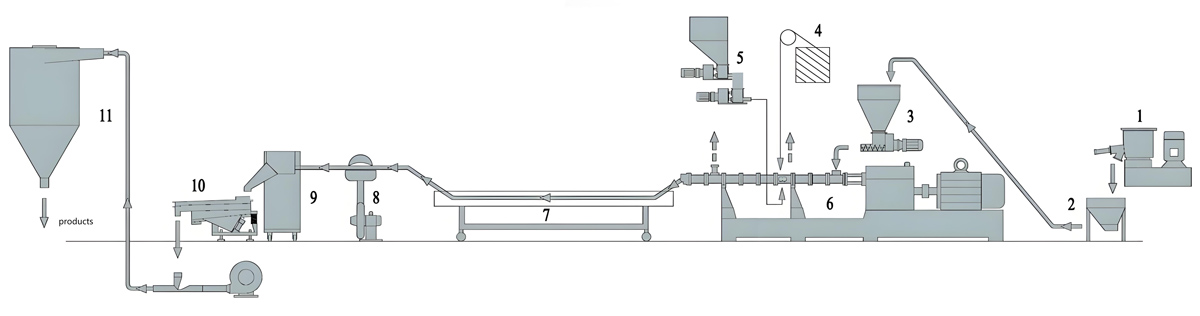
Production of LLDPE CaCO3 filled masterbatch begins with rigorous incoming material quality verification. Calcium carbonate receives testing for particle size distribution, moisture content, surface treatment quality where applicable, and chemical purity. LLDPE carrier resin undergoes melt flow index measurement, density verification, and visual inspection for contamination. Raw material specifications establish acceptance criteria that ensure consistent processing behavior in the twin screw extruder for LLDPE CaCO3 filled masterbatch. Material lot tracking enables quality traceability throughout production.
Drying and Preconditioning
Moisture management is critical for filled masterbatch production. Calcium carbonate undergoes drying to achieve moisture content below 0.1%, typically using rotary dryers at 105-115°C for 2-3 hours. LLDPE pellets may require drying depending on storage conditions and carrier grade. Proper drying prevents void formation, surface defects, and degradation during processing. Materials should be processed promptly after drying or stored in sealed containers with desiccant. The twin screw extruder for LLDPE CaCO3 filled masterbatch performs optimally with properly preconditioned feed materials.
Precision Batching
Accurate formulation begins with precision weighing of all components. Automated batching systems with load cells achieving ±0.1% accuracy ensure formulation consistency. Batching sequence influences pre-blend quality: CaCO3 is typically weighed first, followed by dispersants and processing aids, with LLDPE carrier added last. Computer-controlled batching systems integrate with production management systems for recipe control and documentation. This precision feeding to the twin screw extruder for LLDPE CaCO3 filled masterbatch establishes foundation for consistent product quality.
High-Intensity Premixing
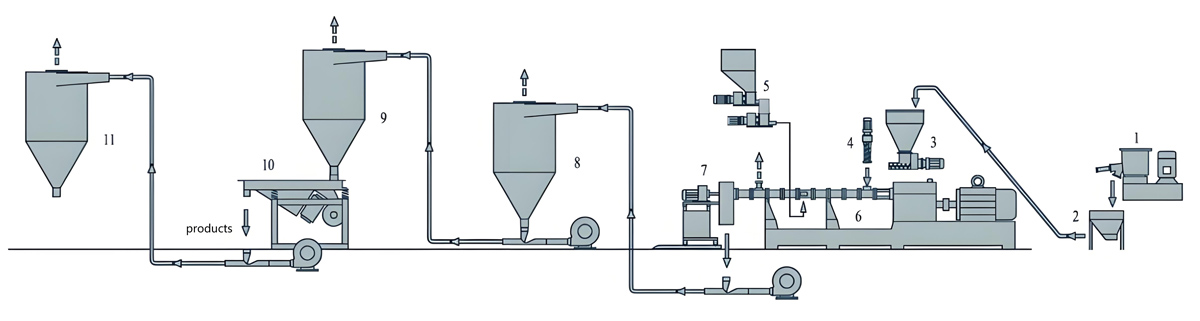
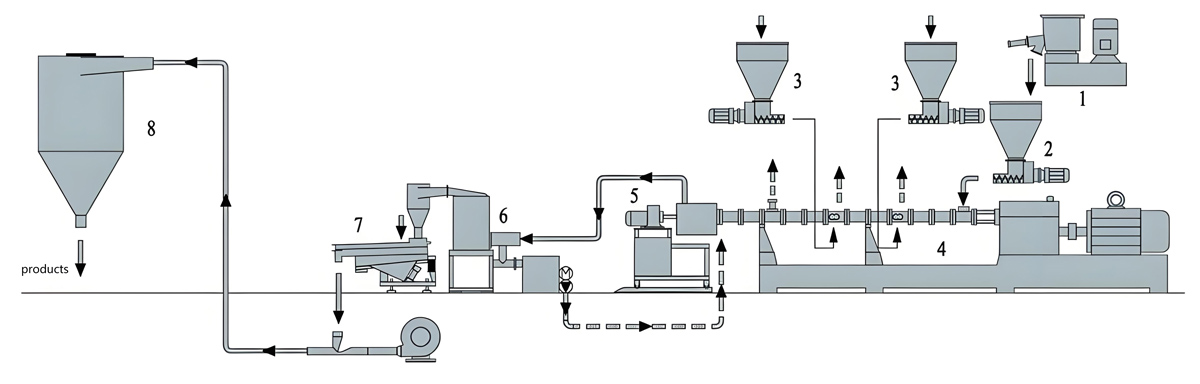
Premixing creates a homogeneous dry blend that feeds consistently into the extruder. High-intensity mixers operating at 1000-1500 RPM for 3-5 minutes achieve thorough component distribution. Mixing sequence affects blend quality: dry CaCO3 and dispersants blend first, followed by LLDPE addition. The high-shear mixing partially disperses dispersants on CaCO3 surfaces, improving downstream extrusion efficiency. Premix quality verification before feeding to the twin screw extruder for LLDPE CaCO3 filled masterbatch prevents formulation inconsistencies.
Gravimetric Feeding System
The twin screw extruder for LLDPE CaCO3 filled masterbatch employs gravimetric feeders for precise, consistent material delivery. Loss-in-weight feeders maintain feed rate within ±0.5% of setpoint, compensating for density variations in the pre-blend. Feed hopper design prevents bridging and ensures consistent material flow. Feed rate calibration matches extruder capacity, typically targeting 70-80% fill level in screw channels. Over-feeding causes incomplete melting and potential vent flooding, while under-feeding reduces throughput and may cause process surging.
LLDPE Melting Characteristics
LLDPE’s linear molecular structure creates distinct melting behavior compared to branched LDPE. The polymer exhibits sharper melting transition and requires higher shear for complete homogenization. Inside the twin screw extruder for LLDPE CaCO3 filled masterbatch, melting occurs progressively as material moves through heated barrel zones. Initial melting zone temperatures of 150-165°C soften LLDPE sufficiently for filler incorporation. The linear structure means LLDPE does not exhibit the same melt strength as LDPE, requiring different screw design considerations for stable extrusion.
Intensive Mixing Requirements
Achieving complete CaCO3 dispersion in LLDPE demands intensive mixing due to the polymer’s higher melt viscosity at equivalent temperatures. Kneading block configurations with forward and reverse elements generate necessary shear forces for agglomerate breakdown. The twin screw extruder for LLDPE CaCO3 filled masterbatch dedicates 35-45% of barrel length to mixing functions. Mixing intensity must balance dispersion requirements against thermal load, as excessive shear generates heat that can degrade LLDPE. Optimized screw configurations achieve quality dispersion while managing melt temperature.
Devolatilization Process
Effective removal of moisture, air, and volatile compounds occurs through vacuum venting positioned after primary mixing zones. Vacuum levels of 0.7-0.9 bar absolute extract entrapped gases from the melt. Vent port design includes melt-sealing elements preventing material escape into vacuum lines. LLDPE’s lower melt strength requires careful vent port geometry to prevent strand breakage or vent flooding. Proper devolatilization in the twin screw extruder for LLDPE CaCO3 filled masterbatch eliminates voids that would compromise film quality in downstream applications.
Pelletizing and Classification
The compound exits through multi-hole strand dies forming continuous strands. Water bath cooling at 35-55°C provides controlled crystallization for LLDPE’s linear structure. Temperature control prevents excessive crystallization that could make strands brittle and difficult to pelletize. Air knives remove surface water before strands enter pelletizers. Rotary knife pelletizers cut strands into cylindrical pellets 2-3mm in length. Pellet classification removes fines and oversized particles, ensuring consistent particle size distribution from the twin screw extruder for LLDPE CaCO3 filled masterbatch.
Production Equipment Introduction
Twin Screw Extruder Core Technology
The twin screw extruder for LLDPE CaCO3 filled masterbatch features co-rotating intermeshing screws providing the intensive mixing required for this application. The KTE Series from Nanjing Kerke Extrusion Equipment Co., Ltd represents advanced technology specifically suited for LLDPE masterbatch production. Barrel length-to-diameter ratios of 44:1 to 52:1 provide sufficient processing length for complete melting, intensive mixing, and proper devolatilization. Modular barrel construction enables custom zone configurations for specific formulation requirements.
Screw Configuration Design
Screw design critically impacts LLDPE processing success. The KTE Series twin screw extruder for LLDPE CaCO3 filled masterbatch utilizes segmented screw elements enabling precise tailoring of shear history. LLDPE’s requirement for higher shear input during melting necessitates specific kneading block arrangements. Forward-conveying kneading blocks in early mixing zones initiate dispersion, while reverse-conveying elements increase residence time for complete filler wetting. Conveying elements with varying pitches control fill level and residence time. Wear-resistant coatings extend element life when processing abrasive CaCO3 formulations.
Barrel Construction Features
Barrel quality affects temperature control and equipment longevity. The KTE Series incorporates bimetallic barrel liners with hardness exceeding HRC 62 for wear resistance against abrasive fillers. Individual heating zones feature cast-in heater bands for uniform, responsive heating. Cooling systems using forced air or circulating water prevent temperature overshoot. Precise temperature control is particularly important for LLDPE processing in a twin screw extruder for LLDPE CaCO3 filled masterbatch, where the polymer’s processing window requires careful thermal management.
Drive System Specifications
Power transmission must deliver adequate torque for LLDPE’s higher viscosity during high-shear mixing. The KTE Series twin screw extruder for LLDPE CaCO3 filled masterbatch incorporates high-torque gearboxes rated for continuous operation at full motor load. Variable frequency drives provide precise speed control from 150 to 600 RPM depending on model. Torque-limiting devices protect against overload damage. Motor power ranges from 55 kW for smaller production units to 600+ kW for high-capacity industrial systems.
Feeding System Integration
Precise feeding ensures formulation consistency and process stability. Twin-screw loss-in-weight feeders handle cohesive CaCO3/LLDPE pre-blends with accuracy of ±0.5%. Feeder design prevents bridging and ensures consistent material flow to the extruder throat. Liquid injection systems meter processing aids or coupling agents where required. The integrated feeding system for a twin screw extruder for LLDPE CaCO3 filled masterbatch includes level monitoring and alarms to prevent hopper runout conditions.
Control System Architecture
Advanced control systems coordinate all extrusion functions for consistent, repeatable operation. PLC-based systems manage temperature zones, screw speed, feed rates, vacuum levels, and safety interlocks. Touch-screen interfaces provide intuitive operator access to process data and control functions. The KTE Series twin screw extruder for LLDPE CaCO3 filled masterbatch includes recipe management for rapid, error-free formulation changes. Data acquisition systems record all critical parameters for quality documentation and process optimization. Remote connectivity enables monitoring and technical support access.
Parameter Settings
Screw Speed Optimization
Screw speed selection affects throughput, mixing intensity, and thermal load. For LLDPE CaCO3 filled masterbatch, optimal speeds range from 280 to 420 RPM depending on extruder size and formulation specifics. Lower speeds provide longer residence time for improved dispersion but reduce production rate. Higher speeds increase shear intensity and output but may generate excessive heat. The KTE Series twin screw extruder for LLDPE CaCO3 filled masterbatch allows dynamic speed adjustment to optimize processing for specific formulations. Speed selection must balance these competing factors for best results.
Temperature Profile Configuration
Temperature settings must accommodate LLDPE’s melting characteristics while achieving proper mixing viscosity. A typical profile starts at 150-160°C in the feed zone, progresses through 165-180°C in the melting zone, reaches 185-200°C in the intensive mixing zone, then moderates to 175-190°C before the die. This profile promotes progressive melting while limiting maximum temperature. Die temperature typically sets 5-15°C below the final barrel zone to build pressure for strand formation. Precise profile control in the twin screw extruder for LLDPE CaCO3 filled masterbatch prevents thermal degradation while ensuring complete melting.
Feed Rate Calibration
Feed rate determines throughput and influences fill level in screw channels. For LLDPE-based masterbatch, feed rates targeting 70-80% fill level optimize mixing efficiency and output. Over-feeding causes incomplete melting, potential vent flooding, and unstable extrusion. Under-feeding reduces productivity and may cause surging due to inconsistent melt formation. Feed rate must coordinate with screw speed for optimal processing. Calibration procedures for the twin screw extruder for LLDPE CaCO3 filled masterbatch should account for formulation density variations across different products.
Vacuum System Parameters
Effective devolatilization requires appropriate vacuum level and vent port configuration. Vacuum levels of 0.7-0.9 bar absolute adequately remove moisture and entrapped gases from LLDPE masterbatch. The vacuum pump must provide adequate capacity for expected volatile load. Condensers protect vacuum equipment from material carryover. Vent port temperature must maintain melt fluidity while preventing material degradation. Monitoring vacuum level and pump performance ensures consistent degassing in the twin screw extruder for LLDPE CaCO3 filled masterbatch.
Die Pressure Management
Melt pressure at the die indicates extrusion conditions and affects pellet formation. Target pressures for LLDPE CaCO3 masterbatch range from 45 to 95 bar. Pressure that is too low suggests insufficient melt viscosity or incomplete melting. Excessive pressure indicates restriction, incorrect temperature, or potential die blockage. Pressure sensors enable real-time monitoring with alarm functions for deviation. Maintaining stable die pressure in the twin screw extruder for LLDPE CaCO3 filled masterbatch ensures consistent strand quality for pelletizing.
Torque and Energy Monitoring
Motor torque indicates the energy required for processing and reflects melt characteristics. For LLDPE CaCO3 formulations, torque typically reaches 70-85% of maximum rating during normal operation. Torque increases with filler loading due to higher melt viscosity. Sudden torque changes may indicate feeding issues, temperature problems, or foreign material. The KTE Series twin screw extruder for LLDPE CaCO3 filled masterbatch includes torque monitoring with overload protection. Tracking torque trends helps identify developing issues before they cause quality problems or equipment damage.
Equipment Price
Small-Scale Production Models
The KTE Series offers models for various production scales and investment levels. The KTE-50 serves pilot production or small manufacturing with throughput of 130-380 kg/h. Pricing for this twin screw extruder for LLDPE CaCO3 filled masterbatch ranges from $40,000 to $52,000 USD depending on specifications. This model suits product development, specialty formulations, or markets with moderate demand where capital efficiency is important.
Mainstream Production Capacity
Mid-range models address typical production requirements. The KTE-65 twin screw extruder for LLDPE CaCO3 filled masterbatch delivers capacity of 380-750 kg/h with investment of $65,000 to $88,000 USD. The KTE-75 increases throughput to 650-1300 kg/h with pricing from $95,000 to $130,000 USD. These models represent optimal capacity for established masterbatch producers, providing sufficient output for substantial market demand while maintaining reasonable capital investment.
High-Volume Industrial Systems
Large-scale production requires high-capacity equipment. The KTE-95 provides output of 1000-1800 kg/h with pricing from $155,000 to $210,000 USD. The flagship KTE-110 twin screw extruder for LLDPE CaCO3 filled masterbatch achieves throughput of 1600-2600 kg/h with complete system cost of $240,000 to $320,000 USD. These industrial systems feature enhanced automation, robust construction for continuous operation, and comprehensive process controls for consistent high-volume production.
Complete Production Line Investment
Full production capability requires auxiliary equipment beyond the extruder. Downstream systems including cooling bath, pelletizer, classifier, and material handling add $20,000 to $50,000 USD based on capacity. Upstream equipment for drying, conveying, and feeding contributes additional $15,000 to $40,000 USD. A complete integrated line for twin screw extruder for LLDPE CaCO3 filled masterbatch production typically requires investment 55-75% above the base extruder cost. Turnkey installation services simplify project execution.
Operating Cost Analysis
Operating economics affect total cost of ownership beyond initial investment. Energy consumption for LLDPE masterbatch production typically runs 0.15-0.25 kWh per kilogram of output. Higher shear requirements for LLDPE may increase energy consumption compared to LDPE equivalents. Annual maintenance costs average 3-4.5% of equipment value for well-maintained systems. Consumable parts including screw elements, barrel liners, seals, and heater bands require periodic replacement. The KTE Series twin screw extruder for LLDPE CaCO3 filled masterbatch offers favorable operating economics through efficient design and extended component life.
Problems in Production Process and Solutions
Problem 1: Incomplete Filler Dispersion
Inadequate CaCO3 dispersion creates quality defects including visible agglomerates, inconsistent masterbatch appearance, and reduced downstream product performance. When calcium carbonate fails to distribute uniformly throughout the LLDPE matrix, the masterbatch cannot deliver intended opacity, stiffness enhancement, or cost reduction benefits.
Cause Analysis
Dispersion failures in the twin screw extruder for LLDPE CaCO3 filled masterbatch typically result from insufficient shear energy during mixing. Contributing factors include suboptimal screw configuration lacking adequate mixing intensity, excessive filler loading beyond system capacity, improper dispersant chemistry or concentration, CaCO3 agglomeration from storage conditions, and worn mixing elements reducing shear capability. LLDPE’s higher melt viscosity at comparable temperatures compared to LDPE requires more intensive mixing for equivalent dispersion.
Corrective Actions
Address dispersion problems by first examining screw configuration and increasing kneading block density or aggressiveness in mixing zones. Verify dispersant type and concentration match formulation requirements. Consider surface-treated CaCO3 grades that disperse more readily. Process adjustments including reduced throughput rate for longer residence time or increased mixing zone temperature may provide immediate improvement. If high loading causes persistent issues, evaluate formulation reduction or alternative dispersant technology in the twin screw extruder for LLDPE CaCO3 filled masterbatch.
Prevention Strategy
Prevent dispersion failures through validated processing procedures developed for each formulation. Implement raw material testing for CaCO3 particle size distribution and moisture content. Establish standard screw configurations documented with processing parameters for reproducible results. Schedule regular inspection of mixing elements with planned replacement when performance degrades. Train operators to identify early dispersion problem indicators through visual pellet inspection and downstream quality feedback from the twin screw extruder for LLDPE CaCO3 filled masterbatch.
Problem 2: Melt Temperature Excursions
Excessive melt temperature causes LLDPE degradation resulting in discoloration, molecular weight reduction, gel formation, and compromised mechanical properties. LLDPE’s processing window requires careful temperature management to prevent thermal damage while achieving complete melting and mixing.
Cause Analysis
Thermal degradation in the twin screw extruder for LLDPE CaCO3 filled masterbatch occurs when melt temperature exceeds safe limits, typically above 205-215°C for extended periods. Contributing factors include excessive screw speed generating frictional heat, inadequate cooling capacity, improper temperature profile settings, overly aggressive screw configuration creating excessive shear, or extended residence time from process interruptions. Higher shear requirements for LLDPE increase thermal load compared to LDPE processing.
Corrective Actions
Reduce melt temperature through multiple interventions: decrease screw speed while maintaining appropriate feed rate to reduce shear heating, adjust barrel temperature profile to lower temperatures in early zones, increase cooling capacity to barrel jackets, and modify screw configuration to reduce shear intensity. Consider adding thermal stabilizers to sensitive formulations. Implement melt temperature monitoring with automatic response to temperature excursions in the twin screw extruder for LLDPE CaCO3 filled masterbatch.
Prevention Strategy
Prevent thermal degradation through validated temperature profiles and screw configurations specific to each formulation. Install melt temperature probes with high-temperature alarms and automatic shutdown protection. Maintain cooling systems in optimal condition through regular inspection and cleaning. Establish maximum screw speed limits for LLDPE formulations. Train operators to recognize degradation indicators including color changes and gel particles. Implement process control systems that detect and respond to temperature trends in the twin screw extruder for LLDPE CaCO3 filled masterbatch.
Problem 3: Process Instability and Output Variation
Process instability manifests as cyclic variations in output rate, melt pressure, and pellet quality. Surging and inconsistent output compromise product uniformity and may cause downstream processing difficulties for masterbatch customers.
Cause Analysis
Process instability in the twin screw extruder for LLDPE CaCO3 filled masterbatch originates from multiple sources: feeding inconsistencies from material bridging or feeder calibration drift, melting non-uniformity from temperature control issues, vent port flooding causing pressure fluctuations, or worn screw elements creating unstable conveying. LLDPE’s sharp melting transition and lower melt strength compared to LDPE can exacerbate instability tendencies. High-filler formulations exhibit greater sensitivity to process variations.
Corrective Actions
Address process instability by first stabilizing the feeding system through hopper design modifications and feeder calibration. Verify temperature profile uniformity for consistent melting. Check vacuum system operation if instability coincides with vent port issues. Inspect screw elements for wear and replace degraded components. Consider process adjustments including modified temperature settings or throughput changes. Analyze instability patterns to identify systematic causes in the twin screw extruder for LLDPE CaCO3 filled masterbatch.
Prevention Strategy
Prevent process instability through robust feeding system design, maintenance, and monitoring. Implement real-time monitoring of pressure and output rate with deviation alarms. Establish preventive maintenance schedules for feeders, temperature systems, and screw elements. Develop standard operating procedures for start-up and steady-state operation. Train operators in process observation and intervention techniques. Maintain detailed production records enabling trend analysis and root cause identification for the twin screw extruder for LLDPE CaCO3 filled masterbatch.
Problem 4: Strand Breakage During Pelletizing
Strand breakage interrupts production, reduces yield, and creates processing complications. LLDPE’s lower melt strength compared to LDPE increases susceptibility to strand breakage, particularly with high filler loadings.
Cause Analysis
Strand breakage in the twin screw extruder for LLDPE CaCO3 filled masterbatch results from insufficient melt strength, improper cooling conditions, die design issues, or process instability. LLDPE’s linear molecular structure provides less melt strength than branched LDPE, making strands more fragile. Excessive cooling creates brittle strands prone to breakage. Process surging causes variable output that stresses strands. Filler agglomerates create weak points in strands.
Corrective Actions
Reduce strand breakage by optimizing water bath temperature to provide moderate cooling that solidifies strands without excessive crystallization. Adjust die design for better streamlining and uniform flow distribution. Address process instability affecting output consistency. Improve filler dispersion to eliminate weak points in strands. Consider melt strength enhancers in formulations if breakage persists. Implement strand monitoring with automatic response to breakage events in the twin screw extruder for LLDPE CaCO3 filled masterbatch.
Prevention Strategy
Prevent strand breakage through validated cooling parameters and stable process conditions. Establish water bath temperature standards for different formulations. Maintain consistent output rate and pressure. Ensure excellent filler dispersion throughout the compound. Implement routine strand quality inspection. Train operators on proper start-up procedures that minimize breakage risk. Document breakage incidents with associated process conditions to identify contributing factors in the twin screw extruder for LLDPE CaCO3 filled masterbatch.
Maintenance
Daily Operational Monitoring
Daily maintenance for the twin screw extruder for LLDPE CaCO3 filled masterbatch focuses on operational observation and routine cleaning. Operators conduct visual and auditory inspection during production, identifying unusual sounds, vibrations, or leaks. Process parameter readings are compared against established baselines for each formulation. The die face, water bath, and pelletizer receive cleaning at shift end to prevent material build-up. Production logs document process parameters, observations, and any abnormalities requiring follow-up attention.
Weekly Maintenance Activities
Weekly maintenance emphasizes equipment cleaning and functional verification. Vacuum system filters and condensers undergo inspection and cleaning. Feeder hoppers and transfer lines are inspected for material build-up and cleared as needed. Cooling water systems receive strainer cleaning and flow verification. Temperature controller calibration checks ensure accurate processing. Pelletizer components receive lubrication per manufacturer specifications. These routine activities maintain twin screw extruder for LLDPE CaCO3 filled masterbatch operational reliability.
Monthly Inspection Protocols
Monthly maintenance involves detailed inspection and adjustment procedures. Screw elements undergo thorough wear evaluation with dimensional measurement. Barrel liner condition assessment identifies developing wear patterns. Die plates receive inspection for wear, scoring, and flow channel condition. Electrical systems including heater bands, thermocouples, and connections undergo functional verification. Drive system inspection covers belt or coupling condition and gearbox oil level for the twin screw extruder for LLDPE CaCO3 filled masterbatch.
Quarterly and Annual Service
Quarterly maintenance includes screw extraction for comprehensive inspection and cleaning. All elements receive measurement and wear assessment with documentation. Barrel bore inspection evaluates liner condition. Gearbox service encompasses oil sampling, analysis, and change based on results. Safety system verification confirms interlocks and emergency stops function correctly.
Annual maintenance represents major equipment service including screw element replacement based on wear findings. Barrel liner replacement addresses accumulated wear. Comprehensive gearbox overhaul includes bearing inspection and replacement. All instrumentation undergoes recalibration for accuracy. Control system software updates install improvements. Post-maintenance testing confirms equipment readiness before the twin screw extruder for LLDPE CaCO3 filled masterbatch returns to production.
Spare Parts Management
Strategic inventory minimizes downtime when repairs are needed. Critical components for twin screw extruder for LLDPE CaCO3 filled masterbatch include screw elements, barrel liners, heater bands, thermocouples, seals, bearings, and drive belts. Inventory levels reflect component criticality, procurement lead time, and historical consumption rates. Regular coordination with equipment suppliers ensures availability of KTE Series specific parts. Inventory review and adjustment maintain appropriate stock levels aligned with production requirements.
FAQ
What CaCO3 loading is typical for LLDPE masterbatch?
LLDPE CaCO3 filled masterbatch formulations typically contain 68-78% calcium carbonate by weight. Stretch film applications commonly use 72-76% loading to maintain elasticity. Agricultural films may use 70-75% with additional UV stabilizers. Heavy-duty packaging applications sometimes reach 78-80% with surface-modified CaCO3. Processing in a twin screw extruder for LLDPE CaCO3 filled masterbatch enables these high loadings with appropriate formulations and equipment configuration.
How does LLDPE processing differ from LDPE?
LLDPE requires higher shear input for complete melting due to its linear molecular structure, unlike LDPE’s branched architecture. Processing temperatures for LLDPE CaCO3 filled masterbatch typically run 5-15°C higher than LDPE equivalents. LLDPE exhibits lower melt strength affecting strand formation and pelletizing. Screw configurations for LLDPE require more aggressive mixing elements. The twin screw extruder for LLDPE CaCO3 filled masterbatch must address these differences through optimized design and parameters.
What quality tests are essential for LLDPE masterbatch?
Essential quality parameters include CaCO3 content verification, melt flow index measurement, color evaluation, moisture content, and pellet size distribution. For stretch film applications, additional tests cover mechanical properties including tensile strength and elongation. Agricultural formulations require UV stabilizer content verification. Consistent testing protocols ensure reliable quality from the twin screw extruder for LLDPE CaCO3 filled masterbatch.
How often should screw elements be replaced?
Replacement intervals depend on operating conditions, CaCO3 loading, and filler abrasiveness. Under typical conditions with 70-75% CaCO3 loading, screw elements in the twin screw extruder for LLDPE CaCO3 filled masterbatch may require replacement after 9,000 to 16,000 operating hours. Regular inspection and measurement enable predictive replacement planning. Wear-resistant element coatings extend service life substantially.
What causes masterbatch quality variation?
Quality variations result from raw material inconsistencies, temperature fluctuations, dispersion problems, or contamination. CaCO3 particle size distribution affects masterbatch appearance. Thermal degradation causes color changes. Process variations affecting dispersion create property inconsistencies. Implementing raw material specifications, validated processing procedures, and routine equipment maintenance minimizes quality variation from the twin screw extruder for LLDPE CaCO3 filled masterbatch.
How should CaCO3 be prepared for processing?
Calcium carbonate requires drying to moisture content below 0.1% before extrusion. Drying at 105-115°C for 2-3 hours in appropriate dryers achieves adequate moisture removal. Dried material should be processed promptly or stored in sealed containers with desiccant to prevent moisture reabsorption before introduction to the twin screw extruder for LLDPE CaCO3 filled masterbatch.
What safety requirements apply to extruder operation?
Safety requirements include proper guarding of rotating equipment and heated surfaces, appropriate personal protective equipment, functional emergency stop systems, and lock-out/tag-out procedures for maintenance. Operators require training on start-up, operation, and shutdown procedures. Understanding of pinch point hazards and burn risks is essential. Regular safety system inspection ensures protection during operation of the twin screw extruder for LLDPE CaCO3 filled masterbatch.
Conclusion
The twin screw extruder for LLDPE CaCO3 filled masterbatch represents essential technology for manufacturers serving the stretch film, agricultural, and heavy-duty packaging markets. Success requires understanding LLDPE’s unique processing characteristics and implementing appropriate equipment configurations and operational practices.
Optimal results emerge from integrated attention to formulation development, equipment specification, process optimization, and systematic maintenance. The KTE Series from Nanjing Kerke Extrusion Equipment Co., Ltd delivers the intensive mixing capability, precise temperature control, and operational reliability required for demanding LLDPE masterbatch applications. Appropriate equipment capacity matched to market requirements provides foundation for profitable production.
Continuous improvement through process monitoring, quality analysis, and operational training builds competitive advantage. By implementing the technical guidance and best practices presented in this comprehensive resource, manufacturers achieve consistent quality, minimize production problems, and optimize return on their twin screw extruder for LLDPE CaCO3 filled masterbatch investment. The combination of appropriate technology, skilled operation, and systematic maintenance creates sustainable success in masterbatch manufacturing.