Introduction
HDPE CaCO3 filled masterbatch represents one of the most widely used additive concentrates in the plastic industry. This essential material combines high-density polyethylene with calcium carbonate filler to enhance product properties while reducing production costs. The twin screw extruder for HDPE CaCO3 filled masterbatch has become the preferred equipment choice for manufacturers seeking consistent quality, efficient dispersion, and reliable output in their production lines.
The process of creating HDPE CaCO3 filled masterbatch requires precise control over temperature, mixing intensity, and material residence time. Twin screw extruders excel in this application due to their superior mixing capabilities and ability to handle high filler loadings effectively. Manufacturers worldwide rely on twin screw extruder technology for HDPE CaCO3 filled masterbatch production to create masterbatches that improve stiffness, opacity, and dimensional stability of final plastic products.
Understanding the complete production process from formulation to quality control is crucial for achieving optimal results. This comprehensive guide explores every aspect of twin screw extruder operations for HDPE CaCO3 filled masterbatch production, including detailed formulation ratios, equipment specifications, parameter optimization, common challenges, and maintenance protocols that ensure long-term operational success.
Formulation Ratio (Different Types)
Standard Grade Formulation
The standard formulation for HDPE CaCO3 filled masterbatch typically contains between 70% to 85% calcium carbonate by weight. A common starting point uses 75% CaCO3, 20% HDPE carrier resin, and 5% dispersing agents and additives. This balanced ratio provides excellent dispersion while maintaining good processability during downstream applications. When processing with a twin screw extruder for HDPE CaCO3 filled masterbatch, the carrier resin should match or be compatible with the base polymer in the final product to ensure proper integration.
High Loading Formulation
For applications requiring maximum filler content, high loading formulations push CaCO3 content to 85% or higher. These formulations require specialized dispersing agents and may use lower molecular weight HDPE carriers to improve flow characteristics. The challenge with high loading formulations lies in maintaining adequate dispersion quality without compromising the masterbatch’s mechanical properties during processing in the twin screw extruder for HDPE CaCO3 filled masterbatch.
Surface Modified CaCO3 Formulations
Surface-treated calcium carbonate particles offer enhanced compatibility with HDPE matrix, allowing for better dispersion at higher loadings. These formulations typically use 80% surface-modified CaCO3, 15% HDPE carrier, and 5% processing aids. The surface treatment, usually stearic acid or titanate coupling agents, reduces the interfacial tension between filler and polymer, resulting in superior mechanical properties in the final product produced by the twin screw extruder for HDPE CaCO3 filled masterbatch.
Specialty Additive Formulations
Beyond basic formulations, specialty HDPE CaCO3 filled masterbatch may incorporate additional functional additives. These can include UV stabilizers for outdoor applications, antistatic agents for electronic packaging, or processing lubricants for improved flow. A typical specialty formulation might contain 70% CaCO3, 18% HDPE, 5% dispersant, and 7% specialty additives tailored to specific end-use requirements for processing in a twin screw extruder for HDPE CaCO3 filled masterbatch.
Cost-Optimized Formulations
Economy-grade formulations focus on cost reduction while maintaining acceptable quality standards. These typically use 75-80% lower-cost CaCO3 grades, 15-20% recycled HDPE carrier where permissible, and minimal dispersant content of 3-5%. While suitable for non-critical applications, these formulations require careful quality control to ensure consistent performance when using a twin screw extruder for HDPE CaCO3 filled masterbatch.
Production Process
Raw Material Preparation
The production of HDPE CaCO3 filled masterbatch begins with careful raw material preparation. Calcium carbonate powder must be properly dried to remove moisture content below 0.1% before processing. Moisture in the filler can cause voids, surface defects, and reduced mechanical properties in the final masterbatch. The HDPE carrier resin should also be checked for moisture and pre-dried if necessary, particularly when using hygroscopic grades or materials that have been stored in humid conditions before feeding into the twin screw extruder for HDPE CaCO3 filled masterbatch.
Weighing and Premixing
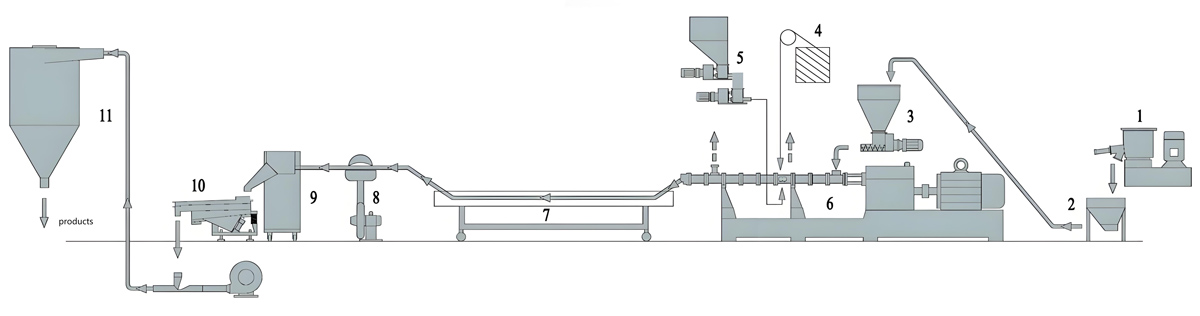
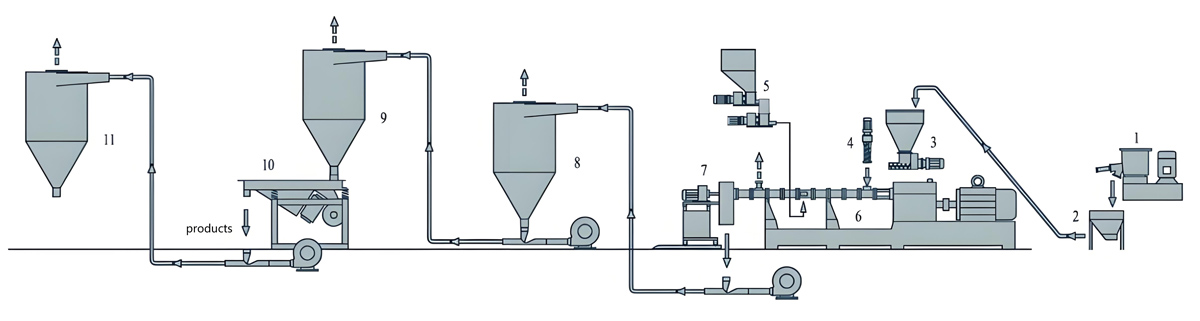
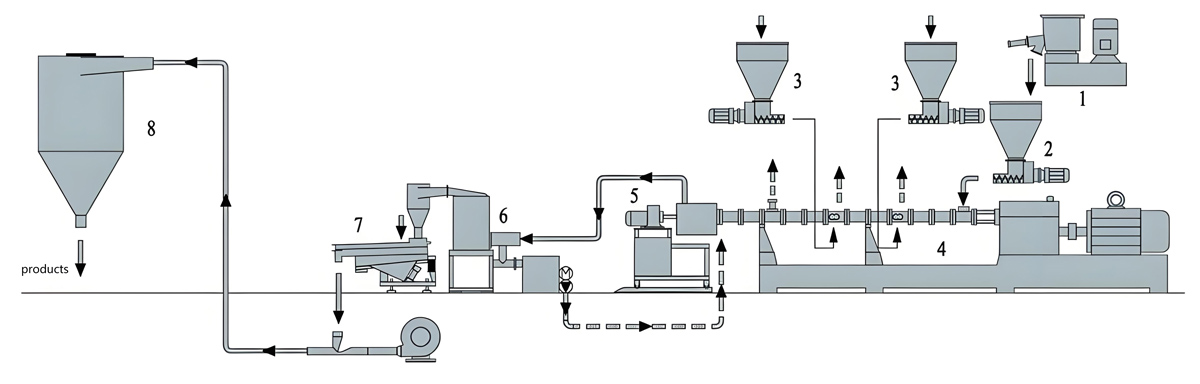
Accurate weighing of all components is critical for batch-to-batch consistency. Automated weighing systems with precision of 0.1% ensure formulation accuracy. The premixing stage combines CaCO3 powder, HDPE pellets or powder, dispersing agents, and other additives in a high-speed mixer. This preliminary blending, typically lasting 3-5 minutes, creates a homogeneous pre-blend that feeds more consistently into the twin screw extruder for HDPE CaCO3 filled masterbatch.
Feeding System Operations
The twin screw extruder for HDPE CaCO3 filled masterbatch utilizes gravimetric feeding systems for precise material delivery. Main feeding typically occurs through the throat of the extruder, while liquid additives may be injected downstream through side ports. Feed rates must be calibrated to match the extruder’s throughput capacity while maintaining optimal fill levels in the screw channels. Over-feeding can cause material backup and incomplete melting, while under-feeding results in poor mixing and reduced output.
Melting and Compounding
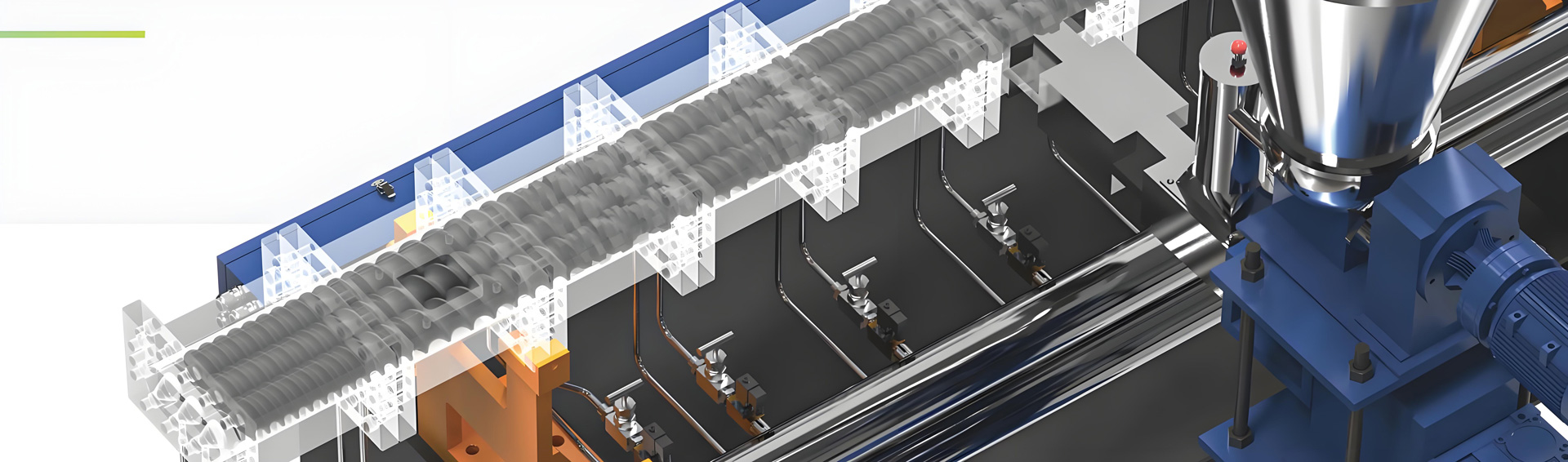
Inside the twin screw extruder for HDPE CaCO3 filled masterbatch, the material undergoes progressive heating and shearing as it moves through different functional zones. The initial melting zone softens the HDPE carrier, allowing it to coat the CaCO3 particles. The kneading blocks and mixing elements in the compounding zone then apply intense shear forces that break down agglomerates and distribute the filler evenly throughout the polymer matrix. Temperature profiles along the barrel are carefully controlled to optimize melting without degrading the HDPE carrier.
Devolatilization
A vacuum vent port positioned after the mixing zone removes any residual moisture, volatiles, or entrapped air from the melt. This devolatilization step is crucial for producing high-quality masterbatch without voids or bubbles. The vacuum level typically ranges from 0.5 to 0.9 bar absolute, depending on material sensitivity and moisture content. Proper devolatilization ensures better surface finish and mechanical properties in the final product from the twin screw extruder for HDPE CaCO3 filled masterbatch.
Extrusion and Pelletizing
The homogenized melt exits the twin screw extruder for HDPE CaCO3 filled masterbatch through a strand die, forming continuous strands that are immediately cooled in a water bath. The cooled strands then enter a pelletizer that cuts them into uniform pellets, typically 2-4mm in length. These pellets represent the final HDPE CaCO3 filled masterbatch product, ready for packaging and shipment to customers or use in downstream processing operations.
Production Equipment Introduction
Twin Screw Extruder Core System
The twin screw extruder for HDPE CaCO3 filled masterbatch features co-rotating intermeshing screw design, which provides superior self-wiping action and intensive mixing. The KTE Series from Nanjing Kerke Extrusion Equipment Co., Ltd represents industry-leading technology for this application. The KTE Series offers modular barrel construction with L/D ratios ranging from 40:1 to 52:1, providing sufficient length for complete melting, thorough mixing, and proper devolatilization of high-filler formulations.
Screw Configuration
Screw design significantly impacts mixing quality and throughput. The screw configuration for CaCO3 masterbatch typically includes conveying elements in the feed zone, transition elements for initial melting, kneading blocks arranged in staggered patterns for intensive mixing, and final conveying elements before the die. The KTE Series twin screw extruder for HDPE CaCO3 filled masterbatch features segmented screw elements that allow customization of shear intensity and residence time to match specific formulation requirements.
Temperature Control System
Precise temperature control is essential for HDPE processing. The barrel heating system uses cast-in heater bands with multiple zones, each independently controlled by PID controllers. Cooling systems, including air cooling or water cooling, prevent temperature overshoot and maintain optimal processing conditions. The KTE Series incorporates advanced temperature control technology with response times under 30 seconds, ensuring stable processing even with high CaCO3 loadings in the twin screw extruder for HDPE CaCO3 filled masterbatch.
Feeding Equipment
Gravimetric feeders provide accurate, consistent material delivery to the extruder. For HDPE CaCO3 filled masterbatch production, twin screw loss-in-weight feeders handle the main pre-blend, while liquid injection systems may deliver processing aids or coupling agents. The feeding system must be properly calibrated and regularly maintained to ensure formulation consistency and prevent production issues related to incorrect material ratios in the twin screw extruder for HDPE CaCO3 filled masterbatch.
Downstream Equipment
The complete production line includes auxiliary equipment essential for efficient operation. A water bath cooling system quickly solidifies extruded strands, while a strand pelletizer with rotary knives produces uniform pellets. An air classifier removes fines and oversized particles, ensuring consistent pellet size. Material handling systems, including pneumatic conveyors and storage silos, complete the installation for automated, continuous production using the twin screw extruder for HDPE CaCO3 filled masterbatch.
Control and Monitoring Systems
Modern twin screw extruders feature sophisticated PLC control systems that monitor and record all critical process parameters. The KTE Series twin screw extruder for HDPE CaCO3 filled masterbatch includes touch-screen interfaces displaying real-time data on barrel temperatures, screw speed, motor load, melt pressure, and feed rates. Data logging capabilities enable quality traceability and process optimization. Remote monitoring options allow operators to track production status and receive alerts for any parameter deviations.
Parameter Settings
Screw Speed Optimization
Screw speed for HDPE CaCO3 filled masterbatch production typically ranges from 250 to 500 RPM, depending on extruder size and formulation requirements. Higher screw speeds increase throughput and shear intensity but may reduce residence time and potentially degrade the polymer. For standard 75% CaCO3 formulations, speeds of 300-350 RPM often provide optimal balance between output rate and dispersion quality in the twin screw extruder for HDPE CaCO3 filled masterbatch. The KTE Series extruders can operate at speeds up to 600 RPM for maximum productivity when processing stable formulations.
Temperature Profile Configuration
The temperature profile along the barrel must be carefully configured to match the processing characteristics of HDPE and the thermal sensitivity of additives. A typical profile starts at 160-170°C in the feed zone to prevent premature melting that could cause bridging. Temperature gradually increases through the melting zone to 180-190°C, peaks at 200-210°C in the mixing zone for optimal dispersion, then slightly decreases to 195-200°C before the die. This profile ensures complete melting and mixing without thermal degradation in the twin screw extruder for HDPE CaCO3 filled masterbatch.
Feed Rate Settings
Feed rate determines the degree of fill in the twin screw extruder channels and significantly impacts mixing quality. For HDPE CaCO3 filled masterbatch, feed rates are calibrated to achieve 60-80% fill level in the conveying sections. Over-feeding results in incomplete melting and poor dispersion, while under-feeding reduces output efficiency. The relationship between feed rate, screw speed, and extruder torque must be balanced for optimal performance. Typical throughput rates for the KTE Series twin screw extruder for HDPE CaCO3 filled masterbatch range from 300 to 2000 kg/h depending on model size.
Vacuum Level Requirements
Effective devolatilization requires adequate vacuum levels at the vent port. For HDPE CaCO3 filled masterbatch, vacuum levels of 0.7-0.9 bar absolute effectively remove moisture and volatiles. The vent port should be positioned after the main mixing zone to allow volatile release while the melt is fully fluid. Proper vent port design, including vent stuffer screws to prevent material escape, ensures efficient devolatilization without production interruptions in the twin screw extruder for HDPE CaCO3 filled masterbatch.
Die Pressure and Melt Temperature
Melt pressure at the die indicates proper extrusion conditions. Typical die pressures range from 50 to 100 bar for HDPE CaCO3 filled masterbatch. Pressure that is too low suggests insufficient melt viscosity or incomplete mixing, while excessive pressure indicates blockages or improper temperature settings. Melt temperature at the die should remain within 195-210°C for HDPE-based formulations. Monitoring these parameters helps operators maintain consistent product quality from the twin screw extruder for HDPE CaCO3 filled masterbatch.
Motor Load and Torque
Motor torque reflects the energy required to process the material and indicates mixing intensity. For high-filler CaCO3 masterbatch, torque values typically reach 70-85% of maximum motor capacity. The KTE Series twin screw extruder for HDPE CaCO3 filled masterbatch features high-torque gearboxes designed to handle the increased viscosity of filled compounds. Sudden torque fluctuations may indicate feed inconsistencies, temperature control issues, or foreign material contamination, requiring immediate attention to prevent equipment damage.
Equipment Price
KTE Series Twin Screw Extruder Pricing
The KTE Series from Nanjing Kerke Extrusion Equipment Co., Ltd offers various models to match different production capacities and budgets. The KTE-50 model, suitable for small-scale production or pilot runs, ranges from $35,000 to $45,000 USD depending on configuration. This twin screw extruder for HDPE CaCO3 filled masterbatch model provides throughput of 100-300 kg/h, making it ideal for development work or limited production volumes.
Mid-Range Production Models
The KTE-65 and KTE-75 models target medium-scale production requirements. The KTE-65 twin screw extruder for HDPE CaCO3 filled masterbatch offers throughput of 300-600 kg/h with pricing between $55,000 and $75,000 USD. The larger KTE-75 delivers 500-1000 kg/h output capacity with prices ranging from $80,000 to $110,000 USD. These models represent the most common choices for established masterbatch producers seeking reliable, efficient equipment for daily production operations.
High-Capacity Production Systems
For large-scale industrial production, the KTE-95 and KTE-110 models provide maximum throughput. The KTE-95 handles 800-1500 kg/h with pricing from $130,000 to $180,000 USD. The flagship KTE-110 twin screw extruder for HDPE CaCO3 filled masterbatch achieves outputs of 1200-2000 kg/h, with prices ranging from $200,000 to $280,000 USD depending on specifications and included auxiliary equipment. These high-capacity systems are designed for continuous 24-hour operation in demanding production environments.
Complete Line Pricing
A complete production line includes the twin screw extruder for HDPE CaCO3 filled masterbatch plus auxiliary equipment. Basic downstream packages with cooling bath, pelletizer, and control system add $15,000 to $40,000 USD to the base extruder price. Comprehensive lines including feeding systems, material handling, quality control equipment, and automation can increase total investment by 40-60% beyond the extruder cost. Investment in complete integrated systems typically provides better long-term value through improved efficiency and consistency.
Operating Cost Considerations
Beyond initial capital investment, operating costs significantly impact total cost of ownership. Energy consumption for twin screw extruder for HDPE CaCO3 filled masterbatch operations varies with size and operating conditions, typically ranging from 0.15 to 0.25 kWh per kilogram of product. Maintenance costs average 3-5% of equipment value annually. Consumables including screw elements, barrel liners, and seals require periodic replacement based on operating hours and material abrasiveness. The KTE Series features robust construction that minimizes maintenance requirements and extends component life.
Problems in Production Process and Solutions
Problem 1: Poor Dispersion of CaCO3
Poor dispersion represents one of the most common challenges in HDPE CaCO3 filled masterbatch production using a twin screw extruder. When calcium carbonate particles remain agglomerated rather than individually distributed throughout the polymer matrix, the resulting masterbatch exhibits inferior mechanical properties, inconsistent color, and poor processing behavior in downstream applications.
Cause Analysis
Inadequate dispersion typically results from insufficient shear intensity during mixing, improper screw configuration, or excessive CaCO3 loading that exceeds the system’s mixing capacity. Additionally, surface moisture on the calcium carbonate, incompatible dispersing agents, or worn screw elements can contribute to poor dispersion quality in the twin screw extruder for HDPE CaCO3 filled masterbatch.
Solution
To resolve dispersion issues, first optimize the screw configuration by increasing the number and angle of kneading blocks in the mixing zone. Ensure barrel temperature in the mixing section is high enough to reduce polymer viscosity and improve shear transfer. Consider adding or increasing dispersing agents in the formulation. If these measures prove insufficient, reducing CaCO3 loading or switching to surface-treated grades may be necessary.
Prevention Methods
Prevent poor dispersion by maintaining proper screw element condition through regular inspection and timely replacement. Implement consistent raw material quality control, particularly checking moisture content and particle size distribution of CaCO3. Develop and validate screw configurations for specific formulations, documenting successful settings for future reference. Train operators to recognize early signs of dispersion problems through visual inspection of extrudate and pellet samples from the twin screw extruder for HDPE CaCO3 filled masterbatch.
Problem 2: Excessive Melt Temperature
High melt temperature can cause thermal degradation of the HDPE carrier, leading to discoloration, reduced molecular weight, and compromised mechanical properties in the masterbatch. This problem is particularly concerning for applications requiring specific color or clarity requirements.
Cause Analysis
Elevated melt temperature in the twin screw extruder for HDPE CaCO3 filled masterbatch results from excessive shear input, inadequate cooling capacity, improper temperature profile settings, or excessive screw speed relative to throughput rate. High filler loading increases melt viscosity, which in turn generates more shear heat during processing.
Solution
Reduce melt temperature by lowering screw speed while maintaining feed rate, adjusting barrel temperature profile to reduce heating in early zones, or improving cooling water flow to barrel cooling jackets. Consider modifying screw configuration to reduce shear intensity, particularly by using wider-pitch conveying elements or fewer kneading blocks. If these adjustments are insufficient, increasing feed rate may help by reducing residence time.
Prevention Methods
Prevent overheating by establishing validated temperature profiles and screw configurations for each formulation. Implement real-time melt temperature monitoring with alarms for deviation beyond acceptable ranges. Maintain cooling systems in optimal condition through regular cleaning and maintenance. Train operators to recognize signs of thermal degradation, including changes in melt color or viscosity, and respond quickly to temperature excursions in the twin screw extruder for HDPE CaCO3 filled masterbatch.
Problem 3: Inconsistent Pellet Quality
Variations in pellet size, shape, or appearance indicate process instability that can affect downstream processing performance and final product quality. Inconsistent pellets may cause feeding problems, uneven dosing, and property variations in end products.
Cause Analysis
Pellet inconsistency originates from fluctuations in extrusion output, unstable melt pressure, temperature variations, or equipment issues in the pelletizing system. Worn die holes, inconsistent cooling water temperature, or improper pelletizer blade settings can also contribute to this problem in the twin screw extruder for HDPE CaCO3 filled masterbatch.
Solution
Address pellet quality issues by first stabilizing the extrusion process, ensuring consistent feed rates and temperature control. Inspect and clean the die plate, replacing worn die holes if necessary. Adjust water bath temperature and level to ensure consistent cooling. Check pelletizer blade sharpness and gap settings, adjusting or replacing components as needed. Implement statistical process control to monitor pellet quality and identify trends before they become significant problems.
Prevention Methods
Prevent pellet inconsistency through regular preventive maintenance of the complete production line. Establish standard operating procedures for start-up, shutdown, and normal operation. Implement routine quality checks of pellet size distribution and appearance. Train operators on proper equipment adjustment techniques and empower them to make corrections before quality suffers in the twin screw extruder for HDPE CaCO3 filled masterbatch.
Problem 4: Equipment Wear
Processing abrasive CaCO3 fillers accelerates wear on screw elements, barrel liners, and other contact surfaces. Excessive wear reduces mixing efficiency, changes process characteristics, and eventually requires costly component replacement.
Cause Analysis
Wear occurs due to the abrasive nature of calcium carbonate particles, particularly when processing high loadings or using coarse particle sizes. Inadequate lubrication between polymer and metal surfaces, excessive screw speed, and improper processing temperatures that increase material abrasiveness contribute to accelerated wear in the twin screw extruder for HDPE CaCO3 filled masterbatch.
Solution
When wear becomes evident through reduced process consistency or visual inspection, replace worn screw elements with wear-resistant alternatives. The KTE Series offers bimetallic barrel liners and wear-coated screw elements specifically designed for filled compound processing. Consider reducing CaCO3 particle size or switching to less abrasive grades if wear problems persist. Optimize processing conditions to ensure adequate polymer melt for lubrication between filler particles and metal surfaces.
Prevention Methods
Extend equipment life by implementing scheduled inspection routines to monitor wear progression. Maintain process conditions that optimize polymer melt viscosity for adequate surface lubrication. Consider investing in wear-resistant components from the outset when specifying new equipment. Document wear rates under different processing conditions to predict replacement intervals and plan maintenance proactively for the twin screw extruder for HDPE CaCO3 filled masterbatch.
Maintenance
Daily Maintenance Procedures
Daily maintenance for the twin screw extruder for HDPE CaCO3 filled masterbatch includes visual inspection of all equipment during operation. Operators should check for unusual noises, vibrations, or leaks that might indicate developing problems. Monitor temperature displays, pressure gauges, and motor load readings, comparing values against established baselines to identify any deviations. Clean the die face and pelletizer area at the end of each production run to prevent material buildup. Document any observations or abnormalities in the production log for follow-up.
Weekly Maintenance Tasks
Weekly maintenance focuses on cleaning and inspection tasks that ensure continued reliable operation. Clean or replace filters in the vacuum system to maintain effective devolatilization. Inspect and clean feed hoppers, feeders, and transfer lines to prevent material contamination. Check cooling water systems for proper flow and temperature, cleaning strainers as needed. Verify calibration of temperature controllers and other instrumentation. Lubricate pelletizer bearings and other mechanical components according to manufacturer specifications for the twin screw extruder for HDPE CaCO3 filled masterbatch.
Monthly Maintenance Schedule
Monthly maintenance addresses more comprehensive inspection and service requirements. Perform detailed inspection of screw elements for wear, checking clearances and surface condition. Examine barrel liners through inspection ports where available, documenting wear progression. Check and adjust die gap and pelletizer blade settings. Inspect electrical connections, heating elements, and cooling circuits for proper function. Review process data and quality records to identify any trends that might indicate developing equipment issues.
Quarterly and Annual Maintenance
Quarterly maintenance includes pulling the screw assembly for detailed inspection and cleaning. Measure screw element dimensions to track wear rates and predict replacement needs. Inspect barrel bore condition using internal inspection tools or cameras. Service gearboxes, changing oil and checking for any signs of wear or contamination. Verify safety systems including interlocks, emergency stops, and pressure relief devices function properly in the twin screw extruder for HDPE CaCO3 filled masterbatch.
Annual maintenance encompasses comprehensive equipment overhaul. Replace worn screw elements and barrel liners based on inspection findings. Perform complete gearbox service including bearing inspection and replacement as needed. Recalibrate all instrumentation and control systems. Update software and control parameters as recommended by the manufacturer. Review and update maintenance procedures based on experience gained during the year.
Spare Parts Inventory
Maintaining appropriate spare parts inventory minimizes downtime when repairs are needed. Critical spare parts for twin screw extruder for HDPE CaCO3 filled masterbatch include screw elements, barrel liners, heating elements, thermocouples, seals, and bearings. Establish minimum inventory levels based on lead times and equipment criticality. Track spare parts usage and adjust inventory levels accordingly. Coordinate with equipment suppliers to ensure availability of parts for specific models like the KTE Series.
FAQ
What is the typical CaCO3 loading for HDPE masterbatch?
The typical CaCO3 loading for HDPE masterbatch ranges from 70% to 85% by weight. Standard formulations commonly use 75-80% CaCO3 content, balanced with HDPE carrier resin and dispersing agents. Higher loadings up to 85% are possible with optimized formulations and advanced processing equipment like the twin screw extruder for HDPE CaCO3 filled masterbatch, but may require specialized dispersants and careful process control to maintain quality.
How does screw configuration affect masterbatch quality?
Screw configuration directly impacts mixing intensity and residence time, both critical for masterbatch quality. More kneading blocks and tighter staggering angles increase shear and improve dispersion but also generate more heat. The optimal configuration balances adequate mixing with manageable temperature rise. Configurations should be developed and validated for specific formulations to ensure consistent quality in the twin screw extruder for HDPE CaCO3 filled masterbatch.
What are the key quality parameters for HDPE CaCO3 masterbatch?
Key quality parameters include CaCO3 content and distribution uniformity, melt flow index, color consistency, moisture content, and pellet size distribution. Additional parameters may include mechanical properties such as tensile strength and impact resistance, depending on end-use requirements. Regular testing according to established methods ensures consistent quality.
How often should screw elements be replaced?
Screw element replacement frequency depends on operating conditions, CaCO3 loading, and filler abrasiveness. Under typical conditions with 75-80% CaCO3 loading, screw elements in the twin screw extruder for HDPE CaCO3 filled masterbatch may require replacement after 8,000 to 15,000 operating hours. Regular inspection allows monitoring of wear progression and planning for timely replacement before quality suffers. Wear-resistant coatings and materials can extend service life significantly.
What causes variations in masterbatch color?
Color variations can result from inconsistent raw material quality, temperature fluctuations during processing, dispersion problems, or contamination. Calcium carbonate purity and consistency significantly affect color. Thermal degradation of the HDPE carrier from excessive processing temperatures can cause yellowing. Establishing consistent raw material sources and validated process parameters minimizes color variation.
How is moisture removed from CaCO3 before processing?
Calcium carbonate must be dried to below 0.1% moisture content before processing. This is typically accomplished using rotary dryers, fluidized bed dryers, or vacuum drying systems. The drying temperature should be controlled to prevent thermal degradation of any surface treatments on the CaCO3. Dried material should be stored in sealed containers or under dry air purge to prevent moisture reabsorption before feeding into the twin screw extruder for HDPE CaCO3 filled masterbatch.
What safety precautions are required for extruder operation?
Safety requirements include proper guarding of all rotating equipment and hot surfaces. Operators must wear appropriate personal protective equipment including heat-resistant gloves, safety glasses, and hearing protection. Emergency stop systems must be functional and accessible. Training on proper start-up, operation, and shutdown procedures is essential. Lock-out/tag-out procedures must be followed during maintenance activities for the twin screw extruder for HDPE CaCO3 filled masterbatch.
Conclusion
The twin screw extruder for HDPE CaCO3 filled masterbatch represents essential technology for plastic compounders seeking to produce high-quality additive concentrates efficiently and consistently. Understanding the complete production process from formulation development through equipment operation and maintenance enables manufacturers to optimize their operations and achieve superior product quality.
Success in HDPE CaCO3 filled masterbatch production requires attention to every aspect of the process. Proper formulation with appropriate CaCO3 loading, dispersant selection, and carrier resin matching provides the foundation for quality products. Optimized process parameters including screw speed, temperature profile, and feed rate ensure consistent production output. The KTE Series twin screw extruder for HDPE CaCO3 filled masterbatch from Nanjing Kerke offers the reliability and performance needed for demanding masterbatch applications.
Addressing production challenges through systematic problem-solving and implementing comprehensive maintenance programs ensures long-term operational success. By following the guidelines and best practices outlined in this comprehensive guide, manufacturers can achieve consistent quality, maximize equipment life, and optimize production efficiency for their twin screw extruder for HDPE CaCO3 filled masterbatch operations. Continuous improvement through process monitoring, data analysis, and operator training builds the foundation for ongoing success in this competitive industry.