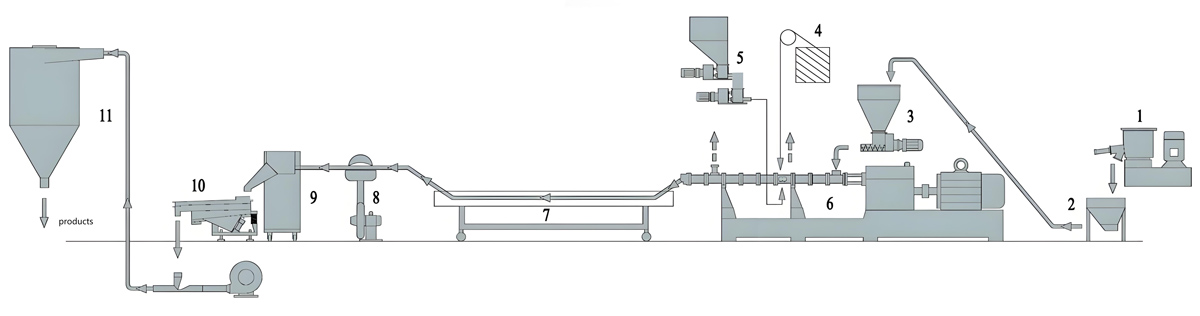
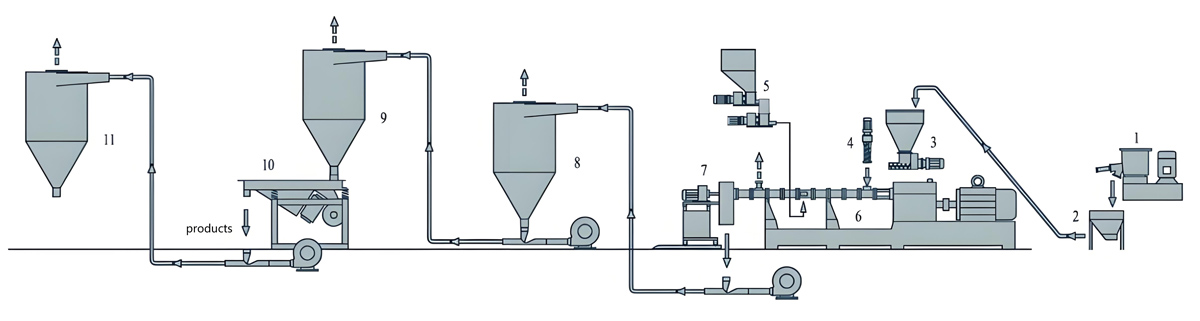
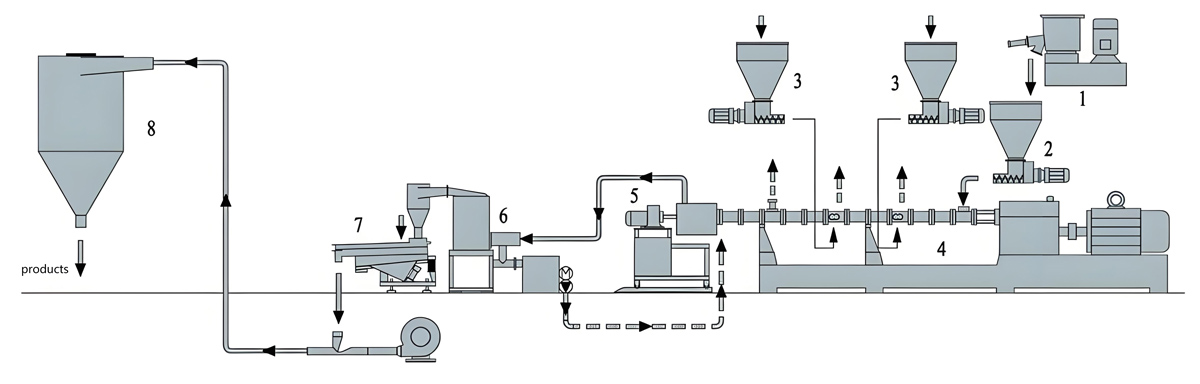
Mica powder filled masterbatch represents a specialized category of mineral-filled compounds that deliver unique optical properties, mechanical reinforcement, and cost efficiency across diverse plastic applications. Mica fillers provide distinctive pearlescent luster, enhanced stiffness, and improved thermal resistance that make these compounds valuable for automotive components, cosmetics packaging, construction materials, and consumer products. The production of high-performance mica powder filled masterbatch demands precise compounding technology capable of maintaining the platelet structure essential for achieving desired optical and mechanical properties. Twin screw extrusion provides the controlled processing necessary for incorporating mica powders while preserving their unique characteristics.
Introduction
Mica has been utilized as a functional filler in plastic compounds for decades due to its unique combination of properties. Natural mica minerals consist of aluminum potassium silicate layers that cleave into thin, plate-like particles with remarkable aspect ratios. These platelet particles provide reinforcement when properly aligned in polymer matrices, enhance barrier properties through tortuous path formation, and create distinctive optical effects through light reflection and interference. The effectiveness of mica as a functional additive depends critically on maintaining platelet integrity during processing.
Mica powder filled masterbatch serves applications requiring specific aesthetic and functional characteristics that cannot be achieved through conventional fillers or pigments. The pearlescent sheen created by aligned mica platelets provides visual appeal in cosmetic containers, household items, and automotive interior components. Mechanical property improvements including increased modulus, reduced thermal expansion, and improved dimensional stability benefit structural applications. Barrier enhancements reduce gas permeability in packaging films and tanks.
Twin screw extrusion technology addresses the unique processing challenges of mica powder filled masterbatch production. Maintaining platelet aspect ratio during compounding requires careful control of shear forces and residence time. Equipment configuration must balance dispersion requirements against platelet breakage risks. Precise temperature management ensures complete polymer melting while preventing thermal degradation. This comprehensive guide provides the technical knowledge necessary for establishing or improving mica powder filled masterbatch manufacturing operations.
Formulation Ratio for Mica Powder Filled Masterbatch
Mica Grade Selection and Concentrations
Mica powder grade selection significantly influences final masterbatch properties and performance characteristics. Muscovite mica represents the most common grade for plastic applications, offering excellent brightness, chemical resistance, and thermal stability. Phlogopite mica provides superior thermal resistance and electrical insulation properties suitable for engineering applications. Synthetic fluorphlogopite mica offers consistent particle size and superior optical clarity for premium aesthetic applications.
Particle size distribution determines optical effects and mechanical reinforcement characteristics. Fine mica powders with median particle sizes of 10 to 45 micrometers create subtle pearlescent effects suitable for general applications. Medium particle sizes of 45 to 150 micrometers produce more pronounced luster and sparkle effects. Coarse mica particles exceeding 150 micrometers provide maximum reinforcement but may create processing challenges and surface roughness in finished products.
Mica concentration in masterbatch formulations typically ranges from 40% to 70% depending on target application and carrier resin compatibility. Standard mica filled masterbatch commonly contains 50% to 60% mica powder with appropriate carrier resin and processing aids. High-loading formulations reaching 65% to 70% mica require specialized surface treatment and carrier systems to maintain acceptable processing characteristics. Lower loading of 40% to 50% provides moderate reinforcement while maintaining excellent aesthetic characteristics.
Carrier Resin and Additive Selection
Carrier resin selection considers compatibility with target application polymers, melt flow requirements, and mica wetting characteristics. Polypropylene homopolymer and copolymer carriers provide excellent mica compatibility and thermal stability for general-purpose applications. Polyethylene carriers offer superior moisture resistance and flexibility for film and packaging applications. Polystyrene carriers achieve high clarity for cosmetic packaging where visual appearance is paramount.
Surface treatment of mica powders enhances polymer-filler interaction and dispersion quality. Silane coupling agents including aminopropyltriethoxysilane and mercaptopropyltrimethoxysilane improve adhesion between mica surfaces and polymer matrices. Fatty acid treatments including stearic acid coating reduce particle agglomeration and improve processing characteristics. Titanate coupling agents provide alternative surface modification for specific polymer systems.
Processing aids and dispersing agents at 2% to 5% concentration facilitate mica dispersion and reduce processing difficulties associated with high filler loadings. Antioxidant packages at 0.3% to 0.5% concentration protect polymer matrices during high-temperature processing. Wax modifiers at 2% to 5% concentration improve melt flow characteristics and surface appearance. Impact modifiers at 3% to 8% concentration compensate for stiffness increases caused by mica addition.
Production Process for Mica Powder Filled Masterbatch
Raw Material Preparation and Treatment
Mica powder preparation begins with quality verification and surface treatment procedures. Particle size distribution analysis confirms that supplied mica meets specification requirements. Moisture content determination indicates whether drying treatment is necessary before compounding. Surface treatment application requires precise metering and adequate mixing to achieve uniform coating of mica particles.
Silane coupling agent treatment typically involves pre-mixing mica with diluted coupling agent solution before drying. Treatment levels of 0.5% to 2.0% silane by weight of mica provide effective surface modification without excessive cost. Proper mixing ensures uniform coating distribution across all particle surfaces. Drying after treatment removes residual solvent and activates the coupling agent coating.
Carrier resin preparation includes drying procedures for hygroscopic polymers and pre-blending with treated mica powders. Blending ratios and mixing time must ensure homogeneous distribution without causing premature platelet breakage. Excessive mixing intensity can damage mica platelets before extrusion processing, compromising final product performance. Low-shear blending for 5 to 10 minutes achieves adequate distribution while preserving platelet integrity.
Extrusion Compounding Process
Extrusion compounding transforms raw materials into mica filled masterbatch through controlled thermal and mechanical processing. The twin screw extruder must achieve adequate dispersion of mica particles while maintaining platelet aspect ratios that determine optical and mechanical performance. Screw configuration optimization represents a critical success factor for mica filled masterbatch production.
Screw configuration design balances dispersive mixing requirements against platelet breakage risks. High-shear mixing elements create sufficient stress to break up mica agglomerates but may excessively fracture platelets if overused. Kneading blocks with forward conveying elements provide distributive mixing without excessive shear intensity. Conservative screw designs with moderate mixing element populations achieve acceptable dispersion while preserving platelet integrity.
Temperature profile configuration requires careful attention to polymer melting and mica wetting characteristics. Barrel zones typically operate from 170°C in the feed section to 240°C in mixing and pumping sections for polypropylene carriers. Polyethylene carriers process at lower temperatures of 160°C to 220°C. Adequate temperature in mixing zones ensures complete polymer melting and proper mica particle wetting. Excessive temperatures risk polymer degradation and potential safety concerns with mica dust.
Vacuum devolatilization removes residual moisture and any volatile byproducts from the formulation. Mica powders may carry moisture despite treatment procedures, requiring efficient devolatilization. Devolatilization zones operate at reduced pressure of 50 to 100 millibars absolute for efficient volatile removal. Screen changing systems with 40 to 80 mesh filters remove contamination and oversized agglomerates that could affect product quality.
Pelletizing and Quality Control
Pelletizing operations for mica filled masterbatch require attention to particle size and morphology control. Underwater pelletizing provides rapid cooling and consistent particle size for most formulations. Strand pelletizing offers alternative processing for high-loading formulations or where different pellet shapes are desired. Cooling water temperature and flow rate affect solidification characteristics and potential plate alignment effects.
Quality control testing for mica filled masterbatch encompasses physical property testing, optical evaluation, and performance verification. Melt flow index measurement indicates processing characteristics and detects excessive polymer degradation. Mica content determination through ash analysis or gravimetric methods verifies formulation compliance. Particle size distribution analysis of diluted samples confirms that platelet integrity has been maintained through processing.
Optical property testing evaluates pearlescent effects through gloss measurement and visual assessment. Tensile testing of injection molded specimens assesses mechanical reinforcement effectiveness. Impact testing verifies that filler addition does not excessively compromise toughness. Application testing under actual production conditions confirms that masterbatch performs as expected in target products. Certificate of analysis documentation provides customers with quality verification and batch traceability.
Production Equipment Introduction
Kerke KTE Series Twin Screw Extruders for Mineral Filled Compounds
Kerke KTE series twin screw extruders provide the processing capability necessary for high-quality mica powder filled masterbatch production. These co-rotating intermeshing extruders feature precision engineered screw elements that achieve adequate particle dispersion while minimizing platelet breakage. Modular barrel and screw configurations enable optimization for specific mica loadings and optical or mechanical performance requirements.
The KTE-36B with 35.6mm screw diameter and 20 to 100 kilograms per hour capacity serves development and small-scale production requirements. This model enables formulation optimization and pilot production before scaling to commercial volumes. The KTE-50B at 50.5mm screw diameter and 80 to 200 kilograms per hour throughput provides intermediate capacity for market development and specialty production runs.
Commercial production typically utilizes the KTE-65B with 62.4mm screw diameter achieving 200 to 450 kilograms per hour, or the KTE-75B at 71mm diameter with 300 to 800 kilograms per hour capacity. The KTE-95D high-capacity model featuring 93mm screw diameter delivers 1000 to 2000 kilograms per hour throughput for established high-volume production operations. Larger extruders with greater processing volume provide more gentle platelet handling due to reduced specific shear energy input.
Supporting Equipment for Mica Filled Masterbatch
Supporting equipment for mica filled masterbatch production includes material handling systems, feeding equipment, and dust collection. Dust collection systems are essential due to the fine particle characteristics of mica powders. Gravimetric feeders with robust construction handle high powder loadings without bridging. Enclosed transfer systems prevent fugitive dust emissions during material handling operations.
Surface treatment equipment may include mixing systems for silane application and drying equipment for treated mica. High-shear mixers for coupling agent application require careful speed control to prevent platelet damage during treatment. Drying ovens with adequate temperature control and air circulation ensure proper silane activation. These preprocessing operations significantly impact final masterbatch quality.
Pelletizing systems with underwater pelletizers or strand pelletizers convert extruded melt into finished product form. Cooling and classification equipment ensures proper handling and packaging of finished products. Packaging machinery with moisture barrier materials protects masterbatch from environmental moisture absorption. Quality control instrumentation including particle size analyzers, testing machines, and optical measurement equipment completes the production capability requirements.
Parameter Settings for Mica Powder Filled Masterbatch
Temperature Profile Configuration
Temperature profile configuration significantly impacts mica filled masterbatch quality, processing stability, and platelet integrity. The feeding zone maintains temperatures of 160°C to 180°C to ensure initial polymer melting while preventing premature heating of mica powders. Compression zones at 180°C to 210°C complete melting and begin mica particle incorporation into the polymer matrix.
Mixing zones require temperatures of 200°C to 240°C depending on carrier resin and mica treatment conditions. Adequate temperature ensures complete polymer melting and proper mica particle wetting by the molten polymer. Higher temperatures reduce melt viscosity and improve particle incorporation but increase degradation risks. Temperature uniformity across mixing zones prevents localized overheating or cold spots that could cause processing problems.
Die head temperatures of 200°C to 230°C ensure smooth melt flow and proper strand formation. Water temperature in pelletizing systems should maintain pellets at 40°C to 60°C entering the cutting chamber to achieve proper solidification without thermal shock. Cooling rate affects final crystallinity and potential plate alignment that influences optical characteristics of the finished masterbatch.
Screw Speed and Residence Time Optimization
Screw speed selection balances processing requirements against platelet breakage risks. Typical operating speeds range from 150 to 300 revolutions per minute, lower than many masterbatch applications due to the sensitivity of mica platelets to high shear forces. Lower speeds reduce mechanical energy input and shear stress on mica particles but may compromise mixing efficiency for high-loading formulations.
Residence time within the extruder should be optimized between 40 and 90 seconds for mica filled masterbatch production. Shorter residence times reduce thermal exposure but may compromise mica dispersion and polymer wetting. Longer residence times improve homogenization but increase platelet breakage risk and thermal degradation exposure. Throughput adjustment enables residence time optimization independent of screw speed selection.
The KTE-36B achieves optimal performance at screw speeds of 180 to 250 rpm with throughput of 30 to 60 kilograms per hour. The KTE-50B operates efficiently at 60 to 120 kilograms per hour with 150 to 220 rpm. The KTE-65B processes 150 to 300 kilograms per hour, while the KTE-75B achieves 250 to 500 kilograms per hour with appropriately configured screw elements designed for mineral-filled processing.
Feeding System Configuration
Feeding system configuration ensures accurate metering and consistent introduction of mica powders and carrier resin. Gravimetric feeders with loss-in-weight technology provide accuracy of plus or minus 0.5% for major components. Mica powder feeding requires robust construction and dust collection to handle high powder loadings reliably.
Feed throat design prevents material bridging and ensures continuous feeding throughout production runs, particularly important with high mica loading formulations. Side feeders positioned along the barrel enable mica addition at optimal locations for dispersion and incorporation. Downstream feeding after initial melting reduces feeding difficulties associated with high powder concentrations in the feed throat.
Dust collection systems protect operators and maintain clean production environments. Local exhaust ventilation at material transfer points captures fugitive dust. Enclosed conveying systems prevent dust generation during transfer operations. Regular cleaning of dust accumulation areas prevents safety hazards and contamination. Personal protective equipment including respirators protects operators when working with fine mica powders.
Equipment Price for Twin Screw Extruders
Kerke KTE Series Investment Overview
Capital investment for Kerke KTE series twin screw extruders varies by model capacity and included features. The KTE-36B laboratory and pilot scale extruder represents an investment range of $25,000 to $35,000, providing accessible entry for formulation development and small-scale production. This model suits research operations and market development activities seeking to establish mica filled masterbatch products.
The KTE-50B intermediate production extruder costs $40,000 to $60,000, offering capacity for growing production requirements and specialty product lines. This model balances throughput capability with reasonable capital requirements for expanding operations. The KTE-65B at $50,000 to $80,000 and KTE-75B at $70,000 to $100,000 serve established commercial production operations requiring higher volumes and production efficiency.
The KTE-95D high-capacity extruder priced at $120,000 to $200,000 provides maximum throughput for large-scale production facilities. This model achieves throughput of 1000 to 2000 kilograms per hour for high-volume mica filled masterbatch manufacturing. Equipment selection should consider current requirements, growth projections, and platelet integrity sensitivity that may favor larger extruders with gentler processing characteristics.
Complete Production Line Investment
Complete production line investment extends beyond extruder purchase to include supporting equipment and facilities. Feeding systems including gravimetric feeders, dust collection, and conveying equipment cost $25,000 to $70,000 depending on automation level and mica powder handling requirements. Surface treatment equipment for silane application and drying may add $15,000 to $40,000 for operations performing their own mica treatment.
Pelletizing systems with underwater pelletizers and classification equipment represent $25,000 to $70,000 additional investment. Quality control instrumentation including particle size analyzers, testing machines, and optical measurement equipment requires $30,000 to $80,000. Material handling and storage systems contribute $15,000 to $40,000. Facility preparation including electrical upgrades, ventilation systems, and dust collection may require $30,000 to $80,000. Total project investment ranges from $120,000 for basic pilot facilities to $600,000 or more for fully equipped commercial production lines.
Problems in Production Process and Solutions
Platelet Breakage and Aspect Ratio Loss
Platelet breakage during processing represents the primary quality concern for mica filled masterbatch production. Excessive shear forces fracture mica platelets, reducing aspect ratio and compromising optical and mechanical performance. Symptoms include reduced pearlescent luster, lower stiffness reinforcement, and inconsistent product performance compared to formulation expectations.
Root causes of platelet breakage include excessive screw speed, overly aggressive screw elements, excessive mixing intensity, and extended residence time at high temperatures. High-shear kneading blocks designed for carbon black or pigment dispersion generate excessive stress for mica platelets. Feed throat feeding problems causing material backups expose platelets to extended mixing before incorporation into the polymer matrix.
Solution approaches focus on reducing mechanical stress during processing. Screw configuration modification replacing high-shear elements with gentler mixing sections reduces platelet fracture. Screw speed reduction decreases specific shear energy input throughout the process. Throughput increase reduces residence time and specific energy input per unit of material. Side feeding of mica after polymer melting prevents pre-melting exposure to high shear. Regular monitoring of product quality through particle size analysis detects developing problems before major quality failures occur.
Dispersion and Agglomeration Problems
Inadequate dispersion produces inconsistent optical properties and mechanical performance in mica filled masterbatch. Agglomerated mica particles create visible specks and streaks in finished products. Poor dispersion reduces effective filler concentration and compromises reinforcement efficiency. These problems result from insufficient mixing energy or improper surface treatment of mica particles.
Screw configuration evaluation identifies mixing inefficiencies. Insufficient mixing elements fail to break up mica agglomerates effectively. Worn screw components reduce mixing effectiveness as clearances increase. Kneading block stagger angle selection influences dispersive mixing intensity. Configuration modifications incorporating additional mixing elements or different element types can improve dispersion without excessive platelet breakage.
Surface treatment improvements address agglomeration at the particle level. Inadequate silane treatment leaves particle surfaces poorly wetted by polymer, promoting agglomeration. Increasing silane treatment level or improving treatment application procedures enhances particle-polymer interaction. Alternative coupling agents may provide better compatibility with specific polymer systems. Dispersing agent addition at appropriate concentrations facilitates particle separation during mixing.
Dust Generation and Handling Issues
Mica powder handling creates significant dust generation challenges during feeding and transfer operations. Fine mica particles become airborne easily, creating respiratory hazards for operators and contamination concerns throughout production facilities. Dust accumulation on equipment surfaces creates maintenance problems and potential quality issues from contamination.
Enclosed feeding systems with dust collection address dust generation at the source. Gravimetric feeders with sealed hoppers prevent powder escape during metering. Local exhaust ventilation at transfer points captures fugitive dust before it disperses. Negative pressure ventilation throughout handling areas maintains clean air conditions. Regular cleaning protocols remove accumulated dust before it creates problems.
Personal protective equipment including respirators with appropriate filter ratings protects operators during material handling activities. Training programs ensure operators understand dust hazards and proper handling procedures. Medical monitoring for workers with extended mica exposure ensures early detection of any health effects. Engineering controls that eliminate dust generation are preferred over personal protective equipment as the primary prevention strategy.
Processing Stability and Throughput Limitations
Processing instability manifests as motor load variations, pressure fluctuations, and inconsistent product quality during mica filled masterbatch production. High mica loadings create processing challenges that require careful equipment and parameter optimization. Instability affects production efficiency and creates quality variations that may not be immediately apparent.
Feeding system problems represent common instability sources. Material bridging in hoppers disrupts continuous feeding of mica powders. Feeder calibration drift causes gradual formulation changes over production runs. Segregation of premixed materials creates concentration variations that affect melt behavior. Feed throat modifications including agitators and liners address bridging and flow problems specific to mineral-filled formulations.
Barrel temperature optimization addresses melt viscosity issues associated with high mica loadings. Increased temperatures reduce melt viscosity and improve pumping stability. Screw configuration adjustments optimize conveying and mixing for high-filler formulations. Gear reduction or motor upgrades may be necessary for applications requiring high throughput with maximum mica loadings. Regular equipment maintenance prevents problems from worn components that exacerbate processing difficulties.
Maintenance
Operational Maintenance Procedures
Daily maintenance activities establish the foundation for reliable mica filled masterbatch production. Visual inspection of equipment condition reveals developing problems before they cause quality failures or production interruptions. Operating parameter monitoring through comparison with established baselines identifies deviations requiring investigation. Feeding system verification ensures consistent metering of both mica powders and carrier resins.
Production record documentation captures critical information for quality tracking and troubleshooting. Recording temperatures, pressures, throughput rates, and quality observations for each batch enables trend analysis and problem investigation. Shift handoff procedures ensure continuity of quality awareness and problem status. Cleaning procedures between formulation changes prevent cross-contamination that could affect product quality.
Equipment housekeeping maintains clean operating conditions that support quality and safety. Regular removal of mica dust accumulations prevents contamination and slip hazards. Dust collection system inspection ensures continued effectiveness. Lubrication of moving components according to manufacturer schedules maintains mechanical reliability. Immediate attention to unusual sounds, vibrations, or odors prevents escalation of developing problems.
Periodic Maintenance Programs
Weekly maintenance encompasses thorough inspection and adjustment activities. Feeder calibration verification ensures continued metering accuracy for both mica and carrier components. Dust collection system maintenance including filter cleaning and replacement ensures effective dust control. Screen changer inspection and cleaning maintains filtration efficiency. Cooling system evaluation confirms adequate flow rates and temperature control.
Monthly maintenance addresses detailed equipment condition assessment. Screw wear measurement identifies sections requiring attention before mixing quality suffers. Barrel inspection detects wear patterns affecting sealing and heat transfer. Gearbox oil analysis reveals mechanical condition trends. Electrical system inspection verifies motor and drive performance. Dust handling equipment inspection identifies wear and blockage issues requiring attention.
Quarterly and annual maintenance programs address major overhaul requirements. Screw element replacement restores mixing performance in worn sections. Barrel liner inspection and replacement ensures proper clearances for effective processing. Complete system calibration verifies all control functions including temperature and pressure accuracy. Dust collection system overhaul including filter replacement and ductwork cleaning maintains effective dust control. Spare parts inventory management ensures availability of critical components.
FAQ
What mica grade is best for plastic applications?
Muscovite mica represents the most versatile grade for general plastic applications, offering excellent brightness and optical properties. Phlogopite mica provides superior thermal resistance for engineering applications requiring stability at elevated temperatures. Synthetic fluorphlogopite offers consistent quality and superior optical clarity for premium cosmetic packaging applications. Grade selection depends on specific application requirements including optical effects, thermal performance, and cost constraints.
How much mica filled masterbatch should I add to achieve good reinforcement?
Addition rates of 10% to 30% mica filled masterbatch typically achieve noticeable mechanical reinforcement in most polymer applications. Higher addition rates provide increased stiffness and thermal resistance but may reduce impact strength and increase density. The specific effect depends on mica concentration, platelet aspect ratio preservation, and polymer matrix properties. Testing with your specific application determines optimal addition rate balancing performance and processing requirements.
Can mica filled masterbatch affect the color of my plastic products?
Mica addition creates subtle pearlescent effects that enhance visual appearance without dramatically changing base color. White mica provides brightness enhancement and subtle luster. Treated mica with metallic oxide coatings creates distinctive color effects including silver, gold, and bronze pearlescence. Mica effects layer with pigment colors to create unique visual appearances. Testing with your specific color formulation determines the final aesthetic result.
How do I prevent platelet breakage during my processing?
Platelet breakage prevention requires attention to processing conditions throughout your manufacturing operation. Lower melt temperatures reduce viscosity and shear stress on platelets. Reduced screw speeds minimize mechanical energy input. Shorter residence times reduce cumulative stress exposure. Proper feeding techniques prevent backup and excessive pre-melting mixing. Close coordination between masterbatch supplier and processor ensures that platelet integrity is preserved through final article production.
What are the benefits of silane treated mica compared to untreated mica?
Silane treatment creates chemical bonds between mica surfaces and polymer matrices, improving mechanical property transfer. Treated mica provides superior stiffness, strength, and thermal resistance compared to untreated alternatives. Better polymer-filler interaction reduces agglomeration and improves dispersion quality. Treatment enables higher filler loadings while maintaining acceptable processing characteristics. The improved properties typically justify the additional treatment cost through reduced masterbatch addition requirements.
Why does mica filled masterbatch create processing difficulties at high loadings?
High mica loadings increase melt viscosity and reduce melt flow characteristics, creating feeding and pumping challenges. The angular mica particles interfere with smooth polymer flow and require additional energy for processing. Dust generation increases at higher loadings, requiring more robust handling systems. Screw configuration optimization, temperature adjustment, and processing aid addition address these difficulties while maintaining acceptable production rates.
What quality tests verify mica filled masterbatch performance?
Key quality tests include mica content determination through ash analysis, particle size distribution analysis, and melt flow index measurement. Gloss and color measurements assess optical characteristics. Tensile and impact testing of molded specimens verifies mechanical reinforcement. Scanning electron microscopy reveals platelet dispersion and alignment quality. Application testing under actual production conditions provides ultimate performance verification. Certificate of analysis confirms specifications are met for each production lot.
How does screw configuration affect mica filled masterbatch quality?
Screw configuration directly influences platelet integrity through control of shear stress and residence time distribution. High-shear elements optimized for pigment dispersion cause excessive platelet breakage. Conservative configurations with moderate mixing elements achieve adequate dispersion while preserving aspect ratio. Feed zone design affects how mica enters the process and potential pre-melting exposure. Configuration optimization requires testing and adjustment for specific formulations and performance requirements.
Conclusion
Manufacturing high-performance mica powder filled masterbatch requires systematic attention to formulation design, platelet integrity preservation, and process optimization throughout production operations. Twin screw extrusion technology provides the controlled processing capability necessary for incorporating mica while maintaining the platelet characteristics that determine optical and mechanical performance. The Kerke KTE series offers scalable equipment solutions suitable for development operations through high-volume commercial production.
Successful production depends on understanding the unique processing challenges associated with mineral platelet fillers. Screw configuration must balance dispersion requirements against platelet breakage risks that compromise final product quality. Temperature management ensures complete polymer melting while preventing thermal degradation and excessive energy input. Dust handling systems protect operators and maintain production quality throughout material processing operations.
Equipment investment considerations extend beyond extruder pricing to encompass complete production line requirements including dust collection, surface treatment capabilities, and quality instrumentation. Maintenance programs preserve equipment performance and product quality throughout the operational lifecycle. Training and technical development build organizational capabilities for sustained competitive advantage in serving demanding applications across cosmetics packaging, automotive components, construction materials, and consumer products markets.
The growing demand for functional fillers providing optical effects and mechanical performance creates opportunities for masterbatch producers capable of delivering consistent quality and technical expertise. Investment in people, processes, and technology builds capabilities that support long-term success in serving applications requiring mica’s unique platelet characteristics. Continuous improvement and customer collaboration drive product development that addresses evolving market requirements for mineral-filled masterbatch products.