Anti-fog and anti-static masterbatch represent critical functional additives in modern plastic packaging and agricultural film industries. These specialized compounds prevent condensation formation on polymer surfaces while eliminating electrostatic charge buildup that attracts dust and creates safety hazards. The production of high-performance anti-fog and anti-static masterbatch requires precise compounding technology, and twin screw extruders have emerged as the preferred equipment for achieving optimal dispersion and thermal stability of functional additives. This comprehensive guide explores the formulation strategies, production processes, equipment selection, and operational parameters necessary for manufacturing premium quality anti-fog and anti-static masterbatch using advanced twin screw extrusion technology.
Introduction
The global demand for anti-fog and anti-static masterbatch continues to grow as packaging requirements evolve across food preservation, agricultural greenhouse applications, and electronic component protection. These functional masterbatches work through distinct mechanisms that address surface moisture and electrostatic concerns in polymer applications. Anti-fog agents function by lowering the surface tension of water droplets, allowing them to form a continuous transparent film rather than discrete droplets that obscure visibility. Anti-static agents mitigate charge accumulation through hydrophilic migration to the polymer surface, creating a conductive pathway that dissipates static electricity.
Twin screw extrusion technology provides exceptional mixing efficiency for incorporating these sensitive additives into polymer matrices. The co-rotating intermeshing screw configuration generates intensive shear forces that achieve uniform dispersion of anti-fog surfactants and anti-static compounds throughout the carrier resin. Modern twin screw extruders equipped with specialized barrel configurations and precise temperature control systems enable processors to maintain additive integrity during high-temperature compounding operations.
This guide addresses the complete production workflow for anti-fog and anti-static masterbatch, from raw material selection through final product quality verification. Process engineers will find detailed formulation guidelines, equipment recommendations, and troubleshooting protocols essential for establishing or optimizing manufacturing operations. The information presented reflects current industry practices and incorporates practical insights from commercial production experience.
Formulation Ratio for Anti-Fog & Anti-Static Masterbatch
Anti-Fog Masterbatch Formulations
Anti-fog masterbatch formulations typically employ glycerol esters, sorbitan esters, or polyglycerol fatty acid esters as active anti-fog agents. The concentration of these surfactants ranges from 15% to 30% depending on the target application and required fog prevention performance. Higher concentrations provide enhanced anti-fog properties but require careful carrier resin selection to ensure proper migration and surface bloom characteristics.
Standard anti-fog masterbatch formulation using glycerol monoester technology includes 20% to 25% glycerol monostearate, 72% to 76% carrier resin, and 3% to 5% processing aids and dispersants. For applications requiring extended durability, glycerol dioleate and sorbitan trioleate combinations achieve superior initial anti-fog performance with controlled migration rates. These formulations typically contain 18% to 22% active anti-fog compound, 74% to 78% carrier resin, and 4% to 6% synergists that enhance compatibility with polyolefin matrices.
Food contact applications demand compliance with food safety regulations, necessitating the use of FDA-approved anti-fog agents at controlled concentrations. Glycerol monooleate formulations at 15% to 20% active content meet these requirements while providing effective fog prevention in refrigerated packaging environments. Agricultural film applications can utilize higher surfactant concentrations, with some formulations reaching 30% active content to withstand prolonged UV exposure and environmental weathering.
Anti-Static Masterbatch Formulations
Anti-static masterbatch production employs amine-based compounds, glycerol esters, or conductive polymers depending on the required permanence and application environment. Temporary anti-static agents such as glycerol monostearate provide effective surface conductivity at concentrations of 10% to 20%, though these additives may migrate and lose effectiveness over time. Permanent anti-static systems utilizing polyether-amide block copolymers achieve long-lasting conductivity at 15% to 25% concentration levels.
Typical anti-static masterbatch for general-purpose polyethylene applications contains 15% to 18% anti-static agent blend, 78% to 82% low-density polyethylene carrier, and 3% to 5% dispersing agents. For polypropylene applications, formulations incorporate 20% to 25% anti-static compound with modified polypropylene carriers to ensure compatibility and proper dispersion. Electronic packaging applications requiring superior static dissipation utilize conductive carbon black or carbon nanotube systems at lower concentrations of 5% to 12%.
Combined anti-fog and anti-static masterbatch formulations address applications requiring both properties simultaneously. These hybrid systems typically contain 12% to 15% anti-fog surfactant, 8% to 12% anti-static agent, 70% to 75% carrier resin, and appropriate processing stabilizers. The synergistic combination requires careful balancing to ensure both components maintain effectiveness without interfering with each other’s migration and surface activity mechanisms.
Production Process for Anti-Fog & Anti-Static Masterbatch
Raw Material Preparation
The production process begins with rigorous raw material verification and pre-treatment procedures. Anti-fog agents and anti-static compounds must be evaluated for purity, moisture content, and thermal stability before use. Moisture-sensitive additives require drying at temperatures between 80°C and 100°C for 4 to 6 hours to prevent hydrolysis during extrusion. Carrier resins should exhibit melt flow indices compatible with the target extrusion rate and final application requirements.
Material weighing and premixing operations utilize precision equipment to ensure accurate formulation compliance. Liquid anti-fog agents can be metered directly into the extruder feed throat using liquid injection systems, while solid additives require dry blending with carrier resin pellets prior to feeding. Premix homogeneity directly impacts final masterbatch quality, making adequate mixing time essential during this preparation stage.
Extrusion Compounding
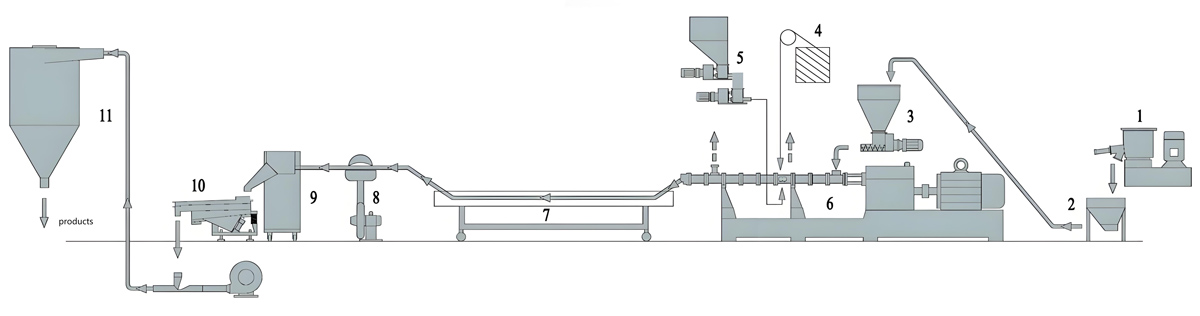
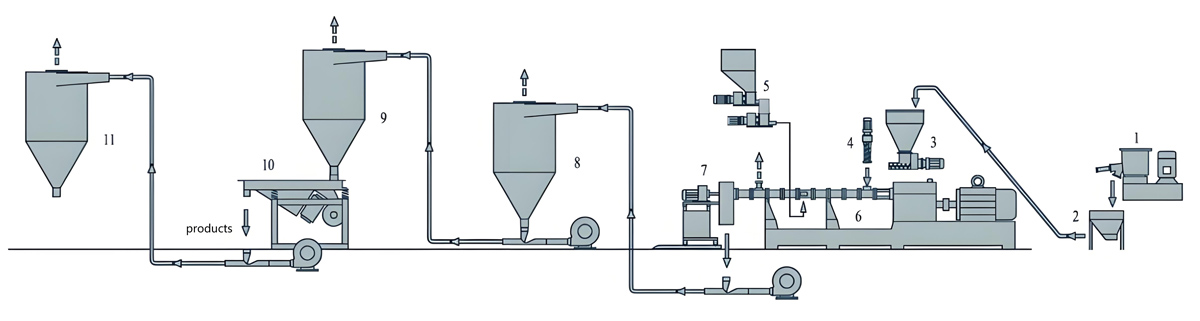
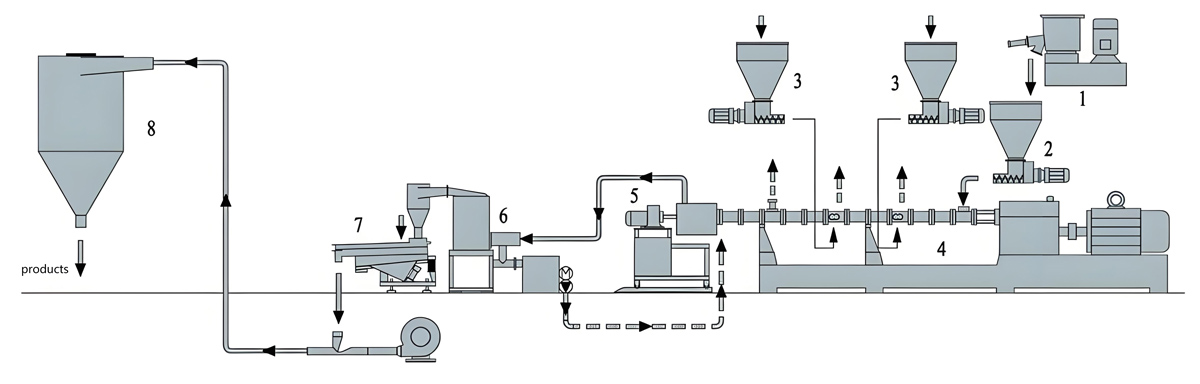
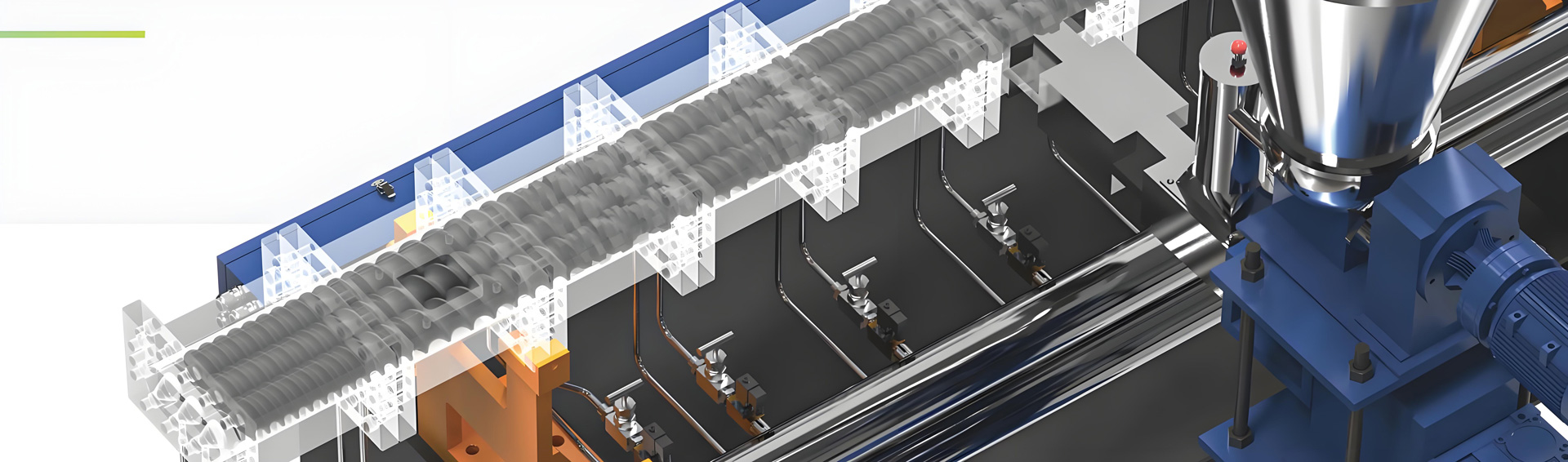
The extrusion compounding stage converts raw materials into homogeneous masterbatch pellets through controlled melting, mixing, and pumping operations. The twin screw extruder performs multiple functions simultaneously: resin melting, additive dispersion, vacuum devolatilization, and melt filtration. Screw configuration optimization ensures proper distributive and dispersive mixing without degrading temperature-sensitive anti-fog and anti-static compounds.
The extrusion process operates at temperatures ranging from 160°C to 220°C depending on the carrier resin and specific additives. Lower processing temperatures preserve volatile anti-fog components, while sufficiently high temperatures ensure complete melting and proper dispersion of anti-static agents. Vacuum devolatilization zones remove residual moisture and any volatile byproducts, preventing bubble formation and ensuring pellet clarity.
Melt filtration through screens of 40 to 80 mesh removes contamination and agglomerates that could affect final product quality. Strand die heads produce continuous melt strands that enter underwater pelletizing systems for precise particle size control. The pelletizing process maintains consistent cooling to prevent particle agglomeration while ensuring complete solidification before packaging.
Quality Control and Packaging
Finished masterbatch undergoes comprehensive quality verification before release for commercial distribution. Physical property testing includes melt flow index determination, moisture content measurement, and particle size distribution analysis. Anti-fog performance evaluation utilizes standardized fog chamber testing at specified temperature and humidity conditions. Anti-static properties are verified through surface resistivity measurements and static charge decay time testing.
Color comparison against reference standards ensures batch-to-batch consistency for pigmented formulations. Mechanical property testing of final plastic articles containing the masterbatch confirms that additive incorporation does not compromise substrate performance. Certificate of analysis documentation accompanies each production lot, providing customers with complete traceability and compliance verification.
Packaging operations utilize sealed containers and moisture barrier materials to protect masterbatch from environmental contamination during storage and transport. Nitrogen flushing of packaging containers extends shelf life by preventing oxidative degradation of sensitive additives. Clear labeling identifies product specifications, application guidelines, and recommended dosage rates for customer reference.
Production Equipment Introduction
Kerke KTE Series Twin Screw Extruders
Kerke KTE series twin screw extruders represent advanced compounding equipment designed for masterbatch production applications. The KTE series incorporates co-rotating intermeshing screw technology with modular barrel configurations that enable flexible adaptation to specific formulation requirements. These extruders feature precision engineered screws with specialized mixing elements that achieve superior dispersion while minimizing thermal degradation of sensitive additives.
The KTE-36B model serves laboratory and small-scale production requirements with a screw diameter of 35.6mm and throughput capacity of 20 to 100 kilograms per hour. This compact configuration suits anti-fog and anti-static masterbatch development and pilot production runs. The KTE-50B offers intermediate capacity with 50.5mm screw diameter and 80 to 200 kilograms per hour output, making it suitable for specialty production and market development quantities.
Commercial production operations typically utilize the KTE-65B with 62.4mm screw diameter and 200 to 450 kilograms per hour throughput. The KTE-75B model provides higher capacity at 300 to 800 kilograms per hour with 71mm screw diameter for established production facilities. Large-scale operations requiring maximum output select the KTE-95D featuring 93mm screw diameter and 1000 to 2000 kilograms per hour capacity for high-volume masterbatch manufacturing.
Supporting Equipment Requirements
Material handling systems including material dryers, feeders, and conveying equipment complement the twin screw extruder for complete production capability. Loss-in-weight feeders provide precise material metering for consistent formulation control. Liquid injection systems enable accurate addition of liquid anti-fog agents directly into the extruder barrel. Vacuum devolatilization systems remove volatiles and moisture that could compromise product quality.
Pelletizing systems convert extruded melt strands into uniform pellets suitable for handling and downstream processing. Underwater pelletizing offers advantages for temperature-sensitive formulations, providing rapid cooling and consistent particle size distribution. Strand pelletizing serves as an alternative for formulations requiring less aggressive cooling. Cooling conveyors and pellet classifiers ensure proper handling and classification before packaging.
Parameter Settings for Anti-Fog & Anti-Static Masterbatch
Temperature Profile Configuration
Temperature profile configuration significantly impacts anti-fog and anti-static masterbatch quality. The feeding zone maintains temperatures of 140°C to 160°C to ensure proper melting while preventing premature degradation of heat-sensitive additives. Initial compression zones operate at 160°C to 180°C, completing the melting process and initiating additive incorporation into the polymer matrix.
Mixing zones require temperatures of 180°C to 200°C for adequate dispersion of anti-fog surfactants and anti-static compounds. These zones generate the shear forces necessary for breaking down additive agglomerates and achieving uniform distribution throughout the carrier resin. Degassing zones operate at slightly reduced temperatures of 170°C to 190°C to promote volatile release without causing additive decomposition.
Die head temperatures of 180°C to 200°C ensure proper melt flow through die openings while maintaining sufficient fluidity for smooth strand formation. Cooling water temperature and flow rate in the pelletizing system require optimization to achieve complete solidification without thermal shock that could cause particle fracture or discoloration.
Screw Speed and Throughput Parameters
Screw speed settings typically range from 200 to 400 revolutions per minute depending on the extruder model and formulation characteristics. Higher screw speeds generate increased shear forces that enhance dispersive mixing but also raise barrel temperatures through mechanical energy input. Process engineers must balance mixing intensity against thermal degradation risk for temperature-sensitive anti-fog and anti-static compounds.
Throughput rates correlate directly with screw speed and are constrained by the extruder motor power and barrel cooling capacity. The KTE-36B achieves optimal throughput of 40 to 80 kilograms per hour at screw speeds of 250 to 350 rpm. The KTE-50B operates efficiently at 100 to 160 kilograms per hour with screw speeds of 200 to 300 rpm. Larger extruders such as the KTE-65B and KTE-75B process 250 to 400 kilograms per hour and 400 to 600 kilograms per hour respectively.
Residence time within the extruder should be minimized for anti-fog and anti-static masterbatch production to prevent thermal degradation. Target residence times of 30 to 60 seconds ensure adequate mixing while preserving additive effectiveness. Process adjustments that increase throughput reduce residence time but may compromise mixing efficiency, requiring careful optimization for each specific formulation.
Feeding System Parameters
Feeder settings require calibration to achieve precise additive metering throughout the production run. Solid additive feeds typically operate at accuracy levels of plus or minus 1% to ensure formulation compliance. Liquid anti-fog agent injection rates require proportional adjustment based on throughput to maintain consistent additive concentration regardless of production rate variations.
Barrel pressure monitoring provides essential feedback for detecting feeding inconsistencies and mixing problems. Normal operating pressures of 5 to 15 megapascals indicate proper melting and pumping behavior. Pressure fluctuations may signal feeding problems, screw wear, or formulation changes that require attention. Vacuum system monitoring ensures effective devolatilization performance throughout the production run.
Equipment Price for Twin Screw Extruders
Kerke KTE Series Pricing Overview
Equipment investment for twin screw extruder production lines varies based on capacity, configuration, and included features. The KTE-36B laboratory and pilot scale extruder represents an investment of $25,000 to $35,000, providing an accessible entry point for formulation development and small-scale production. This model serves research and development operations seeking to establish anti-fog and anti-static masterbatch products before committing to larger production capacity.
The KTE-50B intermediate production extruder costs $40,000 to $60,000, offering a balance between capacity and investment for growing businesses. This model accommodates market development quantities and specialty production runs that exceed pilot scale volumes while maintaining reasonable capital requirements. The KTE-50B configuration provides flexibility for producing multiple masterbatch types with appropriate barrel and screw configurations.
Commercial production operations typically consider the KTE-65B priced at $50,000 to $80,000 or the KTE-75B at $70,000 to $100,000. These models provide sufficient throughput for established production volumes while offering the reliability and process control necessary for consistent quality manufacturing. The KTE-95D high-capacity extruder at $120,000 to $200,000 serves large-scale production facilities requiring maximum output efficiency.
Total Production Line Investment
Complete production line investment extends beyond the extruder to include supporting equipment and facilities. Material handling systems, feeders, and conveyors add $15,000 to $50,000 depending on automation level and capacity. Pelletizing systems including underwater pelletizers and cooling equipment represent $20,000 to $60,000 additional investment. Quality control instrumentation for testing and verification requires $10,000 to $30,000.
Facility requirements including electrical supply, ventilation, and material storage contribute to total project costs. Electrical infrastructure for high-power extruder operation may require $10,000 to $30,000 in installation costs depending on existing facility capabilities. Total capital investment for a complete anti-fog and anti-static masterbatch production line ranges from $80,000 for basic pilot operations to $400,000 or more for fully automated commercial facilities.
Problems in Production Process and Solutions
Additive Degradation Issues
Thermal degradation of anti-fog and anti-static compounds represents a primary concern during masterbatch production. Symptoms include yellowing or discoloration of finished pellets, reduced effectiveness in final applications, and unpleasant odors during processing. This degradation results from excessive temperature exposure or prolonged residence time within the extruder.
The root cause typically involves incorrect temperature profile settings or inadequate cooling capacity. Process modifications should focus on reducing barrel temperatures in mixing zones while maintaining sufficient heat for proper melting. Screw speed reduction decreases mechanical energy input and associated temperature increases. Increasing throughput reduces residence time without compromising mixing quality when screw configuration permits adequate incorporation.
Preventive measures include installing barrel temperature monitoring at multiple points to detect hot spots. Regular equipment maintenance ensures cooling system efficiency and prevents temperature control failures. Formulation optimization through carrier resin selection can lower processing temperatures while maintaining adequate dispersion. Pre-blending additives with stabilizers provides additional protection against thermal degradation during extrusion.
Dispersion Quality Problems
Inadequate dispersion of anti-fog or anti-static compounds produces inconsistent performance in finished products. Visual inspection may reveal streaks, specks, or color variations in masterbatch pellets. Application testing reveals hot spots where additive concentration exceeds intended levels, causing surface defects or property variations in plastic articles.
Screw configuration inadequacies typically cause dispersion problems. Insufficient distributive mixing elements fail to redistribute additive particles throughout the polymer matrix. Worn screw elements reduce mixing efficiency and create dead spots where material accumulates. Barrel wear similarly creates gaps that allow material to bypass mixing sections.
Solution approaches include screw redesign with additional mixing elements positioned strategically throughout the barrel. Increasing screw speed enhances shear forces but must be balanced against temperature effects. Feed throat modifications can prevent material bridging that disrupts steady feeding. Complete equipment inspection identifies wear issues requiring component replacement. Process validation through comprehensive sampling verifies that dispersion improvements achieve target quality levels.
Moisture and Volatility Issues
Moisture contamination produces steam formation during extrusion, causing surface defects and particle irregularities in finished masterbatch. Bubbling or foaming in the melt indicates excessive moisture content that overwhelms the devolatilization system capacity. Volatile components in anti-fog formulations may similarly cause processing difficulties if not properly removed.
Inadequate material drying before processing represents the primary moisture source. Raw material storage conditions and handling practices determine moisture exposure throughout the production process. Extended storage in humid environments increases moisture absorption by hygroscopic components. Insufficient drying time or temperature fails to remove absorbed moisture before extrusion.
Improved drying procedures using dedicated desiccant dryers at appropriate temperatures resolve moisture problems. Raw material storage in climate-controlled environments minimizes moisture pickup. Increased vacuum levels during devolatilization enhance volatile removal efficiency. formulation modifications to reduce volatile components improve processing stability. Regular moisture content testing of incoming materials and finished products provides quality assurance against moisture-related defects.
Flood Feeding and Feeding Problems
Flood feeding occurs when material enters the extruder faster than the screws can convey it, causing accumulation in the feed throat and inconsistent feeding. This problem particularly affects powdered additives and formulations with high concentrations of non-pelletized components. Symptoms include feeding surges, uneven motor load, and pressure fluctuations throughout the process.
Feeder calibration problems and inappropriate feed throat design typically cause flood feeding issues. The feeding zone screw design must match material flow characteristics to prevent accumulation. Downstream compression must be sufficient to develop pumping pressure that pulls material through the feed section.
Solutions include installing vibratory or强制 feeding devices to ensure consistent material introduction. Feed throat modifications such as agitators or assisted feeding screws prevent material packing. Screw feed section redesign with increased depth and appropriate pitch improves conveying capacity. Separate feeding of problematic components through downstream injection ports reduces feed throat congestion. Careful formulation design balances functional additive concentrations against feeding system constraints.
Maintenance
Daily Maintenance Procedures
Daily operational maintenance begins with visual inspection of equipment condition and monitoring of operating parameters. Temperature and pressure readings require comparison against established baselines to detect deviations that indicate developing problems. Feed system accuracy verification through weight checking confirms proper metering throughout production runs.
Screw and barrel cleaning between formulation changes prevents cross-contamination that could affect product quality. Purging compounds or compatible polymers clean residual material from internal surfaces. Die head and screen changer inspection ensures proper function and identifies wear requiring attention. Lubrication of moving components according to manufacturer specifications maintains mechanical reliability.
Production records documentation captures operating parameters, material usage, and quality observations for each batch. Deviations from normal operation require investigation and corrective action before continuing production. End-of-shift cleaning removes material accumulations that could cause problems during subsequent operations. Regular communication between shifts ensures continuity of quality awareness and problem identification.
Periodic Maintenance Schedule
Weekly maintenance activities include thorough inspection of feeding equipment including hoppers, feeders, and associated controls. Belt tension checking and adjustment ensures consistent feeder operation. Screen changer inspection verifies filter integrity and proper function. Cooling system evaluation checks water flow rates and temperature control accuracy.
Monthly maintenance encompasses detailed mechanical inspection of extruder components. Screw wear measurement using specialized gauges identifies section wear that affects mixing performance. Barrel inspection detects wear patterns and clearance increases that compromise sealing and mixing efficiency. Gearbox oil analysis reveals mechanical condition trends that predict impending failures. Electrical system inspection verifies motor condition, drive performance, and control system function.
Quarterly and annual maintenance programs address major component overhaul and system optimization. Screw replacement or refurbishment restores mixing performance in worn sections. Barrel liner inspection and replacement ensures proper clearances for effective sealing and heat transfer. Complete system calibration verifies temperature control, pressure measurement, and throughput accuracy. Documentation updates maintain equipment history records essential for maintenance planning and quality assurance.
FAQ
What concentration of anti-fog masterbatch should I use in my polyethylene film application?
Anti-fog masterbatch concentration depends on film thickness, storage conditions, and performance requirements. Typical addition rates range from 1% to 5% for standard applications. Refrigerated packaging requiring fog prevention at low temperatures may need 3% to 5% addition. Agricultural greenhouse films typically use 2% to 4% concentration with weather-resistant formulations. Testing with your specific application conditions determines optimal concentration for performance and cost balance.
How do I determine if anti-static masterbatch is suitable for my application?
Anti-static masterbatch addresses surface resistivity requirements above 10^11 ohms per square that cause electrostatic problems. Applications involving sensitive electronics, dusty environments, or product sticking require anti-static properties. Surface resistivity testing of your final article determines if anti-static modification is necessary. Temporary anti-static agents suit short-term applications while permanent systems address lasting requirements.
Can anti-fog and anti-static properties be combined in a single masterbatch?
Combined anti-fog and anti-static masterbatch formulations achieve both properties simultaneously for applications requiring comprehensive surface performance. These hybrid systems typically contain 12% to 15% anti-fog agent and 8% to 12% anti-static compound balanced for compatibility. Performance testing verifies that both properties meet application requirements after combining. Some formulations may exhibit trade-offs between individual properties that require optimization.
What storage conditions are recommended for anti-fog and anti-static masterbatch?
Storage in cool, dry conditions preserves anti-fog and anti-static masterbatch quality. Recommended temperature range is 15°C to 30°C with relative humidity below 60%. Sealed containers prevent moisture absorption and contamination. Storage away from direct sunlight and heat sources prevents premature aging. Most formulations maintain effectiveness for 12 months when properly stored, though verification testing after extended storage confirms quality.
How does screw configuration affect anti-fog masterbatch quality?
Screw configuration determines mixing intensity and residence time distribution that directly impact masterbatch quality. High-shear mixing elements achieve superior dispersion of anti-fog surfactants but risk thermal degradation if too aggressive. Kneading block sequences with staggered angles provide balanced distributive and dispersive mixing. Residence time distribution narrowing through appropriate screw design ensures consistent thermal exposure for all material parcels.
What quality tests should I request from masterbatch suppliers?
Essential quality tests include melt flow index determination, moisture content measurement, and anti-fog performance evaluation using standardized fog chamber testing. Anti-static properties require surface resistivity and static decay time measurements. Dispersion quality assessment through microscopic examination or application testing verifies additive distribution. Requesting certificates of analysis with each shipment ensures ongoing quality verification.
Why does my anti-fog masterbatch lose effectiveness over time?
Anti-fog effectiveness loss results from additive migration away from the surface, UV degradation, or extraction by contact materials. Surface bloom provides initial fog prevention, but migration depletes the surface concentration over time. UV-stable formulations resist environmental degradation in outdoor applications. Contact with certain products can extract anti-fog agents, requiring higher concentrations or alternative additives for such applications.
What extruder capacity is needed for economic anti-fog masterbatch production?
Economic production volume depends on market size, product variety, and capital availability. Pilot scale production of 50 to 100 kilograms per hour suits market development and specialty products. Commercial production at 200 to 500 kilograms per hour achieves economies of scale for established products. High-volume production exceeding 800 kilograms per hour minimizes per-kilogram costs for commodity masterbatch markets. Selection should balance current volume requirements against growth potential.
Conclusion
Manufacturing high-performance anti-fog and anti-static masterbatch requires careful attention to formulation design, process optimization, and quality control throughout production operations. Twin screw extrusion technology provides the mixing efficiency, temperature control, and processing flexibility necessary for incorporating these sensitive functional additives into polymer matrices. The Kerke KTE series extruders offer scalable solutions from pilot production through high-volume commercial manufacturing.
Successful production operations depend on understanding the interactions between formulation components, processing parameters, and equipment capabilities. Temperature management preserves anti-fog and anti-static effectiveness while achieving adequate dispersion. Screw configuration optimization balances mixing intensity against thermal degradation risk. Comprehensive quality control ensures that finished products meet performance specifications for target applications.
Equipment investment considerations must account for total production line requirements beyond the extruder itself. Supporting equipment, facility modifications, and quality systems contribute significantly to overall project costs. Process development and optimization efforts during commissioning pay dividends through improved efficiency and quality throughout the equipment lifecycle. Ongoing maintenance programs preserve equipment performance and product quality over extended operating periods.
The growing demand for functional packaging and agricultural film applications creates opportunities for masterbatch producers capable of delivering consistent quality and technical support. Technical expertise in formulation science, process engineering, and application understanding distinguishes successful producers in competitive markets. Investment in people, equipment, and quality systems builds organizational capabilities that support long-term business success in the masterbatch industry.