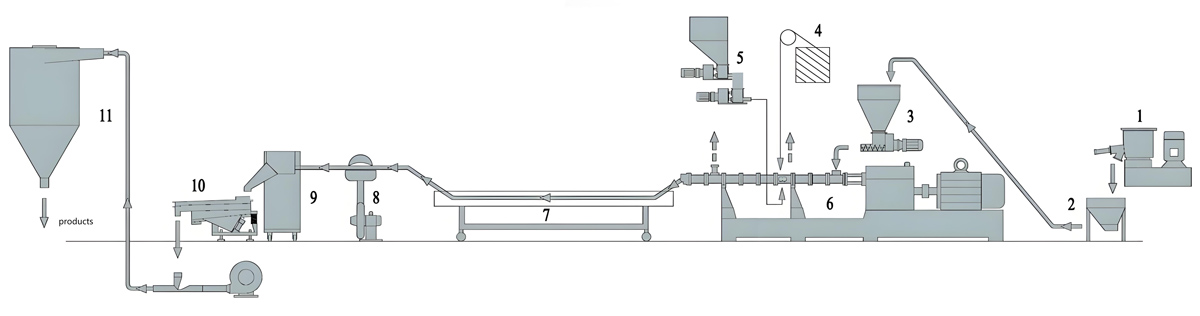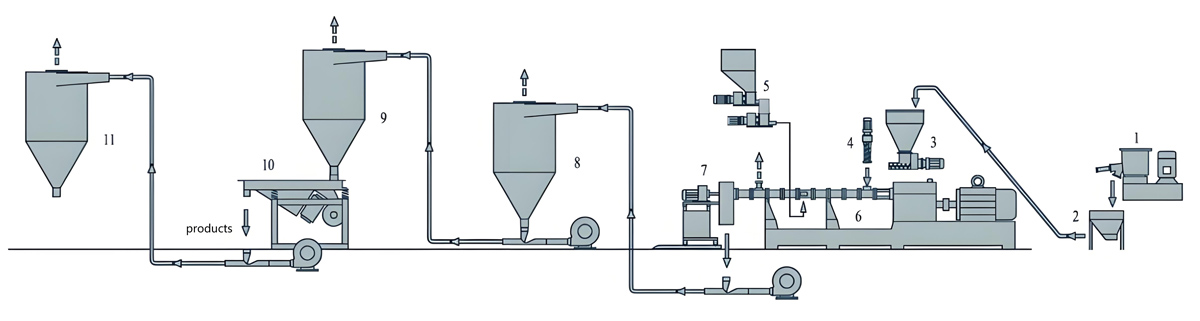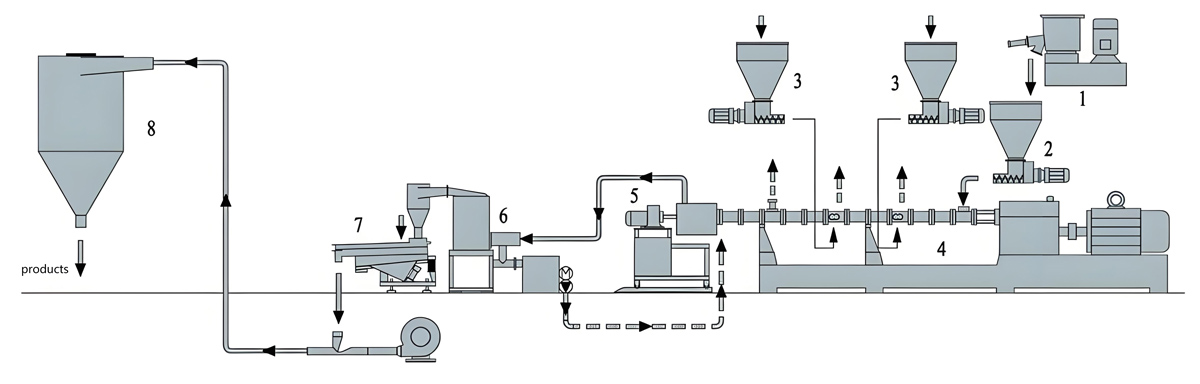
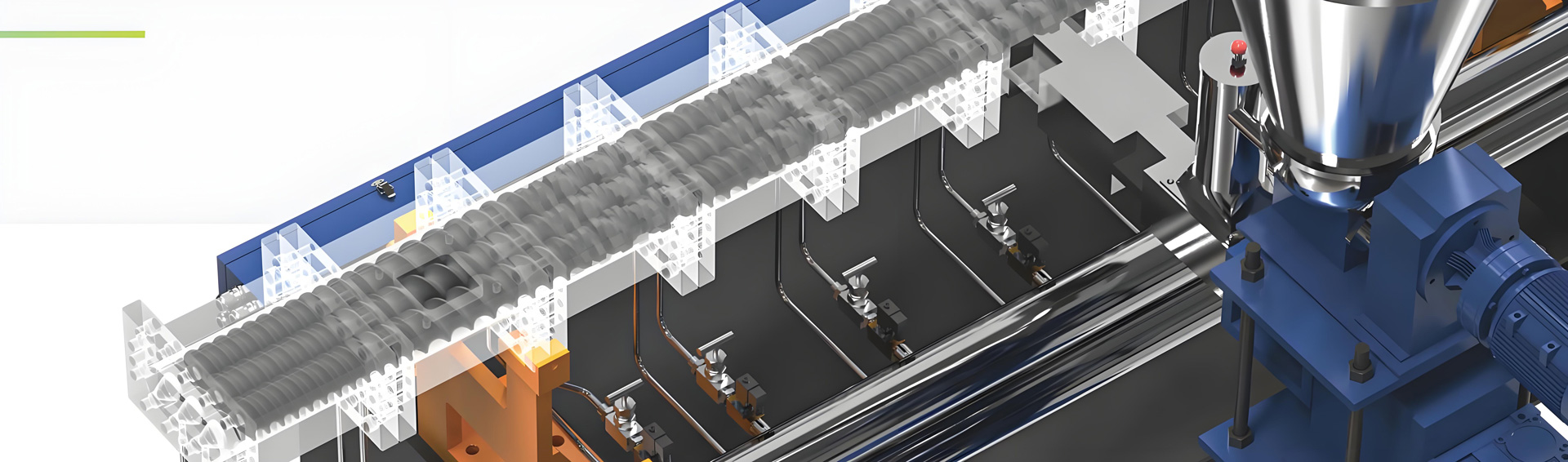
Flame retardant and toughened masterbatch formulations address two critical performance requirements in plastic materials: fire safety and impact resistance. These specialized compounds enable manufacturers to produce plastic products meeting stringent regulatory requirements for flame retardancy while maintaining the mechanical toughness necessary for demanding applications. The production of high-quality flame retardant and toughened masterbatch using twin screw extrusion technology requires careful attention to formulation chemistry, processing conditions, and quality verification practices. This comprehensive guide provides detailed information on all aspects of manufacturing these important functional masterbatch products.
Introduction to Flame Retardant and Toughened Masterbatch
Flame retardant additives reduce the flammability of polymer materials through various chemical and physical mechanisms. Some flame retardants act in the gas phase by releasing flame-inhibiting gases that interrupt combustion reactions. Others function in the solid phase by promoting char formation that creates a protective barrier against heat and flame. The selection of flame retardant type depends on the polymer being protected, the required fire performance level, and regulatory compliance requirements.
Toughening additives improve the impact resistance and damage tolerance of polymer materials by absorbing and dissipating energy during impact events. Elastomeric toughening agents create a dispersed phase within the polymer matrix that initiates energy-absorbing mechanisms including cavitation, shear yielding, and rubber particle bridging. The combination of flame retardant and toughening functionality in single formulations enables manufacturers to meet multiple performance requirements efficiently.
Masterbatch production offers significant advantages for flame retardant and toughening formulations. Converting difficult-to-handle powder additives into free-flowing pellets eliminates dust exposure, improves dosing accuracy, and ensures consistent dispersion in the base polymer. The carrier resin also provides processibility benefits and improves compatibility with the polymer being compounded.
Twin screw extrusion provides the intensive mixing required to disperse flame retardant and toughening additives uniformly throughout the polymer matrix. The modular screw configuration enables customization of mixing intensity and residence time to match the specific requirements of different additive systems and concentration levels.
Formulation Ratios for Flame Retardant and Toughened Masterbatch
Formulation development for flame retardant and toughened masterbatch requires balancing multiple performance requirements against processing constraints and cost considerations. Different application requirements necessitate different additive packages and concentration levels.
Halogen-Based Flame Retardant Masterbatch Formulation
Halogen-based flame retardants including brominated and chlorinated compounds provide excellent flame retardancy through gas-phase radical scavenging mechanisms. These additives are highly effective at relatively low concentrations, typically 10 to 25 percent in the final compound depending on the polymer and required fire performance level.
A standard brominated flame retardant masterbatch formulation might contain 60 to 75 percent active brominated compound such as decabromodiphenyl oxide, tetrabromobisphenol A, or ethylene bis-tetrabromophthalimide. The carrier resin comprises 20 to 35 percent of the formulation, selected for compatibility with the target polymer system. Processing aids and dispersing agents at 1 to 5 percent improve dispersion and reduce dust generation.
Synergists such as antimony trioxide are often incorporated into flame retardant masterbatch formulations at concentrations of 3 to 10 percent. These compounds work synergistically with halogen flame retardants to improve effectiveness and reduce the total additive loading required to achieve target fire performance. Alternative synergists including zinc borate and zinc stannate provide halogen-free options for certain applications.
Phosphorus-Based Flame Retardant Masterbatch Formulation
Phosphorus-based flame retardants provide flame retardancy through both gas-phase and condensed-phase mechanisms depending on the specific compound and polymer system. These additives offer excellent environmental profiles and are increasingly preferred due to regulatory pressures on halogen-based alternatives.
Common phosphorus flame retardants include ammonium polyphosphate, red phosphorus, and organic phosphates and phosphonates. Ammonium polyphosphate masterbatch formulations typically contain 50 to 70 percent active compound combined with carrier resin and processing aids. Red phosphorus masterbatch formulations may contain 40 to 60 percent red phosphorus, though color and compatibility issues require careful formulation development.
Intumescent flame retardant systems combine phosphorus-based flame retardants with nitrogen compounds and char-forming agents to create膨胀 char structures that protect underlying materials. A typical intumescent masterbatch formulation might include 30 to 40 percent ammonium polyphosphate, 15 to 25 percent melamine, and 15 to 25 percent pentaerythritol or similar char former.
Mineral and Inorganic Flame Retardant Masterbatch Formulation
Mineral flame retardants including aluminum trihydroxide and magnesium hydroxide provide flame retardancy through endothermic decomposition that absorbs heat and releases water vapor. These additives offer excellent smoke suppression and toxic gas reduction compared to halogen-based alternatives.
Aluminum trihydroxide masterbatch formulations typically contain 50 to 70 percent active filler, making high-loading masterbatch products necessary to achieve target flame retardant levels in the final compound. Surface treatment with silane or titanate coupling agents improves polymer compatibility and mechanical properties of filled compounds.
Magnesium hydroxide provides higher decomposition temperatures compared to aluminum trihydroxide, making it suitable for polymers processed at elevated temperatures. Masterbatch formulations containing 50 to 70 percent magnesium hydroxide are used for polypropylene and polyethylene applications requiring higher processing temperatures.
Impact Modifier and Toughening Agent Masterbatch Formulation
Toughening agents improve impact resistance through elastomeric modification of the polymer matrix. Different toughening systems are selected based on the base polymer, required impact performance level, and processing conditions. Core-shell impact modifiers with rubber cores and rigid shells provide excellent impact improvement with minimal effect on other properties.
Standard impact modifier masterbatch formulations typically contain 40 to 60 percent active impact modifier particles. The core-shell structure of these modifiers requires careful dispersion to preserve particle integrity and achieve uniform distribution within the polymer matrix. Excessive shear during processing can damage the modifier particles and reduce toughening effectiveness.
Elastomeric toughening agents including ethylene-propylene-diene monomer, styrene-ethylene-butylene-styrene, and maleic anhydride-grafted polymers provide cost-effective impact modification for polyolefin systems. Masterbatch formulations containing 30 to 50 percent of these elastomers improve impact resistance while maintaining good processibility.
Combined Flame Retardant and Toughened Masterbatch Formulation
Applications requiring both flame retardancy and impact resistance benefit from combined formulations that address both requirements. These hybrid formulations must balance flame retardant and toughening mechanisms that may work synergistically or antagonistically depending on the specific additive combination.
A combined flame retardant and toughened masterbatch for engineering plastics might include 20 to 30 percent brominated flame retardant, 10 to 15 percent antimony trioxide synergist, and 10 to 20 percent impact modifier. This combination provides flame retardancy meeting UL94 V-0 requirements while maintaining adequate impact resistance for demanding applications.
For polyolefin applications, combining mineral flame retardants with elastomeric toughening agents addresses both requirements. Formulations might include 30 to 40 percent aluminum trihydroxide, 10 to 20 percent elastomeric impact modifier, and appropriate coupling agents for compatibility. Testing of combined formulations is essential to verify that both flame retardancy and impact performance meet specifications.
Production Process for Flame Retardant and Toughened Masterbatch
The production of flame retardant and toughened masterbatch requires attention to both dispersion quality and preservation of additive functionality. The high loadings typical of flame retardant formulations create processing challenges that must be managed through proper equipment configuration and parameter control.
Raw Material Preparation
Flame retardant compounds require proper drying before processing to remove moisture that could cause hydrolysis reactions, steam formation, or surface defects in the finished product. Aluminum trihydroxide and magnesium hydroxide typically require drying at 120 to 150 degrees Celsius for 4 to 6 hours to achieve moisture contents below 0.1 percent.
Brominated and phosphorus-based flame retardants may also require drying to prevent moisture-related problems. Typical drying conditions for these additives are 80 to 120 degrees Celsius for 3 to 4 hours. Extended drying at excessive temperatures should be avoided as some flame retardants may undergo thermal degradation or sublimation.
Impact modifier materials in pellet or powder form should be dried according to manufacturer recommendations to prevent moisture absorption. Impact modifiers containing polar groups or grafted functional monomers may be particularly moisture-sensitive and require careful drying conditions.
Pre-blending combines all formulation components including flame retardants, toughening agents, carrier resin, and processing aids in the correct proportions. High-intensity mixing ensures uniform distribution of high-density flame retardant particles throughout the carrier resin. The pre-blend should be processed promptly to minimize moisture reabsorption.
Extrusion Processing
Extrusion processing for flame retardant and toughened masterbatch must handle high filler loadings while maintaining adequate mixing to achieve uniform additive distribution. The screw configuration must provide sufficient transport capability to handle the high-solids-content formulations typical of flame retardant products.
Temperature profiles for flame retardant extrusion must balance processing requirements against thermal stability of additives. For polyethylene-based formulations, temperatures typically range from 160 to 220 degrees Celsius across processing zones. Higher temperatures improve melt flow and reduce viscosity but may cause degradation of temperature-sensitive flame retardants.
Screw configuration for high-loading flame retardant formulations emphasizes material transport and distributive mixing over intensive dispersive mixing. Deep screw flights in the feeding zone provide high solids-handling capability. Forward-conveying elements maintain material flow throughout the extrusion length. Moderate-intensity kneading blocks achieve adequate dispersion without excessive shear that might damage impact modifier particles.
Vacuum devolatilization removes moisture and volatile contaminants from the formulation. Multiple vacuum zones may be beneficial for high-moisture-content formulations or those containing volatile flame retardant degradation products. Vacuum levels between 0.5 and 0.9 bar provide effective volatile removal.
Pelletizing and Finishing
Pelletizing systems for flame retardant masterbatch must handle high-throughput rates and maintain cutting quality despite abrasive filler content. Underwater pelletizing with properly maintained knife blades ensures clean cuts and uniform granule dimensions.
The cooling water system must provide adequate heat removal to solidify the high-melting-point formulations typical of flame retardant masterbatch. Water temperature and flow rate should be monitored and adjusted to ensure proper granule solidification before cutting.
Centrifugal drying removes surface moisture from the finished granules. The dried product is inspected for visual quality and then packaged in appropriate containers that provide moisture and contamination protection during storage and transport.
Production Equipment Introduction
Equipment selection for flame retardant and toughened masterbatch production considers the high filler loadings typical of these formulations and the resulting demands on processing capability. The Kerke KTE series provides equipment options suitable for different production scales and formulation requirements.
Kerke KTE-36B Twin Screw Extruder
The compact KTE-36B serves pilot production and small-batch requirements for flame retardant and toughened masterbatch. The 35.6 millimeter screw diameter and 40:1 length-to-diameter ratio provide adequate processing capability for formulation development and low-volume specialty production at 20 to 100 kilograms per hour.
The six-zone temperature control enables precise temperature profiling for temperature-sensitive flame retardant compounds. Modular screw element configuration allows customization of transport and mixing capability to match specific formulation requirements. This model is suitable for businesses establishing flame retardant masterbatch capabilities or conducting product development activities.
Kerke KTE-50B Twin Screw Extruder
The mid-range KTE-50B offers increased production capacity with 50.5 millimeter screw diameter achieving throughput rates of 80 to 200 kilograms per hour. The eight-zone temperature control provides enhanced flexibility for optimizing processing conditions of complex flame retardant formulations.
This model serves small to medium-scale commercial production effectively. The combination of capacity, temperature control capability, and moderate investment makes the KTE-50B an attractive option for growing flame retardant masterbatch businesses.
Kerke KTE-65B Twin Screw Extruder
Medium-scale commercial production is served by the KTE-65B with 62.4 millimeter screw diameter and throughput rates of 200 to 450 kilograms per hour. The ten-zone temperature control enables precise management of temperature-sensitive flame retardant and toughening formulations.
The robust construction and reinforced components support continuous production operation handling the demanding requirements of high-filler flame retardant formulations. The KTE-65B provides an excellent balance of capacity, control capability, and investment level for established flame retardant masterbatch production operations.
Kerke KTE-75B Twin Screw Extruder
High-volume flame retardant masterbatch production is addressed by the KTE-75B with 71 millimeter screw diameter and throughput rates of 300 to 800 kilograms per hour. The twelve-zone temperature control system provides maximum flexibility for demanding formulations.
The extended length-to-diameter ratio of 48:1 offers additional residence time for complete mixing of high-viscosity formulations. Advanced screw elements optimize dispersion quality while maintaining throughput efficiency. This model suits manufacturers with established markets seeking capacity expansion or improved production efficiency.
Kerke KTE-95D Twin Screw Extruder
Maximum production capacity is available through the KTE-95D with 93 millimeter screw diameter achieving throughput rates between 1000 and 2000 kilograms per hour. This industrial-scale platform delivers the throughput required for large-volume flame retardant masterbatch manufacturing.
The comprehensive automation and control systems support continuous production operation with consistent quality. Multiple side-feeder ports and devolatilization zones provide enhanced processing capability for complex formulations. The KTE-95D serves major production facilities requiring maximum capacity output.
Parameter Settings for Flame Retardant and Toughened Masterbatch
Optimal parameter settings for flame retardant and toughened masterbatch balance processing efficiency against product quality requirements. The high filler loadings typical of flame retardant formulations create specific parameter requirements that differ from standard compounding operations.
Temperature Profile Configuration
Temperature profiles must be configured to provide adequate melting and flow while avoiding thermal degradation of flame retardant compounds. For brominated flame retardant formulations, maximum barrel temperatures typically should not exceed 260 degrees Celsius to prevent decomposition and bromine release. Phosphorus-based flame retardants may have different temperature limits depending on the specific compound.
For polyethylene-based flame retardant formulations, typical temperature profiles range from 160 to 220 degrees Celsius across processing zones. The feeding zone operates at lower temperatures to ensure consistent material introduction. Progressive temperature increases through the compression and melting zones achieve complete polymer melting. The final mixing zones maintain temperatures that provide adequate flow without excessive thermal stress.
Die zone temperatures are set 10 to 20 degrees Celsius below the final barrel zone to ensure proper melt consolidation. Temperature uniformity across the die plate ensures uniform strand formation and consistent granule quality.
Screw Speed and Throughput Balance
Screw speeds between 150 and 300 revolutions per minute typically provide good balance between processing efficiency and product quality for flame retardant masterbatch. Lower speeds reduce mechanical energy input and temperature rise, which can benefit temperature-sensitive flame retardants. However, lower speeds also reduce throughput and may affect mixing quality.
Throughput optimization must consider the high solids content of flame retardant formulations. Higher throughput rates reduce residence time, which benefits temperature-sensitive additives but may compromise mixing quality for high-viscosity formulations. The optimal throughput balances these competing requirements based on the specific formulation and equipment.
Recommended throughput ranges for different equipment sizes are: KTE-36B at 30 to 60 kilograms per hour, KTE-50B at 100 to 150 kilograms per hour, KTE-65B at 250 to 350 kilograms per hour, KTE-75B at 400 to 600 kilograms per hour, and KTE-95D at 1200 to 1700 kilograms per hour for high-loading flame retardant formulations.
Back Pressure and Fill Level Control
Melt pressure monitoring provides important information about fill level and processing stability. Flame retardant formulations typically show melt pressures between 5 and 15 megapascals depending on filler loading, viscosity, and throughput rate. Higher filler loadings increase viscosity and pressure requirements.
Controlling back pressure through die configuration affects fill level in the mixing zones and mixing intensity. Higher back pressure increases fill level and residence time, improving mixing but requiring more motor torque. Die restriction elements can be adjusted to achieve optimal back pressure for the specific formulation.
Equipment Price
Investment levels for twin screw extrusion equipment vary based on production capacity, features, and configuration. Kerke offers the KTE series across a comprehensive price range suitable for different market segments and production requirements.
The Kerke KTE-36B is priced between 25,000 and 35,000 dollars, providing an accessible entry point for pilot production and development activities. The compact design minimizes installation requirements while delivering professional-grade mixing performance for flame retardant formulations.
The Kerke KTE-50B ranges from 40,000 to 60,000 dollars, offering increased capacity and enhanced temperature control for small to medium-scale commercial flame retardant masterbatch production. The additional temperature zones and improved control systems support demanding formulation requirements.
Medium-scale production capacity is available through the Kerke KTE-65B at 50,000 to 80,000 dollars. The higher throughput capability and extended features support established commercial production operations requiring consistent output of quality flame retardant masterbatch.
The Kerke KTE-75B, priced between 70,000 and 100,000 dollars, serves high-volume production requirements with maximum capacity and advanced control features. The robust construction supports continuous production operation in demanding manufacturing environments.
Maximum capacity production is available through the Kerke KTE-95D at 120,000 to 200,000 dollars. This industrial-scale platform provides the throughput and automation capabilities required for large-volume flame retardant masterbatch manufacturing operations.
Problems in Production Process and Solutions
Production of flame retardant and toughened masterbatch presents specific technical challenges related to high filler loadings, additive sensitivity, and the need to maintain both flame retardant and toughening functionality. Understanding these challenges enables processors to develop effective solutions.
Problem: Inadequate Flame Retardant Dispersion
Inadequate dispersion of flame retardant compounds creates localized areas of high and low concentration, resulting in inconsistent fire performance in compounded products. This problem manifests as variable burn test results, uneven flame spread, and poor batch-to-batch reproducibility.
Root Cause Analysis
Insufficient mixing during extrusion results from screw configurations lacking adequate distributive mixing elements, inadequate residence time for complete additive distribution, or insufficient shear stress to break down agglomerates of high-density flame retardant particles. The high loadings typical of flame retardant formulations create processing challenges that require careful attention to mixing configuration.
Pre-blending deficiencies leave flame retardant particles poorly distributed before they enter the extruder. Large agglomerates formed during storage or handling resist breakdown during extrusion. Inadequate pre-blending intensity or time fails to achieve the initial distribution required for effective extrusion mixing.
Raw material quality issues including excessive particle size, moisture contamination, or improper surface treatment affect dispersion performance. Flame retardant powders that have absorbed moisture may form clumps that resist dispersion. Particles with irregular shapes or surfaces may resist uniform distribution.
Solutions
Modifying screw configurations to include additional distributive mixing elements improves flame retardant dispersion. Kneading blocks with moderate staggering angles provide intensive mixing that distributes high-density particles throughout the carrier resin. Adding forward-conveying elements between mixing sections maintains material flow while preserving mixing efficiency.
Improving pre-blending procedures ensures better initial distribution of flame retardant compounds before extrusion. Using high-intensity mixing equipment or two-stage blending processes improves the wetting and distribution of flame retardant particles. The improved pre-blend requires less processing to achieve complete dispersion.
Adjusting processing temperatures to optimize viscosity improves mixing effectiveness. Lower viscosity allows greater material circulation and more thorough distribution of flame retardant particles. However, temperatures must remain within limits that prevent flame retardant degradation or processing problems.
Prevention Methods
Standardizing pre-blending procedures ensures consistent preparation regardless of operator or batch. Documenting mixing parameters including time, speed, and sequence provides reproducible preparation conditions. Regular calibration of mixing equipment maintains consistent performance.
Implementing raw material specifications and incoming quality control procedures prevents dispersion problems caused by poor-quality input materials. Testing particle size distribution, moisture content, and bulk density identifies potential problems before they affect production.
Quality testing of finished masterbatch verifies dispersion effectiveness. Burn testing of compounded samples, microscopy examination, and application testing provide confirmation of adequate flame retardant distribution.
Problem: Impact Modifier Damage During Processing
Impact modifier particles can be damaged by excessive shear during extrusion, resulting in reduced toughening effectiveness in the finished masterbatch. This problem manifests as lower-than-expected impact performance in customer applications.
Root Cause Analysis
Excessive shear stress during extrusion breaks or deforms impact modifier particles, reducing their effectiveness in absorbing impact energy. Core-shell impact modifiers with rubber cores are particularly susceptible to shear damage. The high shear rates in intensive mixing elements and the elevated viscosities of high-filler formulations create conditions that can damage modifier particles.
Inadequate temperature control causes viscosity variations that create inconsistent shear stress throughout the processing. Temperature fluctuations during production create periods of high shear that damage modifier particles. Inadequate melting creates regions of solid polymer that create additional shear stress on modifier particles.
Screw configuration with excessive mixing intensity relative to formulation requirements creates unnecessary shear stress on impact modifier particles. Kneading blocks with aggressive staggering angles and extended mixing sections can damage modifier particles that would survive gentler processing.
Solutions
Reducing mixing intensity through screw configuration modifications protects impact modifier particles. Replacing aggressive kneading blocks with moderate-intensity elements, reducing the number of kneading sections, or using wider staggering angles decreases shear stress on modifier particles while maintaining adequate mixing for other formulation components.
Optimizing temperature profiles to reduce melt viscosity decreases shear stress during processing. Higher temperatures reduce viscosity and shear stress, protecting modifier particles from mechanical damage. However, temperatures must remain below levels that cause thermal degradation of the modifier or other formulation components.
Reducing throughput rate decreases fill level and material stress in the mixing zones, providing a gentler processing environment. This approach trades processing efficiency for product quality, which may be appropriate for demanding formulations or premium products.
Prevention Methods
Establishing validated screw configurations for impact modifier-containing formulations ensures consistent processing conditions that protect modifier particles. Documenting successful configurations and reusing them for similar formulations prevents problems from inappropriate screw designs.
Quality testing of finished masterbatch verifies impact modifier effectiveness. Impact testing of compounded samples using appropriate test methods confirms that modifier particles survived processing intact. Establishing specification limits for impact performance ensures consistent product quality.
Process monitoring for torque, pressure, and temperature variations identifies conditions that might indicate changes in processing severity. Sudden changes in operating parameters may indicate equipment problems or formulation variations affecting processing conditions.
Problem: High Extruder Torque and Motor Overload
High filler loadings in flame retardant formulations create processing challenges that can exceed equipment torque capacity. This problem limits throughput and can cause automatic shutdowns or equipment damage.
Root Cause Analysis
High viscosity formulations resulting from high filler loadings create excessive torque requirements that may exceed equipment capacity. The combination of polymer viscosity and solid filler content determines the total power requirement for extrusion. Formulations approaching the limits of equipment processing capability will create torque problems.
Feed rate exceeding equipment capability creates overfilling conditions that dramatically increase torque requirements. The high solids content of flame retardant formulations makes them particularly sensitive to feed rate variations. Uneven feeding creates torque fluctuations that stress the drive system.
Equipment wear including worn screw elements, damaged barrel liners, or degraded bearings increases power requirements beyond normal levels. Normal wear over time reduces equipment efficiency and increases torque demands for equivalent throughput rates.
Solutions
Reducing throughput rate immediately alleviates torque problems by decreasing the fill level and material processing load. Adjusting feed rate to match equipment capability restores stable operation while identifying the maximum sustainable throughput for the specific formulation.
Optimizing the temperature profile increases melt flow and reduces viscosity, directly addressing torque issues caused by inadequate flow. Raising temperatures in the compression and metering zones improves melting efficiency and reduces power requirements. However, temperatures must remain below degradation levels for the specific formulation.
Modifying the screw configuration to improve transport efficiency reduces fill level and torque requirements. Reducing restriction elements, deepening screw flights, or adjusting element sequences can improve throughput capability for high-viscosity formulations.
Prevention Methods
Proper formulation development ensures that masterbatch formulations are compatible with available equipment capabilities. Testing formulations at various throughput rates during development identifies optimal operating conditions and potential problems before production scale-up.
Preventive maintenance of extrusion equipment maintains processing capability over time. Regular inspection of screw elements for wear, checking barrel liner condition, and verifying drive system performance prevents performance degradation that increases torque requirements.
Regular monitoring of torque levels during production enables early detection of developing problems. Establishing normal operating ranges and alarm thresholds provides warning of conditions that might lead to overload situations.
Maintenance of Twin Screw Extruders for Flame Retardant Masterbatch
Consistent maintenance of extrusion equipment ensures reliable production and consistent product quality for flame retardant and toughened masterbatch manufacturing. The maintenance program addresses both general equipment care and specific considerations for high-filler formulations.
Screw and Barrel Wear Management
High filler loadings in flame retardant formulations accelerate wear of screw elements and barrel liners. Regular inspection of these components identifies wear patterns and determines when replacement is necessary. Measuring clearances and comparing with specifications quantifies wear levels.
Abrasion-resistant coatings and materials can extend component life in flame retardant applications. Chromium nitride, titanium nitride, and similar coatings provide improved wear resistance for screw flights and barrel surfaces. The additional cost of coated components may be justified by extended service life in demanding applications.
Barrel liner inspection using borescope equipment reveals wear patterns and surface condition. Worn barrel liners create clearance increases that affect compression and mixing performance. Replacing worn liners restores original equipment specifications and processing capability.
Temperature Control System Maintenance
Accurate temperature control is essential for consistent flame retardant masterbatch production. Regular calibration of temperature sensors ensures measurement accuracy. Verification of temperature readings against known standards identifies drift and accuracy problems.
Heating element condition affects temperature control performance and energy efficiency. Testing element resistance identifies degradation before failure occurs. Replacing worn elements during scheduled maintenance prevents unexpected production interruptions.
Cooling system performance directly impacts temperature control capability. Scale buildup in water-cooled zones reduces heat transfer efficiency and creates control difficulties. Regular cleaning of cooling passages maintains proper heat removal capacity.
Drive System and Feeding Equipment Care
Gearbox maintenance is critical for equipment handling high-viscosity flame retardant formulations. Regular oil analysis identifies wear particles and contamination. Following manufacturer recommendations for oil changes maintains drive system reliability.
Feeding system accuracy affects batch-to-batch consistency. Loss-in-weight feeder calibration ensures accurate feed rate control. Feeder screw condition affects accuracy, particularly for high-solids-content pre-blends. Regular inspection and replacement of worn components maintains feeding accuracy.
Pelletizing equipment requires maintenance attention for high-throughput flame retardant production. Knife blade sharpness affects cut quality and granule appearance. Regular inspection and replacement of dull blades maintains granule quality and minimizes fines production.
FAQ
What flame retardant concentration is needed to achieve UL94 V-0 rating?
The flame retardant concentration required for UL94 V-0 rating depends on the polymer type, flame retardant system, and product thickness. Brominated flame retardant systems typically achieve V-0 rating at 15 to 25 percent concentration in ABS, while phosphorus-based systems may require 10 to 20 percent in polypropylene. Testing of specific formulations is required to confirm performance.
Can flame retardant and impact modifier be used in the same formulation?
Flame retardant and impact modifier can be combined in the same formulation to address both fire safety and impact resistance requirements. However, some combinations may show antagonistic effects where one additive interferes with the function of the other. Testing of combined systems is essential to verify that both properties meet specifications.
What is the difference between brominated and phosphorus-based flame retardants?
Brominated flame retardants function primarily in the gas phase by releasing bromine radicals that interrupt combustion reactions. Phosphorus-based flame retardants function in both gas and condensed phases, with intumescent systems creating protective char barriers. The choice depends on polymer type, required fire performance, and regulatory requirements.
How does flame retardant masterbatch affect the mechanical properties of polymers?
High loadings of flame retardant additives can affect mechanical properties including impact resistance, tensile strength, and elongation. Mineral flame retardants particularly may reduce impact performance. Using toughening agents in combination with flame retardants or selecting flame retardants with minimal property impact helps maintain mechanical performance.
What storage conditions are recommended for flame retardant masterbatch?
Flame retardant masterbatch should be stored in a dry environment with relative humidity below 60 percent to prevent moisture absorption. Storage temperatures between 15 and 30 degrees Celsius are recommended. Some flame retardants may be sensitive to light or elevated temperature during extended storage.
How do I select the appropriate flame retardant system for my application?
Selection of flame retardant system depends on the polymer being protected, required fire performance level, regulatory requirements, and processing conditions. Consulting with flame retardant suppliers and testing specific formulations helps identify optimal solutions for demanding applications.
What causes dripping during flame testing and how can it be prevented?
Dripping during flame testing occurs when the polymer melts and flows away from the flame source. Anti-drip agents including fluoropolymers help prevent dripping by stabilizing the melt. Higher char-forming flame retardant systems also reduce dripping tendency by maintaining material integrity during fire exposure.
Can recycled polymers containing flame retardant masterbatch be reprocessed?
Recycled polymers containing flame retardant additives can be reprocessed, but the flame retardant effectiveness may be reduced due to processing exposure and potential loss of volatile flame retardant components. Additional flame retardant supplementation may be required to achieve target fire performance in recycled polymer applications.
Conclusion
Flame retardant and toughened masterbatch production represents a sophisticated manufacturing operation requiring careful attention to formulation chemistry, processing conditions, and quality verification. These specialized products enable manufacturers to produce plastic products meeting stringent fire safety requirements while maintaining the mechanical toughness necessary for demanding applications.
Successful production of effective flame retardant and toughened masterbatch depends on achieving uniform dispersion of flame retardant compounds while preserving the functionality of impact modifier particles. The high filler loadings typical of flame retardant formulations create processing challenges that must be managed through proper equipment configuration, parameter optimization, and quality control.
The growing importance of fire safety regulations across industries including electronics, construction, transportation, and consumer products creates expanding opportunities for flame retardant masterbatch manufacturers. Twin screw extrusion technology provides the capabilities required to produce high-quality, consistent products meeting demanding fire performance specifications. Processors who master the technical requirements of flame retardant formulation and processing position themselves to serve these critical safety-related markets with products that protect lives and property.