Sports equipment plastic masterbatch production serves an incredibly diverse market segment spanning from recreational fitness products to professional athletic gear and outdoor sporting equipment. These specialized masterbatches must deliver the performance characteristics necessary for demanding applications including superior impact resistance, excellent wear durability, UV protection for outdoor use, and vibrant color aesthetics that appeal to consumers. The manufacturing of sports equipment masterbatch requires precision processing capabilities to incorporate the multiple additive systems necessary for these demanding applications.
The global sports equipment market continues to expand as participation in recreational and competitive sports grows worldwide. Consumers increasingly demand high-performance products that enhance athletic performance, provide durability for intensive use, and maintain attractive appearance over extended product lifecycles. These requirements translate directly into demanding specifications for the masterbatch used in sports equipment manufacturing.
Twin screw extrusion has emerged as the preferred manufacturing technology for sports equipment masterbatch due to its exceptional mixing capabilities, processing flexibility, and ability to handle complex multi-additive formulations. The co-rotating twin screw design creates the intensive mixing action necessary for uniform dispersion of impact modifiers, UV stabilizers, colorants, and other performance additives required for sports equipment applications.
Introduction
Sports equipment encompasses an extraordinarily wide range of product categories, each with specific performance requirements that influence masterbatch formulation and processing. From high-impact helmets and protective gear to durable outdoor fitness equipment, from marine sports gear to winter sports products, the diversity of requirements presents unique challenges for masterbatch manufacturers.
The plastics used in sports equipment must withstand demanding conditions including repeated mechanical stress, environmental exposure, temperature extremes, and chemical contact. The masterbatch incorporated into these materials must enable the base polymer to perform under these challenging conditions while maintaining the aesthetic appeal essential for consumer products.
Impact resistance represents perhaps the most critical performance requirement for many sports equipment applications. Helmets, protective padding, and equipment housings must absorb and dissipate energy from impacts to protect users from injury. Masterbatch formulations must incorporate impact modifiers that enhance toughness without compromising other essential properties.
Wear durability ensures that sports equipment maintains functionality and appearance through extended use. Ground engage surfaces, grip areas, and frequently handled equipment components must resist abrasion and mechanical wear. Wear-resistant additive systems in masterbatch formulations help achieve the durability required for demanding applications.
UV stability protects outdoor sports equipment from degradation during storage, transportation, and use. Exposure to sunlight causes polymer degradation leading to chalking, cracking, color fading, and loss of mechanical properties. UV stabilizer packages incorporated into masterbatch formulations extend product life in outdoor service conditions.
Twin screw extruders from manufacturers like Nanjing Kerke Extrusion Equipment Company provide the processing capabilities necessary for high-quality sports equipment masterbatch production. The KTE series offers equipment suitable for various production volumes and formulation requirements, enabling manufacturers to select optimal equipment configurations for their specific market focus.
This comprehensive guide examines all essential aspects of sports equipment plastic masterbatch production using twin screw extrusion technology, providing detailed formulation guidance, production process descriptions, equipment recommendations, and practical expertise for manufacturers seeking to serve this diverse and growing market segment.
Formulation Ratio
Sports equipment masterbatch formulations must address the specific performance requirements of target applications while achieving the aesthetic characteristics desired by consumers. Understanding the formulation requirements for different sports equipment categories enables manufacturers to develop optimized products.
Impact-Resistant Masterbatch Formulations
Sports equipment requiring high impact resistance includes helmets, protective padding, eyeglass frames, and equipment housings. These applications demand masterbatch formulations that enhance toughness and energy absorption while maintaining adequate stiffness and processability.
Impact modifiers form the foundation of impact-resistant masterbatch formulations. Several classes of impact modifiers are available, each offering specific property combinations.
Ethylene-propylene-diene monomer (EPDM) rubber particles provide excellent impact modification for polypropylene and polyethylene systems. The rubber particles act as stress concentrators that initiate energy-absorbing crazing and shear yielding in the polymer matrix. EPDM modifiers are typically incorporated at 10-25% concentration depending on the required impact resistance level.
Maleic anhydride-grafted polyolefins enhance impact resistance while improving adhesion between dissimilar polymer phases. These modifiers are particularly effective in polypropylene-based formulations where they create impact-modified compounds with good surface appearance. Typical addition levels range from 5-15%.
Styrenic block copolymers including SBS (styrene-butadiene-styrene) and SEBS (styrene-ethylene-butylene-styrene) provide impact modification with excellent aesthetic characteristics. These modifiers are commonly employed in transparent or translucent applications where impact resistance must be achieved without compromising optical clarity. Concentrations typically range from 10-30%.
Carrier resin selection for impact-resistant masterbatch depends on the target application polymer. Polypropylene homopolymer or random copolymer often serves as the carrier for impact-modified masterbatch, providing compatibility with common sports equipment polymers. The carrier typically constitutes 50-75% of the masterbatch formulation.
Wear-Resistant Masterbatch Formulations
Sports equipment subjected to abrasive wear including ground engage surfaces, ski and snowboard components, skate wheels, and exercise equipment requires enhanced wear resistance achieved through specialized additive packages.
Silicone-based additives provide excellent wear resistance while reducing friction coefficients. Silicone oils and silicone-grafted polymers are incorporated at 1-5% concentration to achieve these benefits. The silicone additive migrates to the surface during processing, creating a lubricious surface layer that reduces wear.
PTFE (polytetrafluoroethylene) micropowders enhance wear resistance and reduce friction in demanding applications. PTFE particles are typically incorporated at 5-15% concentration for significant wear improvement. Careful dispersion is essential to achieve uniform distribution and prevent agglomeration that could create stress concentration points.
Abrasive filler systems including aluminum oxide, silicon carbide, or specialized ceramic particles provide extreme wear resistance for the most demanding applications. These additives are typically employed at 5-20% concentration depending on wear requirements. The high hardness of these fillers provides excellent abrasion resistance but requires careful processing to achieve uniform dispersion.
Carbon fiber reinforcement enhances wear resistance while providing stiffness improvement. Short carbon fiber loadings of 5-15% improve wear resistance and mechanical properties. Processing considerations for carbon fiber incorporation include appropriate screw configurations and processing parameters to achieve adequate fiber dispersion and length retention.
Outdoor Sports Equipment Masterbatch
Outdoor sports equipment including patio furniture, pool equipment, playground apparatus, and marine sports gear requires masterbatch formulations with exceptional UV stability and weather resistance.
UV stabilizer packages for outdoor sports equipment must provide comprehensive protection against UV-induced degradation. Hindered amine light stabilizers (HALS) form the foundation of effective UV protection systems. HALS concentrations typically range from 0.3-1.5% depending on expected exposure conditions and required service life.
UV absorber compounds including benzotriazoles, triazines, and benzophenones provide complementary UV protection by absorbing harmful UV radiation before it can damage the polymer. These additives are particularly valuable for thin-section applications where HALS effectiveness may be limited. Typical concentrations range from 0.2-0.8%.
Antioxidant systems protect polymers from thermal oxidation during processing and extend long-term thermal stability in service conditions. Phosphite and thioester antioxidants are incorporated at 0.1-0.5% for processing stability, while higher-molecular-weight phenolic antioxidants provide long-term protection at similar concentrations.
Color selection for outdoor sports equipment should consider lightfastness requirements in addition to aesthetic appeal. Inorganic pigments generally provide superior lightfastness compared to organic pigments and are preferred for outdoor applications. Titanium dioxide provides both whiteness and some UV protection but can cause chalking in long-term outdoor exposure if not properly formulated.
Marine Sports Equipment Masterbatch
Marine sports equipment including boat components, water sports gear, and seaside fitness equipment faces unique challenges including salt spray exposure, continuous UV radiation, and water immersion conditions.
Salt spray resistance requires formulations with enhanced stabilization systems that prevent salt-accelerated degradation. Higher UV stabilizer concentrations in the range of 1.0-2.0% are recommended for marine applications. The synergistic combination of HALS and UV absorber systems provides optimal protection under these demanding conditions.
Hydrolysis stabilizers may be necessary for ester-based polymers such as polycarbonate, polyester elastomers, or thermoplastic polyurethanes used in marine applications. These additives protect against moisture-induced chain scission that can cause property loss over time.
Biocide additives prevent biological fouling on submerged or frequently wet marine equipment surfaces. Anti-fouling masterbatch formulations may incorporate specific biocide compounds registered for the intended application. These specialized formulations require careful attention to regulatory compliance and environmental considerations.
Winter Sports Equipment Masterbatch
Winter sports equipment including ski components, snowboard accessories, ice hockey gear, and cold-weather fitness equipment must maintain performance at low temperatures while withstanding the mechanical stresses of cold-weather use.
Low-temperature impact modifiers ensure adequate toughness in cold conditions. Standard impact modifiers may lose effectiveness at low temperatures, requiring specialized modifier systems with glass transition temperatures below the expected service temperature. Maleic anhydride-grafted ethylene-octene copolymers provide excellent low-temperature impact modification.
Flexibility modifiers for winter sports applications maintain material ductility at low temperatures while providing adequate stiffness at service temperatures. These modifiers enable formulation of materials that remain flexible in cold conditions without becoming excessively soft at ambient temperatures.
Color masterbatch for winter sports equipment often employs bright, saturated colors that remain visible in snowy environments. High lightfastness pigments ensure these colors maintain appearance despite significant UV exposure at high altitudes where winter sports typically occur.
Production Process
The production of sports equipment masterbatch using twin screw extrusion technology requires careful attention to formulation characteristics and processing requirements specific to these demanding applications.
Formulation Preparation
Proper formulation preparation significantly influences final masterbatch quality and processing consistency. Impact modifiers, wear additives, and UV stabilizers require specific handling and preparation procedures to ensure optimal incorporation.
Solid additive preparation may include pre-blending, grinding, or sieving operations to achieve appropriate particle size and distribution. High-loading additive concentrates can facilitate incorporation of difficult-to-disperse additives. Liquid additive systems require appropriate metering equipment and storage conditions.
Carrier resin preparation includes appropriate drying procedures for moisture-sensitive polymers. Polycarbonate, nylon, and other hygroscopic polymers require extended drying at elevated temperatures to prevent moisture-induced defects in finished masterbatch and customer products.
Extrusion Processing
The twin screw extrusion process for sports equipment masterbatch must accommodate various additive systems while achieving the uniform dispersion and quality consistency required for demanding applications.
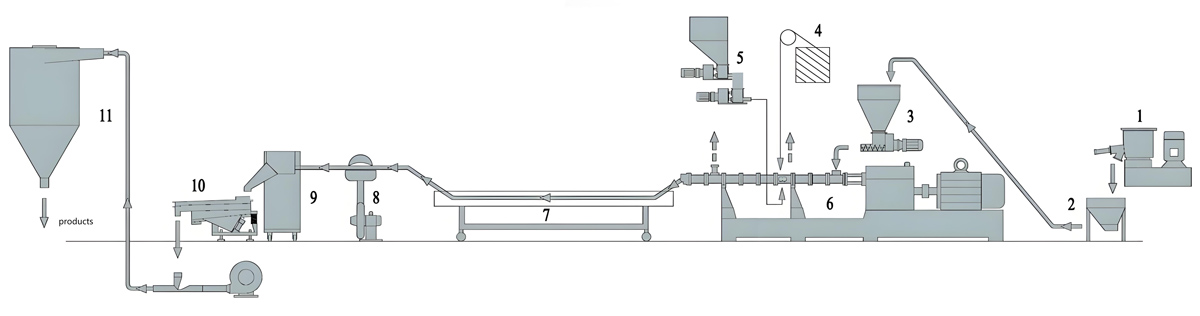
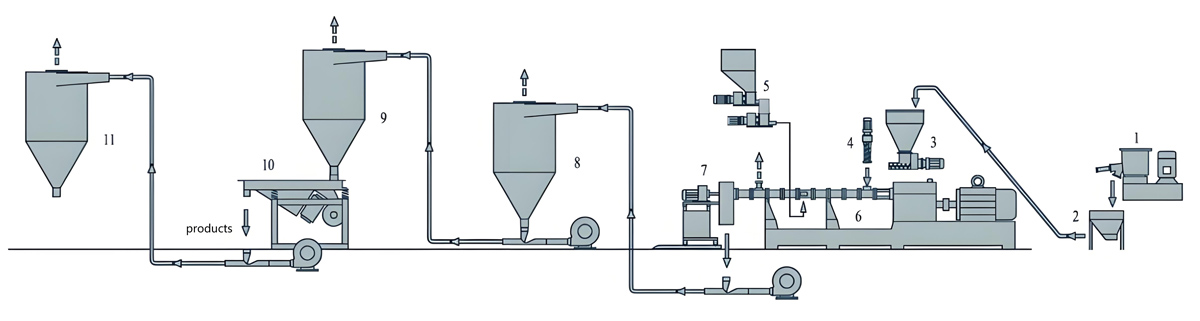
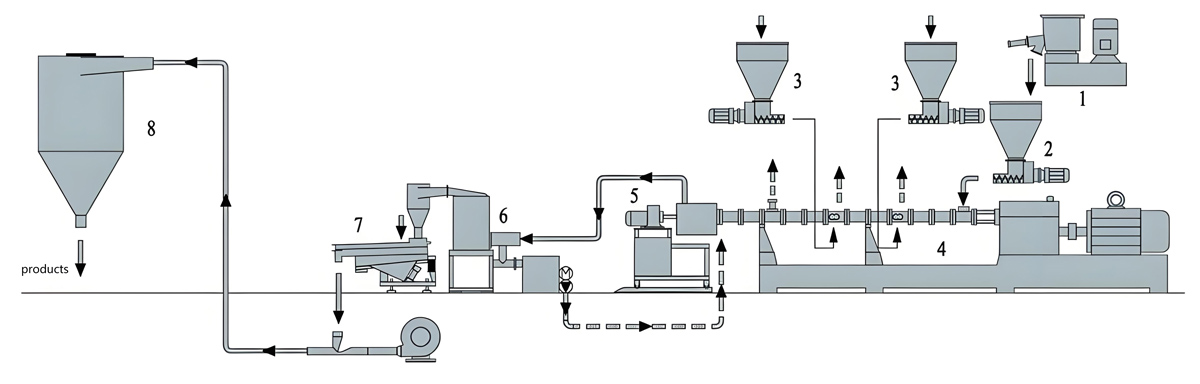
Feeding configurations for multi-additive formulations may employ multiple feed ports along the barrel length. Heat-sensitive additives such as certain UV stabilizers may be added downstream through side-feeders to minimize thermal exposure. This technique enables incorporation of additives that would degrade in traditional feeding configurations.
Mixing zone configurations must balance dispersion requirements against additive sensitivity. Kneading block elements create the shear forces necessary for pigment and additive dispersion, but excessive mixing can cause thermal or mechanical degradation of sensitive components. Screw configurations should be optimized for each formulation type based on additive characteristics and quality requirements.
Temperature profiles for sports equipment masterbatch vary based on polymer carrier and additive systems. Polypropylene-based formulations typically process at 190-230 degrees Celsius. Polyethylene formulations process at 180-220 degrees Celsius. Engineering polymers such as polycarbonate require higher temperatures of 260-300 degrees Celsius with appropriate drying procedures.
Quality Verification
Quality assurance for sports equipment masterbatch includes standard tests plus application-specific verification appropriate to the intended use.
Mechanical property testing including impact resistance measurement, tensile testing, and flexural properties verifies that masterbatch achieves target performance characteristics. Notched Izod or Charpy impact testing provides direct measurement of impact modification effectiveness.
Weathering testing using xenon arc or UV fluorescence chambers accelerates UV exposure to verify long-term outdoor performance capability. These tests enable quality verification within practical timeframes compared to natural exposure testing.
Pelletization and Packaging
Pelletization of sports equipment masterbatch follows standard procedures with attention to contamination prevention and quality preservation. Underwater pelletization is generally preferred for these demanding applications.
Packaging protects masterbatch from moisture, contamination, and physical damage during storage and distribution. Clear labeling identifying formulation characteristics, batch information, and recommended processing conditions supports proper product use.
Production Equipment Introduction
Equipment selection for sports equipment masterbatch production must address the diverse formulation requirements and quality standards necessary for this market segment.
KTE-50B Twin Screw Extruder
The KTE-50B with 50.5mm screw diameter and 80-200kg per hour output capacity provides excellent capabilities for medium-scale sports equipment masterbatch production. This model balances processing capacity with the flexibility necessary for diverse formulation requirements.
The modular barrel system allows configuration optimization for different formulation types. Additional mixing zones can be incorporated for challenging dispersion requirements. Downstream feeding ports enable incorporation of heat-sensitive additives. Devolatilization zones remove moisture and volatiles for processing-sensitive formulations.
The KTE-50B incorporates advanced temperature control and digital control systems supporting precise process management and documentation. These capabilities are essential for maintaining quality consistency and supporting quality assurance requirements.
KTE-65B Twin Screw Extruder
For higher-volume production, the KTE-65B with 62.4mm screw diameter and 200-450kg per hour output capacity provides the throughput necessary for cost-effective production of standard sports equipment masterbatch products.
The larger processing capacity enables efficient production while maintaining quality standards necessary for demanding sports equipment applications. Screw configurations can be optimized for impact modifier dispersion, wear-resistant additive incorporation, or UV stabilizer systems as required by specific product focus.
KTE-75B Twin Screw Extruder
The KTE-75B with 71mm screw diameter and 300-800kg per hour output capacity serves high-volume production requirements for standard sports equipment masterbatch products. This model provides excellent production economics for commodity products while maintaining quality consistency.
Extended barrel length provides additional processing flexibility for complex formulations requiring extended mixing or multiple processing stages. The robust mechanical design supports continuous production operation at high utilization rates.
Support Equipment
Sports equipment masterbatch production requires supporting equipment addressing formulation handling, quality verification, and packaging requirements.
Material handling systems must accommodate various additive forms including powders, pellets, liquids, and pre-blends. Loss-in-weight feeding systems provide accurate addition rates essential for formulation accuracy. Enclosed handling systems protect operators when processing hazardous or dusty materials.
Quality testing equipment includes impact testing apparatus, wear testing equipment, and weathering chambers for UV stability verification. Investment in comprehensive testing capabilities enables quality verification and supports customer technical support activities.
Parameter Settings
Optimization of processing parameters for sports equipment masterbatch requires understanding the relationships between settings and product quality for various formulation types.
Temperature Profile Guidelines
Temperature profiles for impact modifier masterbatch typically employ moderate temperatures that provide adequate melt flow for effective mixing while avoiding thermal degradation of rubber components.
For EPDM impact modifier masterbatch in polypropylene carrier, temperatures typically range from 180-200 degrees Celsius in the feeding zone, 200-220 degrees Celsius in the mixing zones, and 210-230 degrees Celsius at the die. These temperatures allow complete melting and mixing while preserving rubber phase morphology that provides impact modification effectiveness.
Wear-resistant masterbatch formulations incorporating PTFE or silicone additives may require temperature adjustment to accommodate these specific additives. PTFE processing typically benefits from lower temperatures to prevent degradation, while silicone additives may require higher temperatures for adequate incorporation.
UV stabilizer masterbatch processing requires particular attention to temperature control due to the sensitivity of many UV additives to thermal degradation. Temperature profiles should be established based on the specific stabilizer system, with monitoring of melt temperature to verify adequate thermal management.
Screw Speed Optimization
Screw speed affects shear stress, residence time, and throughput capacity. Optimization considers the specific formulation requirements and quality targets.
Impact modifier masterbatch typically processes well at screw speeds of 200-350 rpm. Moderate speeds provide adequate shear for dispersion while limiting mechanical energy input that could cause rubber particle degradation or excessive shear heating.
High-loading formulations may require speed adjustments to achieve optimal processing. Higher speeds can improve dispersion for high filler loadings but may cause processing difficulties if viscosity becomes excessive.
Throughput Optimization
Throughput rates should be established based on equipment capacity, formulation density, and quality requirements. Operating at appropriate throughput levels ensures adequate residence time for mixing while maintaining production efficiency.
For KTE-50B equipment processing sports equipment masterbatch, throughput rates typically range from 100-180kg per hour depending on formulation density and quality requirements. Higher quality requirements may necessitate reduced throughput to achieve adequate mixing.
Equipment Price
Investment planning for sports equipment masterbatch production requires consideration of capacity requirements, formulation complexity, and quality assurance needs.
KTE-50B Investment
The KTE-50B twin screw extruder is priced from $40,000 to $60,000, providing an excellent balance of capability and investment for medium-scale sports equipment masterbatch production.
Complete production line investment for KTE-50B-based systems typically ranges from $80,000 to $130,000, including material handling, pelletization, and quality control equipment.
KTE-65B Investment
The KTE-65B with higher production capacity is priced from $50,000 to $80,000. This model supports cost-effective production of standard sports equipment masterbatch products at higher volumes.
Complete production facilities based on KTE-65B typically require investment ranging from $100,000 to $160,000 depending on support equipment specifications and facility configuration.
KTE-75B Investment
The KTE-75B for high-volume production is priced from $70,000 to $100,000. This model provides favorable production economics for operations with substantial volume requirements.
Complete production lines based on KTE-75B typically require investment ranging from $130,000 to $200,000.
Problems in Production Process and Solutions
Sports equipment masterbatch production presents specific challenges related to the performance-oriented nature of these formulations.
Impact Modifier Effectiveness Loss
Thermal or mechanical degradation of impact modifiers during processing reduces impact resistance effectiveness in finished masterbatch and customer products.
Solutions focus on reducing processing severity. Lower temperature profiles decrease thermal exposure. Reduced screw speed decreases mechanical energy input. Increased throughput reduces residence time in high-temperature zones. Screw configuration review may identify elements causing excessive shear degradation.
Prevention requires careful formulation design selecting impact modifiers with appropriate thermal and mechanical stability for the processing conditions. Process monitoring should include observation of motor load and melt temperature as indicators of processing severity.
Additive Dispersion Problems
Inadequate dispersion of impact modifiers, wear additives, or colorants results in inconsistent performance and appearance in customer applications.
Solutions involve increasing mixing effectiveness through screw configuration modification or processing parameter adjustment. Additional kneading block elements increase shear and residence time for dispersion. Reducing throughput increases material fill level and mixing efficiency.
Prevention involves establishing optimized screw configurations for each formulation type and maintaining these configurations through regular inspection and component replacement. Quality testing of production samples verifies adequate dispersion.
UV Stabilizer Degradation
Thermal degradation of UV stabilizers during processing reduces long-term UV protection effectiveness in finished products.
Corrective actions include temperature profile reduction, screw speed optimization, and potentially reformulation with more thermally stable UV stabilizer systems. Downstream addition of heat-sensitive stabilizers through side-feeders can reduce thermal exposure.
Prevention requires careful stabilizer selection considering thermal stability and processing conditions. Temperature monitoring throughout the barrel identifies excursions that might cause degradation.
Color Consistency Variation
Batch-to-batch color inconsistency creates customer complaints and potential specification compliance issues.
Systematic investigation identifies causes including weighing errors, feeder variations, or raw material changes. Implementation of statistical process control for color measurements, comprehensive quality specifications for raw materials, and detailed production records supports prevention of color consistency problems.
Maintenance
Maintenance requirements for sports equipment masterbatch production follow general twin screw extruder maintenance principles with attention to formulation-specific considerations.
Daily Operations
Daily maintenance includes visual inspection, parameter monitoring, and routine cleaning. Verification of feeder accuracy, temperature control function, and pelletizer performance supports consistent production quality.
Production record documentation supports quality assurance and maintenance planning by identifying trends that might indicate developing issues.
Periodic Maintenance
Weekly and monthly maintenance encompasses detailed inspection activities including screw element examination for wear, temperature system verification, and drive component inspection.
Quality testing verification ensures that equipment is producing product meeting specifications. Regular comparison of production sample results against standards verifies consistent quality performance.
Annual Maintenance
Annual maintenance includes comprehensive equipment overhaul, wear component replacement, and calibration verification. Complete inspection of barrels, screws, and critical components supports reliable long-term operation.
Documentation of maintenance activities and results supports future maintenance planning and identifies patterns suggesting design improvements.
FAQ
What impact modifier systems work best for sports equipment applications?
Impact modifier selection depends on the base polymer, performance requirements, and processing conditions. EPDM rubber modifiers provide excellent impact modification for polypropylene systems. Maleic anhydride-grafted modifiers offer good impact modification with improved compatibility. Styrenic block copolymers provide impact modification with excellent aesthetic properties. The optimal choice depends on the specific application requirements.
How do we achieve adequate UV stability for outdoor sports equipment?
Effective UV stability requires comprehensive stabilization systems including HALS stabilizers and UV absorber compounds. HALS concentrations of 0.5-1.5% combined with appropriate UV absorber systems provide comprehensive protection. For demanding applications, higher stabilizer concentrations and more sophisticated stabilizer combinations may be necessary. Testing using accelerated weathering methods verifies long-term performance capability.
What is the typical concentration of wear-resistant additives in masterbatch?
Wear-resistant additive concentrations vary by additive type and application requirements. Silicone additives typically range from 1-5%. PTFE micropowders are incorporated at 5-15% for significant wear improvement. High-performance ceramic or abrasive fillers may be used at 5-20% for extreme wear resistance applications.
How do we handle low-temperature impact requirements for winter sports equipment?
Low-temperature impact requirements typically require specialized impact modifier systems with glass transition temperatures below the expected service temperature. Maleic anhydride-grafted ethylene-octene copolymers and specialized TPO systems provide good low-temperature impact performance. Formulation optimization through impact testing at representative temperatures verifies performance capability.
What quality tests are recommended for sports equipment masterbatch?
Recommended quality tests include impact testing (notched Izod or Charpy), melt flow measurement, color verification (spectrophotometry), and dispersion quality assessment. For outdoor applications, accelerated weathering testing verifies UV stability capability. Application-specific testing may be appropriate depending on customer requirements.
Conclusion
Sports equipment plastic masterbatch production serves a diverse and demanding market segment requiring comprehensive technical capabilities and manufacturing excellence. The wide range of application requirements, from high-impact protection to wear resistance to outdoor weatherability, demands flexible manufacturing capabilities and deep formulation expertise.
Twin screw extrusion technology provides the processing capabilities necessary for high-quality sports equipment masterbatch production. The mixing efficiency, temperature control, and formulation flexibility of twin screw systems enable manufacturers to produce the complex multi-additive formulations required for demanding sports equipment applications.
The Kerke KTE series offers equipment options suitable for sports equipment masterbatch production across all volume scales. From compact production systems to high-capacity industrial equipment, these machines provide the capabilities necessary to serve this growing market effectively.
Success in sports equipment masterbatch production requires understanding diverse application requirements, formulation capabilities for various additive systems, and quality assurance systems that verify performance characteristics. Manufacturers who develop these competencies will be well-positioned to capture growth opportunities in this attractive market segment.
As consumer expectations for sports equipment performance continue to increase and outdoor recreational activities grow in popularity, demand for high-quality sports equipment masterbatch will continue to expand. Investment in manufacturing capabilities, technical expertise, and quality systems positions manufacturers for sustained success in this dynamic market segment.