Construction pipe grade masterbatch serves as the foundation for producing plastic piping systems that form the critical infrastructure of modern buildings and civil engineering projects. These specialized masterbatches must deliver consistent coloration, UV protection, and specific performance characteristics that ensure long-term durability and functionality of installed piping systems. The manufacturing of construction pipe grade masterbatch demands precision processing equipment capable of achieving uniform additive dispersion, maintaining strict quality tolerances, and producing granules optimized for various pipe extrusion processes.
Plastic piping systems have revolutionized construction practices worldwide, offering advantages over traditional materials including corrosion resistance, lightweight handling, smooth internal surfaces for improved flow characteristics, and extended service life. The performance and appearance of these piping systems depend directly on the quality of the masterbatch incorporated during manufacturing, making masterbatch production a critical link in the construction supply chain.
Twin screw extruders have become the industry standard for construction pipe masterbatch production due to their superior processing capabilities and flexibility. The co-rotating twin screw design provides the intense mixing action necessary for uniform pigment and additive dispersion while offering precise control over processing parameters essential for heat-sensitive formulations. Nanjing Kerke Extrusion Equipment Company’s KTE series represents a comprehensive range of equipment options designed to meet the specific requirements of construction pipe masterbatch manufacturers.
Introduction
The construction industry relies heavily on plastic piping systems for water distribution, drainage, sewage management, electrical conduit, and numerous specialized applications. These pipes are manufactured using various polymer materials including polyvinyl chloride (PVC), polyethylene (PE), polypropylene (PP), and polybutylene (PB), each requiring specific masterbatch formulations tailored to the polymer chemistry and intended application.
Construction pipe grade masterbatch must address multiple functional requirements beyond basic coloration. UV stabilizers protect exposed piping from sunlight degradation during storage and installation. Impact modifiers enhance toughness for applications involving mechanical stress or temperature extremes. Specific additives provide resistance to chemicals commonly encountered in building environments. The masterbatch must also ensure smooth extrusion processing without introducing defects that could compromise pipe quality or production efficiency.
The selection of appropriate manufacturing equipment significantly influences the final masterbatch quality and production economics. Twin screw extruders provide advantages including excellent mixing efficiency, adjustable residence time, flexible barrel configuration, and superior temperature control capabilities. These characteristics make twin screw extrusion the preferred technology for construction pipe masterbatch production across all volume scales.
Nanjing Kerke Extrusion Equipment Company has developed the KTE series specifically addressing the demanding requirements of masterbatch manufacturers. The series offers equipment ranging from compact production models to high-capacity industrial systems, enabling manufacturers to select equipment appropriately sized for their production requirements and market focus.
This comprehensive guide covers every essential aspect of construction pipe grade masterbatch manufacturing, providing detailed formulation guidance, production process descriptions, equipment recommendations, process parameter guidelines, and practical troubleshooting advice. Whether establishing a new production facility or optimizing existing operations, the information presented here supports achievement of superior results in construction pipe masterbatch production.
Formulation Ratio
The formulation of construction pipe grade masterbatch varies significantly based on the target polymer type, intended pipe application, and specific performance requirements. Understanding these formulation variations enables manufacturers to produce masterbatches optimized for diverse customer needs.
PVC Pipe Masterbatch Formulation
PVC pipes represent the largest segment of the plastic construction pipe market, requiring specialized masterbatch formulations designed for PVC processing characteristics. PVC pipe extrusion presents unique challenges including thermal stability requirements, fusion behavior, and the need for specific impact modification.
Carrier resin selection for PVC pipe masterbatch typically involves特种聚氯乙烯 compounds with appropriate molecular weight and熔体流动特性. The carrier resin typically constitutes 50-70% of the masterbatch formulation, with higher concentrations used when incorporating multiple additive systems. For PVC applications, the masterbatch is often referred to as a compound or concentrate rather than a traditional carrier-based masterbatch.
Impact modifiers are essential for PVC pipe formulations intended for applications requiring enhanced toughness. Acrylic impact modifiers, chlorinated polyethylene (CPE), and methyl methacrylate-butadiene-styrene (MBS) copolymers are commonly employed. Impact modifier concentrations typically range from 5-15% depending on the required toughness level and specific application conditions.
Thermal stabilizers must be incorporated in PVC pipe masterbatch to prevent thermal degradation during processing. Calcium-zinc stabilizers have become preferred for their environmental and health characteristics, while lead-based stabilizers continue to be used in some regions despite regulatory pressure. Stabilizer concentrations typically range from 2-8% depending on processing conditions and performance requirements.
TiO2 white pigment is commonly employed in PVC pipe masterbatch for both coloration and UV protection. Rutile titanium dioxide at concentrations of 5-15% provides excellent opacity and whiteness while contributing to UV stability. For colored pipes, organic or inorganic pigments are incorporated at concentrations appropriate for the target color intensity and lightfastness requirements.
PE Pipe Masterbatch Formulation
Polyethylene pipes serve critical applications in water distribution, gas transmission, and numerous industrial uses. PE pipe masterbatch formulations must address the specific requirements of polyethylene processing while providing the performance characteristics needed for these demanding applications.
Carrier resin for PE pipe masterbatch typically involves medium-density or high-density polyethylene matching the target pipe resin. Melt flow index selection depends on the pipe extrusion process and equipment configuration. The carrier resin typically constitutes 70-85% of the masterbatch formulation.
Carbon black provides the primary UV protection mechanism for black PE pipes, which represent the majority of pressure pipe applications. Fine particle carbon black with appropriate structure and surface characteristics is incorporated at 2-3% concentration for outdoor applications requiring extended service life. The quality and dispersion of carbon black critically influence both processing performance and long-term UV protection effectiveness.
UV stabilizer packages for PE pipe applications typically employ hindered amine light stabilizers (HALS) either alone or in combination with UV absorber additives. Stabilizer concentrations range from 0.3-1.0% depending on exposure conditions and required service life. Pipes intended for above-ground installation or outdoor storage require higher stabilizer concentrations.
Color masterbatch formulations for PE pipes employ various pigment systems including inorganic pigments for outdoor applications requiring superior lightfastness and organic pigments for interior applications where cost-effectiveness and color range are prioritized. Pigment concentrations vary widely from 0.5% for pastel shades to 3% or higher for deep, saturated colors.
PP Pipe Masterbatch Formulation
Polypropylene pipes are increasingly used in hot and cold water plumbing systems, heating applications, and industrial process piping. PP pipe masterbatch formulations must address the higher processing temperatures required for polypropylene while providing appropriate performance characteristics for these thermal service applications.
The carrier resin for PP pipe masterbatch typically involves polypropylene random copolymer (PPR) or polypropylene homopolymer matching the target pipe resin. The carrier typically constitutes 75-85% of the masterbatch formulation.
UV stabilization for PP pipes requires particular attention due to polypropylene’s inherent sensitivity to UV degradation. Higher concentrations of HALS stabilizers, typically 0.5-1.5%, combined with appropriate UV absorber systems provide the protection necessary for outdoor applications. Pipes intended for hot water service require stabilization systems effective at elevated temperatures.
Pigments for PP pipe applications must demonstrate adequate thermal stability for the higher processing temperatures required. Inorganic pigments are generally preferred for their superior thermal stability, though certain premium organic pigments designed for high-temperature applications may also be employed.
Specialized Construction Pipe Masterbatch
Beyond standard water and drainage pipes, specialized construction applications require masterbatch formulations addressing specific functional requirements.
Corrugated drainage pipe masterbatch formulations emphasize cost-effectiveness while providing adequate UV protection for above-ground storage and installation. Lower carbon black concentrations of 1-2% may be acceptable for short-term exposure applications, though standard 2.5% carbon black remains recommended for optimal durability.
Electrical conduit pipe masterbatch formulations may incorporate flame retardant additives and smoke suppressant systems. Color coding requirements for different circuit types necessitate precise color matching capabilities. Surface finish requirements for easy wire pulling through installed conduit influence lubricant additive selection.
Double-wall corrugated pipe masterbatch must address the unique processing requirements of this specialized extrusion technology, including the need for good melt strength and appropriate foam cell structure in the corrugated wall layer.
Production Process
The production of construction pipe grade masterbatch involves a series of carefully controlled processing steps, each requiring specific equipment configurations and parameter settings to achieve consistent, high-quality output.
Material Preparation and Handling
Proper material preparation significantly influences final masterbatch quality and processing consistency. Polymer resins require appropriate storage conditions to prevent moisture absorption and contamination. Pre-drying protocols for hygroscopic materials should be established based on material specifications and environmental conditions.
Pigments and additives undergo preparation procedures appropriate to their physical form and concentration requirements. Powdered pigments should be sieved to remove agglomerates and ensure uniform particle size distribution. Liquid additives require appropriate storage and handling to prevent separation or contamination. Pre-blending of additives into master concentrates can facilitate incorporation and improve dispersion quality.
Formulation weighing procedures must ensure accuracy and repeatability. For production batches, pre-weighed formulation packages prepared according to validated procedures help ensure consistency. Automated weighing systems with appropriate calibration and verification protocols provide the accuracy necessary for high-quality masterbatch production.
Extrusion Processing
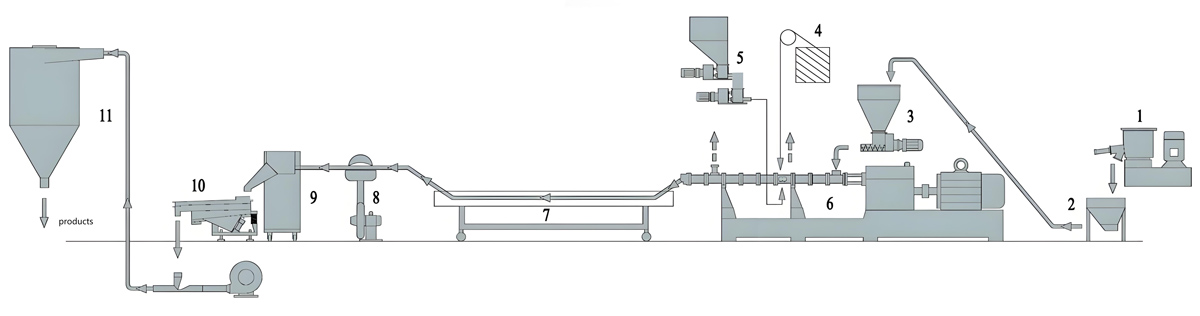
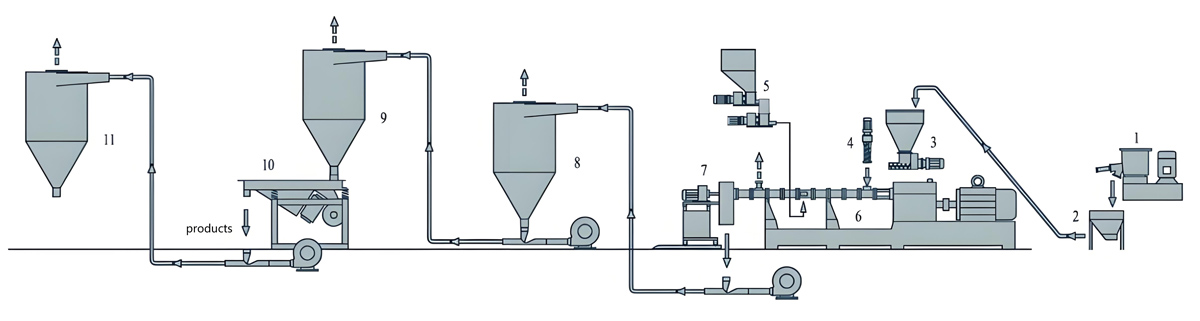
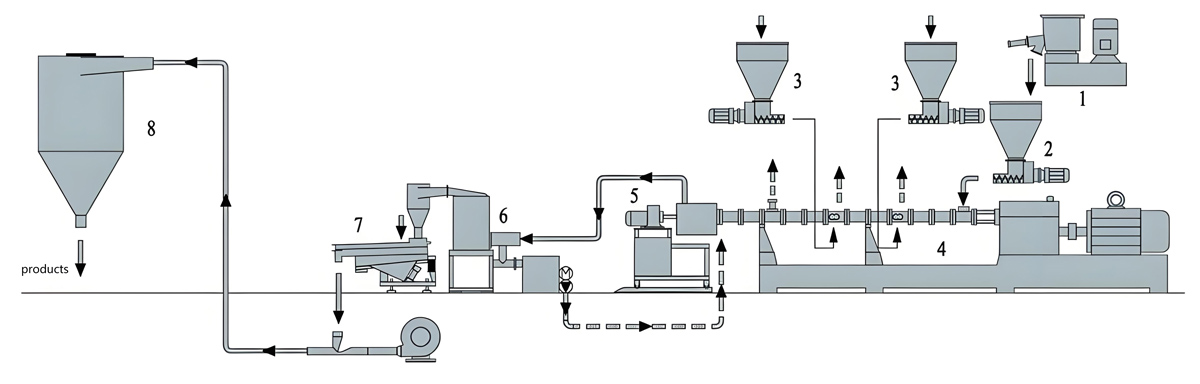
The twin screw extrusion process transforms raw materials into homogeneous masterbatch through controlled melting, mixing, and shaping operations. The processing sequence occurs through distinct functional zones within the extruder barrel.
The feeding zone introduces raw materials into the extruder at controlled rates. Loss-in-weight feeders provide accurate material addition rates essential for maintaining formulation accuracy. Multiple feed ports allow sequential addition of different material components, enabling optimization of incorporation sequences for different additive types.
Material compression and melting occur in the transition zone, where screw design creates the pressure development necessary for extrusion while ensuring complete polymer melting. The compression ratio, determined by screw element geometry, must be appropriate for the specific formulation and processing requirements.
Mixing zones employing kneading block elements create the shear forces necessary for pigment and additive dispersion. The number, type, and arrangement of mixing elements significantly influence dispersion quality and processing efficiency. Formulation characteristics, particularly pigment type and concentration, determine optimal mixing element configuration.
Devolatilization zones remove moisture, residual monomers, and other volatiles from the polymer melt. Vacuum devolatilization systems enhance volatile removal efficiency, particularly important for moisture-sensitive formulations or when processing materials with inherent volatility.
Die systems shape the melt into strands suitable for pelletization. Die plate design, including hole size, number, and arrangement, influences strand quality and cooling efficiency. Proper die maintenance ensures consistent strand diameter and prevents material leakage or degradation.
Pelletization and Packaging
Pelletization transforms extruded strands into the final masterbatch product form. Strand pelletization and underwater pelletization represent the two primary methods employed in masterbatch production.
Strand pelletization involves water cooling of extruded strands followed by rotating knife cutting. This method offers simplicity and lower equipment cost, though careful attention to cooling water temperature and flow rate is necessary to achieve consistent pellet quality.
Underwater pelletization provides superior pellet quality with more consistent size and shape, lower moisture content, and reduced thermal shock to heat-sensitive formulations. The die face is maintained at processing temperature while cut pellets are immediately conveyed away by circulating water. This method is increasingly preferred for construction pipe masterbatch production due to improved product quality and production efficiency.
Finished pellets undergo drying to remove residual moisture, screening to remove fines and contamination, and packaging in appropriate containers. Packaging materials should protect the masterbatch from moisture, contamination, and physical damage during storage and transport. Clear labeling with formulation information, batch identification, and handling instructions supports proper use by customers.
Production Equipment Introduction
Equipment selection fundamentally influences production capabilities, product quality, and operational economics. The Kerke KTE series provides a comprehensive range of twin screw extruders suitable for construction pipe masterbatch production across all volume scales.
KTE-65B Twin Screw Extruder
The KTE-65B with 62.4mm screw diameter and 200-450kg per hour output capacity represents an excellent choice for medium to large-scale construction pipe masterbatch production. This model balances processing capability with operational flexibility, supporting diverse formulation requirements.
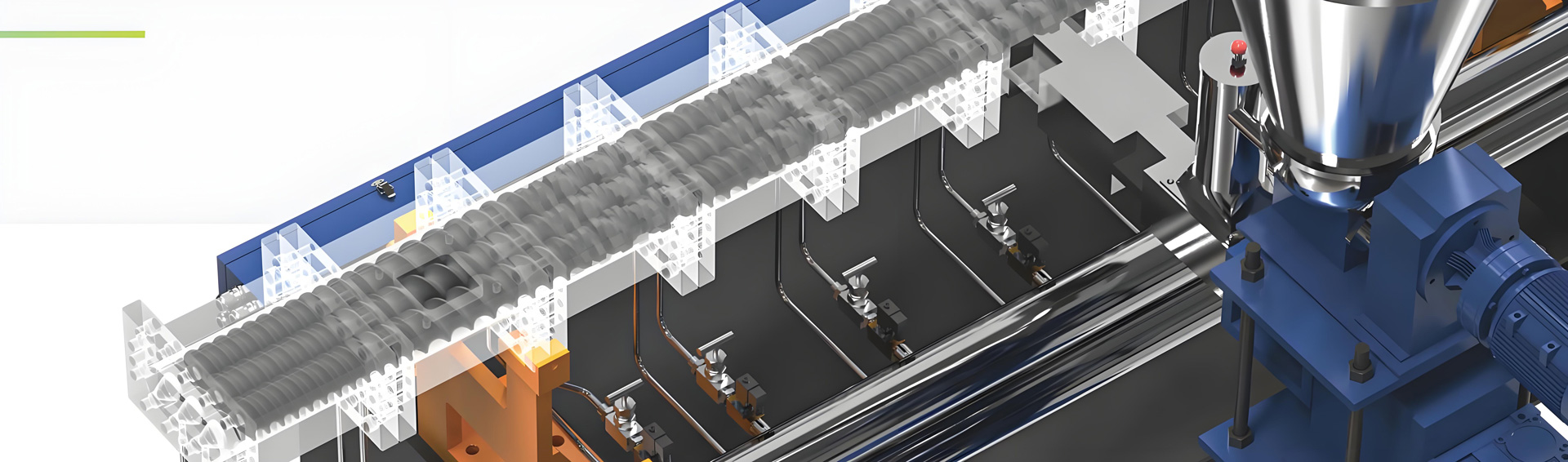
The co-rotating, intermeshing twin screw design creates the intense mixing action necessary for uniform pigment and additive dispersion. Screw elements can be configured to optimize processing for different formulation types, from carbon black concentrates requiring aggressive mixing to specialized additive masterbatches requiring gentler processing.
The modular barrel system allows processors to customize barrel configurations with specialized sections for devolatilization, feeding, or enhanced mixing as specific formulations require. This flexibility supports production of the diverse masterbatch types needed to serve the construction pipe market.
KTE-75B Twin Screw Extruder
For higher-volume production operations, the KTE-75B provides increased capacity with 71mm screw diameter and 300-800kg per hour output range. This model serves manufacturers with substantial production volumes seeking to optimize per-unit production costs.
The larger processing capacity enables more efficient production of standard formulations such as carbon black concentrates for PE pipe applications. The extended barrel length provides additional processing flexibility for complex formulations requiring multiple processing stages.
The KTE-75B benefits from Kerke’s engineering expertise, incorporating efficient drive systems, precise temperature control, and robust mechanical design for continuous production operation. Advanced control systems enable precise monitoring and adjustment of processing parameters throughout the production run.
KTE-95D Twin Screw Extruder
For large-scale production facilities requiring maximum output capacity, the KTE-95D offers exceptional performance with 93mm screw diameter and 1000-2000kg per hour production capability. This high-capacity model enables efficient production of commodity masterbatch products.
The KTE-95D provides the throughput necessary for competitive production of standard carbon black concentrates and other high-volume construction pipe masterbatch products. Processing efficiency at this scale provides favorable unit production costs for price-sensitive commodity applications.
Despite its high capacity, the KTE-95D maintains the processing flexibility necessary for diverse formulation requirements. Modular barrel configuration allows optimization for different product types, ensuring quality across the product range.
Support Equipment Systems
Complete construction pipe masterbatch production requires various support equipment beyond the primary extruder. Material handling systems encompass storage, conveying, drying, and metering equipment necessary for efficient raw material management.
Pelletization equipment selection depends on production volume and quality requirements. Underwater pelletization systems offer superior pellet quality and are recommended for construction pipe masterbatch production where consistent quality is essential. Strand pelletization may be appropriate for smaller operations or specific product types.
Quality control laboratory equipment enables verification of masterbatch characteristics including color, dispersion quality, melt flow properties, and additive performance. Spectrophotometers for color measurement, melt flow index testers, and other analytical instruments support comprehensive quality assurance programs.
Parameter Settings
Optimization of processing parameters requires understanding the relationships between equipment settings and product quality characteristics. The following guidelines provide a foundation for process optimization, with specific adjustments based on formulation and equipment configurations.
Temperature Profile Optimization
Barrel temperature profiles significantly influence melt viscosity, additive effectiveness, and processing stability. Temperature settings must balance melt flow requirements against thermal degradation risks for sensitive additives.
For PVC pipe masterbatch formulations, temperature profiles typically range from 160-180 degrees Celsius in the feeding zone to 180-200 degrees Celsius in the processing zones, with die temperatures of 190-210 degrees Celsius. Lower temperatures in the initial zones prevent premature fusion and ensure appropriate material transport before melting.
PE pipe masterbatch processing typically employs temperatures from 180-200 degrees Celsius in the feeding zone, 200-230 degrees Celsius in the mixing zones, and 210-240 degrees Celsius at the die. These higher temperatures ensure adequate melt flow for effective mixing while remaining within acceptable degradation limits for most additives.
PP pipe masterbatch requires elevated temperatures due to polypropylene’s higher melt temperature requirements. Typical profiles range from 200-220 degrees Celsius in the feeding zone, 220-250 degrees Celsius in the processing zones, and 230-260 degrees Celsius at the die.
Screw Speed and Throughput Parameters
Screw speed influences shear stress, residence time, and throughput capacity. Optimal screw speed depends on formulation characteristics, equipment size, and quality requirements.
For construction pipe masterbatch production, screw speeds typically range from 200-400 rpm for smaller equipment and 150-300 rpm for larger machines. Higher speeds increase throughput but also increase shear heating and stress on formulation components.
Throughput rates should be established based on equipment capacity, formulation density, and quality requirements. Operating at 70-85% of maximum rated throughput typically provides optimal balance between production efficiency and product quality.
Feeding System Parameters
Accurate feeding is essential for maintaining formulation accuracy throughout production runs. Loss-in-weight feeders should be calibrated regularly and verified against formulation requirements.
Main resin feeder settings determine base throughput rates. Additive feeders must be synchronized with main resin feed rates to maintain consistent additive concentrations. The ratio between additive feeder rate and main resin feeder rate should be verified at run start and monitored throughout production.
Equipment Price
Investment planning for construction pipe masterbatch production requires comprehensive understanding of equipment costs across various capacity levels and configurations.
KTE-65B Investment Overview
The KTE-65B twin screw extruder, with 62.4mm screw diameter and 200-450kg per hour capacity, is priced between $50,000 and $80,000. This investment range reflects variations in control system specifications, included accessories, and customization options.
Complete production line investment for KTE-65B-based systems typically ranges from $100,000 to $150,000, including material handling equipment, pelletization systems, and quality control instrumentation. The specific configuration depends on automation level and quality requirements.
KTE-75B Investment Overview
The KTE-75B, offering 71mm screw diameter and 300-800kg per hour output, is priced from $70,000 to $100,000. This higher-capacity model provides improved production economics for operations with substantial volume requirements.
Complete production facilities based on KTE-75B equipment typically require total investment ranging from $130,000 to $200,000. The per-unit production cost advantage of this larger equipment can provide attractive return on investment for high-volume operations.
KTE-95D Investment Overview
For maximum production capacity, the KTE-95D with 93mm screw diameter and 1000-2000kg per hour output is priced from $120,000 to $200,000. This high-capacity equipment enables efficient production at the largest volume scales.
Complete production lines based on KTE-95D equipment typically require investment ranging from $200,000 to $350,000 depending on support equipment selection and facility requirements. Despite the substantial investment, the production economics for high-volume commodity masterbatch can provide favorable return on investment timelines.
Return on Investment Considerations
Equipment investment decisions should consider not only initial cost but also production economics, quality capabilities, and market positioning. Higher-capacity equipment offers per-unit cost advantages but requires corresponding market demand to achieve favorable utilization rates.
Analysis of production costs, market pricing, and expected capacity utilization helps identify optimal equipment sizing for specific business situations. A comprehensive business plan should project revenue, costs, and profitability across different equipment scenarios to support informed investment decisions.
Problems in Production Process and Solutions
Construction pipe masterbatch production presents specific challenges requiring systematic understanding and effective management approaches. The following guidance addresses common problems, root causes, and practical solutions.
Carbon Black Dispersion Quality Issues
Poor carbon black dispersion in PE pipe masterbatch results in color streaking, inconsistent pipe appearance, and inadequate UV protection in finished pipes. Carbon black agglomerates can create stress concentration points that reduce pipe mechanical properties.
Solutions for dispersion problems focus on increasing mixing energy in the extrusion process. Adding additional kneading block elements to the mixing sections increases shear stress and residence time for dispersion. Reducing throughput while maintaining screw speed increases material fill level and mixing intensity. Using carbon black pellets or pre-dispersed concentrates rather than fluffy carbon black powder improves incorporation and dispersion quality.
Preventive measures include establishing standard screw configurations for carbon black masterbatch formulations and verifying configuration compliance before production runs. Regular inspection of kneading block elements identifies wear that reduces mixing efficiency. Implementing dispersion quality testing using filter pressure rise or microscopy examination provides early detection of developing problems.
PVC Thermal Stability Problems
PVC processing presents inherent thermal stability challenges due to the material’s sensitivity to elevated temperatures and shear stress. Insufficient thermal stabilization manifests as discoloration, surface defects, and reduced mechanical properties in masterbatch and finished pipes.
Corrective actions for thermal stability problems include reducing processing temperatures throughout the barrel profile, increasing stabilizer concentration in the formulation, and reducing screw speed to minimize shear heating. If problems persist, formulation reformulation with more effective stabilizer systems may be necessary.
Prevention of PVC thermal stability problems requires careful formulation design with adequate stabilizer levels for the specific processing conditions. Temperature monitoring throughout the barrel enables early detection of temperature excursions. Regular maintenance of equipment to ensure proper functioning of heating and cooling systems supports consistent thermal management.
Color Consistency Variations
Batch-to-batch color variation creates customer complaints and potential specification compliance issues. Color inconsistencies can result from weighing errors, feeder variations, raw material changes, or equipment-related factors.
Systematic investigation identifies the specific cause of color variation. Verify weighing procedures and feeder calibration against reference standards. Review raw material specifications and consider implementing tighter incoming quality controls. Examine feeder performance and adjust settings for optimal consistency.
Preventive measures include implementing statistical process control for color measurements, establishing clear procedures for formulation preparation, and maintaining detailed production records. Working with standardized raw material suppliers and specifications helps minimize input material variability that can affect color consistency.
Pellet Quality Problems
Pellet quality issues including irregular shape, excessive fines, high moisture content, or contamination compromise customer satisfaction and may cause processing problems in pipe extrusion.
Solutions depend on the specific pellet quality problem. Irregular pellet shape can indicate worn pelletizer knives or improper blade adjustment. Excessive fines may result from improper cooling or handling. High moisture content requires extended drying or pelletizer adjustment. Contamination requires investigation of raw material handling and equipment cleaning procedures.
Preventive approaches include establishing regular pelletizer maintenance schedules, implementing screening procedures to remove fines and contamination, and proper drying procedures with verification of moisture content before packaging. Careful attention to material handling throughout production prevents contamination introduction.
Maintenance
Comprehensive maintenance programs are essential for consistent product quality, reliable equipment operation, and maximum equipment service life. Maintenance activities should be organized by frequency and complexity.
Daily Maintenance Operations
Daily maintenance begins with visual inspection of equipment condition and verification of proper function. Check feeding systems for proper material flow and correct calibration. Monitor processing parameters throughout production runs, noting any unexplained variations that might indicate developing problems.
Inspect pelletization equipment including knife sharpness and alignment. Verify cooling systems are functioning properly with appropriate temperature and flow rates. At shift end, clean die plates and remove accumulated material from feed zones.
Record production data, quality measurements, and any observations for trend analysis. This documentation supports continuous improvement and helps identify patterns indicating maintenance needs.
Weekly and Periodic Maintenance
Weekly maintenance encompasses more detailed inspection and verification activities. Examine screw elements for wear, particularly kneading blocks and transfer elements. Check temperature controller accuracy against calibrated reference instruments. Inspect vacuum systems and verify proper function.
Monthly activities include lubrication of bearing points per manufacturer specifications, inspection of drive system components, and verification of electrical connections. Complete color quality verification using standard samples provides confidence in ongoing product consistency.
Quarterly reviews should assess overall equipment condition and identify components approaching replacement criteria. Review production and quality data to identify any trends suggesting equipment issues.
Annual and Major Maintenance
Annual maintenance typically involves comprehensive equipment inspection during planned production downtime. This is the appropriate time for detailed examination of screw elements, barrel liners, and other wear components. Replace components that have reached end-of-service life even if functional, to prevent unexpected failures.
Complete calibration of all measurement and control systems against traceable standards. Review and update standard operating procedures based on operational experience. Document all maintenance activities for future reference and planning purposes.
Consider engaging equipment manufacturer service personnel for comprehensive inspection and any specialized maintenance procedures. This investment supports optimal equipment performance and can identify potential issues before they cause production problems.
FAQ
What equipment is recommended for construction pipe masterbatch production at medium production volumes?
The Kerke KTE-65B with 62.4mm screw diameter and 200-450kg per hour output capacity represents an excellent choice for medium-scale production. This model balances processing capability with flexibility for diverse formulation requirements while maintaining favorable capital investment requirements.
What is the typical carbon black concentration in PE pipe masterbatch?
PE pipe masterbatch for black outdoor applications typically contains 2-3% carbon black. This concentration provides effective UV protection while maintaining cost efficiency. Lower concentrations may be used for interior applications with limited UV exposure requirements.
How do we prevent color variation between production batches?
Preventing color variation requires rigorous control of formulation preparation, equipment calibration, and raw material quality. Implement statistical process control for color measurements, maintain detailed production records, and work with consistent raw material suppliers. Regular calibration of feeders and weighing systems ensures formulation accuracy.
What maintenance is required for twin screw extruders in masterbatch production?
Maintenance includes daily inspection of feeders, pelletizers, and processing parameters; weekly examination of screw elements and temperature controllers; monthly lubrication and drive system inspection; and annual comprehensive overhaul with wear component replacement. Specific maintenance schedules should follow manufacturer recommendations and operational experience.
What is the typical production cost for construction pipe masterbatch?
Production costs vary significantly based on formulation, equipment utilization, and operational efficiency. Major cost components include raw materials representing 70-85% of total cost, followed by labor, energy, equipment depreciation, and overhead. Optimizing equipment utilization and production efficiency provides the most effective cost reduction opportunities.
Conclusion
Construction pipe grade masterbatch manufacturing represents a sophisticated production process requiring careful attention to formulation design, equipment selection, process optimization, and quality management. The diverse requirements of construction pipe applications, from PVC drainage systems to PE pressure pipes to PP plumbing systems, demand flexible manufacturing capabilities and comprehensive technical expertise.
Twin screw extruders have established themselves as the preferred equipment for construction pipe masterbatch production, offering the mixing efficiency, temperature control, and processing flexibility necessary for this demanding application. The Kerke KTE series provides a comprehensive range of equipment options to meet production requirements across all volume scales, from compact production systems to high-capacity industrial facilities.
Successful construction pipe masterbatch production requires understanding the specific requirements of different pipe materials and applications. Each polymer type and application presents unique formulation and processing challenges that must be addressed through appropriate technical approaches and operational practices.
Investment in appropriate production equipment, combined with rigorous quality control systems and comprehensive maintenance programs, enables manufacturers to produce construction pipe masterbatch products meeting the demanding requirements of the construction industry. As global infrastructure development continues and plastic piping systems gain increased market share, the demand for high-quality construction pipe masterbatch will continue to grow.
The information presented in this guide provides a foundation for excellence in construction pipe masterbatch manufacturing. Continued operational experience, ongoing optimization efforts, and commitment to quality will further enhance production capabilities and market success in this important industrial sector.