Building material grade plastic masterbatch serves the demanding construction industry, where products must withstand harsh environmental conditions, provide long-term durability, and meet rigorous performance standards. The production of masterbatch for building material applications requires specialized formulations, robust processing equipment, and stringent quality control measures. Twin screw extruders have established themselves as the preferred technology for manufacturing high-performance building material grade masterbatch, offering the versatility, consistency, and efficiency that construction applications demand. This comprehensive guide examines the technical considerations, formulation strategies, production processes, and equipment requirements essential for successful building material masterbatch production.
Introduction to Building Material Grade Plastic Masterbatch
The building materials industry represents one of the largest end markets for plastic compounds and masterbatch products, encompassing applications ranging from pipes and fittings to window profiles, decking materials, and roofing components. These applications share demanding requirements for weather resistance, structural integrity, color stability, and long-term durability that significantly exceed consumer goods specifications. Building material grade masterbatch must deliver consistent performance across extended service lifetimes measured in decades rather than years.
Construction applications subject plastic materials to extreme environmental conditions, including sustained UV radiation exposure, temperature cycling, moisture contact, and chemical exposure from cleaning agents or environmental factors. The masterbatch formulations used in these applications must provide appropriate UV stabilization, impact modification, and color retention properties while maintaining compatibility with the base polymer matrix. Processing requirements often include extrusion through large cross-section dies, thermoforming, or injection molding of thick-walled components where uniform color distribution presents unique challenges.
Twin screw extrusion technology addresses these demanding requirements through superior mixing capabilities, precise temperature control, and consistent output characteristics. The equipment selection and process optimization for building material masterbatch production must balance quality requirements with production efficiency, ensuring that formulations deliver the performance characteristics essential for construction applications while remaining economically viable for competitive markets.
Formulation Ratio for Building Material Grade Masterbatch
Building material grade masterbatch formulations require careful optimization of multiple components to achieve the performance characteristics essential for construction applications. Each application category presents specific requirements that drive formulation development.
Pipe and Fitting Grade Masterbatch Formulation
Pipe and fitting applications demand masterbatch formulations that maintain color consistency through extrusion processes while providing properties suitable for pressure-rated water and gas distribution systems. Base resin selection typically focuses on PVC compounds for gravity flow applications or polyethylene/polypropylene for pressure piping systems, with each requiring specific masterbatch considerations.
For PVC pipe applications, masterbatch formulations incorporate thermal stabilizers as critical components, including calcium-zinc, lead-based, or organic tin stabilizer systems at loadings of 2% to 5% depending on processing conditions and regulatory requirements. Impact modifiers, including acrylic impact modifiers or chlorinated polyethylene, are incorporated at 3% to 8% to enhance toughness and prevent brittle failure. Pigment loadings typically range from 2% to 10% for colored pipe applications, with titanium dioxide used at 1% to 4% for white pipe formulations where light reflection and color retention are priorities.
Polyolefin pipe masterbatch formulations require different additive packages, including carbon black at 2% to 3% for UV protection, antioxidant systems at 0.2% to 0.5%, and pigment loadings adjusted according to color requirements. Processing aids, including fluoropolymers for polyethylene or acrylic processing aids for polypropylene, improve melt strength and extrusion stability at loadings of 0.5% to 2%.
Window Profile and Extruded Shape Grade Formulation
Window profile and architectural extrusion applications require masterbatch formulations optimized for co-extrusion processes and extended UV exposure resistance. These applications demand exceptional color retention and surface quality maintenance over service lifetimes exceeding 20 years in some climate zones.
Base resins for window profile applications predominantly involve PVC compounds requiring comprehensive additive packages. Weathering stabilizer systems, including titanium dioxide at 4% to 10% for white profiles and specialized UV absorber packages for colored profiles, protect against UV degradation. Impact modifiers at 5% to 10% ensure adequate toughness for the physical demands of installed fenestration products. Calcium carbonate fillers may be incorporated at 5% to 25% for cost reduction and property modification, requiring masterbatch formulations that ensure compatibility and dispersion quality.
Color masterbatch for window profiles typically operates at pigment loadings of 15% to 40%, with organic pigments selected for light fastness ratings of 7 to 8 on the blue wool scale. The formulation must ensure uniform pigment distribution to prevent chalking and surface degradation that compromises appearance over extended exposure periods.
Decking and Fencing Material Grade Formulation
Decking and fencing materials present unique challenges combining structural performance requirements with demanding aesthetic standards for outdoor exposure applications. These wood-plastic composite and solid plastic materials require masterbatch formulations that provide long-term color stability and surface property maintenance.
Wood-plastic composite decking formulations combine wood flour or fiber with plastic polymers, requiring masterbatch that disperses uniformly in the mixed matrix. Pigment loadings typically range from 1% to 5% for natural wood-tone colors, with higher concentrations (3% to 8%) for more vibrant deck colors. UV absorber packages and hindered amine light stabilizers are essential components at total loadings of 0.5% to 2% to prevent color fading and material degradation.
Solid plastic decking formulations, typically based on polyethylene or polypropylene, require similar weathering protection systems with possible enhanced impact modification for walking surface applications. Slip resistance additives, including specialty waxes or inorganic texturing agents, may be incorporated at 1% to 3% for safety considerations in wet conditions.
Production Process for Building Material Grade Masterbatch
The production of building material grade masterbatch follows established compounding principles while incorporating specific considerations for the demanding performance requirements of construction applications. Understanding these process requirements enables consistent quality production.
Raw Material Selection and Handling
Raw material selection for building material masterbatch prioritizes consistency and performance over cost optimization. Base resin specifications must include tight molecular weight distribution requirements, appropriate melt flow characteristics, and documented quality consistency across production lots. For PVC applications, resin selection encompasses suspension, mass, or microsuspension grades with specific particle size distributions suited to the target application.
Additive selection follows similar rigorous criteria. Thermal stabilizers must demonstrate consistent performance across extended processing periods without plate-out or discoloration. Impact modifiers require documented effectiveness data demonstrating achievement of specified impact strength targets. Pigment selection emphasizes light fastness, heat stability, and chemical resistance properties aligned with the demanding requirements of construction applications. Supplier qualification and incoming quality verification programs ensure material consistency essential for building material applications.
Material handling procedures address the physical characteristics of building material masterbatch components. Dusty additives, including calcium carbonate, stabilizers, and pigment powders, require closed handling systems that prevent operator exposure while maintaining cleanliness standards. Proper drying procedures for hygroscopic materials, including many engineering resins and certain additive systems, ensure moisture removal before processing.
Twin Screw Compounding Process
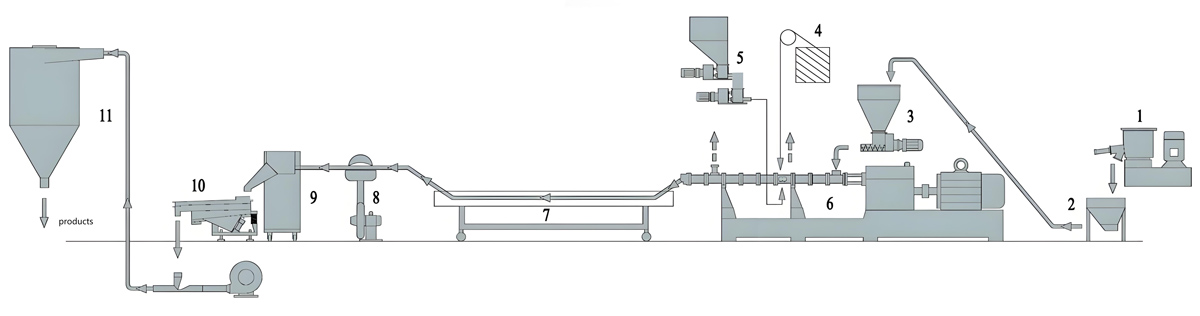
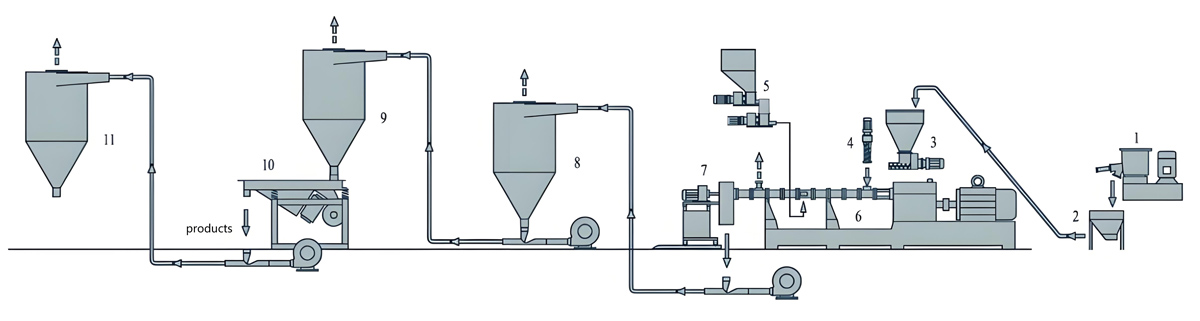
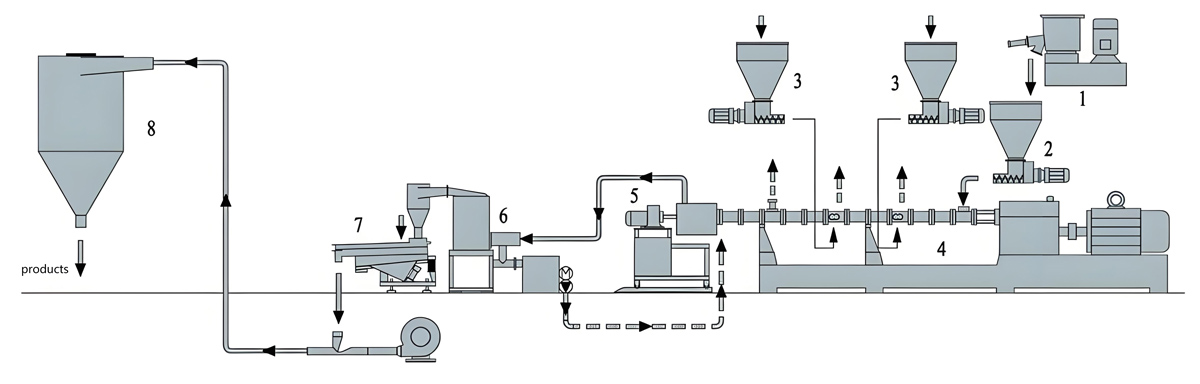
The twin screw compounding process transforms raw materials into finished masterbatch through controlled melting, mixing, and homogenization. Material introduction strategies vary according to formulation complexity, with single-point feeding suitable for simple concentrate formulations and multi-stage feeding required for complex additive packages.
Screw configuration design addresses the specific requirements of building material masterbatch formulations. For PVC applications, screw configurations emphasize gentle melting and mixing to prevent thermal degradation while achieving uniform additive distribution. Typical configurations employ moderate screw speeds (20 to 60 RPM for large extruders) and carefully controlled temperature profiles to prevent localized overheating.
Polyolefin-based building material masterbatch employs higher screw speeds (200 to 500 RPM for production-scale equipment) with mixing sections incorporating kneading blocks and distributive mixing elements. The formulation complexity, including multiple additive types with varying physical characteristics, requires screw configurations that ensure complete incorporation and uniform distribution of all components throughout the polymer matrix.
Strand Cooling and Pelletizing Operations
Strand cooling for building material masterbatch must achieve uniform temperature reduction across the extruded strands while accommodating potentially higher output rates from production-scale equipment. Water cooling systems with controlled temperature regulation maintain consistent cooling rates throughout production runs.
Extended cooling capacity is often required for building material masterbatch due to higher output rates and potentially more thermally resistant formulations. Cooling trough length and water flow rates should accommodate maximum production throughput without strand deformation or surface skin formation. Multiple cooling zones may be employed for high-capacity production lines to ensure complete solidification before pelletizing.
Pelletizing operations for building material masterbatch align with standard strand pelletizing procedures, with knife clearance and cutting speed optimized for the specific strand dimensions and polymer characteristics. The higher output rates characteristic of production-scale building material masterbatch require robust granulation equipment capable of continuous operation at demanding throughput levels.
Quality Assurance and Testing
Quality assurance for building material masterbatch encompasses comprehensive testing that verifies performance characteristics essential for construction applications. Testing protocols extend beyond standard color and dispersion measurements to include application-specific performance verification.
Thermal stability testing evaluates masterbatch performance under processing conditions, measuring discoloration, torque requirements, and volatile emissions during simulated processing. Impact testing of compounded specimens verifies that masterbatch additives achieve target impact modification without adverse effects on other properties. Weathering testing, including UV chamber exposure and natural outdoor aging studies, provides data on long-term color retention and property maintenance.
Application testing in actual or simulated end-use conditions provides the most relevant quality verification for building material applications. Extrusion trials, injection molding tests, and full-scale production runs enable evaluation of masterbatch performance under actual manufacturing conditions, identifying any processing issues before committing to production use.
Production Equipment Introduction
Equipment selection for building material grade masterbatch production must address the demanding throughput requirements and quality standards essential for construction applications. The twin screw extruder serves as the core processing unit, with supporting systems completing the production capability.
Kerke KTE Series Selection for Building Material Applications
The Kerke KTE series provides equipment options that address the full range of building material masterbatch production requirements, from specialty formulations to high-volume commodity products. Equipment selection criteria include throughput requirements, formulation complexity, quality specifications, and production flexibility needs.
The KTE-50B model, featuring 50.5mm screw diameter and 80 to 200 kg/h throughput capability, serves small to medium-scale building material masterbatch production. This model provides sufficient capacity for specialty construction applications, including custom color concentrates and technical masterbatch products with demanding performance specifications.
The KTE-65B, with 62.4mm screw diameter and 200 to 450 kg/h throughput, addresses medium-scale production requirements common in regional building material masterbatch operations. The capacity range accommodates meaningful production volumes while maintaining the flexibility needed for multi-product operations serving diverse construction market segments.
The KTE-75B, featuring 71mm screw diameter and 300 to 800 kg/h throughput capability, provides higher capacity for established production operations. This model suits dedicated production facilities serving consistent demand for standard building material masterbatch products, including commodity color concentrates and established specialty formulations.
The KTE-95D, the largest model with 93mm screw diameter and 1000 to 2000 kg/h throughput, addresses high-volume production requirements for major market demands. This capacity level supports large-scale masterbatch production operations serving regional or national building material markets with consistent product demand.
Supporting Production Systems
Supporting equipment for building material masterbatch production includes material handling systems, quality control instrumentation, and downstream processing equipment. The scale of production typically requires more substantial material handling infrastructure compared to specialty masterbatch operations.
Material storage and handling systems for production-scale operations include bulk resin storage silos, loss-in-weight feeding systems, and pneumatic conveying equipment for continuous material supply. These systems reduce manual handling requirements, improve consistency, and increase production efficiency for high-volume operations.
Quality control instrumentation includes color measurement spectrophotometers, dispersion evaluation equipment, and mechanical testing systems. Production-scale quality assurance programs typically incorporate continuous monitoring systems that provide real-time quality data during production operations, enabling immediate corrective action when deviations occur.
Parameter Settings for Building Material Masterbatch
Optimal parameter settings for building material masterbatch production reflect the specific requirements of construction applications, including formulation complexity, processing characteristics, and quality standards. Systematic optimization ensures consistent production results.
Screw Configuration Optimization
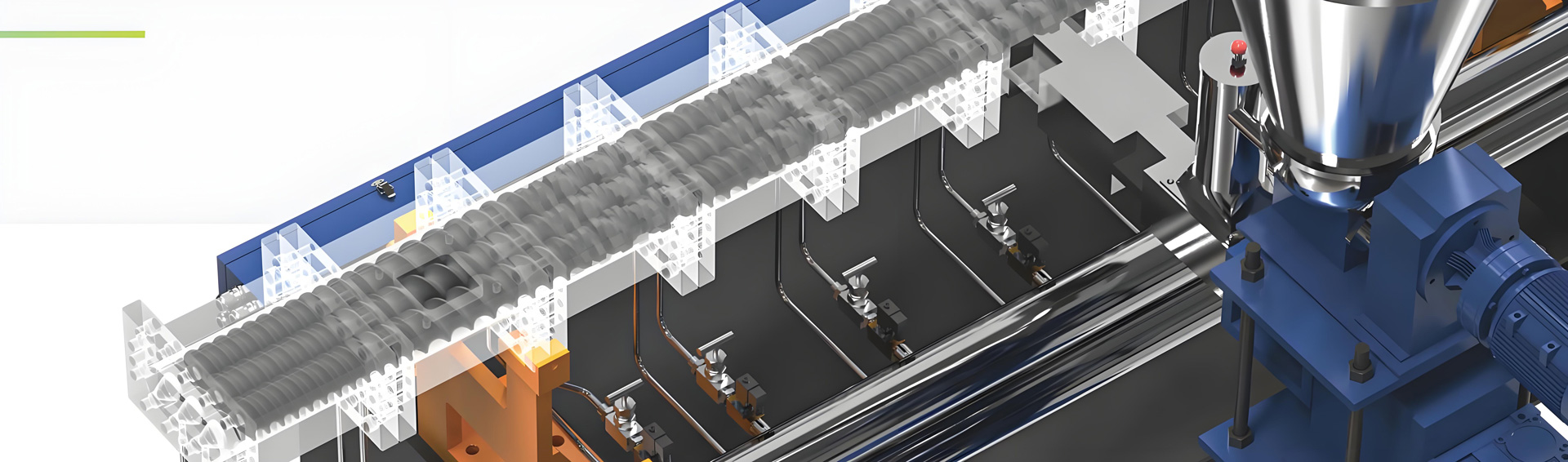
Screw configuration design for building material masterbatch addresses the specific mixing requirements of complex additive packages. Configurations for PVC applications emphasize controlled melting and gentle mixing to prevent thermal degradation, employing screw designs with lower shear characteristics and extended melting zones.
Typical PVC masterbatch screw configurations incorporate feed section depths of 8 to 10 flight depths, compression ratios of 2:1 to 2.5:1, and moderate length-to-diameter ratios of 24:1 to 30:1. Mixing sections employ combination elements and kneading blocks positioned to achieve additive distribution without excessive shear heating. Pumping sections with gradual depth reductions maintain output consistency without excessive pressure development.
Polyolefin building material masterbatch employs higher shear configurations with L/D ratios of 40:1 to 52:1, deeper mixing sections, and higher kneading block density. The complex additive packages characteristic of building material formulations require enhanced mixing intensity to achieve uniform distribution throughout the polymer matrix.
Temperature Profile Development
Temperature profile development for building material masterbatch balances melt viscosity requirements, thermal stability limits, and additive performance considerations. Each formulation requires optimization based on the specific components and their thermal characteristics.
PVC applications typically employ lower processing temperatures, ranging from 160 to 200 degrees Celsius depending on the stabilizer system and formulation specifics. The heat sensitivity of PVC requires careful temperature control to prevent thermal degradation, with barrel temperatures often controlled to maintain melt temperatures below 200 degrees Celsius during processing.
Polyolefin-based building material masterbatch typically processes at higher temperatures, ranging from 200 to 280 degrees Celsius depending on the base resin and additive package. Higher temperatures reduce melt viscosity, improving mixing efficiency and reducing energy requirements, but may affect heat-sensitive additive components. Temperature optimization requires balancing these factors for each specific formulation.
Throughput and Speed Optimization
Throughput optimization for building material masterbatch balances production efficiency with mixing quality requirements. Higher throughput rates increase production efficiency but may compromise mixing quality if residence time becomes insufficient for complete additive distribution.
Typical operating throughputs for building material masterbatch range from 60% to 85% of maximum extruder capacity, varying with formulation complexity and quality requirements. Complex additive packages require reduced throughput to ensure complete incorporation, while simpler formulations may achieve higher rates without quality compromise.
Screw speed optimization similarly balances mixing intensity against residence time requirements. Higher screw speeds increase shear rates and mixing intensity but reduce residence time and increase mechanical energy input. Operating speed selection considers formulation characteristics, with typical production-scale operations running at 60% to 80% of maximum rated speed.
Equipment Price Guide
Equipment investment for building material masterbatch production varies according to capacity requirements, configuration complexity, and automation levels. Understanding the cost structure supports informed equipment selection decisions.
The KTE-36B, priced from $25,000 to $35,000, provides pilot-scale and small-scale production capability suitable for development operations, specialty product lines, or emerging market entry. This capacity level addresses specialty building material masterbatch applications with lower volume requirements or complex formulations requiring frequent product changes.
The KTE-50B, priced from $40,000 to $60,000, delivers intermediate capacity for small to medium-scale building material masterbatch production. The throughput range of 80 to 200 kg/h accommodates regional market service with meaningful production volumes while maintaining flexibility for diverse product requirements.
The KTE-65B, priced from $50,000 to $80,000, addresses medium-scale production requirements with throughput of 200 to 450 kg/h. This capacity level suits established regional operations serving consistent demand for building material masterbatch products.
The KTE-75B, priced from $70,000 to $100,000, provides higher capacity for larger-scale operations with throughput capability of 300 to 800 kg/h. This model suits dedicated production facilities with consistent product demand and efficiency requirements that justify higher capacity equipment.
The KTE-95D, priced from $120,000 to $200,000, represents the highest capacity option with 1000 to 2000 kg/h throughput capability. This equipment investment supports high-volume production operations serving major regional or national markets with consistent demand for building material masterbatch products.
Problems in Production Process and Solutions
Building material masterbatch production presents specific challenges that require systematic understanding and effective resolution strategies. Addressing these issues ensures consistent quality and reliable production performance.
Thermal Degradation and Discoloration
Thermal degradation in building material masterbatch manifests as discoloration, char formation, or property loss in finished products. This issue particularly affects PVC formulations where thermal stability represents a critical performance characteristic. Causes include excessive processing temperatures, extended residence times, or inadequate stabilizer systems.
Resolution begins with comprehensive thermal stability testing to characterize formulation limits and identify safe processing boundaries. Temperature profile optimization, including reduced barrel temperatures and optimized screw speeds, often provides immediate improvement. Formulation adjustments may include enhanced stabilizer packages, reduced friction screw elements, or modified processing aids to improve thermal stability margins.
Prevention strategies emphasize proactive formulation development that establishes validated processing windows for each product. Regular equipment maintenance, including screw and barrel inspection for wear that increases friction and heat generation, prevents degradation issues from equipment condition changes. Continuous monitoring of processing parameters, including melt temperature and motor load, enables early detection of conditions that may lead to thermal degradation.
Inadequate UV Stabilization Performance
Failure of UV stabilization systems in building material masterbatch results in premature color fading, surface chalking, and property degradation during outdoor exposure. This issue compromises the long-term performance essential for construction applications, potentially leading to field failures and customer complaints.
Troubleshooting UV stabilization performance requires comprehensive weathering testing to characterize actual exposure performance. Laboratory accelerated weathering, including xenon arc or UV fluorescent exposure, correlates with natural aging performance. Root cause investigation may identify insufficient stabilizer loading, incompatible stabilizer chemistry, or improper additive dispersion.
Solutions include reformulation with enhanced UV protection packages, including increased UV absorber or HALS loadings, or switching to more effective stabilizer chemistries. Improved dispersion through screw configuration modifications or processing adjustments ensures uniform stabilizer distribution throughout the compound.
Prevention requires robust weathering qualification testing during product development, with performance requirements validated against target application exposure conditions. Supplier technical support for stabilizer selection, combined with systematic formulation optimization, ensures adequate UV protection for each specific building material application.
Impact Modification Deficiency
Inadequate impact modification in building material masterbatch results in compounds that fail impact testing requirements or demonstrate premature brittle failure in end-use applications. This issue may arise from improper impact modifier selection, insufficient loading levels, or dispersion problems that prevent effective stress transfer.
Diagnostic testing includes instrumented impact testing, which characterizes energy absorption and failure mode, alongside morphological analysis using microscopy techniques that reveal impact modifier dispersion quality and particle size distribution. Root causes may include impact modifier quality variation, incompatible modifier-polymer combinations, or processing conditions that damage impact modifier particles.
Solutions involve reformulation to adjust impact modifier type or loading, process optimization to improve dispersion without particle damage, or fundamental reformulation if compatibility issues are identified. Working with impact modifier suppliers during product development ensures optimal modifier selection for each application.
Dispersion and Distribution Inconsistencies
Inconsistent dispersion of additives in building material masterbatch manifests as property variations within production lots, color streaking in extruded products, or performance differences between batches. This issue particularly affects complex formulations with multiple additive types or high filler loadings.
Solutions focus on mixing optimization through screw configuration evaluation and modification. Additional mixing elements, adjusted kneading block positioning, or modified element sequences often resolve dispersion problems. Process parameter optimization, including throughput and screw speed adjustments, ensures adequate mixing intensity and residence time.
Prevention requires systematic qualification of production processes for each formulation, establishing validated parameters and configurations that achieve consistent quality. Regular equipment maintenance, including screw wear inspection and correction, maintains mixing performance over extended production periods.
Maintenance Requirements
Maintenance practices for building material masterbatch production equipment ensure consistent quality and reliable operation essential for construction market service. Scheduled maintenance programs prevent unplanned downtime and maintain production efficiency.
Daily Operational Maintenance
Daily maintenance activities for building material masterbatch production include visual inspection of equipment condition, monitoring of operating parameters, and routine cleaning operations. Shift change inspections verify equipment condition and identify any issues requiring attention before they escalate.
Material feeding systems require daily verification including hopper levels, feeder calibration status, and material flow characteristics. Any changes in feeding behavior may indicate material quality issues or equipment problems requiring investigation. Cooling system verification ensures adequate water flow, appropriate temperature settings, and clean heat exchange surfaces.
Granulator maintenance during daily operations includes knife edge inspection, screen condition verification, and debris removal. Building material masterbatch, particularly formulations with mineral fillers or high pigment loadings, accelerates knife wear compared to standard compounds. Daily inspection and timely knife replacement maintain pellet quality and prevent equipment damage.
Periodic Maintenance Procedures
Periodic maintenance encompasses comprehensive equipment inspection and service at intervals ranging from weekly to quarterly depending on production volume and equipment criticality. These maintenance activities address components that do not require daily attention but significantly impact equipment performance and product quality.
Screw and barrel inspection at monthly intervals evaluates wear patterns and condition, identifying components approaching replacement thresholds. Documentation of wear progression enables predictive maintenance scheduling and prevents quality degradation from worn equipment. Particular attention to mixing section condition is essential for building material masterbatch formulations with complex additive packages.
Temperature controller calibration verification at quarterly intervals ensures continued accuracy of temperature control systems. Calibration drift affects processing consistency and may cause quality variations that are difficult to diagnose without reference to documented calibration status. Regular calibration verification provides confidence in temperature control accuracy.
Gearbox and drive system service, including oil analysis and condition assessment, supports maintenance planning for critical power transmission components. Vibration analysis and temperature monitoring provide additional indicators of drive system condition for scheduled maintenance planning.
Annual and Major Maintenance
Annual maintenance encompasses comprehensive equipment evaluation and service that prepares equipment for continued reliable operation. This includes complete disassembly and inspection of extrusion systems, worn component replacement, and comprehensive system calibration.
Screw element replacement for worn components addresses mixing efficiency degradation that affects product quality. Rebuild specifications should establish minimum acceptable dimensions and wear limits that trigger replacement. Spare screw inventory ensures minimal downtime when replacement becomes necessary.
Control system updates and upgrades maintain equipment capability and address obsolescence issues that may affect production continuity. Annual maintenance provides opportunity for system improvements that enhance production capability or quality performance.
Frequently Asked Questions
What stabilizer systems are suitable for PVC building material masterbatch?
Several stabilizer systems suit PVC building material applications, including calcium-zinc systems for non-toxic applications, lead-based systems for maximum heat stability, and organic tin systems offering balanced performance. Selection depends on application requirements, processing conditions, and regulatory considerations specific to the target market.
How does filler loading affect building material masterbatch performance?
Calcium carbonate and other mineral fillers reduce formulation cost while modifying mechanical properties and processing characteristics. Loadings from 5% to 40% are common in building material applications, with higher loadings requiring enhanced dispersion capability and modified processing parameters to achieve acceptable quality.
What UV protection is required for outdoor building material applications?
Outdoor building material applications typically require carbon black at 2% to 3% for polyethylene, titanium dioxide at 4% to 10% for white products, or specialized UV absorber/HALS packages for colored products. Specific requirements depend on polymer type, exposure conditions, and required service lifetime.
How do I optimize screw configuration for complex additive packages?
Optimization begins with formulation analysis identifying additive types, loadings, and incorporation requirements. Screw configuration typically adds mixing elements, extends mixing sections, or adjusts element sequences to ensure complete incorporation and uniform distribution of all additives. Trial extrusion with systematic configuration changes identifies optimal arrangements.
What quality tests are essential for building material masterbatch?
Essential tests include color measurement, dispersion evaluation, thermal stability testing, and impact testing of compounded specimens. Weathering testing provides critical data for outdoor applications, while application testing validates performance in actual manufacturing conditions.
How do I prevent color variation in high-volume production?
Consistent color production requires strict incoming material control, precise gravimetric dosing, validated mixing procedures, and statistical process control. Regular equipment calibration and maintenance, combined with final product color verification against reference standards, ensure batch-to-batch consistency.
Conclusion
Building material grade plastic masterbatch production demands technical expertise, quality systems, and equipment capabilities aligned with the demanding requirements of construction applications. Twin screw extrusion technology, exemplified by the Kerke KTE series equipment, provides the processing capabilities necessary for successful manufacturing of construction-grade masterbatch products. Success requires systematic attention to formulation design, process optimization, and quality assurance throughout the production operation.
The construction industry continues to evolve, with increasing emphasis on sustainability, energy efficiency, and extended product lifetimes. These trends drive formulation innovation in building material masterbatch, including recycled content integration, advanced stabilization systems, and enhanced performance characteristics. Manufacturers equipped with capable processing technology and technical expertise will be positioned to serve these developing market requirements.
Investment in appropriate equipment, supported by systematic process development and quality-focused manufacturing practices, enables production of building material masterbatch that meets the performance standards essential for construction applications. The combination of capable equipment, trained personnel, and robust quality systems provides the foundation for competitive building material masterbatch production serving diverse construction market needs.