Thin-wall product grade masterbatch represents one of the most demanding categories in the plastics industry, requiring exceptional material properties and precise processing capabilities. The manufacturing of masterbatch for thin-wall applications demands equipment that can deliver consistent quality, excellent dispersion, and optimal processing characteristics. Twin screw extruders have emerged as the preferred choice for producing high-performance thin-wall product grade masterbatch, offering superior mixing efficiency, precise temperature control, and excellent throughput capabilities. This comprehensive guide explores the technical aspects, formulation strategies, production processes, and equipment considerations essential for manufacturing premium thin-wall product grade masterbatch using twin screw extrusion technology.
Introduction to Thin-Wall Product Grade Masterbatch
The thin-wall packaging industry has experienced remarkable growth in recent years, driven by increasing consumer demand for lightweight, cost-effective, and sustainable packaging solutions. Thin-wall containers, cups, bowls, and clamshells require specialized masterbatch formulations that can deliver the necessary color, additive properties, and processing characteristics while meeting stringent quality requirements. These applications demand masterbatch with excellent dispersion quality, consistent pigment loading, and superior thermal stability to withstand the high-speed injection molding or thermoforming processes characteristic of thin-wall production.
Thin-wall products typically feature wall thicknesses ranging from 0.3mm to 1.5mm, which presents unique challenges in terms of material flow, color distribution, and mechanical properties. The masterbatch used in these applications must possess exceptional dispersion characteristics to ensure uniform color distribution across the thin sections. Any incompletely dispersed pigment particles or agglomerates will be immediately visible in thin-wall products, compromising aesthetic appearance and potentially affecting functional properties. Twin screw extruders excel in addressing these challenges through their superior mixing capabilities, precise control systems, and adaptable processing configurations.
The production of thin-wall product grade masterbatch requires careful consideration of multiple factors, including resin selection, pigment concentration, additive package optimization, and processing parameter tuning. Manufacturers must balance cost considerations with performance requirements, ensuring that the final masterbatch delivers consistent quality while maintaining competitive pricing. Twin screw extrusion technology provides the flexibility needed to optimize formulations for specific thin-wall applications, whether for food packaging, consumer goods, or industrial containers.
Formulation Ratio for Thin-Wall Product Grade Masterbatch
Successful thin-wall product grade masterbatch formulations require careful balancing of components to achieve optimal processing characteristics and final product properties. The following sections detail typical formulation approaches for different thin-wall application requirements.
High-Speed Injection Molding Formulation
Thin-wall products manufactured through high-speed injection molding require masterbatch formulations optimized for rapid processing and excellent color development. The base resin selection typically focuses on polypropylene homopolymer or impact copolymer grades with high melt flow rates, commonly ranging from MFI 20 to MFI 60 g/10min. This high melt flow ensures proper filling of thin cavities and reduces stress on the material during processing.
Pigment loading in high-speed injection molding masterbatch typically ranges from 30% to 50% for organic pigments and 40% to 60% for inorganic pigments, depending on the desired color strength and cost considerations. Titanium dioxide extenders may be incorporated at levels of 5% to 15% to enhance opacity and improve economic efficiency. The additive package for these formulations includes flow promoters at 0.5% to 2%, antioxidant stabilizers at 0.2% to 0.5%, and processing aids at 0.3% to 0.8% to ensure smooth processing through thin-section tooling.
Thermoforming Thin-Wall Packaging Formulation
Thermoforming applications for thin-wall containers require masterbatch formulations with excellent thermal stability and consistent color development at elevated processing temperatures. Base resins for thermoforming applications typically include polystyrene, polypropylene, or PETG grades depending on the specific application requirements. The melt flow requirements for thermoforming are generally lower than injection molding, with MFI values ranging from 2 to 10 g/10min for sheet extrusion applications.
Pigment systems for thermoforming masterbatch must demonstrate excellent heat resistance, withstanding processing temperatures of 220 to 280 degrees Celsius without degradation or color shift. Typical pigment loadings range from 25% to 45%, with a focus on pigments that provide excellent light fastness and chemical resistance for food packaging applications. Clarifying agents and optical brighteners may be incorporated at low levels (0.1% to 0.5%) to enhance clarity and visual appeal in transparent thin-wall products.
Foamed Thin-Wall Product Formulation
Foamed thin-wall products require specialized masterbatch formulations that incorporate chemical or physical blowing agents alongside colorants and additives. The masterbatch must ensure uniform distribution of the blowing agent and maintain consistent cell structure throughout the thin sections. Base resin selection typically involves polypropylene or polystyrene grades with controlled molecular weight distribution to optimize foam expansion and cell structure.
The formulation incorporates blowing agent concentrates at 5% to 15% loading, with pigment systems adjusted accordingly to maintain desired color strength in the foamed product. Nucleating agents, including talc, sodium bicarbonate, or specialized nucleating compounds, are included at 0.5% to 2% to promote uniform cell formation. The overall formulation must ensure compatibility between the color concentrate, blowing agent system, and base resin to prevent processing issues and maintain product consistency.
Production Process for Thin-Wall Product Grade Masterbatch
The production of thin-wall product grade masterbatch using twin screw extrusion involves a carefully orchestrated sequence of operations designed to ensure optimal dispersion, consistent quality, and efficient throughput. Understanding each stage of the production process is essential for achieving the high-quality results required for thin-wall applications.
Raw Material Preparation and Pre-Mixing
The production process begins with careful preparation and pre-mixing of raw materials. Base resin pellets are dried according to manufacturer recommendations, typically at 80 to 120 degrees Celsius for 4 to 6 hours to remove moisture and prevent hydrolysis during extrusion. Pigment powders require pre-drying at elevated temperatures (100 to 120 degrees Celsius) for 12 to 24 hours to remove surface moisture and ensure free-flowing characteristics.
Pre-mixing operations combine the dried components in appropriate proportions before introduction to the twin screw extruder. This stage typically involves ribbon blenders or high-intensity mixers operating for 10 to 20 minutes to achieve preliminary distribution of pigments and additives throughout the resin matrix. The pre-mix composition should achieve adequate dispersion to prevent feeding problems and ensure consistent material introduction to the extruder. For pigment concentrations exceeding 40%, a carrier resin pre-blend may be prepared separately to improve handling characteristics and prevent dust generation.
Twin Screw Extrusion Processing
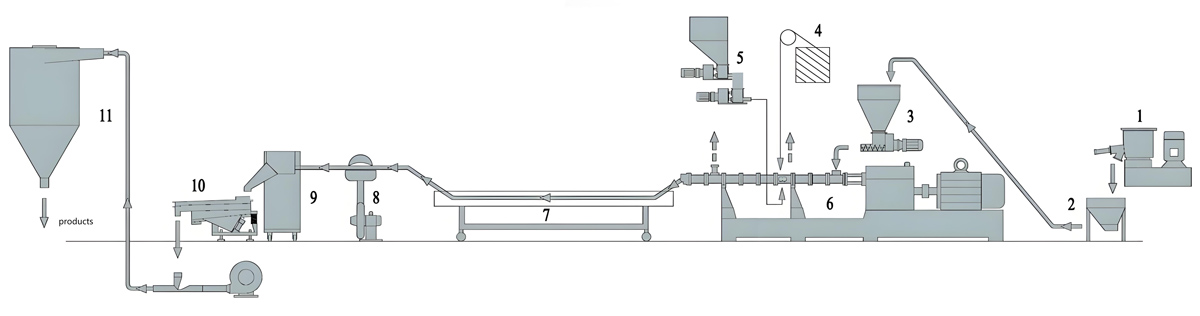
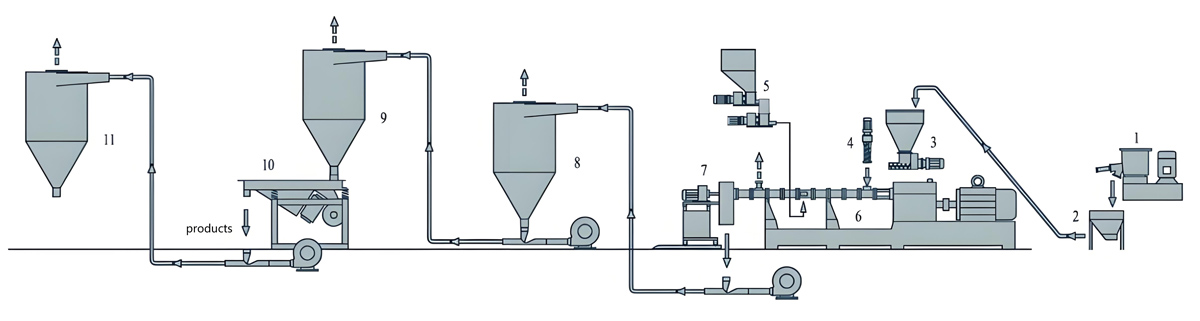
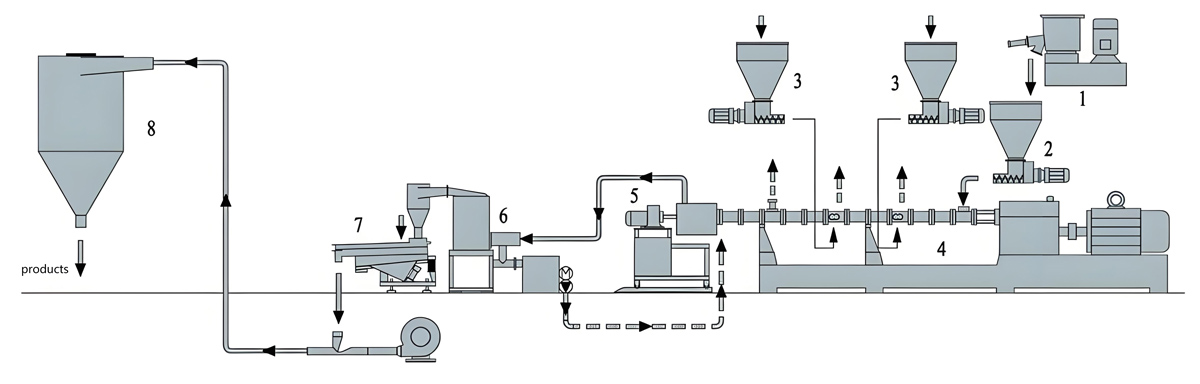
The twin screw extruder performs the critical mixing and compounding operations that transform raw materials into finished masterbatch. Material feeding occurs through either side feeders or main hoppers, depending on the formulation and processing requirements. The twin screw configuration, typically co-rotating with segmented screw elements, provides the mixing action necessary for pigment dispersion while maintaining controlled residence time distribution.
The extrusion process progresses through distinct zones, each serving specific functions in the overall conversion process. The feeding zone accepts raw materials and initiates compression, while mixing zones incorporate high-shear screw elements that break down pigment aggregates and achieve uniform dispersion. The kneading and pumping sections ensure proper melt homogenization and pressure development for extrusion through the die plate. Temperature profiles are carefully controlled across all zones, typically ranging from 180 to 260 degrees Celsius depending on the base resin and pigment systems employed.
Strand Extrusion and Cooling
The compounded material exits the extruder through a multi-hole die plate, forming strands that are subsequently cooled and solidified. Die plate configuration typically includes 6 to 12 holes ranging from 2.5mm to 4mm in diameter, selected based on throughput requirements and desired strand characteristics. Water cooling troughs or air cooling systems reduce the strand temperature to ambient conditions, preparing the material for subsequent granulation.
Cooling systems must provide uniform temperature reduction without causing thermal shock or distortion of the extruded strands. Water temperature is typically maintained between 20 and 40 degrees Celsius, with flow rates adjusted to achieve consistent cooling across the production run. Overcooling can cause brittleness and feeding issues in the granulation step, while insufficient cooling results in soft strands prone to deformation and sticking.
Granulation and Final Processing
Cooled strands enter the strand granulator, where rotating knives cut the material into cylindrical pellets of uniform size. Granulator configuration, including knife clearance, screen size, and rotor speed, requires optimization for each specific masterbatch formulation. Typical pellet dimensions range from 2.5mm to 4mm in length and 2.5mm to 3.5mm in diameter, providing favorable handling characteristics and dissolution rates in subsequent processing.
Finished pellets undergo quality control inspection, including color measurement, pigment dispersion evaluation, and melt flow testing. Conforming material is transferred to packaging operations, typically involving sealed containers or bags that protect against moisture ingress and maintain product cleanliness. Proper packaging and storage conditions (typically below 40 degrees Celsius, away from direct sunlight) ensure extended shelf life and consistent performance during customer use.
Production Equipment Introduction for Thin-Wall Masterbatch
Equipment selection significantly impacts the quality, efficiency, and cost-effectiveness of thin-wall product grade masterbatch production. The twin screw extruder serves as the core processing unit, with supporting equipment completing the production system.
Kerke KTE Series Twin Screw Extruders
The Kerke KTE series represents a comprehensive range of twin screw extruders designed for masterbatch production applications. These extruders feature modular screw configurations, precise temperature control systems, and robust construction suitable for demanding production environments. The series includes multiple models to address varying capacity requirements.
The KTE-36B model features a screw diameter of 35.6mm and achieves throughput rates of 20 to 100 kg/h, making it suitable for pilot production, research and development, and small-scale commercial production. Its compact footprint and excellent mixing performance make it ideal for specialty masterbatch production with frequent formulation changes.
The KTE-50B model provides intermediate capacity with a 50.5mm screw diameter and throughput of 80 to 200 kg/h. This model balances production efficiency with flexibility, accommodating both color masterbatch and additive concentrate production with excellent cost-effectiveness.
The KTE-65B, featuring a 62.4mm screw diameter, delivers throughput rates of 200 to 450 kg/h. This capacity range suits medium-scale production operations with moderate product variety requirements. The model maintains excellent mixing quality while achieving meaningful production volumes.
The KTE-75B model provides higher capacity with a 71mm screw diameter and throughput of 300 to 800 kg/h. This model addresses production requirements for large-volume color masterbatch and commodity additive concentrates with consistent quality performance.
The KTE-95D, the largest model in the series, features a 93mm screw diameter and achieves throughput rates of 1000 to 2000 kg/h. This high-capacity model suits dedicated production facilities requiring maximum output while maintaining the quality standards essential for thin-wall product applications.
Supporting Equipment Systems
Material handling systems including resin dryers, feeders, and conveying equipment ensure consistent material supply throughout the production process. Gravimetric dosing systems provide precise ingredient control, essential for maintaining consistent masterbatch quality across production batches. Loss-in-weight feeders offer accuracy of 0.5% to 1% for main components and 1% to 2% for minor additives.
Cooling systems, including water cooling troughs and air knives, prepare extruded strands for granulation. The granulation equipment, typically strand pelletizers with hardened cutting blades, produces uniform pellets with minimal fines generation. Downstream equipment, including classifiers, metal detectors, and packaging systems, complete the production line with quality assurance and product packaging capabilities.
Parameter Settings for Thin-Wall Masterbatch Production
Optimal parameter settings distinguish between acceptable and exceptional masterbatch quality in thin-wall applications. The complex interactions between screw configuration, temperature profiles, and processing speeds require careful optimization for each specific formulation.
Screw Configuration Parameters
Screw configuration for thin-wall masterbatch production balances mixing intensity with throughput requirements. A typical configuration for high-pigment-loading masterbatch incorporates feed screws with deep flights for efficient material transport, transitioning to shallower mixing sections with kneading blocks and right-angle mixing elements. The screw compression ratio typically ranges from 2.5:1 to 3.5:1, ensuring proper melting and compaction of the polymer matrix.
The length-to-diameter ratio significantly impacts mixing quality and production efficiency. Standard configurations employ L/D ratios of 40:1 to 48:1, providing sufficient residence time for complete melting and pigment dispersion while maintaining acceptable throughput rates. High-intensity mixing sections typically occupy 30% to 50% of the screw length, strategically positioned to achieve optimal dispersion before the pumping sections.
Temperature Profile Settings
Temperature profile optimization balances melt viscosity, pigment dispersion, and thermal stability requirements. A typical profile for polypropylene-based thin-wall masterbatch might include: zone 1 (feeding) at 180 to 200 degrees Celsius, zones 2 to 4 (compression and initial mixing) at 200 to 230 degrees Celsius, zones 5 to 7 (high-shear mixing) at 230 to 250 degrees Celsius, and zones 8 to 10 (pumping and die) at 240 to 260 degrees Celsius.
Temperature adjustments depend on the specific pigment systems and additive packages incorporated in the formulation. Heat-sensitive pigments may require reduced temperatures in the mixing zones, potentially necessitating extended mixing sections or modified screw configurations to achieve adequate dispersion at lower processing temperatures. Conversely, high-temperature-resistant pigments allow processing at elevated temperatures, reducing melt viscosity and improving mixing efficiency.
Throughput and Speed Parameters
Throughput rates must balance production efficiency with mixing quality requirements. For thin-wall masterbatch production, throughput rates typically range from 60% to 80% of maximum extruder capacity to ensure adequate residence time for complete dispersion. Specific throughput recommendations vary by extruder model and formulation complexity.
Screw speed affects both mixing intensity and material residence time. Typical operating speeds range from 200 to 500 RPM, depending on the extruder size and formulation requirements. Higher speeds increase shear forces and mixing intensity, beneficial for difficult-to-disperse pigments, but reduce residence time and may cause excessive temperature rise from mechanical heating. Speed optimization requires balancing these competing factors to achieve optimal results for each specific formulation.
Equipment Price Guide
Investment in twin screw extrusion equipment for thin-wall masterbatch production requires careful evaluation of capacity requirements, quality standards, and budget constraints. The Kerke KTE series provides comprehensive options across the capacity and price spectrum.
The KTE-36B model, with its 35.6mm screw diameter and 20 to 100 kg/h throughput capability, represents the entry point for production-scale thin-wall masterbatch manufacturing. Pricing ranges from $25,000 to $35,000, depending on configuration options, control system sophistication, and included accessories. This investment suits R&D facilities, specialty producers, and entrepreneurs entering the masterbatch market.
The KTE-50B model, priced at $40,000 to $60,000, offers intermediate capacity suitable for growing production operations. The 50.5mm screw diameter and 80 to 200 kg/h throughput provide meaningful production capability with excellent flexibility for product changeovers and formulation variations.
The KTE-65B, with pricing from $50,000 to $80,000, addresses medium-scale production requirements with throughput rates of 200 to 450 kg/h. The 62.4mm screw diameter delivers efficient production while maintaining quality standards essential for thin-wall applications.
The KTE-75B model, priced between $70,000 and $100,000, provides higher capacity with its 71mm screw diameter and 300 to 800 kg/h throughput range. This model suits established production facilities with consistent demand for standard color masterbatch products.
The KTE-95D, the flagship model in the series, commands prices from $120,000 to $200,000. Its 93mm screw diameter and 1000 to 2000 kg/h throughput capability support high-volume production operations requiring maximum output efficiency while maintaining the quality consistency essential for thin-wall masterbatch applications.
Problems in Production Process and Solutions
Thin-wall product grade masterbatch production presents unique challenges requiring systematic understanding and effective solutions. Addressing these issues proactively ensures consistent quality and efficient operations.
Pigment Dispersion Issues and Solutions
Inadequate pigment dispersion manifests as color streaks, specks, or inconsistent coloration in finished thin-wall products. The primary causes include insufficient shear forces during mixing, improper screw configuration, inadequate pre-mixing, or moisture contamination of raw materials. When pigment aggregates survive the extrusion process, they appear as visible defects in the thin sections of molded or thermoformed products.
Solutions focus on increasing mixing intensity through screw configuration modifications, including additional kneading blocks, specialized mixing elements, or increased mixing section length. Pre-mixing improvements, including extended blending times and high-intensity mixing equipment, ensure better preliminary pigment distribution. Moisture control through proper drying procedures and sealed material handling prevents hydrolysis-related dispersion problems.
Prevention strategies emphasize establishing validated procedures for each formulation, regular equipment maintenance to ensure consistent performance, and statistical process control to detect trends before they result in defective product. Initial trials with new formulations should include dispersion testing using techniques such as color strength measurements, optical microscopy, or melt flow testing to confirm adequate dispersion before full-scale production.
Melt Fracture and Surface Defects
Melt fracture appears as rough, sharkskin-like surfaces on extruded strands or final pellets, compromising product appearance and potentially causing processing issues in subsequent applications. This phenomenon results from excessive shear stress exceeding the melt strength of the polymer matrix, often caused by high screw speeds, low melt temperatures, or excessive pigment loading.
Addressing melt fracture involves increasing melt temperature through barrel zone adjustments, reducing screw speed to decrease shear rates, or modifying the formulation to incorporate processing aids and viscosity modifiers. Screw modifications, including shallower flight depths in the pumping sections and specialized screw elements designed for low-shear pumping, help reduce stress on the melt.
Preventive measures include maintaining appropriate processing temperatures for the specific formulation, establishing speed limits based on formulation testing, and monitoring melt pressure as an indicator of processing stress. Regular equipment maintenance, including screw wear inspection and barrel clearance verification, ensures consistent processing conditions throughout production runs.
Feeding and Output Consistency Problems
Inconsistent feeding causes output fluctuations that translate directly into quality variations across production batches. Common causes include bridging in hoppers, poor flow characteristics of pre-mixed materials, incorrect feeder calibration, or material caking from moisture or temperature exposure.
Solutions involve hopper design modifications to prevent bridging, including vibrating agitators, screw feeders, or redesigned hopper geometry. Gravimetric feeding systems provide improved accuracy and consistency compared to volumetric alternatives. Material handling improvements, including climate-controlled storage and handling equipment, prevent caking and flow problems.
Prevention requires establishing material specifications that include flow characteristics requirements, regular feeder calibration verification, and batch scheduling that minimizes material exposure time before processing. Quality monitoring systems should track output consistency continuously, triggering investigation when variations exceed established tolerances.
Color Variation and Batch Consistency
Color variation between production batches represents a significant quality concern for thin-wall masterbatch, where consistent coloration is essential for brand identity and product appearance. Sources of variation include pigment lot changes, weighing errors, mixing inconsistencies, and processing parameter drift.
Effective solutions include strict incoming quality control for pigment materials, including color strength verification and dispersion testing. Manufacturing execution systems that control and document formulation weights eliminate manual weighing errors. Improved mixing procedures, including extended blend times and validated mixing protocols, ensure complete homogenization of components.
Prevention strategies emphasize manufacturing discipline and quality systems. Standard operating procedures should specify ingredient verification, mixing protocols, and processing parameters for each formulation. Final product testing against established color standards, using objective color measurement equipment rather than visual comparison alone, provides quantitative quality verification. Statistical process control charts for color measurements enable early detection of trends requiring corrective action.
Maintenance Requirements
Consistent maintenance practices ensure reliable equipment performance and consistent masterbatch quality in thin-wall applications. Regular maintenance schedules, combined with responsive corrective actions, minimize unplanned downtime and maintain production efficiency.
Daily Maintenance Procedures
Daily maintenance begins with visual inspection of equipment condition and operational parameters. Operators should verify proper material levels in hoppers, confirm appropriate drying system operation, and check coolant circulation systems. Observation of extruded strand quality provides immediate feedback on processing conditions, with any significant changes warranting investigation.
Strand granulator maintenance includes knife edge inspection, screen condition verification, and blade gap adjustment. Dull knives cause irregular pellet shape and increased fines generation, compromising product quality and potentially causing feeding issues in subsequent processing. Daily cleaning of die plate holes and strand cooling equipment prevents buildup that affects product quality and processing efficiency.
Recording operational parameters throughout production runs establishes baselines for trend analysis and early problem detection. Documentation should include throughput rates, screw speeds, temperature profiles, melt pressures, and quality observations. This data supports root cause analysis when quality issues occur and provides guidance for continuous improvement initiatives.
Weekly and Monthly Maintenance
Weekly maintenance includes more comprehensive equipment inspection and calibration verification. Feeder calibration verification ensures continued accuracy of ingredient addition, particularly important for formulations with tight tolerance requirements. Temperature controller calibration confirmation maintains accurate temperature control throughout the extrusion process.
Screw and barrel inspection at regular intervals identifies wear patterns that affect mixing performance and product quality. Wear in the feeding sections causes reduced compression, while wear in mixing sections compromises dispersion efficiency. Documentation of wear progression supports predictive maintenance scheduling and capital planning for component replacement.
Monthly maintenance encompasses comprehensive equipment cleaning, including barrel purging with compatible polymers, die plate removal and cleaning, and thorough inspection of all critical components. Drive system inspection, including belt tension verification, gearbox oil analysis, and motor condition assessment, ensures continued reliable operation of drive systems.
Periodic and Annual Maintenance
Periodic maintenance addresses components with longer service intervals, including screw element inspection and replacement, barrel wear measurement, and gearbox service. Screw elements experiencing significant wear should be replaced or repositioned to maintain mixing efficiency and product quality standards.
Annual maintenance encompasses comprehensive equipment overhaul, including complete disassembly and inspection of the extrusion system, replacement of wear components, and system calibration. This comprehensive review identifies emerging issues before they cause production disruptions and ensures equipment readiness for continued quality production.
Maintenance records should document all activities, including inspections, adjustments, and component replacements. This documentation supports warranty claims, informs capital planning, and provides reference for troubleshooting recurring issues. Computerized maintenance management systems enhance tracking and scheduling capabilities for production facilities with multiple pieces of equipment.
Frequently Asked Questions
What pigment concentration is recommended for thin-wall product masterbatch?
Typical pigment loadings for thin-wall masterbatch range from 30% to 50% for organic pigments and 40% to 60% for inorganic pigments. The specific concentration depends on the target application, color strength requirements, and cost considerations. Higher concentrations offer cost advantages but may affect processing characteristics and require modified extrusion configurations.
How does screw configuration affect dispersion quality in thin-wall masterbatch?
Screw configuration directly impacts mixing intensity and residence time distribution, both critical for pigment dispersion. Kneading blocks, mixing elements, and screw geometry determine the shear forces applied to the material and the time available for dispersion. Optimized configurations balance mixing intensity with throughput requirements to achieve complete dispersion while maintaining acceptable production rates.
What temperature settings are appropriate for polypropylene thin-wall masterbatch?
Typical processing temperatures for polypropylene-based thin-wall masterbatch range from 180 to 260 degrees Celsius across barrel zones. The specific profile depends on the pigment systems employed, with heat-sensitive pigments requiring lower temperatures and thermally stable pigments allowing higher processing temperatures. Temperature optimization balances melt viscosity, pigment dispersion, and thermal stability requirements.
How can we prevent color variation between production batches?
Preventing color variation requires comprehensive quality systems including incoming material verification, precise weighing procedures, validated mixing protocols, and final product testing. Gravimetric ingredient control, extended mixing procedures, and statistical process control all contribute to batch-to-batch consistency. Documented procedures and operator training ensure consistent execution of quality-critical operations.
What is the expected production capacity for thin-wall masterbatch?
Production capacity depends on the extruder model and formulation characteristics. The Kerke KTE series offers capacity ranges from 20-100 kg/h (KTE-36B) to 1000-2000 kg/h (KTE-95D). Actual throughput achievable depends on formulation viscosity, pigment loading, and quality requirements, with optimization typically achieving 60% to 80% of maximum theoretical throughput.
How often should screw elements be inspected for wear?
Screw element inspection frequency depends on production volume, materials processed, and operating conditions. Monthly visual inspection during scheduled maintenance is recommended, with more detailed dimensional inspection quarterly or semi-annually for high-volume production. Documentation of wear patterns enables predictive maintenance scheduling and prevents quality degradation from worn components.
What are the critical quality tests for thin-wall masterbatch?
Critical quality tests include color strength measurement using spectrophotometry, dispersion evaluation through microscopy or melt index testing, moisture content determination, and melt flow testing for processing characterization. Mechanical testing of test specimens and application testing in actual thin-wall products provide comprehensive quality assurance for demanding applications.
Conclusion
Thin-wall product grade masterbatch production demands exceptional attention to formulation design, processing optimization, and quality control. Twin screw extrusion technology, exemplified by the Kerke KTE series, provides the capabilities necessary to achieve the dispersion quality, consistency, and throughput required for competitive thin-wall masterbatch manufacturing. Success in this demanding application segment requires understanding the technical fundamentals while maintaining disciplined manufacturing practices that ensure consistent quality across production runs.
The investment in appropriate equipment, combined with systematic process optimization and comprehensive quality systems, positions manufacturers to serve the growing thin-wall packaging market effectively. As thin-wall applications continue to evolve, with increasing emphasis on sustainability, lightweighting, and functional performance, masterbatch producers must maintain technical capabilities that address emerging requirements while delivering the consistent quality that thin-wall applications demand.
Future developments in thin-wall masterbatch technology will likely focus on enhanced sustainability through recycled content integration, advanced functional additives for property enhancement, and processing technologies that enable higher throughput without compromising quality. Manufacturers prepared with capable equipment, skilled personnel, and quality-focused cultures will be positioned to capitalize on these opportunities while serving the current demands of the thin-wall packaging industry.