The plastics industry faces increasing pressure to reduce environmental impact and carbon emissions throughout the production value chain. Low-carbon masterbatch granulation represents a critical capability for manufacturers seeking to address sustainability requirements from brand owners and regulatory agencies. The production equipment selected for low-carbon masterbatch manufacturing significantly influences both the environmental footprint of the manufacturing process and the carbon content of the final product. Energy saving twin screw extruders have emerged as the preferred equipment choice for manufacturers committed to minimizing energy consumption while maintaining competitive production economics and product quality. This comprehensive guide examines the technical, operational, and strategic considerations for implementing energy-efficient twin screw extrusion technology in low-carbon masterbatch production applications.
Introduction
Low-carbon masterbatch production encompasses both the reduction of energy consumption during manufacturing and the incorporation of bio-based or recycled materials that lower the carbon intensity of the final product. These dual objectives require careful equipment selection and process optimization to achieve meaningful carbon reductions without compromising product quality or production economics. The extrusion equipment market has responded to these requirements with significant advances in energy efficiency, process control precision, and production optimization capabilities.
Modern energy saving twin screw extruders incorporate multiple design features that reduce electrical energy consumption, optimize thermal efficiency, and extend equipment operating life. These improvements address the economic and environmental concerns of manufacturers while meeting the increasingly stringent sustainability requirements of downstream customers. Understanding the capabilities and applications of energy-efficient extrusion technology enables manufacturers to make informed equipment investment decisions that support both immediate production needs and long-term business objectives.
This guide provides comprehensive technical information for manufacturers evaluating or implementing energy saving twin screw extruders for low-carbon masterbatch granulation. The content addresses equipment selection criteria, process optimization strategies, energy monitoring approaches, and operational best practices. By implementing the recommendations presented here, manufacturers can achieve meaningful reductions in energy consumption and carbon emissions while maintaining or improving product quality and production profitability.
Formulation Strategies for Low-Carbon Masterbatch
Bio-Based Carrier Systems
The selection of carrier resin significantly impacts the carbon footprint of the resulting masterbatch product. Bio-based carriers derived from renewable agricultural resources offer substantial carbon advantages compared to petroleum-derived alternatives. Polylactic acid produced from corn starch or sugarcane provides the most widely available bio-based carrier option, with demonstrated carbon reduction potential of 60-80% compared to conventional petroleum-based carriers. The actual carbon reduction depends on agricultural practices, transportation distances, and manufacturing processes used in bio-based resin production.
Formulations incorporating PLA as the primary carrier typically contain 55-70% PLA resin, with remainder allocated to pigments, additives, and processing modifiers. The specific formulation composition affects both processing requirements and final product performance characteristics. Higher PLA content increases bio-based content and carbon reduction but may require process adjustments to accommodate PLA processing characteristics including moisture sensitivity and narrower thermal processing window.
Recycled Content Formulations
Incorporating post-consumer or post-industrial recycled materials offers additional carbon reduction pathways for masterbatch manufacturers. Recycled polymer carriers typically exhibit lower embodied carbon than virgin materials due to avoided production emissions from new polymer synthesis. However, recycled materials require careful quality verification and may require additional processing modifications to achieve consistent product quality. Typical recycled content formulations include 30-60% post-consumer recycled polymer combined with bio-based or virgin bio-based carriers to achieve target carbon reduction levels while maintaining processing stability and final product performance.
The contamination and variability inherent in recycled materials require enhanced quality control procedures and potentially more sophisticated processing equipment to achieve acceptable product consistency. Energy saving twin screw extruders with precise temperature control and advanced mixing capabilities prove particularly valuable for processing challenging recycled feedstocks while maintaining production efficiency and product quality.
Additive Optimization for Carbon Reduction
Additive selection and loading optimization contribute to carbon reduction objectives by enabling formulation efficiency and reducing total material requirements. High-concentration masterbatch formulations that achieve target performance with lower total additive loading reduce both material carbon footprint and processing energy requirements. Processing aids that improve extrusion efficiency enable throughput increases that spread equipment energy consumption across greater production volumes, improving energy intensity metrics.
Bio-based additives including natural antioxidants, plant-derived plasticizers, and biodegradable processing aids provide functional performance while contributing to carbon reduction goals. These materials may command premium pricing but can provide overall cost benefits when accounting for carbon compliance value and sustainability certification advantages. Formulation development should evaluate total life cycle carbon impact rather than focusing solely on material costs to identify the most effective carbon reduction strategies.
Energy-Efficient Production Process Design
Process Integration Opportunities
Energy efficient masterbatch production requires systematic evaluation of process integration opportunities that reduce energy consumption while maintaining production output. Heat recovery systems capture thermal energy from the extrusion process and redirect it to preheat incoming materials or supply facility heating requirements. Counterflow heat exchangers between feed and discharge streams can recover 15-25% of thermal energy that would otherwise be lost to cooling systems. The recovered heat reduces demand on natural gas or electrical heating systems, directly reducing both energy costs and associated carbon emissions.
Thermal insulation improvements throughout the extruder barrel and die assemblies reduce heat loss and improve thermal efficiency of the heating and cooling systems. Modern high-efficiency insulation materials applied during equipment installation or retrofit can reduce barrel heat losses by 30-40% compared to standard insulation configurations. The combination of heat recovery and insulation improvements can reduce net heating energy requirements by 40-60% for typical masterbatch extrusion applications.
Throughput Optimization Strategies
Energy consumption per unit of production decreases as throughput increases for twin screw extrusion processes due to the relatively fixed energy overhead of the extrusion system. Operating at maximum efficient throughput reduces both energy costs and associated carbon emissions per kilogram of produced masterbatch. Throughput optimization requires balancing maximum throughput against product quality requirements, equipment reliability considerations, and changeover efficiency for multi-product production operations.
Production scheduling that batches similar formulations together minimizes changeover frequency and reduces energy waste associated with purging and setup operations. Extended production runs on well-optimized formulations achieve better energy efficiency than frequent short runs with extensive changeover requirements. Advanced production planning systems can optimize scheduling to minimize energy consumption while meeting delivery requirements and quality specifications.
Motor and Drive System Efficiency
The main drive motor represents the largest single energy consumption component in twin screw extrusion, accounting for 60-80% of total electrical energy use in typical applications. Premium efficiency motors meeting IE4 or IE5 efficiency standards reduce motor losses by 15-25% compared to standard efficiency designs. Variable frequency drives enabling precise speed control provide additional energy savings by matching motor power to actual processing requirements rather than operating at fixed speed with throttled output.
Regenerative drive systems that capture and return braking energy during减速或者停机 provide further efficiency improvements for production operations with frequent throughput changes. The energy savings from regenerative drives depend on production patterns but can achieve 5-15% reduction in total electrical energy consumption for appropriate applications. Combined motor and drive system efficiency improvements can reduce extrusion drive energy requirements by 20-40% compared to older standard efficiency equipment.
Production Equipment for Low-Carbon Masterbatch
KTE Series Energy Saving Twin Screw Extruder Features
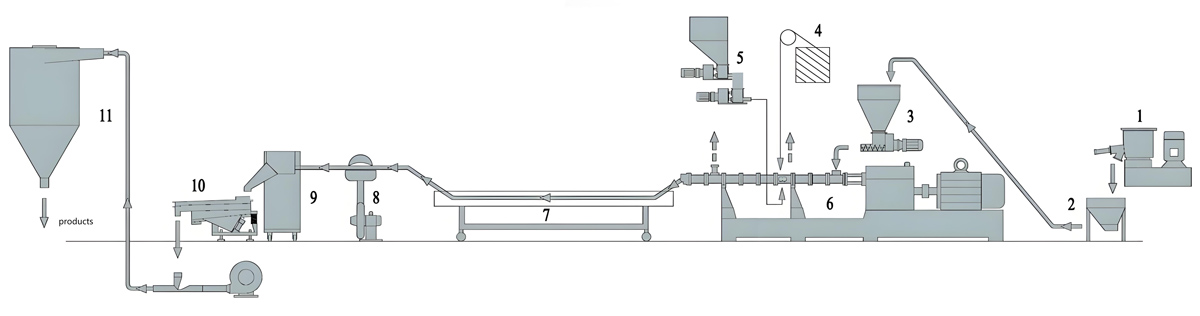
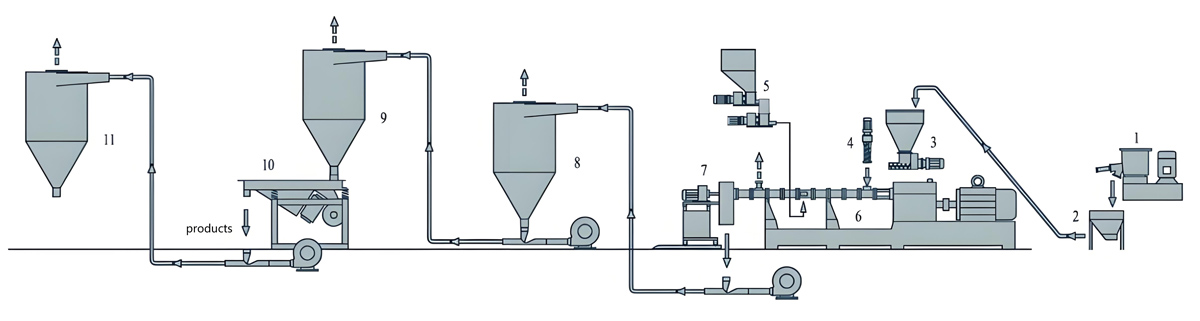
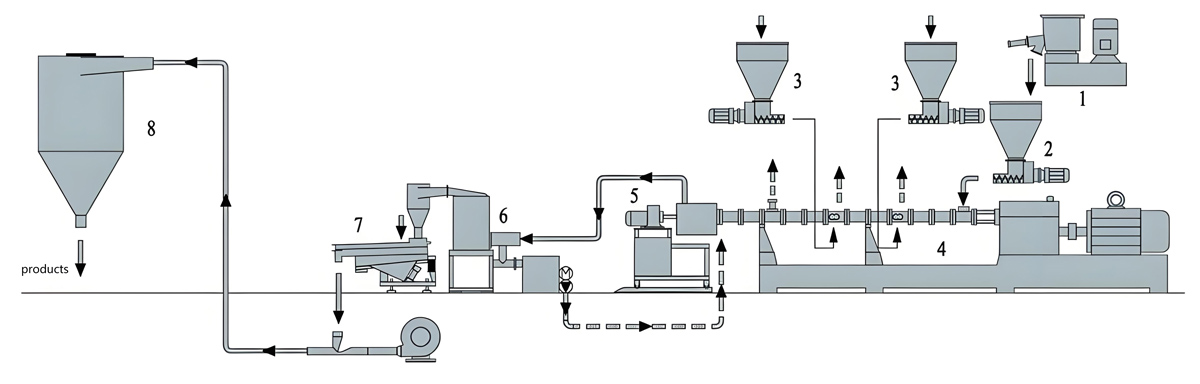
The KTE Series energy saving twin screw extruder from Kerke incorporates multiple design features specifically developed for low-carbon masterbatch production applications. Advanced motor and drive systems deliver high torque output while minimizing electrical energy consumption through premium efficiency components and intelligent power management systems. The KTE Series includes regenerative drive options that capture and reuse braking energy, further reducing net energy consumption for production operations with variable throughput requirements.
Optimized barrel heating and cooling systems in the KTE Series reduce thermal energy requirements through improved heat transfer efficiency and precise temperature control. Multi-zone temperature management enables processor-optimized thermal profiles that minimize energy waste while maintaining precise processing conditions. The combination of reduced electrical energy consumption and improved thermal efficiency results in 25-40% lower energy consumption compared to conventional twin screw extrusion equipment.
The modular screw element system in the KTE Series enables configuration optimization for specific formulations and production requirements. Properly configured screw elements maximize mixing efficiency while minimizing energy consumption through optimized screw speed and throughput combinations. Kerke technical support engineers assist customers in developing optimized screw configurations that achieve production quality targets while minimizing energy requirements.
Energy Monitoring and Management Systems
Modern energy saving twin screw extruders incorporate comprehensive energy monitoring capabilities that enable real-time tracking of energy consumption and efficiency metrics. Power metering on the main drive motor provides accurate energy consumption data for production accounting and cost analysis. Temperature and pressure monitoring enable correlation of energy consumption with processing conditions to identify optimization opportunities. Integration with plant energy management systems enables comprehensive facility energy monitoring and reporting.
Advanced process control systems automatically optimize operating parameters to maintain target production rates while minimizing energy consumption. These systems analyze real-time sensor data and adjust speed, temperature, and throughput to maintain optimal efficiency across varying production conditions. Machine learning algorithms continuously improve energy optimization based on accumulated operating data, providing ongoing efficiency improvements over equipment operating life.
Support Equipment for Energy Efficiency
Material drying systems represent significant energy consumers in masterbatch production facilities. Modern desiccant dryer designs achieve substantial energy reductions through heat recovery, variable speed blowers, and advanced control algorithms that match drying energy to actual material requirements. Zeolite wheel dryers provide particularly efficient drying for hygroscopic materials by recovering energy from the regeneration cycle to preheat incoming air streams.
Pellet cooling and handling systems can be optimized for energy efficiency through selection of appropriate cooling methods and system sizing. Indirect cooling systems that separate cooling medium from pellets enable more efficient heat removal with lower pumping energy requirements. Properly sized material handling systems avoid excessive conveying energy consumption that occurs with oversized equipment operating at reduced capacity.
Parameter Settings for Energy-Efficient Production
Optimal Temperature Profile Development
Temperature profile optimization significantly impacts energy consumption in twin screw extrusion processes. The optimal profile minimizes heating energy while maintaining processing quality and avoiding excessive cooling requirements. Profile development begins with material-specific recommendations and adjusts based on actual performance observations and energy consumption monitoring data.
Modern extrusion systems enable precise multi-zone temperature control that supports optimized profiles for specific formulations. Initial temperature profiles typically start 10-20 degrees Celsius below the recommended processing temperature and increase gradually through subsequent zones to achieve complete melting and proper mixing. Final zones may be set slightly lower than peak mixing zones to reduce cooling requirements at the die while maintaining adequate flow characteristics. Continuous profile refinement based on production data achieves steady-state conditions that minimize both energy waste and quality variation.
Screw Speed Optimization
Screw speed directly affects energy consumption through motor power requirements and indirectly influences energy efficiency through impacts on throughput, mixing quality, and thermal balance. Lower screw speeds reduce motor energy consumption but may decrease throughput and extend cycle times, potentially increasing overall production energy per unit. Optimal screw speed balances these competing factors to minimize total energy consumption while meeting production quality and throughput requirements.
For low-carbon masterbatch production, typical screw speeds range from 250-450 rpm depending on formulation characteristics and equipment configuration. High-torque drive systems in modern energy saving extruders enable effective processing at lower speeds than required with conventional equipment, providing additional energy savings while maintaining product quality. Process optimization should evaluate energy consumption across a range of screw speeds to identify the optimal operating point for each specific formulation.
Throughput and Efficiency Balancing
Maximum efficient throughput represents the production rate at which energy consumption per unit reaches its minimum value for a given formulation and equipment configuration. Operating above this throughput level can compromise product quality or equipment reliability, while operating below this level wastes energy on fixed overhead costs that do not contribute to production output. Understanding and targeting maximum efficient throughput enables optimization of energy efficiency for each production run.
Production scheduling should prioritize extended runs at optimal throughput for formulations where demand allows, reserving lower-throughput operations for urgent requirements or changeover periods. Multi-product facilities may benefit from dedicating specific equipment to high-volume formulations where throughput optimization provides the greatest energy savings. Variable frequency drives facilitate throughput optimization by enabling smooth speed adjustment across the operating range.
Equipment Price and Investment Considerations
Energy saving twin screw extruders command a price premium over standard efficiency equipment due to the advanced components and design features required to achieve superior energy performance. Laboratory and pilot scale energy efficient extruders suitable for development and small batch production range from $35,000 to $95,000 depending on capacity and feature level. The premium pricing relative to standard equipment is typically recovered through energy savings within 18-36 months of operation based on typical energy costs and production volumes.
Production scale energy saving extruders with throughput capacity of 300-800 kg/hour typically range from $180,000 to $420,000 for complete systems including drives, controls, and basic support equipment. High-capacity systems exceeding 1000 kg/hour require investments of $550,000 to $1,200,000 or more depending on configuration and automation level. Complete production line investments including material handling, drying, and pelletizing systems add $200,000 to $600,000 depending on capacity and sophistication.
Total cost of ownership analysis should consider energy savings, maintenance requirements, production efficiency improvements, and potential premium pricing for low-carbon products when evaluating equipment investment alternatives. Government incentives, utility rebates, and sustainability certification value may further improve the economics of energy efficient equipment investments. The continuing trend toward carbon pricing and sustainability requirements suggests that early investment in energy efficient production capability provides strategic value beyond immediate financial returns.
Production Problems, Causes, Solutions and Prevention
Excessive Energy Consumption
Problem: Energy consumption measurements indicate higher than expected or benchmark energy requirements for the production process. Operating costs exceed projections and carbon reduction targets appear unattainable with current processing configuration.
Cause Analysis: Excessive energy consumption typically results from suboptimal equipment configuration, improper operating parameters, or equipment degradation that reduces efficiency. Screw configurations that do not match formulation requirements may cause excessive motor load without improving product quality. Temperature profiles set too high or too low relative to material requirements waste energy through excessive heating or cooling loads. Worn components including screw elements, bearings, and seals reduce mechanical efficiency and increase energy requirements to maintain production output.
Solution: Conduct comprehensive energy audit to identify specific sources of excess consumption. Review and optimize screw configuration in collaboration with equipment supplier technical support. Adjust temperature profiles based on material requirements and monitoring data rather than conservative default settings. Implement preventive maintenance program to restore equipment efficiency as components wear.
Prevention: Establish baseline energy consumption metrics during equipment commissioning and validate against manufacturer specifications. Implement continuous energy monitoring to identify efficiency changes requiring investigation. Schedule regular maintenance activities that maintain equipment efficiency throughout operating life. Document and maintain optimized operating parameters to prevent drift from efficient configurations.
Product Quality Degradation During Optimization
Problem: Energy optimization efforts produce measurable reductions in energy consumption but simultaneously cause unacceptable product quality degradation including poor dispersion, inconsistent color, or inferior physical properties.
Cause Analysis: Quality degradation during energy optimization typically results from aggressive parameter changes that exceed formulation processing limits. Temperature reductions beyond material capability cause incomplete melting or inadequate mixing that compromises dispersion quality. Throughput increases beyond mixing capacity produce quality defects as processing intensity becomes insufficient for proper compound development. Speed reductions that save motor energy may increase residence time beyond thermal stability limits, causing degradation in heat-sensitive materials.
Solution: Establish minimum acceptable quality specifications before initiating energy optimization and commit to maintaining these specifications regardless of energy savings achieved. Revert to previous operating parameters when quality limits are reached and seek additional optimization opportunities that do not compromise quality. Engage formulation suppliers and equipment manufacturers in collaborative optimization efforts that identify safe operating windows for both energy efficiency and product quality.
Prevention: Develop comprehensive understanding of formulation processing windows through systematic trials before attempting energy optimization. Establish quality specifications and monitoring procedures that provide early warning of quality degradation. Implement staged optimization approaches that make incremental changes and verify quality maintenance before proceeding to additional optimization steps. Document all optimization activities and outcomes to build institutional knowledge for future efficiency improvement efforts.
Carbon Accounting Inconsistencies
Problem: Calculated carbon reduction values for low-carbon masterbatch products vary inconsistently or fail to achieve claimed reduction levels when independently verified. Carbon accounting methodologies produce results that cannot be replicated or reconciled with production records.
Cause Analysis: Carbon accounting inconsistencies typically arise from methodological limitations in data collection, boundary definition problems, or emission factor variations. Incomplete tracking of energy consumption across supporting equipment and facilities causes underestimation of production carbon footprint. Allocation of shared facility energy across multiple products may not accurately reflect actual consumption patterns. Emission factors for purchased electricity vary by grid region and time of day, complicating accurate carbon calculation.
Solution: Implement comprehensive energy metering that captures all relevant consumption including supporting equipment and facility loads. Define clear system boundaries for carbon accounting calculations and document assumptions and methodologies. Use time-based or region-specific electricity emission factors that accurately reflect actual supply conditions. Engage third-party verification to ensure carbon accounting methodologies meet recognized standards and produce reproducible results.
Prevention: Establish standardized carbon accounting procedures aligned with recognized standards such as ISO 14067 or GHG Protocol. Train personnel in carbon accounting methodology and data collection requirements. Implement automated data collection and calculation systems that minimize human error and ensure consistency. Conduct regular internal audits of carbon accounting procedures and results to identify and correct potential issues.
Equipment Reliability Issues During Extended Operation
Problem: Energy efficient operating modes cause increased equipment wear, premature component failures, or reliability problems that offset energy savings through increased maintenance costs and production downtime.
Cause Analysis: Reliability issues during energy efficient operation typically result from operating conditions that stress equipment beyond design limits or accelerated wear from new operating patterns. High-torque operation at reduced speeds can increase bearing loads beyond specifications designed for higher-speed lower-torque operation. Extended operation at elevated temperatures within material processing windows may exceed equipment thermal design limits for extended periods. Startup and shutdown procedures optimized for energy efficiency may not provide adequate component protection during transient conditions.
Solution: Review operating parameters with equipment manufacturer to confirm that intended operating modes fall within equipment design capabilities. Implement enhanced monitoring for critical components that may experience accelerated wear under optimized operating conditions. Adjust maintenance schedules to account for changed wear patterns while operating in energy efficient modes. Consider equipment upgrades or modifications that enable energy efficient operation within appropriate reliability constraints.
Prevention: Obtain equipment manufacturer endorsement of intended operating parameters before implementing energy efficient operating modes. Develop operating procedures that balance energy efficiency objectives with equipment protection requirements. Implement condition monitoring systems that detect developing problems before they cause failures. Maintain spare parts inventory for critical wear components to minimize downtime when replacement becomes necessary.
Heat Recovery System Performance Issues
Problem: Installed heat recovery systems fail to achieve projected energy savings or require excessive maintenance to maintain performance levels. Heat recovery efficiency decreases over time, reducing carbon reduction benefits and extending payback periods beyond original projections.
Cause Analysis: Heat recovery system performance issues result from design limitations, improper installation, contaminated heat exchange surfaces, or inadequate control system integration. Heat exchangers sized conservatively may lack sufficient capacity to capture available heat recovery opportunities. Fouling or scaling on heat exchange surfaces reduces thermal transfer efficiency and requires frequent cleaning maintenance. Control systems that do not properly coordinate heat recovery operation with extrusion process conditions waste potential recovery opportunities.
Solution: Conduct performance verification testing to quantify actual heat recovery compared to design specifications and projections. Clean or replace heat exchange surfaces to restore thermal transfer efficiency. Review control system configuration and adjust setpoints and operating logic to maximize recovery while maintaining process stability. Consult with heat recovery system supplier to identify performance improvement opportunities specific to the installation.
Prevention: Specify heat recovery systems with appropriate capacity margins to allow for fouling and performance degradation over time. Implement water treatment and filtration systems that minimize fouling accumulation on heat exchange surfaces. Establish regular heat exchanger cleaning schedules based on observed performance rather than fixed time intervals. Monitor heat recovery performance metrics continuously and investigate any degradation before it significantly impacts savings.
Maintenance and Care
Energy Efficiency Maintenance Priorities
Maintenance activities for energy efficient twin screw extrusion systems should prioritize components that most significantly impact energy consumption and efficiency. Drive system maintenance including motor testing, bearing inspection, and V-belt tension verification ensures that power transmission efficiency remains at design levels. Worn bearings increase motor load measurably, providing a useful diagnostic indicator for maintenance timing. Variable frequency drive parameters and protection settings should be verified regularly to ensure optimal motor control and efficiency.
Thermal system maintenance directly affects heating and cooling energy consumption. Barrel insulation integrity should be verified periodically, with damaged or degraded insulation replaced to maintain thermal efficiency. Temperature sensor accuracy should be checked against reference instruments to ensure that temperature control decisions are based on accurate data. Heat exchanger cleaning and cooling tower maintenance ensure that heat rejection systems operate efficiently, indirectly affecting heating energy consumption through thermal balance impacts.
Predictive Maintenance Implementation
Predictive maintenance approaches that monitor actual component condition enable maintenance timing optimization that prevents both premature maintenance and unexpected failures. Motor current monitoring detects bearing wear and other mechanical problems that increase load before they cause failures. Vibration analysis identifies emerging problems in rotating equipment including motors, gearboxes, and extruder drive systems. Thermal imaging of electrical connections and motor windings identifies hot spots that indicate developing problems requiring attention.
The investment in predictive maintenance monitoring systems typically recovers through reduced unplanned downtime, optimized maintenance scheduling, and extended component life. Energy consumption monitoring itself provides valuable predictive maintenance data, as unexplained increases in energy consumption often indicate developing mechanical problems before other symptoms become apparent. Integration of predictive maintenance data with production management systems enables coordinated scheduling that minimizes production impacts from maintenance activities.
Maintenance Scheduling Optimization
Maintenance scheduling should balance equipment reliability requirements with production efficiency and energy optimization objectives. Scheduled downtime for preventive maintenance inevitably reduces production output and may cause operational inefficiency during startup and shutdown periods. However, inadequate preventive maintenance increases risks of unplanned downtime and accelerated wear that ultimately reduces both production efficiency and equipment life.
Energy efficient operating modes may require modified maintenance approaches to account for changed wear patterns. Higher torque operation at reduced speeds can accelerate bearing wear in some configurations while reducing wear in others depending on specific design characteristics. Collaboration with equipment manufacturers helps identify optimal maintenance approaches for specific operating configurations and production patterns.
FAQ
What energy savings can be achieved by switching to energy efficient twin screw extrusion equipment?
Modern energy saving twin screw extruders typically achieve 25-40% reduction in electrical energy consumption compared to standard efficiency equipment from previous generations. Combined with thermal efficiency improvements from heat recovery and optimized temperature management, total energy reduction potential reaches 30-50% depending on baseline equipment condition and specific application characteristics. Actual savings vary based on formulation requirements, production patterns, and operating parameter optimization. Most facilities achieve payback on energy efficiency investments within 2-3 years through reduced energy costs alone, before considering premium product pricing opportunities.
How does low-carbon masterbatch pricing compare to conventional alternatives?
Low-carbon masterbatch products typically command pricing premiums of 10-25% depending on carbon reduction levels achieved, target market segments, and competitive positioning strategies. Premium pricing reflects both actual production cost differences and the value that sustainability-conscious customers place on carbon reduction benefits. As carbon pricing mechanisms expand and consumer sustainability awareness grows, the premium pricing opportunity for low-carbon products continues to strengthen. Some manufacturers offer tiered pricing structures that enable customers to select carbon reduction levels matching their sustainability requirements and budget constraints.
What quality differences exist between low-carbon and conventional masterbatch products?
Properly formulated and processed low-carbon masterbatch can achieve quality levels comparable to conventional products for most applications. Bio-based carriers including PLA provide functional performance suitable for standard packaging, consumer products, and industrial applications. Some specialized applications with extreme performance requirements may require modified formulations or processing approaches to achieve equivalent quality levels. Comprehensive qualification testing with specific end-use applications and processing conditions should verify suitability before committing to commercial production.
What carbon accounting standards apply to low-carbon masterbatch products?
Carbon accounting for masterbatch products should follow recognized international standards including ISO 14067 for product carbon footprint quantification, the GHG Protocol for organizational and value chain emissions, and relevant industry-specific guidance. System boundary definition must clearly specify whether raw material extraction, transportation, manufacturing, and end-of-life considerations are included in carbon calculations. Third-party verification by accredited verification bodies provides credibility for carbon claims and meets requirements of major customers and regulatory authorities.
How do utility incentives and carbon pricing affect energy efficient equipment investment decisions?
Utility rebates for energy efficient equipment, tax incentives for sustainability investments, and emerging carbon pricing mechanisms all improve the economics of energy efficient equipment investments. Available incentives vary significantly by location and change over time as policies evolve. Comprehensive investment analysis should include all applicable incentives and account for anticipated future carbon pricing as sustainability requirements continue to tighten. The strategic value of establishing low-carbon production capability ahead of competitors may justify investment even when purely financial payback calculations appear marginal.
Conclusion
Low-carbon masterbatch production represents both an environmental imperative and a business opportunity for plastics industry participants. Energy saving twin screw extrusion technology provides the foundation for competitive low-carbon manufacturing that meets sustainability requirements while maintaining production economics and product quality. Successful implementation requires integrated attention to formulation strategy, equipment selection, process optimization, and operational excellence.
The KTE Series energy saving twin screw extruder from Kerke incorporates proven design features that reduce energy consumption and carbon emissions while maintaining the processing capability required for high-quality masterbatch production. Combined with appropriate support equipment, comprehensive energy monitoring, and optimized operating procedures, these systems enable manufacturers to achieve meaningful carbon reductions that meet customer and regulatory requirements.
The continued evolution of sustainability requirements, carbon pricing mechanisms, and consumer preferences suggests that low-carbon manufacturing capability will become increasingly important for competitive positioning in the plastics industry. Early investment in energy efficient production technology and operational expertise positions manufacturers to capture emerging opportunities while building the technical capabilities required for long-term success in sustainable manufacturing.