Introduction
Acrylonitrile Styrene (AS), also known as SAN, is a transparent, rigid polymer used in household items, packaging, and electronics. While similar to ABS, it lacks the rubber phase, making it harder and more brittle. For masterbatch production, especially for smaller to medium-sized compounders or laboratory settings, a Compact Twin Screw Extruder offers the perfect balance of efficiency and footprint. The “Compact” design refers to a shortened L/D ratio (length-to-diameter) and an integrated control system that reduces floor space requirements without sacrificing mixing capability. This article explores the use of the Nanjing Kerke KTE Series compact models for AS masterbatch production, focusing on space efficiency, quick changeovers, and process optimization for this specific resin.
Formulation Ratios (Different Types)
General Purpose Color Masterbatch
AS is naturally clear, so color masterbatches are the most common. A standard formulation includes 20-30% pigment (often phthalocyanine blues/greens or azo yellows) and 70-80% AS carrier. Because AS is rigid, impact modifiers (like MBS) are sometimes added (5-10%) to prevent the final product from becoming too brittle, along with the pigment.
Heat Stabilizer Masterbatch
AS can degrade during processing if exposed to high heat for too long. A stabilizer masterbatch might contain 50% AS carrier and 50% heat stabilizer package (phenolic antioxidants and phosphites). This high additive loading requires good mixing to ensure the stabilizer is evenly distributed.
Antistatic Masterbatch
For electronic housings, antistatic properties are required. The formulation includes AS carrier (60%), antistatic agent (30% – usually ethoxylated amines), and 10% compatibilizer. The antistatic agent can be liquid or paste, requiring special feeding equipment often integrated into compact systems.
Production Process
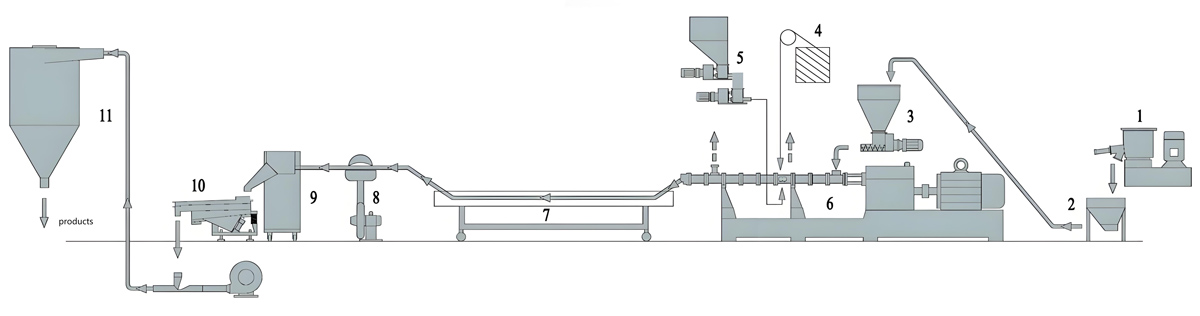
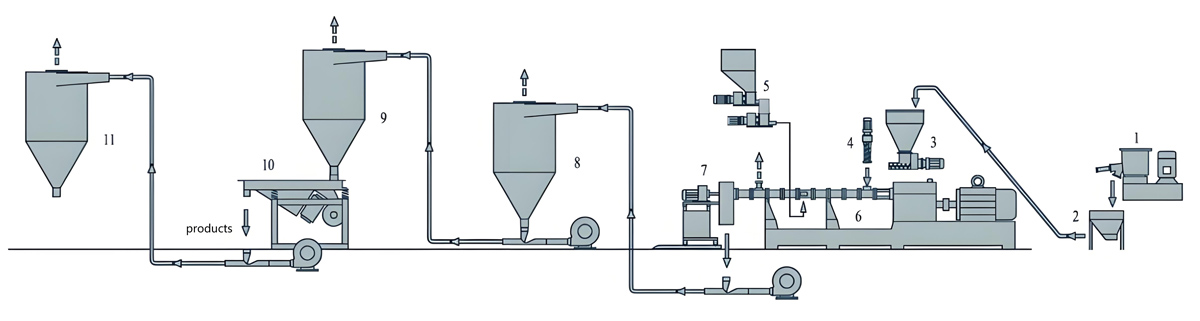
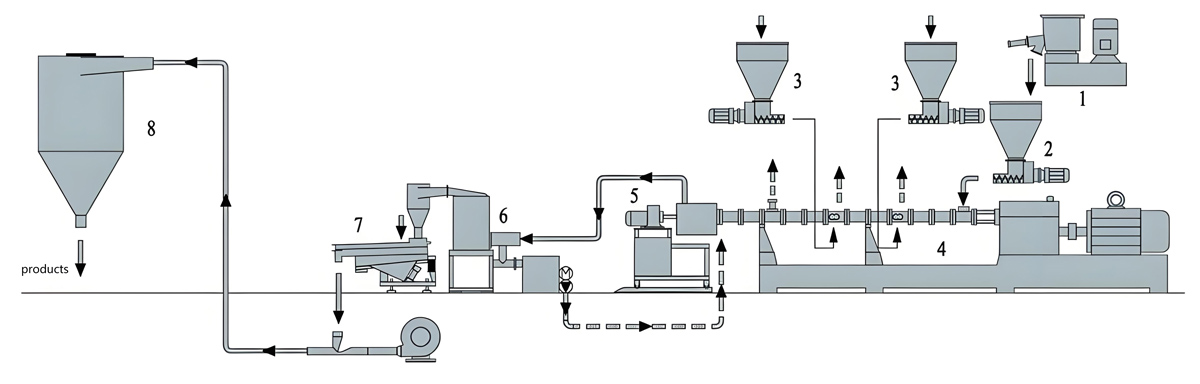
The production of AS masterbatches on a compact extruder emphasizes efficiency. AS pellets are dried (moisture < 0.1%) and fed into the compact KTE extruder. The compact design typically has an L/D of 36:1 to 40:1, which is shorter than standard compounding lines. To compensate for the shorter residence time, the screw speed is slightly higher, and the mixing elements are intensified. The process involves rapid melting, high-shear mixing to disperse pigments, and immediate pressure build-up for filtration. The melt is pelletized via a water-ring or strand pelletizer. The compact unit often includes the feeder, extruder, and pelletizer on a single skid, minimizing material travel distance and cooling time, which is beneficial for heat-sensitive AS.
Production Equipment Introduction
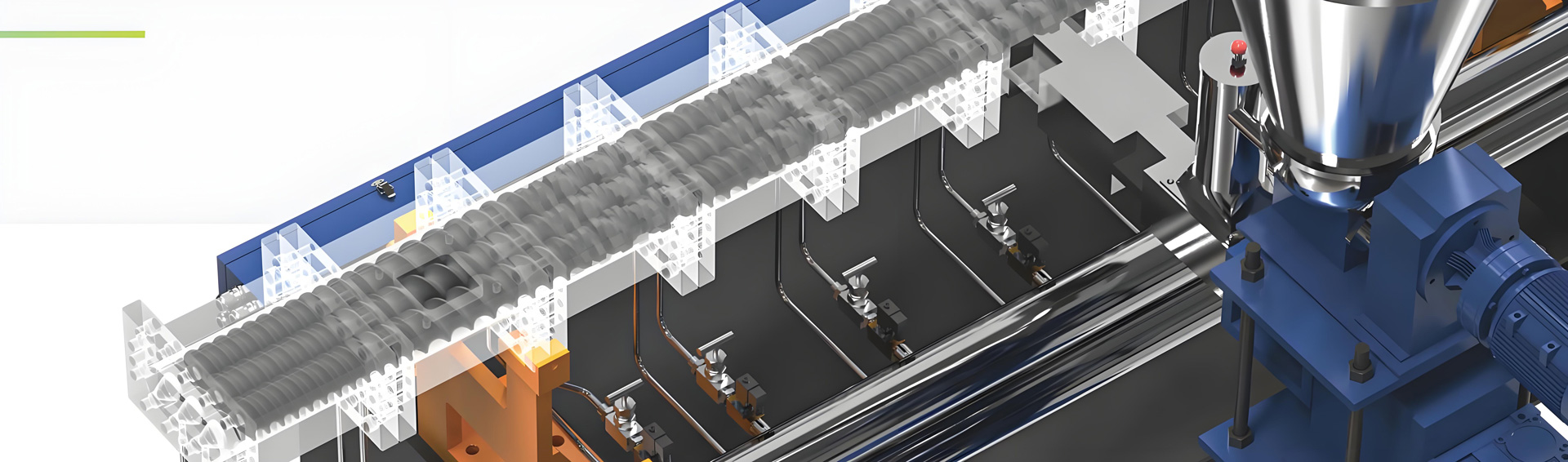
The Nanjing Kerke KTE Series Compact Extruder (e.g., KTE-50 or KTE-65) is designed for a small footprint (often less than 4 meters in length total). Despite its size, it uses the same high-quality gearboxes and screw manufacturing precision as the larger models. The barrel is shorter but features optimized heating/cooling zones to ensure rapid thermal response. The control cabinet is usually mounted directly on the extruder or on a small side-car frame, reducing wiring complexity. For AS processing, the screws are configured with strong mixing elements early in the barrel to ensure the rigid AS melts quickly. The system often includes a vacuum vent, though it may be shorter than on PVA or PETG systems. The drive motor is high-efficiency to save energy in smaller batch productions.
Parameter Settings
Temperature Profile
AS melts between 200°C and 240°C. Zone 1: 150°C, Zone 2: 190°C, Zone 3-4: 220°C – 230°C, Zone 5-6: 230°C, Die: 235°C. The profile is relatively flat to prevent heat accumulation in the short barrel.
Screw Speed and Throughput
Compact extruders run at higher speeds to achieve capacity. For AS, speeds range from 400 to 800 rpm. The throughput is lower (50-300 kg/h), making it ideal for specialty batches. The torque should be maintained between 50-70% to ensure good mixing without overloading the smaller gearbox.
Residence Time
Residence time is critical in compact systems. It is typically 30-60 seconds. This requires precise feeding; if the feed stops, the barrel must be emptied quickly to prevent material degradation. Automatic purge systems are often included in compact designs.
Equipment Price
Reference Price for Nanjing Kerke KTE Series (Compact Model):
- Model KTE-50 (Lab/Pilot Scale): $65,000 – $85,000 USD. Output: 50-150 kg/h.
- Model KTE-65 (Small Scale Production): $95,000 – $120,000 USD. Output: 200-400 kg/h.
Note: These models are skid-mounted and plug-and-play. Prices are significantly lower than full-size compounding lines. FOB Nanjing.
Production Problems, Solutions, and Avoidance
Problem: Inconsistent Color (Streaking)
Cause Analysis: In a compact system with a shorter L/D, there is less room for distributive mixing. If the screw configuration is not optimized, or if the pigment feeding is not synchronized with the main feed, streaks of unmixed pigment can appear. Another cause is temperature fluctuation in the shorter barrel, leading to inconsistent melting.
Solution: Increase the number of kneading blocks or use toothed mixing elements to improve distributive mixing. Use a liquid pigment injection system instead of solid feeding for better dispersion. Stabilize the feeding rate; use loss-in-weight feeders with high refresh rates. Check heater bands for tight contact; loose bands cause temperature swings.
Avoidance Method: Optimize the screw design specifically for AS rheology before manufacturing. Use masterbatching software to calculate the required mixing energy. Pre-blend the pigment with a small amount of AS carrier in a high-speed mixer to create a “pre-mix” before feeding into the extruder. This reduces the mixing burden on the compact extruder.
Problem: Pellet Deformation (Sticking to Cutter)
Cause Analysis: AS has a relatively low melt strength. If the strands from the die are not cooled quickly enough, or if the water bath is too warm, the soft strands can flatten or stick to the pelletizer cutter. This is more common in compact lines where the distance from die to cutter is short, leaving less cooling time.
Solution: Lower the water temperature significantly (use chilled water if necessary, around 10-15°C). Increase the water flow rate around the strands. Apply a very light coating of silicone oil or water-based release agent to the strands (if approved by the end-user). Reduce the cutter speed to match the output exactly so there is no tension on the strands.
Avoidance Method: Use an underwater pelletizing system instead of a water bath for compact lines. Underwater systems cut the melt directly into water, ensuring perfect spherical pellets and immediate cooling. Design the die face with a larger number of small holes rather than a few large ones to increase surface area for cooling. Ensure the take-up roller (if used) is synchronized perfectly with the extruder speed.
Problem: Brittle Masterbatch Pellets
Cause Analysis: AS is inherently brittle. If the extrusion process involves excessive shear or if the material degrades (chain scission), the final masterbatch pellets will be dusty or break easily during handling. Over-drying or overheating can also cause embrittlement.
Solution: Reduce screw speed to lower shear heat. Lower barrel temperatures by 10°C. Check if an impact modifier is needed in the formulation (if not restricted). Ensure the drying temperature is not too high; 80°C for 2 hours is usually sufficient for AS.
Avoidance Method: Monitor the intrinsic viscosity (IV) of the AS carrier regularly. If IV drops, the material has degraded. Use a gentler screw profile with fewer high-shear elements. Avoid reprocessing AS multiple times; use virgin carrier for high-quality masterbatches. Incorporate a small amount of elastomer if the application allows to improve toughness.
Maintenance
Compact extruders require diligent maintenance because they operate at higher speeds and loads relative to their size. Daily inspection of the seals and oil levels is critical. Because the system is integrated, any leak (hydraulic or thermal oil) can contaminate the product. The screw elements should be inspected weekly for wear, as the higher speeds cause faster abrasion. The die face should be cleaned regularly to prevent “die drool” (oxidized material buildup). The electrical cabinet cooling fans must be kept clean to prevent overheating of the PLC and drives. Since compact systems are often used for frequent color changes, a good purge compound procedure is essential to minimize downtime between batches.
FAQ
Q: Is a compact extruder suitable for filled AS compounds?
A: It is suitable for light filling (up to 20% talc or calcium carbonate). For heavy filling (>30%), the torque requirements might exceed the capacity of a compact gearbox, and a full-size high-torque extruder (KTE-75 or larger) is recommended.
Q: How fast can I change colors on a compact line?
A: Compact lines have less volume in the barrel, so color changes are relatively fast (15-30 minutes depending on the screw design and purge compound used). Using a color-changing valve or purging with a low-melting-point polymer speeds this up.
Q: Can I run AS on a single screw extruder?
A: Yes, for very simple color batches with low pigment loading. However, for consistent dispersion and to handle additives like antistatic agents or stabilizers, a twin screw (even a compact one) provides significantly better mixing and product consistency.
Conclusion
The Compact Twin Screw Extruder from the Nanjing Kerke KTE Series offers an ideal solution for manufacturers needing flexibility and space efficiency in AS masterbatch production. While the L/D ratio is shorter, careful screw design and optimized process parameters allow for high-quality compounding of rigid AS polymers. The compact footprint makes it perfect for pilot plants, specialty compounders, or facilities with limited space. By understanding the limitations (torque capacity) and advantages (quick response, easy cleaning) of compact systems, producers can efficiently manufacture AS masterbatches with excellent color dispersion and thermal stability. The lower initial investment compared to full-scale lines makes it an attractive option for entering the masterbatch market or producing smaller, specialized batches.