Introduction
PPR CaCO3 filled masterbatch represents a crucial additive in the polymer industry, enabling manufacturers to enhance material properties while optimizing production costs. The production of high quality masterbatch requires precise control over processing conditions, appropriate equipment selection, and thorough understanding of material characteristics. Twin screw extruders have emerged as the preferred equipment for manufacturing PPR CaCO3 filled masterbatch due to their superior mixing capabilities, excellent dispersion characteristics, and efficient processing performance.
The utilization of calcium carbonate as a filler in PPR matrices offers multiple advantages, including improved stiffness, enhanced dimensional stability, and significant cost reduction. However, achieving uniform dispersion of CaCO3 particles within the PPR matrix demands specialized processing equipment and optimized operating conditions. This comprehensive guide explores every aspect of twin screw extruder operation for PPR CaCO3 filled masterbatch production, from formulation strategies to troubleshooting common processing issues.
Formulation Ratios for PPR CaCO3 Filled Masterbatch
Standard Formulation Ranges
The formulation of PPR CaCO3 filled masterbatch varies depending on the intended application and desired final properties. Standard CaCO3 loading levels typically range from 20% to 70% by weight, with carrier resin content between 30% and 80%. Common commercial formulations include:
Low Loading Grade (20-30% CaCO3): Suitable for applications requiring minimal property modification while still benefiting from cost reduction. This formulation maintains excellent mechanical properties and processability.
Medium Loading Grade (40-50% CaCO3): Represents the most widely used range, balancing property enhancement with economic benefits. This grade provides significant cost savings while maintaining acceptable mechanical performance.
High Loading Grade (60-70% CaCO3): Designed for applications where cost reduction is the primary concern. This formulation requires careful attention to processing conditions to maintain adequate dispersion and prevent property degradation.
Carrier Resin Selection
PPR grade selection significantly influences masterbatch quality and processing behavior. High melt flow index (MFI) PPR resins (MFI 10-20 g/10min) are preferred for better filler dispersion and easier processing. The carrier resin should exhibit good compatibility with the target application resin to ensure proper incorporation during final product manufacturing.
Additives Package
Comprehensive formulation includes various additives to enhance performance and processability:
Coupling Agents: Maleic anhydride grafted polypropylene (PP-g-MA) at 1-3% loading improves interfacial adhesion between CaCO3 particles and PPR matrix, enhancing mechanical properties.
Lubricants: Calcium stearate (0.5-1.5%) or zinc stearate (0.3-1.0%) reduce friction during processing, improving output rates and reducing equipment wear.
Processing Aids: Fluoropolymers (0.1-0.5%) enhance melt flow characteristics and reduce die build-up.
Stabilizers: Antioxidants and heat stabilizers (0.2-0.5%) protect the polymer during processing and extend product service life.
Production Process
Raw Material Preparation
Effective production begins with proper raw material preparation. PPR resin should be pre-dried at 80-90°C for 2-4 hours to reduce moisture content below 0.1%. Calcium carbonate must also be dried if surface moisture exceeds 0.5%, particularly for high loading formulations. All additives should be weighed accurately according to the formulation and pre-mixed to ensure uniform distribution.
Feeding System Configuration
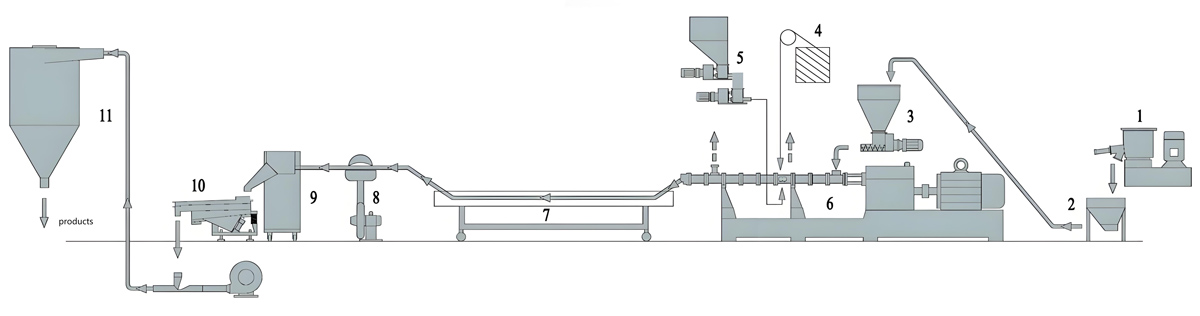
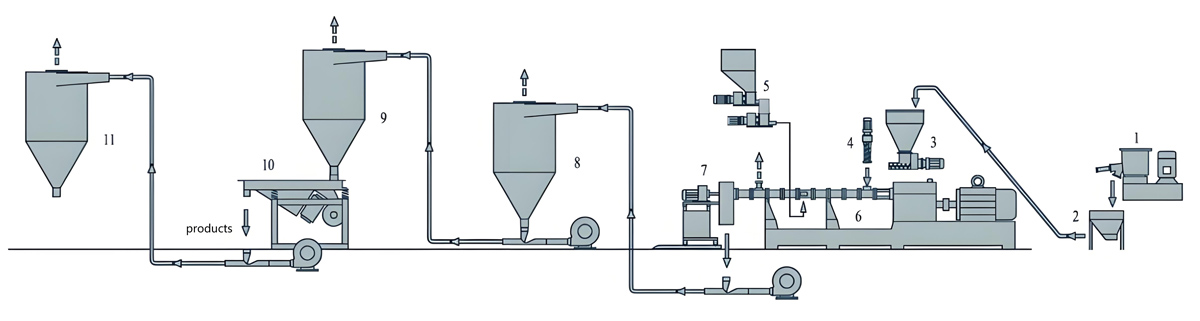
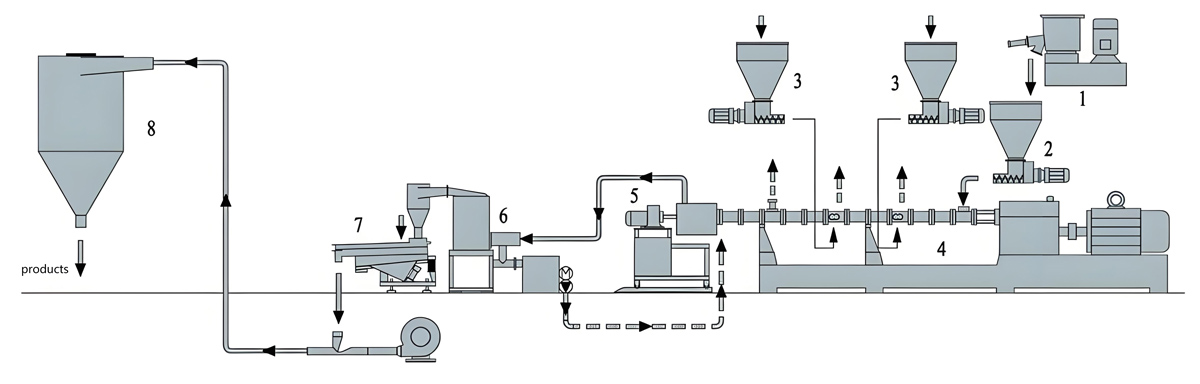
Modern twin screw extruders employ gravimetric feeding systems for precise material metering. The primary feeding port typically receives the PPR carrier resin, while downstream side feeders introduce the CaCO3 filler and additives. This configuration allows for optimal residence time control and prevents premature filler degradation.
Extruder Zones Configuration
PPR CaCO3 filled masterbatch production typically utilizes an extruder with 8-12 processing zones. The initial zones (1-3) focus on polymer melting and initial mixing. Intermediate zones (4-7) provide high shear mixing for filler dispersion. Final zones (8-12) complete dispersion and prepare the melt for pelletization.
Temperature Profile
Optimal temperature profiles vary based on formulation and equipment configuration. A typical profile for PPR CaCO3 masterbatch production:
Zone 1 (Feed): 180-190°C
Zone 2-3 (Compression): 190-200°C
Zone 4-6 (Mixing): 200-210°C
Zone 7-9 (Dispersion): 205-215°C
Zone 10-12 (Metering/Die): 210-220°C
Die temperatures should be maintained 5-10°C above the final melt temperature to ensure smooth flow.
Screw Speed and Throughput
Screw speed significantly impacts mixing quality and production efficiency. For PPR CaCO3 masterbatch, screw speeds between 200-400 RPM are typical, with higher speeds favored for improved dispersion. However, excessive speed may reduce residence time and compromise mixing quality. Throughput rates range from 50-300 kg/h depending on extruder size and formulation.
Pelletization
Water ring or strand pelletizers are commonly used for PPR CaCO3 masterbatch. The pelletization system must handle abrasive filled materials without excessive wear. Water-cooled pellets should be dried immediately to prevent moisture absorption, particularly for hydrophilic CaCO3 formulations.
Production Equipment Introduction
Twin Screw Extruder Configuration
The production of PPR CaCO3 filled masterbatch requires specialized twin screw extruder equipment. The KTE Series twin screw extruders from Kerke Extrusion Equipment Company are particularly well-suited for this application due to their robust construction and optimized screw design.
Extruder Specifications
KTE Series extruders feature co-rotating twin screw configurations with L/D ratios between 30:1 and 40:1, providing adequate mixing length for filler dispersion. The screw diameters range from 25mm to 92mm, corresponding to production capacities from 20 kg/h to 500 kg/h. These extruders employ modular screw elements that can be customized for specific formulation requirements.
Feeding System Components
Advanced feeding systems include gravimetric twin screw feeders for resin and loss-in-weight feeders for fillers. The main hopper typically includes dehumidification capability to maintain resin moisture content. Side stuffing units enable downstream filler addition, improving dispersion efficiency while reducing thermal degradation.
Barrel and Screw Design
The barrel construction features hardened wear-resistant liners to withstand abrasive CaCO3 particles. Screw elements are constructed from tool steel with specialized hardening treatments. The modular design allows for element configuration optimization based on processing requirements.
Temperature Control System
Precise temperature control is achieved through electric heating zones with independent PID controllers. Each barrel zone includes multiple heating cartridges for uniform heat distribution. Air or water cooling systems provide rapid temperature adjustment when needed.
Die and Pelletizing System
The die system typically features multi-strand designs with adjustable flow resistance. Strand guides direct molten material to the pelletizing system. Water ring pelletizers offer compact operation and reduced water consumption compared to strand pelletizers.
Parameter Settings
Screw Configuration Optimization
Effective screw configuration for PPR CaCO3 masterbatch includes:
Transport Elements: Standard conveying elements in feed and metering zones ensure reliable material transport.
Kneading Blocks: 60° staggered kneading blocks in mixing zones provide dispersive mixing action. Multiple kneading block assemblies with varying staggers optimize both distributive and dispersive mixing.
Reverse Elements: Periodic reverse elements enhance residence time and mixing efficiency.
Gear Mixers: Downstream gear mixers complete dispersion and homogenization.
Processing Temperature Optimization
Temperature settings must balance adequate melting and mixing with thermal degradation prevention. Higher temperatures improve filler wetting but may cause polymer degradation. The optimal profile depends on specific PPR grade and CaCO3 loading level.
Throughput and Screw Speed Balance
The ratio of throughput to screw speed (specific throughput) influences mixing quality. Lower specific throughput (higher screw speed for given throughput) generally improves dispersion but increases shear heating. Finding the optimal balance requires experimentation for each formulation.
Vacuum Venting Settings
Vacuum venting between 400-600 mbar absolute pressure removes volatiles and entrapped air. Vent port location typically follows the mixing zones where volatiles are released. Proper venting reduces defects and improves product quality.
Equipment Price
Twin Screw Extruder Cost Range
The investment cost for twin screw extruders varies significantly based on capacity and configuration:
Small Scale (25-35mm screw): $25,000 – $45,000
Medium Scale (45-65mm screw): $60,000 – $120,000
Large Scale (75-92mm screw): $150,000 – $300,000
Additional Equipment Costs
Complete production lines require additional investment:
Feeding Systems: $8,000 – $25,000
Pelletizing Systems: $12,000 – $35,000
Control Systems: $5,000 – $15,000
Auxiliary Equipment (Dryers, Conveyors, etc.): $15,000 – $40,000
Total Production Line Investment
Complete twin screw extruder lines for PPR CaCO3 masterbatch production typically range from $65,000 for small capacity systems to over $400,000 for large-scale industrial installations.
Production Problems and Solutions
Poor Filler Dispersion
Problem Identification: Poor dispersion manifests as visible agglomerates, surface defects, and inconsistent mechanical properties in final products. The masterbatch may show streaks or speckled appearance indicating inadequate mixing.
Root Causes: Insufficient mixing energy due to low screw speed or inadequate kneading elements. Incorrect screw configuration lacking proper dispersive mixing elements. Low barrel temperatures reducing polymer melt viscosity and mixing efficiency. Overloading filler concentration exceeding mixing capacity. Inadequate residence time preventing complete dispersion.
Solutions: Increase screw speed within equipment limits while monitoring melt temperature. Redesign screw configuration adding more kneading blocks and gear mixers. Increase barrel temperature profile to reduce melt viscosity and improve mixing. Reduce filler loading or increase carrier resin content. Modify throughput to achieve appropriate specific throughput. Implement side feeding for filler to improve dispersion efficiency.
Prevention Methods: Regular screw configuration optimization for each formulation. Establish baseline processing parameters for each formulation. Implement quality control testing for dispersion quality using microscopy. Maintain consistent raw material quality, particularly filler particle size distribution. Use coupling agents to improve filler-matrix compatibility reducing required mixing energy.
Inconsistent Pellet Size and Shape
Problem Identification: Pellets vary in size, shape, or have irregular edges. Stringy pellets or fines indicate pelletizing issues affecting subsequent processing.
Root Causes: Inconsistent melt temperature causing viscosity variations. Uneven flow through die strands. Pelletizer speed mismatched with extrusion rate. Water temperature fluctuations in water ring pelletizers. Worn or damaged pelletizer knives. Incorrect die geometry or die face wear.
Solutions: Stabilize barrel temperature profile within tighter tolerances. Equalize die flow resistance through die design optimization. Synchronize pelletizer speed with extrusion rate using automatic control systems. Maintain consistent water temperature in pelletizing system. Replace worn pelletizer knives regularly. Recondition or replace worn die faces.
Prevention Methods: Implement automatic temperature control systems with PID tuning. Install flow monitoring and control systems. Establish regular knife replacement schedule. Use water temperature control systems. Perform regular die inspection and maintenance.
Masterbatch Moisture Content
Problem Identification: Moisture-related defects including bubbles, voids, surface imperfections, or inconsistent flow in subsequent processing. The masterbatch may show poor dispersion during end-use processing.
Root Causes: Inadequate drying of raw materials before processing. Atmospheric moisture absorption during storage. Insufficient venting capacity in extruder. High humidity production environment. Inadequate pellet drying after production.
Solutions: Implement pre-drying of PPR resin at 80-90°C for 2-4 hours. Add moisture absorbent desiccants to storage containers. Increase vacuum venting capacity. Install environmental controls for production area humidity. Implement post-production pellet drying systems.
Prevention Methods: Establish strict raw material quality control procedures. Install dehumidification systems in production area. Use moisture barrier packaging for finished masterbatch. Implement regular moisture content testing. Train operators on proper material handling procedures.
Thermal Degradation
Problem Identification: Yellowing or darkening of masterbatch, burnt odor, or reduced molecular weight indicated by viscosity measurements. Degraded masterbatch shows poor processing characteristics.
Root Causes: Excessive barrel temperatures causing polymer degradation. Overly long residence time due to low throughput or complex screw configuration. Poor thermal stability of PPR resin grade. Hot spots in barrel due to heater malfunction. Screw design creating excessive shear heating.
Solutions: Reduce barrel temperature profile to minimum required for processing. Optimize throughput to reduce residence time. Use thermally stable PPR grades for filled masterbatch. Repair malfunctioning heating elements. Redesign screw configuration to reduce shear heating. Add stabilizers to formulation.
Prevention Methods: Implement temperature monitoring at multiple points. Use thermal stabilizers in formulation. Perform regular maintenance on heating and cooling systems. Establish maximum residence time limits. Monitor melt viscosity regularly as degradation indicator.
Equipment Wear and Abrasion
Problem Identification: Reduced output over time, decreased mixing quality, visible metal contamination in masterbatch, increased power consumption. Barrel and screw wear indicates abrasive filler damage.
Root Causes: High filler loading causing accelerated wear. Inadequate material hardness in barrel and screw construction. Improper screw speed creating excessive mechanical stress. Poorly maintained equipment allowing contamination. Operating beyond equipment design specifications.
Solutions: Replace worn barrel liners and screw elements regularly. Upgrade to harder materials such as tungsten carbide coatings. Reduce screw speed if excessive wear occurs. Implement regular maintenance and inspection schedules. Redesign formulation to reduce abrasive filler if possible.
Prevention Methods: Use hardened wear-resistant materials for all contacting components. Implement regular wear monitoring and replacement schedules. Maintain proper operating parameters within equipment limits. Use high quality filler with controlled particle size distribution. Install filtration systems to capture metal contamination.
Maintenance and Care
Daily Maintenance Procedures
Daily maintenance activities ensure consistent operation and prevent unexpected downtime:
Visual Inspection: Check for leaks, unusual vibrations, or abnormal sounds during operation. Monitor amperage readings for changes indicating equipment stress.
Temperature Verification: Verify all temperature zones are operating within specified ranges. Check for proper heating and cooling operation.
Feeding System Check: Ensure feeders are delivering material consistently at set rates. Clean feeder hoppers of any material build-up.
Pelletizer Inspection: Check pelletizer knives for wear and proper alignment. Ensure water flow and temperature are correct.
Housekeeping: Clean equipment exterior and work area to prevent contamination.
Weekly Maintenance Activities
Weekly maintenance addresses less immediate but important equipment needs:
Screw and Barrel Inspection: If possible, inspect screw elements for wear or damage. Check barrel for signs of wear or scoring.
Lubrication: Apply lubrication to all moving parts according to manufacturer specifications. Check gearbox oil levels and condition.
Electrical System Check: Verify all electrical connections are secure. Check control system operation and calibration.
Cooling System Maintenance: Clean cooling water filters and check water quality. Inspect cooling lines for leaks or blockages.
Filter Inspection: Check and replace melt filters according to schedule or condition.
Monthly Maintenance Requirements
Monthly maintenance includes more comprehensive inspection and maintenance activities:
Complete System Inspection: Perform thorough inspection of all mechanical components. Check alignment of drives, gears, and bearings.
Seal and Gasket Replacement: Replace seals and gaskets showing wear or damage to prevent leaks.
Control System Calibration: Verify temperature, speed, and pressure sensors are calibrated accurately. Update control system software if needed.
Safety System Check: Test all emergency stop systems and safety interlocks. Verify safety guards are properly secured.
Documentation Review: Review maintenance logs and update procedures based on equipment performance.
Annual Maintenance Overhaul
Annual maintenance provides comprehensive equipment evaluation and refurbishment:
Complete Disassembly Inspection: Disassemble major components for thorough inspection. Identify worn or damaged parts requiring replacement.
Wear Measurement: Measure screw and barrel wear quantitatively to assess remaining service life. Compare measurements to original specifications.
Motor and Drive Inspection: Test motor windings, bearings, and coupling condition. Verify gearbox gear wear and lubrication condition.
Control System Upgrade: Update control systems with latest software versions. Replace obsolete components.
Documentation Update: Update all technical documentation and maintenance records based on overhaul findings.
Troubleshooting Guide
Common operational problems require systematic troubleshooting approaches:
Output Reduction: Check for worn screw elements or barrel liner. Verify feeder calibration. Examine melt filter for blockage. Assess raw material quality changes.
Quality Degradation: Analyze processing parameter deviations. Check mixing efficiency through sampling. Evaluate raw material consistency. Inspect pelletizer condition.
Power Consumption Increase: Examine gearbox and drive condition. Check for screw or barrel binding. Assess material viscosity changes. Verify proper lubrication.
Temperature Control Issues: Check heating element operation. Verify cooling system function. Examine sensor calibration. Assess thermal insulation condition.
Safety and Compliance
Operating twin screw extruders requires attention to safety and regulatory compliance:
Personal Protective Equipment: Operators must wear appropriate PPE including heat resistant gloves, safety glasses, and hearing protection. Use proper lifting techniques for heavy components.
Emergency Procedures: Establish clear emergency shutdown procedures. Train operators on fire and electrical emergency response. Install and maintain emergency stops at accessible locations.
Regulatory Compliance: Ensure equipment meets local electrical and safety standards. Maintain proper documentation for regulatory inspections. Implement lockout/tagout procedures for maintenance.
Environmental Considerations: Control emissions and waste properly. Recycle scrap material when possible. Minimize energy consumption through efficient operation.
FAQ
What is the optimal CaCO3 loading level for PPR masterbatch?
The optimal loading depends on application requirements. For general applications, 40-50% CaCO3 provides good balance of cost and properties. Higher loadings up to 70% are possible but may compromise mechanical properties. Lower loadings of 20-30% maintain excellent properties with modest cost savings.
How do I achieve uniform CaCO3 dispersion in PPR?
Achieve uniform dispersion through proper screw configuration with sufficient kneading blocks, appropriate screw speed (200-400 RPM), adequate barrel temperature, and sufficient residence time. Using coupling agents like PP-g-MA also improves dispersion and final properties.
What type of twin screw extruder is best for PPR CaCO3 masterbatch?
Co-rotating twin screw extruders with L/D ratios between 30:1 and 40:1 provide excellent mixing for filled masterbatch. KTE Series extruders from Kerke offer robust construction suitable for abrasive fillers. Modular screw design allows configuration optimization.
How important is raw material drying?
Raw material drying is critical for consistent quality. PPR should be dried at 80-90°C for 2-4 hours to reduce moisture below 0.1%. Even with hydrophobic PPR, residual moisture can cause defects. Calcium carbonate may also require drying if surface moisture is present.
What are the signs of poor dispersion?
Poor dispersion manifests as visible agglomerates, surface defects, speckled appearance, and inconsistent mechanical properties. Microscopic examination reveals undispersed particles. Testing masterbatch in final applications shows inconsistent processing and properties.
How often should screw elements be replaced?
Replacement frequency depends on filler loading and operating conditions. With moderate CaCO3 loading (40-50%), screw elements typically last 2-3 years with proper maintenance. Higher loadings increase wear rates. Regular inspection and measurement help predict replacement needs.
Can I produce high loading CaCO3 masterbatch?
High loading masterbatch (60-70% CaCO3) is possible but requires careful processing. Use specialized screw configurations with enhanced mixing elements. Reduce throughput to increase residence time. Consider using coupling agents to maintain properties. Expect increased equipment wear.
What temperature profile should I use?
A typical profile starts at 180-190°C in feed zones, gradually increasing to 210-220°C in final zones. Exact temperatures depend on PPR grade and CaCO3 loading. Higher loadings may require slightly lower temperatures to prevent thermal degradation from increased viscosity.
How do I prevent thermal degradation?
Prevent degradation by using appropriate temperature profiles, avoiding excessive residence time, selecting thermally stable PPR grades, adding stabilizers to formulation, and maintaining equipment to prevent hot spots. Regular melt viscosity monitoring helps detect degradation early.
What maintenance is most critical?
Most critical maintenance includes regular screw and barrel inspection for wear, proper lubrication, temperature sensor calibration, and pelletizer knife maintenance. Establishing and following a maintenance schedule prevents unexpected downtime and extends equipment life.
Conclusion
The production of PPR CaCO3 filled masterbatch using twin screw extruders requires comprehensive understanding of formulation, processing parameters, equipment characteristics, and troubleshooting techniques. Success depends on balancing multiple factors including filler loading, mixing efficiency, thermal management, and equipment maintenance.
Proper formulation selection provides the foundation for quality masterbatch production. The carrier resin, CaCO3 loading level, and additives package must be optimized for specific application requirements. Processing parameters including temperature profile, screw speed, throughput, and residence time must be carefully controlled to achieve consistent quality.
Equipment selection and maintenance significantly impact production success. KTE Series twin screw extruders offer the robust construction and modular design needed for abrasive filled masterbatch production. Regular maintenance prevents unexpected downtime and extends equipment service life.
Troubleshooting skills enable rapid resolution of production problems and prevention of recurring issues. Understanding root causes and implementing effective solutions maintains consistent product quality and production efficiency.
By following the guidelines and best practices outlined in this comprehensive guide, manufacturers can achieve consistent, high quality PPR CaCO3 filled masterbatch production while optimizing costs and maximizing equipment utilization. Continuous improvement through monitoring, analysis, and refinement of processes ensures long-term success in competitive masterbatch markets.