Introduction to Anti-Scratch Masterbatches
Anti-scratch masterbatches represent specialized formulations designed to enhance surface hardness and scratch resistance of polymer materials without sacrificing aesthetic or mechanical properties. These masterbatches incorporate concentrated additives including crosslinking agents, nanoparticles, or surface modifiers that migrate to the polymer surface during processing or use, creating a protective layer that resists scratching and marring. The production of anti-scratch masterbatches requires specialized equipment capable of uniformly dispersing these specialized additives while maintaining additive integrity and functional performance.
Conical twin screw extruders have emerged as the preferred equipment for anti-scratch masterbatch production due to their unique processing characteristics including variable screw geometry, ability to handle varying melt viscosities, and excellent distributive mixing capabilities. Conical technology enables efficient incorporation of scratch-resistant additives without compromising additive structure or functionality. This comprehensive guide explores anti-scratch masterbatch formulations, conical twin screw extrusion technology, processing parameters, and production optimization strategies.
Understanding Anti-Scratch Technology and Mechanisms
Anti-scratch functionality can be achieved through multiple mechanisms depending on additive chemistry and formulation approach. Surface migration technology incorporates additives that diffuse to the polymer surface, creating a thin protective layer that improves scratch resistance. Crosslinking mechanisms enhance surface hardness by forming network structures at or near the polymer surface. Nanoparticle reinforcement enhances surface hardness by incorporating hard filler particles that deflect scratching forces.
Different anti-scratch technologies offer distinct advantages and trade-offs. Surface migration technology provides excellent scratch resistance with minimal impact on mechanical properties but may compromise weather resistance for some formulations. Crosslinking mechanisms provide durable surface hardness but can introduce processing challenges. Nanoparticle reinforcement provides exceptional scratch resistance but requires careful dispersion to maintain clarity and processability.
Anti-Scratch Additive Chemistry
Common anti-scratch additives include polysiloxane-based materials, crosslinking agents, silica nanoparticles, and specialized wax formulations. Polysiloxane additives provide effective scratch resistance through surface migration and formation of lubricious layers. Crosslinking agents such as peroxides or maleic anhydride derivatives enhance surface hardness through chemical crosslinking. Silica nanoparticles provide dimensional stability and hardness reinforcement through rigid particle incorporation.
The selection of anti-scratch additive depends on polymer base, application requirements, and processing conditions. Polysiloxane additives are particularly effective for polyolefin-based formulations due to compatibility and surface migration characteristics. Crosslinking agents are effective for engineering polymers where dimensional stability is critical. Nanoparticle reinforcements provide exceptional scratch resistance but may require specialized processing techniques to maintain dispersion quality.
Formulation Design for Anti-Scratch Masterbatches
Effective anti-scratch masterbatch formulations require careful selection of base polymer, anti-scratch additives, dispersion aids, and processing modifiers. Formulation ratios depend on additive type, polymer compatibility, and performance requirements. Typical anti-scratch masterbatch concentration ranges from 10% to 40% active ingredient loading, with most applications utilizing 15% to 30% additive content for balanced performance and economy.
Base Polymer Selection
The base polymer serves as the carrier for anti-scratch additives, influencing additive dispersion, surface migration, and final product properties. The base polymer should demonstrate good compatibility with the anti-scratch additive to ensure uniform dispersion and retention of functionality. Common base polymers include polyethylene, polypropylene, ethylene-vinyl acetate copolymers, and various engineering polymers.
Polyethylene bases are common for general-purpose applications due to good compatibility with many anti-scratch additives. Polypropylene bases offer higher stiffness and surface hardness, enhancing anti-scratch performance synergistically with additives. Engineering polymer bases provide compatibility for specific applications requiring chemical resistance or thermal stability. Base polymer typically constitutes 60% to 90% of masterbatch formulation depending on additive loading.
Anti-Scratch Additive Loading
Additive loading levels depend on scratch resistance requirements, additive effectiveness, and formulation compatibility. Typical polysiloxane additive loading ranges from 15% to 30% for moderate scratch resistance applications, with high-performance formulations utilizing up to 40% loading. Crosslinking agent loading typically ranges from 5% to 20% depending on polymer reactivity and crosslink density requirements. Nanoparticle reinforcement loading typically ranges from 5% to 25% based on particle size and reinforcing effectiveness.
Optimal additive loading requires balancing scratch resistance benefit against cost and processing constraints. Higher additive loading improves scratch resistance but increases material cost and may introduce processing challenges. Formulation optimization through systematic testing determines minimum effective loading for specific application requirements, maximizing performance while minimizing cost.
Dispersion Aids and Processing Modifiers
Dispersion aids and processing modifiers are essential for achieving uniform additive distribution and maintaining processability. Compatibility agents ensure consistent mixing of immiscible components, preventing additive agglomeration and phase separation. Processing aids reduce melt viscosity and improve flow characteristics, enabling processing with high additive loading.
Compatibility agents typically constitute 1% to 5% of formulation depending on additive compatibility. Processing aids typically range from 2% to 8% for high-loading formulations. These additives ensure consistent additive dispersion while maintaining desirable process characteristics. Proper formulation balance ensures that anti-scratch performance benefits are not compromised by processing or storage conditions.
Conical Twin Screw Extruder Technology
Conical twin screw extruders represent specialized compounding equipment with unique geometric characteristics that distinguish them from parallel twin screw designs. These machines feature tapered screws with increasing root diameter from feed section to discharge, creating a narrowing gap between screws that increases pressure and mixing intensity along the process length. Nanjing Kerke Extrusion Equipment Company KTE Series conical twin screw extruders provide unique capabilities for anti-scratch masterbatch production through advanced design features optimized for specialty compounding applications.
Conical Geometry and Processing Characteristics
Conical geometry creates variable shear conditions along the screw length that enhance mixing efficiency and accommodate viscosity changes during processing. In the feed zone, wider screw spacing facilitates material feeding and initial plasticization. As material moves downstream, narrowing screw spacing increases pressure and shear intensity, enhancing dispersion and mixing effectiveness. This geometry provides superior distributive mixing while accommodating varying melt viscosities during processing.
The variable screw geometry enables processing of formulations with wide ranges of viscosity properties and additive types. Conical extruders demonstrate particular advantages for shear-sensitive materials requiring gentle processing conditions and applications demanding excellent distributive mixing. The design provides flexibility for processing materials with significantly different properties in the same equipment through screw configuration adjustments.
Dispersion Characteristics of Conical Technology
Conical twin screw extruders provide excellent distributive mixing capabilities due to the increasing screw diameter that creates a continuous increase in channel volume from feed to die. This geometry induces elongational flow and distributive mixing through varying channel dimensions. Combined with kneading block configurations, conical technology ensures uniform spatial distribution of additives throughout the polymer matrix.
While providing excellent distributive mixing, conical technology typically provides moderate to low dispersive mixing intensity compared to parallel twin screw designs with tight clearances. This characteristic makes conical technology suitable for shear-sensitive additives and formulations where maintaining particle structure is critical, such as anti-scratch nanoparticle additives. Supplemental dispersion aids or special screw configurations may be required for formulations containing high-loading agglomerating additives.
Production Process and Equipment Configuration
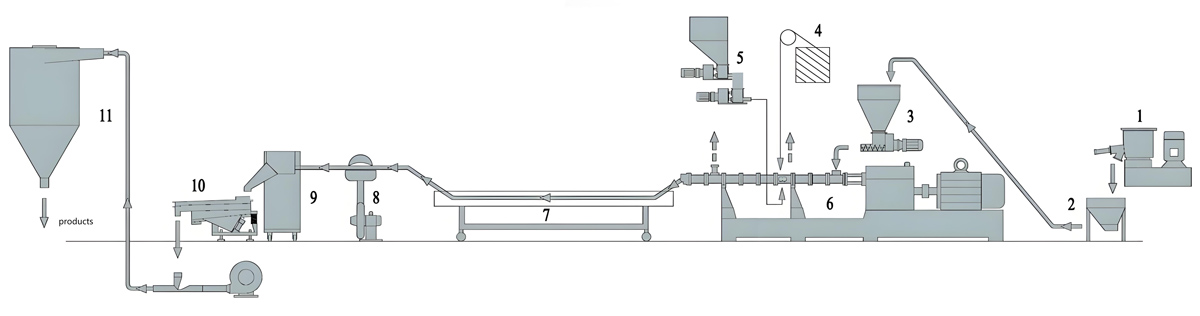
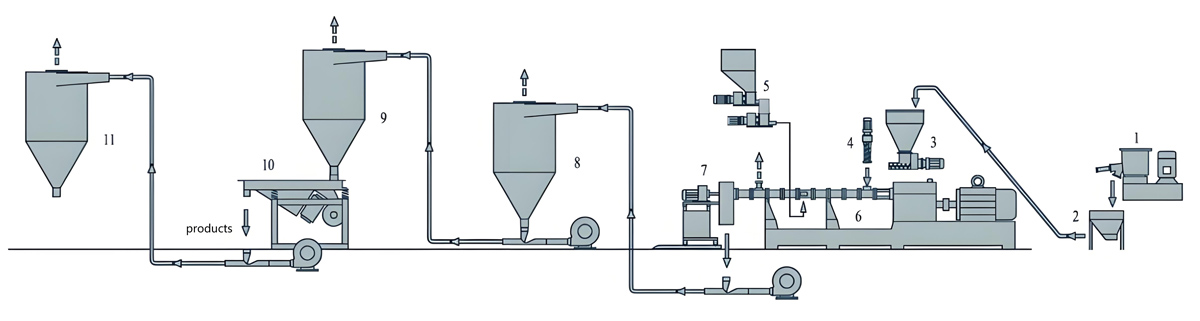
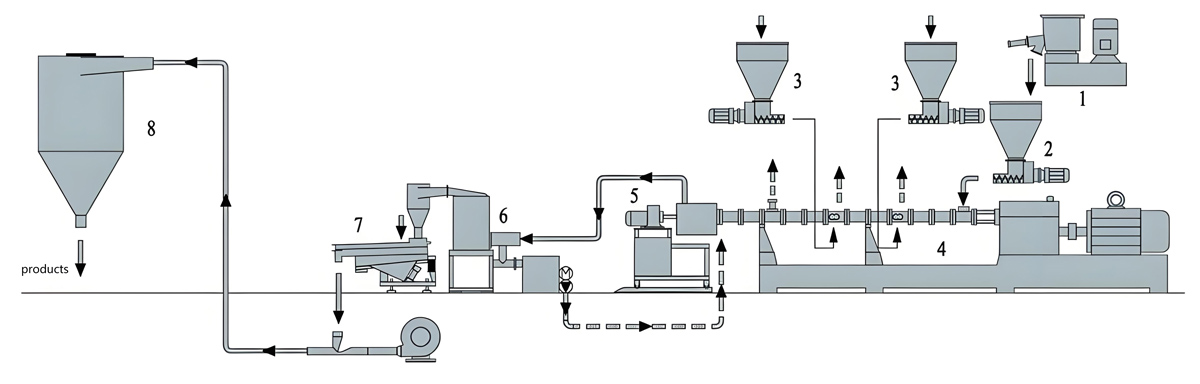
The production of anti-scratch masterbatches using conical twin screw extruders involves sequential processing stages including material preparation, feeding, plasticization, mixing, and pelletization. Conical technology provides unique processing capabilities that must be optimized for anti-scratch formulation requirements and additive characteristics.
Material Preparation and Handling
Material preparation is critical for maintaining additive functionality and ensuring consistent product quality. Anti-scratch additives often require careful handling to avoid moisture absorption, agglomeration, or degradation during storage or processing. Some sensitive additives may require moisture control or inert atmosphere handling to preserve performance characteristics.
Pre-mixing of components using high-intensity mixers can improve initial dispersion and reduce processing difficulty. Pre-blending ensures additive homogeneity before extrusion, reducing energy requirements and improving dispersion quality. Dry blending protocols must be followed to avoid additive separation during transport or feeding. Proper material preparation ensures consistent additive performance and masterbatch quality.
Feeding System Design
Feeding system design for anti-scratch masterbatch production must accommodate diverse material forms including pellets, powders, and potentially liquid additives. Main feeding systems for polymer base material typically utilize gravimetric feeders for accurate formulation control. Side feeding systems enable introduction of temperature-sensitive or shear-sensitive additives at downstream locations where temperatures and shear rates are lower.
Liquid additive feeding systems require specialized pumps capable of precise volumetric control. Metering pumps with calibration capabilities ensure consistent additive introduction rates. For high-loading formulations, split feeding systems may be employed to avoid overloading downstream zones with high-viscosity materials. Feeding accuracy within 1% is essential for maintaining consistent formulation ratios and performance.
Mixing Zone Optimization
Mixing zone configuration in conical extruders must balance mixing intensity with additive sensitivity. Shear-sensitive additives require gentler mixing conditions to preserve particle structure and performance. More robust mixing configurations are suitable for formulations containing agglomerating additives that require higher shear intensity for dispersion.
Conical extruder mixing zones typically incorporate modular kneading blocks and flighted elements that provide adjustable mixing intensity. Forward-conveying kneading blocks provide moderate shear and distributive mixing. Reverse-conveying kneading blocks increase residence time and mixing intensity through back-mixing zones. Neutral kneading blocks provide high shear for dispersion of agglomerated particles. Optimal mixing configuration depends on additive type, loading level, and formulation complexity.
Processing Parameters and Optimization
Processing parameters for anti-scratch masterbatch production must optimize additive dispersion, processing efficiency, and additive retention while maintaining functional performance. Temperature profile, screw speed, throughput, and vacuum conditions influence product quality and process efficiency.
Temperature Profile Management
Temperature profile configuration depends on polymer base, additive type, and processing objectives. Typical temperature profiles start at 160-180 degrees Celsius in feed zones, increase to 180-200 degrees Celsius in plasticization zones, and maintain 190-200 degrees Celsius through die zones. Temperature settings must avoid additive degradation while ensuring complete polymer melting.
Shear-sensitive additives may require lower temperature profiles or side feeding at downstream locations to minimize exposure to high temperatures. High-melting-point additives may require elevated temperature zones for adequate incorporation. Temperature optimization through systematic testing determines profile settings that balance dispersion quality and additive functionality. Consistent temperature control ensures uniform product quality across production runs.
Screw Speed and Throughput Optimization
Screw speed and throughput rates must be balanced to achieve optimal mixing quality and production efficiency while maintaining additive integrity. Conical twin screw extruders for anti-scratch masterbatch production typically operate at screw speeds from 50 to 150 rpm depending on formulation complexity and additive sensitivity. Lower screw speeds reduce shear intensity and additive degradation risk but increase residence time.
Throughput rates typically range from 50 to 500 kg/hr depending on machine size and formulation complexity. Throughput optimization considers screw speed, mixing quality requirements, and energy efficiency. Higher throughput rates increase productivity but may compromise dispersion quality for sensitive formulations. Throughput-to-speed ratio optimization ensures adequate residence time for dispersion while maximizing production efficiency.
Vacuum and Venting Configuration
Vacuum venting removes volatiles, moisture, and residual monomers while maintaining additive integrity. Some anti-scratch additives release volatiles during processing that must be removed to prevent porosity or surface defects. Vacuum systems typically apply 20-60 mbar absolute pressure to effectively remove volatiles without causing material buildup in vent zones.
Vent port location must be optimized to avoid additive accumulation or degradation. Side feeding zones following vacuum vents can prevent additive loss through vent ports. Multiple venting stages may be required for formulations releasing significant volatiles. Vacuum maintenance including filter replacement ensures consistent performance and prevents contamination from volatiles or material buildup.
Equipment Pricing and Cost Analysis
Investment in conical twin screw extrusion equipment for anti-scratch masterbatch production requires careful consideration of initial investment, operating costs, and long-term value. Understanding cost components enables informed equipment selection and investment decisions.
Capital Investment Requirements
Conical twin screw extruders for anti-scratch masterbatch production typically range in price from 60,000 to 220,000 US dollars depending on machine size, configuration, and manufacturer specifications. Small-scale machines suitable for pilot production or specialty applications typically cost 60,000 to 100,000 US dollars. Production-scale machines with throughput capacities 200-1000 kg/hr typically cost 100,000 to 220,000 US dollars.
Configuration options significantly influence pricing. Automation features including gravimetric feeding, automatic pelletizing, and process control systems add 20-35% to base cost. Wear-resistant components for abrasive formulations add 10-20% to capital investment. Liquid additive feeding systems and specialized die heads increase capital expenditure proportionally to complexity and capabilities.
Operating Cost Considerations
Operating costs include energy consumption, labor, maintenance, materials, and auxiliary systems. Energy consumption for conical twin screw extruders typically ranges from 0.10 to 0.20 kWh per kg of product depending on machine size and formulation complexity. Conical machines generally demonstrate higher energy efficiency than parallel twin screw designs for comparable output.
Labor requirements vary based on automation level, with fully automated systems requiring minimal operator intervention beyond setup and monitoring. Maintenance costs typically represent 2-4% of initial investment annually when proper preventive maintenance programs are followed. Material costs represent the largest operating expense, with anti-scratch additives often accounting for 30-70% of material cost depending on formulation complexity.
Production Challenges and Solutions
Anti-scratch masterbatch production encounters specific challenges related to additive sensitivity, dispersion quality, and functional performance retention. Understanding these challenges and implementing appropriate solutions ensures consistent product quality and manufacturing efficiency.
Additive Degradation and Performance Loss
Problem: Additive degradation manifests as reduced scratch resistance performance, discoloration, or reduced efficiency. Degraded additives lose functional performance characteristics, significantly compromising masterbatch effectiveness.
Cause Analysis: Excessive processing temperatures, high shear rates, exposure to moisture, or chemical reactions with other formulation components can cause additive degradation. Some sensitive additives including nanoparticles or crosslinking agents may decompose at typical processing temperatures or shear conditions. Incompatibility with formulation components may cause unwanted chemical reactions.
Solution and Prevention: Optimize temperature profile to minimize additive exposure to high temperatures. Reduce screw speed or shear intensity by modifying screw configuration. Implement side feeding of sensitive additives at lower-temperature locations. Use additive protection measures including compatibilizers or processing aids. Store sensitive additives under appropriate conditions to prevent pre-processing degradation. Select temperature-stable additive alternatives when necessary.
Poor Additive Dispersion and Uneven Performance
Problem: Poor additive dispersion results in inconsistent scratch resistance across product surfaces, visible streaks, or property variations. Poor dispersion significantly compromises functional performance and product quality.
Cause Analysis: Inadequate mixing intensity, inappropriate screw configuration, excessive throughput rates, or poor additive compatibility can cause dispersion problems. Agglomerating additives may not be sufficiently deagglomerated during processing. Formulation incompatibilities can cause additive migration or phase separation during extrusion or pelletization.
Solution and Prevention: Optimize screw configuration by adding high-shear kneading blocks or special dispersive mixing elements. Reduce throughput rates to increase residence time and mixing intensity. Utilize dispersion aids or compatibilizers to improve additive compatibility and prevent agglomeration. Implement pre-dispersion using high-intensity mixers before feeding. Ensure additive particle size is appropriate for processing conditions. Regularly maintain screw and barrel surfaces to maintain mixing performance.
Post-Processing Performance Variations
Problem: Post-processing performance variations occur when scratch resistance efficacy differs between masterbatch and final product performance. This discrepancy may result from additive migration, dispersion changes, or formulation interactions during downstream processing.
Cause Analysis: Additive re-agglomeration during reprocessing, surface migration changes during annealing, or chemical interactions with downstream process additives can alter scratch resistance. Residual stresses or part geometry variations may influence additive migration during molding or extrusion. Formulation changes or incomplete dispersion in masterbatch production can cause final product performance variations.
Solution and Prevention: Optimize masterbatch formulation to ensure additive stability during reprocessing. Test formulation under simulated downstream processing conditions before full-scale production. Adjust additive loading to compensate for potential performance losses during reprocessing. Incorporate stabilizing additives to maintain scratch resistance during post-processing treatments. Perform final product testing to validate masterbatch performance under actual production conditions.
Moisture Sensitivity and Porosity
Problem: Moisture sensitivity manifests as porosity, surface defects, or reduced additive performance. Some anti-scratch additives can react with moisture, compromising performance characteristics or causing visual defects.
Cause Analysis: Moisture absorption from ambient conditions, improper material storage, or inadequate drying protocols can introduce water into formulation components. Moisture can hydrolyze sensitive additives, creating gas bubbles during processing or reducing functional performance. Wet materials can cause premature additive reaction or dispersion problems.
Solution and Prevention: Implement strict moisture control protocols including material drying to reduce moisture content to below 0.02% for sensitive additives. Store sensitive materials in low-humidity conditions or sealed containers. Use closed material handling systems to prevent moisture pickup. Monitor moisture content throughout production process. Include desiccants or moisture scavengers in formulations to control residual moisture. Implement vacuum venting to remove moisture-related volatiles during processing.
Maintenance and Equipment Optimization
Regular maintenance ensures consistent conical twin screw extruder performance and extends equipment life. Preventive maintenance programs for conical equipment must address specific design characteristics including variable geometry components, unique sealing arrangements, and temperature control systems.
Conical Screw and Barrel Maintenance
Conical screw maintenance includes regular inspection of flight profiles, clearance measurements, and wear assessments. Variable clearance geometry requires precise clearance monitoring to maintain process consistency and performance. Clearance should be measured periodically across screw length, with adjustments or replacements made when clearances exceed manufacturer recommendations.
Barrel inspection focuses on liner condition, wear patterns, and temperature sensor function. Barrel liners may require replacement after extended operation with abrasive fillers or reactive additives. Screw components showing significant wear should be replaced to maintain mixing performance and process efficiency. Proper maintenance ensures consistent process characteristics and product quality.
Drive System and Gearbox Maintenance
Drive system maintenance ensures reliable power transmission and consistent screw speed control. Regular inspection of gearbox condition including oil analysis, bearing monitoring, and seal integrity ensures early detection of developing problems. Gearbox lubrication should follow manufacturer schedules using appropriate oil viscosity and quality.
Variable speed drive calibration ensures accurate speed control across operating ranges. Motor current monitoring detects abnormal load conditions indicating processing problems or equipment issues. Electrical system inspection including connection tightness and insulation testing prevents unexpected failures. Regular drive system maintenance ensures consistent operating performance and equipment longevity.
Temperature Control System Maintenance
Temperature control system maintenance ensures stable heating and cooling across process zones. Regular calibration of temperature sensors ensures accurate temperature measurement and control. Heating element and cooling circuit inspection ensures uniform heat transfer and temperature response.
Proportional-integral-derivative (PID) controller tuning ensures optimal temperature control response times and stability. Periodic validation of temperature uniformity across barrel zones ensures consistent processing conditions. Insulation inspection and replacement maintains energy efficiency and prevents worker safety hazards. Temperature system maintenance ensures consistent product quality and process reliability.
Quality Assurance and Testing Protocols
Comprehensive quality assurance protocols are essential for ensuring anti-scratch masterbatch performance and batch consistency. Testing should evaluate dispersion quality, additive functionality, stability, and processing characteristics throughout production.
Scratch Resistance Testing
Scratch resistance testing evaluates masterbatch performance through controlled scratching using standardized methods. Methods including taber abrasion testing, pencil hardness testing, and cross-hatch testing quantify scratch resistance under controlled conditions. Results are compared to established standards to ensure performance meets application requirements.
Scratch resistance testing should be performed at intervals throughout production to monitor consistency and performance. Accelerated testing under extreme conditions may predict long-term performance. Correlation between masterbatch testing and final product performance ensures functional efficacy under actual application conditions.
Dispersion Quality Assessment
Dispersion quality assessment evaluates additive distribution throughout polymer matrix using microscopy, spectroscopy, or visual inspection. Techniques including scanning electron microscopy or transmission electron microscopy quantify additive particle size and distribution. Color uniformity assessment visually identifies streaking or uneven dispersion in pellets.
Dispersion quality assessment ensures additive performance and functionality. Poor dispersion may lead to inconsistent scratch resistance or visual defects. Statistical process control monitors dispersion quality across production runs to identify process variations requiring corrective action.
Frequently Asked Questions
This section addresses common questions regarding anti-scratch masterbatch production using conical twin screw extruders.
What is the minimum anti-scratch additive loading required for effective performance?
Minimum effective additive loading depends on additive type, polymer base, and performance requirements. Typical minimum loading ranges from 0.1% to 5% of final product weight depending on mechanism effectiveness and application demands. Higher loading levels provide enhanced performance but increase material cost and processing challenges.
How does processing affect anti-scratch additive functionality?
Processing conditions significantly influence anti-scratch additive performance through effects on dispersion, migration, and structure retention. Excessive temperature or shear may degrade sensitive additives. Inadequate dispersion causes inconsistent performance. Processing parameters must be optimized to balance dispersion quality and additive functional integrity.
What factors influence additive migration behavior in final products?
Additive migration behavior is influenced by additive molecular weight, polymer base compatibility, processing temperature, and part geometry. Higher molecular weight additives migrate slower but provide more durable protection. Compatibility with polymer base influences migration kinetics. Temperature and cooling rate during molding affect migration direction and rate.
How often should equipment maintenance and calibration be performed?
Equipment maintenance frequency depends on operating conditions, formulation abrasiveness, and additive sensitivity. Daily maintenance should include visual inspection and cleaning. Weekly maintenance includes basic calibration and lubrication checks. Monthly maintenance includes more detailed inspection of screw and barrel condition. Quarterly maintenance includes complete calibration and major component inspection.
Conclusion
Conical twin screw extrusion technology represents the preferred equipment for anti-scratch masterbatch production due to its unique processing capabilities including variable screw geometry, ability to handle shear-sensitive additives, and excellent distributive mixing characteristics. Nanjing Kerke Extrusion Equipment Company KTE Series conical extruders provide advanced processing capabilities optimized for specialty compounding applications including anti-scratch masterbatch manufacturing.
Success in anti-scratch masterbatch production depends on additive chemistry understanding, formulation design optimization, processing parameter control, and comprehensive quality assurance. The growing demand for scratch-resistant polymer products across diverse applications ensures continued market expansion for anti-scratch masterbatches and compounding technology. By implementing appropriate production practices and leveraging conical extrusion technology, manufacturers can meet these market demands with consistent high-quality products.