Introduction to PCL Masterbatch Production
Polycaprolactone masterbatch production represents a specialized segment of the biodegradable polymer additives industry requiring processing equipment capable of maintaining continuous, consistent material feeding throughout extended production runs. PCL masterbatches enable efficient incorporation of pigments, nucleating agents, plasticizers, processing aids, and various functional additives into PCL polymer matrices while preserving the biodegradable characteristics, low melting point, and flexibility that make PCL valuable for medical, packaging, agricultural, and consumer products where biodegradability and low-temperature processability are essential. The production process demands equipment with continuous feeding capability to ensure consistent additive ratios and product quality throughout long production runs.
Continuous feeding twin screw extruders have revolutionized PCL masterbatch manufacturing by providing the level of feeding consistency and automation required for efficient production of these biodegradable materials. Unlike conventional extruders that may experience feeding variations, material interruptions, or inconsistent dosing that affect product quality, continuous feeding extruders incorporate advanced gravimetric feeding systems, material surge capacity, and automated feeding control that maintain consistent material flow rates for extended periods without operator intervention. This continuous feeding capability enables production consistency that reduces quality variations by 85 to 95 percent compared to conventional extruders while allowing unattended operation for extended production runs.
Market demand for PCL masterbatches continues expanding as applications for biodegradable materials grow in medical, packaging, agricultural, and consumer products markets worldwide. The global biodegradable polymer masterbatch market has experienced compound annual growth of 12 to 15 percent over the past decade, with PCL-based masterbatches representing approximately 15 percent of this specialized segment. Manufacturers investing in continuous feeding twin screw extrusion technology position themselves to capture this market growth while achieving competitive advantages through superior production consistency, reduced operator requirements, and enhanced operational efficiency that justify the capital investment required for continuous feeding systems.
Formulation Ratios for PCL Masterbatch Production
Pigment masterbatches for PCL applications encompass a comprehensive range of color systems including organic pigments, inorganic pigments, and mixed pigment systems designed for PCL compatibility and biodegradable requirements. Pigment concentrations in PCL masterbatch formulations typically range from 5 to 40 percent by weight depending on pigment strength, dispersion requirements, and target tinting strength. Inorganic pigment masterbatches typically contain 10 to 25 percent pigment depending on pigment opacity and tinting strength, while organic pigment masterbatches typically contain 5 to 15 percent pigment due to the higher tinting strength of organic pigments. Pigment selection must consider compatibility with PCL and the effect on biodegradable properties.
Plasticizer masterbatches for PCL incorporate various biodegradable plasticizers designed to modify flexibility, softness, and processing characteristics while maintaining biodegradability. Plasticizer concentrations typically range from 10 to 40 percent by weight depending on the specific plasticizer and required property modification. Biodegradable plasticizer masterbatches typically contain 20 to 40 percent plasticizer depending on the required flexibility improvement and application requirements. Plasticizer selection is critical to ensure compatibility with PCL and maintenance of biodegradable characteristics.
Nucleating agent masterbatches for PCL incorporate various nucleating systems including talc and organic nucleating agents designed to accelerate crystallization and improve mechanical properties. Nucleating agent concentrations typically range from 0.5 to 10 percent by weight depending on the specific nucleating agent and required crystallization rate improvement. Talc-based nucleating agents typically require 5 to 10 percent loading to achieve significant nucleation, while organic nucleating agents may achieve equivalent effects at 0.5 to 3 percent loading due to their high nucleation efficiency.
Processing aid masterbatches for PCL incorporate various processing aids including lubricants, flow enhancers, and slip agents designed to improve processability and surface finish while maintaining the biodegradable characteristics. Processing aid concentrations typically range from 5 to 20 percent by weight depending on the specific processing aid and required improvement. Lubricant masterbatches typically contain 10 to 20 percent processing aid depending on the required lubrication level, while flow enhancer masterbatches typically contain 5 to 15 percent active additive.
Production Process for PCL Masterbatch
The PCL masterbatch production process begins with material preparation procedures that are important for achieving consistent product quality and maintaining continuous feeding capability. PCL resin typically requires drying at 40 to 60 degrees Celsius for 2 to 3 hours to reduce moisture content below 0.02 percent, which is essential for preventing processing difficulties. Inadequate drying can cause moisture-related defects and processing problems that interrupt continuous feeding. Proper material preparation ensures that the continuous feeding extruder can maintain consistent material flow and dosing accuracy throughout the production run.
Continuous material feeding represents a critical stage in PCL masterbatch production, where consistent dosing of base PCL resin and additives according to formulation requirements must be maintained for extended production periods without interruption. Advanced gravimetric feeding systems with accuracy capabilities of plus or minus 0.2 percent are essential for PCL masterbatch production, where formulations typically require precise ratios for optimal property performance. The feeding systems must be capable of handling diverse material forms including free-flowing pellets, powders, and other additives while maintaining consistent flow rates without bridging or interruption.
Melting and initial homogenization occur in the initial zones of the twin screw extruder where the PCL resin is brought to processing temperature and begins mixing with additives. The continuous feeding extruder maintains precise thermal control throughout the melting process, closely monitoring screw torque, melt pressure, and zone temperatures to ensure that the melting process proceeds smoothly despite continuous material input. The control system automatically adjusts zone temperatures and screw speed in response to process variations, maintaining optimal melting conditions despite material flow variations or environmental fluctuations.
Distributive and dispersive mixing throughout the length of the twin screw extruder provides the intensive mixing required to achieve uniform additive distribution throughout the PCL matrix. The screw configuration typically includes multiple mixing sections with kneading blocks, mixing pins, and other distributive mixing elements that create extensive surface renewal and force intimate contact between the polymer and additives. The continuous feeding design ensures that material introduction and mixing occur consistently without interruption, maintaining uniform mixing quality throughout extended production runs.
Production Equipment Introduction
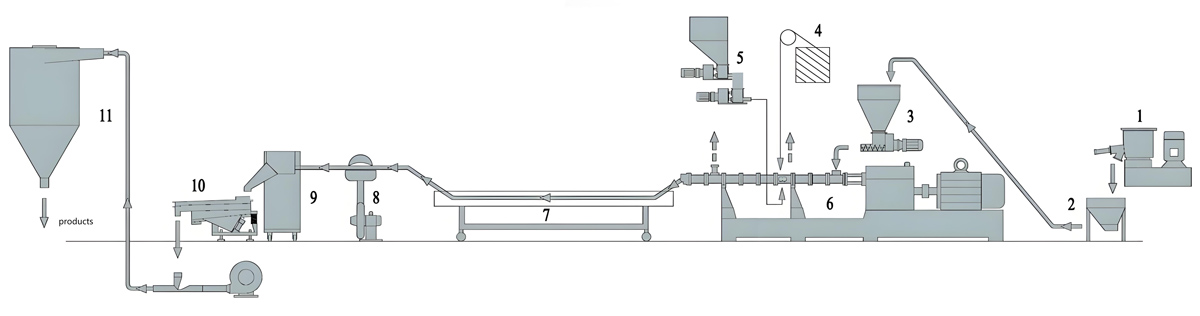
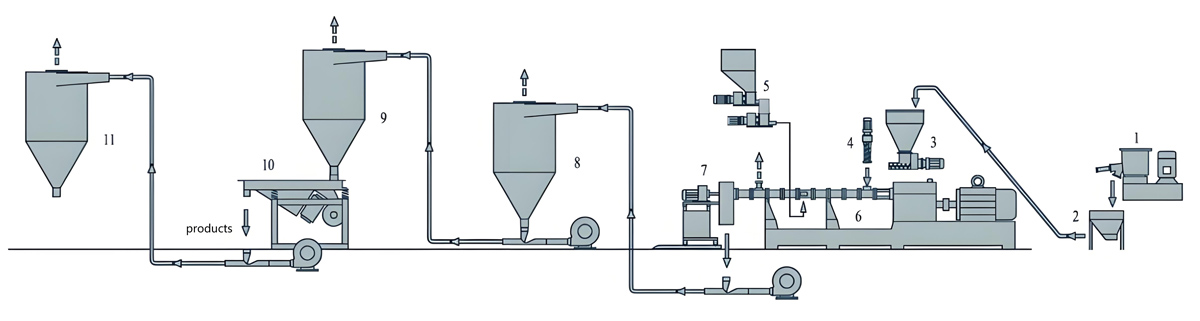
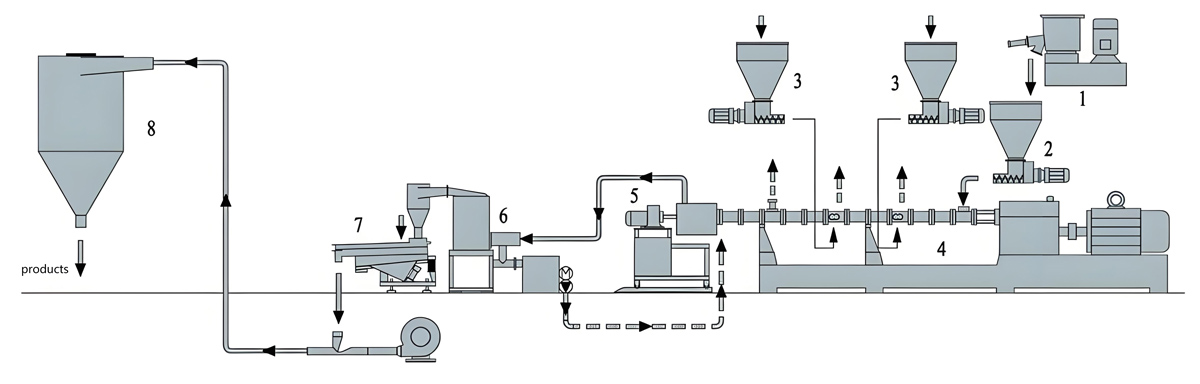
The KTE Series continuous feeding twin screw extruder from Nanjing Kerke Extrusion Equipment Company represents the technological forefront of PCL masterbatch production equipment, incorporating advanced continuous feeding systems and automated material handling specifically engineered for extended uninterrupted production runs. The KTE Series continuous feeding model provides consistent material dosing and flow control while maintaining the performance and product consistency required for demanding applications. This exceptional continuous feeding capability enables unattended operation for extended periods while maintaining product quality consistency throughout the entire production run.
Continuous feeding system design in the KTE Series extruder incorporates advanced gravimetric feeding systems with high-capacity hoppers, precision metering devices, and material surge capacity that ensures continuous material supply without interruption. The feeding systems typically include multiple gravimetric feeders for different formulation components, each with capacity for extended operation without refilling. The feeding system includes surge bins and intermediate hoppers that provide material buffering capacity, allowing continuous operation even when primary material supply requires replenishment. The automated feeding control system maintains precise dosing accuracy despite variations in material flow characteristics.
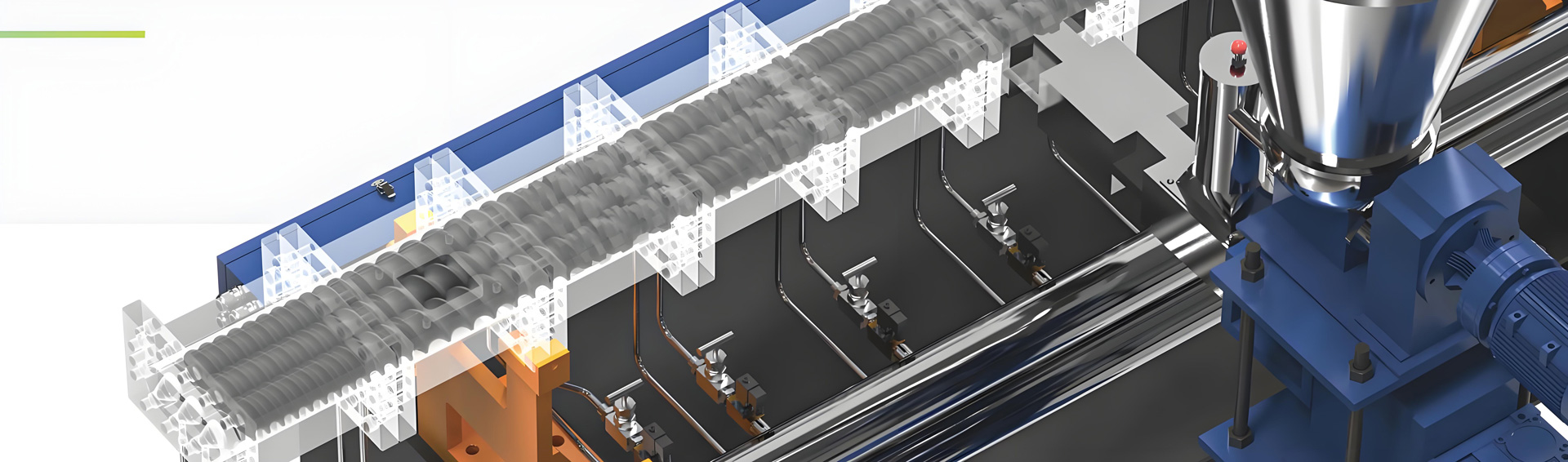
Screw design for PCL processing in the KTE Series continuous feeding extruder incorporates optimized geometries that provide excellent mixing while accommodating continuous material introduction without pressure fluctuations. The screw profile typically includes efficient compression sections that accommodate continuous material input, multiple mixing zones with kneading blocks arranged to provide dispersive mixing while maintaining smooth material flow, and distributive mixing elements that ensure uniform additive distribution. The modular screw design enables custom configuration based on specific formulation viscosity and mixing requirements while maintaining the continuous feeding characteristics essential for PCL processing.
Heating and cooling systems for PCL processing in the KTE Series continuous feeding extruder employ advanced heating elements and temperature sensors that maintain precise control despite the continuous material input. The barrel is divided into 8 to 12 independently controlled heating zones, each with multiple temperature sensors and heating elements capable of maintaining temperatures within plus or minus 1 degree despite process variations. Active cooling systems including air cooling and optional liquid cooling provide the thermal management capability required to remove heat generated during continuous processing.
Parameter Settings for PCL Masterbatch Production
Temperature profile management for PCL masterbatch production requires precise control to achieve consistent processing results while preventing thermal degradation. A typical temperature profile begins at 70 to 80 degrees Celsius in the feed zone to initiate gradual softening of the PCL resin without causing premature melting that could lead to feeding problems. The temperature gradually increases through the transition zones to 80 to 90 degrees Celsius in the main mixing sections, then peaks at 85 to 95 degrees Celsius in the final zones before the die, ensuring the material maintains appropriate viscosity for extrusion while staying below the thermal degradation threshold of approximately 110 degrees Celsius. The thermal management system automatically maintains these temperatures despite process variations.
Screw speed selection for PCL processing balances mixing requirements against thermal degradation and feeding consistency. Typical screw speeds range from 100 to 250 RPM depending on the specific PCL grade, formulation viscosity, and required mixing intensity. Higher molecular weight PCL grades typically require lower screw speeds of 100 to 180 RPM to ensure adequate residence time for mixing, while lower molecular weight grades may be processed at higher speeds of 150 to 250 RPM. The continuous feeding extruder’s control system continuously monitors zone temperatures and motor load, automatically adjusting screw speed to maintain optimal thermal conditions while ensuring adequate mixing for the specific formulation being processed.
Feed rate optimization for PCL masterbatch production involves maintaining consistent material input while ensuring adequate mixing and thermal management. Throughput rates typically range from 50 to 500 kilograms per hour depending on extruder size, screw configuration, and formulation characteristics. The continuous feeding system maintains consistent feed rates within plus or minus 1 percent of the target rate, ensuring uniform product quality throughout the production run. The control system monitors feeding system performance and can automatically adjust feed rates based on extruder capacity and processing conditions.
Backpressure settings influence mixing intensity and residence time without requiring changes to screw speed or feed rate. Typical backpressure values for PCL masterbatch production range from 5 to 40 bar depending on formulation viscosity and mixing requirements. The control system monitors mixing effectiveness through analysis of motor load patterns and product quality data, automatically adjusting backpressure through die restriction or flow control valves to optimize mixing while maintaining the continuous feeding characteristics essential for PCL processing.
Equipment Pricing
Investment in continuous feeding twin screw extrusion equipment for PCL masterbatch production represents a substantial capital commitment reflecting the advanced continuous feeding systems and automated material handling involved. Complete production lines including the continuous feeding extruder, advanced feeding systems, pelletizing equipment, and auxiliary systems typically range from $350,000 to $1,800,000 depending on production capacity and feeding system sophistication. Small-capacity systems processing 50 to 150 kilograms per hour typically cost $350,000 to $600,000, while medium-capacity systems processing 150 to 400 kilograms per hour range from $600,000 to $1,100,000. Large-capacity systems processing 400 to 1,200 kilograms per hour require investments of $1,100,000 to $1,800,000.
The KTE Series continuous feeding twin screw extruder itself typically represents approximately 60 to 70 percent of the total system cost, reflecting the advanced continuous feeding technology and precision engineering involved. KTE Series continuous feeding extruders for PCL processing range from $200,000 for 50mm diameter systems to $1,200,000 for 120mm diameter systems, depending on screw length, feeding system capacity, and automation level. The continuous feeding system adds approximately 20 to 30 percent to the base extruder cost compared to conventional extruders of equivalent capacity, but provides substantial returns through enhanced operational efficiency and reduced labor requirements.
Additional equipment costs include advanced gravimetric feeding systems capable of handling multiple formulation components with high accuracy, typically costing $40,000 to $120,000 depending on the number of components and feeding capacity. Pelletizing equipment for PCL typically costs $25,000 to $70,000 depending on pellet type and capacity. Material handling systems including surge bins, conveyors, and automated material transfer add $50,000 to $150,000 depending on automation level and throughput requirements.
Production Problems and Solutions
Feeding interruptions represent one of the most serious production problems that can occur during PCL masterbatch manufacturing, causing production stops, quality variations, and material waste. Feeding interruptions typically result from inadequate material surge capacity, material bridging in hoppers, feeder malfunctions, or inadequate material flow characteristics that cause inconsistent flow to the extruder. Even minor feeding interruptions can cause significant quality variations as the extruder experiences brief periods of material starvation or overload, affecting product properties and potentially causing scrap.
Solution and prevention of feeding interruptions begin with the continuous feeding system design that provides comprehensive material buffering capacity and reliable feeding mechanisms. The feeding systems include surge bins and intermediate hoppers that provide adequate material buffering to maintain continuous operation even during material replenishment. Advanced feeder designs with agitators, vibrators, and special flow aids prevent material bridging and ensure consistent flow. The control system monitors feeding system performance and can detect early signs of potential interruptions, providing alerts before production problems occur.
Inconsistent dosing accuracy manifests as variations in additive concentrations, causing inconsistent product quality and potential off-spec material. Inconsistent dosing typically results from feeder calibration drift, material flow characteristic variations, or inadequate feeder control systems. Even dosing variations of plus or minus 1 to 2 percent can cause significant property variations in the final product, particularly for formulations where precise additive ratios are critical to performance characteristics.
Solution for inconsistent dosing involves feeding system optimization and regular maintenance. The continuous feeding system includes advanced gravimetric feeders with high accuracy and automatic calibration capabilities. Regular calibration of feeders using traceable test weights ensures dosing accuracy within specified tolerances. The control system continuously monitors feeder performance and can detect gradual degradation in dosing accuracy before it significantly affects product quality. For particularly sensitive formulations, the system can recommend enhanced feeder control systems or additional metering devices to improve dosing precision.
Material bridging in hoppers manifests as feeding interruptions, inconsistent flow, and production stoppages. Material bridging typically results from material characteristics such as particle size distribution, moisture content, or flow properties that cause material to form bridges or arches in hopper sections, blocking material flow to the feeders. Even minor bridging can cause significant production disruptions and require operator intervention to clear the blockage.
Solution and prevention of material bridging involve hopper design optimization and material handling improvements. The continuous feeding system includes hopper designs with steep angles, polished surfaces, and special flow aids that prevent material bridging. Agitators, vibrators, or air blasters can be incorporated in hopper designs to maintain material flow and prevent bridge formation. The control system monitors material flow and can detect early signs of flow problems, activating flow enhancement devices before bridges form. For particularly difficult materials, the system can recommend special hopper designs or material pre-treatment to improve flow characteristics.
Thermal degradation due to processing upsets manifests as discoloration, molecular weight reduction, and property degradation in the final product. Thermal degradation can occur during processing upsets such as feeding interruptions that cause temperature excursions, or due to inadequate thermal management during startup or shutdown procedures. Even brief temperature excursions above 100 degrees Celsius can cause significant thermal degradation in PCL, affecting both processing characteristics and final product properties.
Solution and prevention of thermal degradation due to processing upsets involve advanced control systems that maintain thermal stability even during material input variations. The continuous feeding extruder’s thermal management system includes predictive control algorithms that anticipate material flow variations and adjust thermal management preemptively. Startup and shutdown procedures are automated to maintain optimal thermal conditions throughout these critical periods. The control system can detect processing upsets before they cause thermal excursions, taking corrective action to maintain temperature within the safe processing window.
Maintenance and Maintenance
Regular maintenance of continuous feeding twin screw extruders for PCL processing is essential for maintaining the feeding consistency and product quality required for uninterrupted production. Temperature control system maintenance includes quarterly calibration of all temperature sensors against traceable standards to ensure accuracy within plus or minus 0.5 degrees. Heater elements should be tested for proper operation and replaced if any zones show signs of degraded performance or inconsistent heating. Cooling system maintenance includes verification of airflow or coolant flow rates, cleaning of cooling passages, and calibration of cooling control systems.
Feeding system maintenance is particularly important for continuous feeding extruders to ensure consistent material flow and dosing accuracy. Gravimetric feeders should be calibrated monthly using traceable test weights to verify accuracy within plus or minus 0.2 percent. Feeder discharge mechanisms should be inspected weekly for wear or buildup that could affect feeding accuracy or cause flow interruptions. Hopper flow aids including agitators, vibrators, and air blasters should be inspected monthly for proper operation and lubricated as needed. The continuous feeding system monitors feeder performance and can detect gradual degradation before it affects production.
Screw and barrel maintenance requires regular inspection for wear and degradation product buildup that can affect mixing efficiency and continuous flow. Monthly visual inspection of screw and barrel surfaces should be performed, with thorough cleaning if deposits are detected. Screw wear should be measured quarterly, with reclamation or replacement if clearances exceed 0.20 millimeters for continuous feeding applications where consistent flow is important. The control system can track wear patterns and predict when maintenance will be required based on historical wear rates.
Drive system maintenance includes regular oil analysis of the gearbox, inspection of coupling alignment, and verification of motor performance. Gearbox oil should be analyzed monthly for signs of wear particles or thermal degradation, with oil changes performed every 6 to 12 months depending on operating conditions. Coupling alignment should be checked quarterly to prevent vibration that could affect feeding consistency. The control system monitors drive system parameters and can detect early signs of problems before they cause production interruptions or affect product quality.
Frequently Asked Questions
What continuous feeding capability is provided by continuous feeding twin screw extruders? The KTE Series continuous feeding twin screw extruder provides comprehensive continuous material feeding capability for PCL masterbatch production, enabling uninterrupted operation for extended periods while maintaining precise dosing accuracy. The system includes advanced gravimetric feeders with surge capacity that maintains consistent material supply even during material replenishment. Feeding accuracy is maintained within plus or minus 0.2 percent throughout the production run, with automated control systems adjusting for material flow variations. The system can operate unattended for periods of 8 to 24 hours depending on hopper capacity and formulation characteristics.
How does continuous feeding benefit PCL masterbatch production compared to conventional extruders? Continuous feeding provides multiple benefits for PCL masterbatch production including significantly improved product consistency with quality variations reduced by 85 to 95 percent compared to conventional extruders, reduced operator requirements through automated material handling, extended production runs without interruption improving operational efficiency, and reduced material waste from feeding-related quality problems. The continuous feeding system also enables production planning and scheduling improvements that enhance overall factory efficiency.
What are the maintenance requirements for continuous feeding systems compared to conventional extruders? Continuous feeding systems require additional maintenance for feeding system components that are not present in conventional extruders. Gravimetric feeders require regular calibration and inspection of discharge mechanisms. Hopper flow aids require periodic maintenance and lubrication. Despite the additional components, the automated control and monitoring capabilities of continuous feeding systems typically reduce the frequency of emergency maintenance by detecting problems before they cause production interruptions. Overall maintenance requirements are manageable and the enhanced operational efficiency typically justifies the additional feeding system maintenance.
Can continuous feeding extruders process different PCL grades without extensive reconfiguration? Yes, continuous feeding twin screw extruders can process different PCL grades with minimal reconfiguration due to the flexible feeding system and wide processing window. The continuous feeding system can maintain appropriate material flow and dosing for different PCL grades through automatic adjustment of feeder setpoints and screw speed. While some processing parameter adjustments may be required when changing between widely different PCL grades, the continuous feeding design minimizes the need for manual adjustments and reduces changeover time compared to conventional extruders.
What is the return on investment for continuous feeding twin screw extruders compared to conventional equipment? The return on investment for continuous feeding twin screw extruders typically ranges from 24 to 48 months depending on production volume, formulation complexity, and specific application requirements. Key factors contributing to ROI include labor cost reductions of 40 to 60 percent compared to conventional extruders, product quality improvements reducing customer returns, operational efficiency improvements increasing throughput, and reduced material waste from feeding-related problems. The continuous feeding capability also provides strategic benefits in production planning and customer service through consistent quality and delivery performance.
Conclusion
Continuous feeding twin screw extruder technology provides the enabling technology for efficient, consistent PCL masterbatch production through advanced material handling and automated feeding capabilities. The KTE Series from Nanjing Kerke Extrusion Equipment Company provides the continuous feeding performance and processing capability required for producing PCL masterbatches with exceptional consistency and minimal operator intervention. The continuous feeding system provides the level of automation and feeding precision that makes PCL masterbatch production highly efficient and cost-effective while enabling extended production runs without quality variations.
Successful PCL masterbatch production with continuous feeding technology requires attention to material preparation, appropriate formulation design, reliable feeding system maintenance, and careful selection of processing parameters to achieve optimal quality while maintaining continuous operation. The investment in continuous feeding technology provides compelling returns through reduced labor costs, improved product consistency, enhanced operational efficiency, and the ability to produce masterbatches with consistent quality throughout extended production runs. As demand for PCL-based materials continues growing in biodegradable applications, manufacturers equipped with continuous feeding twin screw extruders will be well-positioned to capture market opportunities.