Introduction
Thermoplastic vulcanizates TPV represent a unique class of thermoplastic elastomers combining the elastic properties of vulcanized rubber with the processability of thermoplastics. The production of TPV masterbatch demands continuous high capacity equipment capable of handling complex dynamic vulcanization processes while maintaining consistent product quality. High capacity twin screw extruders provide the necessary throughput and processing capabilities for large scale TPV masterbatch production.
The automotive and industrial markets continue to drive demand for TPV materials due to their excellent weather resistance good mechanical properties and recyclability. Continuous processing equipment enables manufacturers to meet this demand efficiently while maintaining tight control over dynamic vulcanization reactions that determine final product properties. High capacity twin screw extruders offer the reliability and productivity required for competitive TPV masterbatch manufacturing operations.
Formulation Ratios for TPV Masterbatch
TPV masterbatch formulations vary based on the base polymer crosslinking system and intended application requirements. Different formulations require specific processing conditions to achieve proper dynamic vulcanization and desired performance characteristics.
PP/EPDM TPV Masterbatch
This formulation based on polypropylene and ethylene propylene diene monomer rubber represents the most common TPV composition. Typical formulation includes 50-70 percent polypropylene 25-45 percent EPDM and 5-10 percent total additives. The additive package includes crosslinking agents typically phenolic resins processing aids and stabilizers. The high capacity extruder must achieve thorough dispersion of EPDM within the PP matrix while facilitating the dynamic vulcanization reaction. Oil plasticizers may be added at 5-15 percent to adjust hardness and improve processability.
Dynamic Vulcanization Formulations
Dynamic vulcanization requires precise control of crosslinking agent distribution and reaction kinetics. Crosslinking agent concentration typically ranges from 0.5-3 percent of total formulation. Accelerators and activators add 0.2-1.5 percent to control reaction rate and extent. Processing aids such as stearic acid and zinc oxide at 1-3 percent ensure proper crosslinking efficiency. The continuous processing system must maintain precise residence time and temperature profiles to achieve complete vulcanization without degradation.
Filled TPV Formulations
Reinforced TPV formulations incorporate fillers to enhance mechanical properties and reduce cost. Typical filler loading includes 10-30 percent calcium carbonate 5-20 percent talc or 5-15 percent carbon black depending on application requirements. The high capacity extruder must achieve uniform filler dispersion without excessive degradation of the polymer matrix. Fillers increase viscosity and require adjustments to processing parameters. Surface treated fillers improve compatibility and dispersion within the TPV matrix.
Oil Extended TPV Formulations
Oil extended formulations use plasticizing oils to reduce hardness and improve flexibility. Oil content typically ranges from 5-25 percent of total formulation with paraffinic or naphthenic oils commonly used. The oil must be thoroughly dispersed and stabilized within the TPV matrix to prevent migration during service. Continuous processing equipment with multiple injection points enables staged oil addition for optimal distribution. Higher oil content formulations require adjustments to crosslinking agent levels to compensate for dilution effects.
Specialty TPV Masterbatch
Specialty formulations include flame retardant conductive or weather resistant TPV masterbatches. Flame retardant formulations include 15-30 percent halogenated or phosphorus based flame retardants. Conductive formulations incorporate 10-30 percent carbon black or 5-15 percent carbon fibers. Weather resistant formulations include 2-5 percent UV stabilizers and 1-3 percent antioxidants. These specialty formulations require careful selection of additives compatible with the dynamic vulcanization system. The high capacity extruder must handle these specialized materials without contamination between different formulations.
Production Process
The TPV masterbatch production process involves multiple stages that must be precisely controlled to achieve proper dynamic vulcanization while maintaining high throughput. Continuous processing ensures consistent product quality and production efficiency.
Material Preconditioning
Polypropylene and EPDM rubber must be properly conditioned before processing. Polypropylene typically requires minimal drying with 2-4 hours at 80°C sufficient to reduce surface moisture. EPDM rubber may require 4-8 hours at 70-80°C depending on moisture content and form. Fillers and powders should be dried to below 0.5 percent moisture to prevent hydrolysis of crosslinking agents. Oil components may be preheated to 50-60°C to reduce viscosity for easier metering and dispersion.
Feeding System
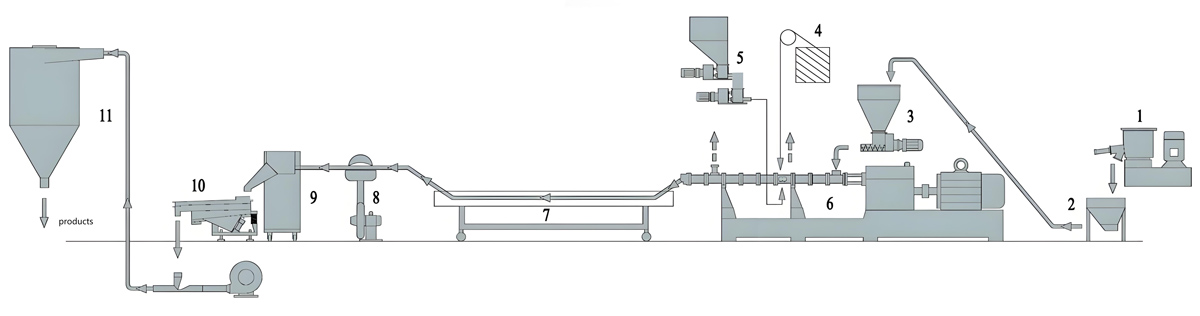
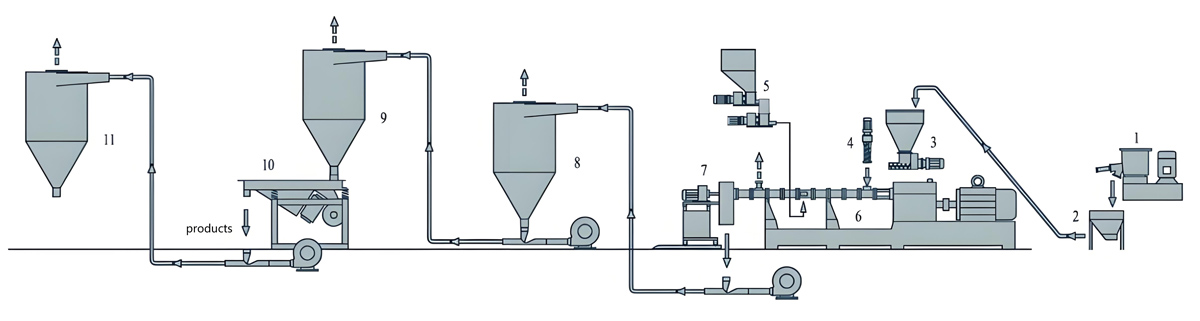
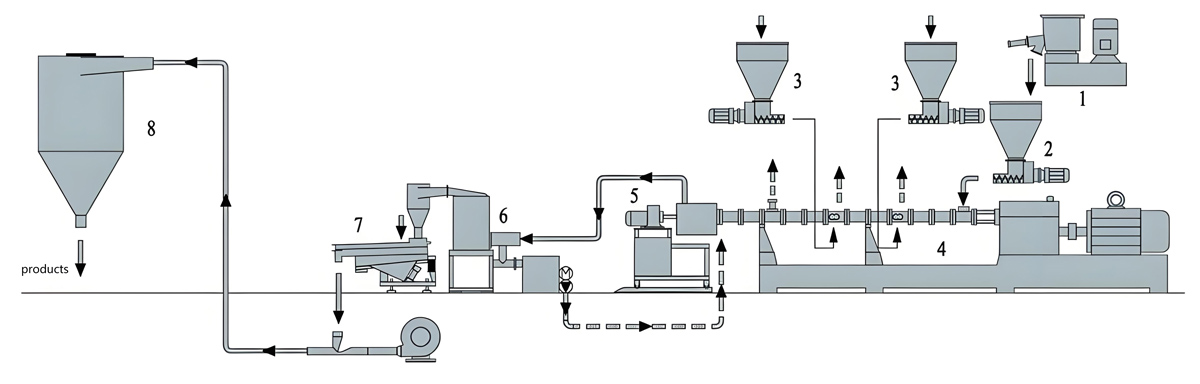
High capacity feeding systems deliver materials to the extruder at rates up to 2000 kg per hour for large production lines. Main hoppers feed polypropylene and EPDM through separate gravimetric feeders for precise ratio control. Fillers are fed through loss-in-weight feeders capable of handling high bulk density materials. Crosslinking agents and additives are pre-blended and fed through secondary feeders for accurate dosing. Oil components are injected downstream through metered pumps with capacity to handle high oil content formulations.
Melting and Initial Mixing
The initial melting zone softens polypropylene and EPDM to begin the blending process. Temperature progression typically starts at 160-180°C in feed zones increasing to 180-200°C in the melting zone. The high capacity extruder provides sufficient mechanical energy to melt the polymers within the residence time constraints. Screw configuration in this zone emphasizes conveying elements to ensure positive displacement of materials into the mixing zones. The melt temperature must be carefully controlled to initiate crosslinking reactions at the proper location.
Dynamic Vulcanization Zone
The dynamic vulcanization zone represents the critical stage where crosslinking reactions occur within the melt under shear. Temperature in this zone typically maintained at 190-220°C to activate crosslinking agents. Screw configuration includes intensive mixing elements to disperse crosslinking agents and ensure uniform reaction throughout the EPDM phase. Residence time in this zone typically ranges from 30-90 seconds depending on formulation and desired crosslink density. The high capacity extruder must maintain precise control of residence time to achieve consistent vulcanization.
Compatibilization and Homogenization
Following dynamic vulcanization additional mixing zones ensure homogeneous distribution of the vulcanized EPDM particles within the PP matrix. Temperature in this zone typically reduced to 180-200°C to prevent continued crosslinking or degradation. Mixing elements create dispersive and distributive mixing to achieve the desired morphology. The continuous process must maintain consistent shear conditions to achieve proper EPDM particle size typically 1-3 microns. This morphology determines the final elastomeric properties of the TPV material.
Additive Incorporation
Additional additives such as stabilizers processing aids and specialty components are incorporated after vulcanization is complete. Injection points are carefully selected based on thermal stability and function of each additive. Oil plasticizers are typically added after vulcanization to avoid interference with crosslinking reactions. The high capacity system must handle high viscosity of the crosslinked material while ensuring uniform additive distribution. Touch screen control enables precise timing and rate of additive additions.
Degassing and Vacuum Venting
Vacuum vent zones remove volatiles generated during dynamic vulcanization and any entrapped air. Vacuum levels typically maintained between 50-200 mbar depending on formulation and throughput. The high capacity system includes sufficient vent port area to handle volatile load at maximum production rates. Multiple vent zones may be required for formulations with high volatile content. Proper venting prevents porosity and ensures consistent density in the final masterbatch product.
Granulation and Cooling
The extruded strand is cooled through water baths or air cooling systems designed for high throughput. Strand cooling systems handle multiple strands simultaneously to match extruder capacity. Water temperature maintained at 15-25°C to ensure rapid cooling without thermal shock. Strand diameter monitored and controlled through die design and take-up speed. High capacity granulators produce pellets at rates matching extruder output with consistent size and shape.
Production Equipment Introduction
Continuous high capacity twin screw extruders provide the throughput and processing capabilities required for TPV masterbatch manufacturing. The KTE Series from Kerke offers specialized features for dynamic vulcanization processes.
High Capacity Drive System
The drive system delivers high torque capacity to handle the viscosity increases during dynamic vulcanization. Motors rated up to 1000 kW or more depending on extruder size and required throughput. Heavy duty gearboxes transmit torque efficiently while withstanding high shock loads from viscosity changes. Variable frequency drives enable precise speed control across the operating range. The drive system designed for continuous operation at high load conditions typical of TPV processing. Real-time torque monitoring provides feedback for process optimization.
Robust Barrel Construction
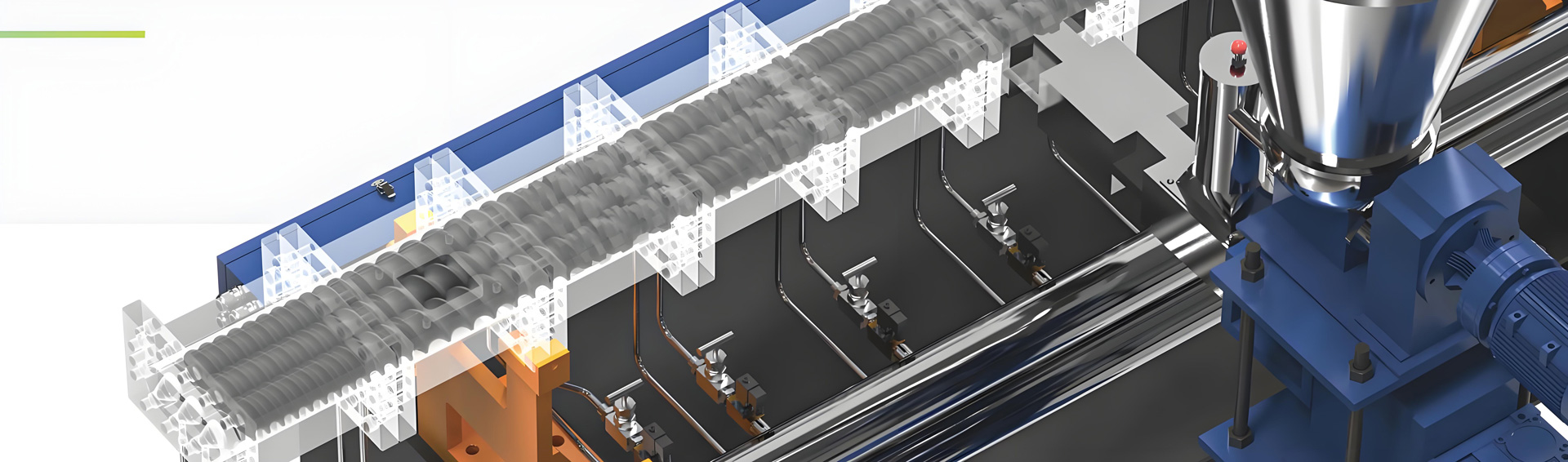
Barrel assemblies are constructed from high strength materials to withstand high pressures and temperatures. Bimetallic liners provide wear resistance for abrasive filled formulations while maintaining thermal conductivity. High temperature capabilities up to 300°C allow processing of high performance TPV formulations. The barrel design includes multiple temperature control zones for precise thermal management of the vulcanization process. Reinforced construction prevents barrel deformation under high operating pressures.
Advanced Screw Design
Screw elements are specifically designed for TPV processing and dynamic vulcanization. Special mixing elements ensure thorough dispersion of crosslinking agents and uniform vulcanization. Wear resistant materials extend service life particularly when processing filled formulations. Modular configuration allows optimization for different TPV formulations and throughput requirements. The screw design achieves proper shear profiles for dynamic vulcanization while maintaining adequate conveying capacity. Element selection balances dispersive mixing with residence time requirements.
High Capacity Feeding Systems
Feeding systems designed for high throughput operation with precise ingredient control. Gravimetric feeders with capacities up to 2000 kg per hour for major components. Multiple feeder hoppers enable simultaneous feeding of all formulation components. Loss-in-weight technology ensures accurate ratio control regardless of material properties. Oil injection systems with high capacity pumps handle up to 500 kg per hour for oil extended formulations. Feeder integration with extruder control maintains consistent formulation at high production rates.
Precision Temperature Control
Advanced temperature control systems maintain precise thermal profiles critical for dynamic vulcanization. Multiple independent zones enable temperature gradients along the barrel length. Rapid response heaters and cooling systems accommodate the exothermic crosslinking reactions. Temperature control accuracy within plus or minus 1°C ensures consistent vulcanization kinetics. The system manages heat generation from mechanical energy input and exothermic reactions. Real-time temperature monitoring provides feedback for process optimization and quality control.
High Capacity Vent Systems
Venting systems designed to handle high volatile loads during dynamic vulcanization. Large vent port areas provide adequate capacity for maximum production rates. Multiple vent zones staged along the barrel length enable effective devolarization. High capacity vacuum pumps maintain required vacuum levels even at maximum throughput. Automated vent cleaning systems maintain continuous operation without manual intervention. Pressure monitoring prevents polymer loss through vent ports during processing.
Integrated Process Control
Comprehensive control systems manage all aspects of the continuous TPV production process. Touch screen interfaces provide real-time monitoring and control of all process parameters. Recipe management enables quick changeover between different TPV formulations. Data logging and traceability support quality control and regulatory requirements. Integrated safety systems protect equipment and personnel during high operation. Remote monitoring capabilities provide production visibility from multiple locations.
Parameter Settings
Optimal parameter settings for TPV masterbatch production balance throughput with quality requirements. High capacity continuous processing enables production rates up to 2000 kg per hour for large systems.
Temperature Profile
Temperature profiles must accommodate the melting of base polymers and the exothermic vulcanization reaction. Feed zones typically set at 160-180°C to soften polypropylene and EPDM. Dynamic vulcanization zones maintained at 190-220°C to activate crosslinking agents. Post vulcanization zones reduced to 180-200°C to complete mixing without overcrosslinking. Die temperatures maintained at 180-200°C for proper flow and pellet formation. Temperature control must compensate for the exothermic nature of crosslinking reactions.
Screw Speed and Throughput
Screw speeds for high capacity operation typically range from 200-400 RPM depending on extruder size. Throughput rates vary from 200-2000 kg per hour based on machine size and formulation. The continuous operation maintains consistent filling degree between 75-90 percent for optimal processing. Higher throughput reduces residence time requiring adjustments to temperature and screw configuration. Production rate optimization must balance efficiency with adequate residence time for complete vulcanization.
Feeder Rate Synchronization
Feeder rates are synchronized with extruder throughput to maintain consistent formulation. Gravimetric feeders automatically adjust to maintain precise ratios regardless of throughput changes. Feed accuracy within plus or minus 0.5 percent ensures consistent TPV properties. High capacity feeders maintain accuracy even at maximum production rates. Oil injection systems precisely control oil content for consistent hardness. The integrated control system ensures formulation consistency across production rate changes.
Vacuum Vent Operation
Vacuum levels typically maintained between 50-200 mbar depending on formulation volatile content. High capacity vacuum pumps ensure adequate venting even at maximum production rates. Multiple vent zones may operate at different vacuum levels for optimal devolarization. Vent port area sized to handle volatile load without polymer carryover. Automated cleaning systems maintain vent efficiency during continuous operation. Proper venting prevents porosity and density variations in the final product.
Residence Time Distribution
Residence time in dynamic vulcanization zones typically ranges from 30-90 seconds. The continuous process must maintain consistent residence time for uniform crosslink density. Screw configuration and throughput determine actual residence time. Higher throughput reduces residence time requiring adjustments to temperature and crosslinking agent levels. Narrow residence time distribution is critical for consistent product quality. The high capacity system must maintain consistent residence time despite high production rates.
Pressure Profile
Die pressures typically range from 50-150 bar depending on formulation and throughput. Pressure increases during dynamic vulcanization due to viscosity increase from crosslinking. The high capacity drive system must handle pressure spikes during vulcanization. Pressure monitoring provides feedback for process optimization and quality control. Excessive pressure may indicate overcrosslinking or improper formulation. Pressure profile optimization balances productivity with product quality requirements.
Equipment Price
Continuous high capacity twin screw extruder pricing reflects the robust construction and advanced features required for TPV masterbatch production. Investment considerations include production capacity and operating costs over equipment lifetime.
High Capacity Extruder Pricing
Medium capacity extruders for TPV production with 75-90mm screw diameter range from 250000 to 400000 US dollars. Large capacity systems with 100-125mm screw diameter range from 400000 to 700000 US dollars. Extra high capacity systems with 150mm or larger screw diameters exceed 1000000 US dollars. These prices include the extruder barrel screws high capacity drive system and basic control system. Pricing varies with specific configuration features and production capacity requirements.
High Capacity Drive System
High capacity drive systems with 500-1000 kW motors add 80000 to 200000 US dollars to base equipment cost. Heavy duty gearboxes for high torque transmission cost 40000 to 80000 US dollars. Variable frequency drives for large motors cost 30000 to 60000 US dollars. The drive system must be sized to handle the viscosity increases and pressure spikes during dynamic vulcanization. Robust drive systems ensure reliable continuous operation under high load conditions.
Feeding System Costs
High capacity gravimetric feeding systems cost 60000 to 150000 US dollars depending on number of feeders and capacity. Large capacity oil injection systems range from 30000 to 70000 US dollars. Pre-blending systems for additives cost 20000 to 50000 US dollars. The feeding system must handle high throughput rates while maintaining precise ratio control. Integrated feeder control with extruder synchronization adds to the total investment.
Vent System Costs
High capacity vacuum systems for TPV processing range from 40000 to 100000 US dollars. Multiple vent zones and automated cleaning systems add 20000 to 50000 US dollars. Condensers for volatile recovery cost 15000 to 40000 US dollars. The vent system must handle the high volatile load from dynamic vulcanization reactions. Proper venting is essential for product quality and preventing environmental emissions.
Granulation System Costs
High capacity granulation systems range from 60000 to 150000 US dollars. Multi-strand cooling systems cost 40000 to 90000 US dollars. High capacity water cooling systems with chillers range from 30000 to 70000 US dollars. The granulation system must match the maximum throughput of the extruder. Consistent pellet size and shape are essential for customer acceptance and downstream processing.
Total Investment Analysis
A complete continuous high capacity TPV masterbatch production line typically requires investment between 600000 and 1500000 US dollars for medium to large capacity production. Extra high capacity fully automated systems may exceed 2500000 US dollars. The investment is justified by high production capability and continuous operation efficiency. Operating costs per kilogram decrease significantly with high capacity equipment due to economies of scale. Life cycle cost analysis shows attractive return on investment for high volume TPV masterbatch production.
Production Problems and Solutions
TPV masterbatch production may encounter various processing challenges particularly related to dynamic vulcanization. High capacity continuous processing provides solutions to many common problems while maintaining productivity.
Inconsistent Crosslink Density
Problem Analysis: Variations in crosslink density affect elastic properties compression set and overall performance. Causes include uneven distribution of crosslinking agents temperature variations or residence time fluctuations. The high capacity continuous process must maintain precise control of all vulcanization parameters. Inconsistent crosslinking leads to product quality variations and customer complaints.
Solutions: Optimize screw configuration to ensure thorough dispersion of crosslinking agents before vulcanization zone. Implement temperature profiling to maintain uniform temperature throughout vulcanization zones. Adjust residence time through screw speed or barrel length to achieve complete vulcanization. Verify crosslinking agent feed accuracy through gravimetric feeder calibration. Use real-time torque monitoring to detect variations in crosslink kinetics. Implement statistical process control to identify and correct process variations.
Prevention Methods: Develop validated screw configurations for each TPV formulation. Establish strict temperature control procedures with regular sensor calibration. Implement residence time monitoring and control to maintain consistency. Use high accuracy gravimetric feeders for crosslinking agents. Train operators to recognize symptoms of inconsistent vulcanization through torque and pressure changes. Maintain detailed records of processing conditions for quality traceability.
Viscosity Surge During Vulcanization
Problem Analysis: Dramatic viscosity increase during dynamic vulcanization can cause processing difficulties and equipment overloading. Causes include excessive crosslinking rate too high crosslinking agent levels or inadequate mixing. The high capacity drive system must handle viscosity increases without overloading. Uncontrolled viscosity surges can lead to motor overload equipment damage or production shutdowns.
Solutions: Optimize crosslinking agent formulation to control reaction rate and extent. Adjust temperature profile to moderate vulcanization rate. Improve mixing before vulcanization zone to ensure uniform crosslinking agent distribution. Implement torque monitoring with automatic speed adjustment to prevent overloading. Consider staged addition of crosslinking agents to spread the vulcanization reaction over a longer section. Use screw configurations that provide controlled shear to manage viscosity increase.
Prevention Methods: Develop formulations with balanced crosslinking kinetics suitable for continuous processing. Establish maximum torque limits with automatic speed reduction triggers. Maintain consistent crosslinking agent quality and handling procedures. Implement predictive monitoring based on torque trends to anticipate viscosity increases. Train operators on proper response to torque alarms and viscosity surges. Maintain drive system components to ensure reliable operation under varying load conditions.
Vent Port Blockage
Problem Analysis: Vent ports can become blocked by polymer carryover reducing volatile removal efficiency. Causes include excessive throughput insufficient vent area or improper screw configuration. Blocked vents lead to poor product quality porosity and density variations. High capacity operation generates significant volatile load requiring adequate venting capacity.
Solutions: Increase vent port area or add additional vent zones for higher capacity. Implement vent stuffer screws to prevent polymer carryover into vent ports. Use atmospheric vents before vacuum vents to remove bulk material. Optimize vent zone temperature to prevent polymer solidification. Reduce throughput if vent capacity is insufficient. Install automated vent cleaning systems for continuous operation.
Prevention Methods: Establish regular vent port inspection and cleaning schedules based on operating hours. Monitor vent pressure continuously to detect developing blockages. Design screw configuration to minimize material carryover into vent zones. Implement automated cleaning cycles during operation. Train operators to recognize symptoms of vent blockage through pressure changes. Maintain spare vent port components for quick replacement when needed.
Inadequate Dispersion of EPDM
Problem Analysis: Poor dispersion of EPDM within the PP matrix results in non-uniform morphology and inconsistent properties. Causes include insufficient mixing energy inappropriate screw configuration or high viscosity ratio between components. Proper EPDM dispersion is critical for achieving the desired elastomeric properties. Inadequate dispersion leads to poor mechanical properties and customer rejection.
Solutions: Optimize screw configuration with intensive mixing elements before vulcanization. Increase screw speed or reduce throughput to increase mixing energy. Use compatibilizers to improve interface adhesion between PP and EPDM. Adjust temperature profile to reduce viscosity differences between components. Implement multiple mixing zones with different shear profiles. Monitor energy consumption as an indicator of mixing effectiveness.
Prevention Methods: Develop validated screw configurations for specific EPDM content and morphology requirements. Establish standard operating procedures for screw element assembly and replacement. Implement quality control testing for EPDM dispersion including microscopic analysis. Train operators on proper screw configuration for different formulations. Maintain detailed records of successful processing parameters for future reference.
Pellet Size Inconsistency
Problem Analysis: Non-uniform pellet size affects downstream processing and customer specifications. Causes include variations in strand diameter inconsistent cutting speed or strand cooling variations. High capacity granulation systems must maintain consistency at high throughput rates. Pellet size variations may cause feeding problems in customer processing equipment.
Solutions: Implement closed-loop control of take-up speed to maintain constant strand diameter. Install automatic strand diameter monitoring with feedback control. Ensure uniform die temperature to prevent flow variations. Use multiple cutter heads for high capacity granulation. Calibrate cutter speed and knife sharpness regularly. Implement automatic cut length control systems with real-time adjustment.
Prevention Methods: Establish standard operating procedures for granulation equipment maintenance. Regularly maintain cutting knives and replace according to wear monitoring. Monitor strand diameter and cutter performance continuously. Implement quality control sampling to detect size variations early. Train operators on proper granulation equipment adjustment and troubleshooting procedures.
Oil Migration Issues
Problem Analysis: Oil migration to the surface or exudation during processing causes stickiness and handling problems. Causes include insufficient oil stabilization excessive oil content or improper mixing. High capacity continuous processing must ensure uniform oil distribution and proper stabilization. Oil migration affects product quality appearance and downstream processing.
Solutions: Add oil absorbent fillers or stabilizers to prevent migration. Optimize mixing after oil addition to ensure uniform distribution. Consider staged oil addition across multiple injection points. Reduce oil content if feasible for the application requirements. Increase crosslink density to trap oil within the matrix. Implement post extrusion stabilization through appropriate cooling and handling.
Prevention Methods: Develop formulations with appropriate oil content and stabilization for the application. Use oils with better compatibility with the TPV matrix. Implement thorough mixing after oil addition to ensure uniform distribution. Establish quality control testing for oil migration including surface tack measurements. Train operators to recognize signs of oil migration during processing.
Maintenance and Care
Proper maintenance ensures reliable continuous operation and extends equipment life. High capacity TPV processing equipment requires comprehensive maintenance programs to handle demanding operating conditions.
Daily Maintenance
Daily maintenance includes checking oil levels in gearboxes and lubrication points for high capacity drive systems. Monitor motor temperatures and cooling system operation. Inspect all temperature sensors for proper operation through control system displays. Check cooling water flows and temperatures for barrel drives and granulation systems. Monitor vacuum pump operation and vent pressures for normal readings. Document any unusual observations or alarms in the maintenance log.
Weekly Maintenance
Weekly maintenance involves inspecting high capacity drive components for signs of wear or overheating. Check all seals and gaskets for leaks particularly in high pressure areas. Test safety interlocks and emergency stop systems for proper operation. Clean or replace air filters on control cabinets and drive enclosures to maintain proper cooling. Verify accuracy of high capacity feeder calibrations at multiple throughput levels. Inspect vent ports and clean if needed to prevent blockages.
Monthly Maintenance
Monthly maintenance includes changing gearbox oil according to manufacturer recommendations for high capacity gearboxes. Inspect heater bands and thermocouples for proper function across all temperature zones. Check alignment of drive system components including couplings and shafts. Test all alarm and safety systems through diagnostic routines. Review high capacity feeder performance data to identify developing issues. Inspect screw elements through cleanout ports for wear patterns or damage.
Quarterly Maintenance
Quarterly maintenance involves removing and inspecting screw elements for wear patterns particularly in high shear zones. Measure screw and barrel dimensions to monitor wear rates using precision measurement tools. Inspect motor bearings and replace if necessary based on vibration or temperature trends. Check vacuum pump seals and replace if performance degradation detected. Test emergency stop circuits and safety systems thoroughly under load conditions. Review maintenance records and operating data to identify trends or developing problems.
Annual Maintenance
Annual maintenance includes comprehensive inspection of all major components by qualified technicians. Replace worn parts according to manufacturer recommendations and maintenance history including screw elements barrel liners and wear parts. Realign drive system if necessary to prevent premature wear and ensure efficient power transmission. Test and calibrate all control systems sensors and instrumentation. Review and update maintenance procedures based on operating experience and equipment condition. Conduct thorough safety inspection and testing of all safety interlocks and emergency systems.
High Capacity Component Maintenance
High capacity components require specific maintenance attention due to their size and operating loads. Large motor bearings require regular lubrication and vibration monitoring. Heavy duty gearboxes need frequent oil analysis and condition monitoring. High capacity vacuum pumps require regular seal replacement and performance verification. Large cooling systems need heat exchanger cleaning and water treatment. High capacity feeders require regular scale calibration and verification. Maintaining these critical components ensures reliable continuous operation.
FAQ
What are the advantages of continuous high capacity processing for TPV masterbatch?
Continuous high capacity processing provides several key advantages for TPV masterbatch manufacturing. High throughput rates up to 2000 kg per hour enable efficient production for large volume requirements. Consistent product quality achieved through precise control of dynamic vulcanization parameters. Lower production cost per kilogram through economies of scale and continuous operation. Reduced changeover time between different formulations compared to batch processing. Integrated control systems enable optimization of all processing parameters simultaneously. Energy efficiency improvements compared to multiple smaller lines operating at partial capacity.
How do I optimize screw configuration for dynamic vulcanization?
Screw configuration optimization for dynamic vulcanization requires careful element selection. Initial melting zones use conveying elements to ensure positive material transport. Mixing zones before vulcanization include kneading blocks for thorough crosslinking agent dispersion. Vulcanization zones use specialized mixing elements that provide shear without excessive energy input. Post vulcanization zones include distributive mixing elements for homogenization. The configuration must balance mixing requirements with conveying capacity to handle viscosity increases. Consult with equipment manufacturers for validated configurations specific to your TPV formulation.
What is the typical production rate for high capacity TPV extruders?
Production rates for high capacity TPV extruders vary based on machine size and formulation. Medium capacity systems with 75-90mm screw diameter typically produce 300-800 kg per hour. Large capacity systems with 100-125mm screw diameter range from 800-1500 kg per hour. Extra high capacity systems with 150mm or larger screw diameters can exceed 2000 kg per hour. Actual throughput depends on formulation viscosity required residence time for vulcanization and product quality requirements. Continuous operation enables consistent production rates across extended production periods.
How do I handle viscosity increases during dynamic vulcanization?
Handling viscosity increases during dynamic vulcanization requires proper equipment and control systems. Select drive systems with sufficient torque capacity to handle viscosity surges. Implement torque monitoring with automatic speed adjustment to prevent motor overloading. Use temperature control to moderate vulcanization rate and viscosity increase. Consider staged addition of crosslinking agents to spread the reaction over a longer section. Design screw configuration that provides controlled shear to manage viscosity changes. Train operators to respond appropriately to torque alarms and viscosity changes.
What maintenance is required for high capacity vent systems?
High capacity vent systems require regular maintenance to ensure effective volatile removal. Clean vent ports regularly to prevent polymer blockage and maintain capacity. Monitor vacuum pump performance and replace seals as needed to maintain efficiency. Inspect and clean condensers to maintain heat transfer efficiency. Check vent zone temperatures and adjust heating to prevent polymer solidification. Implement automated cleaning systems for continuous operation without manual intervention. Maintain spare vent port components for quick replacement during maintenance periods.
How do I ensure consistent crosslink density in continuous operation?
Ensuring consistent crosslink density requires precise control of multiple process parameters. Maintain accurate feed rates for crosslinking agents using high precision gravimetric feeders. Implement precise temperature control throughout vulcanization zones with accuracy within plus or minus 1°C. Control residence time through screw speed and barrel length adjustments. Monitor real-time torque as an indicator of crosslink kinetics and adjust parameters accordingly. Use statistical process control to detect and correct variations before they affect product quality. Implement quality control testing to verify crosslink density on a regular basis.
What is the typical energy consumption for high capacity TPV processing?
Energy consumption for high capacity TPV processing depends on machine size and formulation. Specific energy consumption typically ranges from 0.25 to 0.45 kWh per kilogram of TPV masterbatch. Large capacity systems benefit from economies of scale with lower specific energy consumption than smaller machines. The exothermic vulcanization reaction contributes some heat reducing external heating requirements. High capacity drive systems with efficient motors and variable frequency drives optimize energy usage. Energy monitoring systems provide real-time data for optimization opportunities and cost tracking.
How do I optimize throughput while maintaining product quality?
Optimizing throughput while maintaining quality requires balancing multiple process parameters. Start with validated processing parameters and gradually increase throughput while monitoring quality. Adjust temperature profile as needed to compensate for reduced residence time at higher throughput. Verify that feeder accuracy remains acceptable at higher throughput rates. Monitor torque and pressure as indicators of process stability. Implement quality control testing at multiple throughput levels to establish limits. Use process monitoring systems to detect quality variations early and adjust parameters automatically.
Conclusion
Continuous high capacity twin screw extruders provide the processing capabilities required for efficient TPV masterbatch manufacturing. The KTE Series from Kerke offers robust construction high capacity drive systems and advanced control features specifically designed for dynamic vulcanization processes. High throughput rates up to 2000 kg per hour enable manufacturers to meet growing demand for TPV materials while maintaining consistent product quality and competitive production costs.
The automotive and industrial markets continue to expand their use of TPV materials due to excellent performance characteristics and recyclability. Continuous processing technology enables manufacturers to meet this demand efficiently while maintaining tight control over dynamic vulcanization reactions that determine final product properties. Proper equipment selection parameter optimization and comprehensive maintenance programs ensure reliable operation and optimal productivity in high volume TPV masterbatch manufacturing operations.