Introduction
Flame retardant polypropylene masterbatch production represents a critical segment of the polymer additives industry, serving the essential need for materials that meet stringent fire safety standards across diverse applications including automotive components, construction materials, electrical equipment, and consumer goods. The digital control twin screw extruder serves as the advanced manufacturing equipment for producing these specialized flame retardant concentrates, providing sophisticated automation, precise process control, and real-time monitoring capabilities necessary to deliver consistent flame retardant performance while maintaining production efficiency and product quality at the highest standards.
Flame retardant polypropylene masterbatches are concentrated formulations containing flame retardant agents dispersed in polypropylene carrier resins, designed to provide effective fire resistance when incorporated into final PP products. These additives function through various mechanisms including gas phase radical quenching, char formation, endothermic cooling, or thermal shielding. Common flame retardant agents include halogenated compounds, phosphorus-based compounds, inorganic fillers like magnesium hydroxide or aluminum trihydrate, and intumescent systems that swell to form protective char layers. The effectiveness of these agents depends critically on uniform distribution and proper dispersion throughout the polypropylene matrix.
The production of flame retardant PP masterbatch presents unique technical challenges that distinguish it from conventional additive manufacturing. The high loading levels required for effective flame retardancy, often exceeding 50% total additive content, create challenging rheological characteristics that demand robust processing capabilities. The thermal sensitivity of some flame retardant systems requires precise temperature management to prevent decomposition that could reduce effectiveness or generate hazardous byproducts. The requirement for uniform dispersion to ensure consistent flame retardant performance throughout the material necessitates exceptional mixing capabilities. Digital control twin screw extruders address these challenges through advanced control systems and real-time monitoring capabilities.
This comprehensive guide examines the critical aspects of digital control twin screw extruder applications in flame retardant PP masterbatch manufacturing, covering formulation considerations, digital production processes, advanced equipment specifications, parameter optimization strategies, quality assurance requirements, and technical approaches to achieving the exceptional consistency and performance demanded by safety-critical applications.
Formulation Ratios for Different Types
Flame retardant PP masterbatch formulations encompass diverse additive types and loading levels, each requiring specific formulation approaches to achieve effective flame retardancy while maintaining processability and mechanical properties in final applications. The digital control twin screw extruder must accommodate varied formulation requirements while ensuring uniform dispersion and consistent product quality across different flame retardant systems.
Halogen-based flame retardant masterbatches typically contain 20-40% halogenated compounds such as decabromodiphenyl ether (decaBDE), tetrabromobisphenol A (TBBPA), or other brominated or chlorinated compounds dispersed in polypropylene carrier. These formulations provide effective flame retardancy through gas phase radical quenching mechanisms, where halogen radicals interfere with combustion chemistry. Standard formulations for general-purpose applications might include 30% brominated flame retardant, 5% synergist such as antimony trioxide, and 65% polypropylene carrier resin. The moderate loading levels compared to other flame retardant systems require robust mixing to achieve uniform distribution while maintaining good processability. Halogen-based formulations generally offer good thermal stability, allowing processing temperatures up to 240-260°C.
Phosphorus-based flame retardant masterbatches incorporate 25-50% phosphorus compounds such as ammonium polyphosphate (APP), red phosphorus, or organophosphorus compounds dispersed in polypropylene. These formulations provide flame retardancy primarily through char formation mechanisms, where the additives promote the formation of protective carbonaceous layers that insulate the underlying material from heat and oxygen. Typical compositions for electrical applications might include 40% ammonium polyphosphate, 5% char-forming synergist, and 55% polypropylene carrier resin. The higher loading levels create significant processing challenges including increased viscosity and potential impact on mechanical properties. Phosphorus-based formulations generally offer good thermal stability and environmental advantages compared to halogenated systems.
Mineral filler-based flame retardant masterbatches utilize 50-70% inorganic fillers such as magnesium hydroxide or aluminum trihydrate as the primary flame retardant agents. These formulations provide flame retardancy through endothermic decomposition mechanisms, where the fillers absorb heat and release water vapor that dilutes combustible gases. A typical formulation for construction applications might include 60% magnesium hydroxide, 5% surface treatment agents, and 35% polypropylene carrier resin. The very high loading levels present significant processing challenges including dramatically increased viscosity, reduced flow properties, and potential effects on mechanical properties. Mineral-based formulations require high shear mixing and specialized screw configurations to achieve acceptable dispersion and processability.
Intumescent flame retardant masterbatches incorporate 40-60% multi-component intumescent systems that swell when exposed to heat, forming an expanded protective char layer that insulates the material. These sophisticated formulations typically contain three components: an acid source such as ammonium polyphosphate, a carbon source such as pentaerythritol or starch derivatives, and a blowing agent such as melamine. A typical intumescent formulation might include 30% ammonium polyphosphate, 15% char-forming agent, 10% blowing agent, and 45% polypropylene carrier resin. The complexity of these formulations demands advanced screw configurations and precise thermal management to achieve uniform distribution of all components while preventing premature decomposition of sensitive blowing agents.
Nano-flame retardant masterbatches represent the latest generation of flame retardant technology, incorporating 5-15% nano-sized flame retardant particles such as nanoclays, carbon nanotubes, or nano-oxides dispersed in polypropylene carriers. These formulations provide enhanced flame retardant performance at low loading levels through surface area effects and barrier formation. A typical nano-flame retardant formulation might include 10% nano-clay, 5% synergist, and 85% polypropylene carrier resin. The nano-scale particle size presents unique dispersion challenges requiring specialized high-shear mixing and potentially surface treatment of nanoparticles to prevent aggregation. The low loading levels maintain good processability while achieving effective flame retardancy.
Production Process
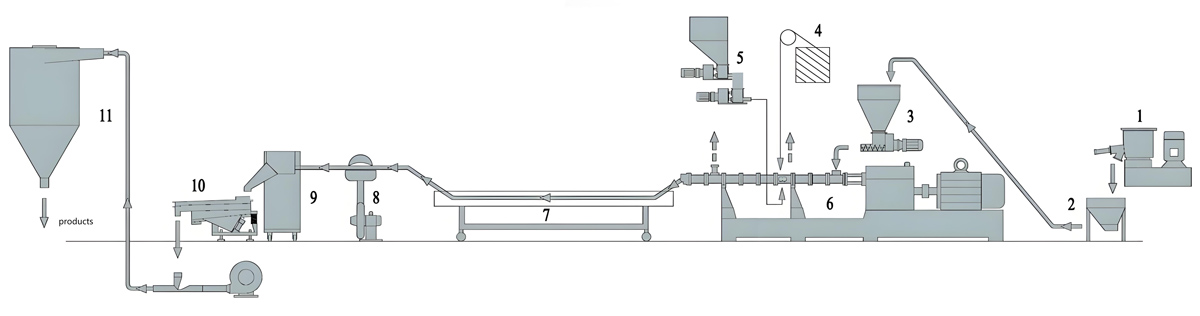
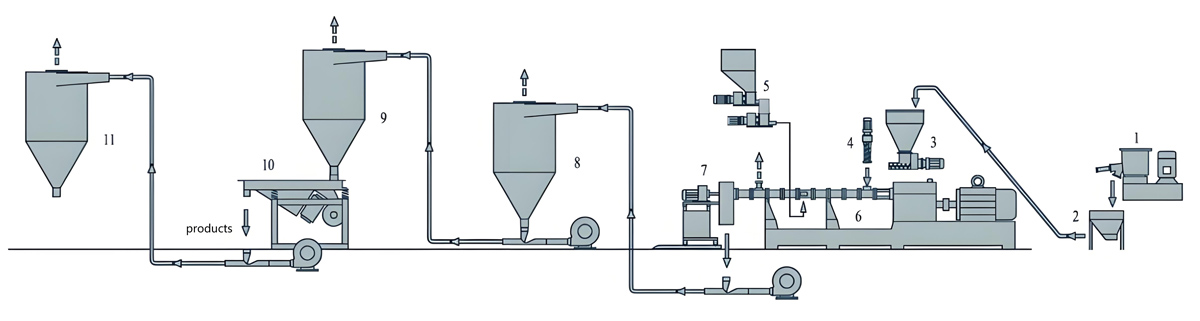
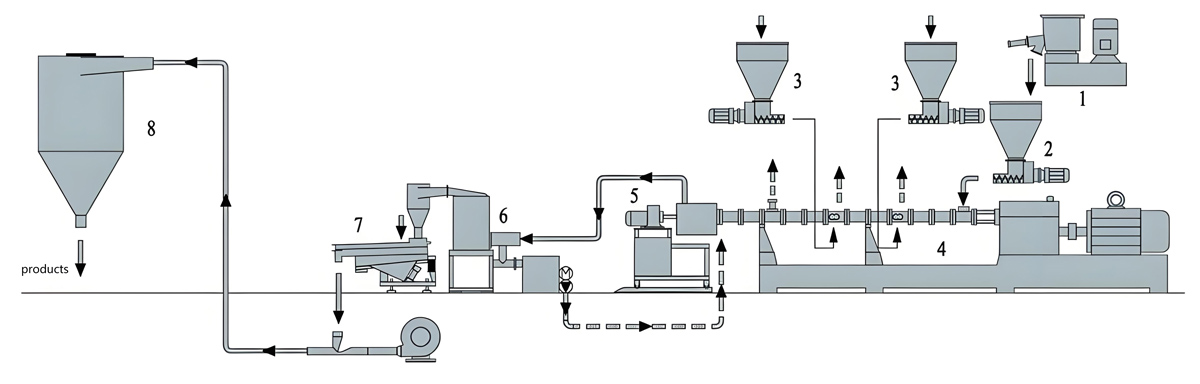
The digital control production process for flame retardant PP masterbatch using twin screw extruders incorporates advanced automation and monitoring systems to ensure precise control of critical parameters, real-time quality assessment, and consistent product quality. The digital capabilities of modern twin screw extruders enable sophisticated process control, data collection, and analysis that enhance production efficiency and product quality consistency.
Digital raw material handling and dosing systems establish the foundation for accurate and consistent production. Automated gravimetric dosing systems with loss-in-weight technology provide continuous monitoring and adjustment of feed rates for all formulation components, ensuring that flame retardant agents are maintained at precise concentrations. These systems incorporate digital interfaces for real-time monitoring of feed rates, inventory levels, and component status. For multi-component flame retardant formulations, multiple dosing systems operate in coordinated digital control, maintaining proper ratios between all components including flame retardants, synergists, and carrier resin. The digital system logs all dosing data with timestamps, creating comprehensive traceability records for quality assurance and regulatory compliance.
Material feeding and introduction to the extruder barrel benefit from digital control systems that optimize feed timing and distribution. Main feeders introduce bulk polypropylene carrier and high-concentration premixes through the primary feed port with precise digital control of feed rates and timing. Side feeders may be employed for temperature-sensitive flame retardant components that require introduction downstream of initial heating zones, with digital synchronization ensuring optimal addition points. The digital control system coordinates all feeding operations with extruder operating conditions, adjusting feed rates based on screw speed, barrel fill level, and process conditions in real-time to maintain optimal processing conditions.
Digital temperature control systems provide precise thermal management essential for flame retardant masterbatch production, particularly for formulations containing thermally sensitive components. Temperature profiles are established based on formulation thermal characteristics and flame retardant stability requirements, with digital controllers implementing precise regulation across all barrel zones. The digital system monitors multiple redundant temperature sensors, adjusting heating and cooling output to maintain setpoints despite variations in ambient conditions or process disturbances. For formulations containing components with specific thermal decomposition characteristics, the system can implement specialized temperature profiles with different setpoints for different zones, preventing premature decomposition or degradation of flame retardant agents.
Digital mixing and dispersion control utilizes advanced screw designs and process algorithms to achieve uniform distribution of flame retardant agents. The digital control system monitors mixing parameters including torque, specific mechanical energy input, and residence time distribution, automatically adjusting screw speed and throughput to maintain optimal mixing conditions. For formulations requiring specific shear profiles, the system can implement variable screw speed programs that adjust mixing intensity based on the specific requirements of different formulation components. Real-time monitoring of energy consumption and mixing efficiency enables the digital system to detect deviations from optimal mixing conditions and implement corrective adjustments before product quality is affected.
Digital quality monitoring and verification systems represent a significant advancement for flame retardant masterbatch production. Near-infrared spectroscopy systems with digital signal processing can monitor flame retardant agent concentration in real-time, providing immediate feedback for dosing system adjustments. Rheological monitoring systems track melt viscosity, detecting variations that could indicate formulation changes or processing issues. Inline particle size analysis systems verify dispersion quality, detecting agglomerates before they affect final product quality. The digital control system integrates all monitoring data, implementing automatic adjustments to maintain product specifications and alerting operators when intervention is required.
Digital pelletizing and finishing operations complete the production process with advanced control capabilities. Strand pelletizers with digital knife adjustment systems maintain consistent pellet size without manual intervention, automatically compensating for wear and process variations. Underwater pelletizing systems with digital process control produce uniform pellets with excellent surface finish. Automated inspection systems with digital image analysis verify pellet dimensions, color, and appearance with 100% inspection capability when required. The entire production line operates under integrated digital control, enabling continuous operation with consistent quality output and comprehensive data collection for quality improvement.
Production Equipment Introduction
Modern digital control twin screw extruders for flame retardant PP masterbatch production incorporate advanced digital technologies specifically designed to enhance process control, quality monitoring, and production efficiency. The integration of digital automation, real-time monitoring, and data analytics capabilities enables consistent production of masterbatches with tight control of critical quality parameters essential for safety-critical applications.
Nanjing Kerke Extrusion Equipment Company KTE Series digital control twin screw extruders provide comprehensive solutions for flame retardant PP masterbatch production, combining robust extrusion technology with advanced digital control capabilities. These systems feature co-rotating screw designs with L/D ratios ranging from 40:1 to 48:1, providing the extended residence time necessary for achieving uniform dispersion of high-loading flame retardant formulations while maintaining production throughput that meets commercial requirements. The integrated digital control architecture enables seamless coordination between extruder operation, dosing systems, and quality monitoring equipment, creating a fully digitized production cell with comprehensive data collection and analysis capabilities.
Digital dosing and feeding systems represent critical components for flame retardant masterbatch production, where precise control of multiple components is essential. The KTE Series extruders can be equipped with multiple gravimetric dosing systems featuring loss-in-weight technology with digital interfaces for real-time monitoring and control. These systems typically include separate feeders for polypropylene carrier and flame retardant components, each with independent digital control while maintaining coordinated operation. For formulations with high filler loadings, specialized high-capacity feeding systems handle bulk powders efficiently. The digital control system coordinates all feeding operations, recording detailed data on feed rates, component usage, and inventory levels for complete traceability.
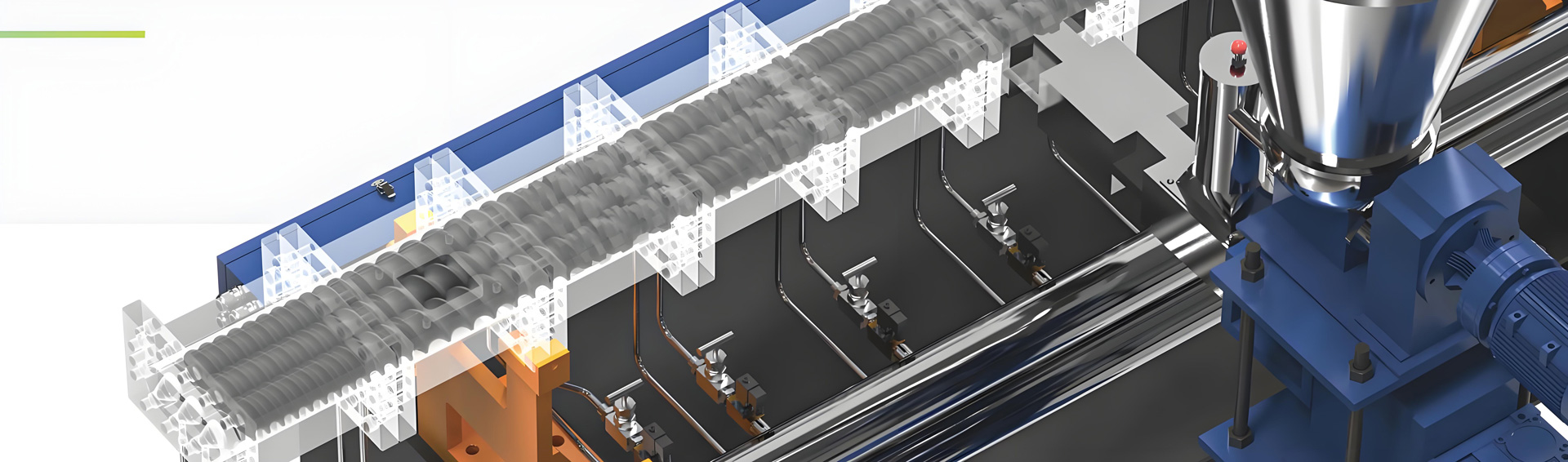
Advanced digital temperature control systems provide the precise thermal management required for flame retardant formulations. The KTE Series extruders feature electrically heated barrels with 10-12 independent temperature control zones, each equipped with digital PID controllers with advanced algorithms for precise regulation. The digital control system can implement complex temperature profiles with different setpoints for each zone, enabling optimization for different flame retardant chemistries. Redundant temperature sensors provide cross-verification of measurements, ensuring reliable temperature control. Automated temperature ramping during startup and controlled cooling during shutdown protect sensitive components from thermal stress that could affect flame retardant efficacy.
Digital process monitoring and control systems provide comprehensive oversight of all production parameters with advanced data collection and analysis capabilities. The KTE Series extruders feature high-resolution touchscreen HMI interfaces with real-time display of critical parameters including temperatures, screw speed, feed rates, torque, pressure, motor load, and calculated process metrics. Advanced control algorithms implement automatic regulation of temperature, pressure, and throughput, maintaining stable operating conditions despite external disturbances. High-frequency data logging records all process parameters with timestamps, providing comprehensive production history for quality assurance and enabling detailed analysis of process variations and trends.
Digital quality monitoring systems can be integrated with the extruder control system to provide real-time assessment of product quality and enable immediate corrective actions. Near-infrared spectroscopy systems with advanced chemometric analysis can measure flame retardant agent concentration in the melt stream, providing continuous concentration verification. Rheological monitoring systems track melt viscosity, detecting variations that could indicate formulation changes or processing issues. Inline microscopy or particle size analysis systems can evaluate dispersion quality. The digital control system integrates this monitoring data, implementing automatic adjustments to maintain product specifications and storing quality data for comprehensive traceability.
Digital drive systems and power management provide consistent performance while optimizing energy consumption. The KTE Series extruders are equipped with high-efficiency AC drive motors with digital control, power ratings from 75-300 kW depending on extruder size and production requirements. Torque capabilities typically range from 800-2000 Nm, providing sufficient power for processing high-loading flame retardant formulations. Digital variable frequency drives enable precise speed control and optimize energy consumption through smart algorithms that match motor output to actual load requirements. Digital power monitoring systems track energy consumption and can implement energy-saving strategies while maintaining production quality.
Downstream digital equipment for flame retardant PP masterbatch production includes automated pelletizing systems, quality inspection equipment, and packaging systems that maintain the digital control throughout the production line. Strand pelletizers with digital knife adjustment systems maintain consistent pellet size despite process variations. Underwater pelletizing systems with digital process control produce uniform pellets with excellent surface finish. Digital inspection systems including automated size classification, color monitoring, and density verification ensure that finished product meets specifications. Automated packaging systems with digital weight control and batch tracking complete the fully digitized production line.
Parameter Settings
Optimization of process parameters for digital control twin screw extruder production of flame retardant PP masterbatch requires systematic evaluation of multiple variables while leveraging digital control capabilities to maintain precise parameter control and real-time adjustment. The digital control system enables precise management of temperature profiles, screw speed, feed rates, and mixing intensity to achieve optimal balance between dispersion quality, thermal stability, and production efficiency.
Digital temperature profile optimization represents one of the most critical aspects of flame retardant masterbatch production. For polypropylene-based formulations containing brominated flame retardants, a typical digital temperature profile might include feed zone at 170-180°C, first transition zone at 180-190°C, second transition zone at 190-200°C, mixing zone 1 at 200-210°C, mixing zone 2 at 210-220°C, metering zone at 220-230°C, and die zone at 230-240°C. For formulations containing mineral fillers like magnesium hydroxide, temperatures may need to be reduced to prevent premature decomposition, with mixing zones typically maintained 10-20°C below the filler decomposition temperature. The digital control system maintains precise temperature control with accuracy better than ±1°C across all zones and can automatically adjust based on real-time monitoring of thermal conditions.
Digital screw speed control impacts mixing intensity, residence time, and thermal exposure for flame retardant components. Higher screw speeds generate increased shear forces that improve dispersion but may also increase thermal load on sensitive components. Typical operating speeds for flame retardant PP masterbatch range from 100-350 RPM, with lower speeds (100-150 RPM) appropriate for formulations containing thermally sensitive components or very high filler loadings, and higher speeds (250-350 RPM) suitable for formulations with moderate loading levels and robust thermal stability. The digital control system maintains precise screw speed with accuracy better than 0.5% and can implement variable speed programs optimized for specific formulation requirements.
Digital feed rate and throughput optimization directly impacts production efficiency and product quality consistency. The gravimetric dosing systems automatically adjust feed rates to maintain precise concentration control, but the overall throughput must be optimized based on formulation characteristics and equipment capacity. For flame retardant PP masterbatch production, throughput rates typically range from 100-600 kg/hour depending on extruder size and formulation complexity. The digital control system maintains optimal fill level in the extruder barrel, typically 70-85% of maximum volumetric capacity, by coordinating feed rates with screw speed and processing conditions in real-time. This coordinated control ensures consistent residence time and mixing efficiency while maximizing production efficiency.
Digital mixing element configuration significantly affects dispersion quality and distribution uniformity. For flame retardant PP masterbatch production, screw configurations typically include multiple mixing zones with different mixing element types. Initial mixing zones may include mild distributive mixing elements to begin dispersing flame retardant agents without excessive thermal generation. Subsequent mixing zones may include more intensive dispersive elements such as kneading blocks to break down agglomerates and achieve uniform distribution, particularly important for high-loading formulations. The digital control system monitors mixing efficiency through torque and energy consumption measurements, automatically adjusting screw speed or throughput to maintain optimal mixing conditions.
Digital concentration control parameters are critical for flame retardant masterbatch to ensure consistent performance. The gravimetric dosing systems provide continuous concentration monitoring and automatic adjustment to maintain target concentrations within tight tolerances, typically ±1-2% of target concentration. The digital control system coordinates multiple dosing systems for multi-component formulations, maintaining proper ratios between all active components and carrier materials. Real-time concentration monitoring through inline spectroscopy provides immediate feedback for dosing adjustments, ensuring that concentration deviations are detected and corrected before they affect product quality.
Digital die temperature and pressure control parameters directly impact strand formation and pellet quality. Die temperature should be maintained 5-10°C above the melt temperature to ensure smooth flow, with the digital control system automatically adjusting die heating based on melt temperature measurements. Die pressure typically ranges from 3-7 MPa for flame retardant PP masterbatch production, with higher pressures required for high-loading formulations. The digital control system monitors pressure with high resolution and implements automatic adjustments to feed rate or screw speed to maintain stable pressure. Pressure fluctuations can indicate formulation changes or processing issues, with the system triggering alarms or automatic adjustments when pressure exceeds specified limits.
Digital cooling and solidification parameters significantly affect pellet quality and dimensional stability. Water bath temperature should be maintained between 40-60°C for most flame retardant PP masterbatch formulations, with the digital control system implementing precise temperature control with accuracy better than ±1°C to maintain consistent cooling rates. Bath immersion length must be optimized to ensure complete solidification, typically 4-6 meters depending on line speed and formulation characteristics. The digital control system can adjust water bath circulation rate and temperature based on line speed and ambient conditions to maintain consistent cooling. For formulations containing components with specific crystallinity requirements, the system can implement controlled cooling profiles to optimize solidification and pellet properties.
Equipment Price
Investment in digital control twin screw extruder equipment for flame retardant PP masterbatch production encompasses multiple cost categories including the base extruder system with digital control capabilities, digital dosing components, quality monitoring equipment, and integration services. Understanding the cost structure and value propositions of different digital automation levels enables informed investment decisions aligned with production requirements, quality standards, and business objectives.
Basic digital twin screw extruder systems for flame retardant PP masterbatch production typically range from 180,000-300,000 USD. These systems include the base extruder with standard digital control features including PLC-based control, touchscreen HMI with basic digital functionality, digital temperature control, and single gravimetric dosing system with digital interface. While these systems provide digital capabilities for process monitoring and basic control, they may have limitations regarding advanced analytics and sophisticated process optimization. These systems are suitable for producers with moderate production volumes who require digital capabilities for basic process monitoring and control but have limited budgets for advanced digital features.
Advanced digital systems such as the Nanjing Kerke KTE Series with comprehensive digital capabilities typically represent investments of 300,000-550,000 USD. These systems include advanced digital capabilities including multiple digital gravimetric dosing systems, advanced multi-zone temperature control with digital optimization, integrated process monitoring with high-frequency data collection and storage, advanced digital pelletizing systems, and sophisticated HMI with comprehensive process visualization and analytics. These systems provide the digital capability level necessary for commercial-scale production of flame retardant PP masterbatches with consistent quality and enhanced process control. The enhanced digital capabilities enable data-driven process optimization, improved quality consistency, and comprehensive traceability documentation.
State-of-the-art fully digital production systems for large-scale flame retardant PP masterbatch manufacturing typically range from 600,000-1,000,000 USD or more depending on specifications and digital capabilities. These systems feature the highest level of digital integration including advanced process control algorithms with AI-based optimization, comprehensive in-line quality monitoring with digital analytics, advanced data management with cloud connectivity and remote access, full integration of dosing, extrusion, pelletizing, and quality inspection operations, and sophisticated data analytics platforms for continuous process improvement. These systems provide maximum production efficiency with exceptional process control, comprehensive quality assurance, and advanced capabilities for predictive maintenance and process optimization.
Digital components and quality monitoring equipment significantly impact total investment. Multiple digital gravimetric dosing systems for multi-component formulations typically cost 40,000-80,000 USD each depending on capacity and digital capabilities. In-line NIR spectroscopy systems with digital analysis capabilities cost approximately 50,000-100,000 USD including installation and calibration. Digital rheological monitoring systems cost 30,000-60,000 USD. Advanced digital pelletizing systems with automated features add 40,000-80,000 USD. Digital integration services including programming, data network architecture, system integration, and operator training typically cost 25-35% of equipment value depending on system complexity and digital capabilities.
Operational cost considerations for digital systems include energy consumption, maintenance requirements, labor costs, and quality-related expenses. Digital systems typically have higher initial costs but lower operational costs due to improved process efficiency, reduced energy consumption through optimization, improved quality consistency reducing scrap and rework, and enhanced data enabling predictive maintenance. Energy consumption varies based on system size and operating parameters, with digital systems often optimizing energy consumption through smart control algorithms. Maintenance costs include regular servicing of digital components, software maintenance and updates, and calibration of digital sensors and instruments. The improved consistency and enhanced process understanding in digital systems typically result in significantly lower quality-related costs and improved overall operational efficiency.
Total cost of ownership analysis should consider factors beyond initial investment including production capacity, quality requirements, regulatory compliance needs, data management requirements, and expected equipment service life. Higher levels of digital integration may justify their increased cost through improved process understanding, reduced operational costs, enhanced quality consistency, predictive maintenance capabilities, and data-driven continuous improvement. Financing options including equipment leasing, vendor financing programs, and government incentives for digital manufacturing can help manage capital requirements. The value of enhanced data capabilities, improved process control, and reduced variability should be included in cost-benefit analysis.
Production Problems and Solutions
Problem 1: Incomplete Dispersion of High-Loading Flame Retardants
Problem Analysis: Incomplete dispersion of high-loading flame retardants results in non-uniform distribution throughout the polypropylene matrix, causing inconsistent flame retardant performance and potential failure to meet safety standards. This issue manifests as visible particles or agglomerates, variable efficacy in flammability testing, and inconsistent physical properties. Root causes include insufficient mixing intensity, inadequate residence time, inappropriate screw configuration for high-loading formulations, or thermal conditions that prevent proper wetting and distribution of flame retardant particles. Achieving uniform dispersion at high loading levels represents one of the most significant technical challenges in flame retardant masterbatch production.
Causes: Screw speed insufficient for high-loading dispersion requirements; mixing zones inadequate for formulation complexity; residence time too short for complete dispersion; screw configuration not optimized for high filler loadings; feed rate too high for mixing capacity; particle size of flame retardants not optimized for dispersion; worn mixing elements reduce shear efficiency; formulation components incompatible causing poor wetting.
Solutions: Increase screw speed within thermal stability limits for enhanced mixing; modify screw configuration to include intensive mixing elements specifically designed for high loadings; reduce throughput to increase residence time; optimize mixing element types and placement for high-loading formulations; pre-process flame retardant particles to optimal size distribution; replace worn mixing elements; evaluate formulation compatibility and incorporate wetting agents when necessary; implement digital monitoring of mixing efficiency.
Prevention Methods: Develop high-loading-specific screw configurations; establish minimum mixing criteria for each formulation; implement regular dispersion testing with appropriate methods; monitor mixing efficiency through digital torque and energy consumption monitoring; maintain screw elements in optimal condition; use pre-dispersed flame retardant concentrates when available; implement statistical process control with digital monitoring of dispersion quality parameters.
Problem 2: Thermal Decomposition of Flame Retardant Components
Problem Analysis: Thermal decomposition of flame retardant components reduces or eliminates flame retardant efficacy, potentially resulting in products that fail to meet required safety standards. This issue is particularly critical for components with specific thermal decomposition characteristics such as magnesium hydroxide or aluminum trihydrate that decompose at processing temperatures, and for intumescent systems where premature decomposition of blowing agents reduces effectiveness. Decomposition typically occurs when processing temperatures exceed thermal stability limits, causing premature endothermic decomposition or chemical breakdown that reduces flame retardant performance.
Causes: Barrel temperatures set too high for thermal stability limits; screw speed generates excessive shear heating; inadequate barrel cooling; residence time too long; localized hot spots in barrel or die; temperature sensors inaccurate; improper temperature profile for specific flame retardant chemistry; lack of thermal stability data for formulation components.
Solutions: Reduce temperature setpoints below decomposition thresholds; implement digital temperature control with enhanced accuracy and monitoring; lower screw speed while maintaining adequate dispersion; upgrade barrel cooling systems for faster response; increase throughput rate to reduce residence time; replace worn barrel sections and heating elements; calibrate temperature sensors with digital accuracy; optimize temperature profile for specific flame retardant chemistry; implement side feeding for thermally sensitive components.
Prevention Methods: Establish strict temperature limits based on thermal analysis data; install additional temperature sensors for hot spot monitoring; implement temperature interlocks preventing operation above safe limits; conduct regular thermal analysis on product samples; train operators on recognizing decomposition symptoms; develop formulations with enhanced thermal stability; use digital temperature monitoring with multiple sensors and automated responses.
Problem 3: Inadequate Flame Retardant Performance
Problem Analysis: Inadequate flame retardant performance results in products that fail to meet required fire safety standards, creating potential safety hazards and regulatory non-compliance. This issue can manifest from various causes including insufficient flame retardant concentration, poor dispersion, thermal degradation during processing, incompatibility with polypropylene matrix, or inadequate synergist levels. Given the safety-critical nature of flame retardant applications, ensuring consistent and adequate performance is essential for product viability and regulatory compliance.
Causes: Flame retardant concentration below specification; incomplete dispersion reducing effectiveness; thermal degradation during processing reducing efficacy; incompatibility between flame retardant and polypropylene matrix; insufficient synergist levels; improper particle size distribution; inadequate loading levels for required performance; processing conditions affecting flame retardant structure.
Solutions: Verify and adjust flame retardant concentration to specification; improve dispersion through optimized mixing and processing; adjust processing temperatures to prevent degradation; optimize formulation compatibility with appropriate coupling agents; adjust synergist levels to optimal values; optimize particle size distribution for effectiveness; evaluate loading levels against performance requirements; implement digital monitoring of critical processing parameters.
Prevention Methods: Implement comprehensive formulation development and optimization; establish rigorous quality control for all formulation components; implement statistical process control on flame retardant concentration and dispersion quality; conduct regular flammability testing on production samples; maintain detailed records linking processing parameters to performance results; use digital systems to track and correlate process conditions with final performance.
Problem 4: High Melt Viscosity and Processing Difficulties
Problem Analysis: High melt viscosity and processing difficulties result from high flame retardant loading levels, particularly with mineral fillers like magnesium hydroxide or aluminum trihydrate, creating challenges including excessive torque requirements, poor flow, and potential equipment overload. This issue manifests as high motor loads, difficulty achieving target throughput, strand formation problems, and excessive energy consumption. Managing high viscosity while achieving adequate dispersion and production throughput represents a significant technical challenge for high-loading flame retardant formulations.
Causes: High filler loading levels increasing viscosity; inadequate particle size distribution; poor particle wetting by polypropylene matrix; insufficient processing temperature; excessive throughput rates; screw configuration generating high shear; particle agglomeration increasing effective loading; lack of flow-enhancing additives.
Solutions: Optimize particle size distribution for improved packing and flow; implement surface treatment of filler particles to improve wetting; increase processing temperature within thermal stability limits; reduce throughput to manageable levels; optimize screw configuration for high-viscosity processing; incorporate flow-enhancing additives when appropriate; pre-disperse fillers to reduce agglomeration; use digital monitoring to manage viscosity-related parameters.
Prevention Methods: Develop formulation strategies for optimal particle packing and flow; implement surface treatment protocols for filler particles; establish viscosity limits for processing; use digital viscosity monitoring to detect and respond to variations; maintain precise temperature control; select appropriate screw designs for high-viscosity materials.
Problem 5: Inconsistent Product Quality Between Batches
Problem Analysis: Inconsistent product quality between production batches compromises reliability and safety performance, potentially causing customer dissatisfaction and regulatory compliance issues. Variations can occur in flame retardant concentration, dispersion quality, physical properties, or flammability performance. Root causes include process parameter variations between batches, equipment condition changes, raw material variability, or differences in operator procedures. For safety-critical applications, batch-to-batch consistency is essential for reliable performance and regulatory compliance.
Causes: Inconsistent startup procedures between operators; equipment condition variations including screw wear or temperature sensor calibration; raw material property variations between lots; inadequate process control allowing parameter drift; lack of standardized operating procedures; insufficient process monitoring and feedback control; ambient condition variations affecting process stability.
Solutions: Implement standardized startup procedures with detailed documentation; implement comprehensive preventive maintenance program with calibration; establish raw material quality control with tight specifications; implement advanced digital process control with automatic parameter regulation; use statistical process control to detect parameter drift; implement environmental control where feasible; train operators on standardized procedures and digital system operation.
Prevention Methods: Develop and implement detailed standard operating procedures; implement comprehensive operator training programs; use automated recipe systems ensuring consistent parameter settings; implement real-time digital process monitoring with automatic feedback control; maintain detailed production records for trend analysis; implement regular batch-to-batch quality comparisons using digital data analysis.
Maintenance and Care
Comprehensive maintenance programs for digital control twin screw extruders used in flame retardant PP masterbatch production are essential for ensuring consistent product quality, maintaining digital system reliability, and maximizing equipment service life. The maintenance program must address not only the mechanical extruder components but also the digital control systems, sensors, automation components, and data infrastructure that enable advanced digital capabilities.
Daily maintenance procedures should be performed at the start of each production shift to identify potential issues before they affect production. These procedures include detailed visual inspection of all mechanical components for wear or damage; verification of all safety interlocks and emergency stop functionality; checking digital control system status including PLC operation, HMI displays, communication networks, and data logging; verification of proper operation of all temperature control zones with accuracy checks; inspecting digital dosing systems for proper operation and consistent material flow; monitoring drive system operation for digital speed control accuracy; and verification of proper operation of all digital sensors and monitoring instruments. Documenting these daily checks in the digital system creates a comprehensive maintenance history.
Weekly maintenance tasks address digital components and precision equipment that require regular attention. These tasks include digital cleaning and inspection of all sensor elements including temperature probes, pressure transmitters, load cells, and optical sensors; verification of digital calibration accuracy for critical sensors; checking and securing all digital electrical connections and network cables; inspecting and cleaning digital dosing system components; verifying proper operation of all digital communication networks and data logging systems; cleaning HMI screens and verifying digital display accuracy; inspecting and cleaning pelletizer digital control components; and performing digital system backups to ensure data security. Weekly maintenance ensures that digital components maintain their accuracy and reliability.
Monthly maintenance procedures include detailed digital system verification and testing. These tasks include comprehensive testing of all safety systems with digital verification; digital calibration of all sensors and instruments against traceable standards; detailed inspection and verification of dosing system digital accuracy; testing backup digital systems and redundancy features; reviewing and analyzing digital system logs for error patterns, trends, or cybersecurity events; inspecting electrical cabinets for proper environmental conditions including temperature, humidity, and cleanliness; testing all manual override functions for proper operation when needed; and reviewing and updating digital software backups and documentation. Monthly maintenance provides early detection of digital system issues and ensures that backup systems are functional.
Quarterly maintenance encompasses comprehensive digital system calibration and preventive maintenance. These tasks include complete digital calibration of all temperature sensors and control loops; digital calibration of all dosing systems and flow meters; detailed inspection and testing of PLC and control system hardware; testing of all digital communication networks and data logging systems; inspection and replacement of wearing components in dosing systems including precision feeder screws and bearings; comprehensive electrical system inspection including testing of digital motor drives and control accuracy; detailed review of digital system performance data to identify trends or developing issues; and digital software updates and system optimization based on manufacturer recommendations. Quarterly maintenance ensures that digital systems maintain peak performance.
Annual maintenance represents the most comprehensive maintenance activities and should include complete digital system audits and overhauls. These tasks include complete digital system backup and reinstallation verification; detailed inspection and testing of all electrical and electronic components for digital specifications; comprehensive digital calibration of all instruments and sensors; complete digital system performance validation including control loop tuning and response time verification; detailed inspection of mechanical components including screws, barrels, and drives; review and update of all digital documentation including maintenance procedures and system manuals; comprehensive testing of all digital system functions and backup procedures; and detailed review of digital maintenance records to identify trends. Annual maintenance provides opportunities for major digital system updates and optimizations.
Digital system cybersecurity maintenance represents a critical component given the increasing connectivity of modern digital extruders. This includes regular software updates and security patches, firewall configuration and monitoring, antivirus software maintenance, network security assessments, access control management, and backup system verification. The increasing connectivity of digital systems requires attention to cybersecurity to protect against unauthorized access, data breaches, or malicious attacks that could compromise production or quality. Regular cybersecurity audits and penetration testing should be conducted to identify and address vulnerabilities.
Digital maintenance record-keeping and analysis provides valuable information for optimizing maintenance intervals, predicting failures before they occur, and identifying opportunities for system improvements. Comprehensive digital records should include dates and details of all maintenance activities, calibration results with digital accuracy values, system error logs and digital diagnostics, software versions and update history, spare parts usage, and any production issues related to digital system problems. Analysis of these digital records enables predictive maintenance strategies and provides data-driven insights for continuous improvement of maintenance practices and system performance.
FAQ
What are the advantages of digital control systems for flame retardant PP masterbatch production?
Digital control systems provide multiple significant advantages including precise parameter control with accuracy and repeatability unachievable with analog systems, comprehensive data collection enabling detailed process analysis and optimization, real-time monitoring with automatic adjustment capabilities, enhanced quality consistency through tight process control, comprehensive traceability documentation for regulatory compliance, predictive maintenance capabilities based on data analysis, remote monitoring and control capabilities, and integration opportunities with enterprise systems for comprehensive digital manufacturing. The data collected enables continuous process improvement and data-driven decision making that enhances overall production efficiency and product quality.
How do digital systems enhance quality control in flame retardant masterbatch production?
Digital systems enhance quality control through multiple mechanisms including real-time monitoring of critical quality parameters such as concentration and dispersion, automatic adjustment of process parameters to maintain product within specifications, comprehensive data logging for complete batch traceability, statistical process control with digital data analysis, integration with in-line quality monitoring systems, automatic alerting when parameters deviate from acceptable ranges, and historical data analysis to identify correlations between process conditions and final quality. The combination of real-time monitoring, automatic adjustment, and comprehensive data collection ensures that quality issues are detected and addressed immediately, while the extensive data collection enables root cause analysis and continuous improvement of quality performance.
What digital quality monitoring technologies are most valuable for flame retardant PP masterbatch?
The most valuable digital quality monitoring technologies for flame retardant PP masterbatch production include near-infrared spectroscopy for real-time concentration monitoring, digital rheological monitoring for detecting viscosity variations, inline digital microscopy or particle size analysis for dispersion assessment, digital melt pressure and temperature monitoring for process stability, digital torque and energy consumption monitoring for mixing efficiency, and digital imaging systems for pellet quality verification. Integration of these monitoring technologies with the extruder digital control system enables real-time quality assurance and automatic process adjustment to maintain product specifications while building comprehensive data for quality analysis and continuous improvement.
How can digital systems help optimize energy consumption in flame retardant masterbatch production?
Digital systems optimize energy consumption through multiple mechanisms including smart control algorithms that match motor output to actual load requirements, automatic adjustment of temperature profiles to minimum necessary levels, optimization of screw speed and throughput for maximum production per unit energy, real-time monitoring of energy consumption with digital analytics, predictive control to avoid energy-intensive process upsets, and data analysis to identify energy consumption patterns and optimization opportunities. The digital control system can implement energy-saving strategies automatically while maintaining product quality, and the extensive data collection enables detailed energy analysis and identification of further optimization opportunities. Many digital systems report energy consumption metrics in real-time, enabling energy-aware operation and continuous improvement of energy efficiency.
What are the cybersecurity considerations for digital twin screw extruder systems?
Cybersecurity considerations for digital twin screw extruder systems include network security with firewalls and access controls, regular software updates and security patches, antivirus and anti-malware protection, secure remote access protocols, user authentication and authorization systems, data encryption for sensitive information, regular cybersecurity audits and penetration testing, backup system verification and recovery testing, physical security for control system hardware, and employee training on cybersecurity awareness. The increasing connectivity and data collection capabilities of digital systems create potential vulnerabilities that must be addressed through comprehensive cybersecurity programs. Regular security assessments should be conducted, and incident response procedures should be established and tested to address potential security breaches.
How do digital systems support regulatory compliance for flame retardant masterbatch production?
Digital systems support regulatory compliance through multiple mechanisms including comprehensive data logging for complete batch traceability, automatic recording of all critical process parameters, integration with quality monitoring systems for continuous quality documentation, electronic batch records that meet regulatory requirements, automatic generation of compliance reports, secure data storage with appropriate backup and retention policies, audit trail functionality recording all system changes and operator actions, and integration with enterprise quality management systems. The extensive data collection and documentation capabilities of digital systems provide the comprehensive records required for regulatory audits and customer quality verification while reducing the manual effort required for compliance documentation.
What are the key considerations for implementing digital twin screw extruders in existing production facilities?
Key considerations for implementing digital twin screw extruders in existing facilities include infrastructure assessment for electrical and network requirements, integration with existing enterprise systems and data networks, operator training for new digital interfaces and capabilities, data management strategy for handling extensive data collection, cybersecurity assessment and implementation, change management for transitioning from analog to digital systems, phased implementation strategy to minimize production disruption, and ongoing support and maintenance planning. Successful implementation requires careful planning addressing both technical and organizational aspects of the transition. The investment in digital technology should be accompanied by investment in training and organizational change management to fully realize the benefits of digital capabilities.
How can I leverage data from digital systems for continuous process improvement?
Leveraging data from digital systems for continuous improvement involves multiple approaches including statistical analysis of process parameter data to identify correlations with quality, time series analysis to identify trends and patterns, root cause analysis of quality issues using historical data, optimization experiments using design of experiments with digital data collection, predictive modeling to optimize process parameters, benchmarking performance across different production periods or machines, and data visualization to communicate insights to production teams. The extensive data collection from digital systems provides a rich resource for analysis and improvement. Advanced analytics including machine learning can identify patterns and optimization opportunities that would be impossible to detect with manual data collection. The key is establishing processes and capabilities for regular data analysis and translating insights into process improvements.
Conclusion
The production of flame retardant PP masterbatch using digital control twin screw extruder technology represents a sophisticated manufacturing process that demands exceptional consistency, precise control, and comprehensive quality assurance for safety-critical applications. The increasing stringency of fire safety regulations across diverse markets creates significant demand for high-quality flame retardant materials that can be consistently produced with tight control of critical quality parameters.
Digital control twin screw extruders provide the technological foundation for successful flame retardant PP masterbatch production, offering the advanced process control, real-time monitoring, and data analytics capabilities necessary to meet the exacting requirements of safety-critical applications. Equipment such as the Nanjing Kerke KTE Series with integrated digital control systems, advanced monitoring capabilities, and comprehensive data collection enables consistent production of masterbatches with tight control of flame retardant concentration, uniform dispersion, and consistent performance essential for meeting regulatory requirements and customer specifications.
The complexity of flame retardant masterbatch production extends beyond simple concentration control to include dispersion uniformity at high loading levels, thermal management to prevent degradation of flame retardant components, consistency across production batches, and compliance with diverse regulatory requirements for different end-use applications. Achieving these quality standards demands comprehensive digital control systems that provide precise parameter control, real-time quality monitoring, extensive data collection for traceability, and advanced analytics for continuous improvement. The most successful producers leverage digital capabilities not just for control but for data-driven optimization and continuous improvement.
Looking forward, the flame retardant PP masterbatch market will continue evolving with new flame retardant chemistries, enhanced performance requirements, increasingly stringent regulatory standards, and growing demand for environmentally sustainable solutions. Successful producers will continue investing in advanced digital extrusion technology, data analytics capabilities, and quality control systems to maintain competitive advantage. The fundamental principles of uniform dispersion, thermal management, and precise control will remain essential, but their application will evolve with digital technologies enabling unprecedented levels of process understanding and optimization.
By implementing the technical principles and best practices outlined in this comprehensive guide, producers can optimize their digital control twin screw extruder operations for flame retardant PP masterbatch manufacturing, achieve superior product quality and consistency, meet stringent safety and regulatory requirements, and establish strong positions in this safety-critical and technically demanding market segment. The integration of appropriate digital technology, formulation expertise, and quality assurance creates the foundation for sustainable success in flame retardant masterbatch production.