Introduction
Anti-cracking masterbatch production represents a specialized segment in the masterbatch industry, focusing on improving crack resistance and stress crack resistance in plastic products. Digital display twin screw extruders provide the precise control and monitoring capabilities necessary for consistent production of these advanced additive concentrates. The production process demands exceptional accuracy in formulation control and processing parameters to achieve the desired anti-cracking performance in final applications.
Anti-cracking masterbatch formulations incorporate various functional additives including impact modifiers, stress crack inhibitors, and plasticizers that work synergistically to prevent crack initiation and propagation. These masterbatch products are particularly valuable in applications subjected to mechanical stress, temperature variations, and environmental exposure such as automotive components, pipe systems, and outdoor infrastructure.
Modern digital display twin screw extruders from Kerke Extrusion Equipment Company incorporate advanced human-machine interfaces (HMI), real-time parameter monitoring, and automated control systems that enable precise production of anti-cracking masterbatch. These digital capabilities provide operators with comprehensive process visibility and enable rapid adjustment of processing parameters to maintain optimal production conditions. This comprehensive guide explores the complete production process for anti-cracking masterbatch using digital display twin screw extruders.
Formulation Proportions (Different Types)
Formulation development for anti-cracking masterbatch requires careful consideration of additive types, concentrations, and their synergistic interactions. Different application requirements dictate varying concentration ranges and additive combinations to achieve desired crack resistance performance.
Impact Modifier Based Formulations
Impact modifier based anti-cracking formulations represent the most widely used type, particularly for applications requiring both crack resistance and impact strength. These formulations typically contain 15% to 35% impact modifiers such as methacrylate-butadiene-styrene (MBS) copolymers, acrylic-based impact modifiers, or core-shell rubber particles.
Polypropylene pipe applications requiring environmental stress crack resistance (ESCR) often employ formulations with 20% to 30% MBS impact modifiers. These formulations provide ESCR values exceeding 2000 hours under standard test conditions. The impact modifier concentration must be carefully balanced, as higher concentrations may compromise other mechanical properties.
When combined with other anti-cracking additives, impact modifier formulations typically include 5% to 15% additional stress crack inhibitors such as polycarbonate-styrene-acrylonitrile (SAN) blends or ethylene-propylene rubber (EPR). The combined approach provides synergistic effects, allowing lower overall additive loading while maintaining crack resistance.
Stress Crack Inhibitor Systems
Stress crack inhibitor based formulations focus specifically on preventing environmental stress cracking in polymers exposed to aggressive environments. These formulations typically contain 20% to 40% stress crack inhibitors including polycarbonate, polybutylene terephthalate (PBT), or specialized acrylic copolymers.
Automotive exterior applications exposed to UV radiation and temperature cycling often employ formulations with 25% to 35% polycarbonate-based stress crack inhibitors. These formulations provide excellent resistance to crack initiation and propagation under environmental exposure. The polycarbonate content improves not only crack resistance but also thermal stability and dimensional performance.
For polyolefin-based applications, EPR-based stress crack inhibitors at 20% to 30% concentration provide effective crack prevention while maintaining good compatibility with base polymers. These formulations are particularly valuable for pipe and tank applications where long-term environmental resistance is critical.
Plasticizer Enhanced Formulations
Plasticizer enhanced anti-cracking formulations incorporate both traditional plasticizers and crack-inhibiting polymers to achieve comprehensive crack resistance. These formulations typically contain 10% to 25% plasticizers such as dioctyl phthalate (DOP) or dioctyl terephthalate (DOTP), combined with 10% to 20% crack-inhibiting polymers.
Flexible film and sheet applications requiring both flexibility and crack resistance often employ formulations with 15% to 20% plasticizers and 15% to 20% crack-inhibiting polymers. The plasticizer component provides flexibility and stress relief, while the crack-inhibiting polymers prevent crack initiation under stress.
Regulatory considerations may influence plasticizer selection for certain applications, particularly food packaging and medical applications. Non-phthalate plasticizers such as DOTP or diisononyl cyclohexane-1,2-dicarboxylate (DINCH) provide comparable performance with improved regulatory compliance.
Hybrid Anti-Cracking Formulations
Advanced applications requiring comprehensive crack resistance often employ hybrid formulations combining multiple anti-cracking mechanisms. These formulations may contain total additive loadings of 40% to 60%, with various additives providing complementary crack prevention strategies.
Automotive under-the-hood applications subjected to thermal cycling, chemical exposure, and mechanical stress may employ formulations containing 20% impact modifiers, 15% stress crack inhibitors, and 10% plasticizers. The combination provides comprehensive protection against different cracking mechanisms that can occur under complex operating conditions.
Processing these high-loading hybrid formulations requires careful optimization of processing conditions to achieve homogeneous distribution of all additive components without causing thermal degradation. The synergistic effects of multiple anti-cracking mechanisms often allow lower total additive loading compared to single-mechanism formulations for equivalent performance.
Long-Term Aging Resistance Formulations
Applications requiring crack resistance over extended time periods, often 10 years or more, employ formulations with additives specifically selected for long-term stability. These formulations typically contain 20% to 35% crack-resistant polymers with proven long-term performance, combined with 2% to 5% thermal stabilizers and UV stabilizers.
Underground piping and infrastructure applications often employ formulations with 25% to 30% long-term crack-resistant polymers, along with 3% to 4% thermal stabilizers and 2% to 3% UV stabilizers. These formulations must maintain crack resistance over decades of underground service while resisting thermal degradation from processing and UV exposure during installation.
Formulation development for long-term applications requires extensive accelerated aging testing to predict performance over service life. Testing under elevated temperatures, UV exposure, and mechanical stress helps validate formulation effectiveness before commercialization.
Production Process
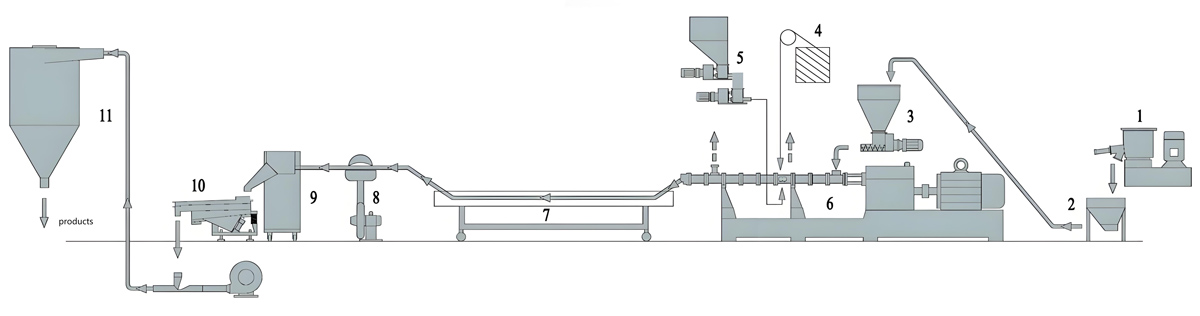
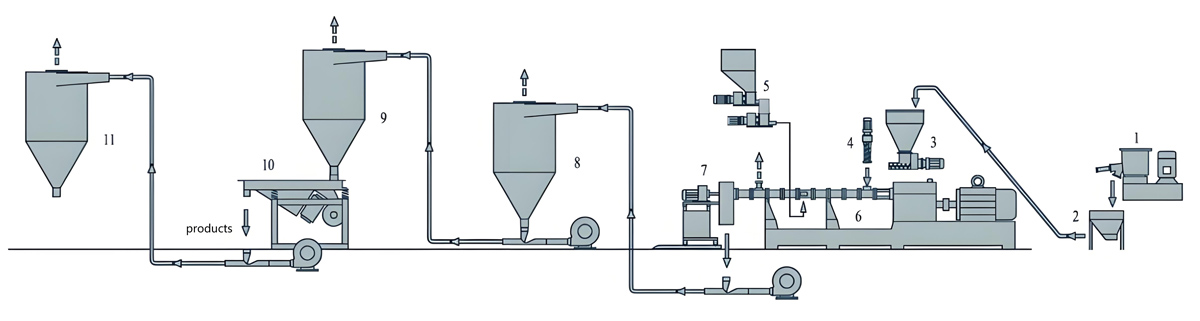
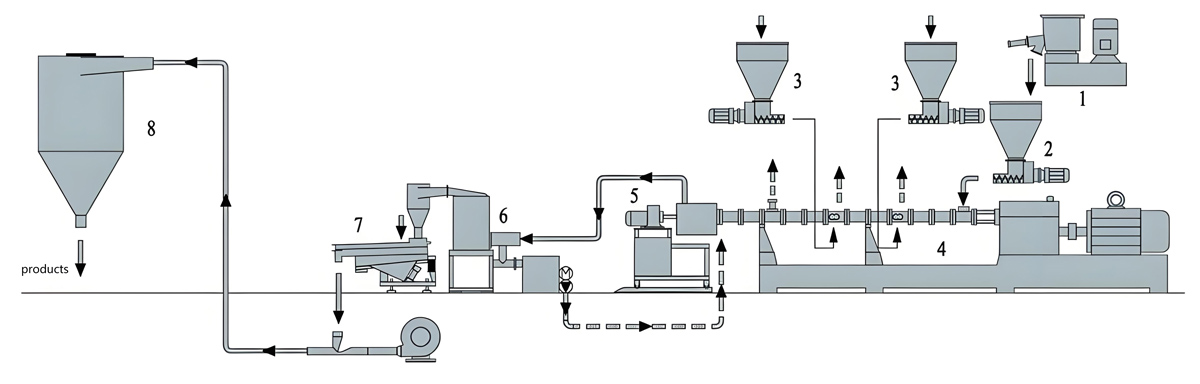
The production process for anti-cracking masterbatch on digital display twin screw extruders requires careful control of formulation composition, processing parameters, and additive distribution to achieve consistent crack resistance performance. Digital monitoring and control systems enable precise regulation of all critical parameters.
Digital Feeding System Integration
Modern digital display extruders integrate with advanced feeding systems that provide real-time monitoring and precise control of material addition rates. Gravimetric feeding systems with digital interfaces enable continuous monitoring of feeding accuracy and automatic adjustment to maintain target composition.
Anti-cracking masterbatch formulations often contain multiple additive streams requiring precise coordination between multiple feeders. Digital control systems enable synchronized operation of all feeders, ensuring that the relative proportions of all components remain constant throughout production runs. This synchronization is critical for formulations where small variations in additive ratios can significantly impact crack resistance performance.
Loss-in-weight feeding technology with real-time weight monitoring provides the highest accuracy, typically within ±0.1% of setpoint. The digital display systems show real-time feeding rates, accumulated totals, and deviation from setpoint, enabling operators to identify and correct feeding issues immediately.
Real-Time Temperature Monitoring
Digital display extruders provide comprehensive temperature monitoring across all barrel zones and the die. Modern systems display actual temperatures, setpoints, and deviations for each zone, enabling operators to maintain optimal thermal conditions throughout the production process.
Anti-cracking formulations often contain temperature-sensitive components that require precise temperature control to prevent degradation. Digital temperature monitoring enables operators to identify developing temperature variations before they cause additive degradation. The historical temperature data logging capabilities allow analysis of temperature patterns over production runs, helping identify process optimization opportunities.
Temperature profile adjustments can be made through the digital interface during production runs to optimize conditions for specific formulations. This real-time adjustment capability is particularly valuable when transitioning between formulations or when processing conditions need fine-tuning to achieve optimal dispersion.
Automated Screw Speed Control
Digital display systems provide precise control over screw speed and display real-time motor current and power consumption data. This information enables operators to optimize screw speed for each formulation while monitoring equipment loading and identifying potential problems.
Screw speed optimization for anti-cracking formulations must balance dispersion quality with thermal exposure. Higher screw speeds provide better mixing but increase residence time and thermal exposure for temperature-sensitive additives. The digital display enables operators to find the optimal screw speed that provides adequate dispersion without compromising additive stability.
Motor current monitoring through the digital display helps identify viscosity changes that could indicate formulation inconsistencies or processing problems. Sudden increases in motor current may indicate additive agglomeration or temperature profile issues that require immediate attention.
Precise Process Parameter Recording
Digital display extruders automatically record all process parameters throughout production runs, creating comprehensive production records. These records include temperature profiles, screw speeds, feeding rates, throughput, and motor performance data. The recorded data provides invaluable information for quality control, process optimization, and troubleshooting.
Production record analysis enables identification of correlations between processing parameters and final product quality. This analysis helps establish optimal processing conditions for each anti-cracking formulation and identify parameters that most significantly impact crack resistance performance.
The historical data storage capability enables trend analysis over multiple production runs, helping identify gradual changes in equipment performance that could affect product quality. This proactive approach to equipment monitoring helps prevent quality problems before they occur.
Quality Control Integration
Advanced digital display systems can integrate with online quality control equipment such as melt pressure sensors, viscosity meters, and online spectroscopic analyzers. This integration provides real-time quality monitoring and enables immediate adjustments when quality parameters deviate from specifications.
Melt pressure monitoring helps identify viscosity changes that could indicate formulation inconsistencies or additive degradation. Sudden pressure increases may indicate additive agglomeration or insufficient mixing, while pressure decreases could indicate additive degradation or formulation drift.
Online spectroscopic analysis can monitor additive concentration in the melt, providing immediate feedback on composition consistency. This capability is particularly valuable for anti-cracking formulations where precise additive ratios are critical for performance.
Automated Recipe Management
Digital display extruders incorporate automated recipe management systems that store complete processing parameter sets for each formulation. These recipes include temperature profiles, screw speeds, feeder settings, and other critical parameters, enabling rapid changeover between different formulations.
Recipe storage capabilities typically accommodate 50 to 100 or more formulations, enabling manufacturers to produce multiple anti-cracking masterbatch products on the same equipment with minimal changeover time. The automated recall of complete parameter sets reduces human error during changeover and ensures consistent processing conditions for each production run.
Recipe protection features prevent unauthorized changes to established formulations, maintaining process consistency. Recipe version control enables tracking of process improvements and provides historical records of formulation evolution.
Alarm and Notification Systems
Digital display systems incorporate comprehensive alarm systems that notify operators when process parameters deviate from acceptable ranges. These alarms include temperature deviations, feeder rate variations, motor current anomalies, and equipment performance issues.
Configurable alarm limits allow customization for each formulation, with tighter tolerances for formulations requiring more precise control. The alarm notification can be visual, audible, or both, ensuring immediate operator attention to developing problems.
Alarm logging capabilities record all alarm events with timestamp and parameter values, providing valuable information for troubleshooting and process optimization. Analysis of alarm patterns can help identify recurring issues and prevent future problems.
Production Equipment Introduction
Digital display twin screw extruders designed for anti-cracking masterbatch production incorporate advanced digital control and monitoring systems that enable precise processing of these sensitive formulations.
KTE Series Digital Display Extruders
The KTE Series parallel twin screw extruders from Kerke Extrusion Equipment Company include models specifically designed with advanced digital display and control capabilities. These extruders feature modern human-machine interfaces with touchscreen displays, real-time parameter monitoring, and sophisticated process control algorithms.
The KTE-40D digital display model with 40mm screw diameter provides production capacities from 150 to 300 kg/hr for anti-cracking formulations. The KTE-50D model with 50mm screw diameter achieves 300 to 500 kg/hr. The KTE-65D model with 65mm screw diameter provides 500 to 800 kg/hr. All digital display models feature L/D ratios of 40:1 to 48:1, providing sufficient mixing length for anti-cracking formulations.
Advanced digital systems on these models include 10-inch to 15-inch touchscreen displays, depending on model size. The interface displays real-time parameters including temperature profile, screw speed, feeder rates, motor current, and equipment status. The user-friendly interface enables easy parameter adjustment and comprehensive monitoring.
Advanced HMI Capabilities
Modern digital display extruders incorporate sophisticated human-machine interface (HMI) capabilities that enhance operator productivity and process control. Touchscreen displays provide intuitive navigation through multiple screens showing different aspects of process operation.
Multiple display screens enable comprehensive monitoring without information overload. Typical screen layouts include main overview screen showing all critical parameters, temperature screen showing detailed barrel and die temperature profile, feeding screen showing feeder performance, and historical trend screen showing parameter evolution over time.
Customizable screen layouts allow operators to create displays optimized for specific applications and operator preferences. This customization enhances usability and reduces operator fatigue during long production runs.
Integrated Process Control
Digital display extruders incorporate integrated process control algorithms that maintain optimal processing conditions automatically. These control systems can adjust parameters in real-time to compensate for variations in raw material properties, ambient conditions, or equipment performance.
Adaptive temperature control algorithms adjust heating and cooling output to maintain precise temperature setpoints despite variations in ambient temperature or equipment condition. The control systems learn from historical performance and adjust control parameters to optimize temperature stability over time.
Integrated process control can also coordinate multiple process parameters. For example, the system can automatically adjust screw speed when throughput changes to maintain optimal residence time and shear conditions. This coordination helps maintain consistent product quality despite production rate variations.
Data Logging and Analysis
Comprehensive data logging capabilities store all process parameters throughout production runs. The stored data includes timestamped values for all temperature zones, screw speed, feeder rates, motor current, melt pressure, and other monitored parameters.
Data analysis software enables visualization of process parameters over time, correlation analysis between different parameters, and identification of processing windows for optimal product quality. Historical data comparison enables identification of gradual changes in equipment performance that could affect product quality.
Export capabilities allow data export to standard formats for further analysis and quality documentation. The stored data provides comprehensive production records valuable for quality assurance, customer documentation, and process optimization.
Remote Monitoring Capabilities
Advanced digital display systems incorporate remote monitoring capabilities that enable supervision from centralized control rooms or remote locations. These capabilities include network connectivity, web-based interfaces, and mobile app access.
Remote monitoring enables production supervision from a central control room covering multiple extruders. Operators can monitor process parameters, receive alarms, and adjust settings remotely, reducing need for constant operator presence at each extruder.
Secure access protocols prevent unauthorized remote access while enabling authorized personnel to monitor and control equipment from anywhere with network connectivity. This capability is particularly valuable for facilities with multiple production lines or decentralized operations.
Predictive Maintenance Features
Advanced digital display systems incorporate predictive maintenance features that analyze equipment performance data to identify developing problems before they cause failures. These features include motor current analysis, vibration monitoring (where equipped), and performance trend analysis.
Motor current analysis can identify developing bearing problems, coupling issues, or increased mechanical resistance. Vibration monitoring systems can detect developing imbalances, bearing wear, or alignment problems. Performance trend analysis identifies gradual changes in energy consumption or processing efficiency that may indicate equipment degradation.
The predictive maintenance features enable scheduling of maintenance before failures occur, reducing unplanned downtime and preventing quality problems that could result from equipment performance degradation.
Parameter Settings
Optimal parameter settings for anti-cracking masterbatch production on digital display extruders must balance processing efficiency with additive preservation and dispersion quality. Digital monitoring enables precise control and adjustment of all critical parameters.
Temperature Profile Configuration
Temperature profiles for anti-cracking formulations vary based on the specific additives and carrier resin. For polypropylene-based formulations containing impact modifiers, typical temperature profiles include: feed zone 180°C to 190°C, melting zone 190°C to 205°C, mixing zone 200°C to 220°C, and die zone 210°C to 225°C.
Formulations containing polycarbonate-based stress crack inhibitors may require higher temperature profiles, typically 200°C to 240°C, depending on the polycarbonate content. However, formulations containing plasticizers or other temperature-sensitive additives may require lower temperature profiles to prevent additive degradation, typically 170°C to 200°C.
The digital display enables precise temperature control within ±1°C of setpoint across all zones. The historical temperature trend displays help operators identify gradual temperature drifts that could affect product quality. Automatic temperature compensation features maintain temperature despite variations in ambient conditions or equipment loading.
Screw Speed Optimization
Screw speed optimization for anti-cracking formulations must balance dispersion quality with thermal exposure. Typical screw speeds range from 150 to 300 RPM, with specific speeds determined by formulation viscosity and additive thermal sensitivity.
Higher screw speeds (250 to 300 RPM) provide better distributive mixing and dispersion but increase shear heating and reduce residence time. These speeds are appropriate for formulations with thermally stable additives that benefit from improved dispersion quality.
Lower screw speeds (150 to 200 RPM) reduce thermal exposure and increase residence time, beneficial for formulations containing temperature-sensitive additives. However, these speeds may require longer mixing sections to achieve adequate dispersion quality.
The digital display shows real-time screw speed and motor current, enabling operators to monitor equipment loading and adjust screw speed based on processing conditions. The automatic screw speed control features can maintain optimal screw speed despite variations in material viscosity or equipment condition.
Feeding Rate Precision
Feeding rate precision is critical for anti-cracking formulations where small variations in additive ratios can significantly impact performance. Digital feeding systems typically maintain accuracy within ±0.2% of setpoint, with advanced systems achieving ±0.1% accuracy.
For formulations containing 30% total additives, a ±0.2% feeder accuracy represents ±0.06% absolute concentration variation. While this may seem small, certain anti-cracking additives show significant performance variations even with small concentration changes, making feeding precision critical.
The digital display shows real-time feeding rates, accumulated totals, and deviation from setpoint for each feeder. This comprehensive monitoring enables operators to identify feeding issues immediately and take corrective action. Automatic feeding rate adjustment features maintain target rates despite variations in material bulk density or flow characteristics.
Throughput Rate Control
Throughput rate optimization for anti-cracking formulations must balance production efficiency with adequate residence time for dispersion and thermal control. Typical throughput rates range from 100 to 800 kg/hr depending on extruder size and formulation characteristics.
The digital display enables precise throughput control through coordinated adjustment of screw speed and feeding rates. The throughput rate is displayed in real-time along with cumulative production totals, enabling production monitoring and scheduling.
Throughput rate adjustments can be made through the digital interface during production runs to optimize conditions for specific formulations or to match downstream equipment requirements. The automatic throughput control features maintain target rates despite variations in material properties or equipment performance.
Residence Time Optimization
Residence time optimization for anti-cracking formulations must provide sufficient time for additive dispersion while limiting thermal exposure. Digital monitoring of screw speed and throughput rate enables calculation and control of residence time.
Typical residence times for anti-cracking formulations range from 2 to 4 minutes, depending on formulation complexity and additive thermal sensitivity. Longer residence times improve dispersion quality but increase thermal exposure for temperature-sensitive additives.
The digital display systems can calculate and display residence time based on screw speed and throughput rate, enabling operators to optimize this critical parameter automatically. Residence time setpoints can be established for each formulation, with the control system adjusting parameters to maintain target residence time.
Equipment Pricing
Investment in digital display twin screw extruder equipment for anti-cracking masterbatch production represents substantial capital expenditure. Digital capabilities add significant value but increase equipment cost compared to standard extruders.
Main Extruder Investment
KTE Series digital display twin screw extruders represent premium equipment with advanced digital capabilities. The KTE-40D model with 40mm screw diameter typically costs from $250,000 to $350,000. The KTE-50D model with 50mm screw diameter ranges from $350,000 to $500,000. The KTE-65D model with 65mm screw diameter typically costs from $500,000 to $700,000.
These prices include the basic digital display extruder configuration with touchscreen HMI, advanced control systems, and standard digital capabilities. Additional features such as remote monitoring packages, enhanced data analysis software, or predictive maintenance capabilities add 10% to 20% to the base price.
Digital Feeding Systems
Digital feeding systems integrated with the extruder control system represent significant additional investment. Gravimetric feeding systems with digital interfaces and real-time monitoring typically cost from $25,000 to $60,000 each depending on capacity and sophistication.
Loss-in-weight feeding systems for minor components requiring highest accuracy cost from $20,000 to $50,000. Complete digital feeding systems for anti-cracking formulations with multiple additive streams may cost from $100,000 to $200,000 depending on the number of feeders and their capabilities.
Digital Monitoring and Control Systems
Advanced digital monitoring and control systems beyond the standard HMI capabilities represent additional investment. Quality control integration including melt pressure sensors and spectroscopic analyzers costs from $15,000 to $50,000.
Remote monitoring packages with network connectivity and web-based interfaces cost from $10,000 to $30,000. Predictive maintenance features including vibration monitoring and advanced data analysis cost from $20,000 to $50,000. These advanced capabilities provide significant value but add to total capital investment.
Complete Line Investment
Complete production lines for anti-cracking masterbatch, including digital display extruder, digital feeding systems, pelletizing equipment, and auxiliary systems, typically represent investments from $500,000 to $1,500,000. The specific investment depends on production capacity, digital capabilities required, and equipment options.
Additional costs including installation, commissioning, operator training, and initial raw materials add 10% to 15% to the base equipment investment. These costs must be considered when planning total capital investment for a digital production line.
Production Problems and Solutions
Production of anti-cracking masterbatch presents unique challenges that digital monitoring systems help identify and resolve quickly. Early detection of problems through digital monitoring prevents quality issues and production waste.
Additive Degradation
Problem Description: Additive degradation causes discoloration, odor development, and reduced crack resistance performance. This problem is particularly common with temperature-sensitive impact modifiers and plasticizers.
Causes: Excessive temperature in mixing or die zones causes thermal degradation. Excessive residence time at elevated temperatures accelerates degradation. Screw configuration creates excessive shear heating. Temperature control system malfunctions or miscalibration.
Solutions: Reduce temperature profile, particularly in mixing and die zones. Increase throughput rate or reduce screw speed to decrease residence time. Optimize screw configuration to reduce shear heating. Repair or recalibrate temperature control system.
Prevention Methods: Establish maximum temperature limits based on additive thermal stability specifications. Implement residence time monitoring and control. Regular temperature sensor calibration ensures accurate control. Develop screw configurations optimized for anti-cracking formulations.
Inconsistent Additive Distribution
Problem Description: Anti-cracking additives show uneven distribution throughout the matrix, resulting in inconsistent crack resistance performance and visible defects in final products. This problem often accompanies insufficient mixing or feeding inconsistencies.
Causes: Inadequate mixing due to insufficient screw speed or inappropriate screw configuration. Feeding inconsistencies cause localized high or low additive concentrations. Temperature profile that is too low reduces polymer mobility, hindering additive wetting and distribution.
Solutions: Increase screw speed to improve distributive mixing. Optimize screw configuration by adding or repositioning mixing elements. Verify feeder calibration and ensure consistent feeding. Adjust temperature profile to improve polymer mobility.
Prevention Methods: Develop mixing element configurations optimized for additive distribution. Implement regular feeder calibration. Establish temperature profile specifications for each formulation. Monitor feeding performance through digital systems.
Formulation Drift During Production
Problem Description: Additive ratios drift from target values during production runs, causing gradual changes in crack resistance performance. This problem may not be immediately visible but can be detected through digital feeding system monitoring.
Causes: Feeder calibration drift over extended production runs. Material bulk density variations cause feeding rate changes. Environmental temperature and humidity affect material flow characteristics. Feeder component wear affects feeding accuracy.
Solutions: Recalibrate feeders to restore accuracy. Monitor material properties and adjust feeding parameters as needed. Implement environmental controls for material storage areas. Replace worn feeder components.
Prevention Methods: Establish regular feeder calibration schedules, particularly for long production runs. Monitor material properties and feeding performance through digital systems. Implement preventive maintenance for feeder components. Use bulk density compensation features in advanced feeding systems.
Productivity Losses from Equipment Issues
Problem Description: Production rates decline gradually or suddenly due to equipment performance degradation, increasing unit costs and reducing profitability. Digital monitoring can detect these issues before they cause significant productivity losses.
Causes: Equipment wear increases power consumption and reduces throughput. Drive system problems reduce available torque. Temperature control degradation causes processing parameter instability. Material handling issues affect feeding consistency.
Solutions: Schedule preventive maintenance based on digital monitoring data. Repair or replace worn drive components. Repair or upgrade temperature control systems. Address material handling issues affecting feeding.
Prevention Methods: Implement comprehensive predictive maintenance based on digital monitoring. Analyze performance trends to identify developing problems. Establish maintenance schedules based on actual equipment condition rather than arbitrary time intervals. Monitor energy consumption and throughput rates.
Quality Variations Between Production Runs
Problem Description: Product quality varies between different production runs of the same formulation, causing customer complaints and quality control failures. Digital recipe management and process recording helps identify the causes of these variations.
Causes: Different operators use different processing parameters. Equipment condition varies between runs. Raw material properties vary between batches. Environmental conditions affect processing.
Solutions: Implement automated recipe management to ensure consistent parameters. Use recorded process data to identify optimal processing windows. Monitor raw material properties and adjust processing accordingly. Implement environmental controls for production areas.
Prevention Methods: Use digital recipe management for all production runs. Analyze recorded process data to establish optimal processing parameters. Implement raw material specification and testing programs. Monitor environmental conditions and adjust processing as needed.
Maintenance and Care
Digital display twin screw extruders require comprehensive maintenance programs that address both mechanical components and digital control systems. Digital monitoring capabilities enable predictive maintenance approaches that prevent problems before they occur.
Daily Maintenance Procedures
Daily maintenance includes inspection of all system displays and verification of parameter accuracy. Operators should verify that all displayed values match expected ranges and investigate any deviations. Check all alarm indicators and address any active alarms promptly.
Verify that all digital systems are functioning properly, including displays, data logging, and control functions. Inspect all physical components including belts, couplings, and cooling systems. Document all daily observations in digital maintenance logs.
Weekly Maintenance Tasks
Weekly maintenance includes verification of digital system accuracy and calibration checks. Verify temperature sensor accuracy using reference thermometers and calibrate as necessary. Check feeding system accuracy and performance through digital monitoring and calibration routines.
Inspect and clean all electronic cabinets and control panels to prevent heat buildup and component failure. Verify that data logging functions are working properly and download archived data for analysis. Check all network connections and remote monitoring functionality.
Monthly Maintenance Activities
Monthly maintenance includes comprehensive calibration of all digital systems and detailed inspection of mechanical components. Perform full calibration of all temperature sensors, feeding systems, and process monitoring equipment. Verify backup systems and data recovery procedures.
Review performance data recorded over the past month to identify developing trends or problems. Analyze alarm patterns to identify recurring issues. Update software and firmware as recommended by the manufacturer. Perform comprehensive inspection of all mechanical components based on recorded performance data.
Semi-Annual and Annual Maintenance
Semi-annual maintenance should include detailed inspection of all electronic components and control systems. Perform comprehensive testing of all control algorithms and safety systems. Check all wiring and connections for signs of degradation or damage.
Annual maintenance may include software updates, complete system recalibration, and component replacement based on predicted maintenance data. Review recorded performance data over the past year to identify long-term trends and plan maintenance accordingly.
FAQ
What are the benefits of digital display extruders for anti-cracking masterbatch production?
Digital display extruders provide comprehensive process monitoring and control capabilities that are particularly valuable for anti-cracking formulations. Real-time parameter monitoring enables early detection of processing problems. Automated recipe management ensures consistent processing conditions. Advanced data analysis helps optimize processes and identify equipment problems before they cause failures. These capabilities improve product quality consistency, reduce waste, and enable predictive maintenance approaches.
How do I select the right temperature profile for anti-cracking formulations?
Temperature profile selection depends on the specific additives and carrier resin. Standard polypropylene-based formulations typically require 180°C to 220°C profiles. Polycarbonate-containing formulations may require 200°C to 240°C. Formulations with plasticizers or other temperature-sensitive additives may require lower profiles, typically 170°C to 200°C. The digital display enables precise temperature control and adjustment based on additive thermal stability specifications and formulation requirements.
What causes additive degradation during anti-cracking masterbatch production?
Additive degradation typically results from excessive temperature, excessive residence time, or excessive shear heating. Temperature-sensitive additives such as certain impact modifiers and plasticizers are particularly susceptible. The digital monitoring systems help detect temperature deviations that could lead to degradation. Monitoring residence time through screw speed and throughput rate calculations enables optimization of this critical parameter. Proper screw configuration selection minimizes shear heating while providing adequate mixing.
How do I ensure consistent additive distribution in anti-cracking masterbatch?
Consistent additive distribution requires adequate mixing, accurate feeding, and appropriate processing conditions. Screw configuration with sufficient mixing elements provides distributive and dispersive mixing. Feeding accuracy within ±0.2% of setpoint ensures consistent additive ratios. Temperature profiles that provide adequate polymer mobility enhance additive wetting and distribution. Digital monitoring of all these parameters enables optimization and early detection of problems that could affect distribution.
What maintenance does digital display equipment require?
Digital display equipment requires maintenance of both mechanical components and digital control systems. Daily inspection of displays and parameter verification. Weekly calibration of sensors and verification of digital system function. Monthly comprehensive calibration and data analysis review. Semi-annual inspection of electronic components and control systems. Annual software updates and complete system recalibration. Digital monitoring capabilities enable predictive maintenance approaches that address problems before they cause failures.
How do I optimize residence time for anti-cracking formulations?
Residence time optimization balances adequate mixing with limited thermal exposure. Typical residence times range from 2 to 4 minutes depending on formulation complexity and additive thermal sensitivity. Higher screw speeds and throughput rates reduce residence time but may compromise mixing quality. Lower screw speeds increase residence time but may increase thermal exposure. The digital display enables calculation and control of residence time, allowing optimization for each specific formulation.
What are the typical throughput rates for anti-cracking masterbatch production?
Throughput rates vary based on extruder size and formulation characteristics. Digital display models with 40mm screws typically produce 150-300 kg/hr. 50mm screw models produce 300-500 kg/hr. 65mm screw models produce 500-800 kg/hr. The specific rate depends on formulation viscosity, additive loading, and desired residence time. Digital monitoring enables precise throughput control and optimization.
How do I detect formulation drift during production?
Formulation drift is detected through digital feeding system monitoring that displays real-time feeding rates, accumulated totals, and deviation from setpoint. Alarm features notify operators when feeding rates deviate beyond acceptable tolerances. Historical data logging enables trend analysis to identify gradual drifts over time. Regular calibration maintains feeding accuracy and prevents drift from becoming a problem.
What is the return on investment for digital display equipment?
Return on investment for digital display equipment comes from multiple sources. Improved product quality consistency reduces waste and customer complaints. Predictive maintenance reduces unplanned downtime and repair costs. Process optimization through data analysis improves efficiency. Reduced labor requirements through automated features. The typical payback period for digital capabilities ranges from 18 to 36 months depending on the level of digital capabilities and production volume.
Conclusion
Digital display twin screw extruders provide advanced capabilities essential for consistent production of anti-cracking masterbatch. The KTE Series digital display models from Kerke Extrusion Equipment Company incorporate comprehensive monitoring, control, and data analysis capabilities that enable precise processing of these sensitive formulations.
Success in anti-cracking masterbatch production requires understanding of additive mechanisms, formulation development based on application requirements, and optimization of processing parameters for each specific formulation. Digital monitoring and control systems provide the tools necessary to achieve and maintain optimal processing conditions, ensuring consistent product quality.
As industries continue demanding higher performance materials with longer service life, the market for anti-cracking masterbatch will continue growing. Manufacturers who invest in advanced digital display equipment and develop comprehensive digital process control expertise will maintain competitive advantages in this technically demanding market segment.