Introduction
Polybutylene adipate terephthalate PBAT and polylactic acid PLA are among the most widely used biodegradable polymers for sustainable packaging applications. The production of PBAT/PLA masterbatch demands equipment that combines corrosion resistance with energy efficiency to meet both environmental and economic objectives. Energy saving stainless steel twin screw extruders provide the ideal solution for processing these materials while minimizing energy consumption and ensuring product purity.
The increasing adoption of biodegradable plastics in packaging applications has driven demand for efficient production equipment capable of handling large volumes while maintaining low environmental impact. Stainless steel construction prevents contamination and enables easy cleaning essential for food contact applications. Advanced energy saving features reduce operating costs and carbon footprint making these extruders attractive for sustainable manufacturing operations.
Formulation Ratios for PBAT/PLA Masterbatch
PBAT/PLA blend formulations vary based on desired flexibility degradation rate and processing characteristics. Different ratio combinations and additive packages enable customization for specific end use applications.
PBAT/PLA 80/20 Blend
This formulation emphasizes the flexibility of PBAT while incorporating PLA for stiffness and cost reduction. Typical composition includes 75-85 percent PBAT and 15-25 percent PLA with 3-8 percent total additives. The blend exhibits excellent flexibility and good processability suitable for film applications. Additives include processing aids compatibilizers and biodegradable plasticizers. Energy efficient processing requires optimized temperature profiles due to different melting characteristics of the two polymers.
PBAT/PLA 60/40 Blend
The 60/40 ratio provides balanced mechanical properties suitable for rigid packaging applications. Formulation typically contains 55-65 percent PBAT and 35-45 percent PLA with 3-8 percent additives. This blend offers improved stiffness compared to higher PBAT content formulations while maintaining reasonable flexibility. Additives may include nucleating agents to control crystallinity and improve barrier properties. Stainless steel equipment ensures no contamination during processing of food contact materials.
PBAT/PLA 50/50 Blend
Equal ratio formulations provide a balance between PBAT flexibility and PLA stiffness. Typical composition ranges from 45-55 percent each polymer with 3-8 percent additives. This blend requires careful compatibilization to achieve optimal properties due to the immiscibility of PBAT and PLA. Compatibilizers such as chain extenders or reactive compatibilizers are essential for adequate interface bonding. Energy efficient mixing reduces shear heating that could degrade PLA components.
PBAT/PLA 40/60 Blend
This formulation emphasizes PLA stiffness with PBAT providing flexibility and impact modification. Typical composition includes 35-45 percent PBAT and 55-65 percent PLA with 3-8 percent additives. The blend offers higher modulus and improved barrier properties suitable for rigid containers. Processing temperatures must accommodate PLA’s higher melting point while preventing PBAT degradation. Stainless steel barrel construction ensures consistent heat transfer without contamination.
PBAT/PLA 20/80 Blend
This formulation primarily uses PLA for stiffness and cost with PBAT providing impact modification. Typical composition ranges from 15-25 percent PBAT and 75-85 percent PLA with 3-8 percent additives. The blend exhibits high stiffness and good barrier properties for food packaging applications. Additives include nucleating agents and impact modifiers to compensate for reduced PBAT content. Energy efficient design is critical for processing high PLA content formulations.
Production Process
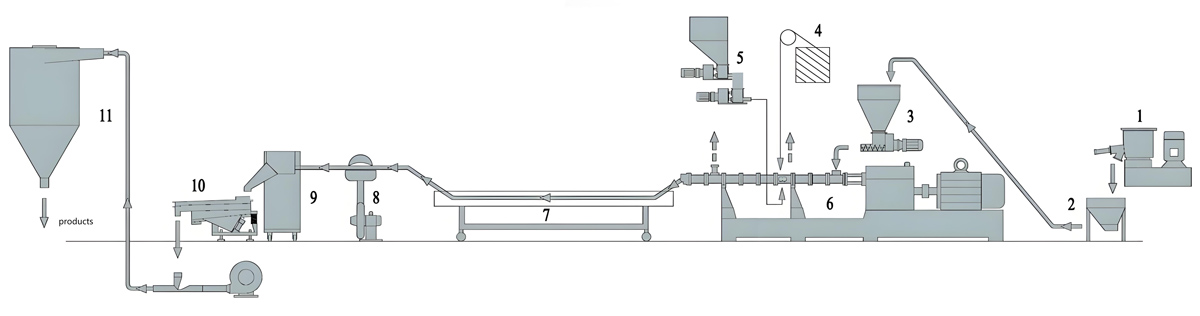
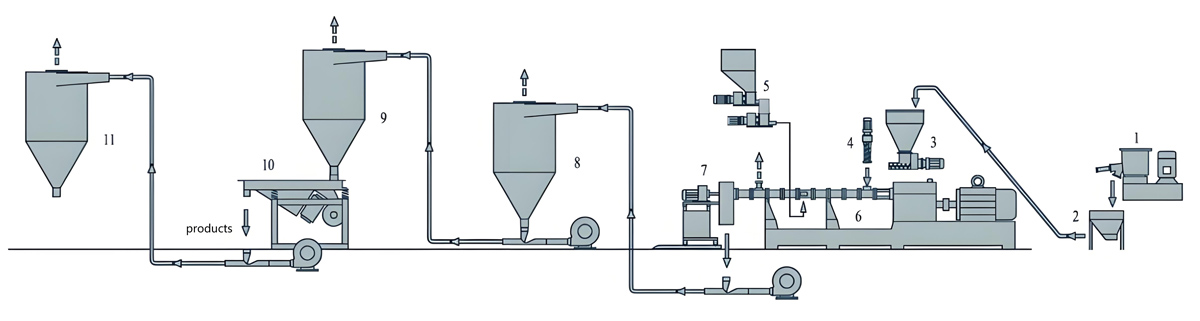
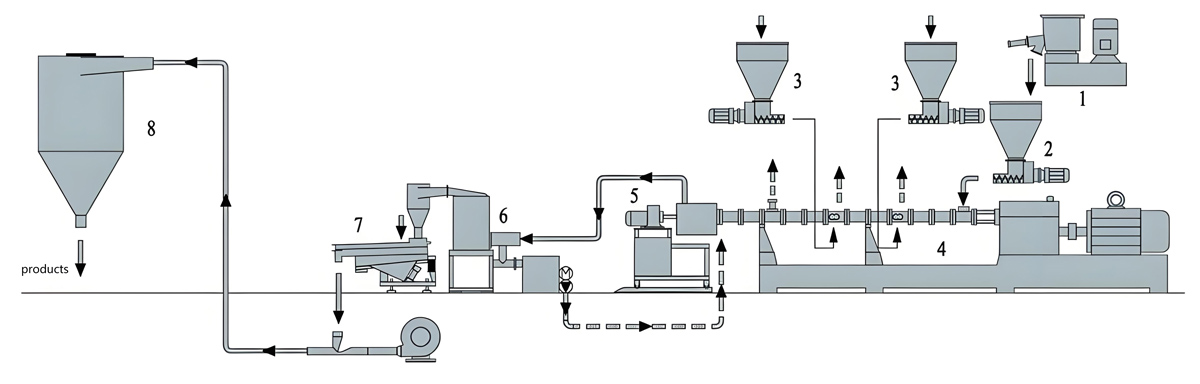
The PBAT/PLA masterbatch production process involves multiple stages that must be carefully controlled to ensure proper blending and additive dispersion while maintaining energy efficiency.
Material Preparation
Raw materials must be dried to appropriate moisture levels before processing to prevent hydrolytic degradation. PLA typically requires drying at 80-90°C for 4-6 hours to reduce moisture below 0.025 percent while PBAT requires 70-80°C for 3-5 hours for moisture below 0.1 percent. The stainless steel construction prevents rust formation from moisture exposure. Energy efficient dryers reclaim and recycle heat to reduce energy consumption during material preparation.
Feeding System
Gravimetric feeders deliver precise quantities of PBAT and PLA to the extruder maintaining accurate blend ratios. Liquid additives can be injected downstream through metered systems. The feeding system must accommodate different bulk densities and flow characteristics of PBAT and PLA. Energy efficient feeder designs minimize power consumption while maintaining accurate dosing. Stainless steel feed surfaces prevent contamination and enable easy cleaning between formulations.
Melting and Compounding
The melting zone applies thermal and mechanical energy to melt both polymers and begin the blending process. Temperature progression typically starts at 130-140°C for PBAT melting then increases to 170-185°C for PLA melting. The energy efficient design recovers heat from cooling systems to reduce heating requirements. Stainless steel barrel sections provide uniform heat distribution without hot spots that could degrade PLA. Screw configuration ensures proper melting while minimizing energy consumption.
Blend Homogenization
The mixing zone ensures thorough distribution of PBAT and PLA components throughout the masterbatch. Kneading blocks and mixing elements create intensive dispersive mixing to break up phase domains. Compatibilizers react at the interface to improve blend homogeneity. Energy efficient screw designs achieve required mixing with reduced torque requirements. Stainless steel mixing elements resist corrosion from any acidic additives used in formulations.
Additive Incorporation
Additives are injected at appropriate locations along the extruder based on their thermal stability and function. Processing aids are typically added early while nucleating agents and impact modifiers are added later in the process. The stainless steel construction prevents reaction between additives and metal surfaces. Energy efficient additive injection systems minimize pressure drop and energy consumption. Touch screen control enables precise timing and rate of additive addition.
Degassing and Venting
Vent zones remove any residual moisture or volatile components from the melt. Vacuum vents maintain pressures between 20-80 mbar to extract volatiles without polymer loss. The stainless steel vent design prevents corrosion from acidic volatiles. Energy efficient vacuum systems with variable speed drives reduce power consumption. Touch screen monitoring ensures optimal vent operation and alerts operators to blockages.
Pelletizing and Cooling
The extruded strand is cooled through water baths or air cooling systems before pelletizing. Energy efficient cooling systems recover heat for reuse in drying operations. Stainless steel strand guides prevent contamination during cooling. Strand diameter is monitored and controlled through die design and take-up speed. Pelletizers produce uniform pellets suitable for downstream processing.
Production Equipment Introduction
Energy saving stainless steel twin screw extruders combine corrosion resistance with advanced energy management features for efficient PBAT/PLA masterbatch production. The KTE Series from Kerke offers specialized configurations for biodegradable polymer processing.
Stainless Steel Construction
The entire barrel assembly and screw elements are fabricated from high grade stainless steel for corrosion resistance and product purity. Type 316L stainless steel is commonly used for superior resistance to acidic additives and cleaning chemicals. All wetted surfaces are polished to prevent material sticking and enable thorough cleaning. Stainless steel construction eliminates the risk of contamination from iron or other metals that could affect product quality and color.
Energy Efficient Heating
Advanced heating systems incorporate multiple energy saving features. High efficiency ceramic heater bands provide rapid heat transfer with minimal thermal mass for responsive temperature control. Insulation jackets reduce heat loss from barrel sections by up to 40 percent compared to uninsulated designs. Heat recovery systems capture waste heat from cooling water for reuse in drying operations. Variable power control adjusts heating output based on actual demand reducing energy consumption.
Energy Efficient Drive
The main drive system uses high efficiency motors and variable frequency drives to match power consumption to actual processing requirements. Permanent magnet motors achieve efficiencies above 95 percent compared to 85-90 percent for standard motors. Variable frequency drives provide soft start capabilities reducing mechanical stress and energy consumption during startup. The drive system automatically adjusts power output based on torque requirements maintaining optimal efficiency across the operating range.
Efficient Screw Design
Screw elements are designed to achieve required mixing and conveying with minimal energy input. Optimized flight depths and pitches reduce power consumption while maintaining throughput. Special mixing elements provide intensive dispersion with lower torque requirements compared to conventional kneading blocks. The energy efficient screw design can reduce power consumption by 15-25 percent compared to standard configurations while maintaining product quality.
Integrated Heat Recovery
Heat recovery systems capture thermal energy from multiple sources for reuse throughout the process. Waste heat from barrel cooling and extrudate cooling is recovered for preheating drying air or feed zone heating. Heat exchangers transfer energy between process streams reducing external heating requirements. The integrated heat recovery system can reduce total energy consumption by 20-35 percent depending on process configuration and operating conditions.
Efficient Cooling Systems
Cooling systems are designed to minimize energy consumption while maintaining precise temperature control. Variable speed pumps adjust water flow based on actual cooling demand. Cooling water temperature is optimized to balance energy consumption with cooling effectiveness. Intelligent control systems coordinate multiple cooling circuits to prevent unnecessary energy use. The cooling design supports operation in ambient conditions up to 35°C without excessive energy consumption.
Energy Monitoring System
Integrated energy monitoring systems track power consumption for all major components. Real-time power data is displayed on touch screen interfaces enabling operators to identify optimization opportunities. Energy consumption is logged for each production run enabling detailed analysis and comparison. The system can identify inefficient operation patterns and suggest optimization adjustments. Energy benchmarking helps establish targets for continuous improvement.
Parameter Settings
Optimal parameter settings for PBAT/PLA masterbatch production balance product quality with energy efficiency. Energy saving extruders provide wide adjustment ranges while minimizing power consumption.
Temperature Profile
Temperature profiles must accommodate the different melting points of PBAT and PLA. Typical settings range from 130-140°C in feed zones for PBAT melting to 170-185°C in later zones for PLA processing. Die temperatures are maintained at 160-175°C to ensure proper flow without degradation. Energy efficient designs maintain tight temperature control with reduced power consumption through optimized insulation and heating control. Temperature ramping during start-up reduces energy waste.
Screw Speed
Screw speeds between 150-350 RPM are typical depending on formulation and desired throughput. Higher speeds increase production rate but may reduce energy efficiency due to increased friction and shear heating. Energy efficient screw designs enable adequate mixing at moderate speeds reducing power consumption. Variable frequency drives optimize motor efficiency at different speed settings. Touch screen displays show real-time power consumption enabling speed optimization.
Throughput Rate
Production throughput typically ranges from 50-400 kg per hour depending on machine size and formulation. Energy efficient designs achieve specific throughput with lower power consumption per kilogram. The relationship between throughput and energy consumption is not linear with optimal efficiency typically at 70-85 percent of maximum capacity. Touch screen monitoring helps identify the most efficient operating point for each formulation.
Vent Zone Conditions
Vent zone pressures typically range from 20-80 mbar depending on formulation requirements. Lower pressures improve moisture removal but increase vacuum pump energy consumption. Energy efficient vacuum systems with variable speed drives match power to actual demand. The number and position of vent zones are optimized to balance devolarization effectiveness with energy consumption. Touch screen monitoring shows vacuum pump power consumption for optimization.
Cooling Water Temperature
Cooling water temperature typically maintained between 15-25°C for optimal energy efficiency. Lower temperatures increase cooling effectiveness but also increase chiller energy consumption. The system automatically adjusts water flow and temperature based on actual cooling demand. Energy efficient designs recover heat from cooling water for reuse in other process steps reducing total energy consumption.
Filling Degree
Optimal filling degree in the extruder typically ranges from 70-85 percent for maximum energy efficiency. Overfilling increases motor load without proportionate throughput increase while underfilling wastes energy due to inefficient mixing. The energy efficient drive system automatically adjusts to maintain optimal filling degree. Touch screen displays show torque and energy consumption data for filling degree optimization.
Equipment Price
Energy saving stainless steel twin screw extruder prices reflect the premium materials and advanced energy management features. Investment should consider energy savings and operating cost reduction over equipment lifetime.
Stainless Steel Extruder Pricing
Entry-level energy efficient stainless steel extruders with 30mm screw diameter start at approximately 70000 to 95000 US dollars. Mid-range models with 40-50mm screw diameter range from 130000 to 190000 US dollars. Large capacity systems with 75mm or larger screw diameters exceed 300000 US dollars. These prices include stainless steel construction and energy efficient drive systems but exclude auxiliary equipment.
Energy Saving Features Cost
Energy saving features including advanced insulation heat recovery systems and efficient motors add 20000 to 50000 US dollars to base extruder cost depending on configuration. Integrated energy monitoring systems add 5000 to 12000 US dollars. Variable frequency drives for all motors add 8000 to 20000 US dollars. The additional investment typically pays back through energy savings within 2-4 years depending on operating hours and energy costs.
Stainless Steel Construction Premium
Stainless steel construction adds 30-50 percent to the base cost of carbon steel extruders. The premium includes specialized welding surface finishing and corrosion resistant components. Additional costs include specialized tooling for machining stainless steel and quality assurance testing for corrosion resistance. The premium is justified by longer service life and reduced contamination risk for food contact applications.
Auxiliary Equipment Costs
Energy efficient drying systems with heat recovery cost between 25000 and 60000 US dollars. Advanced cooling systems with variable speed pumps and heat recovery range from 30000 to 70000 US dollars. Energy efficient pelletizing systems cost 35000 to 80000 US dollars. Complete auxiliary packages including all energy saving features can add 100000 to 200000 US dollars to total system cost.
Operating Cost Savings
Energy saving designs typically reduce energy consumption by 20-40 percent compared to standard extruders. For operations running 6000 hours annually with energy costs of 0.15 US dollars per kWh this can save 15000 to 45000 US dollars per year depending on machine size and utilization. Stainless steel construction reduces maintenance costs by 20-30 percent due to reduced wear and corrosion. Reduced downtime and longer service life contribute additional operational savings.
Total Investment Analysis
A complete energy saving stainless steel PBAT/PLA masterbatch production line typically requires investment between 400000 and 900000 US dollars for medium capacity production. Large capacity fully automated systems may exceed 1800000 US dollars. Energy cost savings of 20000-60000 US dollars per year combined with maintenance savings provide attractive return on investment. Life cycle cost analysis over 10 years typically shows total cost of ownership 30-50 percent lower than standard equipment despite higher initial investment.
Production Problems and Solutions
PBAT/PLA masterbatch production may encounter various processing challenges. Energy saving stainless steel extruders provide solutions while maintaining efficiency and product purity.
Phase Separation
Problem Analysis: Inadequate compatibilization leads to phase separation between PBAT and PLA resulting in poor mechanical properties and inconsistent product quality. The immiscibility of these polymers requires proper compatibilizer selection and processing conditions. Causes include insufficient mixing inadequate compatibilizer dosage or inappropriate compatibilizer type. Energy efficient processing must balance mixing requirements with power consumption.
Solutions: Incorporate appropriate compatibilizers such as reactive chain extenders or block copolymers. Optimize screw configuration to achieve intensive dispersive mixing while maintaining energy efficiency. Increase temperature in mixing zones to improve compatibilizer reaction rates. Adjust compatibilizer injection point to ensure proper distribution. Use energy efficient screw designs that achieve required mixing with reduced torque requirements.
Prevention Methods: Develop validated compatibilizer formulations for each blend ratio. Monitor blend morphology through microscopic analysis on a regular basis. Implement standard operating procedures based on energy efficient mixing parameters. Maintain detailed records of successful processing conditions. Train operators to recognize symptoms of phase separation such as hazy appearance or poor mechanical properties.
PLA Degradation
Problem Analysis: PLA is susceptible to thermal and hydrolytic degradation during processing resulting in molecular weight loss and impaired properties. Symptoms include yellowing reduced viscosity and increased brittleness. Causes include excessive temperatures prolonged residence time high moisture content or excessive shear. Energy efficient designs minimize thermal degradation through precise temperature control and reduced residence time.
Solutions: Reduce barrel temperatures to minimum required levels while maintaining proper melt viscosity. Implement proper drying to reduce hydrolytic degradation. Increase feed rate to reduce residence time without compromising mixing. Optimize screw configuration to minimize high shear zones. Use thermal stabilizers compatible with PLA. Monitor melt viscosity regularly to detect degradation early through energy consumption changes.
Prevention Methods: Establish strict drying specifications and verify moisture content before processing. Implement maximum residence time limits for PLA containing formulations. Use PLA grades with appropriate thermal stability for processing conditions. Monitor energy consumption patterns that may indicate degradation. Train operators on proper temperature profile settings for PLA processing.
PBAT Migration
Problem Analysis: PBAT migration to equipment surfaces can cause buildup and contamination over time affecting product quality and requiring frequent cleaning. Stainless steel surfaces reduce but do not eliminate migration. Causes include processing temperatures above PBAT melting point insufficient cooling and surface roughness. Energy efficient designs include features to minimize migration and facilitate cleaning.
Solutions: Implement regular cleaning schedules using appropriate stainless steel cleaning procedures. Optimize temperature profile to minimize PBAT exposure to high temperatures. Use release agents or surface treatments compatible with food contact materials. Design screw and barrel surfaces with appropriate finish to reduce material adherence. Utilize energy efficient designs that minimize material sticking through proper temperature control.
Prevention Methods: Establish standard cleaning procedures based on production hours and material formulations. Use high purity stainless steel with appropriate surface finish. Implement preventive maintenance to identify surface wear before it causes problems. Train operators on proper cleaning techniques for stainless steel surfaces. Monitor product quality for signs of contamination or migration.
Color Consistency Issues
Problem Analysis: Inconsistent color in final masterbatch affects appearance and may indicate other quality problems. Causes include inadequate pigment dispersion variations in blend ratio or thermal degradation affecting color. Stainless steel construction prevents metal contamination that could affect color. Energy efficient mixing must achieve proper dispersion with appropriate energy input.
Solutions: Optimize screw configuration to achieve uniform pigment distribution. Implement pre-dispersion of pigments before addition to extruder. Monitor blend ratios through gravimetric feeding to ensure consistency. Adjust temperature profile to minimize thermal degradation that can cause color changes. Use energy efficient mixing elements that achieve required dispersion without excessive energy consumption.
Prevention Methods: Develop validated pigment dispersion procedures for each color formulation. Implement regular color measurement during production. Maintain consistent raw material specifications including color consistency. Use statistical process control based on energy consumption data to detect processing variations. Train operators on color quality requirements and recognition of color deviations.
Inconsistent Melt Viscosity
Problem Analysis: Variations in melt viscosity affect processing and final product properties. Causes include inconsistent blend ratio variations in moisture content temperature fluctuations or polymer degradation. Energy efficient designs maintain consistent processing conditions through precise control and monitoring.
Solutions: Verify gravimetric feeder calibration and operation for consistent blend ratio. Implement strict drying procedures to maintain consistent moisture content. Optimize temperature control to minimize fluctuations. Monitor energy consumption patterns to detect changes in material behavior. Use PLC systems to maintain consistent processing parameters and detect deviations.
Prevention Methods: Establish incoming material testing for moisture and viscosity. Implement regular calibration of all feeders and temperature sensors. Use statistical process control based on energy consumption and temperature data. Maintain detailed records of processing conditions for each production run. Train operators to recognize symptoms of viscosity variations through equipment behavior changes.
Maintenance and Care
Proper maintenance ensures energy efficiency and extends equipment life. Stainless steel construction requires specific care to maintain corrosion resistance and surface finish.
Daily Maintenance
Daily maintenance includes checking oil levels in gearboxes and lubrication points. Inspect temperature sensors through touch screen diagnostic displays for proper operation. Monitor energy consumption through the energy monitoring system and note any deviations. Check cooling water flows and temperatures are within efficient operating ranges. Verify all insulation jackets are intact to maintain energy efficiency. Document any unusual observations in the maintenance log.
Weekly Maintenance
Weekly maintenance involves inspecting stainless steel surfaces for signs of corrosion or contamination. Check all seals and gaskets for leaks that could affect efficiency. Test safety interlocks and emergency stop systems. Clean or replace air filters on control cabinets to maintain proper cooling of electrical components. Verify accuracy of energy monitoring sensors through touch screen diagnostic routines. Inspect heater band insulation for damage or wear.
Monthly Maintenance
Monthly maintenance includes changing gearbox oil according to manufacturer recommendations. Inspect heater bands and thermocouples for proper function through touch screen temperature verification. Check alignment of drive system components for optimal energy efficiency. Test all alarm and safety systems through PLC diagnostic routines. Review energy consumption logs to identify developing efficiency problems. Inspect stainless steel surfaces for surface finish integrity.
Quarterly Maintenance
Quarterly maintenance involves removing and inspecting screw elements for wear patterns that could affect efficiency. Measure screw and barrel dimensions to monitor wear rates using precision tools. Inspect bearing seals and replace if necessary to maintain energy efficiency. Check motor and drive couplings for wear and alignment. Test emergency stop circuits and safety systems thoroughly. Review energy consumption trends to identify optimization opportunities.
Annual Maintenance
Annual maintenance includes comprehensive inspection of all major components by qualified technicians. Replace worn parts according to manufacturer recommendations and maintenance history. Realign drive system if necessary to maintain optimal energy efficiency. Test and calibrate all control systems and energy monitoring equipment. Review and update maintenance procedures based on operating experience. Conduct thorough safety inspection and testing. Evaluate energy efficiency trends and plan improvements.
Stainless Steel Care
Stainless steel surfaces require specific care to maintain corrosion resistance and appearance. Use only cleaning agents approved for stainless steel to avoid corrosion. Regularly clean surfaces to prevent material buildup and contamination. Polish surfaces as needed to maintain proper finish for energy efficiency and product purity. Avoid using abrasive materials or cleaning methods that could damage the surface finish. Inspect surfaces regularly for signs of pitting or corrosion and address promptly.
FAQ
What are the main energy saving features of stainless steel extruders?
Energy saving features include high efficiency motors and variable frequency drives that match power to demand. Advanced insulation reduces heat loss from barrel sections. Heat recovery systems capture waste heat for reuse in drying operations. Efficient screw designs achieve required mixing with reduced torque requirements. Integrated energy monitoring systems track consumption and identify optimization opportunities. Variable speed pumps and fans in cooling systems match energy use to actual demand.
How does stainless steel construction benefit PBAT/PLA processing?
Stainless steel construction eliminates contamination from metal corrosion that could affect product color and purity. The corrosion resistance allows use with acidic additives and cleaning chemicals without degradation. Smooth stainless steel surfaces reduce material sticking and facilitate thorough cleaning between formulations. The thermal properties of stainless steel support uniform temperature distribution preventing hot spots that could degrade PLA. Stainless steel is essential for food contact applications and pharmaceutical applications requiring high purity.
What is the typical energy savings compared to standard extruders?
Energy saving stainless steel extruders typically achieve 20-40 percent reduction in energy consumption compared to standard carbon steel extruders. Insulated barrels reduce heating requirements by up to 40 percent. Heat recovery systems can save an additional 10-15 percent. Efficient motors and drives save 5-10 percent. Optimized screw designs contribute 5-10 percent savings through reduced torque requirements. Actual savings depend on operating conditions production formulation and equipment configuration.
How do I clean stainless steel extrusion equipment properly?
Use only cleaners specifically designed for stainless steel to avoid corrosion. Start with mechanical cleaning to remove bulk material residue. Apply approved cleaning solutions according to manufacturer instructions. Use soft cloths or non-abrasive pads to avoid damaging the surface finish. Rinse thoroughly with clean water to remove all cleaning residue. Dry surfaces completely to prevent water spots. Regular cleaning prevents buildup and maintains energy efficiency. Establish cleaning schedules based on production requirements and material formulations.
What maintenance is required for energy saving features?
Energy saving features require regular maintenance to maintain optimal performance. Insulation jackets should be inspected for damage or wear regularly. Heat recovery systems need periodic cleaning and maintenance to ensure heat transfer efficiency. Variable frequency drives require regular inspection for proper cooling and operation. Energy monitoring sensors should be calibrated according to manufacturer recommendations. Motors with high efficiency ratings require standard motor maintenance practices. Keep detailed records of energy consumption to identify maintenance needs.
How can I optimize energy efficiency for different PBAT/PLA formulations?
Optimize temperature profiles to use minimum heat required for each formulation. Adjust screw speed to find the most efficient operating point balancing throughput and energy consumption. Monitor energy consumption through the integrated monitoring system to identify optimization opportunities. Use energy saving features such as variable speed drives on all motors. Adjust throughput to operate near optimal efficiency typically 70-85 percent of capacity. Implement recipe-based parameter settings to quickly achieve efficient conditions for each formulation.
What is the typical payback period for energy saving investments?
The payback period for energy saving features typically ranges from 2 to 4 years depending on operating hours and energy costs. Insulated barrels often pay back within 1-2 years through reduced heating costs. Heat recovery systems typically pay back in 2-3 years. Efficient motors and drives may pay back in 3-5 years. Complete energy saving packages often achieve payback in 2-3 years. Operating hours above 4000 annually and high energy costs accelerate payback periods. Life cycle cost analysis over 10 years shows significant savings despite higher initial investment.
How does energy efficient design affect product quality?
Energy efficient designs maintain or improve product quality through better process control. Precise temperature control reduces degradation and improves consistency. Reduced residence time minimizes thermal effects on sensitive polymers like PLA. Uniform heating eliminates hot spots that could cause quality variations. Efficient mixing ensures proper dispersion without excessive shear. Stable operating conditions reduce quality variations between batches. The energy monitoring system helps maintain consistent processing conditions that directly affect product quality.
Conclusion
Energy saving stainless steel twin screw extruders provide the ideal solution for PBAT/PLA masterbatch production combining corrosion resistance with superior energy efficiency. The KTE Series from Kerke offers specialized features designed for biodegradable polymer processing including advanced heat recovery efficient drive systems and comprehensive energy monitoring. Stainless steel construction ensures product purity for food contact applications while enabling easy cleaning between formulations.
The growing market for sustainable packaging continues to drive demand for PBAT/PLA blend masterbatches with enhanced performance characteristics. Energy efficient production equipment enables manufacturers to meet this demand while reducing environmental impact and operating costs. Proper equipment selection parameter optimization and comprehensive maintenance programs ensure reliable operation and optimal productivity in biodegradable polymer masterbatch manufacturing with minimal energy consumption.